


 Скачать презентацию Performance Optimization cont How do we fix performance
ba410da588a1b8b9045f7adc292dfd19.ppt
- Количество слайдов: 17
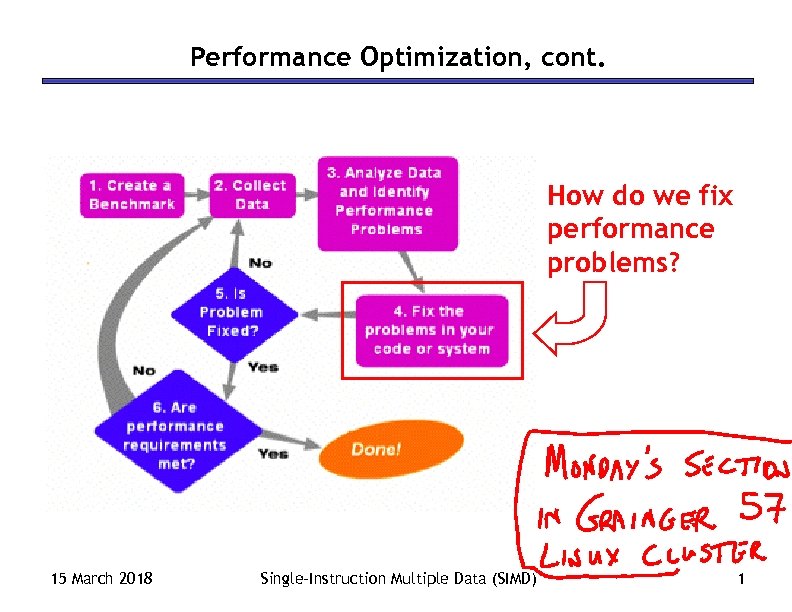 Performance Optimization, cont. How do we fix performance problems? 15 March 2018 Single-Instruction Multiple Data (SIMD) 1
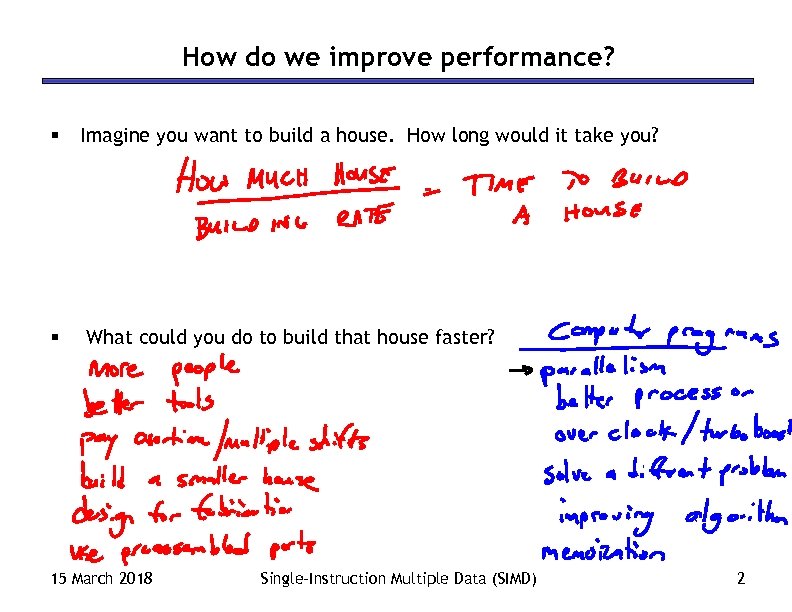 How do we improve performance? § § Imagine you want to build a house. How long would it take you? What could you do to build that house faster? 15 March 2018 Single-Instruction Multiple Data (SIMD) 2
 Exploiting Parallelism § Of the computing problems for which performance is important, many have inherent parallelism. § E. g. , computer games: — graphics, physics, sound, A. I. etc. can be done separately — Furthermore, there is often parallelism within each of these: • Each pixel on the screen’s color can be computed independently • Non-contacting objects can be updated/simulated independently • Artificial intelligence of non-human entities done independently § E. g. , Google queries: — Every query is independent • Google searches are read-only!! 15 March 2018 Single-Instruction Multiple Data (SIMD) 3
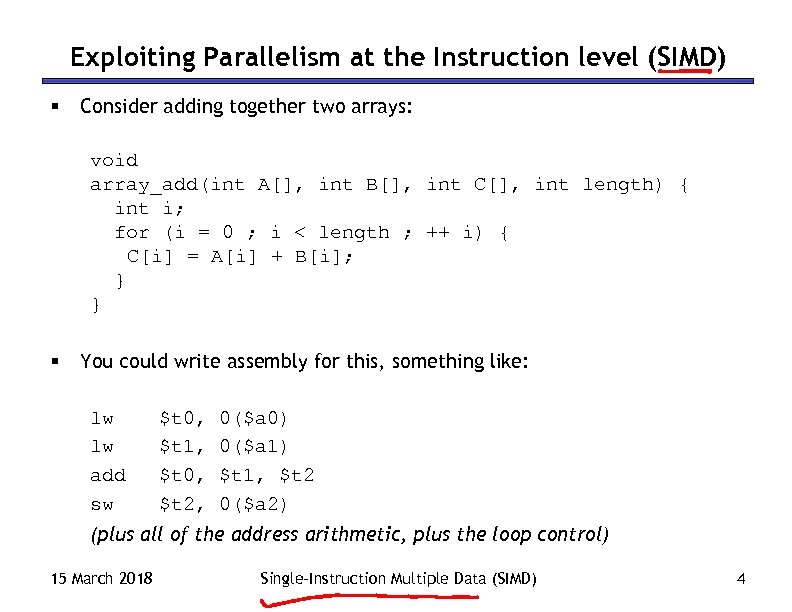 Exploiting Parallelism at the Instruction level (SIMD) § Consider adding together two arrays: void array_add(int A[], int B[], int C[], int length) { int i; for (i = 0 ; i < length ; ++ i) { C[i] = A[i] + B[i]; } } § You could write assembly for this, something like: lw lw add sw $t 0, $t 1, $t 0, $t 2, 0($a 0) 0($a 1) $t 1, $t 2 0($a 2) (plus all of the address arithmetic, plus the loop control) 15 March 2018 Single-Instruction Multiple Data (SIMD) 4
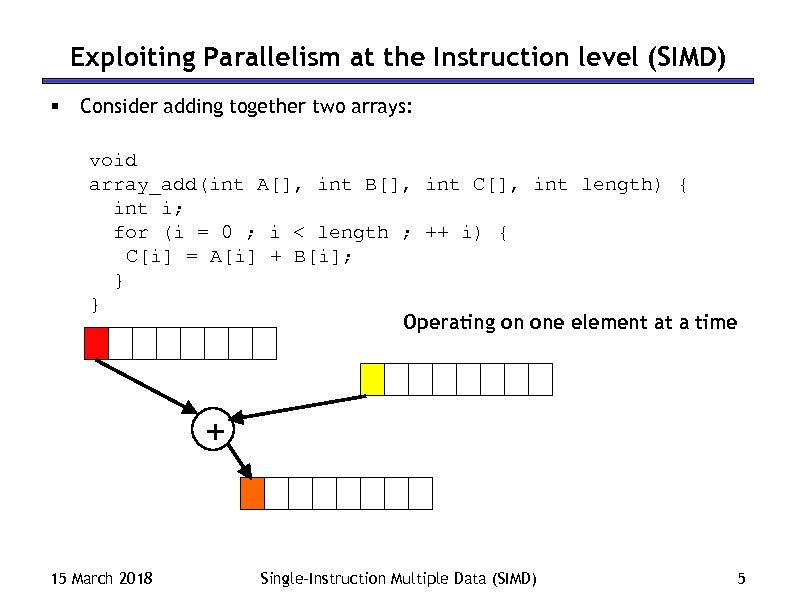 Exploiting Parallelism at the Instruction level (SIMD) § Consider adding together two arrays: void array_add(int A[], int B[], int C[], int length) { int i; for (i = 0 ; i < length ; ++ i) { C[i] = A[i] + B[i]; } } Operating on one element at a time + 15 March 2018 Single-Instruction Multiple Data (SIMD) 5
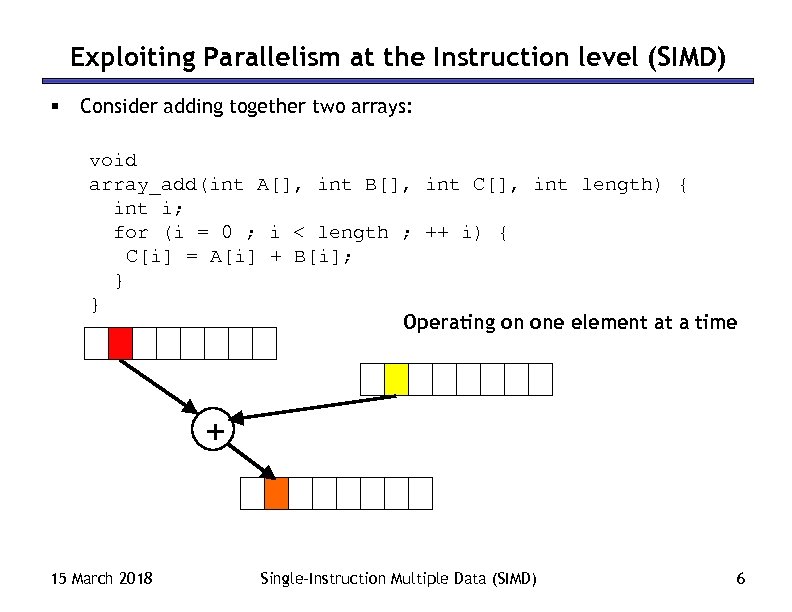 Exploiting Parallelism at the Instruction level (SIMD) § Consider adding together two arrays: void array_add(int A[], int B[], int C[], int length) { int i; for (i = 0 ; i < length ; ++ i) { C[i] = A[i] + B[i]; } } Operating on one element at a time + 15 March 2018 Single-Instruction Multiple Data (SIMD) 6
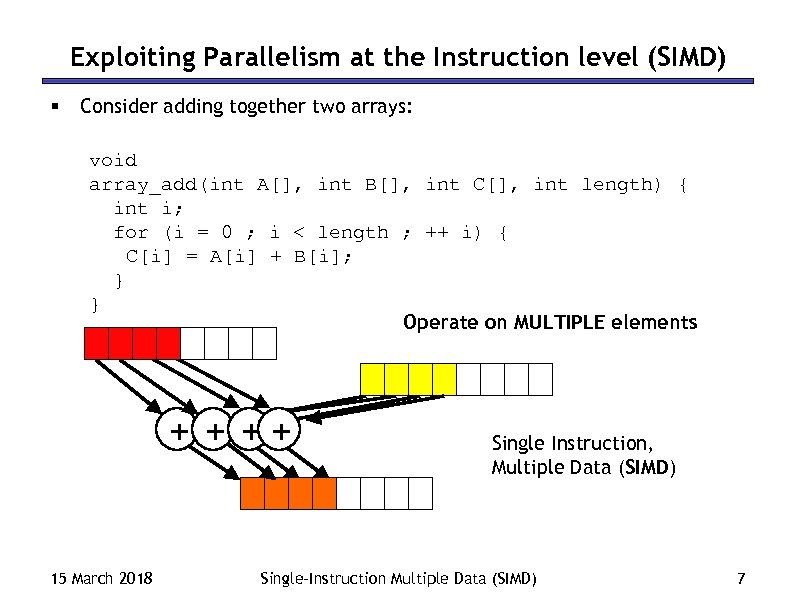 Exploiting Parallelism at the Instruction level (SIMD) § Consider adding together two arrays: void array_add(int A[], int B[], int C[], int length) { int i; for (i = 0 ; i < length ; ++ i) { C[i] = A[i] + B[i]; } } Operate on MULTIPLE elements + + ++ 15 March 2018 Single Instruction, Multiple Data (SIMD) Single-Instruction Multiple Data (SIMD) 7
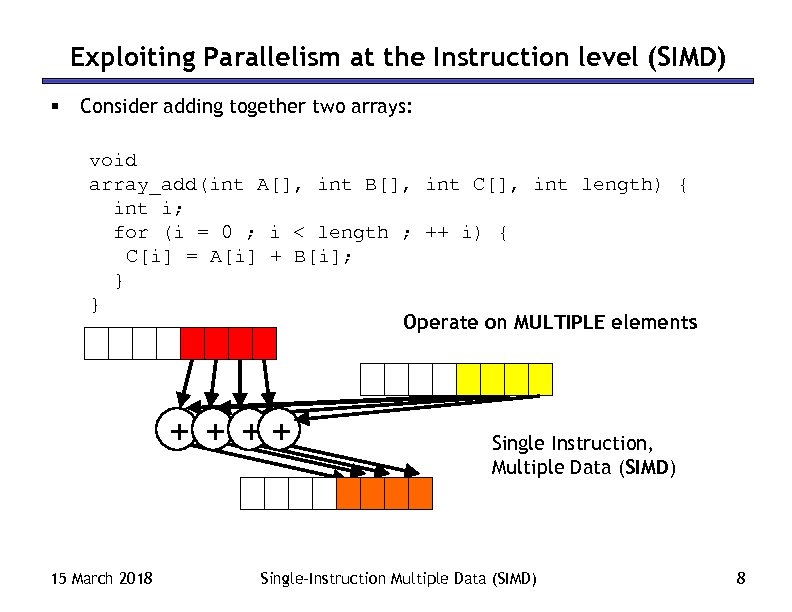 Exploiting Parallelism at the Instruction level (SIMD) § Consider adding together two arrays: void array_add(int A[], int B[], int C[], int length) { int i; for (i = 0 ; i < length ; ++ i) { C[i] = A[i] + B[i]; } } Operate on MULTIPLE elements + + ++ 15 March 2018 Single Instruction, Multiple Data (SIMD) Single-Instruction Multiple Data (SIMD) 8
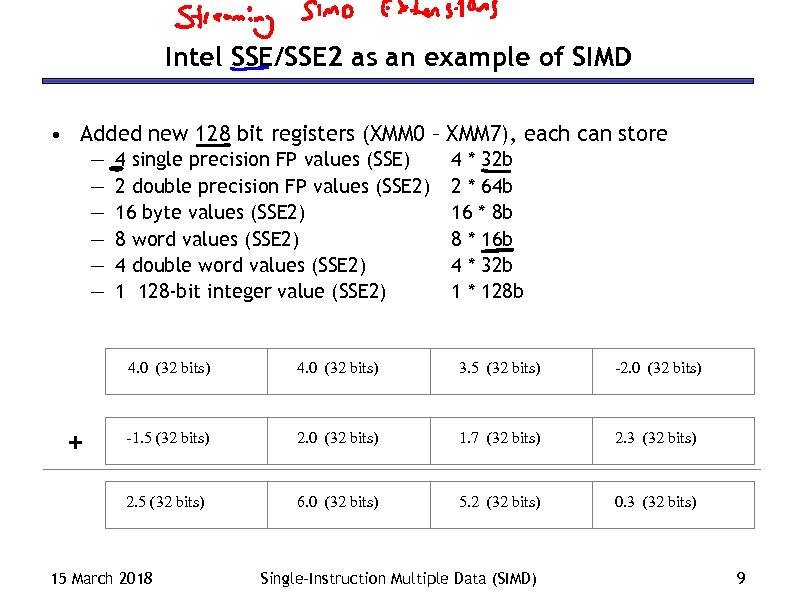 Intel SSE/SSE 2 as an example of SIMD • Added new 128 bit registers (XMM 0 – XMM 7), each can store — — — 4 single precision FP values (SSE) 2 double precision FP values (SSE 2) 16 byte values (SSE 2) 8 word values (SSE 2) 4 double word values (SSE 2) 1 128 -bit integer value (SSE 2) 4 * 32 b 2 * 64 b 16 * 8 b 8 * 16 b 4 * 32 b 1 * 128 b 4. 0 (32 bits) 3. 5 (32 bits) -2. 0 (32 bits) -1. 5 (32 bits) 2. 0 (32 bits) 1. 7 (32 bits) 2. 3 (32 bits) 2. 5 (32 bits) + 4. 0 (32 bits) 6. 0 (32 bits) 5. 2 (32 bits) 0. 3 (32 bits) 15 March 2018 Single-Instruction Multiple Data (SIMD) 9
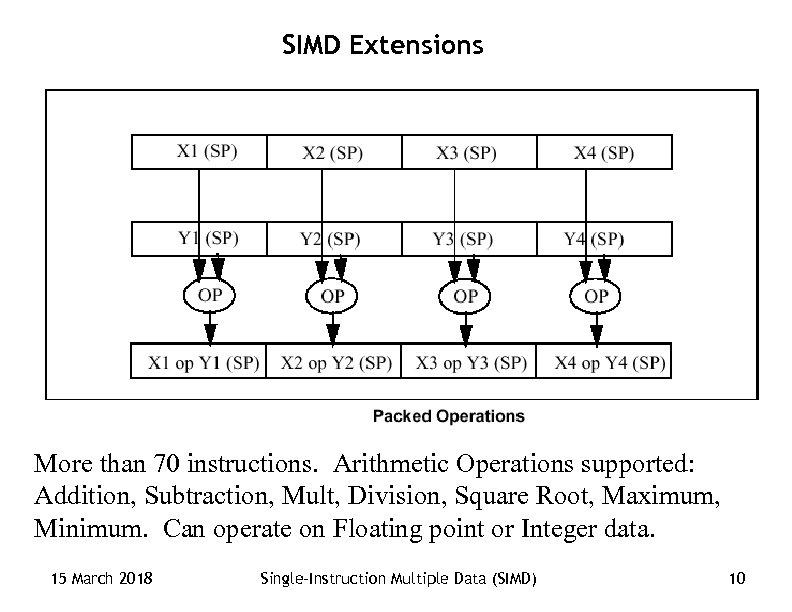 SIMD Extensions More than 70 instructions. Arithmetic Operations supported: Addition, Subtraction, Mult, Division, Square Root, Maximum, Minimum. Can operate on Floating point or Integer data. 15 March 2018 Single-Instruction Multiple Data (SIMD) 10
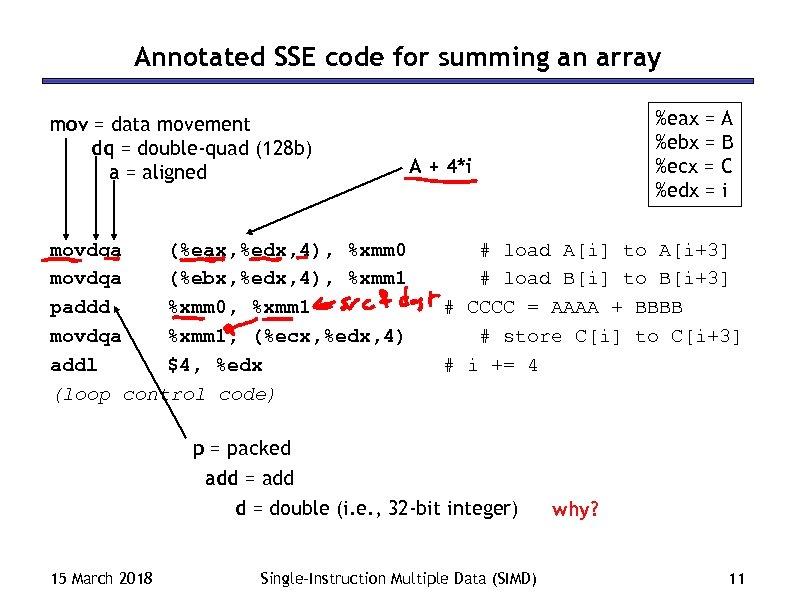 Annotated SSE code for summing an array mov = data movement dq = double-quad (128 b) a = aligned movdqa (%eax, %edx, 4), %xmm 0 movdqa (%ebx, %edx, 4), %xmm 1 paddd %xmm 0, %xmm 1 movdqa %xmm 1, (%ecx, %edx, 4) addl $4, %edx (loop control code) A + 4*i # load A[i] to A[i+3] # load B[i] to B[i+3] # CCCC = AAAA + BBBB # store C[i] to C[i+3] # i += 4 p = packed add = add d = double (i. e. , 32 -bit integer) 15 March 2018 %eax = A %ebx = B %ecx = C %edx = i Single-Instruction Multiple Data (SIMD) why? 11
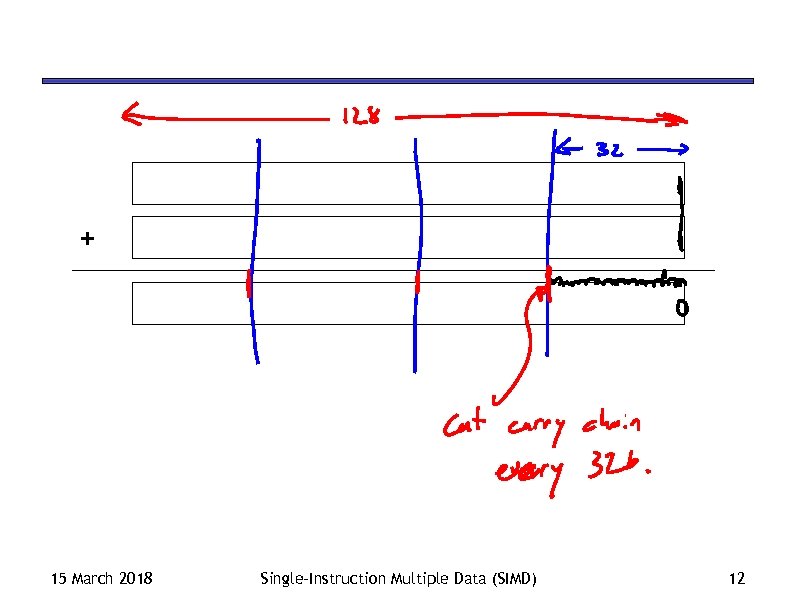 + 15 March 2018 Single-Instruction Multiple Data (SIMD) 12
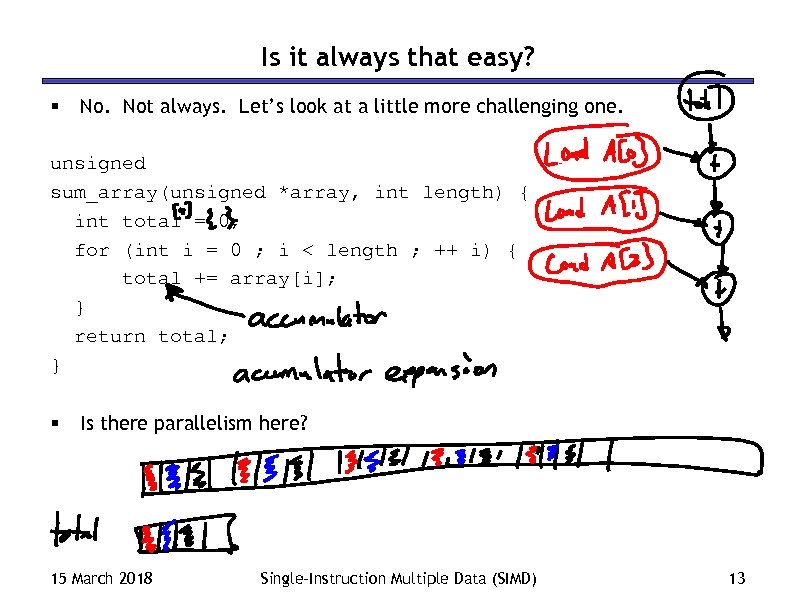 Is it always that easy? § No. Not always. Let’s look at a little more challenging one. unsigned sum_array(unsigned *array, int length) { int total = 0; for (int i = 0 ; i < length ; ++ i) { total += array[i]; } return total; } § Is there parallelism here? 15 March 2018 Single-Instruction Multiple Data (SIMD) 13
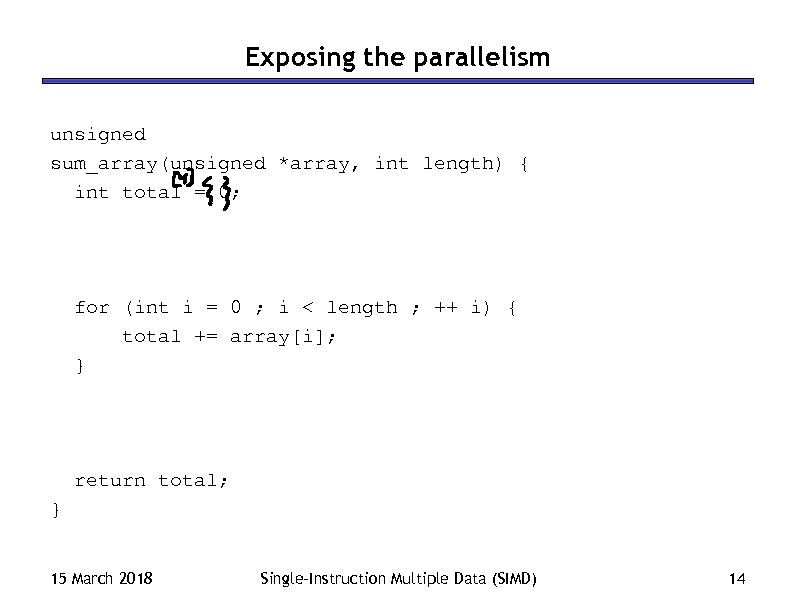 Exposing the parallelism unsigned sum_array(unsigned *array, int length) { int total = 0; for (int i = 0 ; i < length ; ++ i) { total += array[i]; } return total; } 15 March 2018 Single-Instruction Multiple Data (SIMD) 14
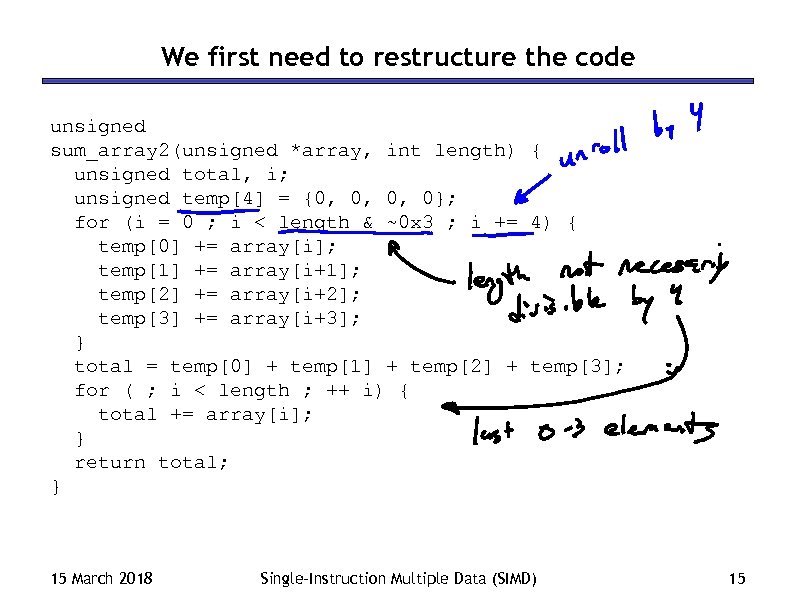 We first need to restructure the code unsigned sum_array 2(unsigned *array, int length) { unsigned total, i; unsigned temp[4] = {0, 0, 0, 0}; for (i = 0 ; i < length & ~0 x 3 ; i += 4) { temp[0] += array[i]; temp[1] += array[i+1]; temp[2] += array[i+2]; temp[3] += array[i+3]; } total = temp[0] + temp[1] + temp[2] + temp[3]; for ( ; i < length ; ++ i) { total += array[i]; } return total; } 15 March 2018 Single-Instruction Multiple Data (SIMD) 15
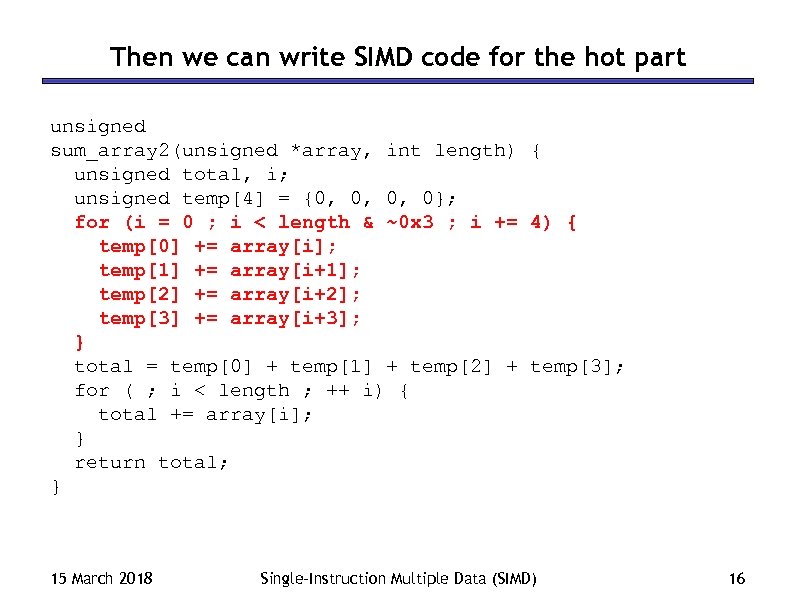 Then we can write SIMD code for the hot part unsigned sum_array 2(unsigned *array, int length) { unsigned total, i; unsigned temp[4] = {0, 0, 0, 0}; for (i = 0 ; i < length & ~0 x 3 ; i += 4) { temp[0] += array[i]; temp[1] += array[i+1]; temp[2] += array[i+2]; temp[3] += array[i+3]; } total = temp[0] + temp[1] + temp[2] + temp[3]; for ( ; i < length ; ++ i) { total += array[i]; } return total; } 15 March 2018 Single-Instruction Multiple Data (SIMD) 16
 Summary § Performance is of primary concern in some applications — Games, servers, mobile devices, super computers § Many important applications have parallelism — Exploiting it is a good way to speed up programs. § Single Instruction Multiple Data (SIMD) does this at ISA level — Registers hold multiple data items, instruction operate on them — Can achieve factor or 2, 4, 8 speedups on kernels — May require some restructuring of code to expose parallelism • Create temporary vectors, which are then reduced • Deal with remainder of array (if not evenly divisible) 15 March 2018 Single-Instruction Multiple Data (SIMD) 17