 Скачать презентацию Performance objectives Issues include What should we
7665c662a3c13df610c22e4190124b97.ppt
- Количество слайдов: 21



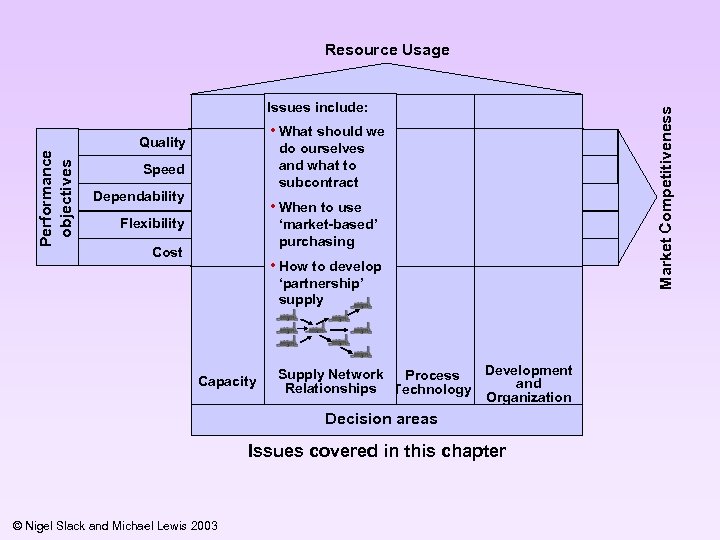
Performance objectives Issues include: • What should we Quality do ourselves and what to subcontract Speed Dependability • When to use Flexibility ‘market-based’ purchasing Cost • How to develop ‘partnership’ supply Capacity Development Supply Network Process and Relationships Technology Organization Decision areas Issues covered in this chapter © Nigel Slack and Michael Lewis 2003 Market Competitiveness Resource Usage
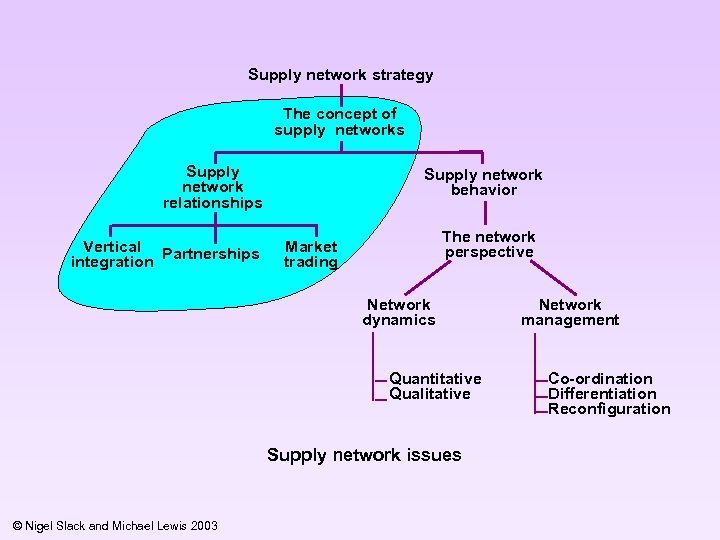
Supply network strategy The concept of supply networks Supply network relationships Vertical Partnerships integration Supply network behavior The network perspective Market trading Network dynamics Quantitative Qualitative Supply network issues © Nigel Slack and Michael Lewis 2003 Network management Co-ordination Differentiation Reconfiguration
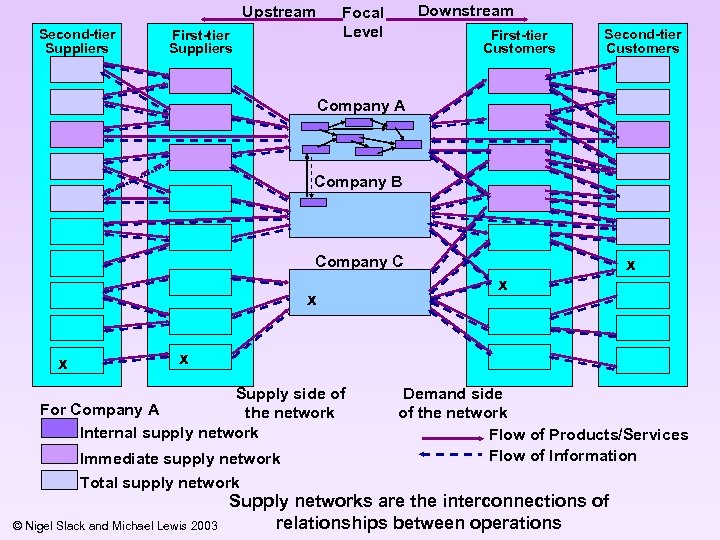
Upstream Second-tier Suppliers First-tier Suppliers Downstream Focal Level First-tier Customers Second-tier Customers Company A Company B Company C x x x Supply side of For Company A the network Internal supply network Immediate supply network Total supply network © Nigel Slack and Michael Lewis 2003 Demand side of the network Flow of Products/Services Flow of Information Supply networks are the interconnections of relationships between operations
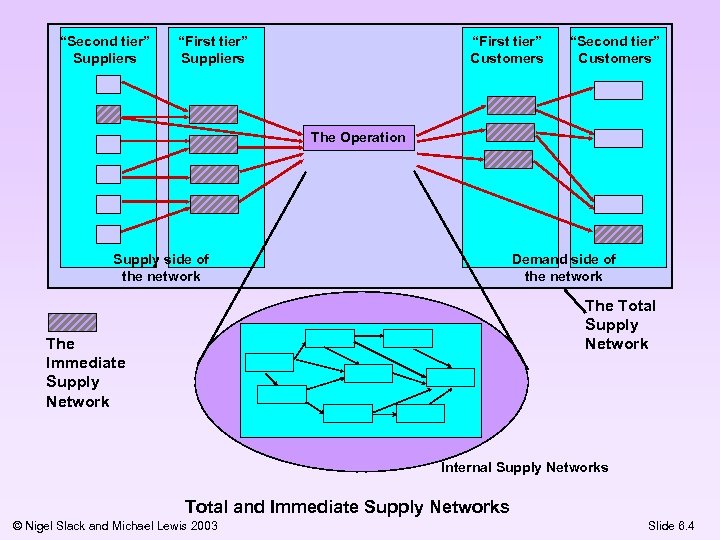
“Second tier” Suppliers “First tier” Customers “Second tier” Customers The Operation Supply side of the network Demand side of the network The Total Supply Network The Immediate Supply Network Internal Supply Networks Total and Immediate Supply Networks © Nigel Slack and Michael Lewis 2003 Slide 6. 4
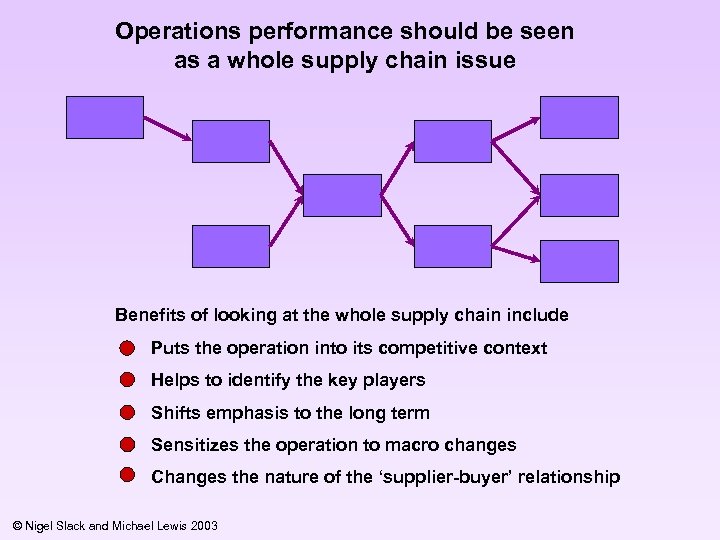
Operations performance should be seen as a whole supply chain issue Benefits of looking at the whole supply chain include Puts the operation into its competitive context Helps to identify the key players Shifts emphasis to the long term Sensitizes the operation to macro changes Changes the nature of the ‘supplier-buyer’ relationship © Nigel Slack and Michael Lewis 2003
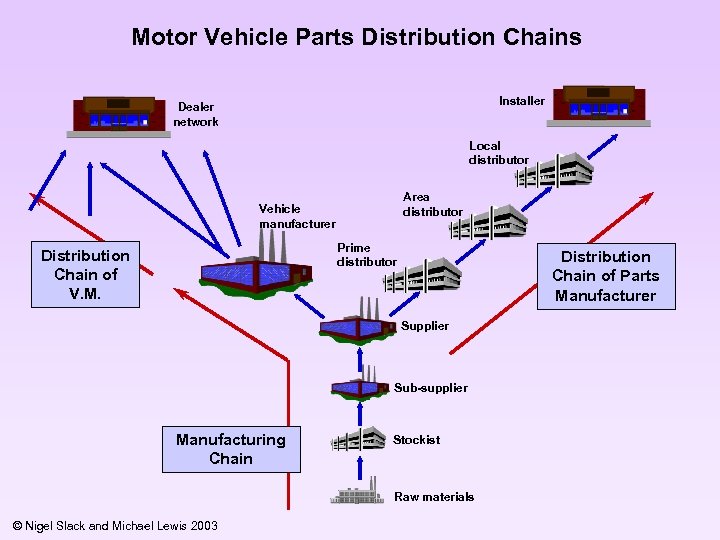
Motor Vehicle Parts Distribution Chains Installer Dealer network Local distributor Area distributor Vehicle manufacturer Prime distributor Distribution Chain of V. M. Distribution Chain of Parts Manufacturer Supplier Sub-supplier Manufacturing Chain Stockist Raw materials © Nigel Slack and Michael Lewis 2003
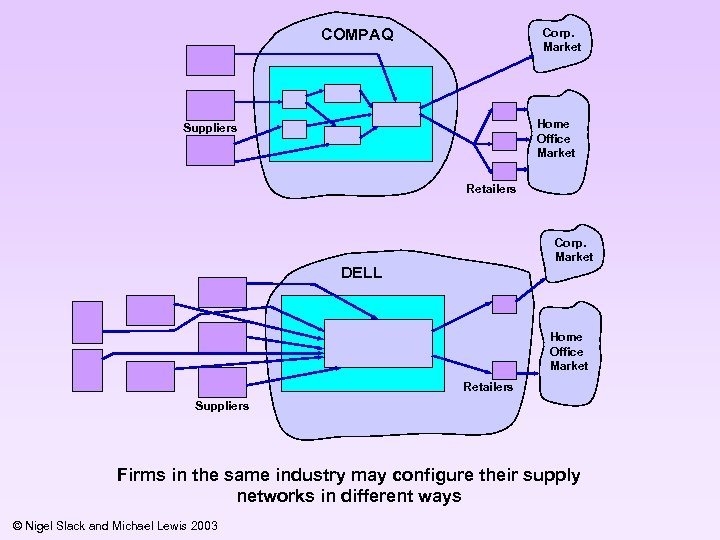
COMPAQ Corp. Market Home Office Market Suppliers Retailers Corp. Market DELL Home Office Market Retailers Suppliers Firms in the same industry may configure their supply networks in different ways © Nigel Slack and Michael Lewis 2003
Supply chain Management The opportunities lie at the boundaries © Nigel Slack and Michael Lewis 2003
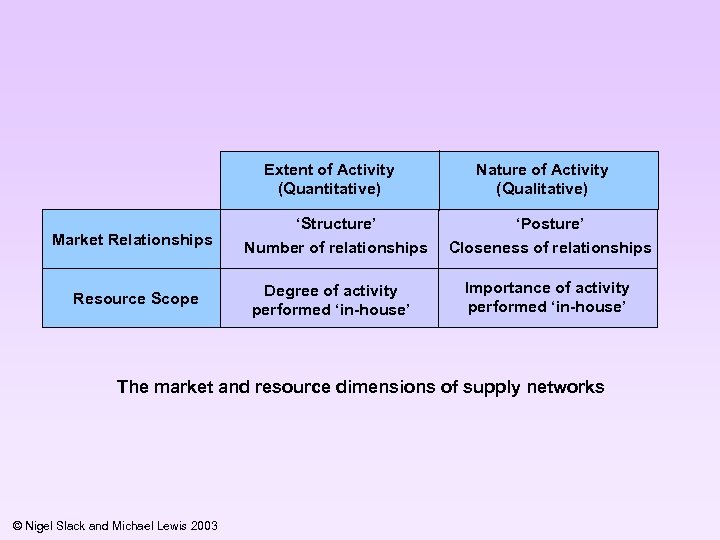
Extent of Activity (Quantitative) Market Relationships Resource Scope ‘Structure’ Number of relationships Degree of activity performed ‘in-house’ Nature of Activity (Qualitative) ‘Posture’ Closeness of relationships Importance of activity performed ‘in-house’ The market and resource dimensions of supply networks © Nigel Slack and Michael Lewis 2003
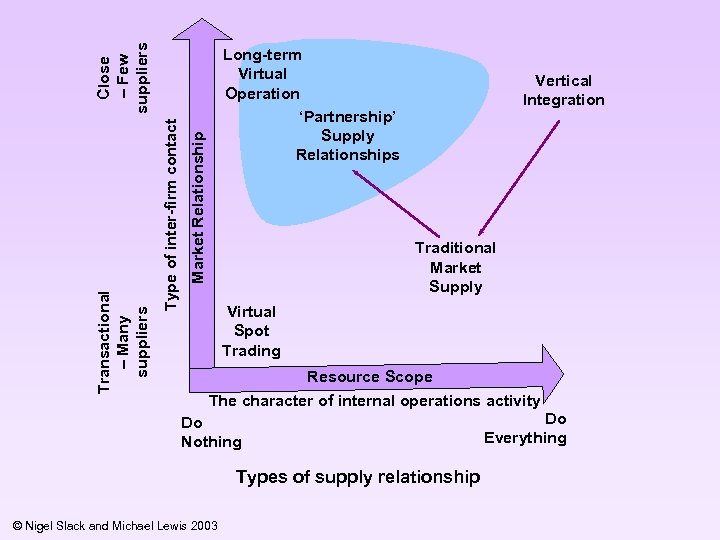
Market Relationship Type of inter-firm contact Close – Few suppliers Transactional – Many suppliers Long-term Virtual Operation ‘Partnership’ Supply Relationships Vertical Integration Traditional Market Supply Virtual Spot Trading Resource Scope The character of internal operations activity Do Nothing Types of supply relationship © Nigel Slack and Michael Lewis 2003 Do Everything
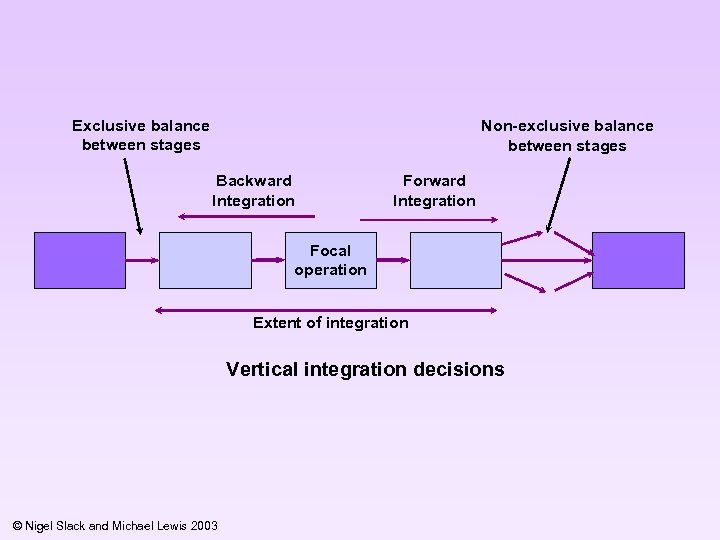
Exclusive balance between stages Non-exclusive balance between stages Backward Integration Forward Integration Focal operation Extent of integration Vertical integration decisions © Nigel Slack and Michael Lewis 2003
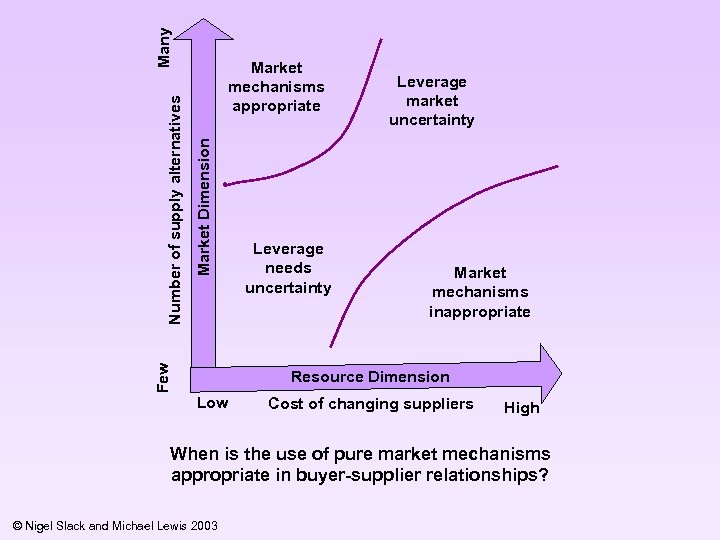
Many Market Dimension Number of supply alternatives Few Market mechanisms appropriate Leverage needs uncertainty Leverage market uncertainty Market mechanisms inappropriate Resource Dimension Low Cost of changing suppliers High When is the use of pure market mechanisms appropriate in buyer-supplier relationships? © Nigel Slack and Michael Lewis 2003
Supply chain Management Partnership relationships are seen as desirable because they can reduce the transaction costs of doing business © Nigel Slack and Michael Lewis 2003
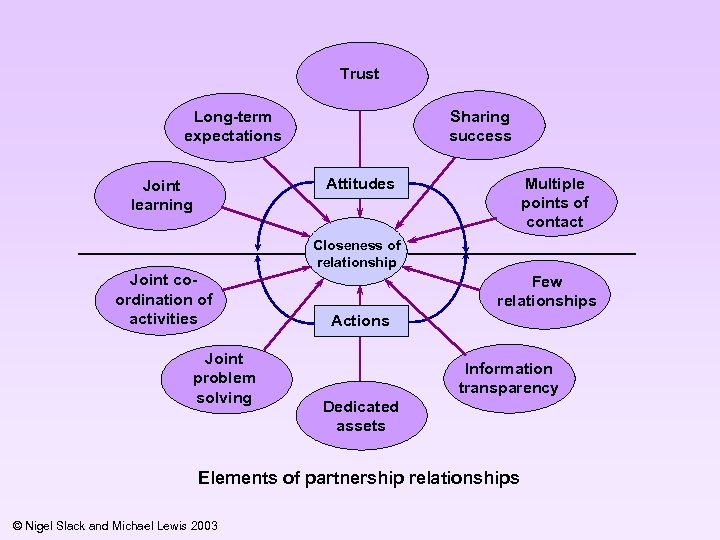
Trust Sharing success Long-term expectations Attitudes Joint learning Multiple points of contact Closeness of relationship Joint coordination of activities Joint problem solving Few relationships Actions Information transparency Dedicated assets Elements of partnership relationships © Nigel Slack and Michael Lewis 2003
Supply chain Management There are strong forces acting against the maintenance of trust © Nigel Slack and Michael Lewis 2003
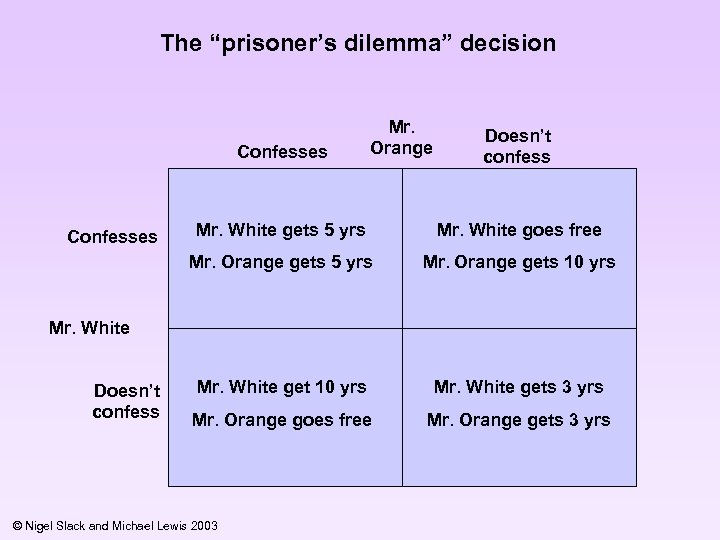
The “prisoner’s dilemma” decision Confesses Mr. Orange Doesn’t confess Mr. White gets 5 yrs Mr. White goes free Mr. Orange gets 5 yrs Confesses Mr. Orange gets 10 yrs Mr. White gets 3 yrs Mr. Orange goes free Mr. Orange gets 3 yrs Mr. White Doesn’t confess © Nigel Slack and Michael Lewis 2003
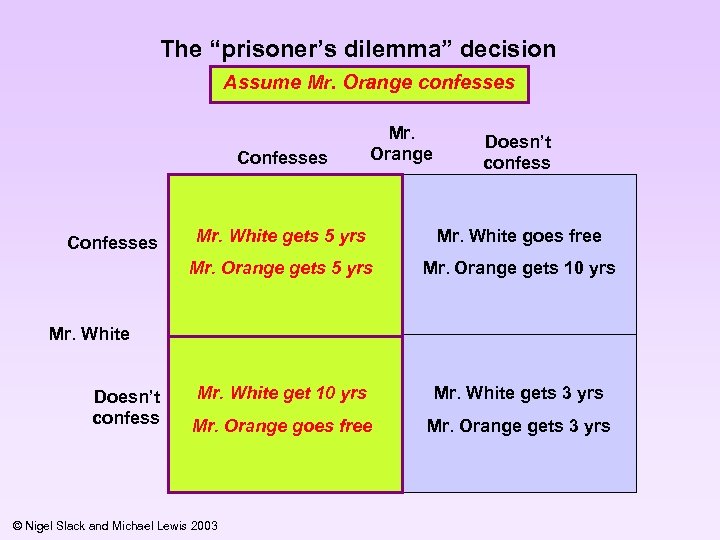
The “prisoner’s dilemma” decision Assume Mr. Orange confesses Confesses Mr. Orange Doesn’t confess Mr. White gets 5 yrs Mr. White goes free Mr. Orange gets 5 yrs Confesses Mr. Orange gets 10 yrs Mr. White gets 3 yrs Mr. Orange goes free Mr. Orange gets 3 yrs Mr. White Doesn’t confess © Nigel Slack and Michael Lewis 2003
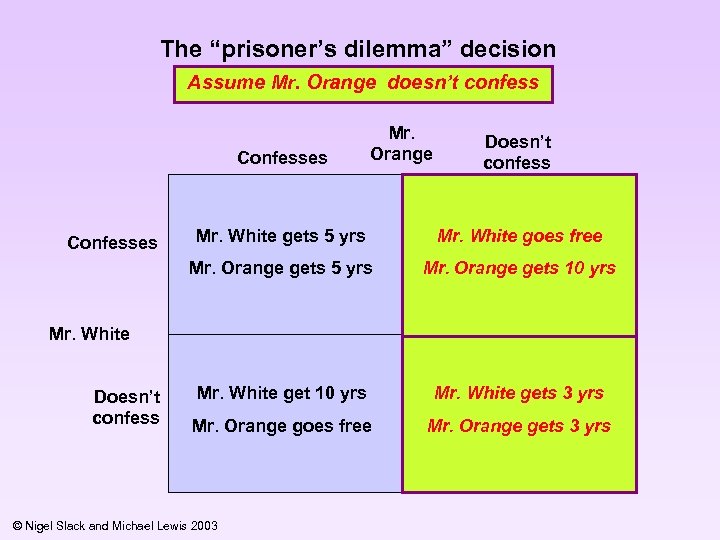
The “prisoner’s dilemma” decision Assume Mr. Orange doesn’t confess Confesses Mr. Orange Doesn’t confess Mr. White gets 5 yrs Mr. White goes free Mr. Orange gets 5 yrs Confesses Mr. Orange gets 10 yrs Mr. White gets 3 yrs Mr. Orange goes free Mr. Orange gets 3 yrs Mr. White Doesn’t confess © Nigel Slack and Michael Lewis 2003
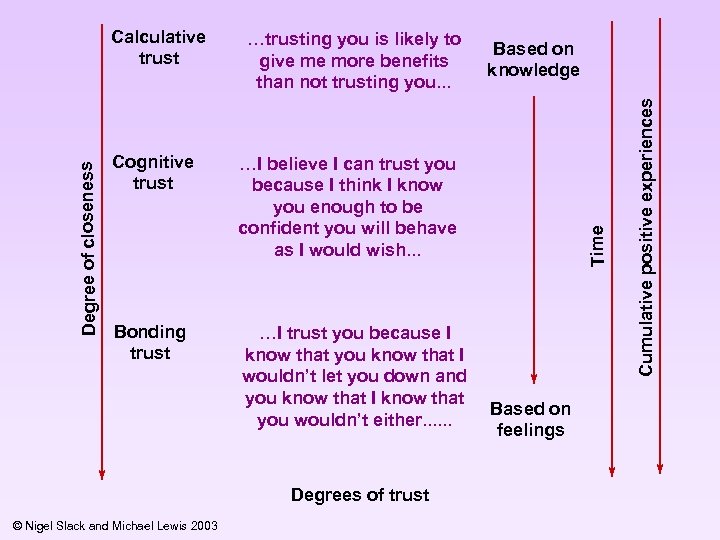
Cognitive trust …I believe I can trust you because I think I know you enough to be confident you will behave as I would wish. . . Bonding trust …I trust you because I know that you know that I wouldn’t let you down and you know that I know that you wouldn’t either. . . Based on knowledge Degrees of trust © Nigel Slack and Michael Lewis 2003 Based on feelings Cumulative positive experiences …trusting you is likely to give me more benefits than not trusting you. . . Time Degree of closeness Calculative trust
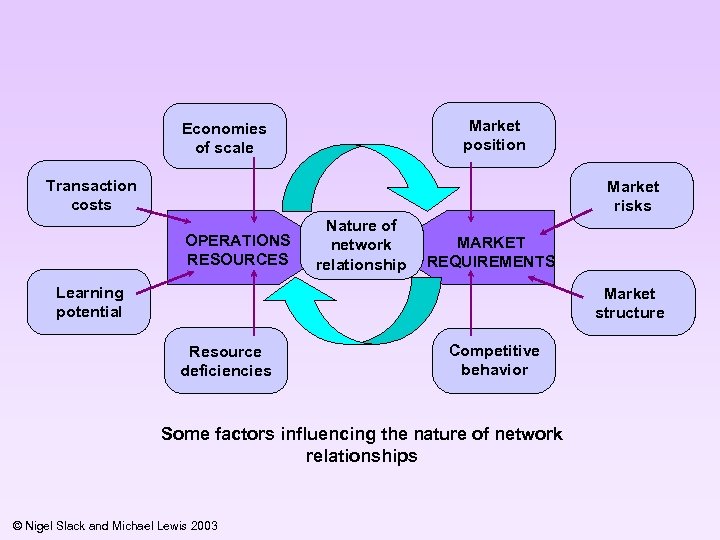
Market position Economies of scale Transaction costs Market risks OPERATIONS RESOURCES Nature of network relationship MARKET REQUIREMENTS Learning potential Market structure Resource deficiencies Competitive behavior Some factors influencing the nature of network relationships © Nigel Slack and Michael Lewis 2003
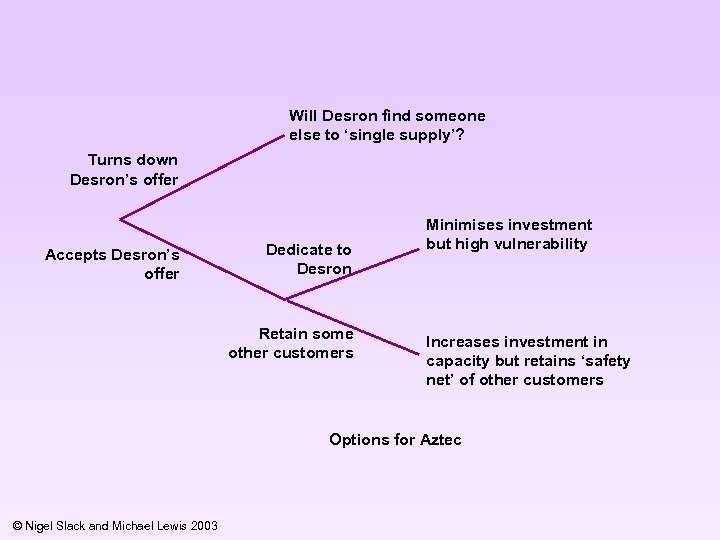
Will Desron find someone else to ‘single supply’? Turns down Desron’s offer Accepts Desron’s offer Dedicate to Desron Retain some other customers Minimises investment but high vulnerability Increases investment in capacity but retains ‘safety net’ of other customers Options for Aztec © Nigel Slack and Michael Lewis 2003
Скачать презентацию Performance objectives Issues include What should we
7665c662a3c13df610c22e4190124b97.ppt