 Скачать презентацию Performance-based Contracting and Competitive Sourcing in Government Florida
4a5da48f4a46654e31c54cf5b0a8d5df.ppt
- Количество слайдов: 68



Performance-based Contracting and Competitive Sourcing in Government Florida State Procurement Forum January 16, 2004
The Mission of The Performance Institute The Nation’s Leader in Government Reform The Performance Institute is a private think tank seeking to improve government performance through the principles of competition, accountability, performance and transparency. PI serves as the nation’s leading authority and repository on performance-based management practices for government. Its mission is to identify, study and disseminate the leading management innovations pioneered by “best-in-class” organizations. Transferring Knowledge to Transform Organizations Through its national conferences on pressing issues, interactive executive training programs, best practice research and strategic consulting services, the Institute provides cutting-edge expertise in the design, implementation and evaluation of strategies to solve operational challenges and enhance organizational performance.
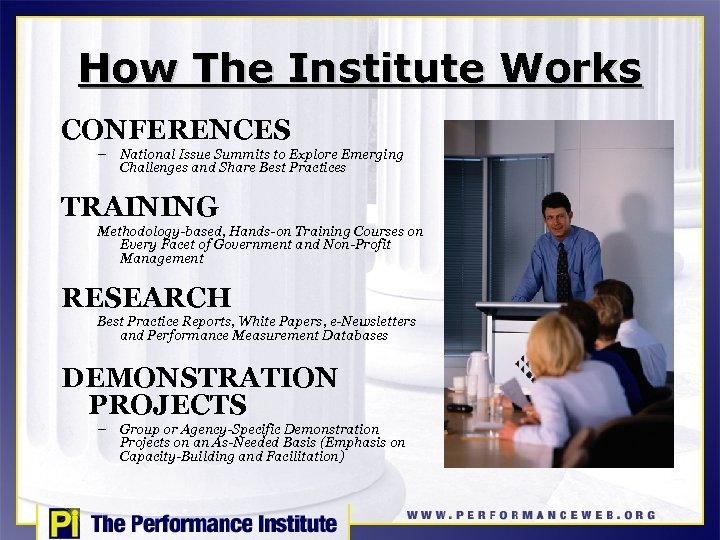
How The Institute Works CONFERENCES – National Issue Summits to Explore Emerging Challenges and Share Best Practices TRAINING Methodology-based, Hands-on Training Courses on Every Facet of Government and Non-Profit Management RESEARCH Best Practice Reports, White Papers, e-Newsletters and Performance Measurement Databases DEMONSTRATION PROJECTS – Group or Agency-Specific Demonstration Projects on an As-Needed Basis (Emphasis on Capacity-Building and Facilitation)
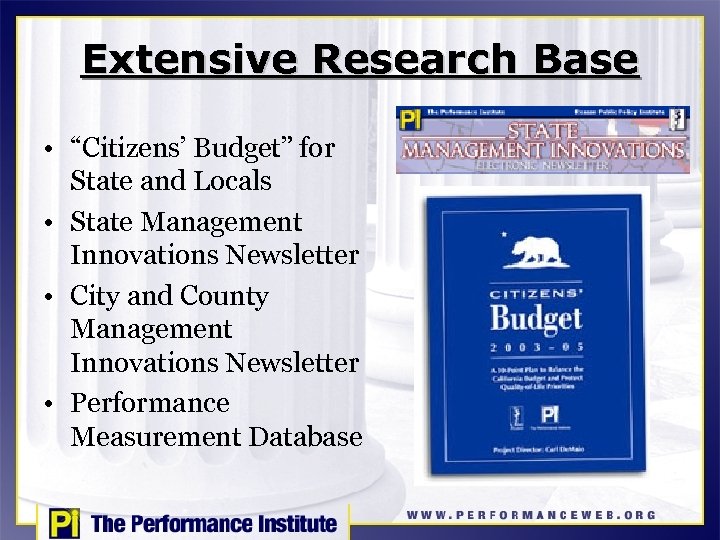
Extensive Research Base • “Citizens’ Budget” for State and Locals • State Management Innovations Newsletter • City and County Management Innovations Newsletter • Performance Measurement Database
Training and Certification Programs • Performance Management • Human Resources Management • Administrative Management • Competitive Sourcing • Performance-based Contracting • IT Budget Justification Attend Public-Offered Courses or Bring a Customized Program In-House
Conference Logistics • Customer Service Requests – Invoices and Receipts – Requests for Documents/Speaker materials – Questions, comments, and suggestions E-Mail: info@performanceweb. org • Conference Networking List – “Opt-in” policy to protect privacy – Place your card in the envelope at the registration table
Contact Information Carl De. Maio President Michael Hoffman Director, Center for Contracting and Outsourcing The Performance Institute 1515 North Courthouse Road, Suite 600, Arlington, VA 22201 Phone: 703 -894 -0481 - Fax: 703 -894 -0482 www. performanceweb. org www. transparentgovernment. org
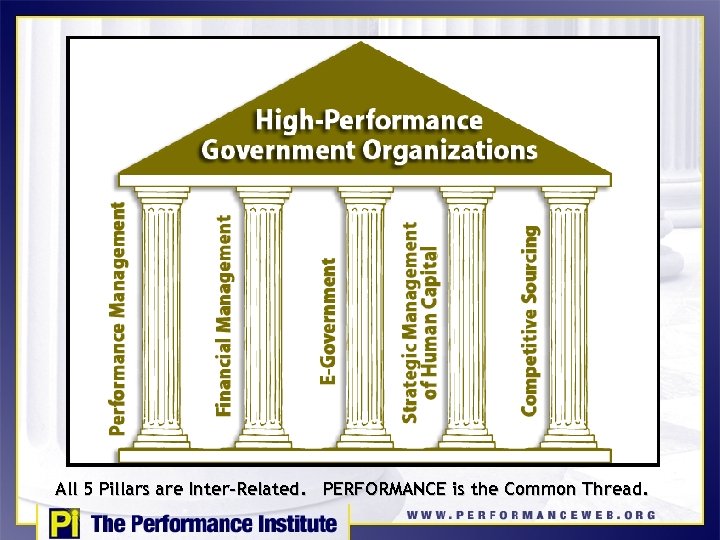
All 5 Pillars are Inter-Related. PERFORMANCE is the Common Thread.
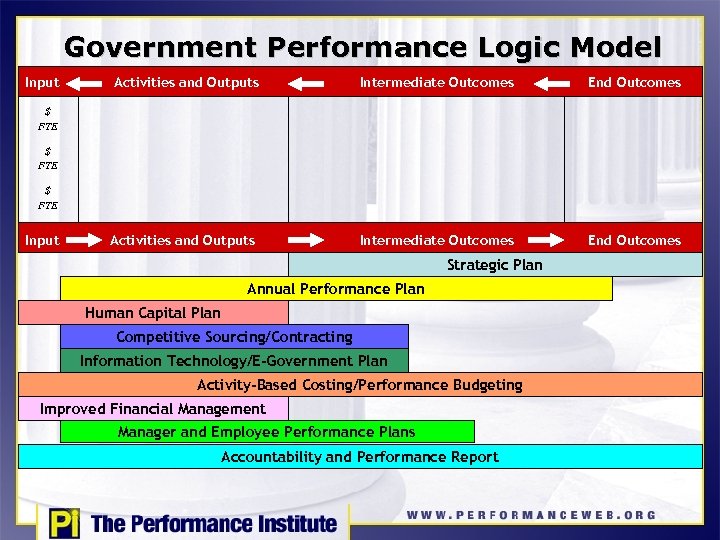
Government Performance Logic Model Input Activities and Outputs Intermediate Outcomes End Outcomes $ FTE Input Activities and Outputs Strategic Plan Annual Performance Plan Human Capital Plan Competitive Sourcing/Contracting Information Technology/E-Government Plan Activity-Based Costing/Performance Budgeting Improved Financial Management Manager and Employee Performance Plans Accountability and Performance Report
It’s NOT just about MEASURES!
STRATEGIZE COMMUNICATE MOTIVATE MANAGE
Best Practices in Competitive Sourcing Using the 7 Step Framework and Logic Model to Develop Performance-based Contracts Carl De. Maio Performance Institute
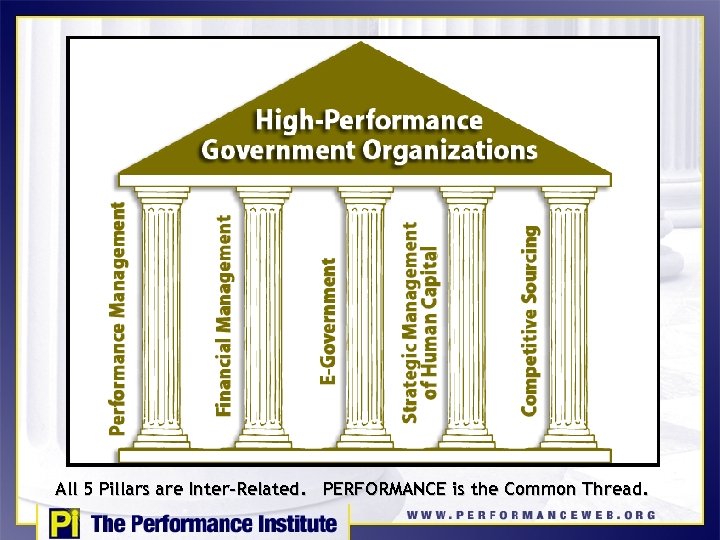
All 5 Pillars are Inter-Related. PERFORMANCE is the Common Thread.
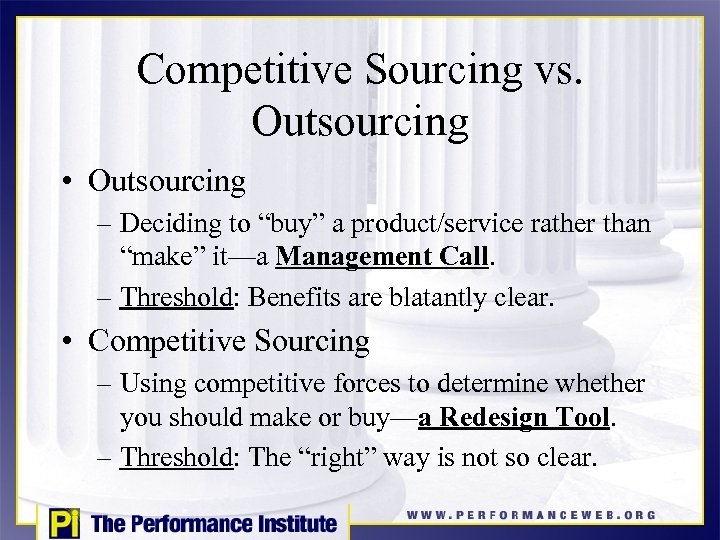
Competitive Sourcing vs. Outsourcing • Outsourcing – Deciding to “buy” a product/service rather than “make” it—a Management Call. – Threshold: Benefits are blatantly clear. • Competitive Sourcing – Using competitive forces to determine whether you should make or buy—a Redesign Tool. – Threshold: The “right” way is not so clear.
Outsourcing and Competitive Sourcing are not the ends, but the means. The end-state we seek is BETTER PERFORMANCE
Opportunities • Cost savings: 20 -40% savings (average=30%) • Cost containment/certainty • Improved Performance: • Flexibility and speed • • Improved quality Access to personnel or skills Innovation Enhancing focus on core mission
Obstacles • • • Misinterpretation of the process. Poor financial information. What does it all cost? ? ? Poor performance information and measures. Cultural resistance. IMPACTS: – – Low employee morale 3 -5 years to complete $2000 -$4000 per position studied Poorer Performance? Higher Costs? Less Accountability?
Agency Mechanisms for Implementing the Effective Use of Competitive Sourcing • Appointment of competitive sourcing officials • Reasoned classification of agency workforce • Cross-functional participation in decision making process • Evaluation of benefits and drawbacks
Agency Commercial Activity Inventories • Categorize Positions as Commercial vs. Inherently Governmental • Examine Agency Activities and Determine # FTE Engaged • HR Assists in Identifying FTE Allocation and Analyzing Work Performed • Use Activity-Based Costing or Managerial Cost Accounting for Data
Selection of Positions for Competitive Sourcing • Focus on Commercial Activities • Examine Human Capital Plan for Skills Gaps • Examine Performance of Activities • Target based on Performance and Workforce Analysis
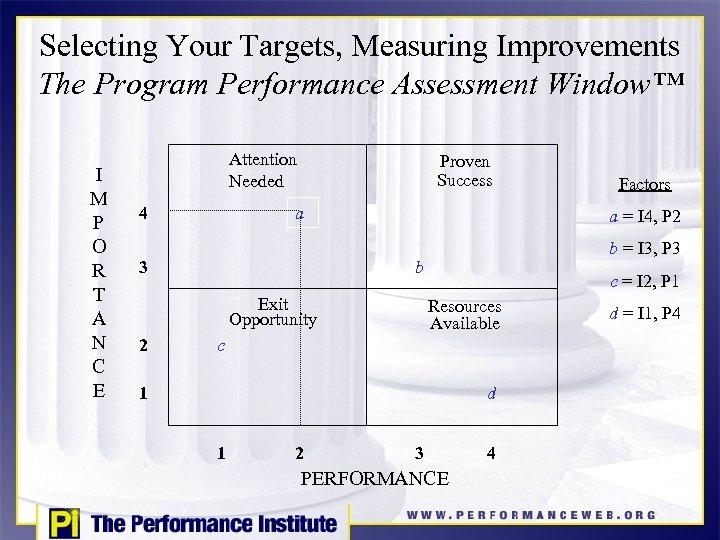
Selecting Your Targets, Measuring Improvements The Program Performance Assessment Window™ I M P O R T A N C E Attention Needed Proven Success a 4 a = I 4, P 2 Exit Opportunity 2 b = I 3, P 3 b 3 c = I 2, P 1 Resources Available c d 1 1 2 Factors 3 PERFORMANCE 4 d = I 1, P 4
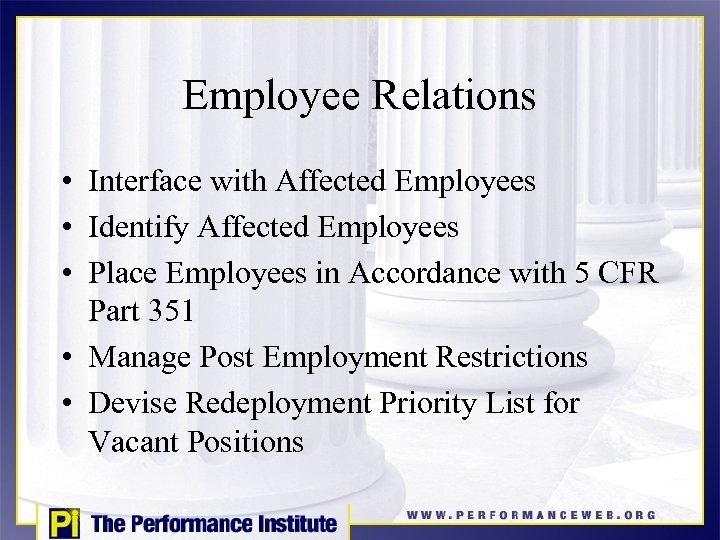
Employee Relations • Interface with Affected Employees • Identify Affected Employees • Place Employees in Accordance with 5 CFR Part 351 • Manage Post Employment Restrictions • Devise Redeployment Priority List for Vacant Positions
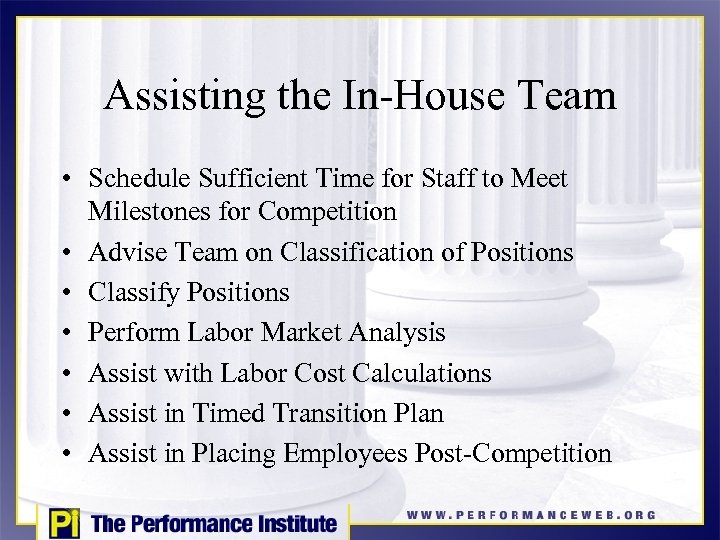
Assisting the In-House Team • Schedule Sufficient Time for Staff to Meet Milestones for Competition • Advise Team on Classification of Positions • Classify Positions • Perform Labor Market Analysis • Assist with Labor Cost Calculations • Assist in Timed Transition Plan • Assist in Placing Employees Post-Competition
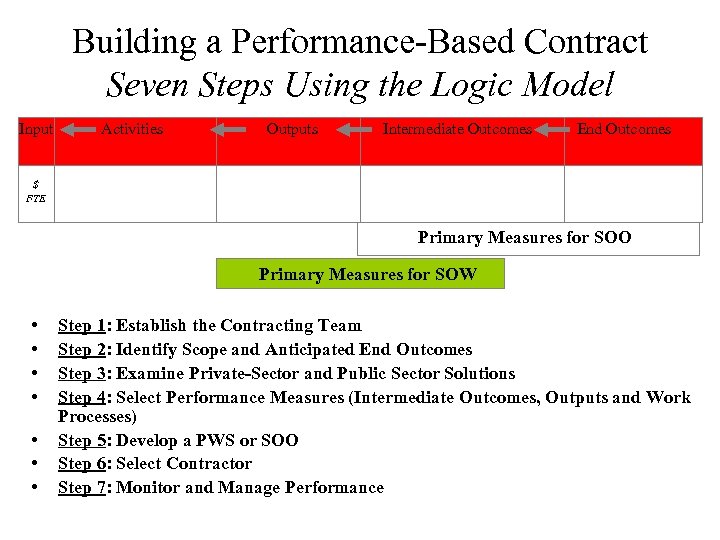
Building a Performance-Based Contract Seven Steps Using the Logic Model Input Activities Outputs Intermediate Outcomes End Outcomes $ FTE Primary Measures for SOO Primary Measures for SOW • • Step 1: Establish the Contracting Team Step 2: Identify Scope and Anticipated End Outcomes Step 3: Examine Private-Sector and Public Sector Solutions Step 4: Select Performance Measures (Intermediate Outcomes, Outputs and Work Processes) Step 5: Develop a PWS or SOO Step 6: Select Contractor Step 7: Monitor and Manage Performance
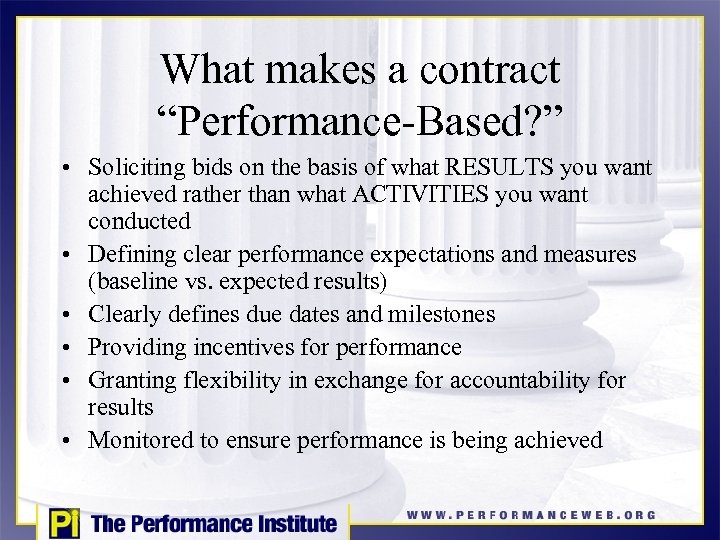
What makes a contract “Performance-Based? ” • Soliciting bids on the basis of what RESULTS you want achieved rather than what ACTIVITIES you want conducted • Defining clear performance expectations and measures (baseline vs. expected results) • Clearly defines due dates and milestones • Providing incentives for performance • Granting flexibility in exchange for accountability for results • Monitored to ensure performance is being achieved
The “State of Practice” in Performance-based Contracting Mandates, Case Studies, and Lessons Learned
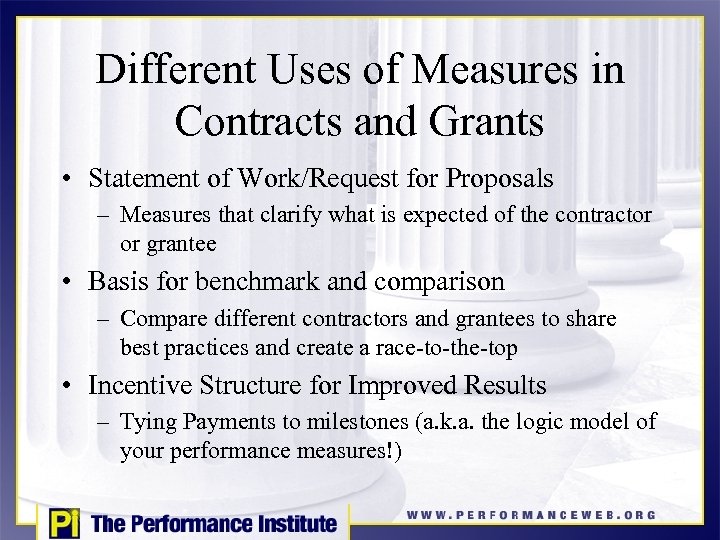
Different Uses of Measures in Contracts and Grants • Statement of Work/Request for Proposals – Measures that clarify what is expected of the contractor or grantee • Basis for benchmark and comparison – Compare different contractors and grantees to share best practices and create a race-to-the-top • Incentive Structure for Improved Results – Tying Payments to milestones (a. k. a. the logic model of your performance measures!)
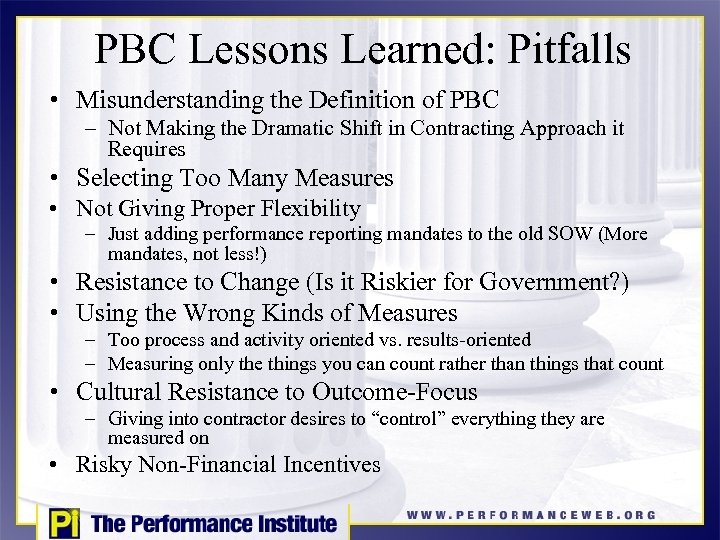
PBC Lessons Learned: Pitfalls • Misunderstanding the Definition of PBC – Not Making the Dramatic Shift in Contracting Approach it Requires • Selecting Too Many Measures • Not Giving Proper Flexibility – Just adding performance reporting mandates to the old SOW (More mandates, not less!) • Resistance to Change (Is it Riskier for Government? ) • Using the Wrong Kinds of Measures – Too process and activity oriented vs. results-oriented – Measuring only the things you can count rather than things that count • Cultural Resistance to Outcome-Focus – Giving into contractor desires to “control” everything they are measured on • Risky Non-Financial Incentives
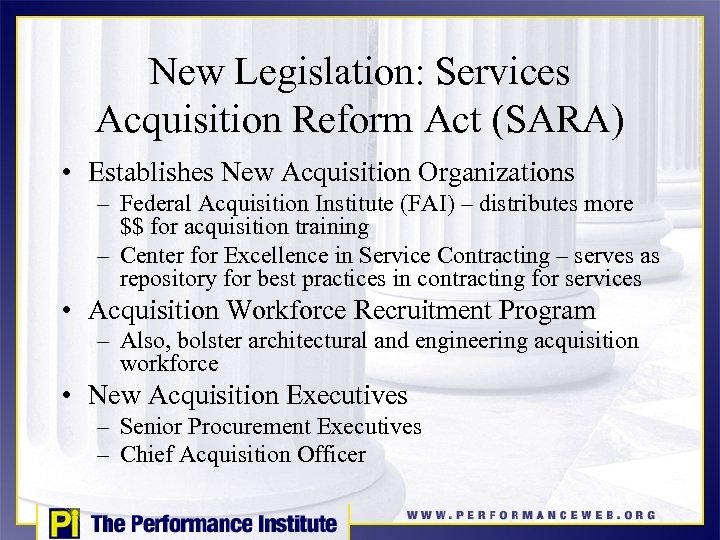
New Legislation: Services Acquisition Reform Act (SARA) • Establishes New Acquisition Organizations – Federal Acquisition Institute (FAI) – distributes more $$ for acquisition training – Center for Excellence in Service Contracting – serves as repository for best practices in contracting for services • Acquisition Workforce Recruitment Program – Also, bolster architectural and engineering acquisition workforce • New Acquisition Executives – Senior Procurement Executives – Chief Acquisition Officer
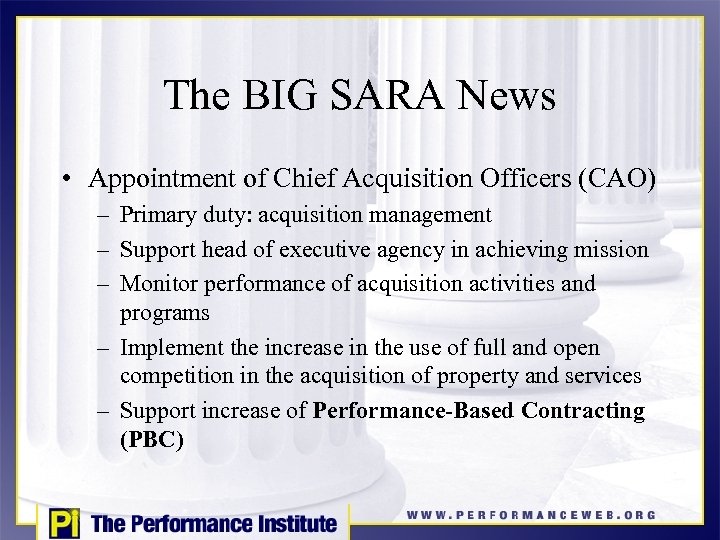
The BIG SARA News • Appointment of Chief Acquisition Officers (CAO) – Primary duty: acquisition management – Support head of executive agency in achieving mission – Monitor performance of acquisition activities and programs – Implement the increase in the use of full and open competition in the acquisition of property and services – Support increase of Performance-Based Contracting (PBC)
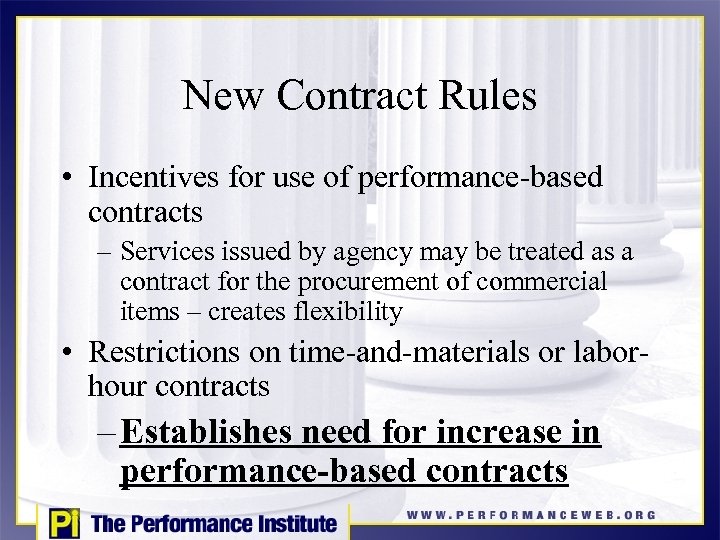
New Contract Rules • Incentives for use of performance-based contracts – Services issued by agency may be treated as a contract for the procurement of commercial items – creates flexibility • Restrictions on time-and-materials or laborhour contracts – Establishes need for increase in performance-based contracts
The Benefits of PBSC • OFPP 1998 Study of PBSCs: – Reduced costs by 18% – Increased customer satisfaction scores by 15% • Specific Case Studies: – CA Earthquake Repair – OK Rehabilitative Services – NC Adoption Program
California Earthquake Repair • Financial Incentives: – $200 k/day (bonus or penalty) – $13. 8 million given in performance bonuses • Savings – $74 million to local economy (end-outcome) – $12 million on contract administration • Construction Time – 2 months vs. an estimated 9 -24 months
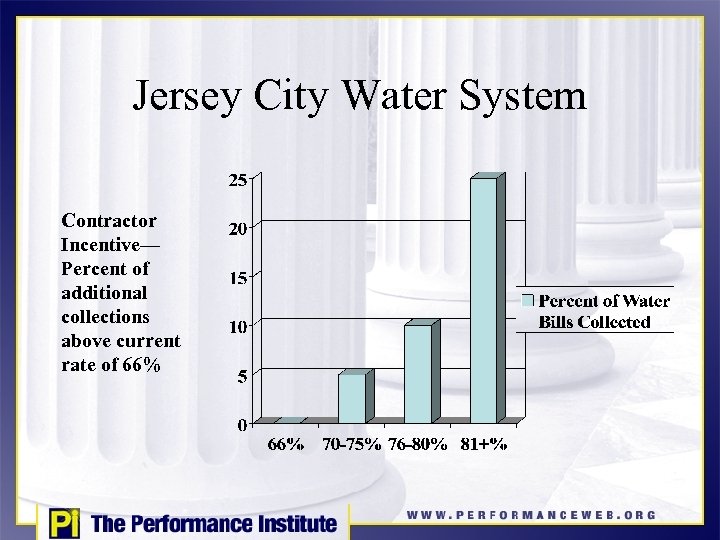
Jersey City Water System Contractor Incentive— Percent of additional collections above current rate of 66%
OK Community Rehabilitation Services Unit Paying contractors at predefined milestones • • • Determination of consumer needs (10% of bid) Vocational preparation completed (10% of bid) Job Placement (10% of bid) Four weeks of job retention (20% of bid) Job stabilization of 10 -17 weeks of retention with minimal support contacts (20% of bid) • Consumer rehabilitated: no support contacts 90 days after stabilization period (30% of bid) Costs per placement declined by 51%, waiting lists for clients dropped by 53%, and the number of individuals who failed to get a job fell by 25%.
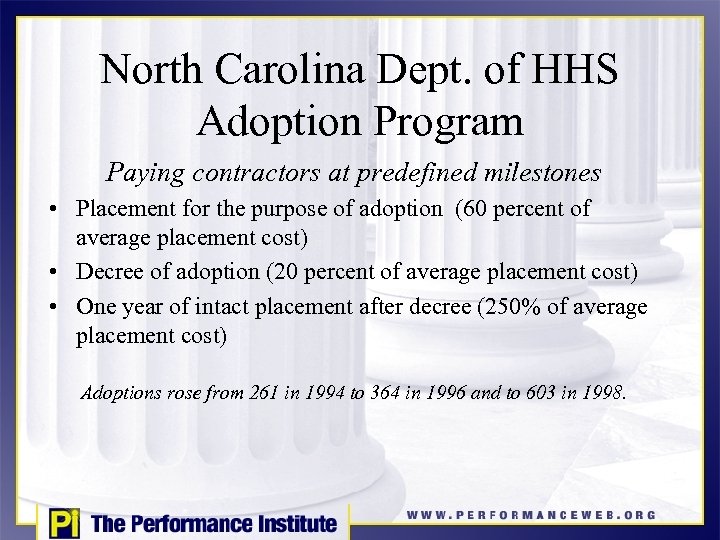
North Carolina Dept. of HHS Adoption Program Paying contractors at predefined milestones • Placement for the purpose of adoption (60 percent of average placement cost) • Decree of adoption (20 percent of average placement cost) • One year of intact placement after decree (250% of average placement cost) Adoptions rose from 261 in 1994 to 364 in 1996 and to 603 in 1998.
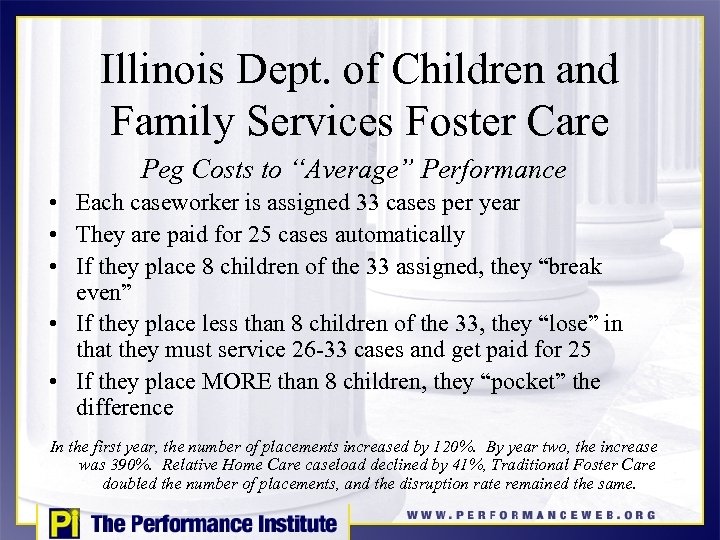
Illinois Dept. of Children and Family Services Foster Care Peg Costs to “Average” Performance • Each caseworker is assigned 33 cases per year • They are paid for 25 cases automatically • If they place 8 children of the 33 assigned, they “break even” • If they place less than 8 children of the 33, they “lose” in that they must service 26 -33 cases and get paid for 25 • If they place MORE than 8 children, they “pocket” the difference In the first year, the number of placements increased by 120%. By year two, the increase was 390%. Relative Home Care caseload declined by 41%, Traditional Foster Care doubled the number of placements, and the disruption rate remained the same.
Critical Success Factors for Designing a Performance-Based Contract • Strategic and Program Logic for the Agency is clear (Strategic Plan -> Performance Plan) • Clearly determine the scope of work and what performance measures will be used • Canvass providers/contractors – What measures would they propose? – What incentives would they want? How? – How would they want to report performance data? • Define your baseline and what level of performance is expected
Critical Success Factors for Designing a Performance-Based Contract, cont. • Include provisions for flexibility and incentives. . and make sure you can afford the incentives! • THEN: Craft a performance-based statement of work and begin contractor selection • Include mechanisms for measurement, reporting, monitoring and contractor feedback • Define a system for revisions and reconciling deviations in expected performance • Consider a transition period “hold harmless” clause
Critical Success Factors for Managing a Performance-Based Contract • Monitor Performance with regular reporting • Adjust! – Identify changes in external factors that will impact performance – Devise corrective action plans for deviations – Benchmark and compare! Analyze for next steps! – Revise performance targets to continue the push for gains • Provide comparative performance data to contractors: create a “race to the top” culture • Communicate and reward success!
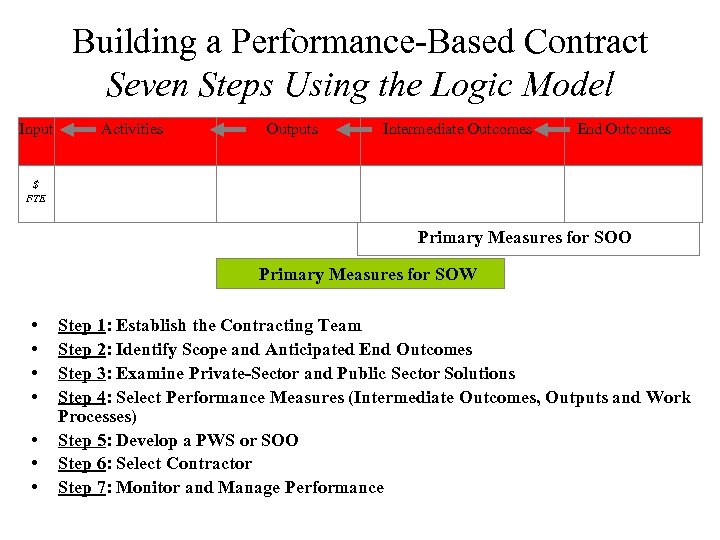
Building a Performance-Based Contract Seven Steps Using the Logic Model Input Activities Outputs Intermediate Outcomes End Outcomes $ FTE Primary Measures for SOO Primary Measures for SOW • • Step 1: Establish the Contracting Team Step 2: Identify Scope and Anticipated End Outcomes Step 3: Examine Private-Sector and Public Sector Solutions Step 4: Select Performance Measures (Intermediate Outcomes, Outputs and Work Processes) Step 5: Develop a PWS or SOO Step 6: Select Contractor Step 7: Monitor and Manage Performance
Step 1: Selecting Your Team • Only works with clear leadership commitment to PBC (accountability a must!) • Contract Officer • Program Manager • Program Partners/Users • Identify and canvass stakeholders – Industry days, RFIs, etc. • Define roles, responsibilities, and due dates • Provide training and proper project support • Think “outside the box” (Don’t assume existing activities are correct!)
Step 2: Identify Scope and Anticipated End Outcomes • Align contract to agency mission and outcome goals • Provides the context to all team members on what impact contract will have to the agency • Key Question: Is the acquisition even needed? • Baseline: What is the current level of performance? • Context: What intermediate outcome issues must be confronted by the contractor?
Step 3: Examine Private and Public Sector Solutions • • Commercial Options: Identify commercial options available off-the-shelf or with modification Government Options: Streamlined vehicles, ISSAs, and coordinated procurement opportunities Competitive Sourcing: Is this part of a managed competition? (If so, follow PWS requirements) Market Research Tactics: – Public Information: Industry associations, trade groups, corporate profiles, etc. – Government Procurement: Vendors of other programs – Solicitation: Industry days, requests for information, etc
Step 4: Developing Performance Measurements Using the Logic Model to Develop Performance Measurements
Performance Measure Criteria “Think SMART” • • • SPECIFIC MEASUREABLE ACCOUNTABLE RESULTS-ORIENTED (#1) TIME-BOUND
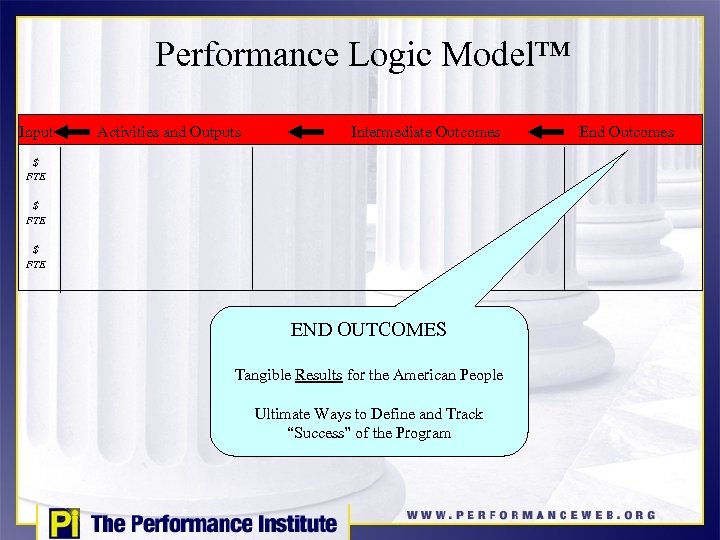
Performance Logic Model™ Input Activities and Outputs Intermediate Outcomes $ FTE END OUTCOMES Tangible Results for the American People Ultimate Ways to Define and Track “Success” of the Program End Outcomes
End Outcomes • What is the “bottomline” of your program? • How will you know you have been so successful that you can shut your program down? • If you had to defend your program’s value/benefit before a grand jury, what 2 -3 pieces of evidence would prove you were a success rather than a failure? • What is the end benefit to the taxpayer or society from your program?
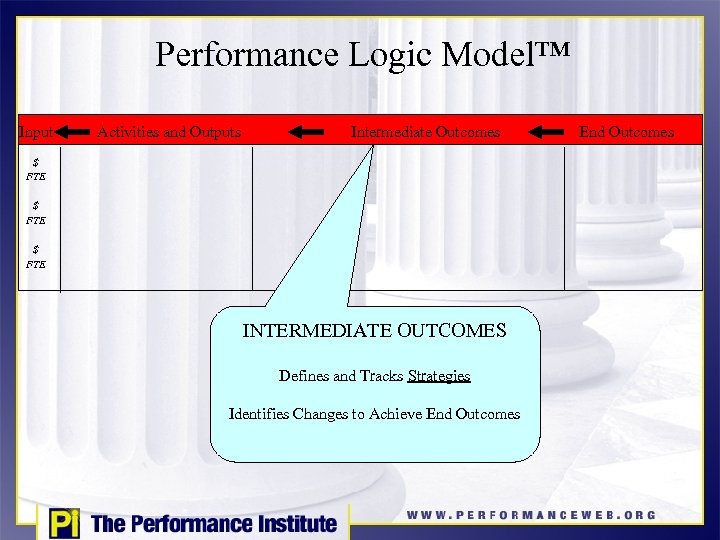
Performance Logic Model™ Input Activities and Outputs Intermediate Outcomes $ FTE INTERMEDIATE OUTCOMES Defines and Tracks Strategies Identifies Changes to Achieve End Outcomes
Intermediate Outcomes Given the end outcomes you seek… • What must change in the status quo to create the conditions necessary for goal attainment? Who are the targets of change and what must they do? • What causes the outcomes NOT to be achieved? • What are your strategies? • What must you influence? • Magic Wand: What are your wishes?
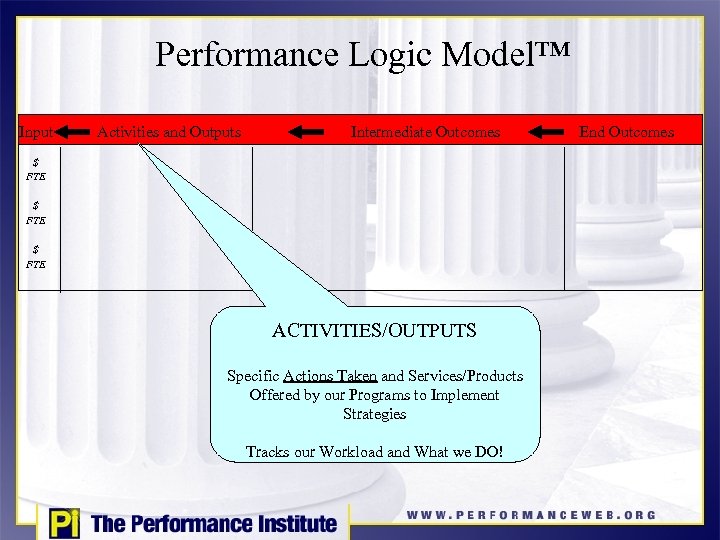
Performance Logic Model™ Input Activities and Outputs Intermediate Outcomes $ FTE ACTIVITIES/OUTPUTS Specific Actions Taken and Services/Products Offered by our Programs to Implement Strategies Tracks our Workload and What we DO! End Outcomes
Program Outputs For each intermediate outcome… • What specific things can this agency do to cause that change to happen? …to influence that target to change? • What products could you produce? • What services could you provide? • What is the actual workload that is to be handled? (Note: Don’t include administrative items inside your program. Think of what things actually leave the four walls of your program. )
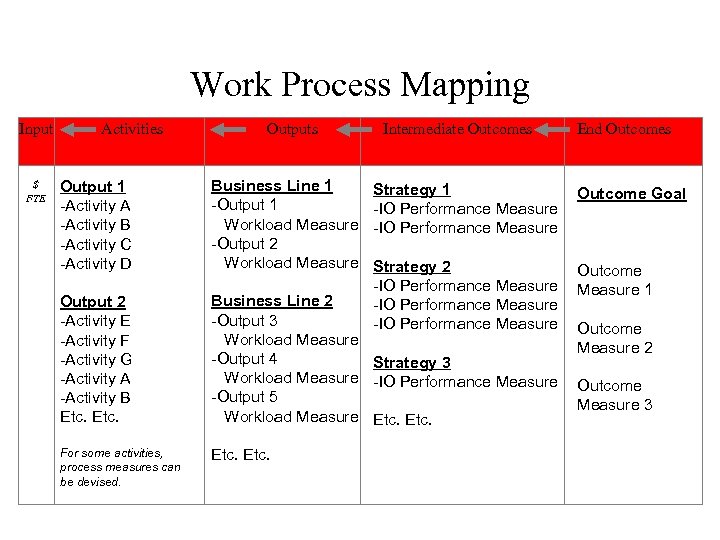
Work Process Mapping Input $ FTE Activities Outputs Intermediate Outcomes Output 1 -Activity A -Activity B -Activity C -Activity D Business Line 1 -Output 1 Workload Measure -Output 2 Workload Measure Output 2 -Activity E -Activity F -Activity G -Activity A -Activity B Etc. Business Line 2 -Output 3 Workload Measure -Output 4 Strategy 3 Workload Measure -IO Performance Measure -Output 5 Workload Measure Etc. For some activities, process measures can be devised. Etc. End Outcomes Strategy 1 -IO Performance Measure Outcome Goal Strategy 2 -IO Performance Measure Outcome Measure 1 Outcome Measure 2 Outcome Measure 3
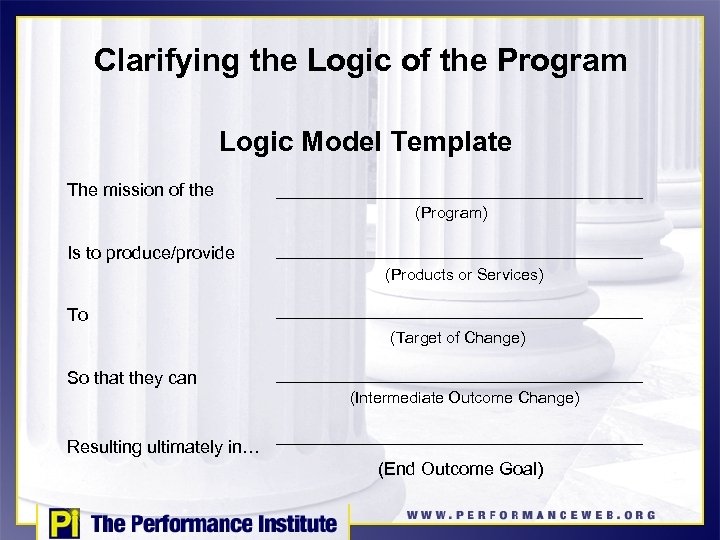
Clarifying the Logic of the Program Logic Model Template The mission of the (Program) Is to produce/provide (Products or Services) To (Target of Change) So that they can (Intermediate Outcome Change) Resulting ultimately in… (End Outcome Goal)
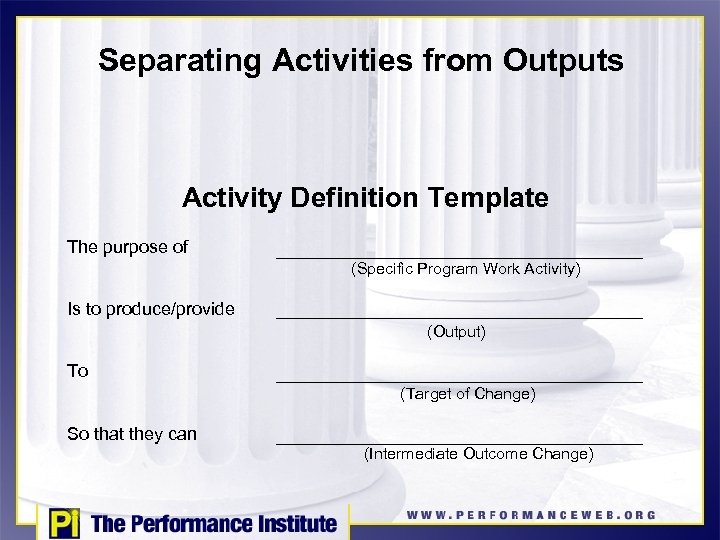
Separating Activities from Outputs Activity Definition Template The purpose of (Specific Program Work Activity) Is to produce/provide (Output) To (Target of Change) So that they can (Intermediate Outcome Change)
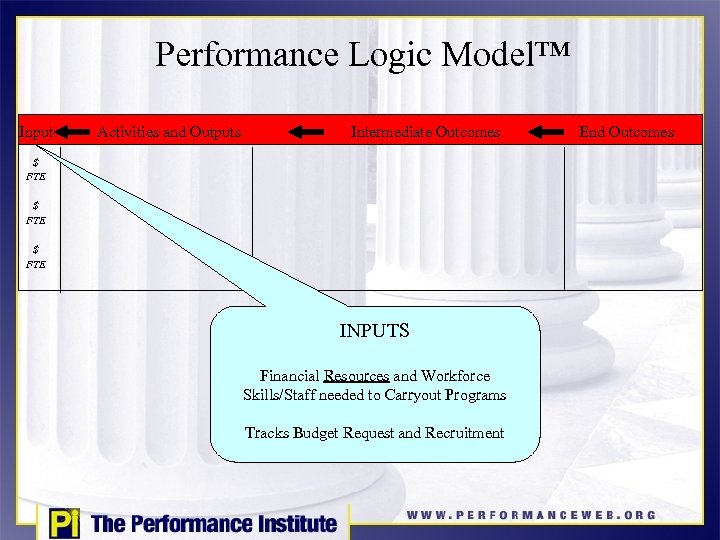
Performance Logic Model™ Input Activities and Outputs Intermediate Outcomes $ FTE INPUTS Financial Resources and Workforce Skills/Staff needed to Carryout Programs Tracks Budget Request and Recruitment End Outcomes
Step 5: Develop SOW/SOO • Statement of Work (SOW) – Outputs are clear and agency wants to purchase specific outputs – Performance incentives tied to cost, timeliness, quality and impact of outputs – Narrow and limiting to the contractor • Statement of Objective (SOO) – Agency defines results to be achieved, and solicits a wide variety of technical solutions from contractors – Outputs are not pre-determined by the agency – Performance incentives tied to achievement of performance results (impact of outputs) and may include cost, timeliness, quality and impact of outputs associated with contractor’s technical solution – Provides maximum flexibility to contractor on what work is to be done; provides room for innovation
Step 6: Select the Contractor • • Develop source selection criteria (traditional) Emphasize best-value approach Cast wide net for maximum competition Emphasize past performance based on your criteria • Examine conflicts-of-interest • Examine financial stability (particularly with shift away from fee-for-service) • Don’t be afraid to re-compete if ideal solution not submitted!!
Step 7: Manage and Monitor Performance • • Management starts with the incentives structure Maintain team-based management approach to PBC after award Develop capacity for collecting and analyzing performance information on contracts Establish mechanisms for validity and verification checks on performance information Manage change: Kick-off meeting, transition period, and roll-out Benchmark and compare…continually push for improvements Exercise “corrective” mechanisms when performance is off track Report contractor's performance regularly
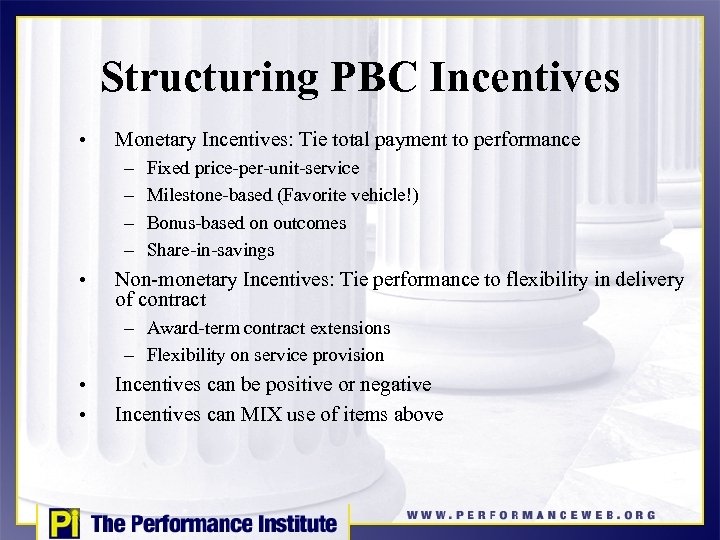
Structuring PBC Incentives • Monetary Incentives: Tie total payment to performance – – • Fixed price-per-unit-service Milestone-based (Favorite vehicle!) Bonus-based on outcomes Share-in-savings Non-monetary Incentives: Tie performance to flexibility in delivery of contract – Award-term contract extensions – Flexibility on service provision • • Incentives can be positive or negative Incentives can MIX use of items above
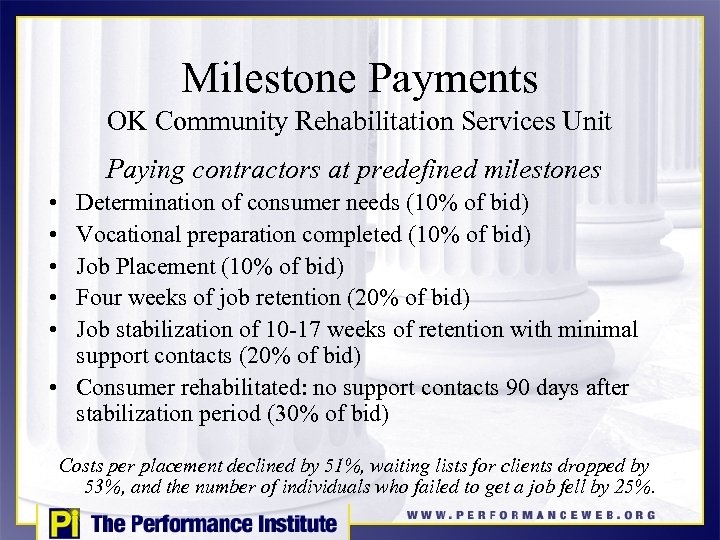
Milestone Payments OK Community Rehabilitation Services Unit Paying contractors at predefined milestones • • • Determination of consumer needs (10% of bid) Vocational preparation completed (10% of bid) Job Placement (10% of bid) Four weeks of job retention (20% of bid) Job stabilization of 10 -17 weeks of retention with minimal support contacts (20% of bid) • Consumer rehabilitated: no support contacts 90 days after stabilization period (30% of bid) Costs per placement declined by 51%, waiting lists for clients dropped by 53%, and the number of individuals who failed to get a job fell by 25%.
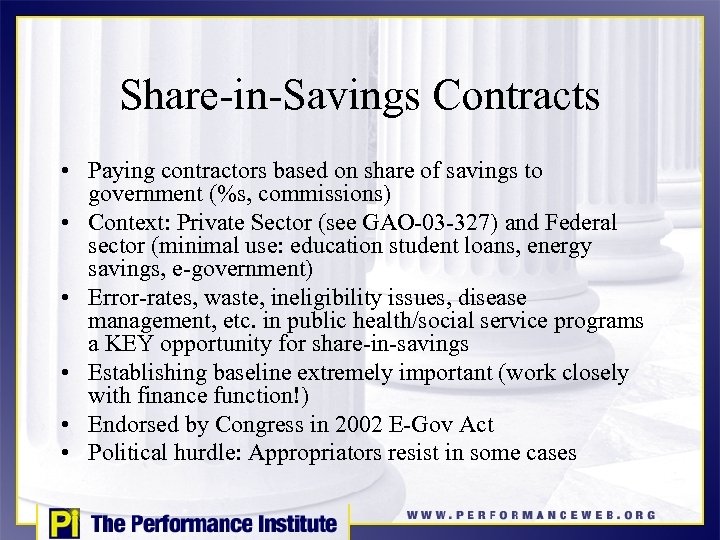
Share-in-Savings Contracts • Paying contractors based on share of savings to government (%s, commissions) • Context: Private Sector (see GAO-03 -327) and Federal sector (minimal use: education student loans, energy savings, e-government) • Error-rates, waste, ineligibility issues, disease management, etc. in public health/social service programs a KEY opportunity for share-in-savings • Establishing baseline extremely important (work closely with finance function!) • Endorsed by Congress in 2002 E-Gov Act • Political hurdle: Appropriators resist in some cases

PBC Application Exercises
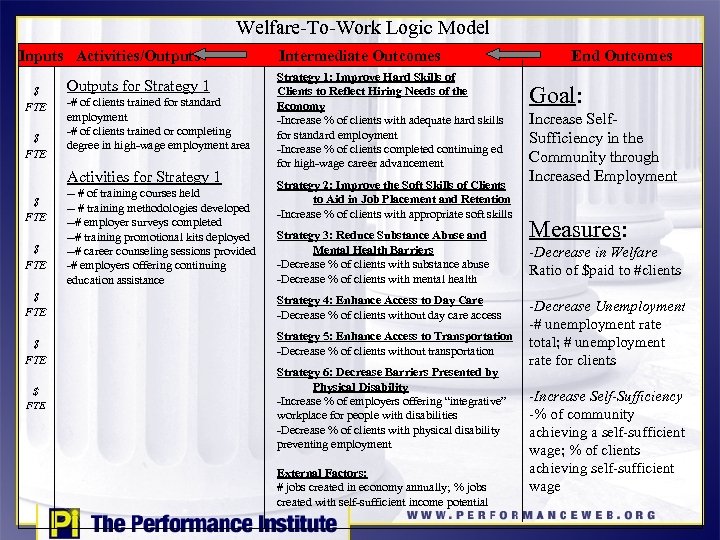
Welfare-To-Work Logic Model Inputs Activities/Outputs $ FTE Outputs for Strategy 1 -# of clients trained for standard employment -# of clients trained or completing degree in high-wage employment area Activities for Strategy 1 $ FTE $ FTE -- # of training courses held -- # training methodologies developed --# employer surveys completed --# training promotional kits deployed --# career counseling sessions provided -# employers offering continuing education assistance Intermediate Outcomes Strategy 1: Improve Hard Skills of Clients to Reflect Hiring Needs of the Economy -Increase % of clients with adequate hard skills for standard employment -Increase % of clients completed continuing ed for high-wage career advancement Strategy 2: Improve the Soft Skills of Clients to Aid in Job Placement and Retention -Increase % of clients with appropriate soft skills Strategy 3: Reduce Substance Abuse and Mental Health Barriers -Decrease % of clients with substance abuse -Decrease % of clients with mental health Strategy 4: Enhance Access to Day Care -Decrease % of clients without day care access Strategy 5: Enhance Access to Transportation -Decrease % of clients without transportation Strategy 6: Decrease Barriers Presented by Physical Disability -Increase % of employers offering “integrative” workplace for people with disabilities -Decrease % of clients with physical disability preventing employment External Factors: # jobs created in economy annually; % jobs created with self-sufficient income potential End Outcomes Goal: Increase Self. Sufficiency in the Community through Increased Employment Measures: -Decrease in Welfare Ratio of $paid to #clients -Decrease Unemployment -# unemployment rate total; # unemployment rate for clients -Increase Self-Sufficiency -% of community achieving a self-sufficient wage; % of clients achieving self-sufficient wage
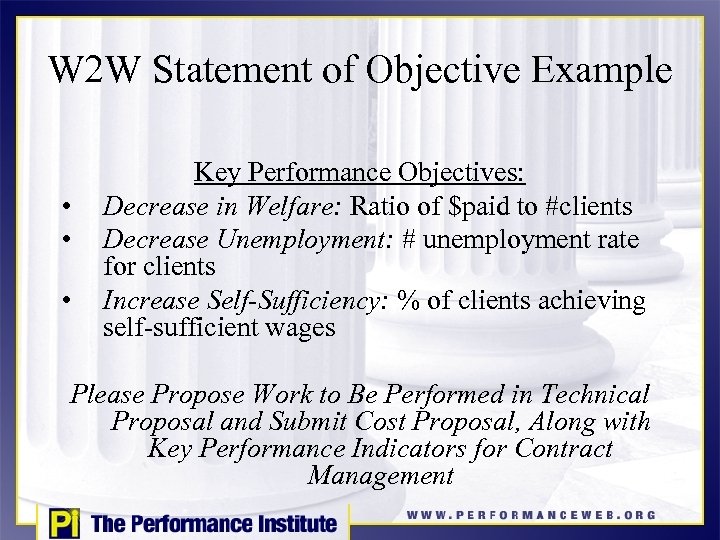
W 2 W Statement of Objective Example • • • Key Performance Objectives: Decrease in Welfare: Ratio of $paid to #clients Decrease Unemployment: # unemployment rate for clients Increase Self-Sufficiency: % of clients achieving self-sufficient wages Please Propose Work to Be Performed in Technical Proposal and Submit Cost Proposal, Along with Key Performance Indicators for Contract Management
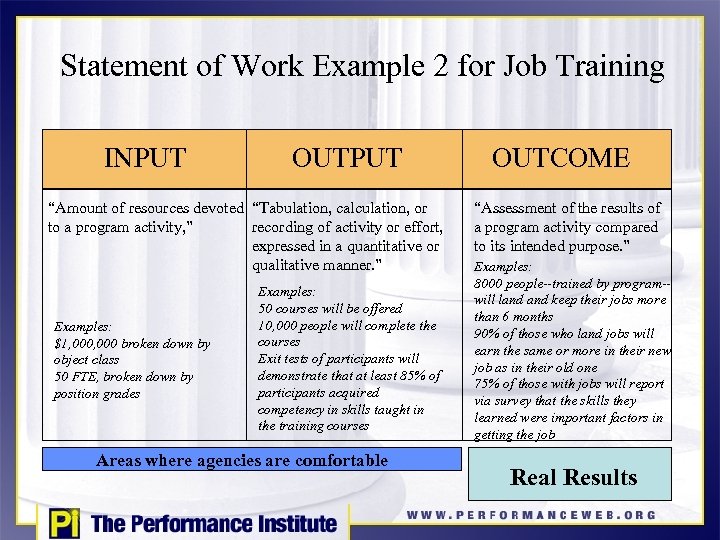
Statement of Work Example 2 for Job Training INPUT OUTPUT “Amount of resources devoted “Tabulation, calculation, or to a program activity, ” recording of activity or effort, expressed in a quantitative or qualitative manner. ” Examples: $1, 000 broken down by object class 50 FTE, broken down by position grades Examples: 50 courses will be offered 10, 000 people will complete the courses Exit tests of participants will demonstrate that at least 85% of participants acquired competency in skills taught in the training courses Areas where agencies are comfortable OUTCOME “Assessment of the results of a program activity compared to its intended purpose. ” Examples: 8000 people--trained by program-will land keep their jobs more than 6 months 90% of those who land jobs will earn the same or more in their new job as in their old one 75% of those with jobs will report via survey that the skills they learned were important factors in getting the job Real Results
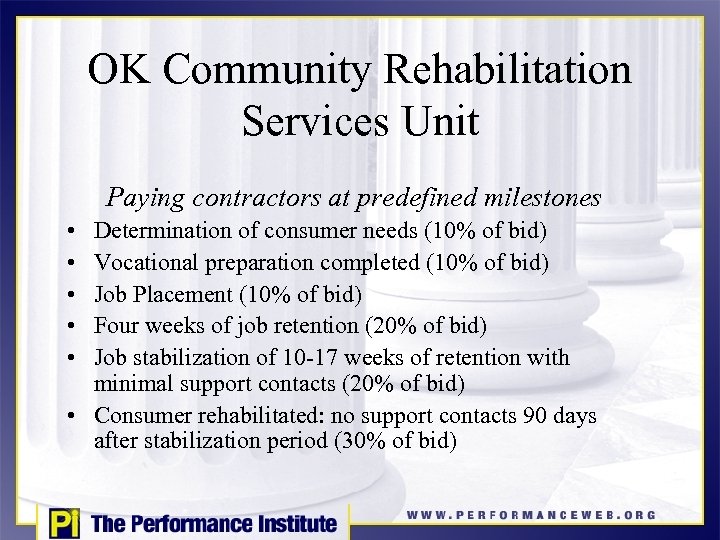
OK Community Rehabilitation Services Unit Paying contractors at predefined milestones • • • Determination of consumer needs (10% of bid) Vocational preparation completed (10% of bid) Job Placement (10% of bid) Four weeks of job retention (20% of bid) Job stabilization of 10 -17 weeks of retention with minimal support contacts (20% of bid) • Consumer rehabilitated: no support contacts 90 days after stabilization period (30% of bid)
Скачать презентацию Performance-based Contracting and Competitive Sourcing in Government Florida
4a5da48f4a46654e31c54cf5b0a8d5df.ppt