


 Скачать презентацию Performance and potential of thermal insulating shutters Roman
54de5e802bcf16c0c769d21e43433070.ppt
- Количество слайдов: 15
 Performance and potential of thermal insulating shutters Roman PARATSCHA Sustainable Constructions Depatment of Civil Engineering and Natural Hazards, University of Natural Ressources and Life Sciences, Vienna, roman. paratscha@boku. ac. at
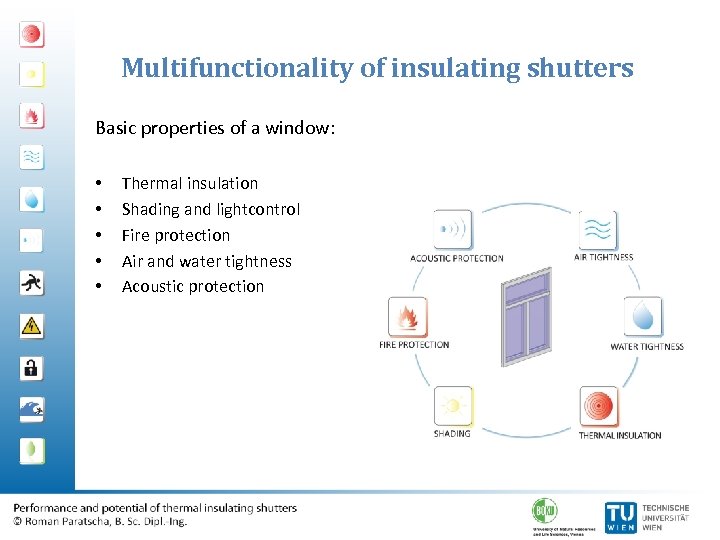 Multifunctionality of insulating shutters Basic properties of a window: • • • Thermal insulation Shading and lightcontrol Fire protection Air and water tightness Acoustic protection
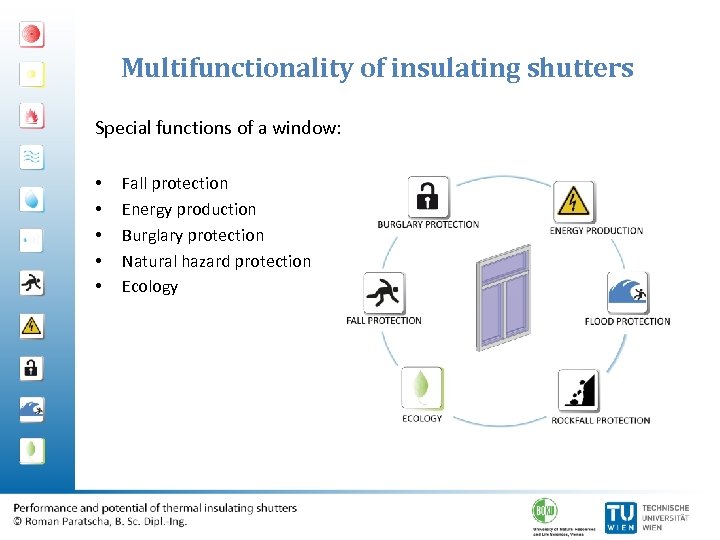 Multifunctionality of insulating shutters Special functions of a window: • • • Fall protection Energy production Burglary protection Natural hazard protection Ecology
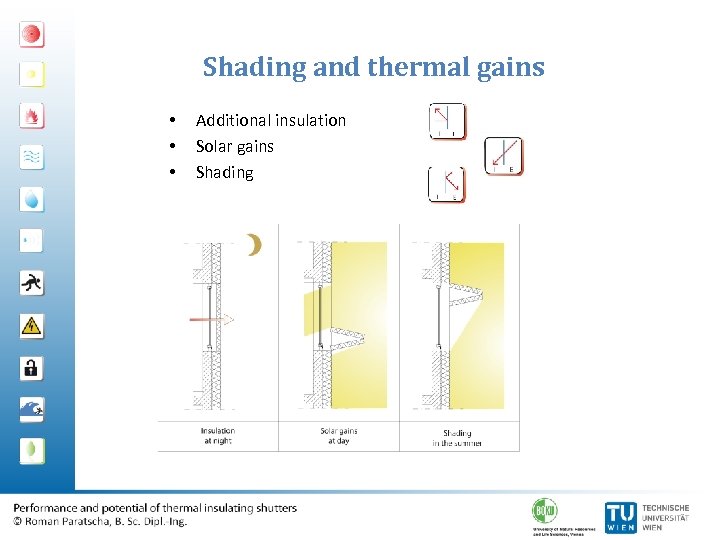 Shading and thermal gains • • • Additional insulation Solar gains Shading
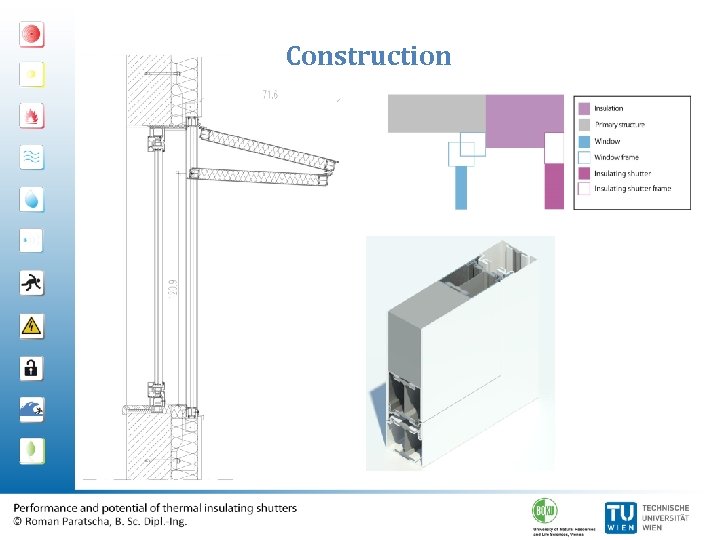 Construction
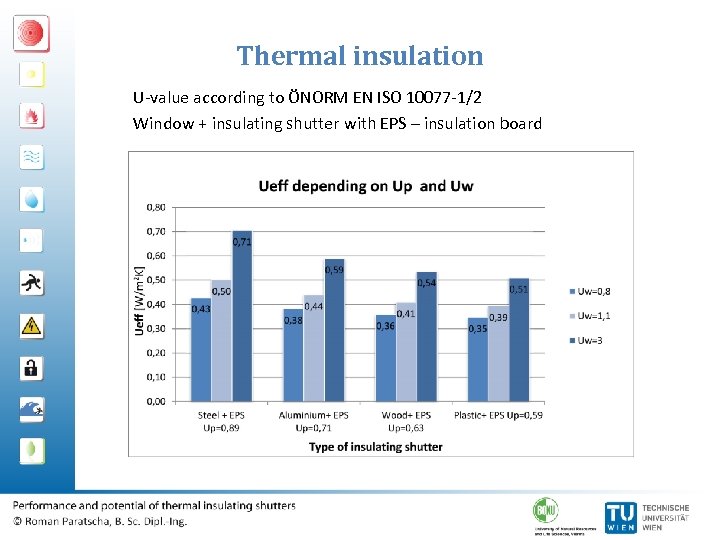 Thermal insulation U-value according to ÖNORM EN ISO 10077 -1/2 Window + insulating shutter with EPS – insulation board
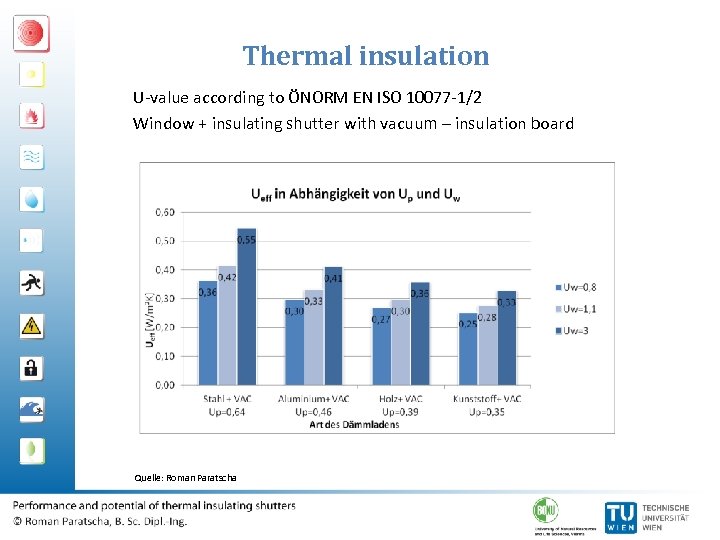 Thermal insulation U-value according to ÖNORM EN ISO 10077 -1/2 Window + insulating shutter with vacuum – insulation board Quelle: Roman Paratscha
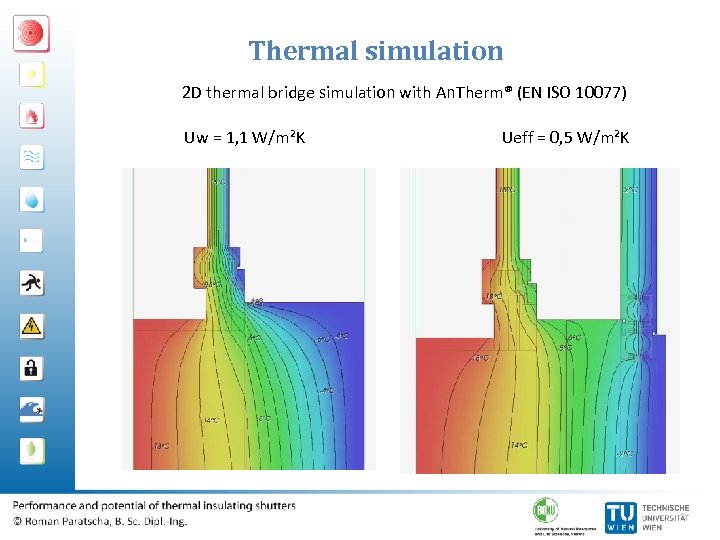 Thermal simulation 2 D thermal bridge simulation with An. Therm® (EN ISO 10077) Uw = 1, 1 W/m²K Ueff = 0, 5 W/m²K
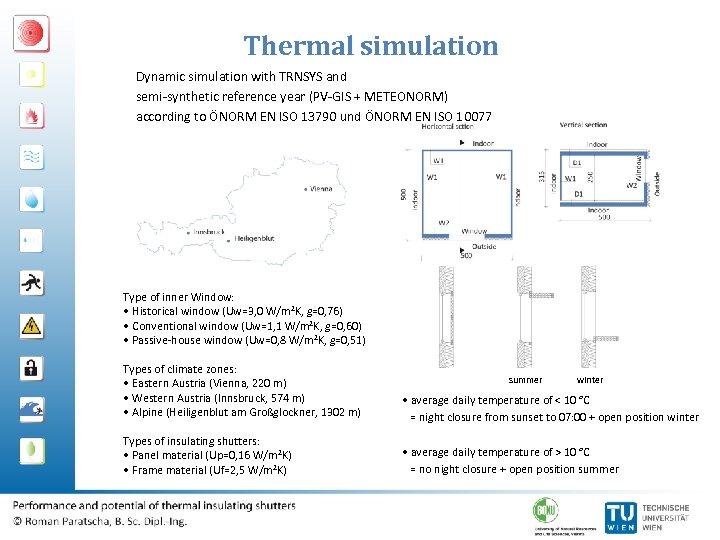 Thermal simulation Dynamic simulation with TRNSYS and semi-synthetic reference year (PV-GIS + METEONORM) according to ÖNORM EN ISO 13790 und ÖNORM EN ISO 10077 Type of inner Window: • Historical window (Uw=3, 0 W/m²K, g=0, 76) • Conventional window (Uw=1, 1 W/m²K, g=0, 60) • Passive-house window (Uw=0, 8 W/m²K, g=0, 51) Types of climate zones: • Eastern Austria (Vienna, 220 m) • Western Austria (Innsbruck, 574 m) • Alpine (Heiligenblut am Großglockner, 1302 m) • average daily temperature of < 10 °C = night closure from sunset to 07: 00 + open position winter Types of insulating shutters: • Panel material (Up=0, 16 W/m²K) • Frame material (Uf=2, 5 W/m²K) • average daily temperature of > 10 °C = no night closure + open position summer winter
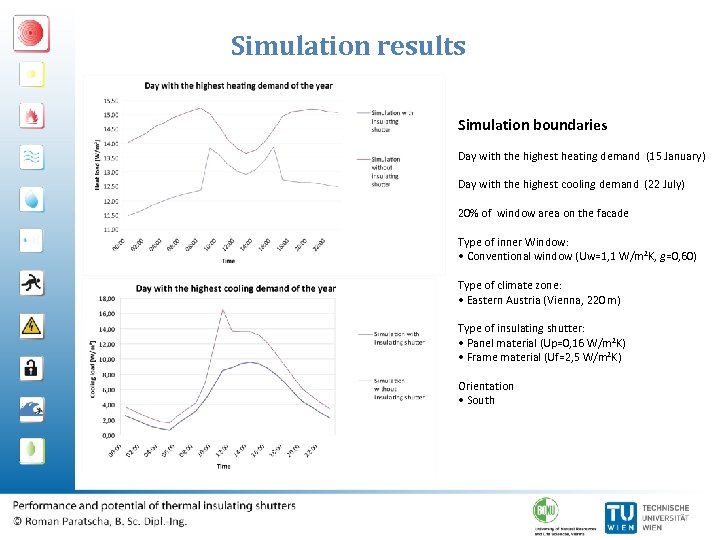 Simulation results Simulation boundaries Day with the highest heating demand (15 January) Day with the highest cooling demand (22 July) 20% of window area on the facade Type of inner Window: • Conventional window (Uw=1, 1 W/m²K, g=0, 60) Type of climate zone: • Eastern Austria (Vienna, 220 m) Type of insulating shutter: • Panel material (Up=0, 16 W/m²K) • Frame material (Uf=2, 5 W/m²K) Orientation • South
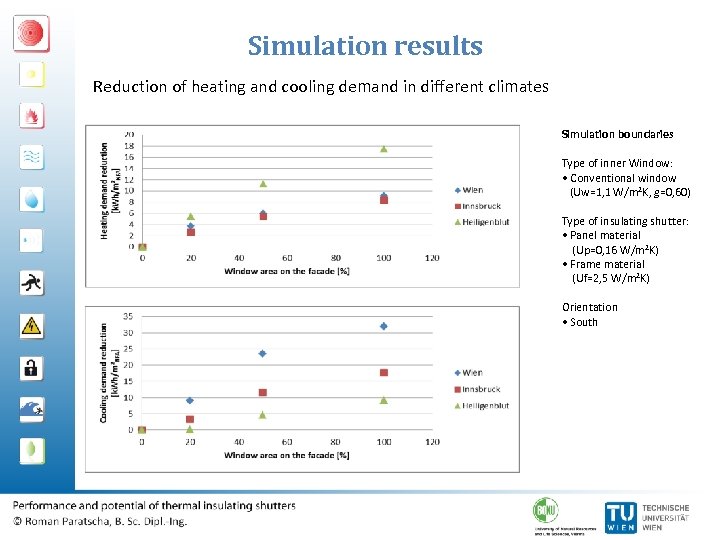 Simulation results Reduction of heating and cooling demand in different climates Simulation boundaries Type of inner Window: • Conventional window (Uw=1, 1 W/m²K, g=0, 60) Type of insulating shutter: • Panel material (Up=0, 16 W/m²K) • Frame material (Uf=2, 5 W/m²K) Orientation • South
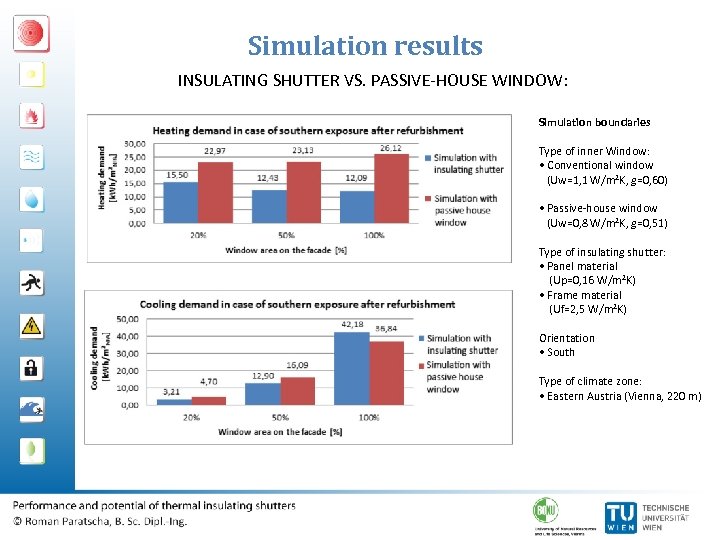 Simulation results INSULATING SHUTTER VS. PASSIVE-HOUSE WINDOW: Simulation boundaries Type of inner Window: • Conventional window (Uw=1, 1 W/m²K, g=0, 60) • Passive-house window (Uw=0, 8 W/m²K, g=0, 51) Type of insulating shutter: • Panel material (Up=0, 16 W/m²K) • Frame material (Uf=2, 5 W/m²K) Orientation • South Type of climate zone: • Eastern Austria (Vienna, 220 m)
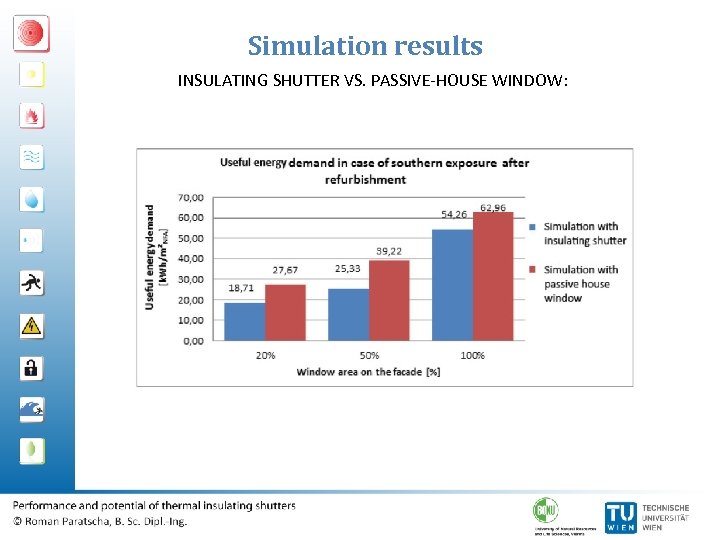 Simulation results INSULATING SHUTTER VS. PASSIVE-HOUSE WINDOW:
 Conclusion • Depending on the quality of the inner window, an improvement of the U-value between 50 % and 80 % can be achieved. • It can be said that an apartment with insulating shutter combination in Vienna is always accounting better for around 10 k. Wh/m²NFA then a apartment with passive house window. • The addition of an insulating shutter is quite an alternative to window replacement. • Optimization through improved control of insulating shutters is quite possible.
 Thank you for your attention