


 Скачать презентацию Perfect Competition n Review of Perfect Competition l
60aa69a7eee92e2c12e2705d143cd28b.ppt
- Количество слайдов: 21
 Perfect Competition n Review of Perfect Competition l P = LMC = LRAC l Normal profits or zero economic profits in the long run l Large number of buyers and sellers l Homogenous product l Perfect information l Firm is a price taker Chapter 10 1
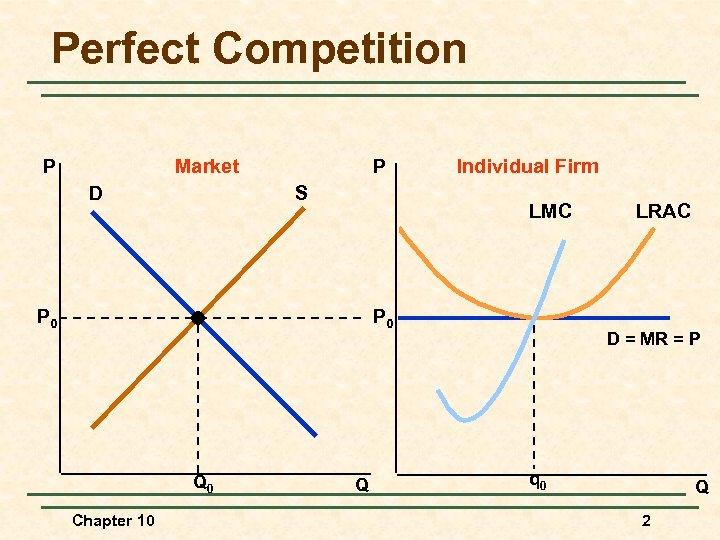 Perfect Competition Market P D P S Individual Firm LMC P 0 Q 0 Chapter 10 Q LRAC D = MR = P q 0 Q 2
 Monopoly n Monopoly 1) One seller - many buyers 2) One product (no good substitutes) 3) Barriers to entry n The monopolist is the supply-side of the market and has complete control over what is offered for sale. n Profits will be maximized at the level of output where marginal revenue equals marginal cost. Chapter 10 3
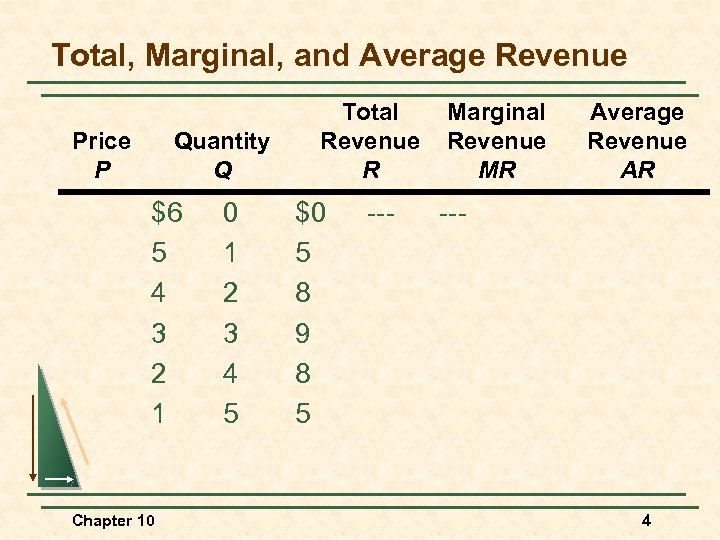 Total, Marginal, and Average Revenue Price P Quantity Q $6 5 4 3 2 1 Chapter 10 0 1 2 3 4 5 Total Revenue R $0 5 8 9 8 5 --- Marginal Revenue MR Average Revenue AR --- 4
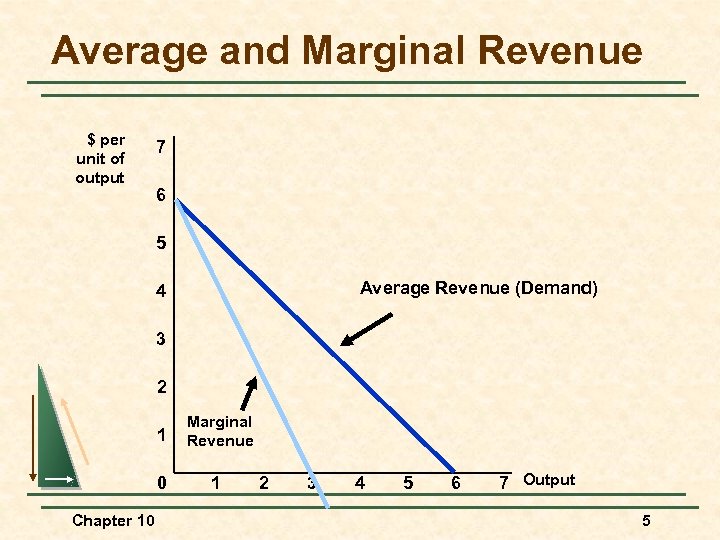 Average and Marginal Revenue $ per unit of output 7 6 5 Average Revenue (Demand) 4 3 2 1 0 Chapter 10 Marginal Revenue 1 2 3 4 5 6 7 Output 5
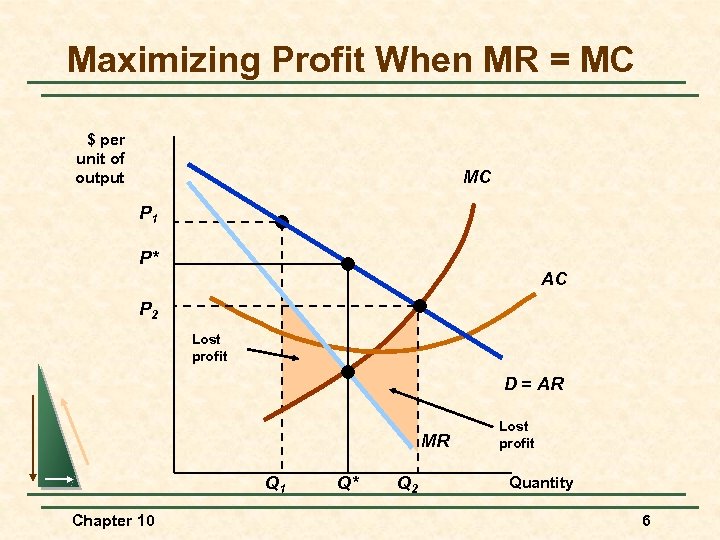 Maximizing Profit When MR = MC $ per unit of output MC P 1 P* AC P 2 Lost profit D = AR MR Q 1 Chapter 10 Q* Q 2 Lost profit Quantity 6
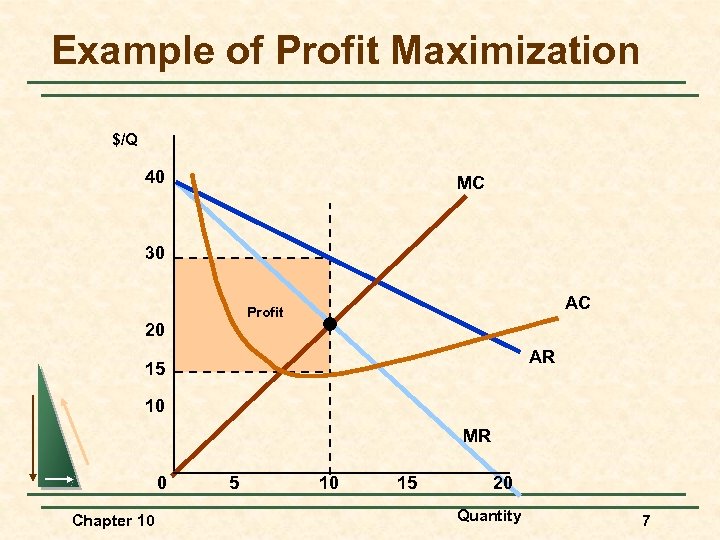 Example of Profit Maximization $/Q 40 MC 30 AC Profit 20 AR 15 10 MR 0 Chapter 10 5 10 15 20 Quantity 7
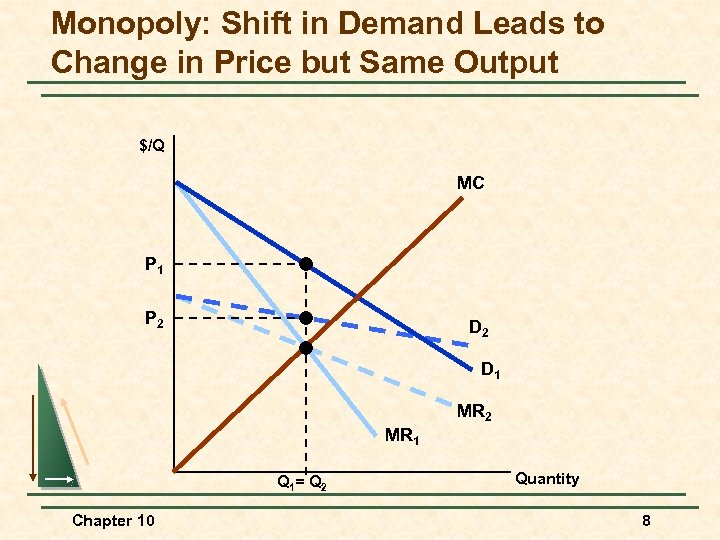 Monopoly: Shift in Demand Leads to Change in Price but Same Output $/Q MC P 1 P 2 D 1 MR 2 MR 1 Q 1= Q 2 Chapter 10 Quantity 8
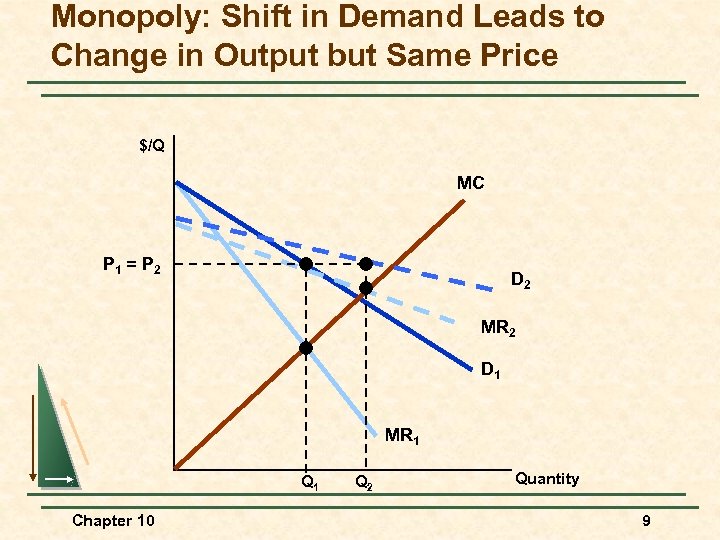 Monopoly: Shift in Demand Leads to Change in Output but Same Price $/Q MC P 1 = P 2 D 2 MR 2 D 1 MR 1 Q 1 Chapter 10 Q 2 Quantity 9
 Monopoly n Observations l Shifts in demand usually cause a change in both price and quantity. l A monopolistic market has no supply curve. l Monopolist may supply many different quantities at the same price. l Monopolist may supply the same quantity at different prices. Chapter 10 10
 Measuring Monopoly Power n Monopoly is rare. However, a market with several firms, each facing a downward sloping demand curve will produce so that price exceeds marginal cost. n In perfect competition: P = MR = MC n Monopoly power: P > MC Chapter 10 11
 Measuring Monopoly Power n Lerner’s Index of Monopoly Power l l n L = (P - MC)/P, where the larger the value of L (between 0 and 1) the greater the degree of monopoly power. L = (P - MC)/P = -1/Ed, where Ed is elasticity of demand for a firm Monopoly power does not guarantee profits. Profit depends on average cost relative to price. Chapter 10 12
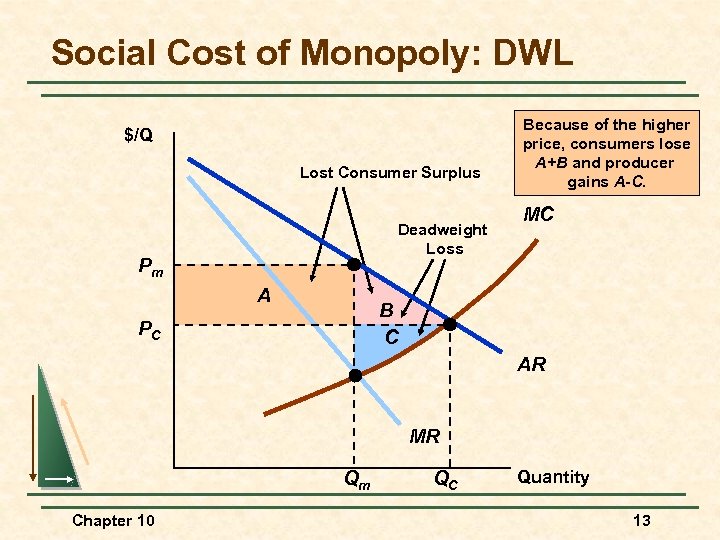 Social Cost of Monopoly: DWL $/Q Lost Consumer Surplus Deadweight Loss Pm A Because of the higher price, consumers lose A+B and producer gains A-C. MC B C PC AR MR Qm Chapter 10 QC Quantity 13
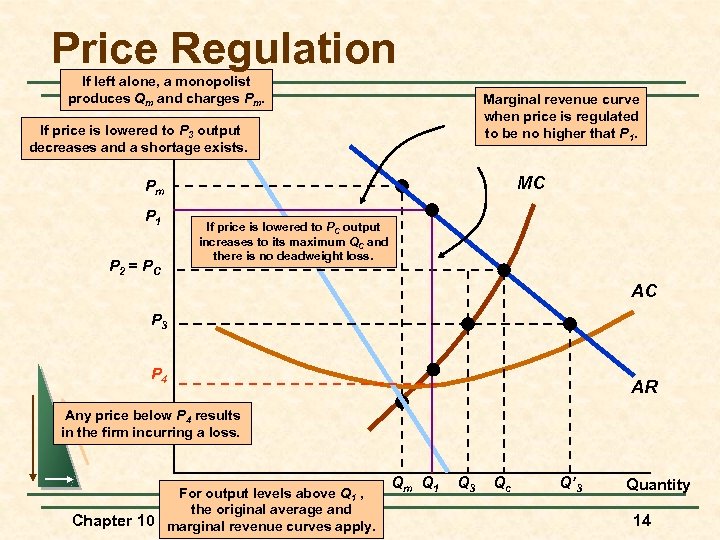 Price Regulation If left alone, a monopolist produces Qm and charges Pm. Marginal revenue curve when price is regulated to be no higher that P 1. If price is lowered to P 3 output $/Q decreases and a shortage exists. MR MC Pm P 1 P 2 = P C If price is lowered to PC output increases to its maximum QC and there is no deadweight loss. AC P 3 P 4 AR Any price below P 4 results in the firm incurring a loss. For output levels above Q 1 , the original average and Chapter 10 marginal revenue curves apply. Qm Q 1 Q 3 Qc Q’ 3 Quantity 14
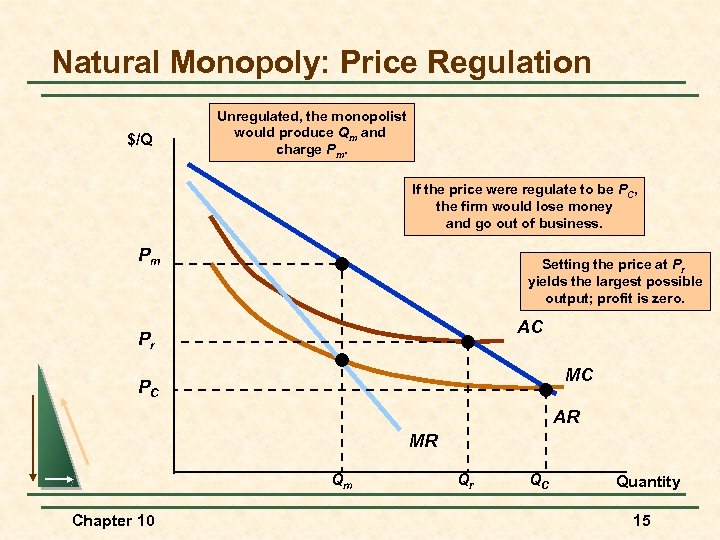 Natural Monopoly: Price Regulation $/Q Unregulated, the monopolist would produce Qm and charge Pm. If the price were regulate to be PC, the firm would lose money and go out of business. Pm Setting the price at Pr yields the largest possible output; profit is zero. AC Pr MC PC AR MR Qm Chapter 10 Qr QC Quantity 15
 Natural Monopoly: Regulation in Practice n Regulation in Practice l It is very difficult to estimate the firm's cost and demand functions because they change with evolving market conditions l An alternative pricing technique = rate-of-return regulation allows the firms to set a maximum price based on the expected rate or return that the firm will earn. l Using this technique requires hearings to arrive at the respective figures. Chapter 10 16
 Limiting Market Power: Antitrust Laws n Sherman Act (1890) l Section 1 prohibits contracts, combinations or conspiracies in restraint of trade l Explicit agreement to restrict output or fix prices l Implicit collusion through parallel conduct l Section 2 makes it illegal to monopolize or attempt to monopolize a market and prohibits conspiracies that result in monopolization. Chapter 10 17
 Limiting Market Power: Antitrust Laws Examples of Illegal Combinations n 1983: Six companies and six executives indicted for price of copper tubing n 1996: Archer Daniels Midland (ADM) pleaded guilty to price fixing for lysine - three sentenced to prison in 1999: Roche A. G. , BASF A. G. , Rhone. Poulenc and Takeda pleaded guilty to price fixing of vitamins - fined more than $1 billion. Chapter 10 18
 Limiting Market Power: Antitrust Laws n Clayton Act (1914) 1) Makes it unlawful to require a buyer or lessor not to buy from a competitor 2) Prohibits predatory pricing 3) Prohibits mergers and acquisitions if they “substantially lessen competition” or “tend to create a monopoly” n Robinson-Patman Act (1936): Prohibits price discrimination if it is likely to injure the competition Chapter 10 19
 Limiting Market Power: Antitrust Laws n Federal Trade Commission Act (1914, amended 1938, 1973, 1975) 1) Created the Federal Trade Commission (FTC) 2) Prohibitions against deceptive advertising, labeling, agreements with retailer to exclude competing brands Chapter 10 20
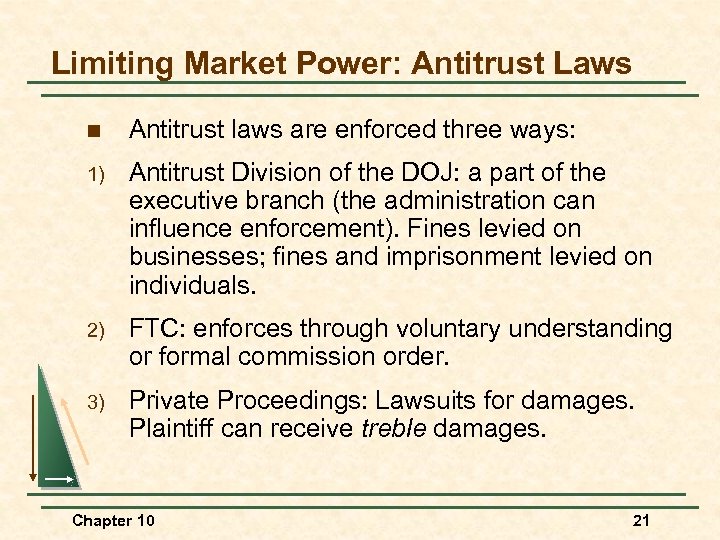 Limiting Market Power: Antitrust Laws n Antitrust laws are enforced three ways: 1) Antitrust Division of the DOJ: a part of the executive branch (the administration can influence enforcement). Fines levied on businesses; fines and imprisonment levied on individuals. 2) FTC: enforces through voluntary understanding or formal commission order. 3) Private Proceedings: Lawsuits for damages. Plaintiff can receive treble damages. Chapter 10 21