


 Скачать презентацию PEPPo a Proof-of-Principle Experiment Polarized Electrons for Polarized
3b6f59c4a36af4953f237f14a3a685d4.ppt
- Количество слайдов: 26
 PEPPo a Proof-of-Principle Experiment Polarized Electrons for Polarized Positrons A. Adeyemi 4, P. Aguilera 1, H. Areti 1, M. Baylac 2, G. Bosson 2, A. Camsonne 1, L. Cardman 1, S. Covrig 1, C. Cuevas 1, O. Dadoun 3, J. Dumas 1, 2, E. Fanchini 2, T. Forest 5, E. Forman 1, A. Freyberger 1, S. Golge 6, J. Grames 1, P. Guèye 4, C. Hyde 7, Y. Kim 1, 5, J. -F. Muraz 2, M. Marton 2, M. Poelker 1, S. Setiniyaz 5, J. -S. Réal 2, R. Suleiman 1, A. Variola 3, E. Voutier 2 Jefferson Lab, Newport News, VA, USA 2 LPSC, Grenoble, France 3 LAL, Orsay, France 4 Hampton University, Hampton, VA, USA 5 Idaho State University & IAC, Pocatello, ID, USA 6 North Carolina University, Durham, NC, USA 7 Old Dominion University, Norfolk, VA, USA 1 PAC 38, Newport News, August 22 -26, 2011
 Objectives This proposal (PR 12 -11 -105) aims at a demonstration of a new technique for producing polarized positrons, and constitutes a first step towards the development of a polarized positron source for Physics experiments at JLab, and other potential applications. It follows PAC 35’s enthusiastic endorsement of LOI-10 -010 which noted that “Any accelerator facility, like JLab, using polarized electrons for its physics program would like an intense beam of polarized positrons. This Letter marks a proof of principle experiment that should become a full proposal. ” Newport News, August 22 -26, 2011 2/17
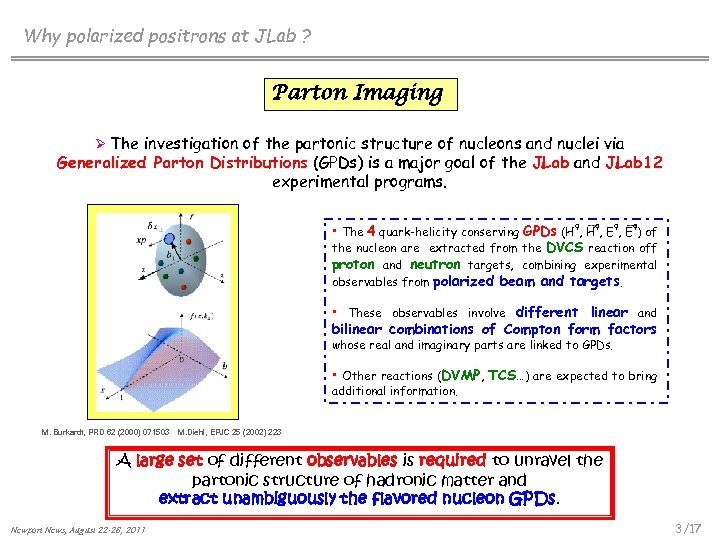 Why polarized positrons at JLab ? Parton Imaging Ø The investigation of the partonic structure of nucleons and nuclei via Generalized Parton Distributions (GPDs) is a major goal of the JLab and JLab 12 experimental programs. • The 4 quark-helicity conserving GPDs (Hq, Eq, Eq) of the nucleon are extracted from the DVCS reaction off proton and neutron targets, combining experimental observables from polarized beam and targets. • These observables involve different linear and bilinear combinations of Compton form factors whose real and imaginary parts are linked to GPDs. • Other reactions (DVMP, TCS…) are expected to bring additional information. M. Burkardt, PRD 62 (2000) 071503 M. Diehl, EPJC 25 (2002) 223 A large set of different observables is required to unravel the partonic structure of hadronic matter and extract unambiguously the flavored nucleon GPDs. Newport News, August 22 -26, 2011 3/17
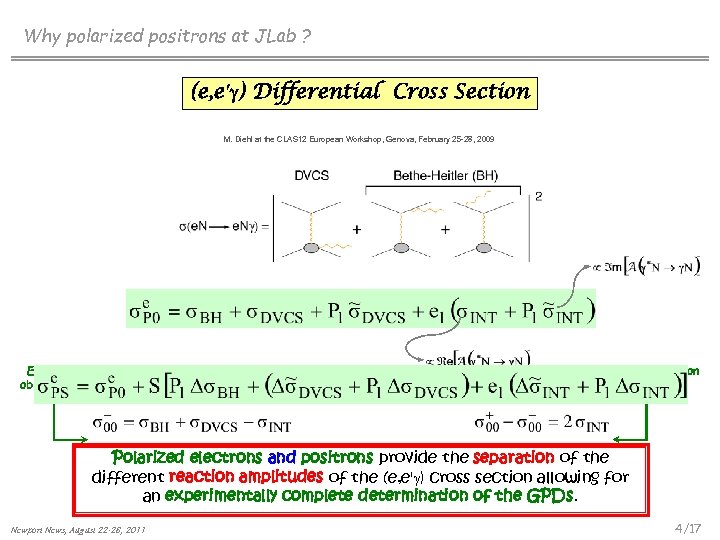 Why polarized positrons at JLab ? (e, e′g) Differential Cross Section M. Diehl at the CLAS 12 European Workshop, Genova, February 25 -28, 2009 Electron & positron observables Electron observables Polarized electrons and positrons provide the separation of the different reaction amplitudes of the (e, e'g) cross section allowing for an experimentally complete determination of the GPDs. Newport News, August 22 -26, 2011 4/17
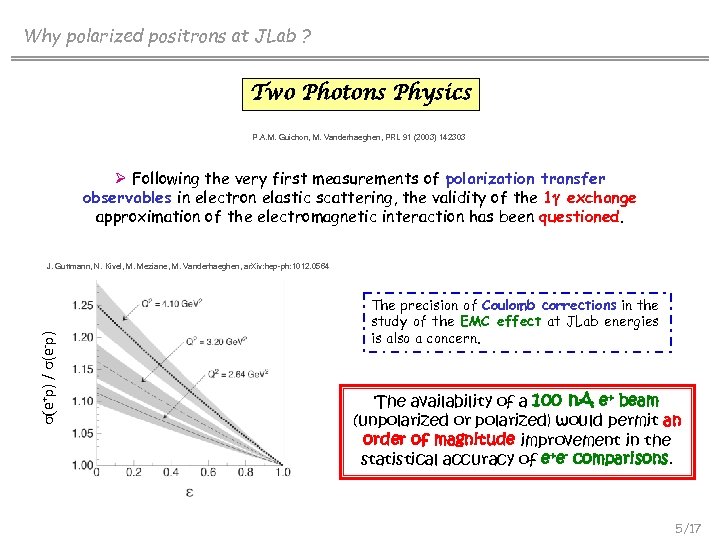 Why polarized positrons at JLab ? Two Photons Physics P. A. M. Guichon, M. Vanderhaeghen, PRL 91 (2003) 142303 Ø Following the very first measurements of polarization transfer observables in electron elastic scattering, the validity of the 1 g exchange approximation of the electromagnetic interaction has been questioned. s(e+p) / s(e-p) J. Guttmann, N. Kivel, M. Meziane, M. Vanderhaeghen, ar. Xiv: hep-ph: 1012. 0564 The precision of Coulomb corrections in the study of the EMC effect at JLab energies is also a concern. The availability of a 100 n. A e+ beam (unpolarized or polarized) would permit an order of magnitude improvement in the statistical accuracy of e+e- comparisons. 5/17
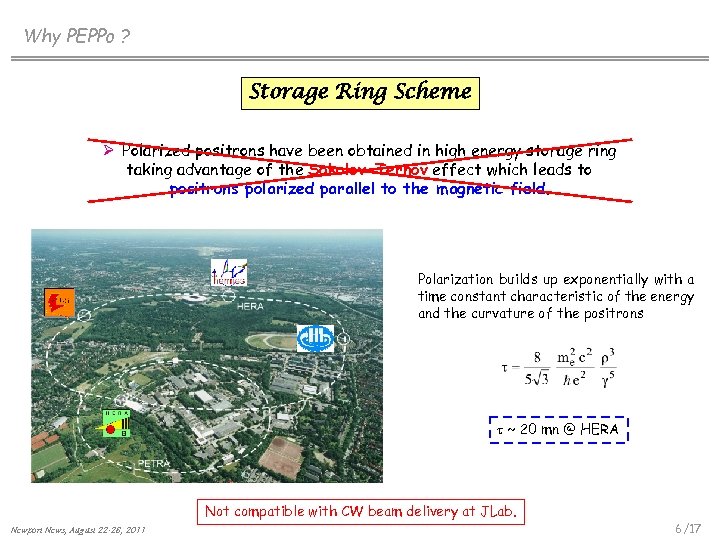 Why PEPPo ? Storage Ring Scheme Ø Polarized positrons have been obtained in high energy storage ring taking advantage of the Sokolov-Ternov effect which leads to positrons polarized parallel to the magnetic field. Polarization builds up exponentially with a time constant characteristic of the energy and the curvature of the positrons t ~ 20 mn @ HERA Not compatible with CW beam delivery at JLab. Newport News, August 22 -26, 2011 6/17
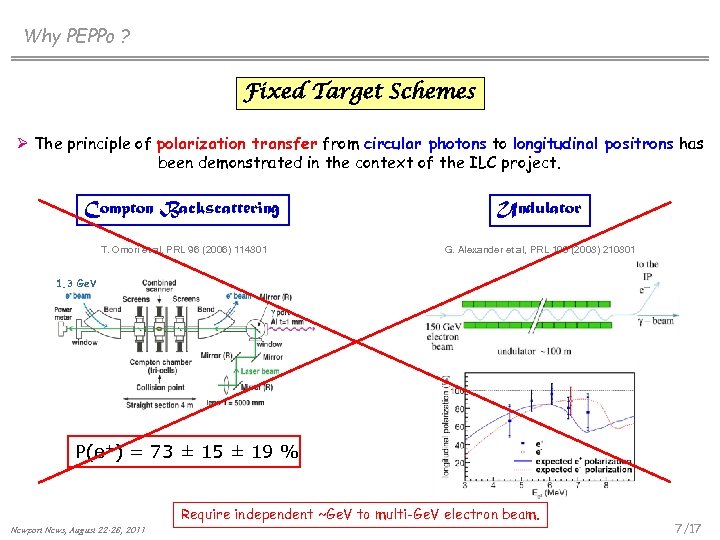 Why PEPPo ? Fixed Target Schemes Ø The principle of polarization transfer from circular photons to longitudinal positrons has been demonstrated in the context of the ILC project. Compton Backscattering Undulator T. Omori et al, PRL 96 (2006) 114801 G. Alexander et al, PRL 100 (2008) 210801 1. 3 Ge. V P(e+) = 73 ± 15 ± 19 % Require independent ~Ge. V to multi-Ge. V electron beam. Newport News, August 22 -26, 2011 7/17
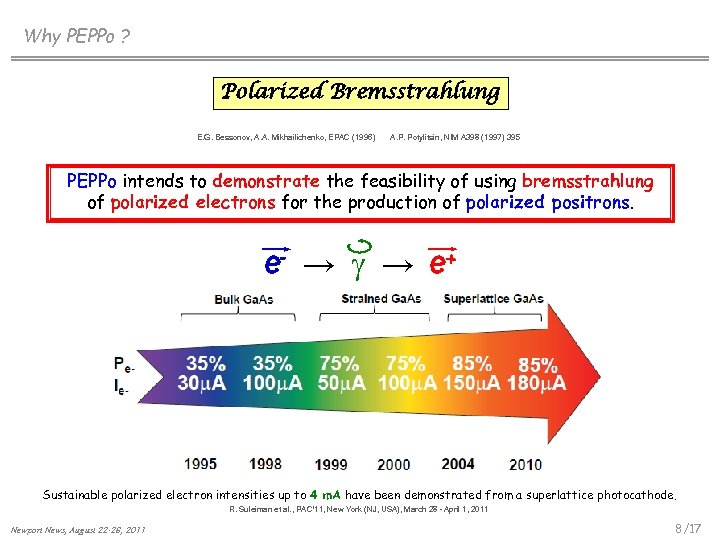 Why PEPPo ? Polarized Bremsstrahlung E. G. Bessonov, A. A. Mikhailichenko, EPAC (1996) A. P. Potylitsin, NIM A 398 (1997) 395 PEPPo intends to demonstrate the feasibility of using bremsstrahlung of polarized electrons for the production of polarized positrons. e- → g → e+ Sustainable polarized electron intensities up to 4 m. A have been demonstrated from a superlattice photocathode. R. Suleiman et al. , PAC’ 11, New York (NJ, USA), March 28 – April 1, 2011 Newport News, August 22 -26, 2011 8/17
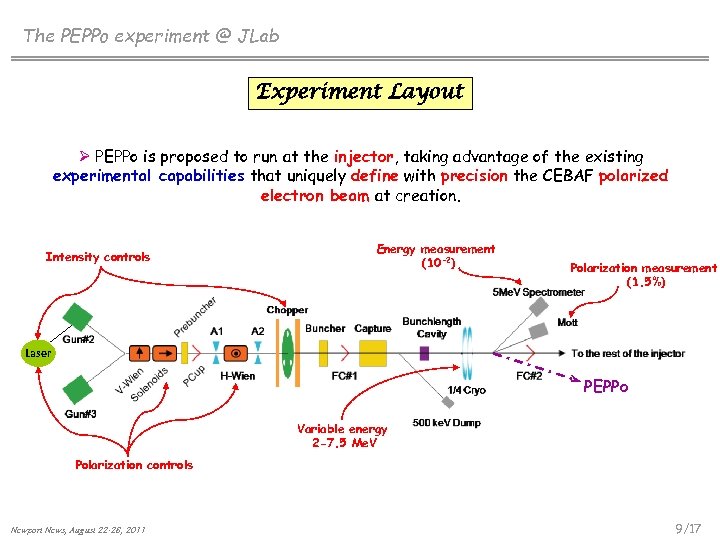 The PEPPo experiment @ JLab Experiment Layout Ø PEPPo is proposed to run at the injector, taking advantage of the existing experimental capabilities that uniquely define with precision the CEBAF polarized electron beam at creation. Intensity controls Energy measurement (10 -2) Polarization measurement (1. 5%) Laser PEPPo Variable energy 2 -7. 5 Me. V Polarization controls Newport News, August 22 -26, 2011 9/17
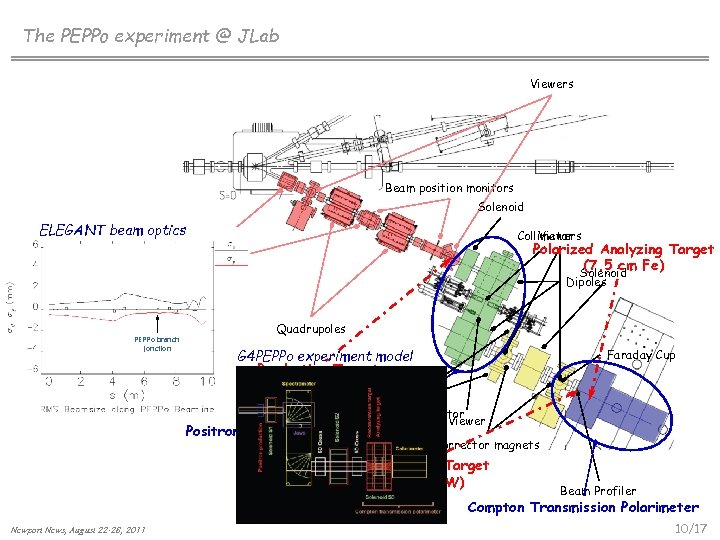 The PEPPo experiment @ JLab Viewers Beam position monitors Solenoid ELEGANT beam optics Viewers Collimator Polarized Analyzing Target (7. 5 cm Fe) Solenoid Dipoles Corrector magnets PEPPo branch jonction Quadrupoles G 4 PEPPo experiment model Production Target T 1 (0. 1 -1 mm W) Faraday Cup Annihilation detector Viewer Positron Selection Device Corrector magnets Reconversion Target T 2 (2 mm W) Beam Profiler Compton Transmission Polarimeter Newport News, August 22 -26, 2011 10/17
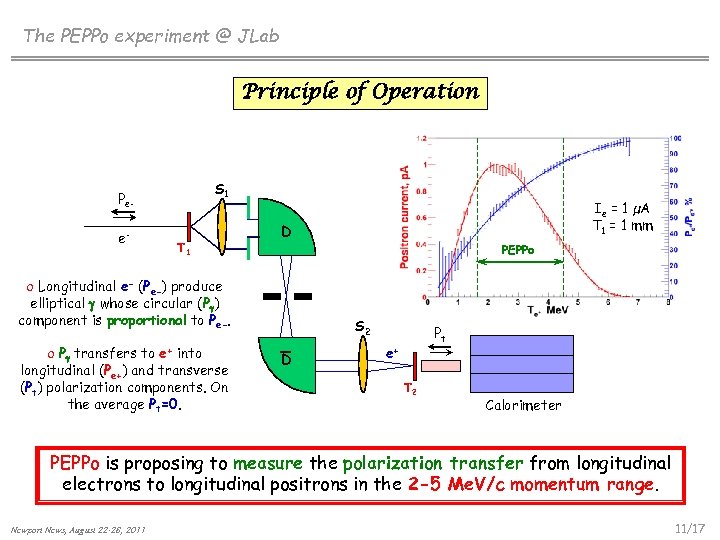 The PEPPo experiment @ JLab Principle of Operation S 1 Pee- T 1 D PEPPo o Longitudinal e- (Pe-) produce elliptical g whose circular (Pg) component is proportional to Pe-. o Pg transfers to e+ into longitudinal (Pe+) and transverse (Pt) polarization components. On the average Pt=0. Ie = 1 µA T 1 = 1 mm S 2 D Pt e+ T 2 Calorimeter PEPPo is proposing to measure the polarization transfer from longitudinal electrons to longitudinal positrons in the 2 -5 Me. V/c momentum range. Newport News, August 22 -26, 2011 11/17
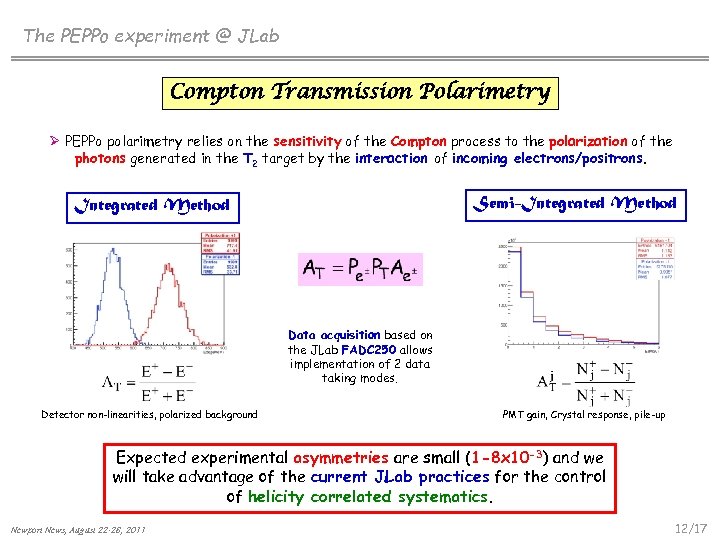 The PEPPo experiment @ JLab Compton Transmission Polarimetry Ø PEPPo polarimetry relies on the sensitivity of the Compton process to the polarization of the photons generated in the T 2 target by the interaction of incoming electrons/positrons. Semi-Integrated Method Data acquisition based on the JLab FADC 250 allows implementation of 2 data taking modes. Detector non-linearities, polarized background PMT gain, Crystal response, pile-up Expected experimental asymmetries are small (1 -8 х10 -3) and we will take advantage of the current JLab practices for the control of helicity correlated systematics. Newport News, August 22 -26, 2011 12/17
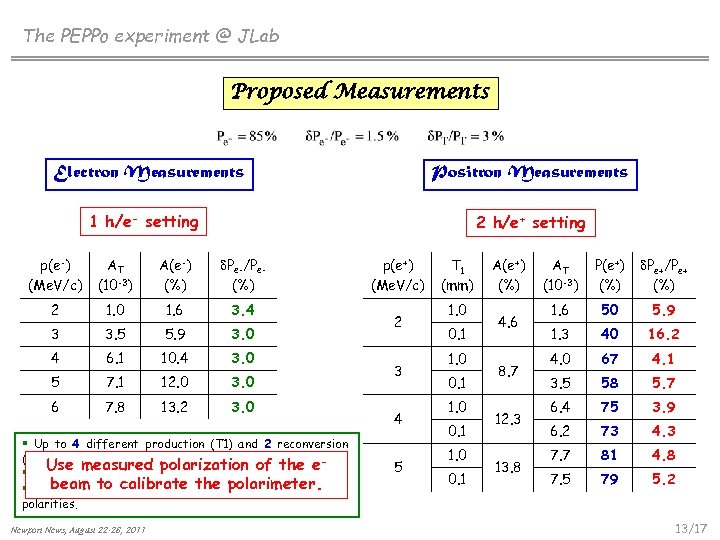 The PEPPo experiment @ JLab Proposed Measurements Electron Measurements Positron Measurements 1 h/e- setting 2 h/e+ setting p(e-) (Me. V/c) AT (10 -3) A(e-) (%) d. Pe-/Pe(%) 2 1. 0 1. 6 3. 4 3 3. 5 5. 9 3. 0 4 6. 1 10. 4 3. 0 5 7. 1 12. 0 3. 0 6 7. 8 13. 2 3. 0 § Up to 4 different production (T 1) and 2 reconversion (T 2) targets configurations will be measured. Use measured polarization of the e§ Background data will be acquired for each configuration. beam to calibrate the polarimeter. § Measurements will be done for + and - analyzing magnet polarities. Newport News, August 22 -26, 2011 p(e+) (Me. V/c) 2 3 4 5 T 1 (mm) 1. 0 0. 1 A(e+) (%) 4. 6 8. 7 12. 3 13. 8 AT (10 -3) P(e+) (%) d. Pe+/Pe+ (%) 1. 6 50 5. 9 1. 3 40 16. 2 4. 0 67 4. 1 3. 5 58 5. 7 6. 4 75 3. 9 6. 2 73 4. 3 7. 7 81 4. 8 7. 5 79 5. 2 13/17
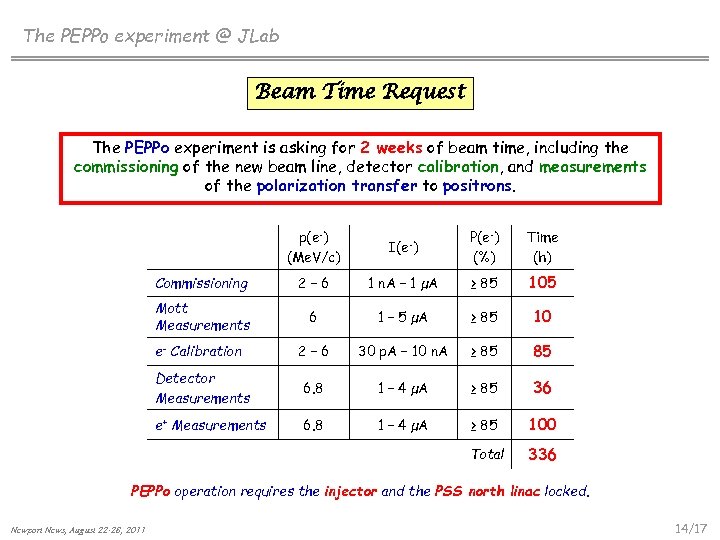 The PEPPo experiment @ JLab Beam Time Request The PEPPo experiment is asking for 2 weeks of beam time, including the commissioning of the new beam line, detector calibration, and measurements of the polarization transfer to positrons. p(e-) (Me. V/c) I(e-) P(e-) (%) Time (h) Commissioning 2– 6 1 n. A – 1 µA ≥ 85 105 Mott Measurements 6 1 – 5 µA ≥ 85 10 2– 6 30 p. A – 10 n. A ≥ 85 85 Detector Measurements 6. 8 1 – 4 µA ≥ 85 36 e+ Measurements 6. 8 1 – 4 µA ≥ 85 100 Total 336 e- Calibration PEPPo operation requires the injector and the PSS north linac locked. Newport News, August 22 -26, 2011 14/17
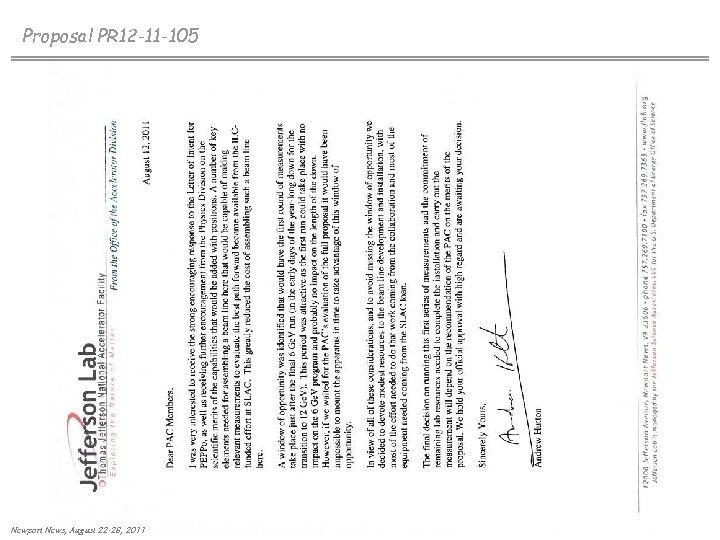
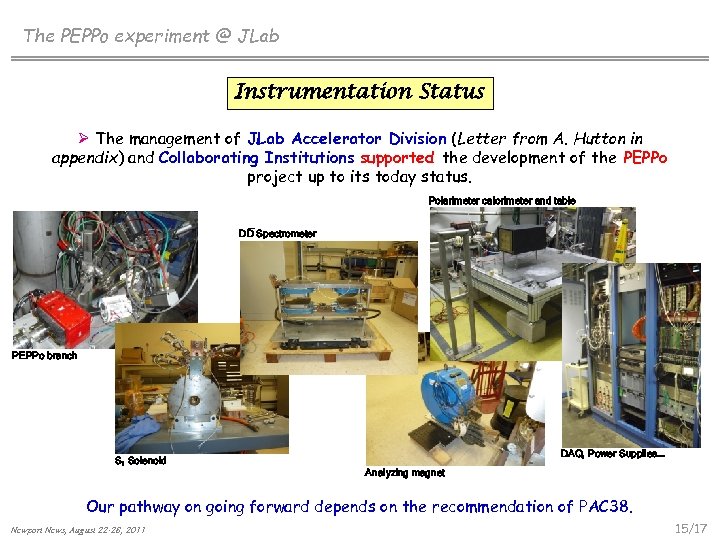 The PEPPo experiment @ JLab Instrumentation Status Ø The management of JLab Accelerator Division (Letter from A. Hutton in appendix) and Collaborating Institutions supported the development of the PEPPo project up to its today status. Polarimeter calorimeter and table DD Spectrometer PEPPo branch S 1 Solenoid DAQ, Power Supplies…. Analyzing magnet The Collaboration is in a great position to depends on the recommendation of PAC 38. 6 MSD. Our pathway on going forward finish PEPPo installation before the end of the Newport News, August 22 -26, 2011 15/17
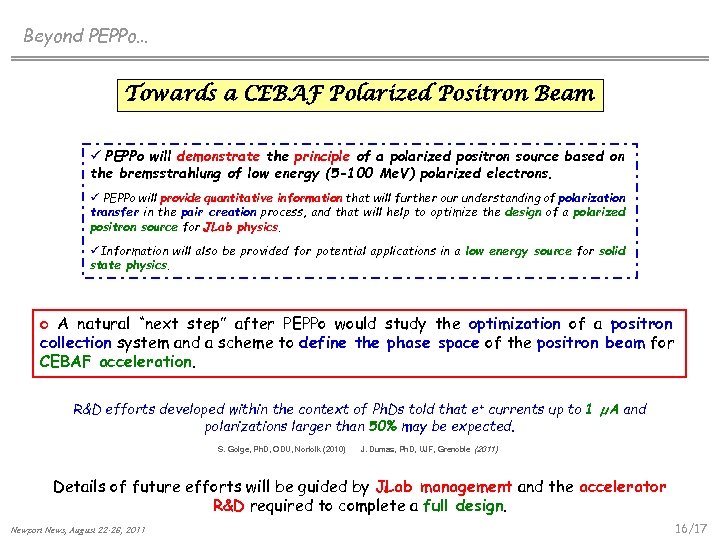 Beyond PEPPo… Towards a CEBAF Polarized Positron Beam ü PEPPo will demonstrate the principle of a polarized positron source based on the bremsstrahlung of low energy (5 -100 Me. V) polarized electrons. ü PEPPo will provide quantitative information that will further our understanding of polarization transfer in the pair creation process, and that will help to optimize the design of a polarized positron source for JLab physics. üInformation will also be provided for potential applications in a low energy source for solid state physics. o A natural “next step” after PEPPo would study the optimization of a positron collection system and a scheme to define the phase space of the positron beam for CEBAF acceleration. R&D efforts developed within the context of Ph. Ds told that e + currents up to 1 µA and polarizations larger than 50% may be expected. S. Golge, Ph. D, ODU, Norfolk (2010) J. Dumas, Ph. D, UJF, Grenoble (2011) Details of future efforts will be guided by JLab management and the accelerator R&D required to complete a full design. Newport News, August 22 -26, 2011 16/17
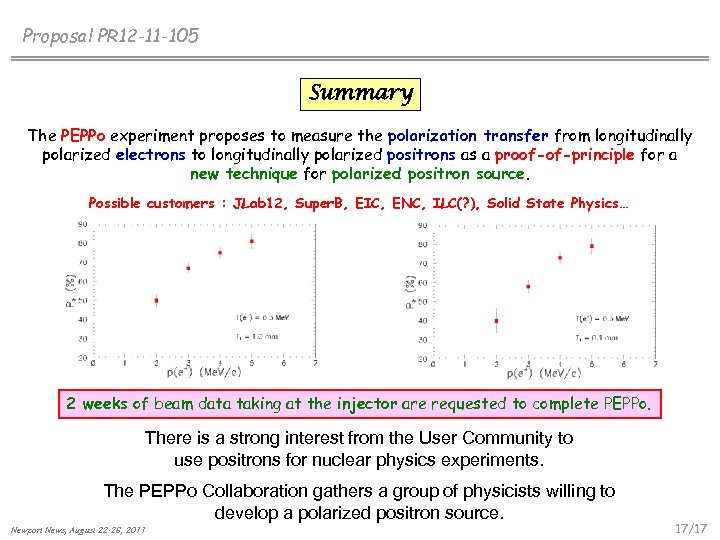 Proposal PR 12 -11 -105 Summary The PEPPo experiment proposes to measure the polarization transfer from longitudinally polarized electrons to longitudinally polarized positrons as a proof-of-principle for a new technique for polarized positron source. Possible customers : JLab 12, Super. B, EIC, ENC, ILC(? ), Solid State Physics… 2 weeks of beam data taking at the injector are requested to complete PEPPo. There is a strong interest from the User Community to use positrons for nuclear physics experiments. The PEPPo Collaboration gathers a group of physicists willing to develop a polarized positron source. Newport News, August 22 -26, 2011 17/17

 Proposal PR 12 -11 -105 Newport News, August 22 -26, 2011

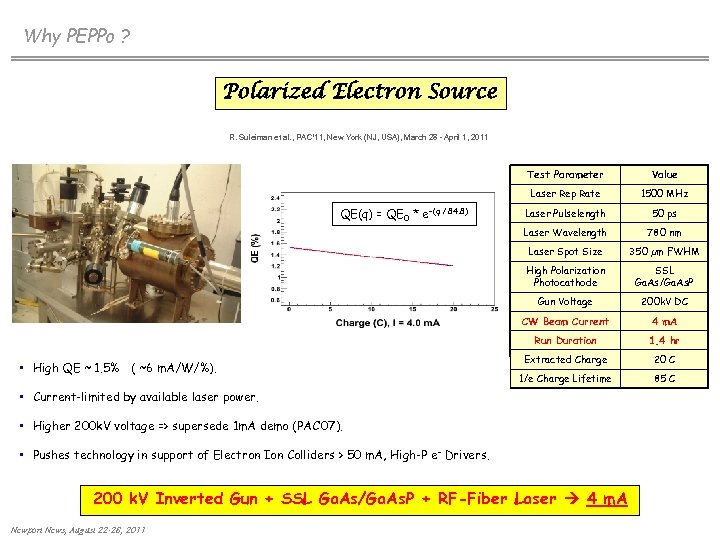 Why PEPPo ? Polarized Electron Source R. Suleiman et al. , PAC’ 11, New York (NJ, USA), March 28 – April 1, 2011 Test Parameter Laser Rep Rate Laser Pulselength 50 ps 780 nm Laser Spot Size 350 µm FWHM High Polarization Photocathode SSL Ga. As/Ga. As. P Gun Voltage 200 k. V DC CW Beam Current 4 m. A Run Duration • High QE ~ 1. 5% ( ~6 m. A/W/%). 1500 MHz Laser Wavelength QE(q) = QE 0 * e–(q / 84. 8) Value 1. 4 hr Extracted Charge 20 C 1/e Charge Lifetime 85 C • Current-limited by available laser power. • Higher 200 k. V voltage => supersede 1 m. A demo (PAC’ 07). • Pushes technology in support of Electron Ion Colliders > 50 m. A, High-P e - Drivers. 200 k. V Inverted Gun + SSL Ga. As/Ga. As. P + RF-Fiber Laser 4 m. A Newport News, August 22 -26, 2011
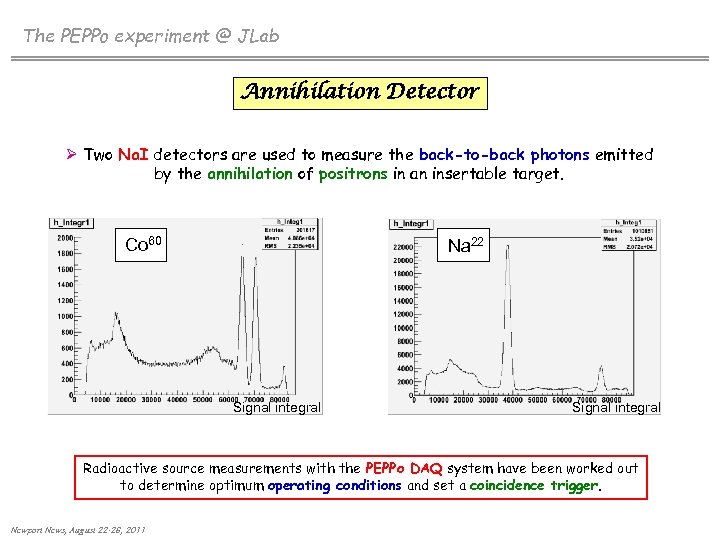 The PEPPo experiment @ JLab Annihilation Detector Ø Two Na. I detectors are used to measure the back-to-back photons emitted by the annihilation of positrons in an insertable target. Co 60 Na 22 Signal integral Radioactive source measurements with the PEPPo DAQ system have been worked out to determine optimum operating conditions and set a coincidence trigger. Newport News, August 22 -26, 2011
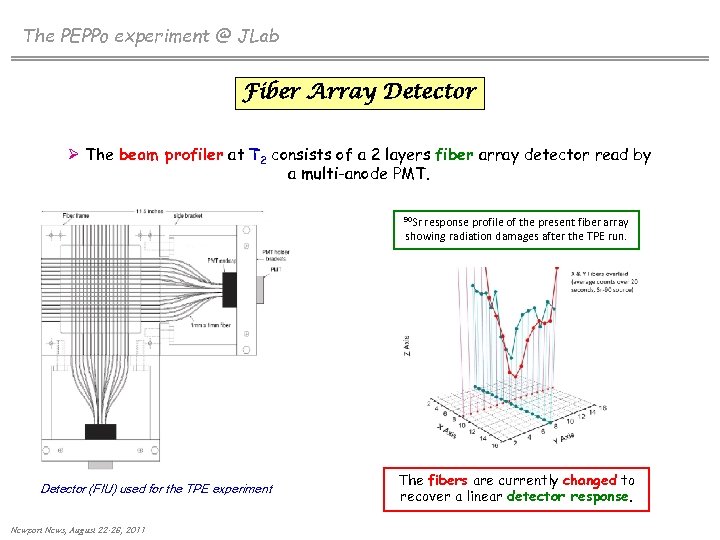 The PEPPo experiment @ JLab Fiber Array Detector Ø The beam profiler at T 2 consists of a 2 layers fiber array detector read by a multi-anode PMT. 90 Sr response profile of the present fiber array showing radiation damages after the TPE run. Detector (FIU) used for the TPE experiment Newport News, August 22 -26, 2011 The fibers are currently changed to recover a linear detector response.
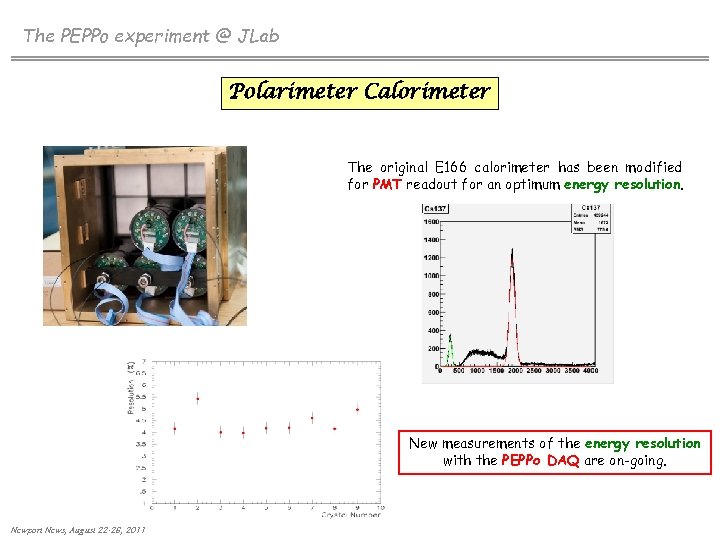 The PEPPo experiment @ JLab Polarimeter Calorimeter The original E 166 calorimeter has been modified for PMT readout for an optimum energy resolution. New measurements of the energy resolution with the PEPPo DAQ are on-going. Newport News, August 22 -26, 2011
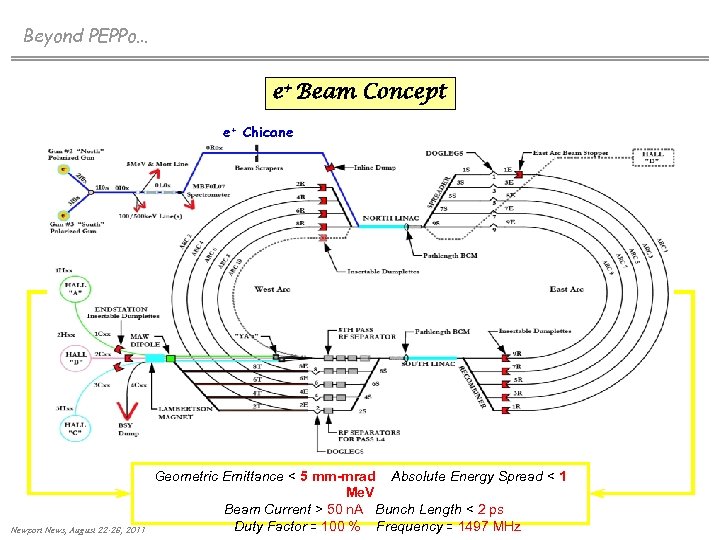 Beyond PEPPo… e+ Beam Concept e+ Chicane Newport News, August 22 -26, 2011 Geometric Emittance < 5 mm-mrad Absolute Energy Spread < 1 Me. V Beam Current > 50 n. A Bunch Length < 2 ps Duty Factor = 100 % Frequency = 1497 MHz
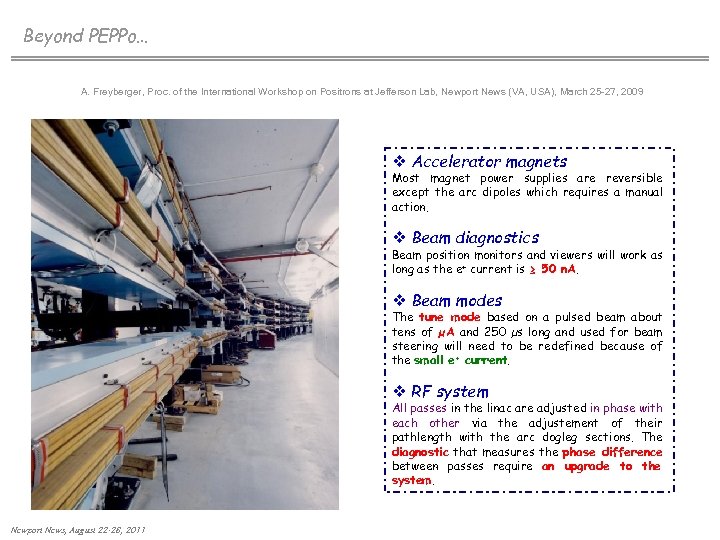 Beyond PEPPo… A. Freyberger, Proc. of the International Workshop on Positrons at Jefferson Lab, Newport News (VA, USA), March 25 -27, 2009 v Accelerator magnets Most magnet power supplies are reversible except the arc dipoles which requires a manual action. v Beam diagnostics Beam position monitors and viewers will work as long as the e+ current is ≥ 50 n. A. v Beam modes The tune mode based on a pulsed beam about tens of µA and 250 µs long and used for beam steering will need to be redefined because of the small e+ current. v RF system All passes in the linac are adjusted in phase with each other via the adjustement of their pathlength with the arc dogleg sections. The diagnostic that measures the phase difference between passes require an upgrade to the system. Newport News, August 22 -26, 2011