


 Скачать презентацию Penn State Autonomous System Navigation Driver Augmentation Engineering
cb10bd5fe03009bb28661fd740db4ec8.ppt
- Количество слайдов: 46
 Penn State Autonomous System Navigation, Driver Augmentation Engineering Project Kickoff March 03, 2008 Page 1
 Kickoff Agenda • Introduction to the Project • Overview of project steps – – – Modeling and Simulation CONOPS (CONcept of OPeration. S) Development Requirements Development Concept Generation Concept Development Concept Presentation • Summary • Appendices & Back-up material • Questions and Discussion Page 2
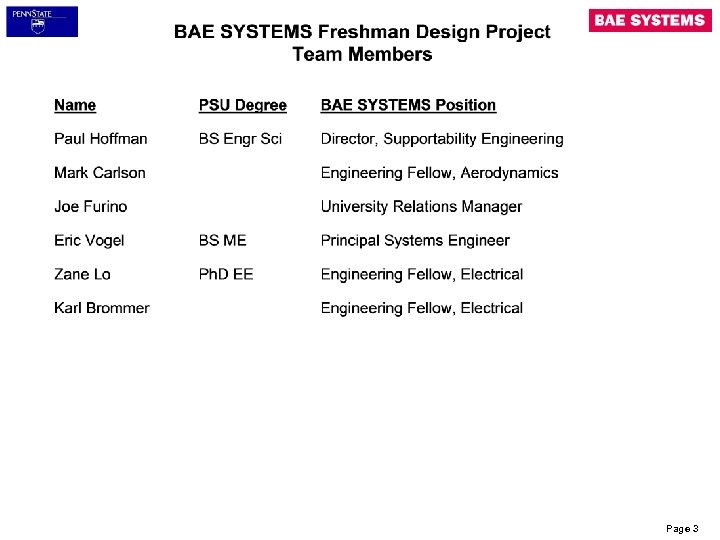 Page 3
 Project Statement • Problem statement: – In the US, Motor vehicle accidents are the leading cause of death for people between 1 to 34 years old. (National Vital Statistics report, September 2002. ) – In spite of advanced structural design of automobiles, crumple zones, air bags, etc. , the death rate has reached a non-zero asymptote. • WHY? • The answer lies in the fact that current technology fielded is reactive and not pre-emptive. – Devices react to the accident, they do not prevent the accident from occurring in the first place. • More warning time and intervention on the part of a driver assist system can prevent accidents or provide additional warning time to, in fact, implement better safety devices. • This problem is particularly acute for certain situations. Consider: – Convoy duty requires close vehicle spacing at high speeds often on damaged or unimproved road surfaces. • Drivers are often called upon to maintain position during periods of high stress. – When under attack, during black conditions, or during high speed maneuvering. • Reaction time is compromised by external distractions. – A system which detects and regulates a vehicles position as well as monitoring road conditions when traveling at high speed could result in a significant reduction in accidents and serious / fatal injury. • Frees up the crew to concentrate on all mission aspects. – This technology is directly applicable to modern highway driving. Page 4
 Project Statement • Objective: – Develop a method to detect and avoid obstacles while maintaining formation. • Define technique to be utilized, I. e. radar, ladar, thermal imaging, spectroscopy, etc. • Design system to detect presence of vehicle, determine range, velocity, position and maintain formation during convoy operations. • Display warning and suggested collision avoidance method to driver. • Detect on-coming traffic and factor into decision process. • Background – Your team is employed by a specialty engineering firm – The firm has been contracted to develop “Driver Assist” concepts for convoy vehicles. – The customer has awarded several contracts to competing firms and will ultimately select the best concept for a lucrative development, production, and fielding contract. • HMMWV upgrade – This is a real problem with real impact in today’s world • Direct leverage into commercial markets. – BMW, Mercedes, GM, Ford, Toyota are all invested. – Solving it literally makes people safer on the road – There are many other practical application areas for this technology. Page 5
 Project Statement Of Work (SOW) • Tasks: Your firm will need to: – Perform a customer needs assessment based on your interpretation of the problem scope. – Develop an initial Concept Of Operations (CONOPS) • The CONOPS is essential and defines how your system will actually operate. • Your CONOPS will evolve as your system architecture matures. – Develop a draft of your system specification. • This will evolve as your system architecture develops • Research sensor types currently available. – Some data on typical sensors is provided for a reference – Don’t forget the display type for the driver and how the system integrates the human in the loop • Perform trade studies on the type and quantity of sensors, type and quantity of vehicles required, how the vehicles are employed, and information provided versus cost. – Design a system using the results of the trade studies including optimal sensor placement, integration with the vehicle, etc. – Calculate size and mass properties impact of the sensor system (including the display). • Check out the DARPA Urban Grand Challenge project. This provides an excellent overview of the ultimate robotic driving problem today and the complexities you will face. – Fortunately your problem is much less complex! • Remember that you can’t displace the passengers or cargo completely and you must integrate the driver into the picture. – Develop the cost to field the system. I. e. , number and type of vehicles, number of sensors, etc. Page 6
 Project Approach • This project will lead you through a disciplined systems engineering approach to engineering concept development – – – Perform a customer needs assessment. Understand the problem via hand analysis, modeling, and simulation Develop the requirements for your system concept Generate ideas for the “Driver Assist” system concept Refine the ideas through concept development Select your best concept and develop it in detail • Develop your CONcept of OPeration. S (CONOPS) – Assess your systems strengths and weaknesses – Sell your final idea to the customer • Tools you will use: Mathematics, physics, spreadsheets, brainstorming, trade studies, CAD, presentation SW – The tools support your creative process *Additional Information on Project Approach is provided in Appendix A-1 Page 7
 Driver Assist Problem Statement Requirements • Maintain formation of three HMMWV’s under blackout conditions. • Determine the best method of station keeping and obstacle avoidance. – The obstacle is a large crater in the road capable of inflicting damage to the lead and following vehicles. • Crater dimensions: 1 meter wide and deep, 2 meters in procession direction. Aligned with passenger roadside. – You must detect the crater and maneuver around it in time. • Assume convoy velocity is 50 km/hr – There may be on-coming traffic so you must detect and declare / decide before you maneuver. • Must determine total time to complete avoidance maneuver for entire procession – You must notify driver using method of your own design • Alert following vehicles of impending maneuver – Can not “throw” occupants from vehicle • Must calculate accelerations induced on occupants from avoidance maneuver 5 m 5 m TBD m Crater Page 8
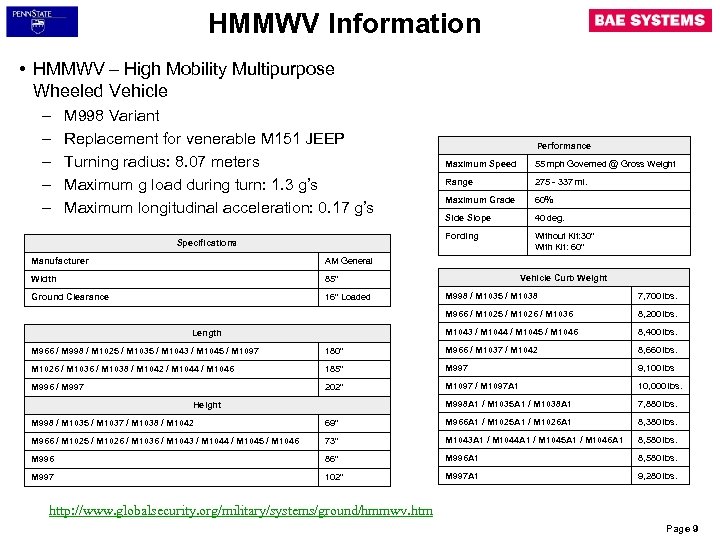 HMMWV Information • HMMWV – High Mobility Multipurpose Wheeled Vehicle – – – M 998 Variant Replacement for venerable M 151 JEEP Turning radius: 8. 07 meters Maximum g load during turn: 1. 3 g’s Maximum longitudinal acceleration: 0. 17 g’s Performance Manufacturer 16" Loaded 275 - 337 mi. Maximum Grade 60% Side Slope 40 deg. Without Kit: 30" With Kit: 60" 85" Ground Clearance Range AM General Width 55 mph Governed @ Gross Weight Fording Specifications Maximum Speed Vehicle Curb Weight 7, 700 lbs. M 966 / M 1025 / M 1026 / M 1036 8, 200 lbs. M 1043 / M 1044 / M 1045 / M 1046 Length M 998 / M 1035 / M 1038 8, 400 lbs. M 966 / M 998 / M 1025 / M 1035 / M 1043 / M 1045 / M 1097 180" M 966 / M 1037 / M 1042 8, 660 lbs. M 1026 / M 1038 / M 1042 / M 1044 / M 1046 185" M 997 9, 100 lbs M 996 / M 997 202" M 1097 / M 1097 A 1 10, 000 lbs. M 998 A 1 / M 1035 A 1 / M 1038 A 1 7, 880 lbs. Height M 998 / M 1035 / M 1037 / M 1038 / M 1042 69" M 966 A 1 / M 1025 A 1 / M 1026 A 1 8, 380 lbs. M 966 / M 1025 / M 1026 / M 1036 / M 1043 / M 1044 / M 1045 / M 1046 73" M 1043 A 1 / M 1044 A 1 / M 1045 A 1 / M 1046 A 1 8, 580 lbs. M 996 86" M 996 A 1 8, 580 lbs. M 997 102" M 997 A 1 9, 280 lbs. http: //www. globalsecurity. org/military/systems/ground/hmmwv. htm Page 9
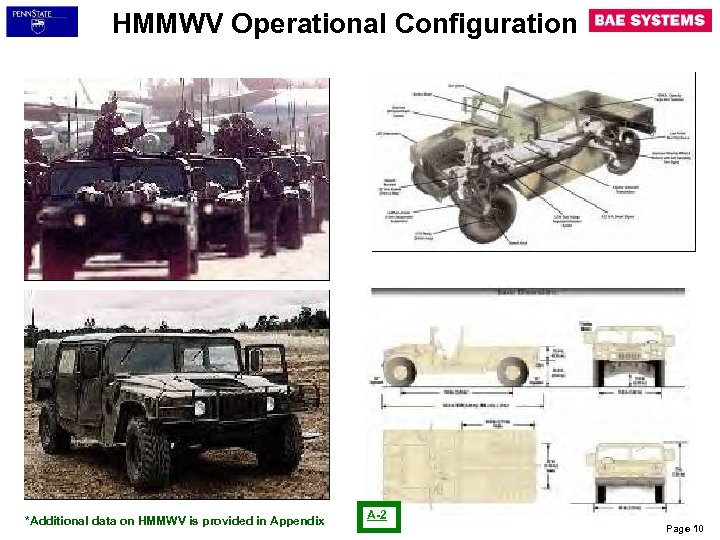 HMMWV Operational Configuration *Additional data on HMMWV is provided in Appendix A-2 Page 10
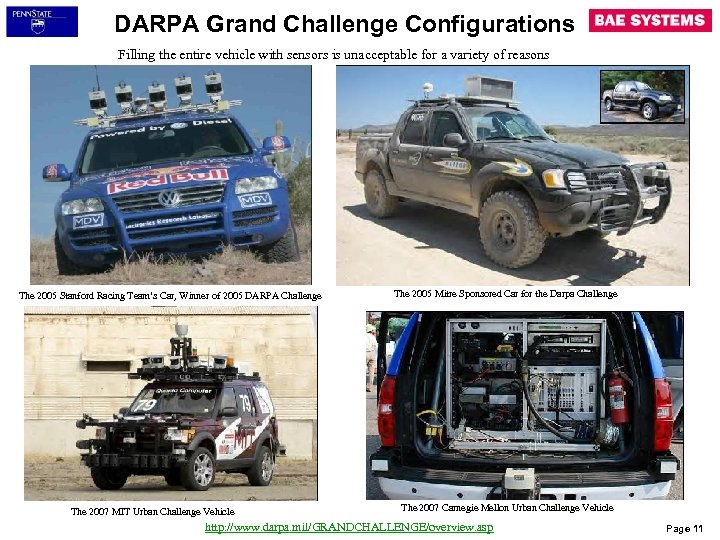 DARPA Grand Challenge Configurations Filling the entire vehicle with sensors is unacceptable for a variety of reasons The 2005 Stanford Racing Team’s Car, Winner of 2005 DARPA Challenge The 2007 MIT Urban Challenge Vehicle The 2005 Mitre Sponsored Car for the Darpa Challenge The 2007 Carnegie Mellon Urban Challenge Vehicle http: //www. darpa. mil/GRANDCHALLENGE/overview. asp Page 11
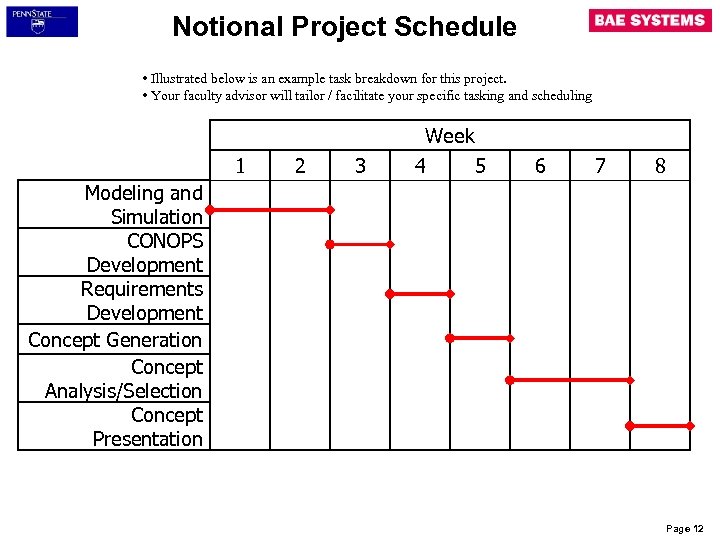 Notional Project Schedule • Illustrated below is an example task breakdown for this project. • Your faculty advisor will tailor / facilitate your specific tasking and scheduling Week 1 2 3 4 5 6 7 8 Modeling and Simulation CONOPS Development Requirements Development Concept Generation Concept Analysis/Selection Concept Presentation Page 12
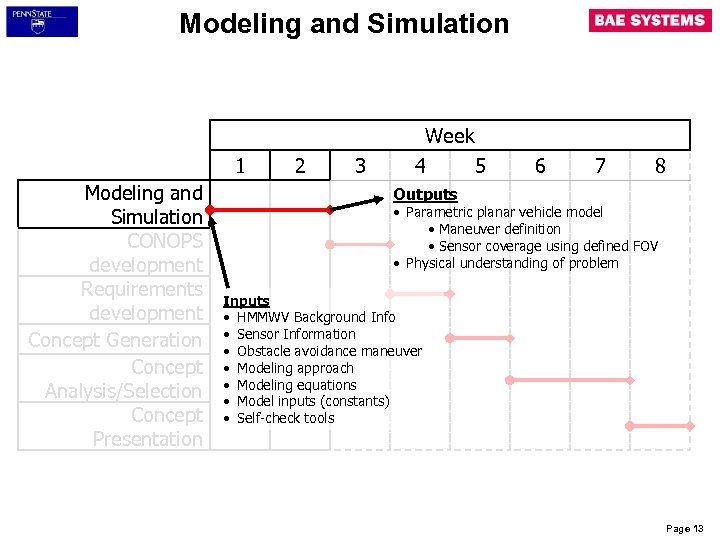 Modeling and Simulation Week 1 Modeling and Simulation CONOPS development Requirements development Concept Generation Concept Analysis/Selection Concept Presentation 2 3 4 5 6 7 8 Outputs • Parametric planar vehicle model • Maneuver definition • Sensor coverage using defined FOV • Physical understanding of problem Inputs • HMMWV Background Info • Sensor Information • Obstacle avoidance maneuver • Modeling approach • Modeling equations • Model inputs (constants) • Self-check tools Page 13
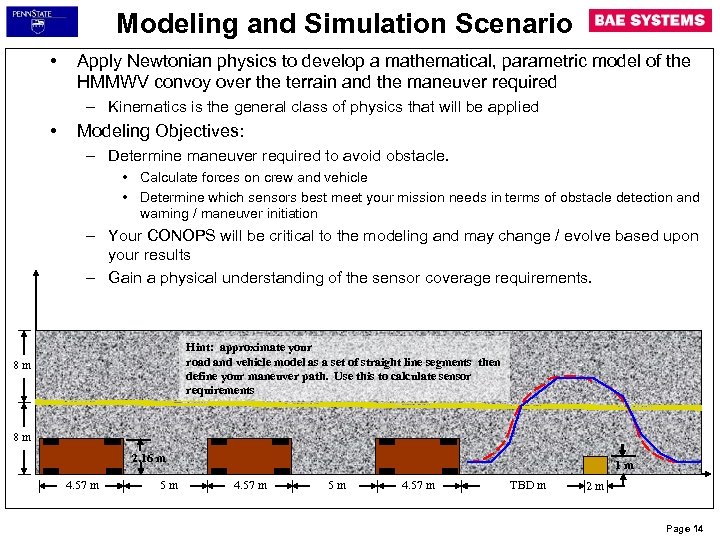 Modeling and Simulation Scenario • Apply Newtonian physics to develop a mathematical, parametric model of the HMMWV convoy over the terrain and the maneuver required – Kinematics is the general class of physics that will be applied • Modeling Objectives: – Determine maneuver required to avoid obstacle. • Calculate forces on crew and vehicle • Determine which sensors best meet your mission needs in terms of obstacle detection and warning / maneuver initiation – Your CONOPS will be critical to the modeling and may change / evolve based upon your results – Gain a physical understanding of the sensor coverage requirements. Hint: approximate your road and vehicle model as a set of straight line segments then define your maneuver path. Use this to calculate sensor requirements 8 m 8 m 2. 16 m 4. 57 m 5 m 1 m 4. 57 m 5 m 4. 57 m TBD m 2 m Page 14
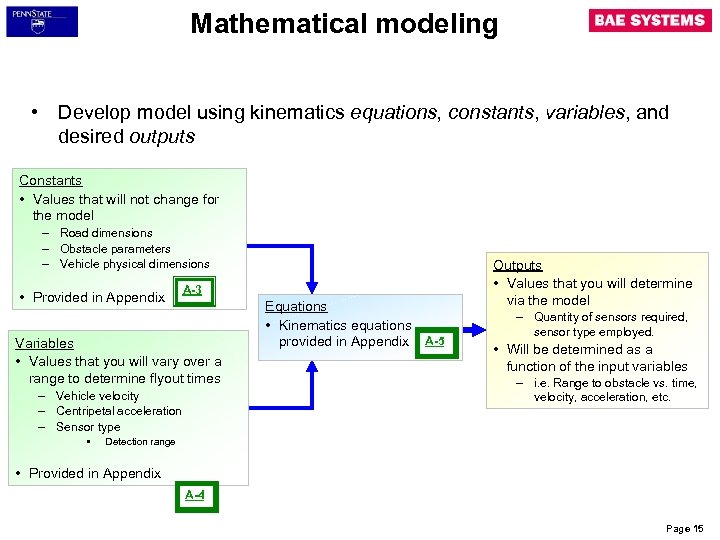 Mathematical modeling • Develop model using kinematics equations, constants, variables, and desired outputs Constants • Values that will not change for the model – Road dimensions – Obstacle parameters – Vehicle physical dimensions • Provided in Appendix A-3 Variables • Values that you will vary over a range to determine flyout times – Vehicle velocity – Centripetal acceleration – Sensor type • Equations • Kinematics equations provided in Appendix A-5 Outputs • Values that you will determine via the model – Quantity of sensors required, sensor type employed. • Will be determined as a function of the input variables – i. e. Range to obstacle vs. time, velocity, acceleration, etc. Detection range • Provided in Appendix A-4 Page 15
 Model development ”What I cannot create, I do not • Step 1: Work the problem a few times understand. " — Richard Feynman, by hand – Treat it like a homework assignment theoretical physicist – For example: How many sensors are required to detect the obstacle? What coverage do they provide, what type of sensor overlap is required, are you going to mix sensor types to optimize coverage, does the total system meet your cost expectations? • How will I model the system to verify performance? – Make sure that the relationships make sense in terms of your trade space. – Don’t forget that detecting the obstacle is not the only requirement. • Remember the following vehicles. • Step 2: Put the equations (or assumptions) into a computer tool so you can vary the inputs over a range and plot relationships – Tools: Custom computer program, Excel, Mat. Lab, Math. Cad, etc. – Now the variables become ranges of values – The “answer” is the plotted relationships and a physical understanding of the maneuver dynamics *Additional suggestions to Model development are provided in Appendix A-6 Page 16
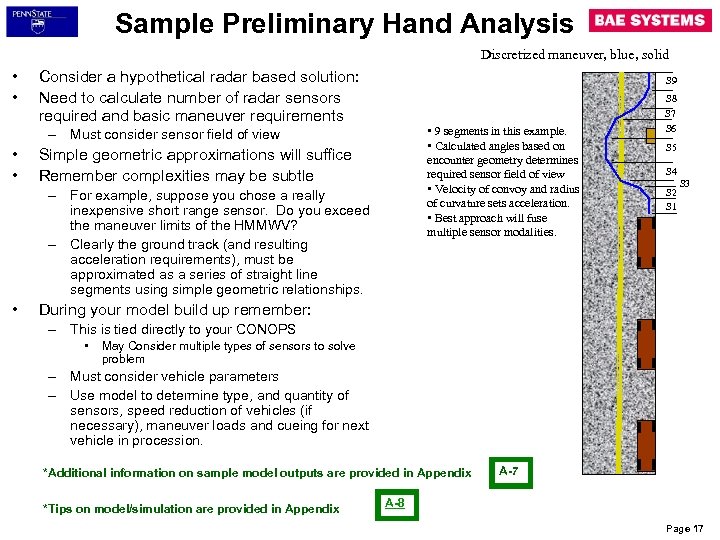 Sample Preliminary Hand Analysis Discretized maneuver, blue, solid • • Consider a hypothetical radar based solution: Need to calculate number of radar sensors required and basic maneuver requirements S 9 • 9 segments in this example. • Calculated angles based on encounter geometry determines required sensor field of view • Velocity of convoy and radius of curvature sets acceleration. • Best approach will fuse multiple sensor modalities. – Must consider sensor field of view • • Simple geometric approximations will suffice Remember complexities may be subtle – For example, suppose you chose a really inexpensive short range sensor. Do you exceed the maneuver limits of the HMMWV? – Clearly the ground track (and resulting acceleration requirements), must be approximated as a series of straight line segments using simple geometric relationships. • S 8 S 7 S 6 S 5 S 4 S 2 S 1 S 3 During your model build up remember: – This is tied directly to your CONOPS • May Consider multiple types of sensors to solve problem – Must consider vehicle parameters – Use model to determine type, and quantity of sensors, speed reduction of vehicles (if necessary), maneuver loads and cueing for next vehicle in procession. A-8 A-7 *Additional information on sample model outputs are provided in Appendix *Tips on model/simulation are provided in Appendix A-7 A-8 Page 17
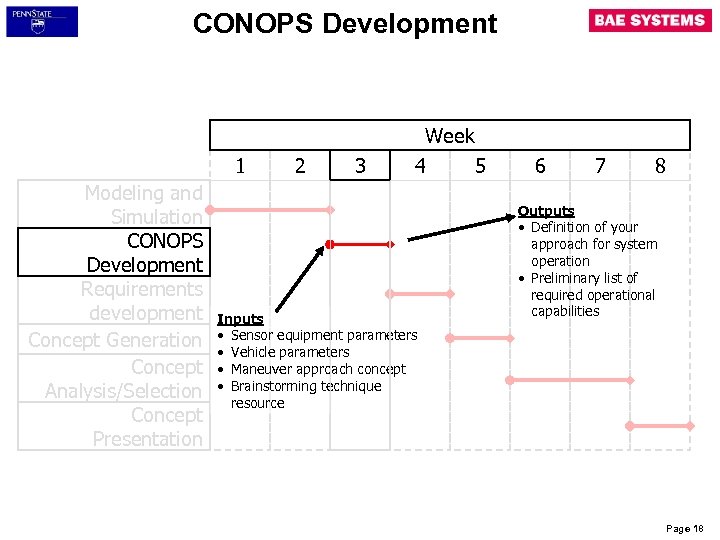 CONOPS Development Week 1 Modeling and Simulation CONOPS Development Requirements development Concept Generation Concept Analysis/Selection Concept Presentation 2 3 4 Inputs • Sensor equipment parameters • Vehicle parameters • Maneuver approach concept • Brainstorming technique resource 5 6 7 8 Outputs • Definition of your approach for system operation • Preliminary list of required operational capabilities Page 18
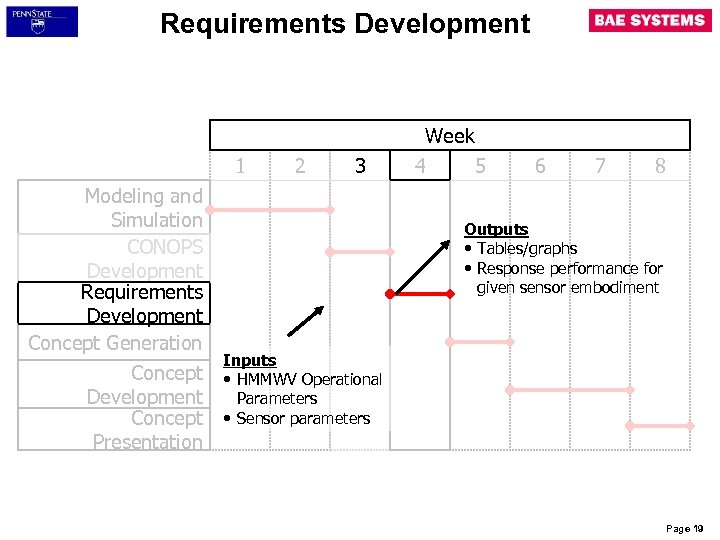 Requirements Development Week 1 Modeling and Simulation CONOPS Development Requirements Development Concept Generation Concept Development Concept Presentation 2 3 4 5 6 7 8 Outputs • Tables/graphs • Response performance for given sensor embodiment Inputs • HMMWV Operational Parameters • Sensor parameters Page 19
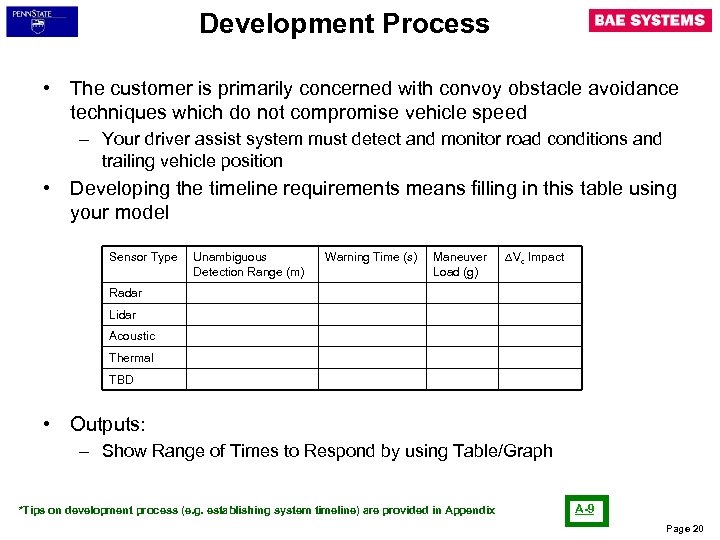 Development Process • The customer is primarily concerned with convoy obstacle avoidance techniques which do not compromise vehicle speed – Your driver assist system must detect and monitor road conditions and trailing vehicle position • Developing the timeline requirements means filling in this table using your model Sensor Type Unambiguous Detection Range (m) Warning Time (s) Maneuver Load (g) Vc Impact Radar Lidar Acoustic Thermal TBD • Outputs: – Show Range of Times to Respond by using Table/Graph *Tips on development process (e. g. establishing system timeline) are provided in Appendix A-9 Page 20
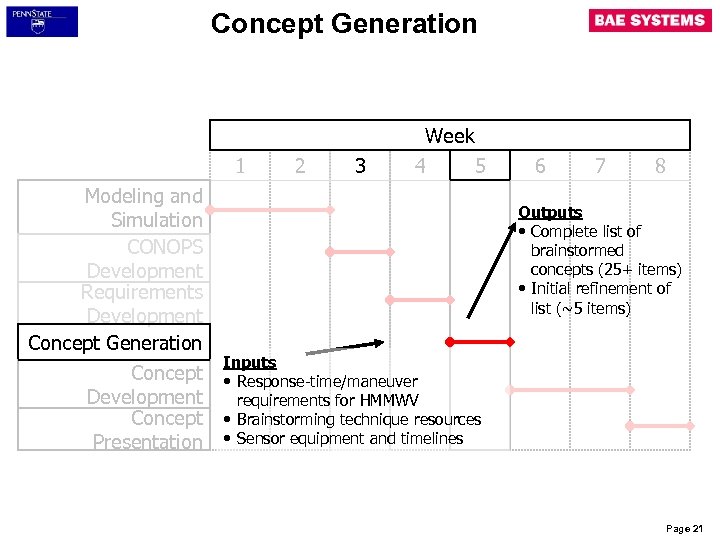 Concept Generation Week 1 Modeling and Simulation CONOPS Development Requirements Development Concept Generation Concept Development Concept Presentation 2 3 4 5 6 7 8 Outputs • Complete list of brainstormed concepts (25+ items) • Initial refinement of list (~5 items) Inputs • Response-time/maneuver requirements for HMMWV • Brainstorming technique resources • Sensor equipment and timelines Page 21
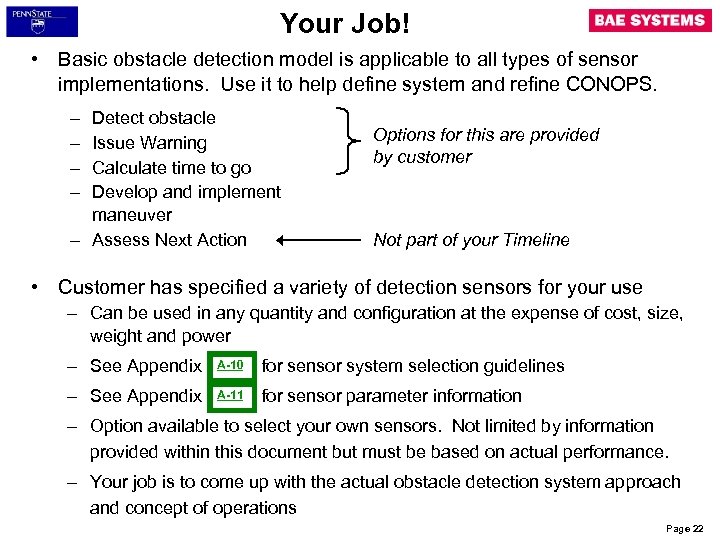 Your Job! • Basic obstacle detection model is applicable to all types of sensor implementations. Use it to help define system and refine CONOPS. – – Detect obstacle Issue Warning Calculate time to go Develop and implement maneuver – Assess Next Action Options for this are provided by customer Not part of your Timeline • Customer has specified a variety of detection sensors for your use – Can be used in any quantity and configuration at the expense of cost, size, weight and power A-10 – See Appendix for sensor system selection guidelines A-11 – See Appendix for sensor parameter information – Option available to select your own sensors. Not limited by information provided within this document but must be based on actual performance. – Your job is to come up with the actual obstacle detection system approach and concept of operations Page 22
 Engineering Creativity • Apply group creative techniques to "The way to get good ideas is to develop a rich set of possible get lots of ideas and throw the solutions bad ones away. " – See resource material on — Linus Pauling, chemist brainstorming and other creative Nobel Prize Winner techniques, Appendix A-12 • Session 1: Develop a large set of possible solutions (25+). At this point, don’t critique - just record the ideas. • Session 2: Cull the list down to 4 or 5 solutions as a group – Use your understanding of the engagement to eliminate the weakest solutions • Tip: Consider the type of detect/cueing sensor(s) that will be needed for each obstacle avoidance system concept (i. e. a very cheap simple sensor may require a vast number but may still be less expensive than a smaller number of sophisticated sensors. ) Consider system level impacts, e. g. , maneuver loads on vehicle. Page 23
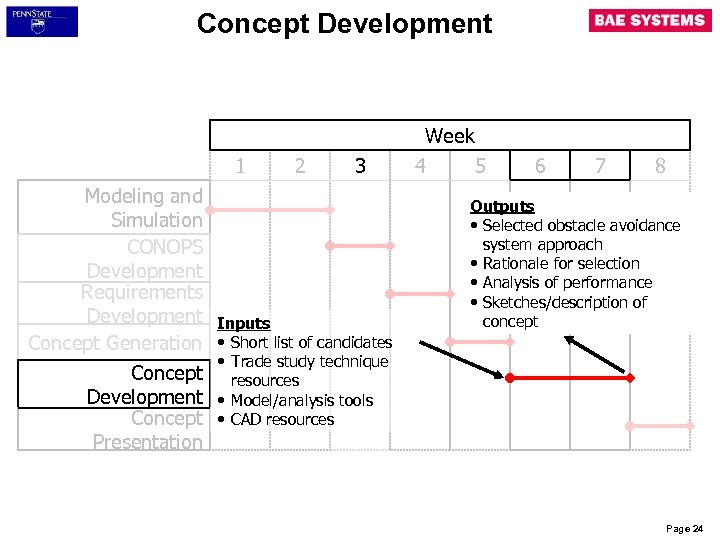 Concept Development Week 1 Modeling and Simulation CONOPS Development Requirements Development Concept Generation Concept Development Concept Presentation 2 3 Inputs • Short list of candidates • Trade study technique resources • Model/analysis tools • CAD resources 4 5 6 7 8 Outputs • Selected obstacle avoidance system approach • Rationale for selection • Analysis of performance • Sketches/description of concept Page 24
 Engineering Selection • Selection of the optimal obstacle avoidance system requires that you further develop each idea on the “short list” • Further development should focus on answering the key questions – – – Will it be effective? How big will it be, what will it weigh, how much power does it take? What type and quantity of sensors are required? How much will it cost? Is it feasible? • Use CAD to sketch your concepts and “visualize” installation • Use your model (possibly with modifications) to determine the effectiveness Page 25
 Trade Studies • Once you have sufficiently developed the alternatives, conduct an engineering trade study to select the optimal approach – Trade studies promote objective review and selection of the best alternative – Frequently used in industry – See online resources regarding engineering trade studies, Appendix • Potential trade study criteria – Physical • Power, weight, size, quantity, FOV – Feasibility • Unique technical challenges – Cost – Performance A-13 ”Out of clutter, find simplicity. From discord, find harmony. In the middle of difficulty lies opportunity. " — Albert Einstein • What implementation stresses the vehicle and occupants the least? Page 26
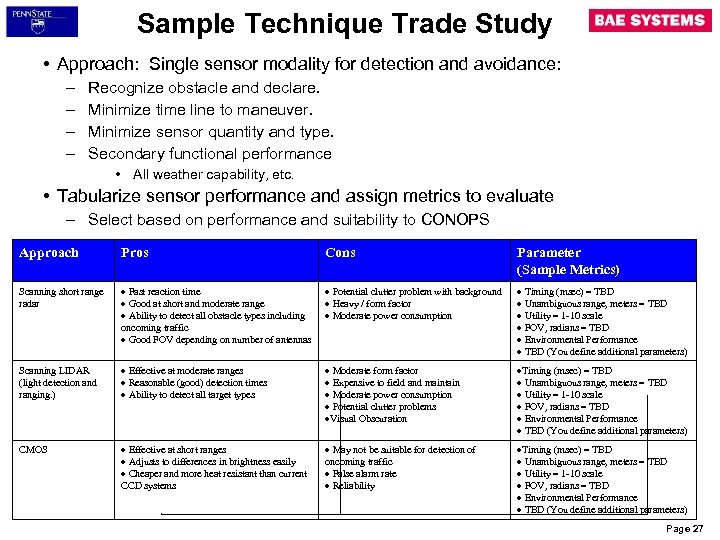 Sample Technique Trade Study • Approach: Single sensor modality for detection and avoidance: – – Recognize obstacle and declare. Minimize time line to maneuver. Minimize sensor quantity and type. Secondary functional performance • All weather capability, etc. • Tabularize sensor performance and assign metrics to evaluate – Select based on performance and suitability to CONOPS Approach Pros Cons Parameter (Sample Metrics) Scanning short range radar Fast reaction time Good at short and moderate range Ability to detect all obstacle types including oncoming traffic Good FOV depending on number of antennas Potential clutter problem with background Heavy / form factor Moderate power consumption Timing (msec) = TBD Unambiguous range, meters = TBD Utility = 1 -10 scale FOV, radians = TBD Environmental Performance TBD (You define additional parameters) Scanning LIDAR (light detection and ranging. ) Effective at moderate ranges Reasonable (good) detection times Ability to detect all target types Moderate form factor Expensive to field and maintain Moderate power consumption Potential clutter problems Visual Obscuration Timing (msec) = TBD Unambiguous range, meters = TBD Utility = 1 -10 scale FOV, radians = TBD Environmental Performance TBD (You define additional parameters) CMOS Effective at short ranges Adjusts to differences in brightness easily Cheaper and more heat resistant than current CCD systems May not be suitable for detection of oncoming traffic False alarm rate Reliability Timing (msec) = TBD Unambiguous range, meters = TBD Utility = 1 -10 scale FOV, radians = TBD Environmental Performance TBD (You define additional parameters) Page 27
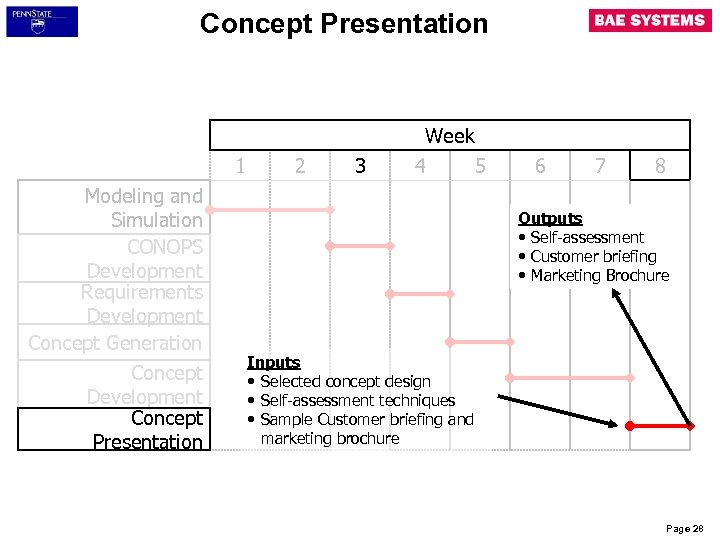 Concept Presentation Week 1 Modeling and Simulation CONOPS Development Requirements Development Concept Generation Concept Development Concept Presentation 2 3 4 5 6 7 8 Outputs • Self-assessment • Customer briefing • Marketing Brochure Inputs • Selected concept design • Self-assessment techniques • Sample Customer briefing and marketing brochure Page 28
 Final Deliverables • Final design briefing – This is your opportunity to “sell” your concept to your customer – Walk them through your whole process, present your chosen concept in detail • Will require further CAD work and refinement • Physical models are an option – The briefing should answer the customers questions, see Appendix A-14 • Brochure – Develop a fold-out brochure for your customer to take with them – Example brochures will be provided • Remember: thorough engineering + solid presentation = SOLD! Anticipate issues your customer may have - incorporate risk mitigation factors into your design briefing. See Appendix A-15 Page 29
 Summary • You will use the systems engineering techniques presented to propose a solution to a significant, real-world problem – You will use many relevant engineering tools and techniques to facilitate your creative process • This briefing provides a kickoff, links, some buried hints, and a framework for the project – Refer to it and the other course material frequently • A few tips: – Take it one step at a time, focus on what’s currently due – You will probably start to have concept ideas immediately, write them down, keep your mind open Page 30
 Appendix Page 31
 A-1: Additional Info on Approach • The Goal is to determine a way to perform the following: – Design a system which: • Detects the presence of obstacles directly in your path and avoids them. (Options given. ) – This includes on-coming traffic in the event avoidance maneuver crosses lanes. • Determine how much time is available to react. (Analysis, modeling and simulation. ) • Determine the proper number and type of sensors to employ. (Design. ) – Based on your calculations of the maneuver profile required, sensor coverage, and effective warning time. • Determine if the system concept was effective. (Assessment. ) • Develop a marketing brochure which highlights specific features of the design approach using a CAD model of the system. – Include a statement of system effectiveness in obstacle detection and avoidance. • The system design should use building blocks provided for specific functions such as obstacle detection. – Concentrate on the actual system design. • Hint: Timing and field of view are going to be key parameters so focusing on calculating parameters related to: – HMMWV motion path » If the HMMWV maintains a certain path, can the sensor suite detect obstacles and on-coming traffic over a wide enough path to effectively maneuver out of the way. Is braking the best option under certain scenarios? » If the lead vehicle detects an obstacle successfully, how will the rest of the convoy be notified? – Time to go, i. e. , how long from detection to obstacle impact? This timeline will define the system response requirements that must be met. – Are multiple solution branches accommodated by your system? Where is this logic accounted for? » Perhaps under certain conditions maneuvering is not possible. Do you have adequate situational awareness to tell the difference? . – Remember that obstacles can occur en-mass. • The system may have to detect and monitor more than one obstacle at a time so think about parameters like field of view, integration onto the HMMWV, motion path, etc. • This is a large scale application. – It needs to be somewhat affordable as there may be many vehicles required to be equipped with this system. Page 32
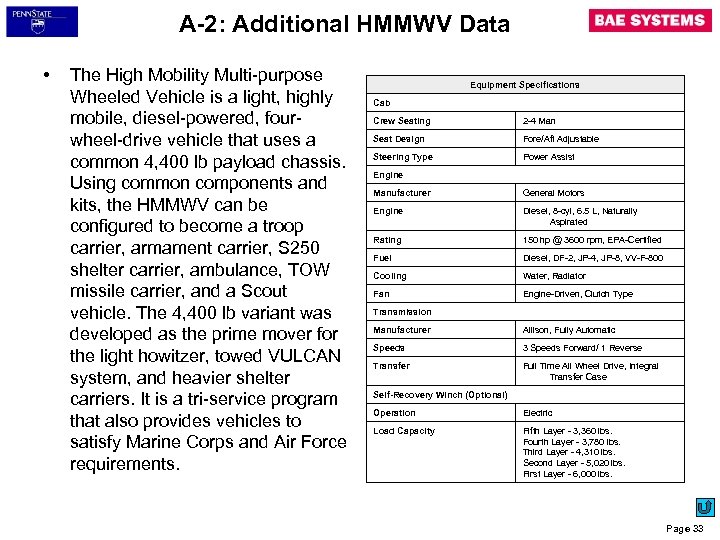 A-2: Additional HMMWV Data • The High Mobility Multi-purpose Wheeled Vehicle is a light, highly mobile, diesel-powered, fourwheel-drive vehicle that uses a common 4, 400 lb payload chassis. Using common components and kits, the HMMWV can be configured to become a troop carrier, armament carrier, S 250 shelter carrier, ambulance, TOW missile carrier, and a Scout vehicle. The 4, 400 lb variant was developed as the prime mover for the light howitzer, towed VULCAN system, and heavier shelter carriers. It is a tri-service program that also provides vehicles to satisfy Marine Corps and Air Force requirements. Equipment Specifications Cab Crew Seating 2 -4 Man Seat Design Fore/Aft Adjustable Steering Type Power Assist Engine Manufacturer General Motors Engine Diesel, 8 -cyl, 6. 5 L, Naturally Aspirated Rating 150 hp @ 3600 rpm, EPA-Certified Fuel Diesel, DF-2, JP-4, JP-8, VV-F-800 Cooling Water, Radiator Fan Engine-Driven, Clutch Type Transmission Manufacturer Allison, Fully Automatic Speeds 3 Speeds Forward/ 1 Reverse Transfer Full Time All Wheel Drive, Integral Transfer Case Self-Recovery Winch (Optional) Operation Electric Load Capacity Fifth Layer - 3, 360 lbs. Fourth Layer - 3, 780 lbs. Third Layer - 4, 310 lbs. Second Layer - 5, 020 lbs. First Layer - 6, 000 lbs. Page 33
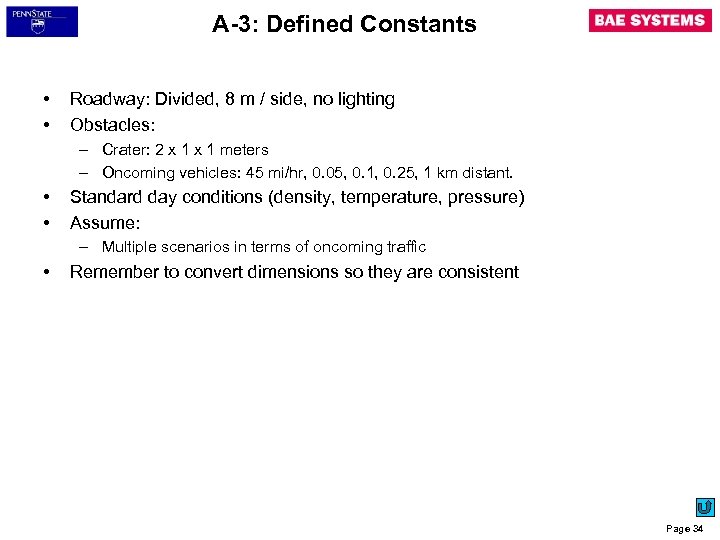 A-3: Defined Constants • • Roadway: Divided, 8 m / side, no lighting Obstacles: – Crater: 2 x 1 meters – Oncoming vehicles: 45 mi/hr, 0. 05, 0. 1, 0. 25, 1 km distant. • • Standard day conditions (density, temperature, pressure) Assume: – Multiple scenarios in terms of oncoming traffic • Remember to convert dimensions so they are consistent Page 34
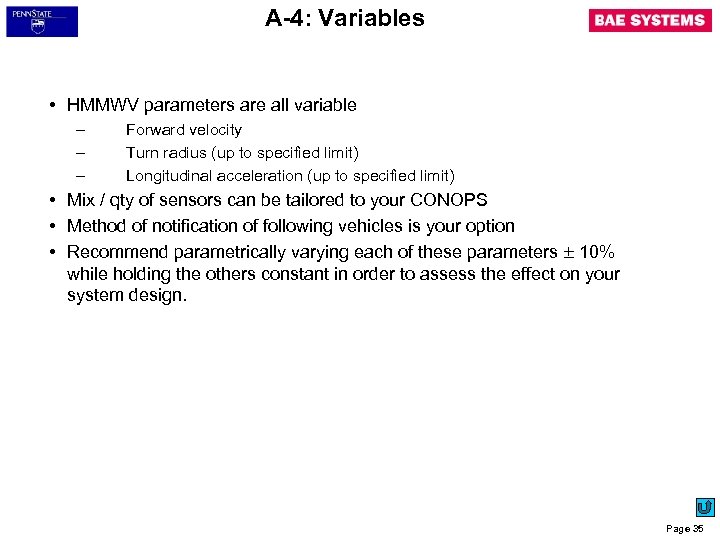 A-4: Variables • HMMWV parameters are all variable – – – Forward velocity Turn radius (up to specified limit) Longitudinal acceleration (up to specified limit) • Mix / qty of sensors can be tailored to your CONOPS • Method of notification of following vehicles is your option • Recommend parametrically varying each of these parameters 10% while holding the others constant in order to assess the effect on your system design. Page 35
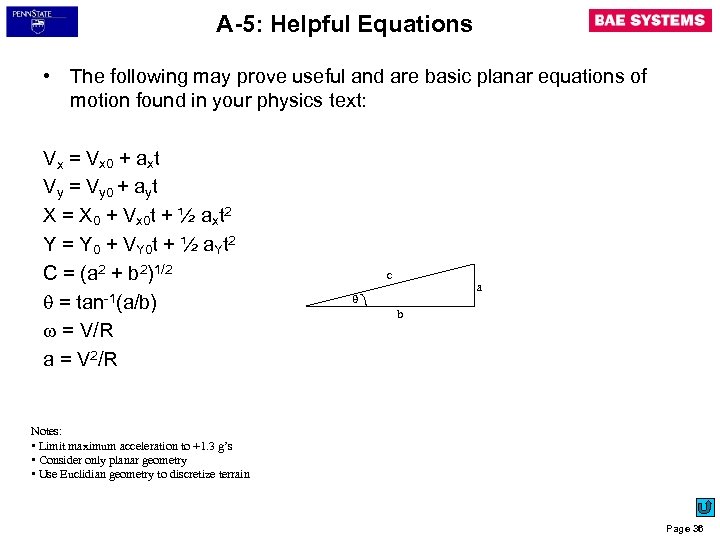 A-5: Helpful Equations • The following may prove useful and are basic planar equations of motion found in your physics text: Vx = Vx 0 + axt Vy = Vy 0 + ayt X = X 0 + Vx 0 t + ½ axt 2 Y = Y 0 + VY 0 t + ½ a. Yt 2 C = (a 2 + b 2)1/2 = tan-1(a/b) = V/R a = V 2/R c a b Notes: • Limit maximum acceleration to +1. 3 g’s • Consider only planar geometry • Use Euclidian geometry to discretize terrain Page 36
 A-6: Suggestions to Model Development • In order to calculate the HMMWV trajectory, the equations (provided in A-5) may be used in a simple commercial software (such as Excel, Mat. Lab, Math. Cad, Fortran, or C) to calculate all necessary geometry and timing parameters associated with the ground track. – Once the basic simulation is running, the equations can be further built up and more can be added to model any specific approach to include, for example, • Effect of multiple oncoming traffic • Effect of convoy velocity changes. • Timing studies to optimize number and type of sensors. • The basic equations provided can be modified to include all vehicles in the convoy and can be run parametrically (automated using user defined rule set) until the desired operational profile and mix of sensors is achieved. Page 37
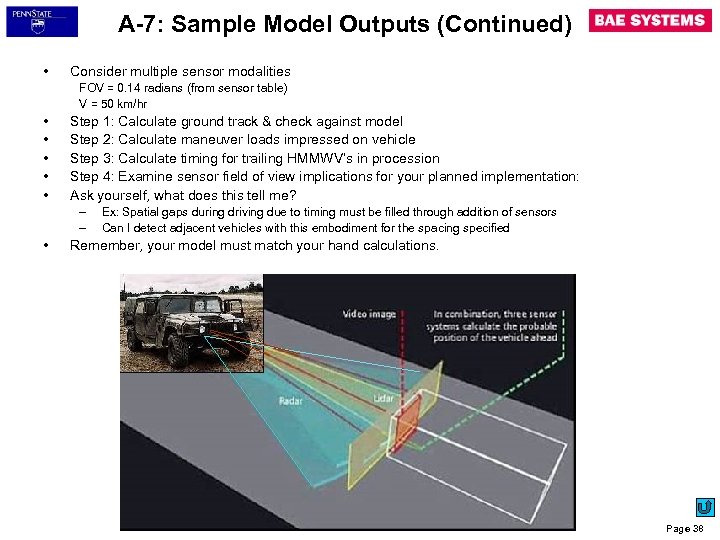 A-7: Sample Model Outputs (Continued) • Consider multiple sensor modalities FOV = 0. 14 radians (from sensor table) V = 50 km/hr • • • Step 1: Calculate ground track & check against model Step 2: Calculate maneuver loads impressed on vehicle Step 3: Calculate timing for trailing HMMWV’s in procession Step 4: Examine sensor field of view implications for your planned implementation: Ask yourself, what does this tell me? – – • Ex: Spatial gaps during driving due to timing must be filled through addition of sensors Can I detect adjacent vehicles with this embodiment for the spacing specified Remember, your model must match your hand calculations. Page 38
 A-8: Tips on Model/Simulation • If your code is running correctly, the maneuver track, timing, and sensor coverage vs. time can now be determined. – The simulation can also be used to perform trade studies designed to optimize your system design and response. • In order to check the code, try calculating the time to cover a straight ground track without any maneuver and comparing the X, Y, and timing against your hand calculations. – Then set the maneuver to a very small offset. The results should compare with the timing being slightly longer due to the increased path length. • An additional suggested check of the simulation is to verify that the units of all calculations are consistent and the results are expressed correctly. – Use dimensional analysis for this. • At the conclusion of the modeling and simulation stage of the project, the following questions and milestones should be met: – A simple, X-Y planar, parametric model of the HMMWV trajectory enabling physical trade studies to be performed should be available. • Given that the detection of the obstacle is assured: (I. e. , zero false alarm rate. ) – Based on selection of the detection sensors, what is the time line for location, notification, and avoidance maneuver implementation? • Suggestion: use timing chart supplied as a template and fill in using data generated with model. • Determine if the system functions in the presence of oncoming traffic or if further modifications to the convoy procession are required. – If so, what changes to formation are required – What changes to system response time could improve performance. • I. e. , what is the functional time allocation to the various parts of the system design and is it correct. • Do you need more than a single type of sensor? – What type of accuracy is needed and what is the cost impact? Page 39
 A-9: Basics of HMMWV Obstacle Avoidance System Timeline • In order to design an effective obstacle avoidance system, an understanding of basic functional requirements, for example timing, is required. You will have to modify the function listing based on system design however this forms a minimal requirement set. – Typical time from detection of the obstacle for a range of ? km is between ? and ? seconds for the proposed geometry – Preliminary allocation of time line based on a threshold value of ? sec and a goal of ? sec can be used to estimate approach viability / develop functional requirements. Function Threshold Goal Detect & declare obstacle ---- ---Issue warning ---- ---Calculate time to maneuver ---- ---Initiate maneuver ---- ---[Assess Next Action] Leave out of timeline, but consider implications of next actions, e. g. acquire and track a second obstacle. Page 40
 A-10: Obstacle Avoidance System Guidelines • The chart in Appendix A-11 provides data on potential sensor systems available to you as the designer. • Assume that the following functions are performed by any of the system options given on the chart. The system will: – – Identify and calculate direction of obstacles within limits prescribed. Issues warning of obstacle and sends message to your command post. Ideal false alarm rate Pfa = 0. 0 Cost includes integrated electronics to fuse sensor, ID function, and transmitter. • Rules: – For RADAR and IR Sensor: better angular accuracy, if required, can be achieved with addition of more sensors (electronics) at increased cost and volume. Assume 15% increase in $, 10% increase in weight, & 2 x sensors qty for each doubling in angular accuracy. Assume no penalty in detection time or track development due to internal system architecture. – Use of multiple sensor types is allowed. – Acoustic sensors do not provide bearing to intruder, only presence in hemisphere defined by diameter equivalent to maximum detection range. – Increasing the scanned area by the LIDAR requires the addition of multiple units at a 1/1 cost, weight, and volume penalty for each unit employed. – UV Sensors provide hemispherical coverage at the elevation angle defined. Page 41
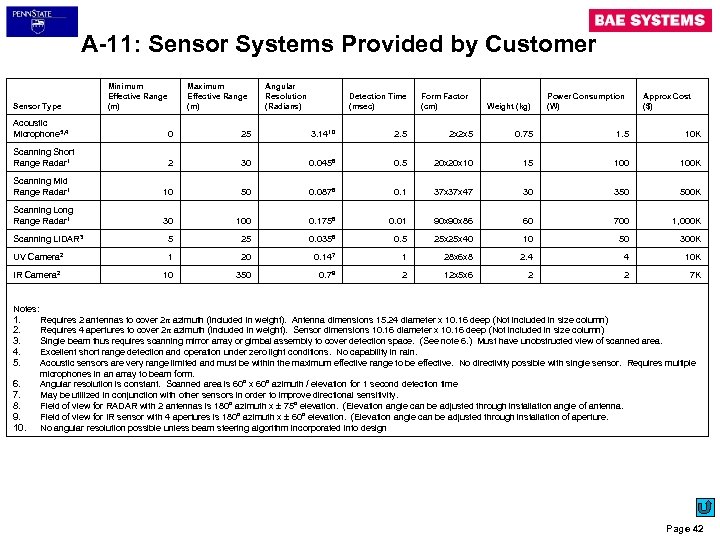 A-11: Sensor Systems Provided by Customer Sensor Type Minimum Effective Range (m) Maximum Effective Range (m) Angular Resolution (Radians) Detection Time (msec) Form Factor (cm) Weight (kg) Power Consumption (W) Approx Cost ($) Acoustic Microphone 5, 4 0 25 3. 1410 2. 5 2 x 2 x 5 0. 75 1. 5 10 K Scanning Short Range Radar 1 2 30 0. 0458 0. 5 20 x 10 15 100 K Scanning Mid Range Radar 1 10 50 0. 0878 0. 1 37 x 47 30 350 500 K Scanning Long Range Radar 1 30 100 0. 1758 0. 01 90 x 86 60 700 1, 000 K Scanning LIDAR 3 5 25 0. 0356 0. 5 25 x 40 10 50 300 K UV Camera 2 1 20 0. 147 1 28 x 6 x 8 2. 4 4 10 K IR Camera 2 10 350 0. 79 2 12 x 5 x 6 2 2 7 K Notes: 1. 2. 3. 4. 5. 6. 7. 8. 9. 10. Requires 2 antennas to cover 2 azimuth (included in weight). Antenna dimensions 15. 24 diameter x 10. 16 deep (Not included in size column) Requires 4 apertures to cover 2 azimuth (included in weight). Sensor dimensions 10. 16 diameter x 10. 16 deep (Not included in size column) Single beam thus requires scanning mirror array or gimbal assembly to cover detection space. (See note 6. ) Must have unobstructed view of scanned area. Excellent short range detection and operation under zero light conditions. No capability in rain. Acoustic sensors are very range limited and must be within the maximum effective range to be effective. No directivity possible with single sensor. Requires multiple microphones in an array to beam form. Angular resolution is constant. Scanned area is 60° x 60° azimuth / elevation for 1 second detection time May be utilized in conjunction with other sensors in order to improve directional sensitivity. Field of view for RADAR with 2 antennas is 180° azimuth x 75° elevation. (Elevation angle can be adjusted through installation angle of antenna. Field of view for IR sensor with 4 apertures is 180° azimuth x 60° elevation. (Elevation angle can be adjusted through installation of aperture. No angular resolution possible unless beam steering algorithm incorporated into design Page 42
 A-12: Creativity Resources ”To have a great idea, have a lot of them. " — Thomas A. Edison • Some web resources on creative techniques – http: //www. brainstorming. co. uk/tutorials/tutorialcontents. html • A comprehensive tutorial on brainstorming and other creative techniques – http: //www. effectivemeetings. com/teams/participation/brainstorming. asp • A pragmatic summary of how to setup and run a brainstorming session – http: //www. promato. com/brainstorm/bslinks. htm • A free trial download of a brainstorming and selection facilitation program Page 43
 A-13: Trade Study Examples • Trade study examples on the web – http: //www. faa. gov/asd/System. Engineering/SEM 3. 0/four_six%20. pdf • A very detailed look at the systems engineering process and at conducting trade studies (Starts on line 27) – http: //www. losangeles. af. mil/Tenants/SCEA/CAIV 18 M/reqtrade 40. ppt • A presentation of a simple CAIV (Cost As an Independent Variable) trade study, a lot of acronyms, most of the good stuff starts on pg 8 Page 44
 A-14: Key customer questions • Key Customer questions – How did you arrive at your timeline and what is it? • Simplifying assumptions you made; why are they valid? – What was your creative process? • Present all of your brainstormed ideas and the context of your brainstorming session? – Why did you select the chosen design? • Have you presented the results of key trade studies conducted? – Have you provided evidence that the concept is effective? • Which obstacle avoidance scenarios can be met successfully? • Which one’s present risk? (How does oncoming traffic effect implementation? – Is your solution realizable, affordable, realistic? – Can your system react to more than one obstacle simultaneously? – Are there any safety related effects from your obstacle detection system design, for example, LIDAR eye safety? • Human life, property? • What ethical issues have been considered? – How long from start to develop and field your solution? – Will it work in a range of outdoor environments? • hot, cold, snow, sand, rain, etc. ? Page 45
 A-15: Assessing Your Offering You will need to perform a critical self-assessment of your offering - before your customer does. Here are some questions to consider: • Available technologies. – What type of technologies can be utilized? Need to be utilized? • Does it exist and how can it be adapted to this problem? • Enabling technologies requiring further development – What needs to be invented? • Is it physically possible? • Cost prohibitive? • What is the system configuration? – Is it compatible with the intended user. • Size, cost, etc. • Does the system specified meet the goal of detecting the target? Page 46