 Скачать презентацию Penn Discourse Treebank PDTB 2 0 Rashmi Prasad
ce1523c60313544c8299a9238fb8a7c8.ppt
- Количество слайдов: 43



Penn Discourse Treebank PDTB 2. 0 Rashmi Prasad, Nikhil Dinesh, Alan Lee, Eleni Miltsakaki, Aravind Joshi University of Pennsylvania, USA Livio Robaldo University of Torino, Italy Bonnie Webber University of Edinburgh, UK LREC VIII, Marrakech, Morocco. May 29, 2008 1
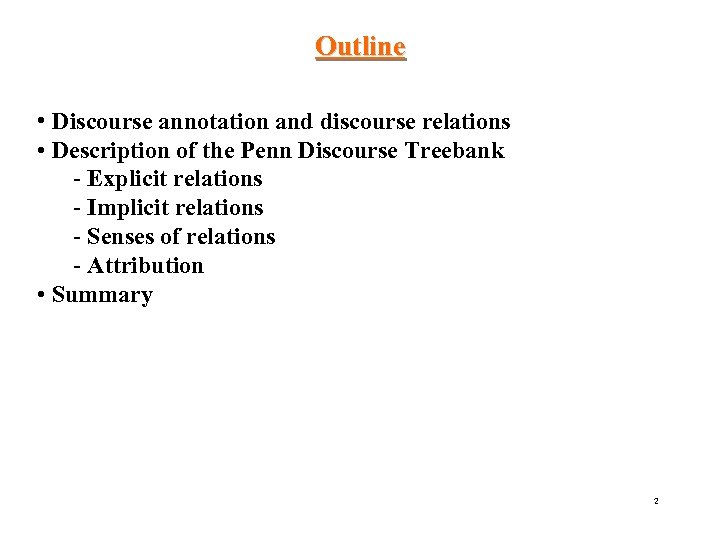
Outline • Discourse annotation and discourse relations • Description of the Penn Discourse Treebank - Explicit relations - Implicit relations - Senses of relations - Attribution • Summary 2
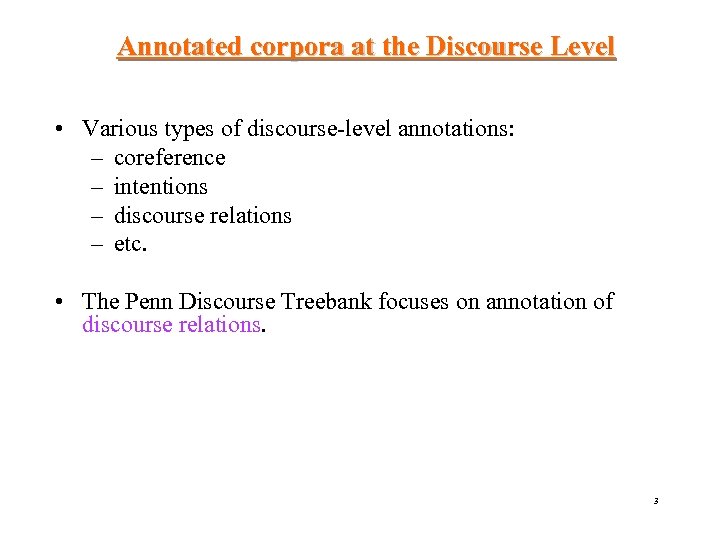
Annotated corpora at the Discourse Level • Various types of discourse-level annotations: – coreference – intentions – discourse relations – etc. • The Penn Discourse Treebank focuses on annotation of discourse relations. 3
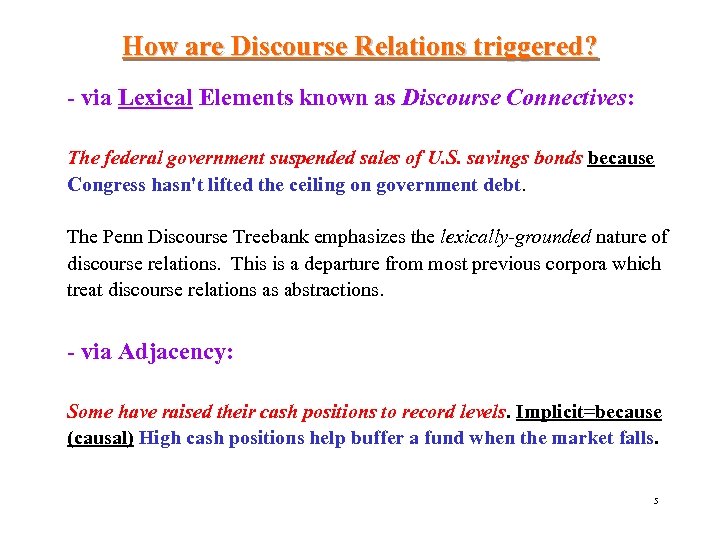
How are Discourse Relations triggered? - via Lexical Elements known as Discourse Connectives: The federal government suspended sales of U. S. savings bonds because Congress hasn't lifted the ceiling on government debt. The Penn Discourse Treebank emphasizes the lexically-grounded nature of discourse relations. This is a departure from most previous corpora which treat discourse relations as abstractions. - via Adjacency: Some have raised their cash positions to record levels. Implicit=because (causal) High cash positions help buffer a fund when the market falls. 5
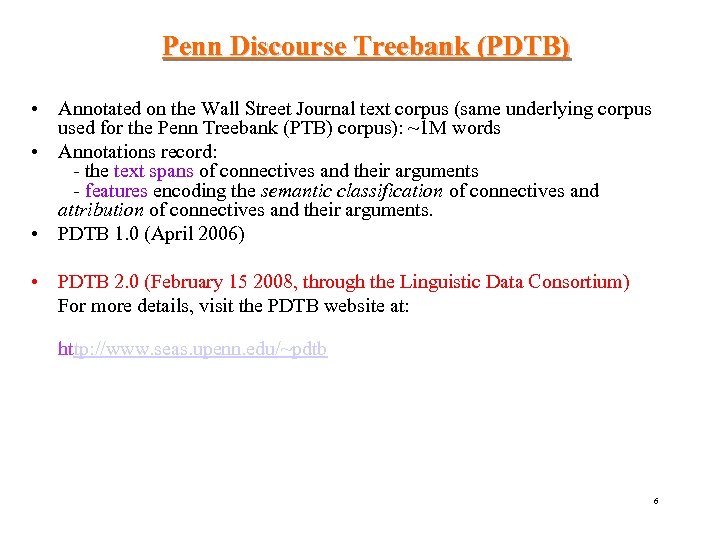
Penn Discourse Treebank (PDTB) • Annotated on the Wall Street Journal text corpus (same underlying corpus used for the Penn Treebank (PTB) corpus): ~1 M words • Annotations record: - the text spans of connectives and their arguments - features encoding the semantic classification of connectives and attribution of connectives and their arguments. • PDTB 1. 0 (April 2006) • PDTB 2. 0 (February 15 2008, through the Linguistic Data Consortium) For more details, visit the PDTB website at: http: //www. seas. upenn. edu/~pdtb 6
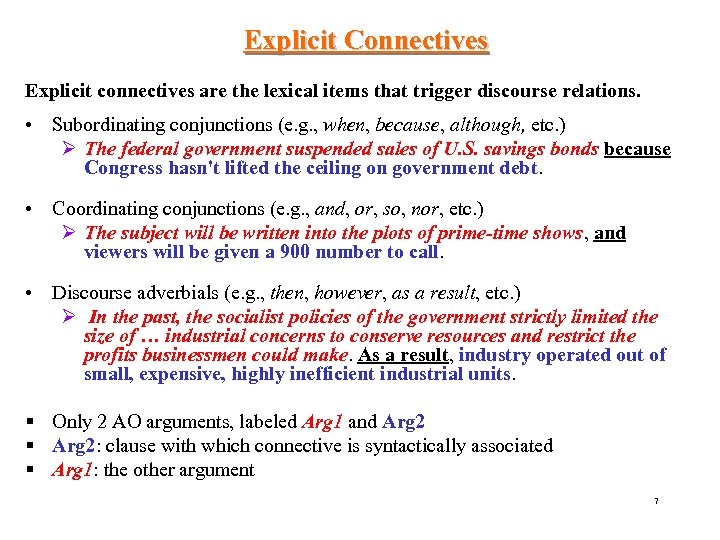
Explicit Connectives Explicit connectives are the lexical items that trigger discourse relations. • Subordinating conjunctions (e. g. , when, because, although, etc. ) Ø The federal government suspended sales of U. S. savings bonds because Congress hasn't lifted the ceiling on government debt. • Coordinating conjunctions (e. g. , and, or, so, nor, etc. ) Ø The subject will be written into the plots of prime-time shows, and viewers will be given a 900 number to call. • Discourse adverbials (e. g. , then, however, as a result, etc. ) Ø In the past, the socialist policies of the government strictly limited the size of … industrial concerns to conserve resources and restrict the profits businessmen could make. As a result, industry operated out of small, expensive, highly inefficient industrial units. § Only 2 AO arguments, labeled Arg 1 and Arg 2 § Arg 2: clause with which connective is syntactically associated § Arg 1: the other argument 7
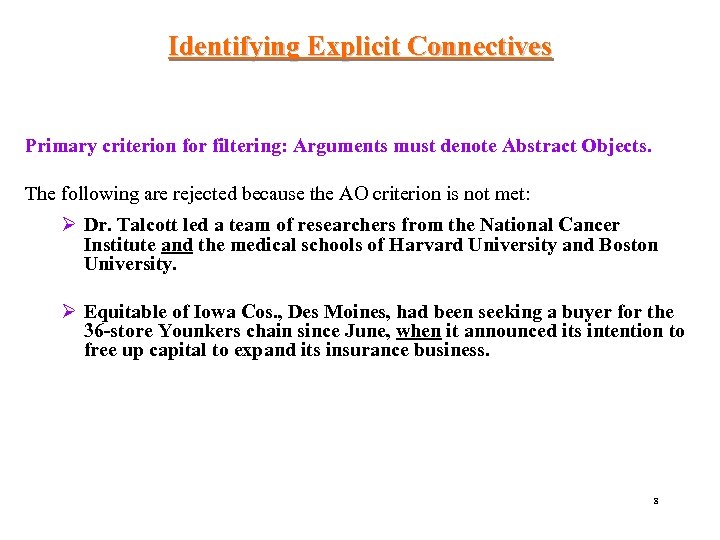
Identifying Explicit Connectives Primary criterion for filtering: Arguments must denote Abstract Objects. The following are rejected because the AO criterion is not met: Ø Dr. Talcott led a team of researchers from the National Cancer Institute and the medical schools of Harvard University and Boston University. Ø Equitable of Iowa Cos. , Des Moines, had been seeking a buyer for the 36 -store Younkers chain since June, when it announced its intention to free up capital to expand its insurance business. 8
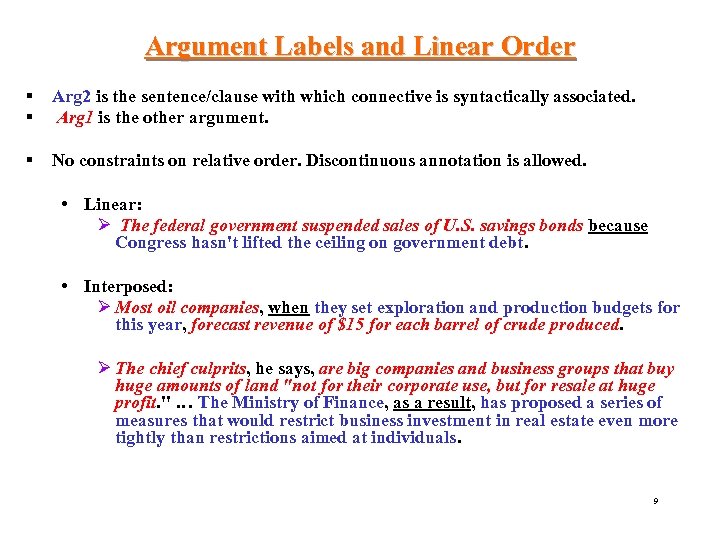
Argument Labels and Linear Order § § Arg 2 is the sentence/clause with which connective is syntactically associated. Arg 1 is the other argument. § No constraints on relative order. Discontinuous annotation is allowed. • Linear: Ø The federal government suspended sales of U. S. savings bonds because Congress hasn't lifted the ceiling on government debt. • Interposed: Ø Most oil companies, when they set exploration and production budgets for this year, forecast revenue of $15 for each barrel of crude produced. Ø The chief culprits, he says, are big companies and business groups that buy huge amounts of land "not for their corporate use, but for resale at huge profit. " … The Ministry of Finance, as a result, has proposed a series of measures that would restrict business investment in real estate even more tightly than restrictions aimed at individuals. 9
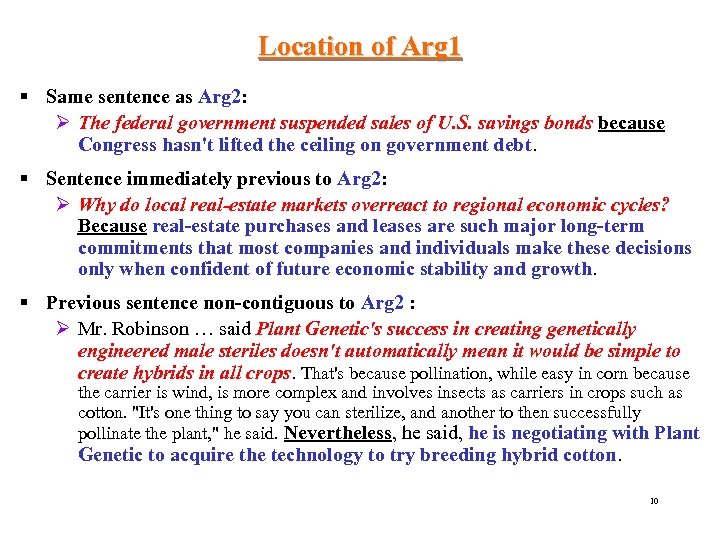
Location of Arg 1 § Same sentence as Arg 2: Ø The federal government suspended sales of U. S. savings bonds because Congress hasn't lifted the ceiling on government debt. § Sentence immediately previous to Arg 2: Ø Why do local real-estate markets overreact to regional economic cycles? Because real-estate purchases and leases are such major long-term commitments that most companies and individuals make these decisions only when confident of future economic stability and growth. § Previous sentence non-contiguous to Arg 2 : Ø Mr. Robinson … said Plant Genetic's success in creating genetically engineered male steriles doesn't automatically mean it would be simple to create hybrids in all crops. That's because pollination, while easy in corn because the carrier is wind, is more complex and involves insects as carriers in crops such as cotton. "It's one thing to say you can sterilize, and another to then successfully pollinate the plant, " he said. Nevertheless, he said, he is negotiating with Plant Genetic to acquire the technology to try breeding hybrid cotton. 10
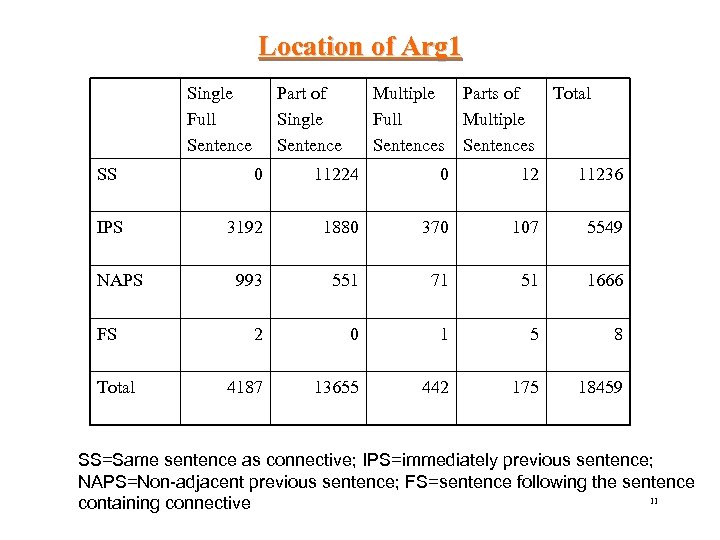
Location of Arg 1 Single Full Sentence SS IPS NAPS FS Total Part of Single Sentence Multiple Full Sentences Parts of Multiple Sentences Total 0 11224 0 12 11236 3192 1880 370 107 5549 993 551 71 51 1666 2 0 1 5 8 4187 13655 442 175 18459 SS=Same sentence as connective; IPS=immediately previous sentence; NAPS=Non-adjacent previous sentence; FS=sentence following the sentence 11 containing connective
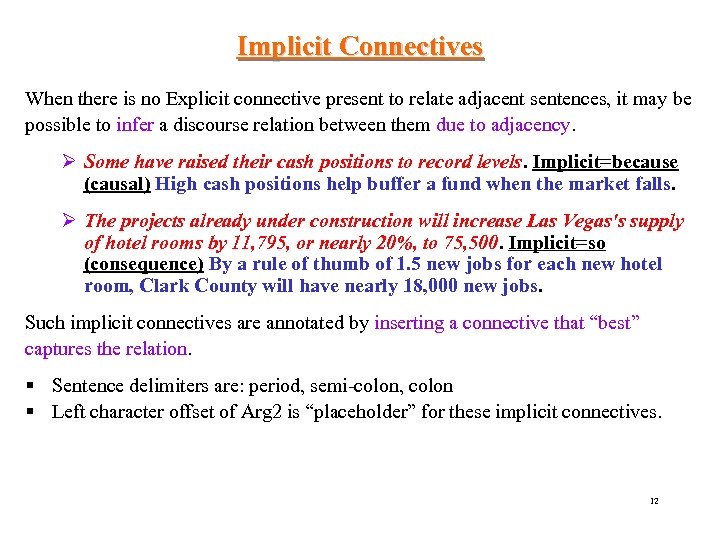
Implicit Connectives When there is no Explicit connective present to relate adjacent sentences, it may be possible to infer a discourse relation between them due to adjacency. Ø Some have raised their cash positions to record levels. Implicit=because (causal) High cash positions help buffer a fund when the market falls. Ø The projects already under construction will increase Las Vegas's supply of hotel rooms by 11, 795, or nearly 20%, to 75, 500. Implicit=so (consequence) By a rule of thumb of 1. 5 new jobs for each new hotel room, Clark County will have nearly 18, 000 new jobs. Such implicit connectives are annotated by inserting a connective that “best” captures the relation. § Sentence delimiters are: period, semi-colon, colon § Left character offset of Arg 2 is “placeholder” for these implicit connectives. 12
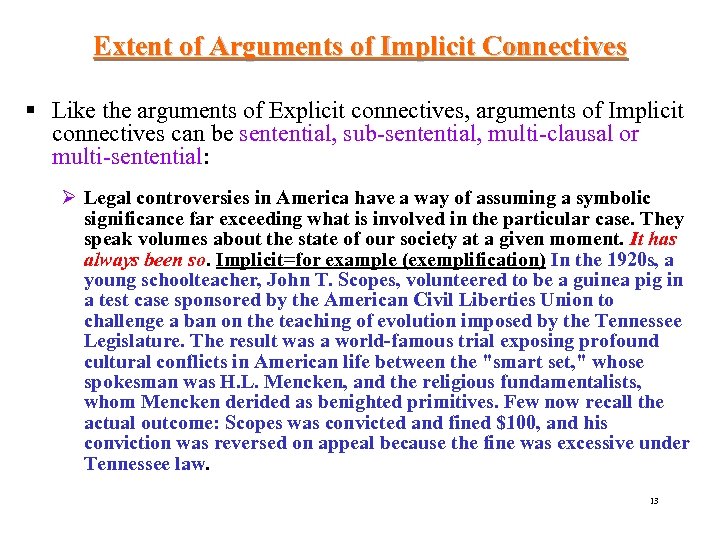
Extent of Arguments of Implicit Connectives § Like the arguments of Explicit connectives, arguments of Implicit connectives can be sentential, sub-sentential, multi-clausal or multi-sentential: Ø Legal controversies in America have a way of assuming a symbolic significance far exceeding what is involved in the particular case. They speak volumes about the state of our society at a given moment. It has always been so. Implicit=for example (exemplification) In the 1920 s, a young schoolteacher, John T. Scopes, volunteered to be a guinea pig in a test case sponsored by the American Civil Liberties Union to challenge a ban on the teaching of evolution imposed by the Tennessee Legislature. The result was a world-famous trial exposing profound cultural conflicts in American life between the "smart set, " whose spokesman was H. L. Mencken, and the religious fundamentalists, whom Mencken derided as benighted primitives. Few now recall the actual outcome: Scopes was convicted and fined $100, and his conviction was reversed on appeal because the fine was excessive under Tennessee law. 13
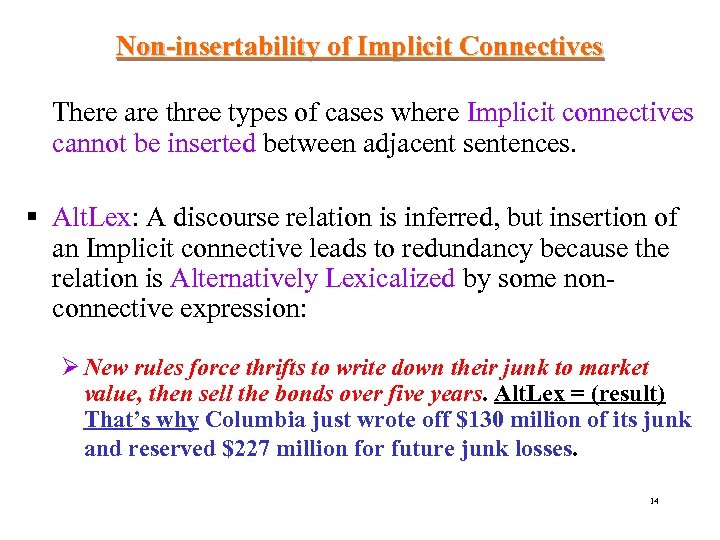
Non-insertability of Implicit Connectives There are three types of cases where Implicit connectives cannot be inserted between adjacent sentences. § Alt. Lex: A discourse relation is inferred, but insertion of an Implicit connective leads to redundancy because the relation is Alternatively Lexicalized by some nonconnective expression: Ø New rules force thrifts to write down their junk to market value, then sell the bonds over five years. Alt. Lex = (result) That’s why Columbia just wrote off $130 million of its junk and reserved $227 million for future junk losses. 14
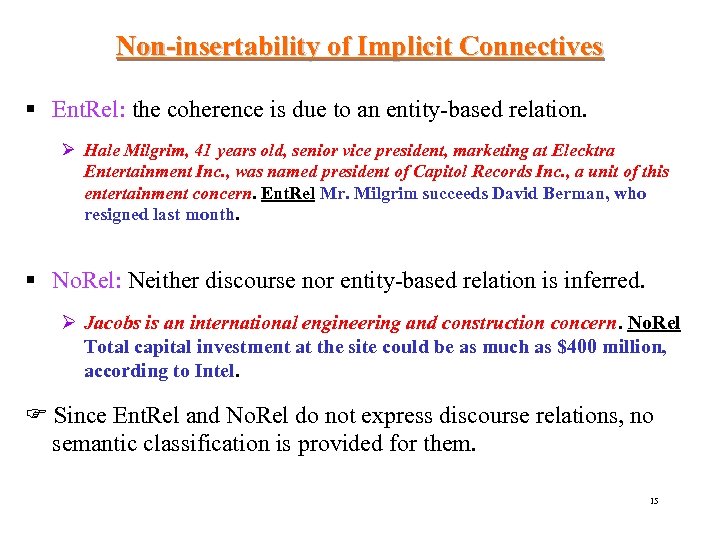
Non-insertability of Implicit Connectives § Ent. Rel: the coherence is due to an entity-based relation. Ø Hale Milgrim, 41 years old, senior vice president, marketing at Elecktra Entertainment Inc. , was named president of Capitol Records Inc. , a unit of this entertainment concern. Ent. Rel Mr. Milgrim succeeds David Berman, who resigned last month. § No. Rel: Neither discourse nor entity-based relation is inferred. Ø Jacobs is an international engineering and construction concern. No. Rel Total capital investment at the site could be as much as $400 million, according to Intel. Since Ent. Rel and No. Rel do not express discourse relations, no semantic classification is provided for them. 15
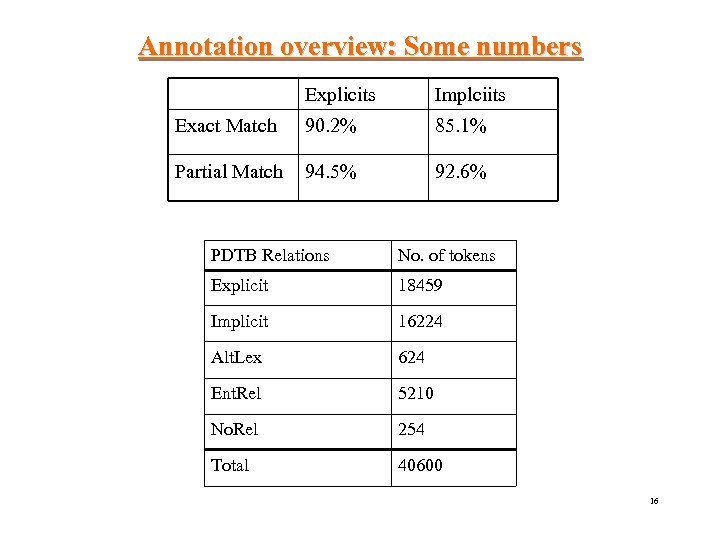
Annotation overview: Some numbers Explicits Implciits Exact Match 90. 2% 85. 1% Partial Match 94. 5% 92. 6% PDTB Relations No. of tokens Explicit 18459 Implicit 16224 Alt. Lex 624 Ent. Rel 5210 No. Rel 254 Total 40600 16
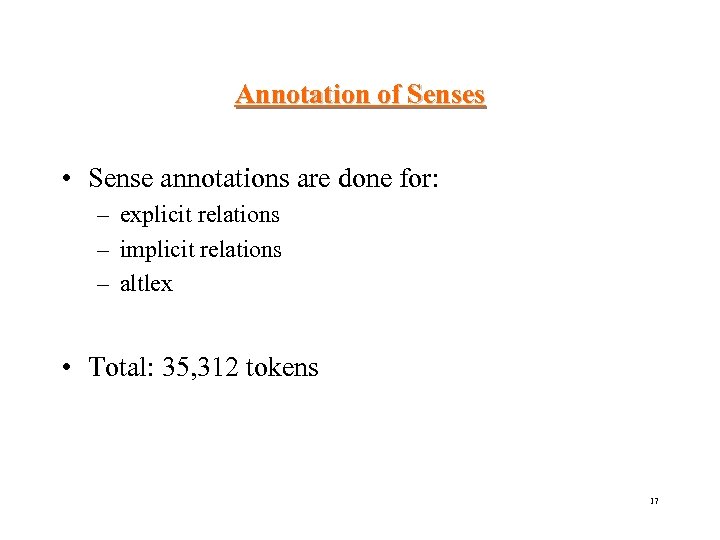
Annotation of Senses • Sense annotations are done for: – explicit relations – implicit relations – altlex • Total: 35, 312 tokens 17
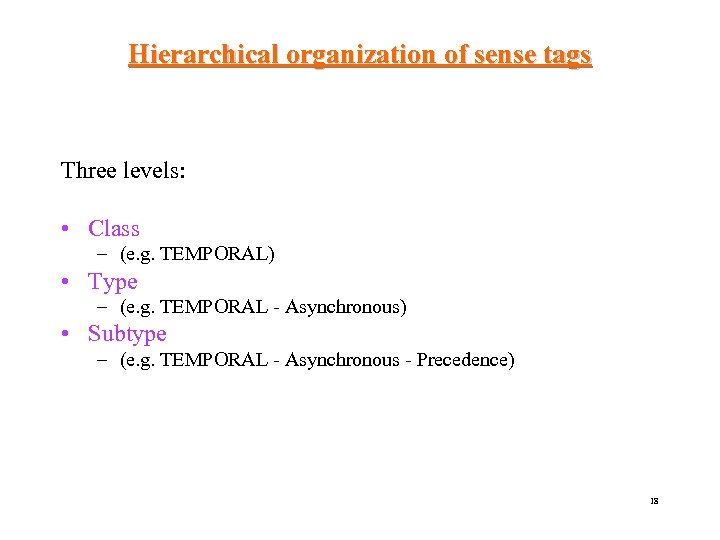
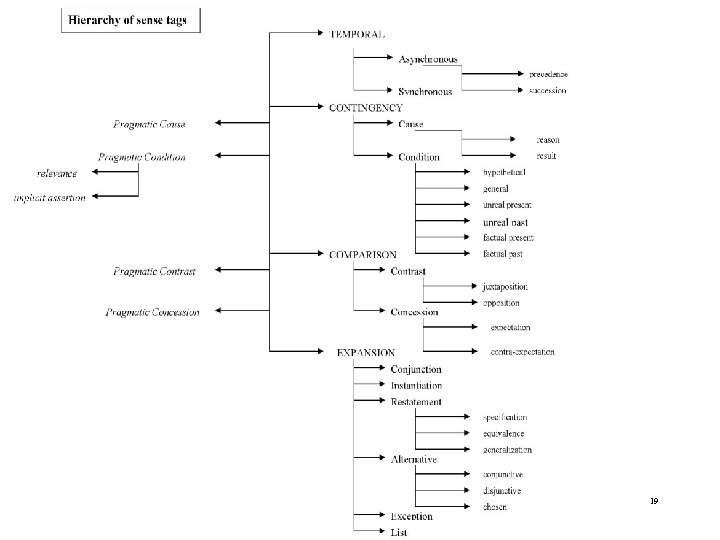
Hierarchical organization of sense tags Three levels: • Class – (e. g. TEMPORAL) • Type – (e. g. TEMPORAL - Asynchronous) • Subtype – (e. g. TEMPORAL - Asynchronous - Precedence) 18
19
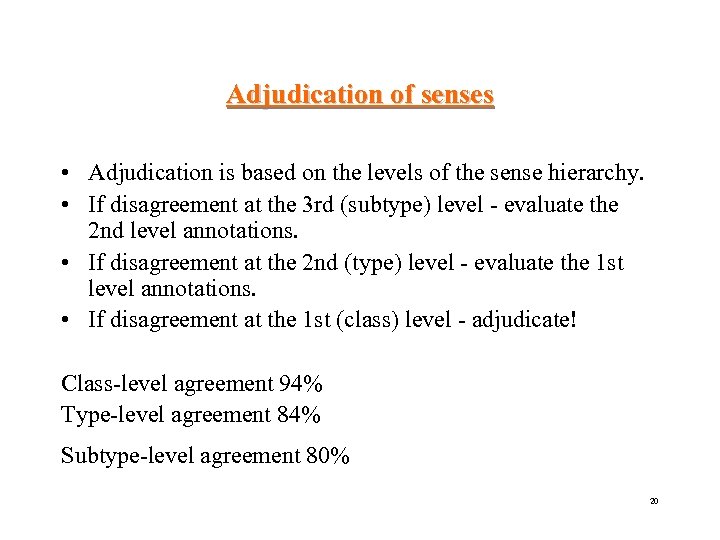
Adjudication of senses • Adjudication is based on the levels of the sense hierarchy. • If disagreement at the 3 rd (subtype) level - evaluate the 2 nd level annotations. • If disagreement at the 2 nd (type) level - evaluate the 1 st level annotations. • If disagreement at the 1 st (class) level - adjudicate! Class-level agreement 94% Type-level agreement 84% Subtype-level agreement 80% 20
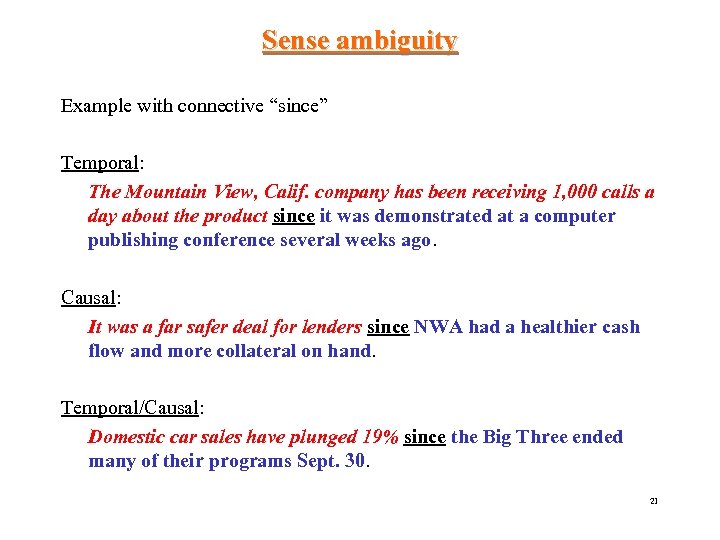
Sense ambiguity Example with connective “since” Temporal: The Mountain View, Calif. company has been receiving 1, 000 calls a day about the product since it was demonstrated at a computer publishing conference several weeks ago. Causal: It was a far safer deal for lenders since NWA had a healthier cash flow and more collateral on hand. Temporal/Causal: Domestic car sales have plunged 19% since the Big Three ended many of their programs Sept. 30. 21
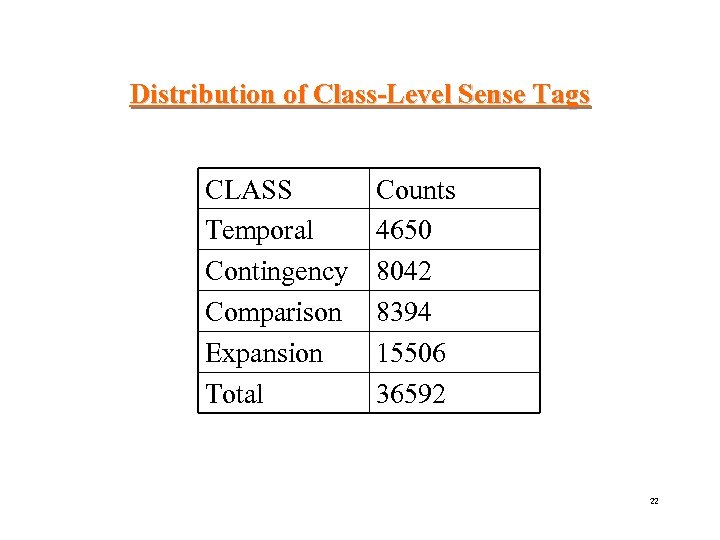
Distribution of Class-Level Sense Tags CLASS Temporal Contingency Comparison Expansion Total Counts 4650 8042 8394 15506 36592 22
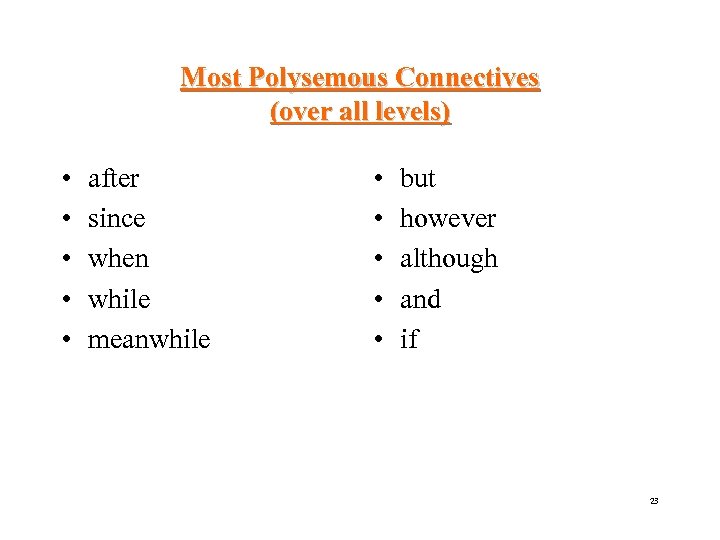
Most Polysemous Connectives (over all levels) • • • after since when while meanwhile • • • but however although and if 23
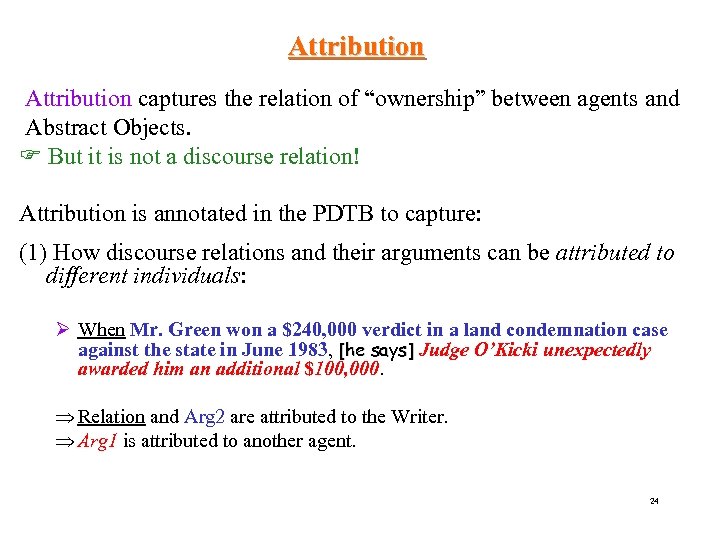
Attribution captures the relation of “ownership” between agents and Abstract Objects. But it is not a discourse relation! Attribution is annotated in the PDTB to capture: (1) How discourse relations and their arguments can be attributed to different individuals: Ø When Mr. Green won a $240, 000 verdict in a land condemnation case against the state in June 1983, [he says] Judge O’Kicki unexpectedly awarded him an additional $100, 000. Þ Relation and Arg 2 are attributed to the Writer. Þ Arg 1 is attributed to another agent. 24
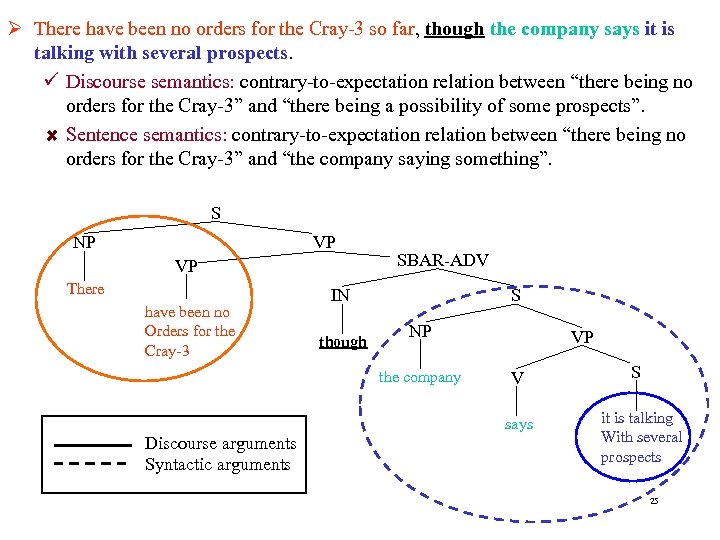
Ø There have been no orders for the Cray-3 so far, though the company says it is talking with several prospects. ü Discourse semantics: contrary-to-expectation relation between “there being no orders for the Cray-3” and “there being a possibility of some prospects”. Sentence semantics: contrary-to-expectation relation between “there being no orders for the Cray-3” and “the company saying something”. S NP VP VP There have been no Orders for the Cray-3 SBAR-ADV IN though S NP the company VP V says Discourse arguments Syntactic arguments S it is talking With several prospects 25
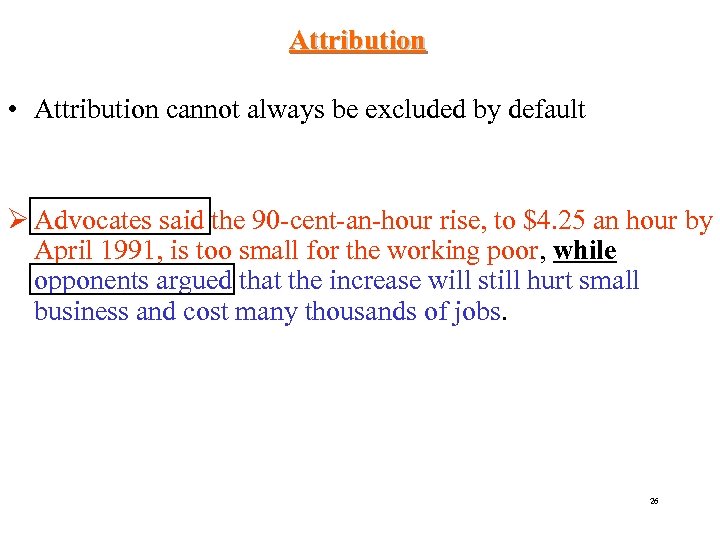
Attribution • Attribution cannot always be excluded by default Ø Advocates said the 90 -cent-an-hour rise, to $4. 25 an hour by April 1991, is too small for the working poor, while opponents argued that the increase will still hurt small business and cost many thousands of jobs. 26
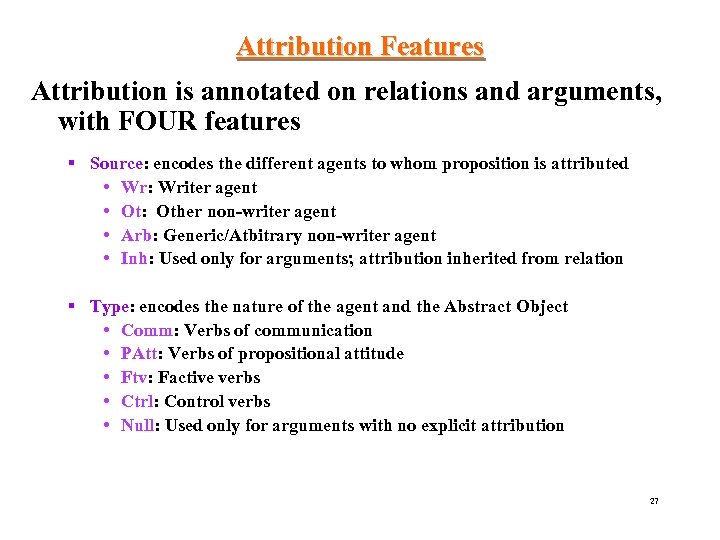
Attribution Features Attribution is annotated on relations and arguments, with FOUR features § Source: encodes the different agents to whom proposition is attributed • Wr: Writer agent • Ot: Other non-writer agent • Arb: Generic/Atbitrary non-writer agent • Inh: Used only for arguments; attribution inherited from relation § Type: encodes the nature of the agent and the Abstract Object • Comm: Verbs of communication • PAtt: Verbs of propositional attitude • Ftv: Factive verbs • Ctrl: Control verbs • Null: Used only for arguments with no explicit attribution 27
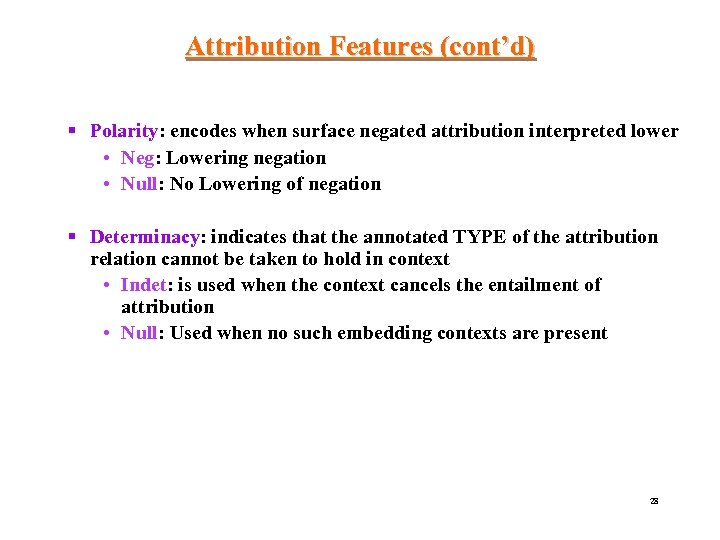
Attribution Features (cont’d) § Polarity: encodes when surface negated attribution interpreted lower • Neg: Lowering negation • Null: No Lowering of negation § Determinacy: indicates that the annotated TYPE of the attribution relation cannot be taken to hold in context • Indet: is used when the context cancels the entailment of attribution • Null: Used when no such embedding contexts are present 28
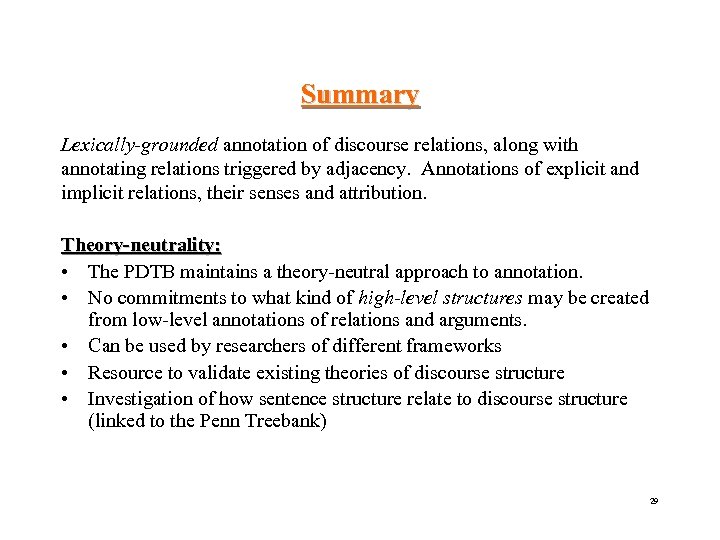
Summary Lexically-grounded annotation of discourse relations, along with annotating relations triggered by adjacency. Annotations of explicit and implicit relations, their senses and attribution. Theory-neutrality: • The PDTB maintains a theory-neutral approach to annotation. • No commitments to what kind of high-level structures may be created from low-level annotations of relations and arguments. • Can be used by researchers of different frameworks • Resource to validate existing theories of discourse structure • Investigation of how sentence structure relate to discourse structure (linked to the Penn Treebank) 29
Summary Future work: • Use PDTB as a resource for the linguistic study of discourse structure and semantics. • Collaborate with other institutes for the anntotation of other languages. Plans are currently under way for Turkish, Hindi, Czech, and possibly Finnish. • Potential applications: summarization, information extraction, generation. PDTB 2. 0 is available from the Linguistic Data Consortium. See website at: http: //www. seas. upenn. edu/~pdtb This work was partially supported by NSF grants: EIA-02 -24417, EIA-05 -63063, and IIS-07 -05671. 30

Shukran! Merci! Thank you! 31
Modified Connectives can be modified by adverbs and focus particles: Ø That power can sometimes be abused, (particularly) since jurists in smaller jurisdictions operate without many of the restraints that serve as corrective measures in urban areas. Ø You can do all this (even) if you're not a reporter or a researcher or a scholar or a member of Congress. § Initially identified connective (since, if) is extended to include modifiers. Each annotation token includes both head and modifier (e. g. , even if). Each token has its head as a feature (e. g. , if) 32
Parallel Connectives Paired connectives take the same arguments: Ø On the one hand, Mr. Front says, it would be misguided to sell into "a classic panic. " On the other hand, it's not necessarily a good time to jump in and buy. Ø Either sign new long-term commitments to buy future episodes or risk losing "Cosby" to a competitor. § Treated as complex connectives – annotated discontinuously § Listed as distinct types (no head-modifier relation) (More in the second talk) 33
Complex Connectives Multiple relations can sometimes be expressed as a conjunction of connectives: Ø When and if the trust runs out of cash -- which seems increasingly likely -- it will need to convert its Manville stock to cash. Ø Hoylake dropped its initial #13. 35 billion ($20. 71 billion) takeover bid after it received the extension, but said it would launch a new bid if and when the proposed sale of Farmers to Axa receives regulatory approval. • Treated as complex connectives • Listed as distinct types (no head-modifier relation) 34
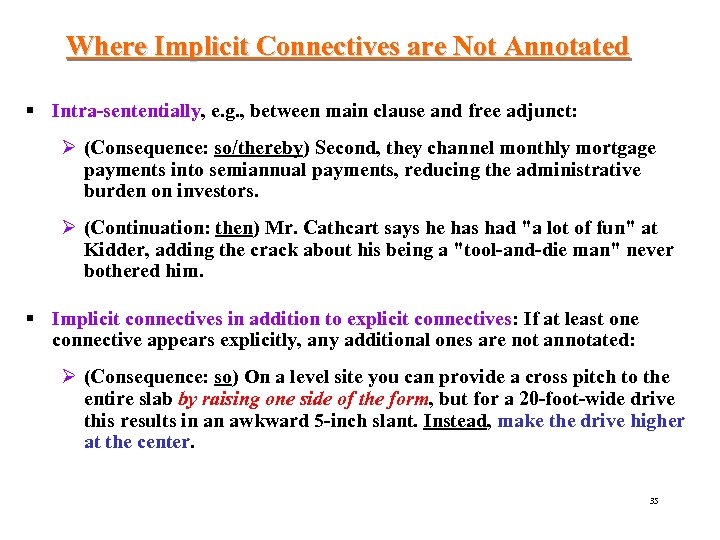
Where Implicit Connectives are Not Annotated § Intra-sententially, e. g. , between main clause and free adjunct: Ø (Consequence: so/thereby) Second, they channel monthly mortgage payments into semiannual payments, reducing the administrative burden on investors. Ø (Continuation: then) Mr. Cathcart says he has had "a lot of fun" at Kidder, adding the crack about his being a "tool-and-die man" never bothered him. § Implicit connectives in addition to explicit connectives: If at least one connective appears explicitly, any additional ones are not annotated: Ø (Consequence: so) On a level site you can provide a cross pitch to the entire slab by raising one side of the form, but for a 20 -foot-wide drive this results in an awkward 5 -inch slant. Instead, make the drive higher at the center. 35
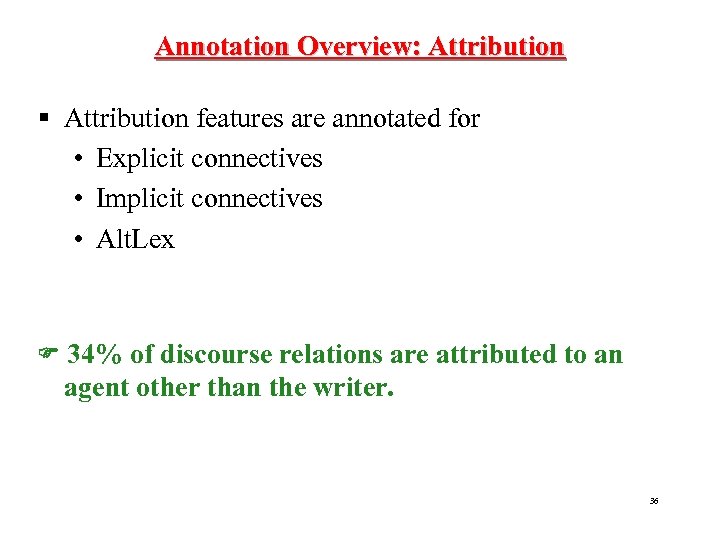
Annotation Overview: Attribution § Attribution features are annotated for • Explicit connectives • Implicit connectives • Alt. Lex 34% of discourse relations are attributed to an agent other than the writer. 36
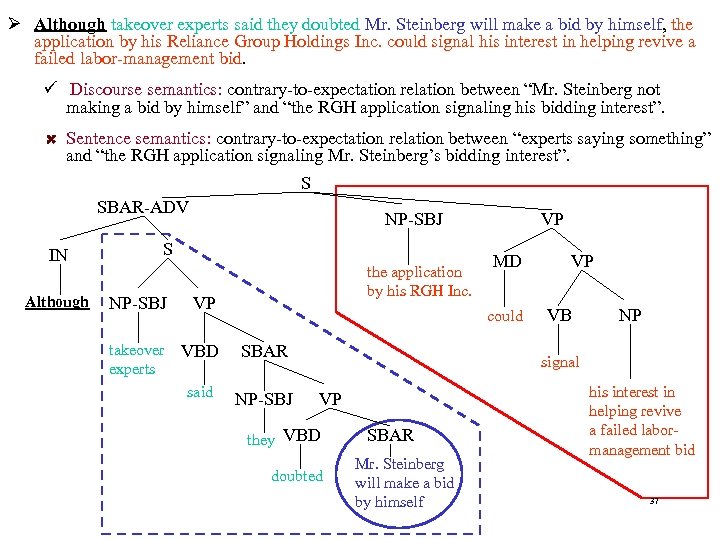
Ø Although takeover experts said they doubted Mr. Steinberg will make a bid by himself, the application by his Reliance Group Holdings Inc. could signal his interest in helping revive a failed labor-management bid. ü Discourse semantics: contrary-to-expectation relation between “Mr. Steinberg not making a bid by himself” and “the RGH application signaling his bidding interest”. Sentence semantics: contrary-to-expectation relation between “experts saying something” and “the RGH application signaling Mr. Steinberg’s bidding interest”. S SBAR-ADV IN Although NP-SBJ S the application by his RGH Inc. NP-SBJ VP takeover experts VBD SBAR said NP-SBJ VP MD could VP VB NP signal VP they VBD doubted SBAR Mr. Steinberg will make a bid by himself his interest in helping revive a failed labormanagement bid 37
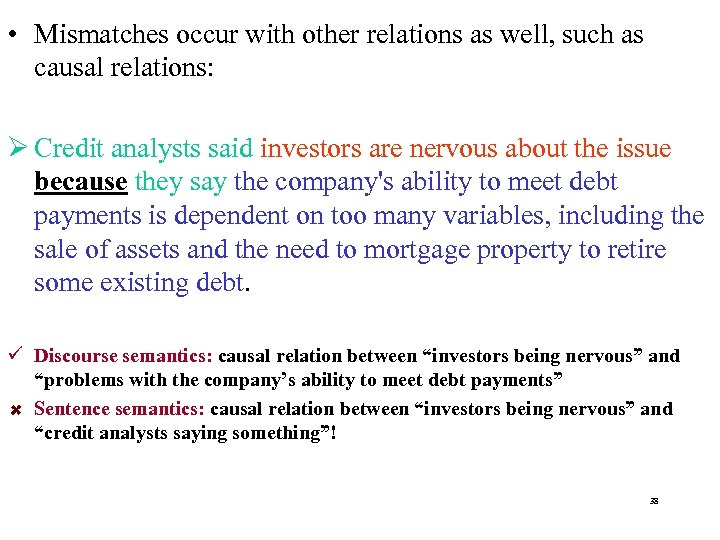
• Mismatches occur with other relations as well, such as causal relations: Ø Credit analysts said investors are nervous about the issue because they say the company's ability to meet debt payments is dependent on too many variables, including the sale of assets and the need to mortgage property to retire some existing debt. ü Discourse semantics: causal relation between “investors being nervous” and “problems with the company’s ability to meet debt payments” Sentence semantics: causal relation between “investors being nervous” and “credit analysts saying something”! 38
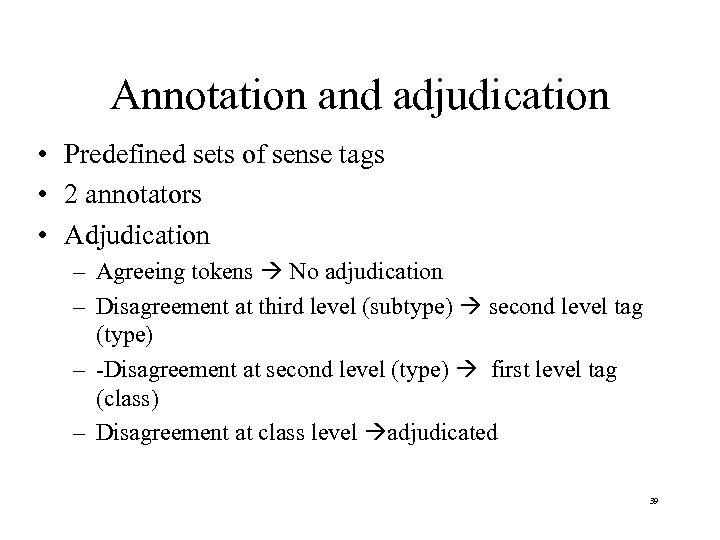
Annotation and adjudication • Predefined sets of sense tags • 2 annotators • Adjudication – Agreeing tokens No adjudication – Disagreement at third level (subtype) second level tag (type) – -Disagreement at second level (type) first level tag (class) – Disagreement at class level adjudicated 39
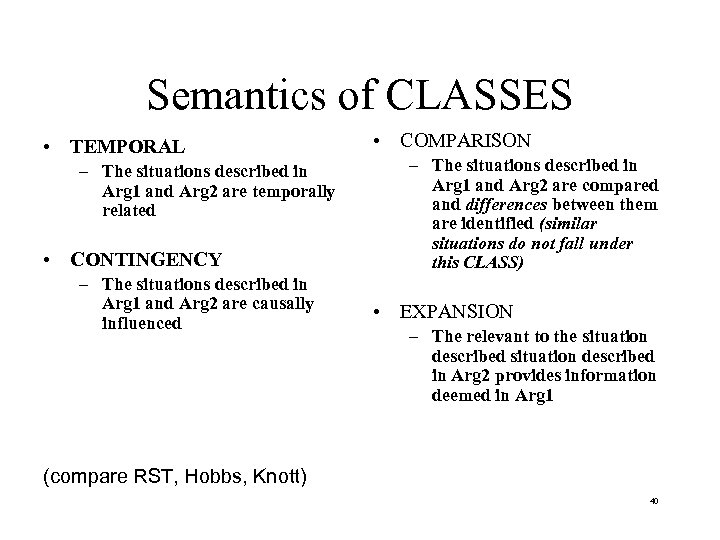
Semantics of CLASSES • TEMPORAL – The situations described in Arg 1 and Arg 2 are temporally related • CONTINGENCY – The situations described in Arg 1 and Arg 2 are causally influenced • COMPARISON – The situations described in Arg 1 and Arg 2 are compared and differences between them are identified (similar situations do not fall under this CLASS) • EXPANSION – The relevant to the situation described in Arg 2 provides information deemed in Arg 1 (compare RST, Hobbs, Knott) 40
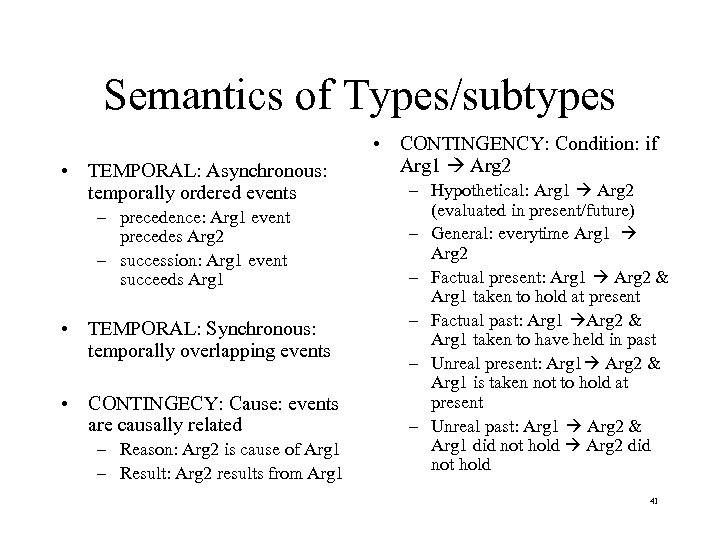
Semantics of Types/subtypes • TEMPORAL: Asynchronous: temporally ordered events – precedence: Arg 1 event precedes Arg 2 – succession: Arg 1 event succeeds Arg 1 • TEMPORAL: Synchronous: temporally overlapping events • CONTINGECY: Cause: events are causally related – Reason: Arg 2 is cause of Arg 1 – Result: Arg 2 results from Arg 1 • CONTINGENCY: Condition: if Arg 1 Arg 2 – Hypothetical: Arg 1 Arg 2 (evaluated in present/future) – General: everytime Arg 1 Arg 2 – Factual present: Arg 1 Arg 2 & Arg 1 taken to hold at present – Factual past: Arg 1 Arg 2 & Arg 1 taken to have held in past – Unreal present: Arg 1 Arg 2 & Arg 1 is taken not to hold at present – Unreal past: Arg 1 Arg 2 & Arg 1 did not hold Arg 2 did not hold 41
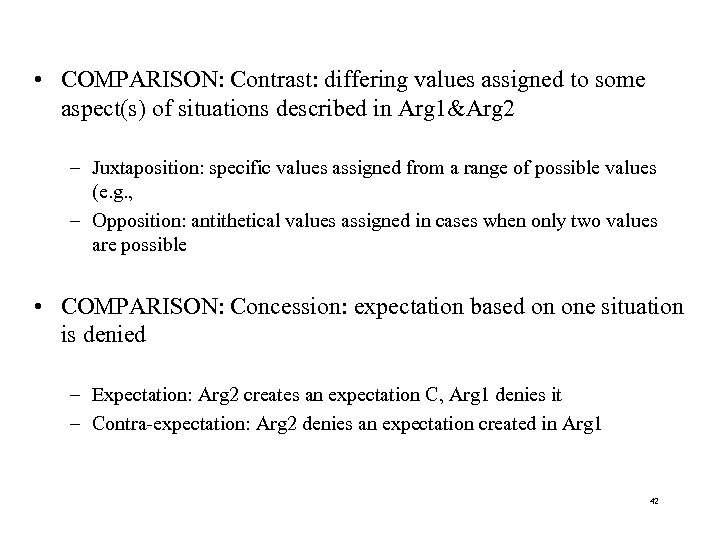
• COMPARISON: Contrast: differing values assigned to some aspect(s) of situations described in Arg 1&Arg 2 – Juxtaposition: specific values assigned from a range of possible values (e. g. , – Opposition: antithetical values assigned in cases when only two values are possible • COMPARISON: Concession: expectation based on one situation is denied – Expectation: Arg 2 creates an expectation C, Arg 1 denies it – Contra-expectation: Arg 2 denies an expectation created in Arg 1 42
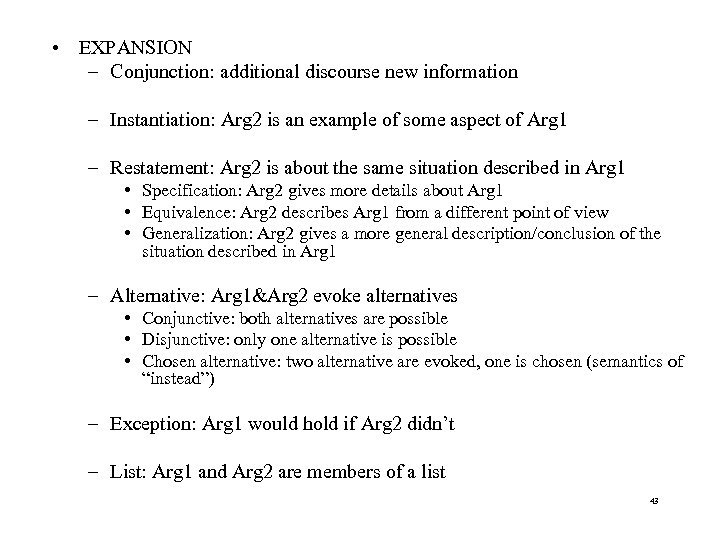
• EXPANSION – Conjunction: additional discourse new information – Instantiation: Arg 2 is an example of some aspect of Arg 1 – Restatement: Arg 2 is about the same situation described in Arg 1 • Specification: Arg 2 gives more details about Arg 1 • Equivalence: Arg 2 describes Arg 1 from a different point of view • Generalization: Arg 2 gives a more general description/conclusion of the situation described in Arg 1 – Alternative: Arg 1&Arg 2 evoke alternatives • Conjunctive: both alternatives are possible • Disjunctive: only one alternative is possible • Chosen alternative: two alternative are evoked, one is chosen (semantics of “instead”) – Exception: Arg 1 would hold if Arg 2 didn’t – List: Arg 1 and Arg 2 are members of a list 43
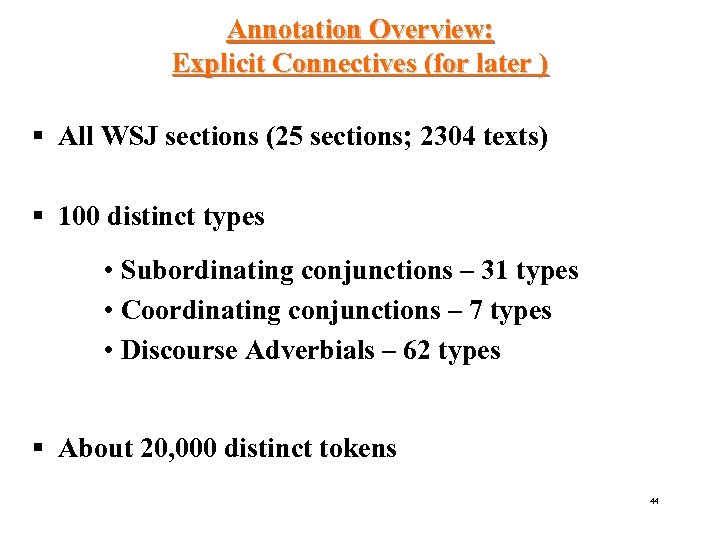
Annotation Overview: Explicit Connectives (for later ) § All WSJ sections (25 sections; 2304 texts) § 100 distinct types • Subordinating conjunctions – 31 types • Coordinating conjunctions – 7 types • Discourse Adverbials – 62 types § About 20, 000 distinct tokens 44
Скачать презентацию Penn Discourse Treebank PDTB 2 0 Rashmi Prasad
ce1523c60313544c8299a9238fb8a7c8.ppt