


 Скачать презентацию Pekka Haavisto UNEP Early warning and post-conflict perspectives
9dbb610b91fc549907948ca1434f2590.ppt
- Количество слайдов: 24
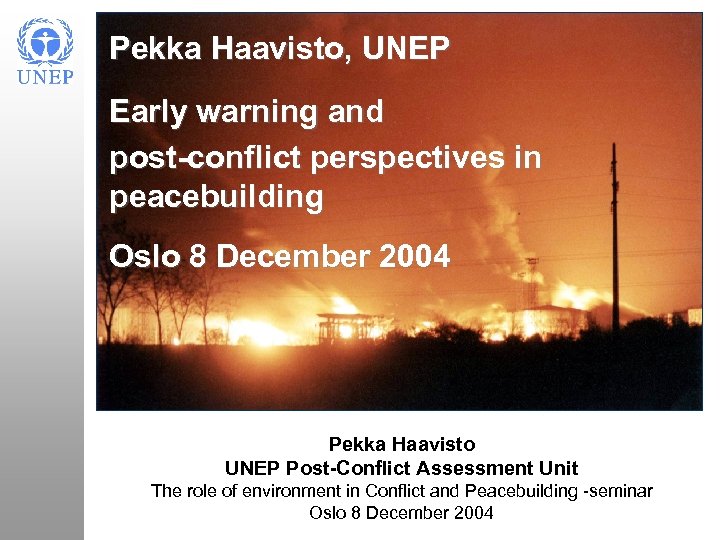 Pekka Haavisto, UNEP Early warning and post-conflict perspectives in peacebuilding Oslo 8 December 2004 In the ashes of conflict lie the seeds of regeneration. Pekka Haavisto UNEP Post-Conflict Assessment Unit The role of environment in Conflict and Peacebuilding -seminar Oslo 8 December 2004
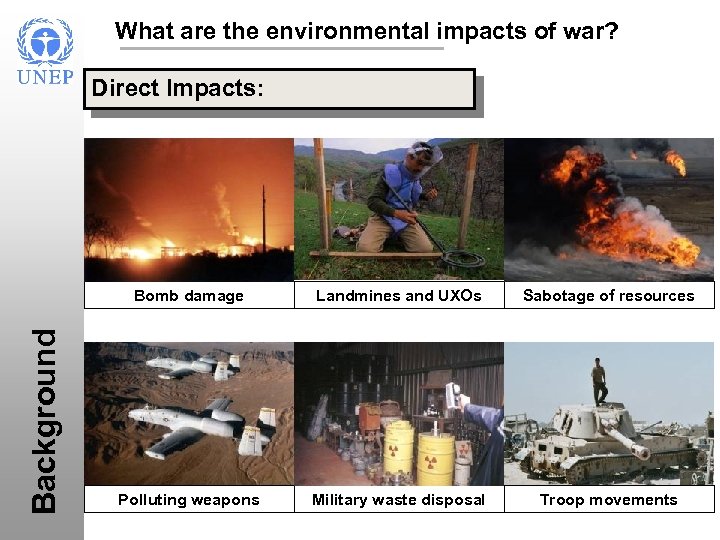 What are the environmental impacts of war? Direct Impacts: What are the environmental impacts of war? Background Bomb damage Bomb Damage Landmines and UXOs Sabotage of resources Depleted uranium Military waste disposal Troop movements Landmines and UXOs Sabotage of resources In the ashes of conflict lie the seeds of regeneration. Polluting weapons Military waste disposal Troop movements
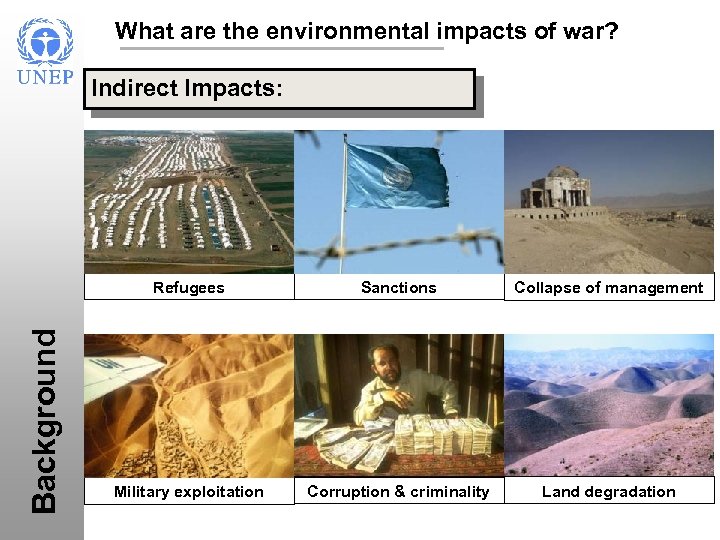 What are the environmental impacts of war? Indirect Impacts: What are the environmental impacts of war? Indirect Impacts Background Refugees Sanctions Collapse of management Military exploitation Opportunity costs Use of marginal lands Sanctions Collapse of management In the ashes of conflict lie the seeds of regeneration. Military exploitation Corruption & criminality Land degradation
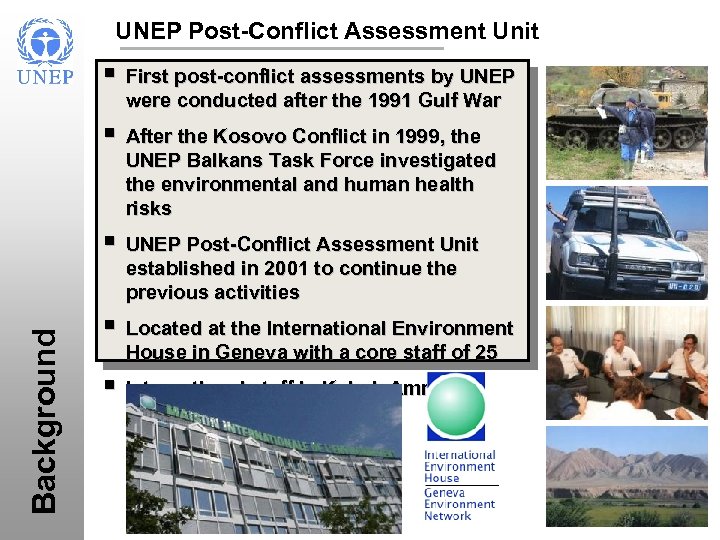 UNEP Post-Conflict Assessment Unit § First post-conflict assessments by UNEP were conducted after the 1991 Gulf War § After the Kosovo Conflict in 1999, the UNEP Balkans Task Force investigated the environmental and human health risks § UNEP Post-Conflict Assessment Unit Background established in 2001 to continue the previous activities § Located at the International Environment House in Geneva with a core staff of 25 § International staff in Kabul, lie the seeds of regeneration. In the ashes of conflict Amman, Monrovia
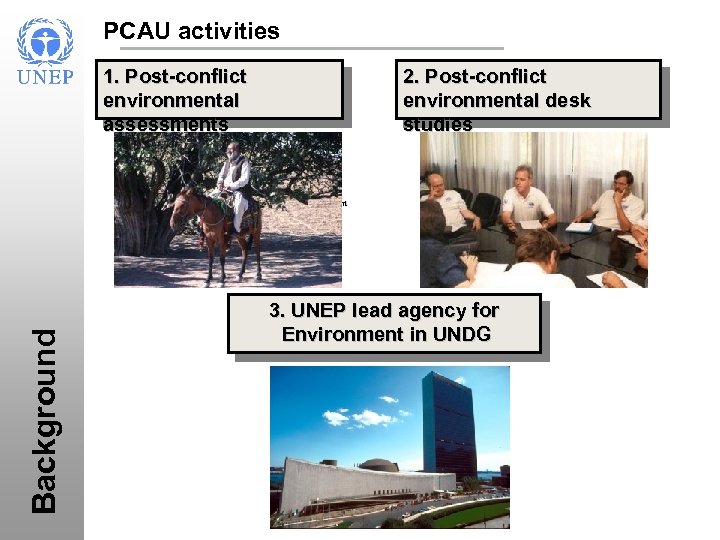 PCAU activities 1. Post-conflict environmental assessments 2. Post-conflict environmental desk studies Background PCAU Activities 1. Post-conflict environmental assessments 2. Post-conflict environmental desk studies 3. UNDG – UNEP lead agency for Environment 3. UNEP lead agency for Environment in UNDG In the ashes of conflict lie the seeds of regeneration.
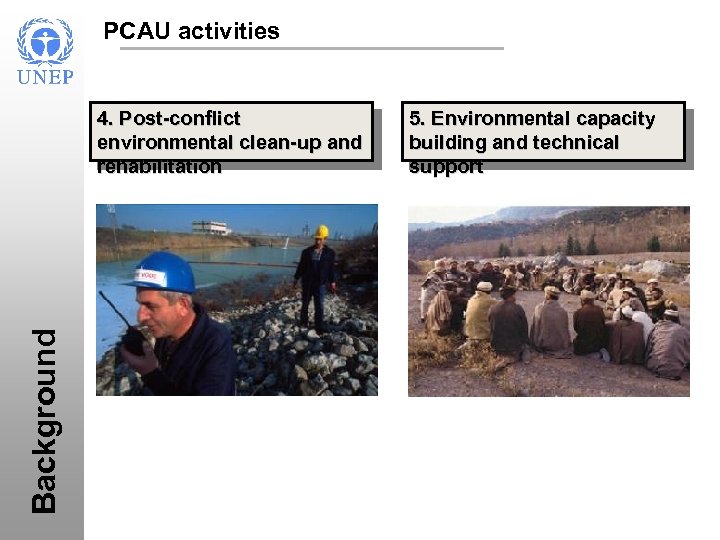 PCAU activities 4. Post-conflict environmental clean-up and rehabilitation 5. Environmental capacity building and technical support Background 4. Post-conflict environmental clean-up and rehabilitation 5. Environmental capacity building and technical support In the ashes of conflict lie the seeds of regeneration.
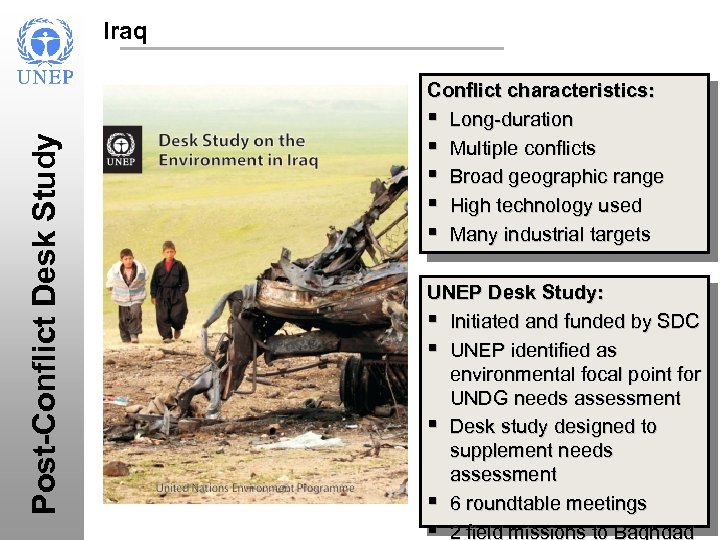 Post-Conflict Desk Study Iraq Conflict Characteristics: § Long-duration § Multiple conflicts § Broad geographic range § High technology used § Many industrial targets 1991 In the ashes of conflict lie Conflict characteristics: § Long-duration § § § Multiple conflicts § § Broad geographic range § § § High technology used § Many industrial targets UNEP Desk Study: Initiated and funded by SDC UNEP identified as environmental focal point for UNDG needs assessment Desk study designed to supplement needs assessment 6 roundtable meetings 2 field missions to Baghdad UNEP Desk Study: 1991 § Initiated and funded by SDC § UNEP identified as environmental focal point for the seeds of regeneration. UNDG needs assessment § Desk study designed to supplement needs assessment § 6 roundtable meetings § 2 field missions to Baghdad
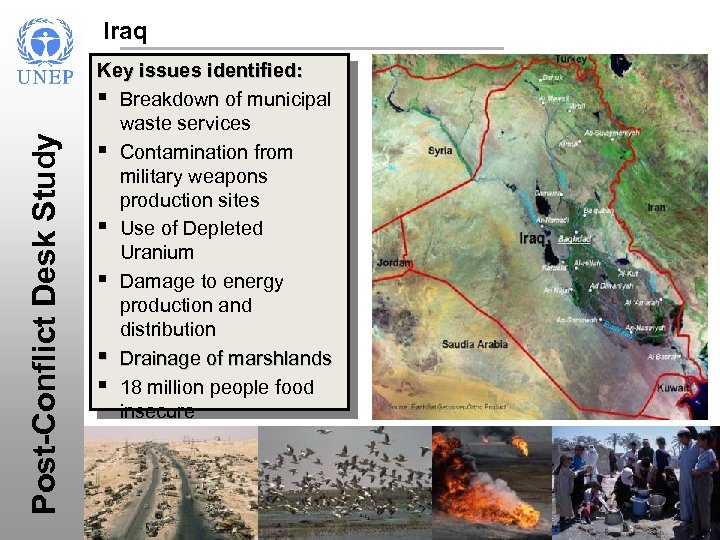 Post-Conflict Desk Study Iraq Key issues identified: § Breakdown of municipal waste services § Contamination from § military weapons § § production sites § § § Use of Depleted § § Uranium § 1991 Damage to energy 1991 production and distribution § Drainage of marshlands § 18 million people food In the ashes of conflict insecure § 74% of irrigated land suffers from salinity Key issues identified: Breakdown of municipal waste services Contamination from military weapons production sites Use of Depleted Uranium Damage to energy production and distribution Drainage of marshlands 18 million people food insecure 74% of irrigated land suffers from salinity 1991 lie the seeds of regeneration.
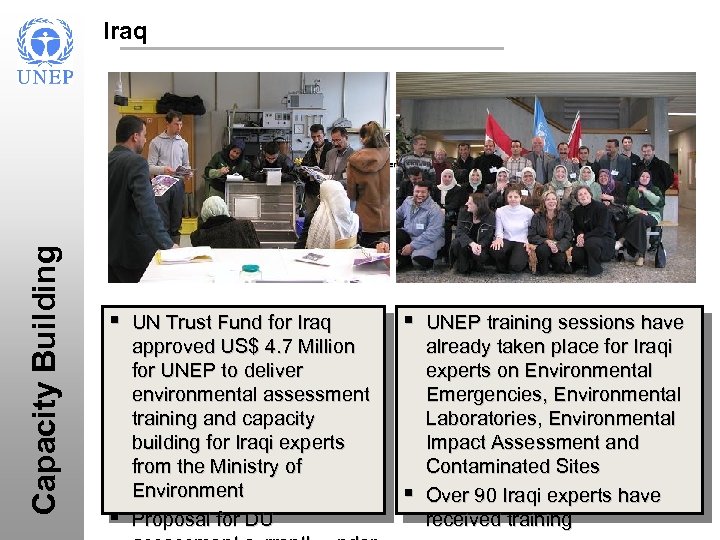 Iraq § Capacity Building § § § UN Trust Fund for Iraq approved US$ 4. 7 Million for UNEP to deliver § environmental assessment training and capacity building for Iraqi experts from the Ministry of Environment. Proposal for DU assessment currently under development. § UN Trust Fund for Iraq approved US$ 4. 7 Million for UNEP to deliver In the ashes of conflict environmental assessment training and capacity building for Iraqi experts from the Ministry of Environment Proposal for DU UNEP training sessions have already taken place for Iraqi experts on Environmental Emergencies, Environmental Laboratories, Environmental Impact Assessment and Contaminated Sites. Over 90 Iraqi experts have received training. § UNEP training sessions have already taken place for Iraqi experts on Environmental lie the seeds of regeneration. Emergencies, Environmental Laboratories, Environmental Impact Assessment and Contaminated Sites § Over 90 Iraqi experts have received training
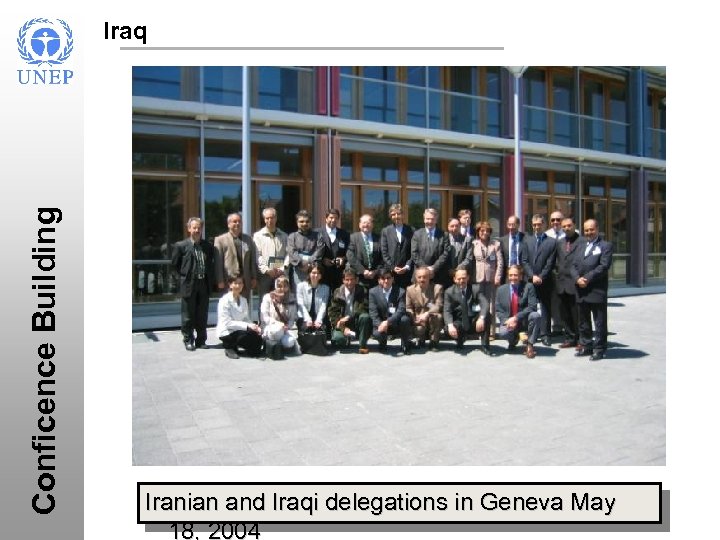 Conficence Building Iraq Iranian and Iraqi delegations in Geneva May 18, 2004 In the ashes of conflict lie the seeds of regeneration. Iranian and Iraqi delegations in Geneva May 18, 2004
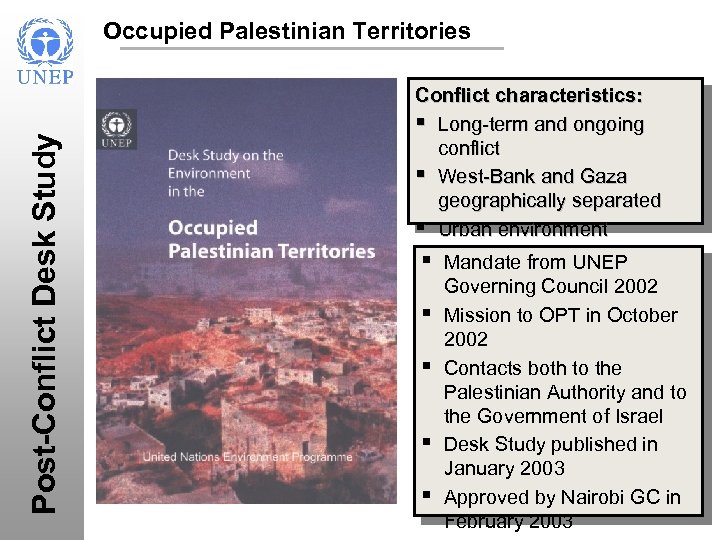 Post-Conflict Desk Study Occupied Palestinian Territories Conflict Characteristics: § Long-term and ongoing conflict § West-Bank and Gaza geographically separated § Urban environment Conflict characteristics: §§ Long-term and ongoing § conflict § §§§ West-Bank and Gaza geographically separated § Urban environment Mandate from UNEP Governing Council 2002 Mission to OPT in October 2002 Contacts both to the Palestinian Authority and to the Government of Israel Desk Study published in January 2003 Approved by Nairobi GC in February 2003 § 1991 In the ashes of conflict lie Mandate from UNEP Governing Council 2002 1991 § Mission to OPT in October 2002 § Contacts both to the Palestinian Authority and to seeds of regeneration. the Government of Israel § Desk Study published in January 2003 § Approved by Nairobi GC in February 2003
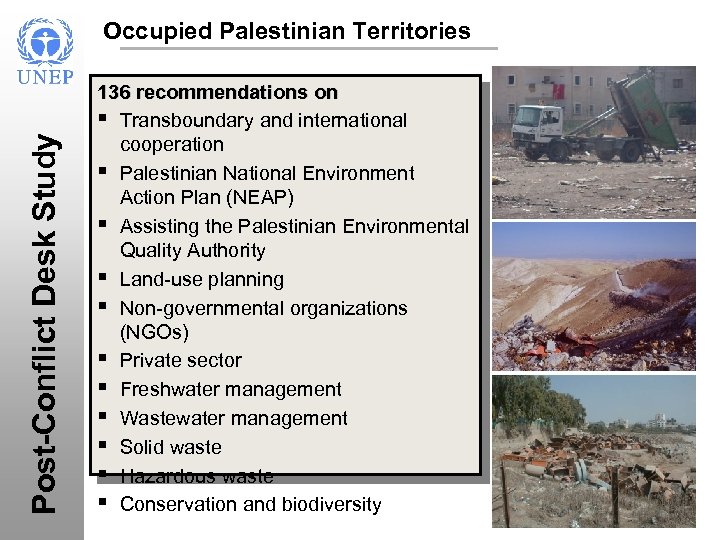 Post-Conflict Desk Study Occupied Palestinian Territories 136 recommendations on § Transboundary and international cooperation §§§ Palestinian National Environment § Action Plan (NEAP) § §§§ Assisting the Palestinian Environmental § § Quality Authority § §§§ Land-use planning 1991 § Non-governmental organizations (NGOs) § Private sector § Freshwaterashes of conflict lie the seeds In the management § Wastewater management § Solid waste § Hazardous waste § Conservation and biodiversity 136 recommendations on Transboundary and international cooperation Palestinian National Environment Action Plan (NEAP) Assisting the Palestinian Environmental Quality Authority Land-use planning Non-governmental organizations (NGOs) Private sector Freshwater management Wastewater management Solid waste Hazardous waste Conservation and biodiversity of regeneration.
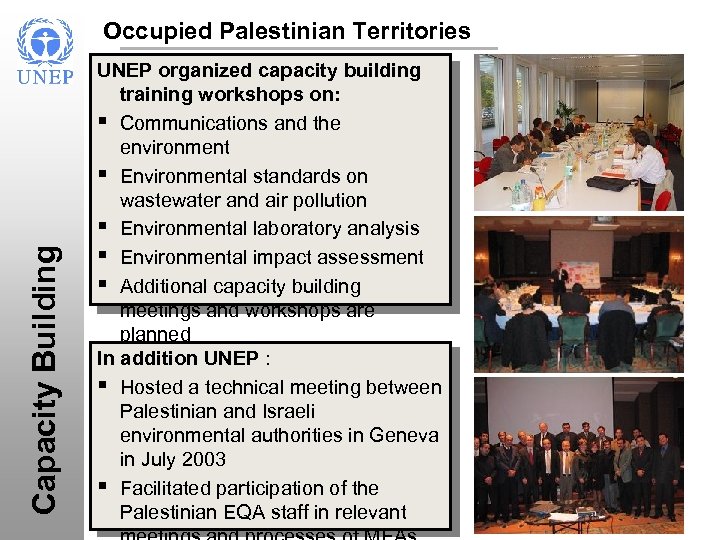 Occupied Palestinian Territories UNEP organized capacity building In addition UNEP : trainingtechnical meeting between Palestinian and Israeli workshops on: § Hosted a § environmental authorities in § § Communications. Geneva in July 2003 in relevant and the § Facilitated participation of the Palestinian EQA staff § meetings and processes of MEAs § environment § § Environmental standards on wastewater and air pollution § Environmental laboratory analysis § Environmental impact assessment § 1991 Additional capacity building 1991 meetings and workshops are planned In addition UNEP : § Hostedthe ashes of conflict lie the seeds In a technical meeting between Palestinian and Israeli environmental authorities in Geneva in July 2003 § Facilitated participation of the Palestinian EQA staff in relevant Capacity Building UNEP organized capacity building training workshops on: Communications and the environment Environmental standards on wastewater and air pollution Environmental laboratory analysis Environmental impact assessment (2 workshops) Additional capacity building meetings and workshops are planned of regeneration.
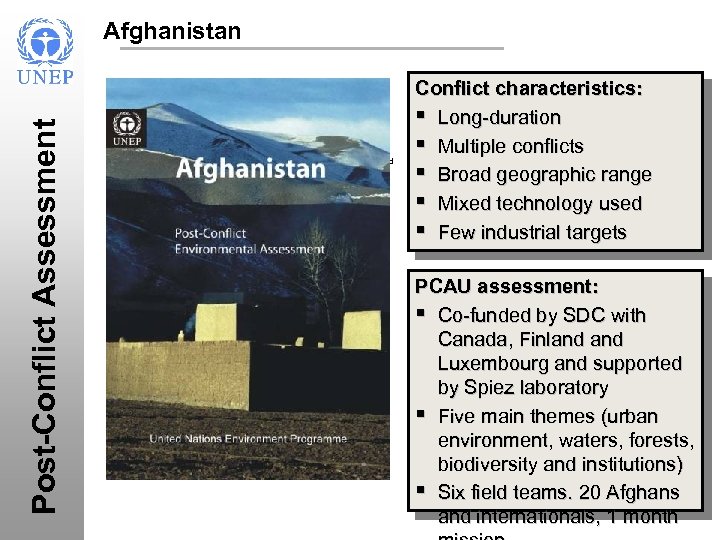 Post-Conflict Assessment Afghanistan PCAU Assessment: § Co-funded by SDC with Canada, Finland Luxembourg and supported by Spiez laboratory § Five main AFGHANISTAN themes (urban environment, waters, forests, biodiversity and institutions) Conflict Characteristics: § Six field teams. 20 Afghans and internationals, 1 month mission § Long-duration § Multiple conflicts § Broad geographic range § Mixed technology used § Few industrial targets 1991 In the ashes of conflict lie Conflict characteristics: § Long-duration § Multiple conflicts § Broad geographic range § Mixed technology used § Few industrial targets PCAU assessment: 1991 § Co-funded by SDC with Canada, Finland Luxembourg and supported theby Spiez laboratory seeds of regeneration. § Five main themes (urban environment, waters, forests, biodiversity and institutions) § Six field teams. 20 Afghans and internationals, 1 month
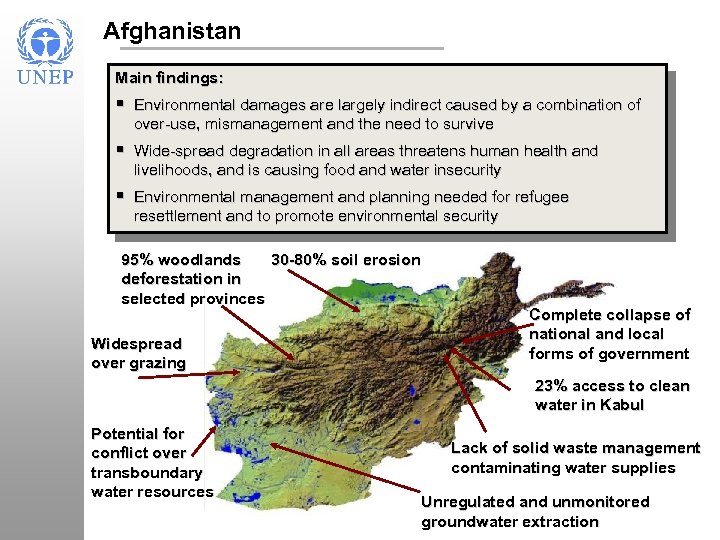 Afghanistan Main findings: § § § Main Findings: 95% woodlands deforestation in selected provinces 30 -80% soil erosion Environmental damages are largely indirect causedofby a combination of Complete collapse of national and local § Environmental damages are largely indirect caused by a combination of forms government over-use, mismanagement and theaccess to clean water in Kabul 23% need to survive. over-use, mismanagement and the need to survive § Wide-spread degradation in all areas threatens human health andcontaminating water supplies Lack of solid waste management livelihoods, and is causing food and water insecurity. Unregulated and unmonitored groundwater extraction Environmental management and planning needed for refugee Potential for security. resettlement and to promote environmental conflict over transboundary water resources Wide-spread degradation in all areas threatens human health and § livelihoods, and is causing food and water insecurity Widespread over grazing Environmental management and planning needed for refugee resettlement and to promote environmental security 95% woodlands 30 -80% soil erosion deforestation in selected provinces Widespread over grazing Complete collapse of national and local forms of government 23% access to clean In the ashes of conflict lie the seeds of regeneration. water in Kabul Potential for conflict over transboundary water resources Lack of solid waste management contaminating water supplies Unregulated and unmonitored groundwater extraction
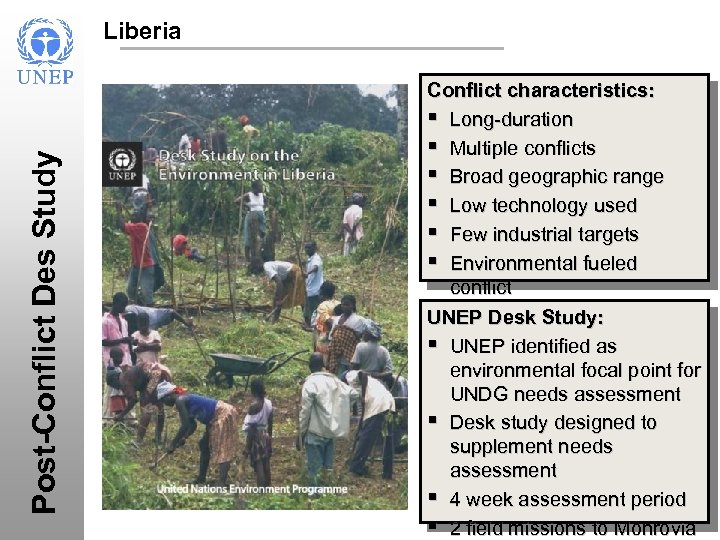 Post-Conflict Des Study Liberia UNEP Desk Study: § UNEP identified as environmental focal point for UNDG needs assessment LIBERIA Desk study designed to supplement needs assessment § Conflict Characteristics: § 4 week assessment period §§ Long-duration 2 field missions to Monrovia § Multiple conflicts § Broad geographic range § Low technology used § Few industrial targets § Environmental fueled conflict 1991 In the ashes of conflict lie Conflict characteristics: § Long-duration § Multiple conflicts § Broad geographic range § Low technology used § Few industrial targets § Environmental fueled conflict UNEP Desk Study: § UNEP identified as environmental focal point for the seeds of regeneration. UNDG needs assessment § Desk study designed to supplement needs assessment § 4 week assessment period § 2 field missions to Monrovia
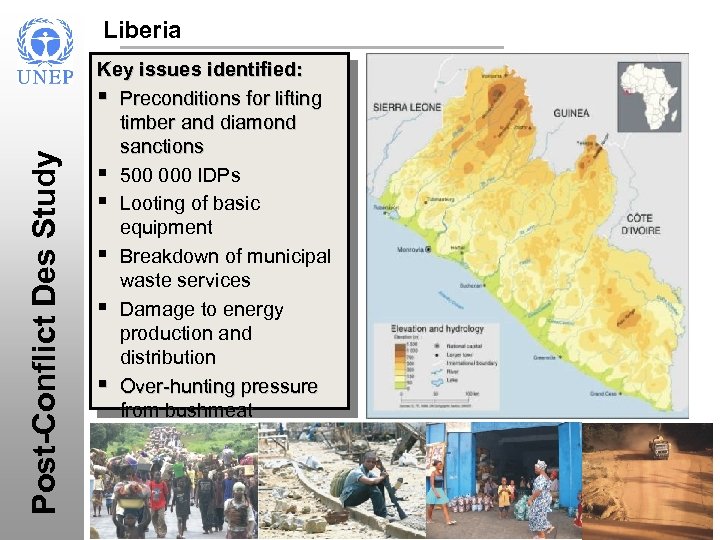 Post-Conflict Des Study Liberia Key issues identified: § Preconditions for lifting timber and diamond § sanctions § § 500 000 IDPs § § § Looting of basic § equipment § Breakdown of municipal waste services 1991 § Damage to energy production and distribution § Over-hunting pressure In the ashes of conflict from bushmeat production § Threats to forest areas from shifting cultivation and roads Key issues identified: Preconditions for lifting timber and diamond sanctions 500 000 IDPs Looting of basic equipment Breakdown of municipal waste services Damage to energy production and distribution Over-hunting pressure from bushmeat production Threats to forest areas from shifting cultivation and roads 1991 lie the seeds of regeneration.
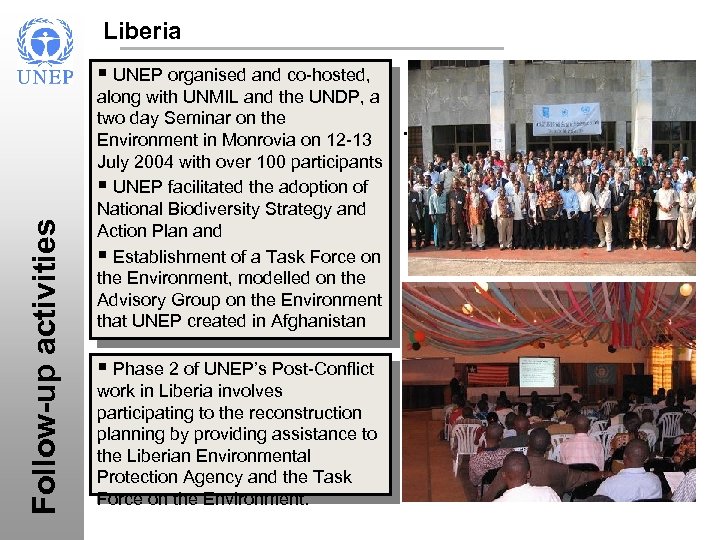 Liberia Follow-up activities § UNEP organised and co-hosted, along with UNMIL and the UNDP, a two dayorganised and co-hosted, along with UNMIL and the UNDP, a Seminar on the § UNEP two day Seminar on Environment the Environment in Monrovia on 12 -13 July 2004 in Monrovia on 12 -13 with over 100 participants § UNEP facilitated July Action Plan and the adoption of National Biodiversity Strategy and 2004 with over 100 participants Establishment Task Force on Advisory facilitated the UNEP created in Afghanistan that adoption of §§ UNEPGroupofonathe Environment, modelled on the National Biodiversity Strategy and Action Plan and § Establishment of a Task Force on the Environment, modelled on the 1991 Advisory Group on the Environment that UNEP created in Afghanistan § Phase 2 of UNEP’s Post-Conflict work in Liberia involves participating to the reconstruction planning by providing assistance to the Liberian Environmental Protection Agency and the Task Force on the Environment. 1991 § Phase 2 of UNEP’s Post-Conflict work in In the involves conflict lie the seeds of regeneration. Liberia ashes of participating to the reconstruction planning by providing assistance to the Liberian Environmental Protection Agency and the Task Force on the Environment.
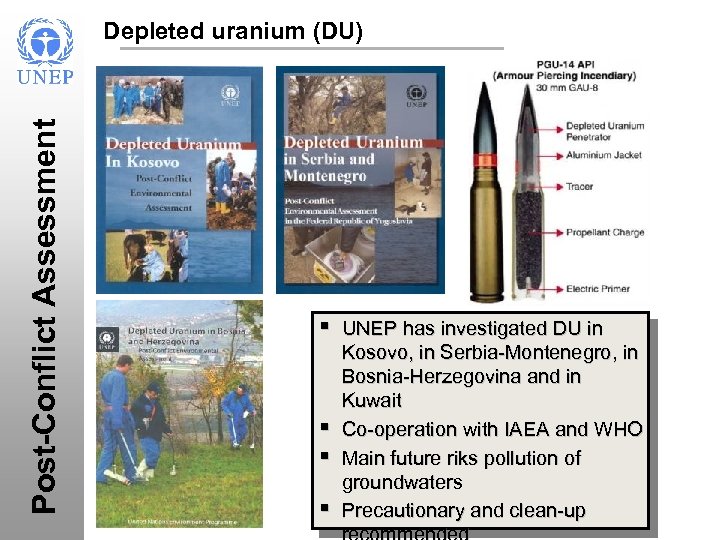 Post-Conflict Assessment Depleted uranium (DU) § In the ashes of UNEP has investigated DU in § Kosovo, in Serbia-Montenegro, in § Bosnia-Herzegovina and in § conflict lie the seeds of regeneration. Kuwait § Co-operation with IAEA and WHO § Main future riks pollution of groundwaters § Precautionary and clean-up DEPLETED URANIUM IN THE BALKANS UNEP has conducted three main reports on the issue of Depleted Uranium in the Balkans Main findings are that DU contamination is present, but not at significant levels that would threaten human health However, UNEP recommends a precautionary approach be taken
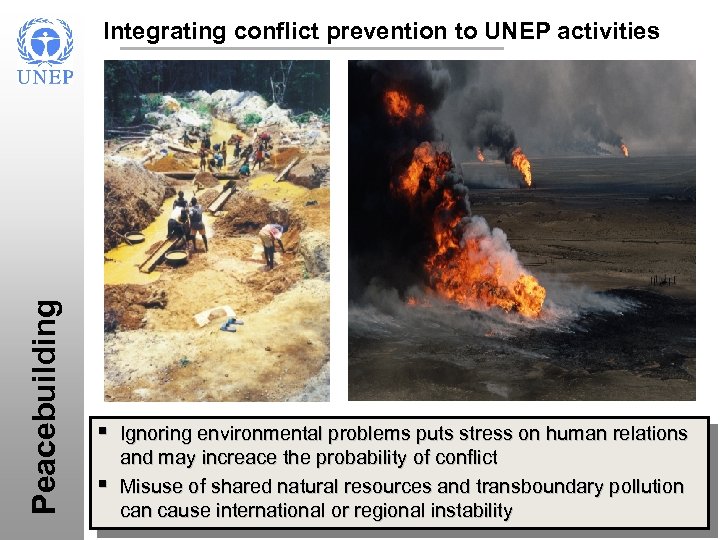 Peacebuilding Integrating conflict prevention to UNEP activities In the ashes of conflict lie the seeds of regeneration. § § Ignoring environmental problems puts stress on human relations and may increace the probability of conflict Misuse of shared natural resources and transboundary pollution cause international or regional instability
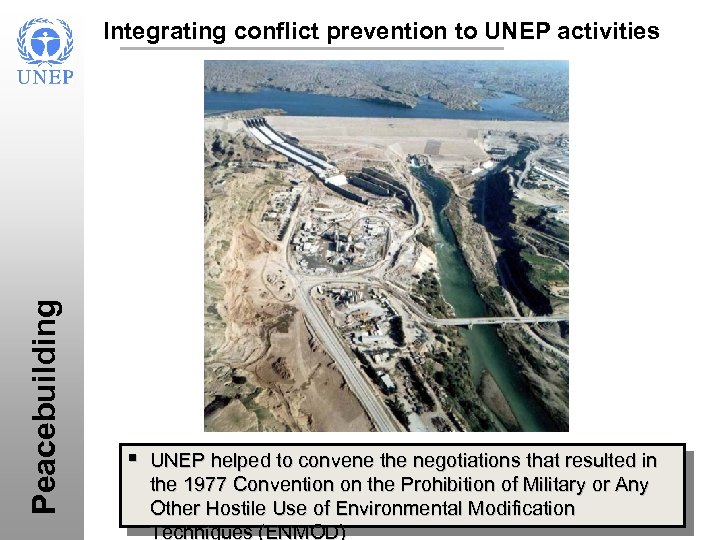 Peacebuilding Integrating conflict prevention to UNEP activities § UNEP helped to convene the negotiations that resulted in the 1977 Convention on the Prohibition of Military or Any Other Hostile Use of Environmental Modification Techniques (ENMOD)
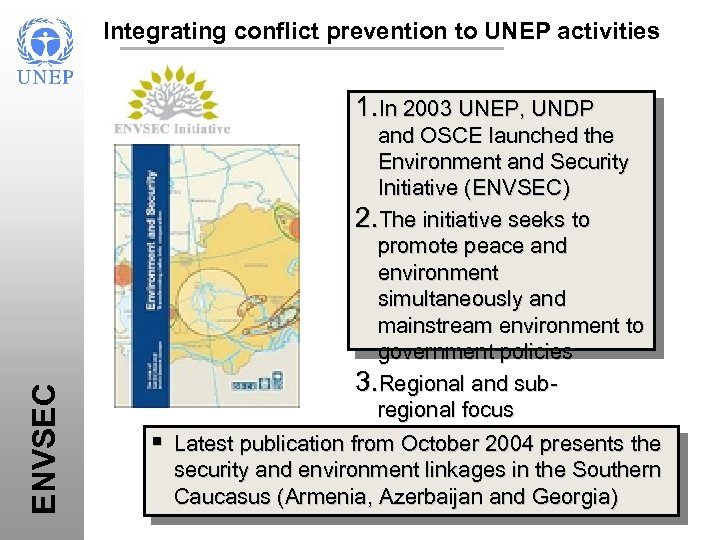 Integrating conflict prevention to UNEP activities ENVSEC 1. In 2003 UNEP, UNDP and OSCE launched the Environment and Security Initiative (ENVSEC) 2. The initiative seeks to promote peace and environment simultaneously and mainstream environment to government policies 3. lie the seeds sub. In the ashes of conflict Regional andof regeneration. regional focus § Latest publication from October 2004 presents the security and environment linkages in the Southern Caucasus (Armenia, Azerbaijan and Georgia)
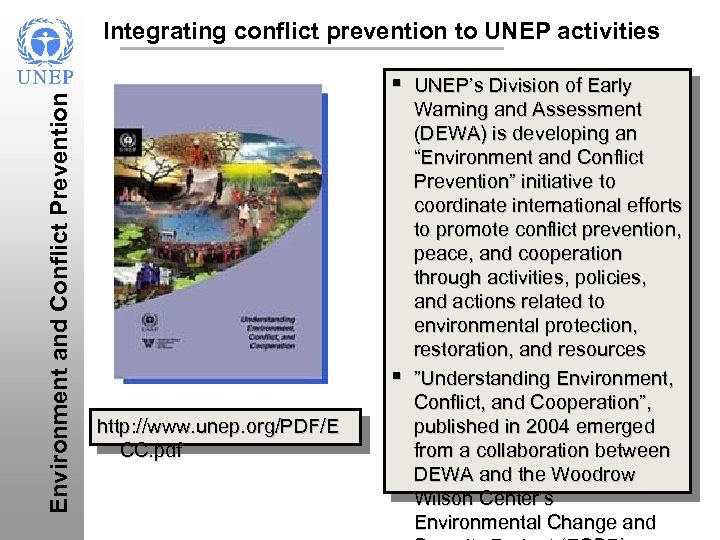 Environment and Conflict Prevention Integrating conflict prevention to UNEP activities § § http: //www. unep. org/PDF/E CC. pdf UNEP’s Division of Early Warning and Assessment (DEWA) is developing an “Environment and Conflict Prevention” initiative to coordinate international efforts to promote conflict prevention, peace, and cooperation through activities, policies, and actions related to environmental protection, restoration, and resources ”Understanding Environment, Conflict, and Cooperation”, published in 2004 emerged from a collaboration between DEWA and the Woodrow Wilson Center’s Environmental Change and
 Thank you for your attention http: //postconflict. unep. ch