


 Скачать презентацию Peers and Learning A Solution to the Teacher
2e3e3d7e25d65d82bd0e4c0e208c8878.ppt
- Количество слайдов: 31
 Peers and Learning A Solution to the “Teacher Bandwidth” Problem David Wiley, Ph. D. Assistant Professor Instructional Technology Utah State University
 Overview Assumptions Affordances Alternatives Another assumption Ants & bees
 The 1: 1 Assumption All other things being equal, the optimal student to teacher ratio is one-to-one Assumption + distance education?
 “The dilemma presented by individually tailored instruction is that it combines an instructional imperative with an economic impossibility. With few exceptions, one instructor for every student, despite its advantages, is not affordable. Instructional technology promises to provide most of the advantages of individualized instruction at affordable cost while maintaining consistent, measurable, high-quality content. ” -ADL / SCORM
 Inside the Assumption “The dilemma presented by individually tailored instruction is that it combines an instructional imperative with an economic impossibility. With few exceptions, one instructor for every student, despite its advantages, is not affordable. ” Individually tailored instruction requires 1: 1
 Roots of Automation Move “tried and true” methods online – Assumption of 1: 1 moves online as well 1: 1 requires massive number of teachers – Teachers are expensive Use an automated system
 Environmental Affordances Control the way we – Plan – Act – Evaluate – Do virtually everything
 ID Methods/Strategies Genesis One room schoolhouse / classroom – 20 to 30 students – Physical proximity Conversation, body language Shared artifacts and workspaces – Intimate relationships – Etc.
 What would you do if… You could read the mind of your boss? You could run 45 mph for any distance without tiring? A religious following of 1, 000 s suddenly dedicated themselves to worshipping you?
 Future Planning Why haven’t you ever seriously considered the effects of these changes? Would success in the old environment be a reliable predictor of success in the new? Would you continue planning the same after the changes occurred?
 ID Methods/Strategies Exodus The Network – 10 s of 1, 000 s of students – Physical separation New modes of real-time conversation and new non -verbal cues New ways of sharing workspaces and artifacts – Generally casual relationships
 More Changes Why haven’t we ever considered instructional methods for 10, 000 students? If small number methods fail with very large numbers, could large number methods not fail with small numbers? We have no 25, 000 student methods because we’ve never had reason or environment to support their discovery
 Still Tried and True? “Tried and true” methods are only so F 2 F Strategic success in F 2 F settings is not necessarily a predictor of success in online settings What would a new method look like?
 Another Assumption ITI requires 1: 1 because students are unqualified to provide learning support to each other “If any student knew enough about the course content to provide learning support to another, they wouldn’t be a student”
 Collaboration? If no one student is incapable, what about a group? 1. Group ignorance is worse than individual 2. Based on the little bit individuals might know, groups would have to be unmanageably large
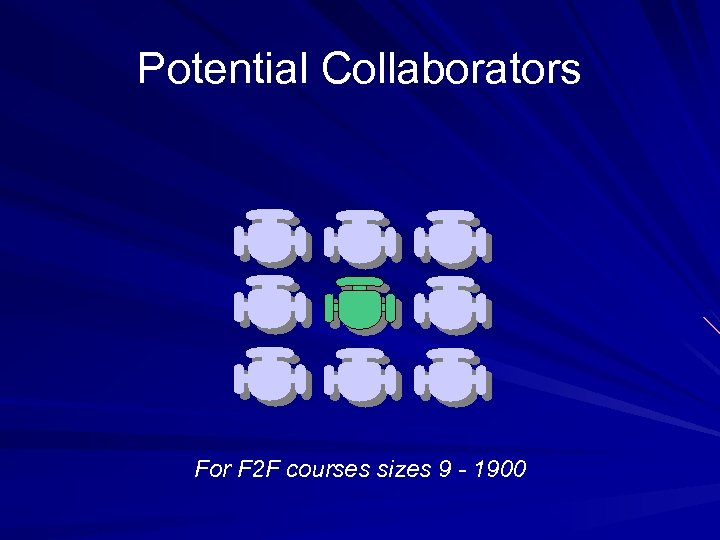 Potential Collaborators For F 2 F courses sizes 9 - 1900
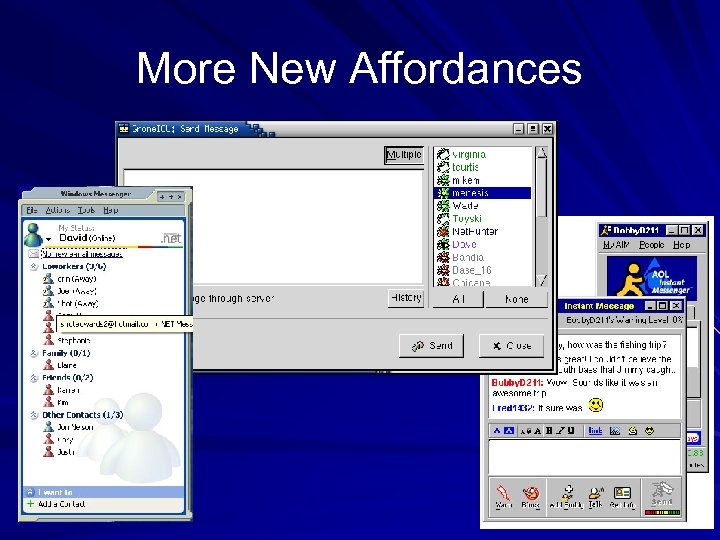
 New Affordances
 More New Affordances
 Low Tech Examples http: //slashdot. org/ http: //kuro 5 hin. org/ http: //perlmonks. org/
 They both fall in the ditch “What is it that governs here? What is it that issues orders, foresees the future, elaborates plans, and preserves equilibrium? ” – Maeterlinck (1927)
 The Ants Do It, The Bees Do It Social insects self-organize without central leadership, planning, or coordination – Food gathering – Food storage – Food delivery – Nest / hive building – Nest / hive defense – Cemetery, garbage dump, etc.
 Even People Do It Pre-zoning Committee Cities – Residential districts – Commercial districts Specialty areas – Slums Economics / markets Communities Organizations
 Instructional Design Theory? Goals: Provide on-going learning support, scale to extremely large numbers of students, provide rich human contact Values: Human interaction, problemsolving, authenticity
 Instructional Design Theory? Methods: Problem-centering, decentralization (teacher as super-peer), collaboration, reusable (digital) educational materials, network Preconditions: Massive number of learners, some existing knowledge, positive attitudes toward collaboration and power-sharing
![Disdain for Pure Design And don't EVER make the mistake [of thinking] that you](https://present5.com/presentation/2e3e3d7e25d65d82bd0e4c0e208c8878/image-26.jpg "Disdain for Pure Design And don't EVER make the mistake [of thinking] that you") Disdain for Pure Design And don't EVER make the mistake [of thinking] that you can design something better than what you get from ruthless massively parallel trial-and-error with a feedback cycle. That's giving your intelligence _much_ too much credit. – Linus Torvalds e-mail dated 12 -04 -01
Disdain for Pure Design And don't EVER make the mistake [of thinking] that you can design something better than what you get from ruthless massively parallel trial-and-error with a feedback cycle. That's giving your intelligence _much_ too much credit. – Linus Torvalds e-mail dated 12 -04 -01
 Grounded Research Examine functioning, large, online learning communities – Ask Slashdot – PERL Monks – Newsgroups (programming) Grounded theory development (ala Strauss & Corbin)
 Conclusion Solve the teacher bandwidth problem by Removing the teacher. Replace the teacher with massive access to peer expertise, resources, and archived materials (conversations and artificial curricular materials)
 Conclusion Right for every circumstance? – NO! Right for a large variety of circumstances? – YES!
 In education, the power of peer-to-peer comes from connecting learners, not machines.
 David Wiley, Ph. D. http: //wiley. ed. usu. edu/ david. wiley@usu. edu