


 Скачать презентацию Peer Addiction Recovery Support Services An Overview Faces
ae6d1238599225e9e434610d4a25dad8.ppt
- Количество слайдов: 83
 Peer Addiction Recovery Support Services: An Overview Faces & Voices of Recovery July 1, 2010 1
 What Are Peer Recovery Support Services? n Nonprofessional and non-clinical n Help individuals and families achieve and/or sustain long-term recovery Provide links to professional treatment and indigenous communities of support. They are not: n Professional addiction treatment services n Mutual-aid support n 2
 Where are Peer Recovery Support Services in the Recovery Process? They can be delivered across the full continuum of the recovery process: n Prior to treatment n n n During treatment Post treatment In lieu of treatment 3
 Types of Peer Recovery Support Services Four social support domains: n Emotional n Informational n Instrumental n Affiliational 4
 Types of Peer Recovery Support Services Roles: n Peer Recovery Coach n Peer Resource Coordinator n Support Group Facilitator n Workshop Leader/Facilitator n Substance-free Activities n Recovery community centers 5
 Where are they delivered? n Recovery community centers Faith- and community-based organizations Recovery homes and sober housing Jails and prisons n Probation and parole programs n Drug Courts HIV/AIDS and other health and social service centers Addiction and mental health service agencies Child, youth, and family service agencies n n n 6
 Who is Delivering Peer Recovery Support Services? n n Individuals with “lived experience” of addiction and recovery A person who both offers and receives “mutual support” from the interaction n Many are volunteers, some are paid staff n Some States offer certified peer addiction recovery support specialists to work as paraprofessionals 7
 One Model: Certified Peer Recovery Support Specialist n 2000: Established in Georgia as paraprofessional role in mental health workforce n 2002: Arizona followed, adding individuals in addiction recovery as peer specialists As of May 2008: n q q 30 States developed criteria for peer specialists 13 States have accessed Medicaid reimbursement for peer-delivered mental health services. 8
 Developing Peer Recovery Support Service Guidelines Draft Organizational and Practice Guidelines developed by SAMHSA’s RCSP grantees and other community leaders: n Five categories q q q n Organizational Capacity Peer Leader Development Ethical Framework Workforce Management Organizational Governance Three domains: Standards, Practices, Indicators 9
 Another Model: Accreditation of Recovery Community Organizations n Reimbursement strategy centered on organizations, rather than individuals, delivering services n Serves to create organizational capacity to deliver services by building infrastructure Creates service stability in organization, even as peers come and go Faces & Voices is moving forward in the direction of accreditation n n 10
 Who Is Paying for Peer Recovery Services n Federal and State grants n State, county, and municipal service contracts n Medicaid reimbursement n Private Pay 11
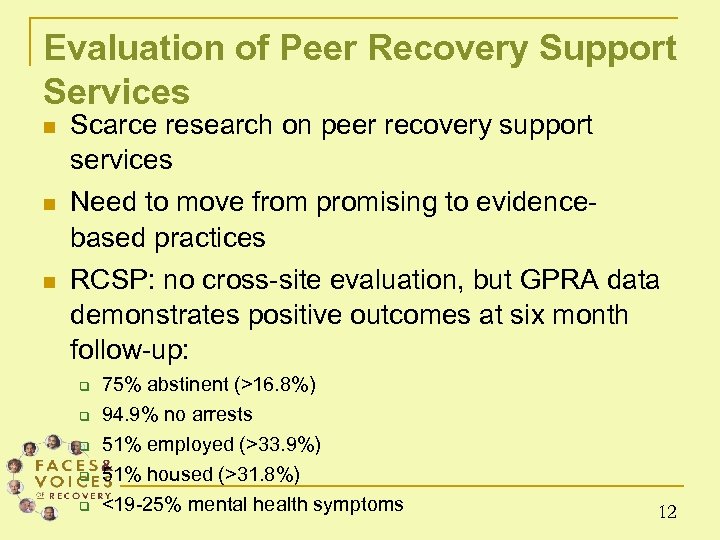 Evaluation of Peer Recovery Support Services n Scarce research on peer recovery support services n Need to move from promising to evidencebased practices RCSP: no cross-site evaluation, but GPRA data demonstrates positive outcomes at six month follow-up: n q q q 75% abstinent (>16. 8%) 94. 9% no arrests 51% employed (>33. 9%) 51% housed (>31. 8%) <19 -25% mental health symptoms 12
 CASE STUDIES: Four Recovery Community Organizations Offering Peer Recovery Support Services Faces & Voices of Recovery July 1, 2010 13
 Recovery Community Organizations Four Organizations Highlighted: n Association of Persons Affected by Addiction (APAA) n Connecticut Community for Addiction Recovery (CCAR) n El Paso Alliance n Pennsylvania Recovery Organization – Achieving Community Together (PRO-ACT) 14
 Shared History n All four organizations participated in the first cohort of the Recovery Community Support Program (RSCP), initiated by SAMHSA in 1998 n In response to a 2002 program shift to the Recovery Community Services Program (RCSP), each organization was instrumental in pioneering the initial design and implementation of peer recovery support services 15
 Serving Diverse Recovery Communities Each organization has developed a unique approach to peer recovery support services that reflects the needs and strengths of their respective communities. The menu of services and their delivery systems have been tailored to meet the needs identified in each community. 16
 Common Threads Each organization has: n Developed and used recovery community centers as a place to deliver peer services and as a service itself n Demonstrated the need to build organizational infrastructure to support the design and delivery of peer services n Employed a number of funding streams and strategies to support and sustain the delivery of peer recovery support services n Learned the value of supporting the development and capacity of their organized recovery communities 17
 Association of Persons Affected by Addiction (APAA) www. apaarecovery. org 18
 APAA: Mission (abbreviated) To encourage and support personal recovery by offering peer to peer services that help support recovery, reduce relapse, and promote wellness in individuals, their families, and the community. 19
 APAA’s Peer Recovery Support Services Peer Recovery Coaching A Peer Recovery Coach is a member of the recovery community who follows a recovery path, can summarize the positive effects of their recovery experience, and empowers individuals to develop or improve their recovery capital. 20
 APAA’s Peer Recovery Support Services Recovery Support Groups Non-clinical, safe places where peers can share their experience and path of recovery with each other. Peers learn how to live in the solution instead of the problem and be honest and open about their thoughts, feelings and behaviors. 21
 APAA’s Peer Recovery Support Services Job Readiness n Assist unemployed/under employed, formerly incarcerated, homeless persons with: q q q q Employment referrals and computer job searches Resume preparation Interviewing skills Interview haircuts Dress for success (clothes) Job fair transportation Access to computer 22
 APAA’s Peer Recovery Support Services Affordable Housing n Affordable housing class to educate peers on available housing aligned with levels of income: crisis, transitional and permanent housing n Housing objectives: q q q Contract with real estate management companies for apartments Secure access to transitional and permanent housing for people with felonies or who were previously incarcerated through a Second Chance Program Increase affordable housing with the Dallas Housing Authority and other housing agencies who will lease to previously incarcerated peers, homeless, and APAA members 23
 APAA: Who Delivers the Services? n n n 14 paid staff 10 volunteer peer leaders Staff and peer leaders must complete APAA Institute Training 24
 APAA: Where Are Services Delivered? 1). APAA Recovery Drop-In Center n Site to provide peer recovery support services n Base of operations for peer recovery coaches n Classes, support groups, activities, and events 25
 APAA: Where Are Services Delivered? 2). The Bridge n Onsite APAA office at the new Homeless Assistance Center. n APAA provides peer recovery coaching, peer support and education groups, engagement of peers in need of treatment. 26
 APAA: Where Are Services Delivered? 3). Phoenix House at Cornell Corrections Facility n APAA provides peer recovery support groups and peer recovery coaching sessions n All groups provide Dual Recovery education and information for co-occurring substance use and mental health disorders 27
 APAA: Where Are Services Delivered? 4). Collin County Recovery Community Center n APAA provides peer recovery support services for Collin County residents released from Collin County Jail (minimum and maximum sentences): q Recovery Coaching q Recovery Support Groups q Job Readiness q Affordable Housing 28
 APAA: Who Is Receiving Services? n n n 44% Women 56% Men 43% White 41% African American 13% Hispanic 85% indigent (managed care funder requires 200% below poverty level to receive services) 29
 APAA: Who Is Receiving Services? n n n Individuals reentering the community from incarceration People transitioning into and out of publiclyfunded treatment Young people coming out of adolescent treatment Individuals involved in the juvenile justice system Homeless persons Families of above 30
 APAA: Evaluation of Services n n n Services are evaluated weekly at the staff/peer meeting Weekly reports from each site Weekly reports from recovery coaches Continual assessment of services by Board of Directors Annual survey with peers Collaborative efforts provide weekly feedback in onsite meetings (the Bridge, Collin County Jail and Phoenix House) 31
 APAA: Measures to Ensure Safety and Quality n n Recovery Institute: week-long training held quarterly for peers and staff to develop knowledge, skills, and attitudes essential to providing peer services in a fee-for-service, managed care setting Trainings on peer ethics, boundaries, conflict resolution, crisis intervention, and risk prevention for peer recovery coaches Risk Management safeguards Eastfield College: College credit Recovery Coach Class, Fall 2010 32
 APAA: Promising Practices Peer Recovery Coaching: continues to be a promising practice, especially in the context of helping individuals with co-occurring disorders with low recovery capital. Research needs to be done on the effectiveness of peer recovery coaches who conduct crisis intervention and recovery stabilization in their work. 33
 APAA: Enhancing Existing and Developing New Services n n n APAA’s goals include providing recovery community engagement and developing new leaders and services Opportunities to enhance APAA programs and services surface on a regular basis Engaging new partners and peers are critical to APAA’s existence 34
 APAA: Developing Infrastructure to Support Services n n n APAA recently opened a new APAA Recovery Drop-in Center (more than twice its former space) Relationship with managed care funder has teamed APAA with providers who want to learn about peer recovery support services and peer recovery coaching APAA is training its managed care organization staff to increase time (units) for peer recovery supports for effectiveness 35
 APAA: Past and Current Funding Strategies n n Sole financial support is through a managed care organization contract to provide peer recovery support services to individuals in recovery from substance use and mental health disorders Recently initiated training for peers, faith-based and behavioral health organizations in peer recovery support services, including the State of Texas (TRI-Texas Recovery Initiative) Department of State Health Services 36
 APAA: Advocacy to Support Peer Recovery Support Services n n n Local: APAA has built ongoing relationships with the North Texas Behavioral Health Authority, local chapters of Mental Health America and NAMI, local community colleges. State: Texas Recovery Initiative, Gulf Coast ATTC, Texas Association for Addiction Professionals, Texas Recovers National: SAMHSA Recovery Month Planning Partners, Faces & Voices, Betty Ford Institute, National Leadership Council on African American Behavioral Health. 37
 Connecticut Community for Addiction Recovery (CCAR) www. ccar-us 38
 CCAR: Mission (abbreviated) The Connecticut Community for Addiction Recovery (CCAR) organizes the recovery community (people in recovery, family members, friends and allies) to 1) put a face on recovery and 2) provide recovery support services. 39
 CCAR: Mission (abbreviated) By promoting recovery from alcohol and other drug addiction through advocacy, education and service, CCAR strives to end discrimination surrounding addiction and recovery, open new doors and remove barriers to recovery, maintain and sustain recovery regardless of the pathway, all the while ensuring that all people in recovery, and people seeking recovery, are treated with dignity and respect. 40
 CCAR’s Peer Recovery Support Services Telephone Recovery Support n n n Weekly phone call from a trained volunteer to a person newly in recovery for a minimum of 12 weeks 2005 -07 (pilot project): fee-for-service under ATR; currently provided under State contract 2009: 1, 470 people enrolled for this service, >36, 000 outbound phone calls, and talked directly to individuals more than 10, 000 times 41
 CCAR’s Peer Recovery Support Services Recovery Works! n Helps people find meaningful employment using a 7 -module vocational curriculum infused with recovery principles n 2009: >70 people completed curriculum 42
 CCAR’s Peer Recovery Support Services Recovery Housing n n Established Find Recovery Housing www. findrecoveryhousing. com a database of over 70 privately-owned, independentlyoperated, “sober houses” or “recovery homes” Helped organize recovery house owners and managers in the Recovery Housing Coalition of Connecticut, a statewide coalition that meets monthly at the Hartford Recovery Community Center q q n Assisted in setting minimum standards of requirements to open and operate recovery houses in order that they could self-monitor Conducts “So, You Want to Open a Recovery House? ” trainings Provided over 3, 000 referrals in 2009 to assist people in finding a safe, sober, living environment 43
 CCAR: Who Delivers Services? n n Completely volunteer: no stipends, no payments Volunteers undergo a screening interview, background check, and extensive training Specific training required for specific volunteer roles Volunteers are supervised, evaluated at 6 weeks, at 6 months, and recognized annually at an awards celebration 44
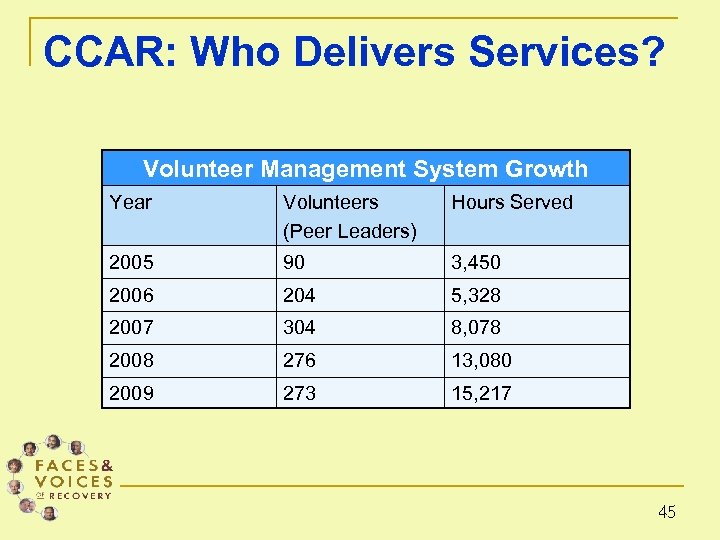 CCAR: Who Delivers Services? Volunteer Management System Growth Year Volunteers (Peer Leaders) Hours Served 2005 90 3, 450 2006 204 5, 328 2007 304 8, 078 2008 276 13, 080 2009 273 15, 217 45
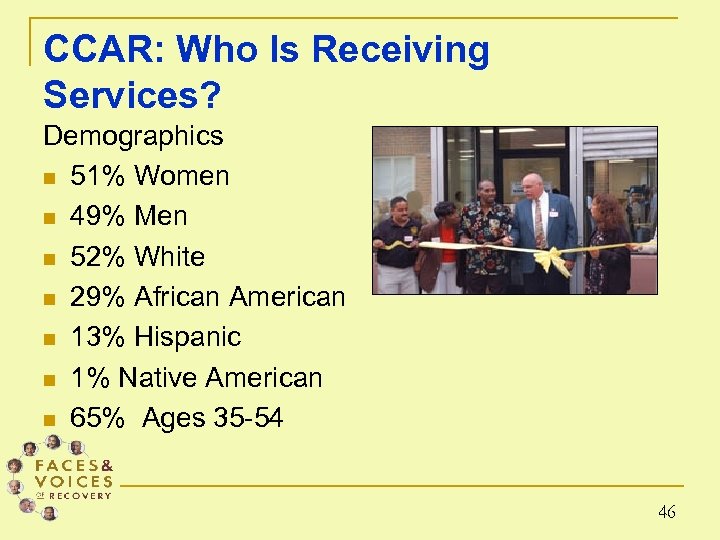 CCAR: Who Is Receiving Services? Demographics n 51% Women n 49% Men n 52% White n 29% African American n 13% Hispanic n 1% Native American n 65% Ages 35 -54 46
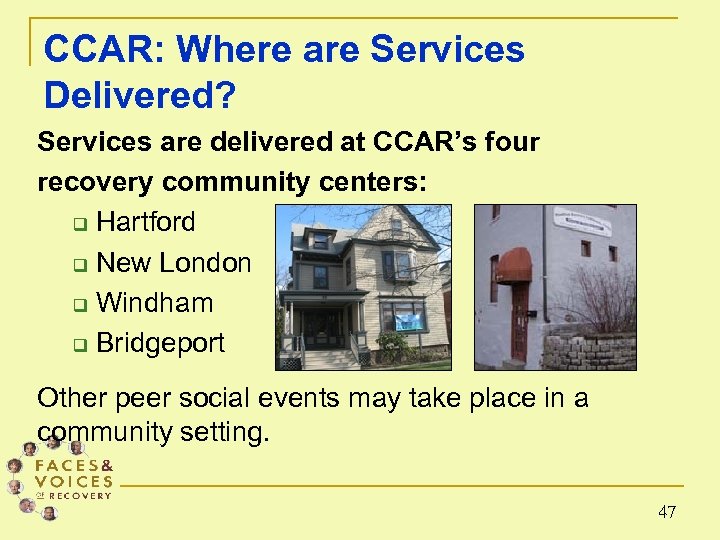 CCAR: Where are Services Delivered? Services are delivered at CCAR’s four recovery community centers: q Hartford q New London q Windham q Bridgeport Other peer social events may take place in a community setting. 47
 CCAR: Measures to Ensure Safety and Quality n n n Comprehensive Volunteer Management System including background checks Ongoing volunteer supervision Code of Conduct (Ethics) for all volunteers Comprehensive Personnel Policies & Procedures for all CCAR employees Grievance Procedure 48
 CCAR: Evaluation of Services n n GPRA data from past funding cycles In-house databases and tracking systems for evaluation use 49
 CCAR: Promising Practices n n Telephone Recovery Support: currently a promising practice, needs to become evidence-based practice Peer Recovery Coaching: needs to be researched and evaluated for effectiveness; Recovery Coach Academy 50
 CCAR: Enhancing Existing and Developing New Services n n n Ongoing participant feedback Willingness to adjust programs to maximize effectiveness. Recovery Community Center Managers and other staff work with participants to develop ideas and services 51
 CCAR: Developing Infrastructure to Support Services n n 2006: Hired Volunteer Manager to coordinate all volunteer activities at CCAR Onsite Volunteer Coordinator at each recovery community center to recruit, train, schedule and retain volunteers 52
 CCAR: Past and Present Funding Strategies n n n State grants (largest source of revenue) Federal grants Telephone Recovery Support: offered as fee for service in ATR I (2005 -07) Recently hired Director of Development All services currently funded by State 53
 CCAR: Advocacy to Support Peer Recovery Support Services n n n Face-to-face meetings Peers and staff involved in committees, task forces, coalitions Frequent speaking engagements Recovery Poster Series: social marketing Public access cable TV shows 54
 Recovery Alliance of El Paso www. recoveryalliance. net/ 55
 El Paso Alliance: Mission (abbreviated) The El Paso Alliance is a leader in the development and delivery of peer recovery services, pioneering in such areas as peer recovery coaching, a peer run residential recovery center, recovery community centers, peer based recovery support services and peer recovery housing. 56
 El Paso Alliance’s Peer Recovery Support Services Peer Recovery Coach n n Matched with people seeking recovery upon their entry into services Provides informational and service coordination supports, and transportation to sober housing residents and persons with low recovery capital Assists in development of recovery plan and meets monthly to monitor progress Spends average of 78 hours with each individual 57
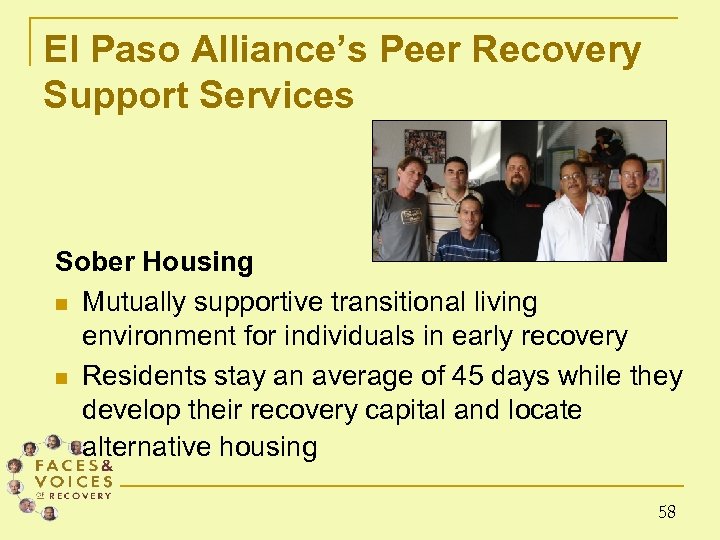 El Paso Alliance’s Peer Recovery Support Services Sober Housing n Mutually supportive transitional living environment for individuals in early recovery n Residents stay an average of 45 days while they develop their recovery capital and locate alternative housing 58
 El Paso Alliance: Where Are Services Delivered? n n Recovery Alliance Center Casa Vida de Salud (transitional sober housing) Drug Court: District Court 384, District Court 65, District Family Court and DWI County Court Child Protective Services 59
 El Paso Alliance: Who Delivers the Services? n n Combination of staff, stipended, and volunteer peer workers Peers must have >1 year recovery Peers must complete three levels of Peer-A-Myd training course Peers must be able to summarize and share the positive effects of their recovery 60
 El Paso Alliance: Who Is Receiving Services? Demographics n 77% Hispanic n 17% Anglo n 4% African American n 2% Other n Large percentage of homeless and co-occurring individuals 61
 El Paso Alliance: Measures to Ensure Safety and Quality n n n Peers (staff and volunteers) screened, including criminal background checks Training: five-day Peer Recovery Coach Academy, Peer-A-Myd peer training pyramid (levels 1 -3), motivational interviewing, trauma sensitivity Weekly meeting to field communications and service issues Regular supervision of peers Risk management 62
 El Paso Alliance: Evaluation of Services n n n Ongoing onsite process evaluation (NIATx) Ongoing worker feedback and mutual support Weekly service provider meeting Process and outcome evaluation performed by the University of Texas School of Social Work, Addiction Research Institute (ARI) ARI provides monitoring and analysis of GPRA data, initial and follow up 63
 El Paso Alliance: Evaluation of Services GPRA: life improvements at 6 month follow up: n Own apartment or house: 30% more likely n Employed: 32% more likely n Report good health: 20% more likely n Abstinent: 70% 64
 El Paso Alliance: Promising Practices Recovery Management, funded by CSAT’s Targeted Capacity Expansion (TCE) program, seeks to engage persons from street level through two years of recovery by a Recovery Ally, a specially trained Alliance worker who guides the participants into the culture of recovery. 65
 El Paso Alliance : Enhancing Existing and Developing New Services Customizes and develops new programs based on: n NIATx process enhancement protocols n Feedback from staff, peers and service recipients n Recovery Community Advisory Board: oversees quality of services and development of new services 66
 El Paso Alliance : Developing Infrastructure to Support Services n n The Alliance has built a service structure based on providing peer-based recovery services. It is closely aligned and works in collaboration with the local recovery community. The Alliance has built infrastructure to support: q q Peer training Housing Transportation Employment and educational assistance 67
 El Paso Alliance: Past and Present Funding Strategies n n n n Fee-for-service: ATR I (2004 -07) SAMHSA grants City of El Paso contracts International AIDS Empowerment (HOPWA housing) Service contracts with other social service agencies Community Fundraising Social Entrepreneurship 68
 El Paso Alliance: Advocacy to Support Peer Recovery Support Services n n Face-to-face advocacy – one-on-one meetings with city council members and State officials Written advocacy (e. g. unsolicited proposals) Meetings with the State of Texas/Department of State Health Services, SAMHSA/CSAT, the El Paso City Council Radio and television 69
 Pennsylvania Recovery Organization – Achieving Community Together (PRO-ACT) www. proact. org 70
 PRO-ACT: Mission (abbreviated) PRO-ACT is working to reduce the stigma of addiction, ensure the availability of adequate treatment and recovery support services, and to influence public opinion and policy regarding the value of recovery. 71
 PRO-ACT’s Peer Recovery Support Services n n n 12 Life Skill programs including computer proficiency, job readiness, recovery and health management, parenting, etc. Recovery Coaching Recovery Plan development/advocacy Family education, support, and skill building Alcohol- and drug-free social skill building 72
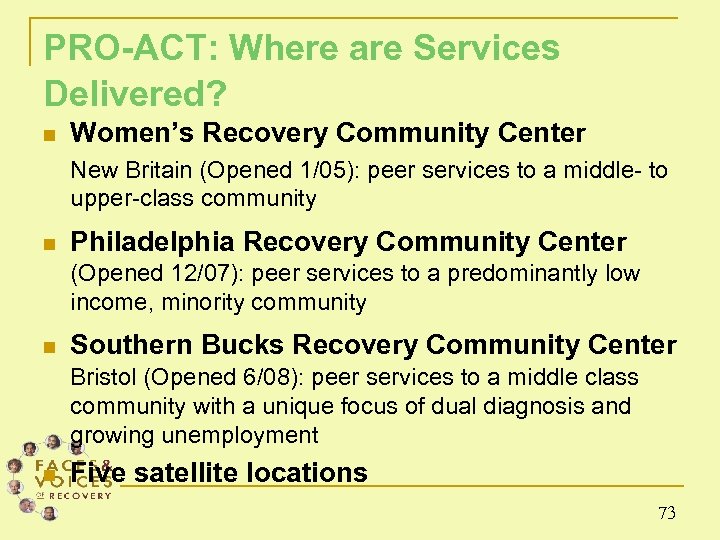 PRO-ACT: Where are Services Delivered? n Women’s Recovery Community Center New Britain (Opened 1/05): peer services to a middle- to upper-class community n Philadelphia Recovery Community Center (Opened 12/07): peer services to a predominantly low income, minority community n Southern Bucks Recovery Community Center Bristol (Opened 6/08): peer services to a middle class community with a unique focus of dual diagnosis and growing unemployment n Five satellite locations 73
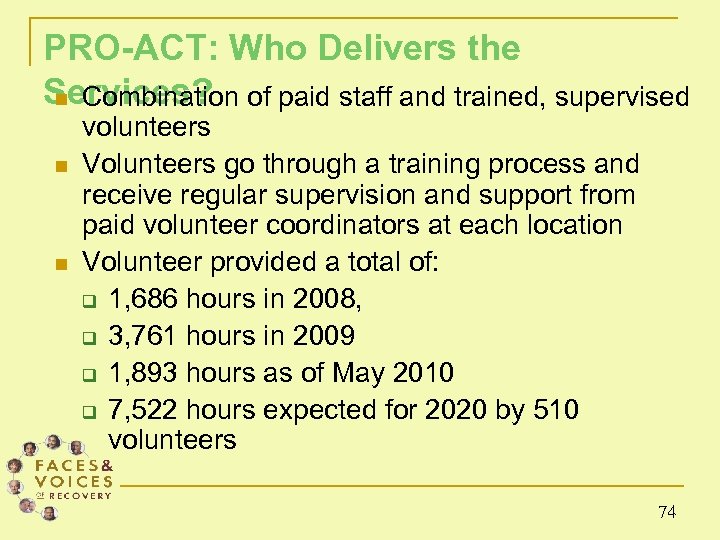 PRO-ACT: Who Delivers the Services? n Combination of paid staff and trained, supervised n n volunteers Volunteers go through a training process and receive regular supervision and support from paid volunteer coordinators at each location Volunteer provided a total of: q 1, 686 hours in 2008, q 3, 761 hours in 2009 q 1, 893 hours as of May 2010 q 7, 522 hours expected for 2020 by 510 volunteers 74
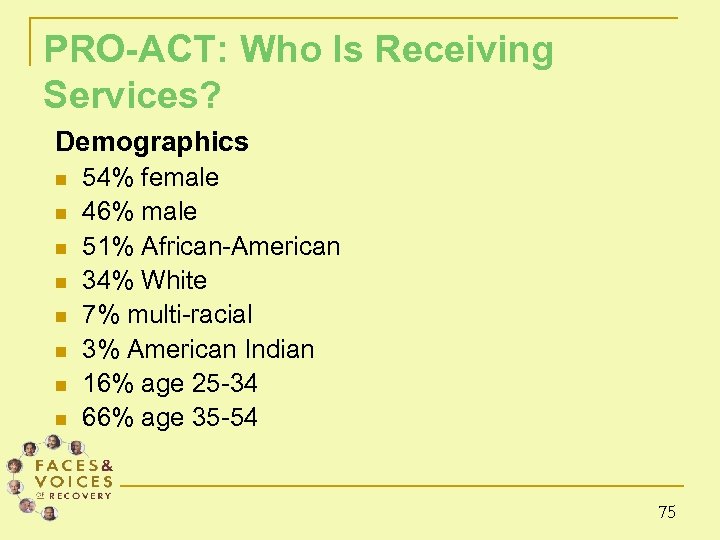 PRO-ACT: Who Is Receiving Services? Demographics n n n n 54% female 46% male 51% African-American 34% White 7% multi-racial 3% American Indian 16% age 25 -34 66% age 35 -54 75
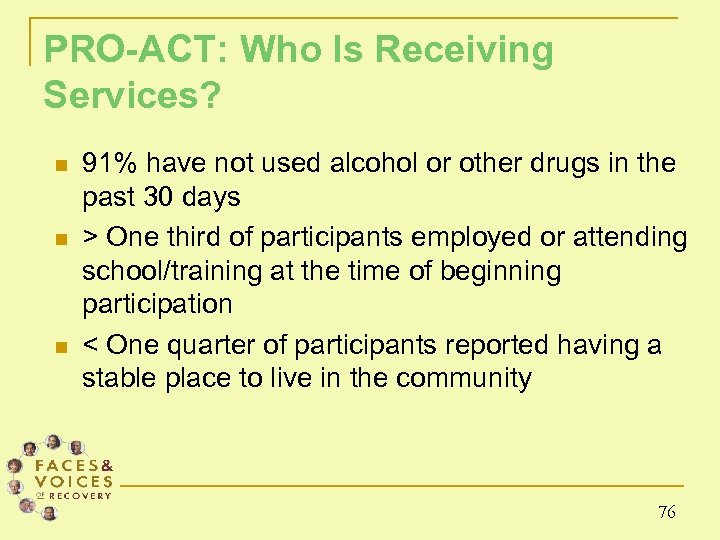 PRO-ACT: Who Is Receiving Services? n n n 91% have not used alcohol or other drugs in the past 30 days > One third of participants employed or attending school/training at the time of beginning participation < One quarter of participants reported having a stable place to live in the community 76
 PRO-ACT: Measures to Ensure Safety and Quality n n n Code of Ethics: reviewed with all volunteers and employees Volunteer Bill of Rights Weekly supervision for those providing one-onone work Monthly education and volunteer meetings Bi-monthly staff meetings at each Recovery Community Center to address quality assurance issues 77
 PRO-ACT: Evaluation of Government Performance and Results Act (GPRA) tool at Services baseline and at 6 month follow-up n n n Track the type and amount of services received by individual participants Track the type and amount of service provided by peer volunteers Analyze data to link participant outcomes to types and amounts of services Consumer satisfaction survey to gauge service satisfaction Process evaluation to assess the implementation plan and successes and challenges in achieving goals and objectives 78
 PRO-ACT: Promising Practices n n n Programs have shown a large increase in the percentage of participants who report gaining employment and stable housing over time, as well as a high percentage of individuals maintaining abstinence from substances Volunteer recruitment, training, and retention Monthly 3 session Family Education program Leadership Development – 15 -week Leadership Academy with monthly graduate meetings Workforce development for Certified Recovery Specialists 79
 PRO-ACT: Enhancing Existing and Developing New Services n n n Participant feedback forms Ongoing member surveys Vision Team review of all programming Policy and Procedure Manual Standardized trainings for all volunteers 80
 PRO-ACT: Developing Infrastructure to Support Services n n Development and ongoing refinement of operational Policies and Procedures Continuum of volunteer training opportunities in place designed to help volunteers continuously build skills and increase work experience Participatory process integrated within every phase of the process Vision Teams of community members are responsible for providing oversight and accountability. 81
 PRO-ACT: Past and Present Funding Strategies n n n Fee-for-service projects and contracts Referral arrangements with specific systems such as Criminal Justice and Children and Youth County governments SAMHSA: RCSP grant Private philanthropic donations 82
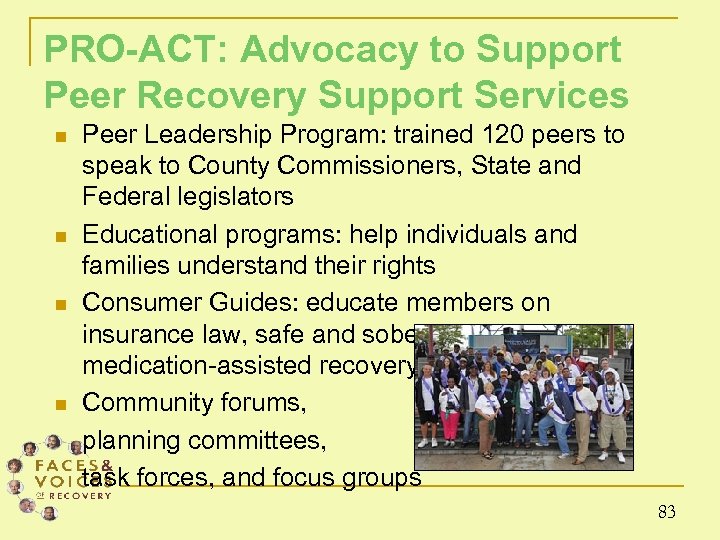 PRO-ACT: Advocacy to Support Peer Recovery Support Services n n Peer Leadership Program: trained 120 peers to speak to County Commissioners, State and Federal legislators Educational programs: help individuals and families understand their rights Consumer Guides: educate members on insurance law, safe and sober housing, and medication-assisted recovery Community forums, planning committees, task forces, and focus groups 83