 Скачать презентацию Pedal Powered Generator for Mobile Charging Haiying Lu
bb63d00243cd0320ac8970b606da4a7e.ppt
- Количество слайдов: 1



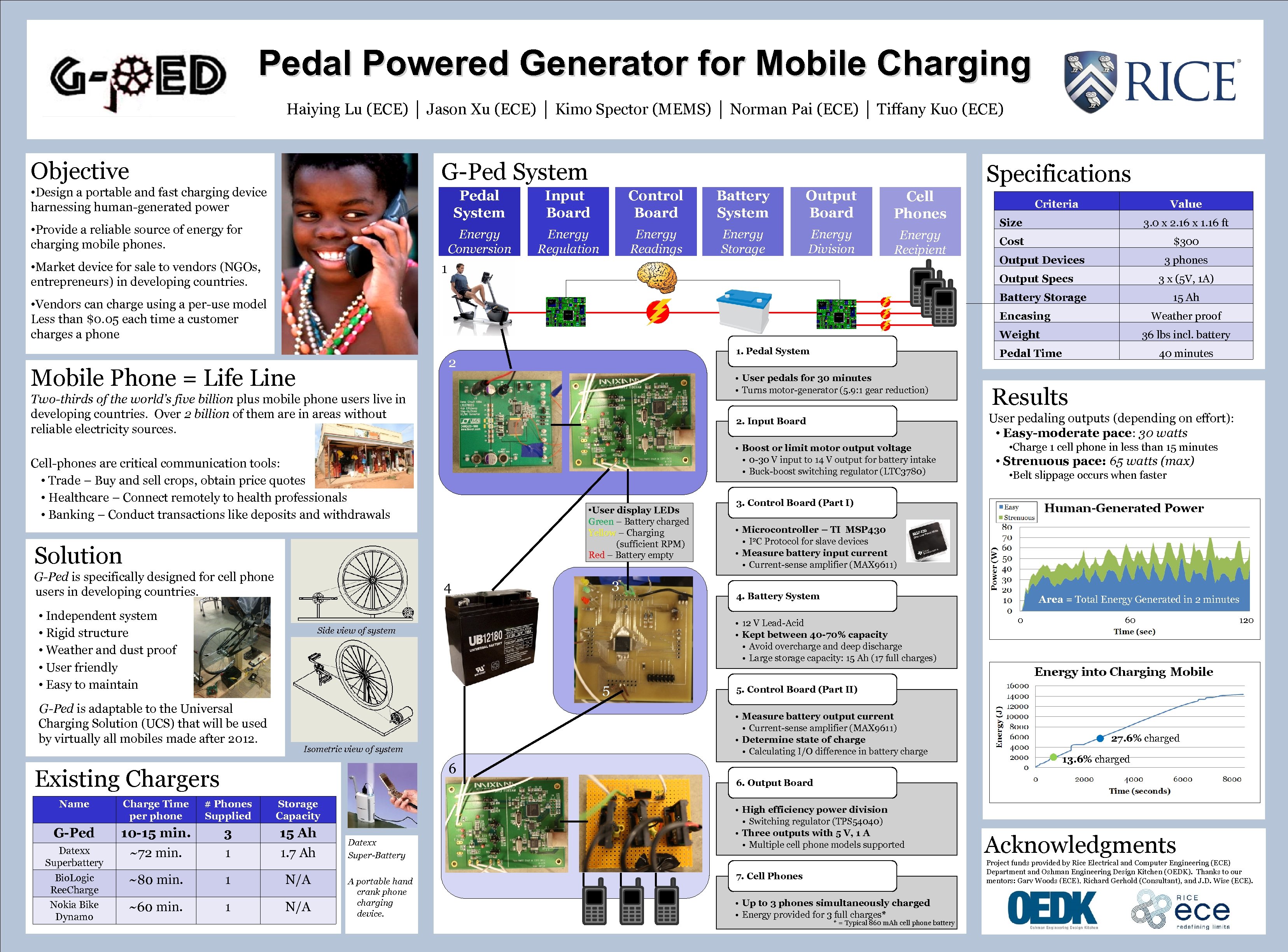
Pedal Powered Generator for Mobile Charging Haiying Lu (ECE) │ Jason Xu (ECE) │ Kimo Spector (MEMS) │ Norman Pai (ECE) │ Tiffany Kuo (ECE) Objective G-Ped System • Design a portable and fast charging device harnessing human-generated power Specifications Pedal System • Market device for sale to vendors (NGOs, entrepreneurs) in developing countries. Control Board Battery System Output Board Cell Phones Energy Conversion • Provide a reliable source of energy for charging mobile phones. Input Board Energy Regulation Energy Readings Energy Storage Energy Division Energy Recipient 1 Size 3. 0 x 2. 16 x 1. 16 ft Cost $300 Output Devices 3 phones 3 x (5 V, 1 A) Battery Storage 15 Ah Encasing Weather proof Weight 1. Pedal System 2 Mobile Phone = Life Line • Boost or limit motor output voltage • 0 -30 V input to 14 V output for battery intake • Buck-boost switching regulator (LTC 3780) • User display LEDs Green – Battery charged Yellow – Charging (sufficient RPM) Red – Battery empty Solution G-Ped is specifically designed for cell phone users in developing countries. 3 4 • Independent system • Rigid structure • Weather and dust proof • User friendly • Easy to maintain 5 • Strenuous pace: 65 watts (max) • Belt slippage occurs when faster 4. Battery System Area = Total Energy Generated in 2 minutes 0 60 120 5. Control Board (Part II) 6 Existing Chargers • Charge 1 cell phone in less than 15 minutes • Microcontroller – TI MSP 430 • I 2 C Protocol for slave devices • Measure battery input current • Current-sense amplifier (MAX 9611) • Measure battery output current • Current-sense amplifier (MAX 9611) • Determine state of charge • Calculating I/O difference in battery charge Isometric view of system Results 3. Control Board (Part I) • 12 V Lead-Acid • Kept between 40 -70% capacity • Avoid overcharge and deep discharge • Large storage capacity: 15 Ah (17 full charges) Side view of system 40 minutes User pedaling outputs (depending on effort): • Easy-moderate pace: 30 watts 2. Input Board Cell-phones are critical communication tools: • Trade – Buy and sell crops, obtain price quotes • Healthcare – Connect remotely to health professionals • Banking – Conduct transactions like deposits and withdrawals 36 lbs incl. battery Pedal Time • User pedals for 30 minutes • Turns motor-generator (5. 9: 1 gear reduction) Two-thirds of the world’s five billion plus mobile phone users live in developing countries. Over 2 billion of them are in areas without reliable electricity sources. 27. 6% charged 13. 6% charged 6. Output Board Name Charge Time per phone # Phones Supplied Storage Capacity G-Ped 10 -15 min. ~72 min. 3 1 15 Ah 1. 7 Ah ~80 min. 1 N/A ~60 min. 1 N/A Datexx Superbattery Bio. Logic Ree. Charge Nokia Bike Dynamo Value Output Specs • Vendors can charge using a per-use model Less than $0. 05 each time a customer charges a phone G-Ped is adaptable to the Universal Charging Solution (UCS) that will be used by virtually all mobiles made after 2012. Criteria Datexx Super-Battery A portable hand crank phone charging device. • High efficiency power division • Switching regulator (TPS 54040) • Three outputs with 5 V, 1 A • Multiple cell phone models supported Acknowledgments Project funds provided by Rice Electrical and Computer Engineering (ECE) Department and Oshman Engineering Design Kitchen (OEDK). Thanks to our mentors: Gary Woods (ECE), Richard Gerhold (Consultant), and J. D. Wise (ECE). 7. Cell Phones • Up to 3 phones simultaneously charged • Energy provided for 3 full charges* * = Typical 860 m. Ah cell phone battery
Скачать презентацию Pedal Powered Generator for Mobile Charging Haiying Lu
bb63d00243cd0320ac8970b606da4a7e.ppt