


 Скачать презентацию Pedagogy Policy and Quality Pedagogy Policy and
3f37f5332ab13a00538c5b9f975ee1a7.ppt
- Количество слайдов: 65
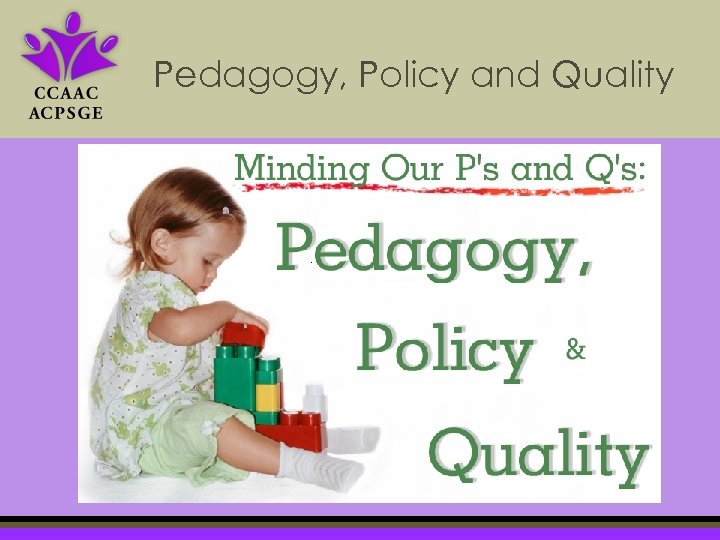 Pedagogy, Policy and Quality
 Pedagogy, Policy and Quality Child Care Advocacy Association of Canada (CCAAC)
 Pedagogy, Policy and Quality The Child Care Advocacy Association of Canada (CCAAC) is dedicated to promoting quality, publicly funded child care accessible to all. Our organization is non-profit, membershipbased and regionally representative.
 Pedagogy, Policy and Quality Purpose of project: to facilitate a national dialogue on curriculum issues in national policy making resulting in the establishment of a national curriculum policy framework.
 Pedagogy, Policy and Quality Objectives : 1. Increased knowledge of curriculum in national policy making through dissemination of research findings and current issues.
 Pedagogy, Policy and Quality Objectives : 2. Increased collaboration between sectors involved in early learning and child care through engagement in public consultation to identify and implement common values and early childhood education goals.
 Pedagogy, Policy and Quality Objectives : 3. Create a national curriculum / pedagogical framework that will provide a common foundation on which to build programs that enhance children’s early learning and development.
 Pedagogy, Policy and Quality What is a national curriculum / pedagogical framework ? Articulating our Vision: What, as a nation, do we envision for our children in the context of early learning and child care services?
 Pedagogy, Policy and Quality John Bennett of the OECD (2004) defines curriculum: A short, general framework that includes: • A statement of principles… • A summary of programme standards… • An outline of goals for children… • Pedagogical principles and guidelines
 Pedagogy, Policy and Quality The term “curriculum” is used…to describe the sum total of the experiences, activities, and events, whether direct or indirect, which occur within an environment designed to foster children’s learning and development. - New Zealand’s Te Whariki
 Pedagogy, Policy and Quality This curriculum framework for a children’s service is a foundation out of which come the daily experiences of children, their families and the professionals who work with them. It is not mainly about what professionals in children’s services do or how they go about their practice; rather, most importantly, this curriculum framework is about why: a rationale for practice. – New South Wales, Australia
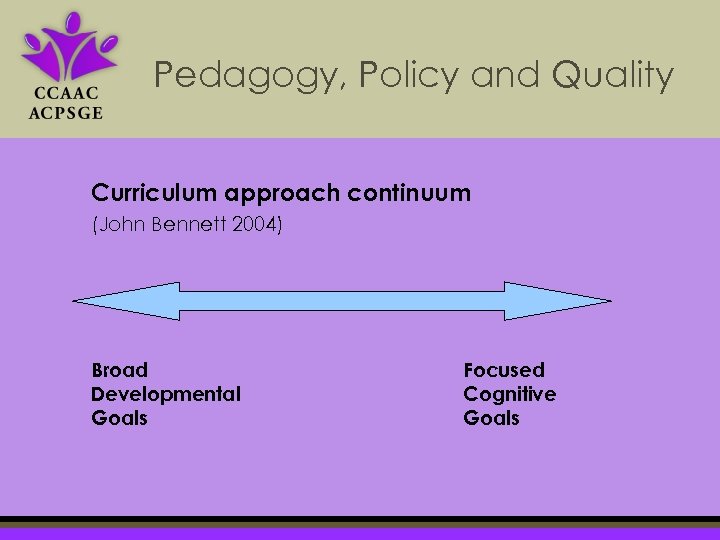 Pedagogy, Policy and Quality Curriculum approach continuum (John Bennett 2004) Broad Developmental Goals Focused Cognitive Goals
 Pedagogy, Policy and Quality Two main approaches to ELCC curriculum: 1. The Social Pedagogy Approach 2. The Infant School Approach (John Bennett 2004)
 Pedagogy, Policy and Quality The Social Pedagogy Approach • A focus on the whole child; “education in the broad sense” • Strong inter-generational and community outreach • A short core curriculum to guide early education practice, local interpretation encouraged (John Bennett 2004)
 Pedagogy, Policy and Quality The Social Pedagogy Approach • Curricula are generally developed in the centres, based on the objectives and content of the core curriculum • A Play-based, active and experiential pedagogy…with an emphasis on the outdoors • Little system monitoring of child outcomes or measures (the centre’s responsibility…) (John Bennett 2004)
 Pedagogy, Policy and Quality The Infant School Approach Focus on readiness for school • Parent/community dimension is underplayed except in at-risk situations • A detailed curriculum by a curriculum authority for 3 -6 year olds, central specification (John Bennett 2004)
 Pedagogy, Policy and Quality The Infant School Approach Structural quality is less • A restrained, teacher-directed play-based pedagogy • Attention is given to achieving curricular aims and to measuring individual performance (John Bennett 2004)
 Pedagogy, Policy and Quality The Social Pedagogy Approach: • Sweden, Finland, Norway, Eastern European countries The Infant School Approach: • USA, Belgium, France, Ireland, Korea, UK, Mexico, Netherlands (John Bennett 2004)
 Pedagogy, Policy and Quality Canada’s Emerging Vision OECD: Starting Strong OECD review of ELCC identifies Canada as the only nation of twenty with no articulated vision for early childhood care and education (ELCC)
 Pedagogy, Policy and Quality Canada’s Emerging Vision OECD: Starting Strong Canada is among the richest nations yet • Lowest spender • Lowest provision of services • High rates of child poverty
 Pedagogy, Policy and Quality Canada’s Emerging Vision Recent Developments in Canada National Forum on Child Care – CCAAC / CCCF (1994) Guiding Principles for Quality Child Care in Canada: • Affordability • Quality • Availability and Accessibility • Accountability
 Pedagogy, Policy and Quality Canada’s Emerging Vision Recent Developments in Canada National Children’s Agenda • Child Poverty • Children’s Rights
 Pedagogy, Policy and Quality Canada’s Emerging Vision Recent Developments in Canada First Ministers’ Communiqué: Early Childhood Development Agreement September 2000
 Pedagogy, Policy and Quality Canada’s Emerging Vision Recent Developments in Canada First Ministers’ Communiqué: Multilateral Framework for Early Learning and Child Care (2003)
 Pedagogy, Policy and Quality Canada’s Emerging Vision Recent Developments in Canada Moving Forward on Early Learning and Child Care: Bilateral Agreements between the Government of Canada and each Provincial Government (2005)
 Pedagogy, Policy and Quality Canada’s Emerging Vision Recent Developments in Canada Termination of Bilateral Agreements; replaced with: • Universal Child Care Benefit (UCCB) direct subsidy to parents ($100 / month) • Additional transfers under the CST to provinces and territories ($250 million)
 Pedagogy, Policy and Quality Canada’s Emerging Vision Recent Developments in Canada The primary purpose of child care in Canada has been seen politically as the provision of care in the parent’s absence, generally so that parents can be employed or engage in training/education. - OECD
 Pedagogy, Policy and Quality Canada’s Emerging Vision Recent Developments in Canada In recent years, there has been a move away from this conception of child care to a more developmental perspective, at least among the administrators, national councils and community groups responsible for the sector. Though this concern has not always been translated into reality by governments – often due to inadequate financing… - OECD
 Pedagogy, Policy and Quality Canada’s Emerging Vision Recent Developments in Canada The women’s movement has for decades highlighted the lack of child care as a significant barrier to achieving women’s equality and gender equity. “Child care is the ramp that provides equal access to the workplace for mothers. . . ” Judge Rosalie Abella, 1984
 Pedagogy, Policy and Quality Canada’s Emerging Vision Recent Developments in Canada Signatories should take appropriate measures to encourage the provision of the necessary supporting services to enable parents to combine family obligations with work responsibilities and participate in public life, in particular through promoting the establishment and development of a network of child care facilities. United Nations, Convention on the Elimination of All Forms of Discrimination Against Women, 1982 (Canada is a signatory)
 Pedagogy, Policy and Quality Canada’s Emerging Vision Recent Developments in Canada How can these competing concepts be integrated into a single vision or model? Peter Moss (2006) discusses the change from a child care discourse to a pedagogical discourse in England:
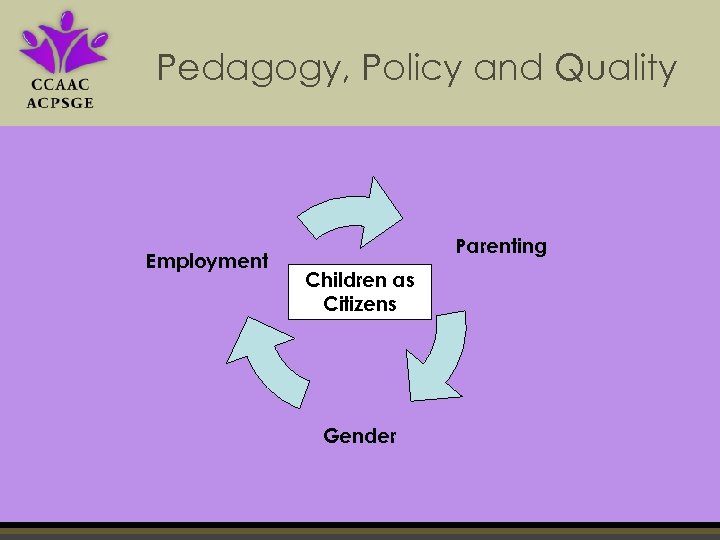 Pedagogy, Policy and Quality Employment Parenting Children as Citizens Gender
 Pedagogy, Policy and Quality Recent Developments in Canada Quality by Design, Canada’s most comprehensive research on quality (Beach, Friendly – CRRU) identify the elements of a quality system beginning with ideas:
 Pedagogy, Policy and Quality Recent Developments in Canada “…begins with a statement of the values held by the society and what it wants for its children. The values statement is based on implicit societal values and beliefs about the nature of the child and childhood. It is coloured by the history, circumstances and context - economic, social and cultural - in which the society exists. ”
 Pedagogy, Policy and Quality Vision What do provinces value in ELCC?
 Pedagogy, Policy and Quality Vision All provinces and territories* endorsed a vision, values, and goals for children as part of the National Children’s Agenda in May 2000. The Communiqué on Early Childhood Development (2000) and the Communiqué on the Multilateral Framework Agreement (2003) further refine agreement. (*with the exception of Quebec)
 Pedagogy, Policy and Quality Vision - Provinces 2005 Early Learning and Child Care Agreements in Principle: Extensive discussion and consensus building across levels of government in identifying key principles for early learning and child care.
 Pedagogy, Policy and Quality Vision - Provinces 2005 Early Learning and Child Care Agreements in Principle: Provinces and territories began to develop their own action plans. While these agreements have now expired, many jurisdictions are following through with these plans, and have experienced considerable progress in achieving their goals.
 Pedagogy, Policy and Quality Vision - Provinces In most provinces, vision statements (and in some cases, values, principles, and goals) are intended to guide the development of all policy and program initiatives for children, including early learning and child care programs.
 Pedagogy, Policy and Quality Vision - Provinces The majority of provinces and territories do not have a distinct “vision” for children who participate in early learning and child care programs.
 Pedagogy, Policy and Quality Vision - Provinces • A number of provinces have developed broad statements to either describe their intent for the nature of early learning and child care programs, or to guide the development of program delivery systems. • tend to focus on the system elements, rather than to describe visions for children who participate in early learning and child care programs
 Pedagogy, Policy and Quality Vision - Provinces Vision Statements regarding children and families typically do not clearly define a provincial or territorial position as to whether early childhood education and care programs are to value children for who they are in the “here and now” or whether the intent is to prepare children for “who they may become”.
 Pedagogy, Policy and Quality Vision - Provinces Curriculum Frameworks Although no province or territory has formally introduced an early learning and child care curriculum, there is considerable work underway across Canada to do so.
 Pedagogy, Policy and Quality Vision - Provinces Five provinces now have draft versions of documents at varying stages of readiness: Quebec New Brunswick Saskatchewan British Columbia Ontario
 Pedagogy, Policy and Quality Vision What do other countries’ citizens value in ELCC?
 Pedagogy, Policy and Quality Vision Ireland All young children will have access to and participate in a range of quality education and care services and supports of an internationally accepted standard through a plan implemented over the next ten years (2005 -2015).
 Pedagogy, Policy and Quality Vision Ireland - Principles for ECCE Policy: • Valuing children’s competence and contribution • Holistic support for young children’s well-being, learning and development • Universal access for all children to early childhood care and education • Ongoing quality development in policy, infrastructure and service provision • Building on existing partnerships
 Pedagogy, Policy and Quality Vision Sweden Child care in Sweden has two primary aims: 1. to support and encourage children's development and learning and 2. to enable parents to combine their childcare responsibilities with education or employment
 Pedagogy, Policy and Quality Vision Sweden ECCE has had high priority for several decades and is viewed as: • a central component of family policy in Sweden • a cornerstone of the Swedish publicly funded social welfare system. • an important task for society • the first step in the life-long learning process
 Pedagogy, Policy and Quality Vision New Zealand to grow up as competent and confident learners and communicators, healthy in mind, body, and spirit, secure in their sense of belonging and in the knowledge that they make a valued contribution to society.
 Pedagogy, Policy and Quality Vision Finland The foundation on which these values rests expresses the ethical attitude which shall characterise all pre-school activity. Care and consideration towards other persons, as well as justice and equality, in addition to the rights of each individual shall be emphasized and made explicit in all preschool activity.
 Pedagogy, Policy and Quality Vision Finland Children assimilate ethical values and norms primarily through their concrete experiences. The attitudes of adults influence the child’s understanding and respect for the rights and obligations that apply in a democratic society. For this reason adults serve an important role as models.
 Pedagogy, Policy and Quality Consultation Process • Facilitated meetings, focus groups, workshops with Canadians representing our diverse geography • Community members and government officials
 Pedagogy, Policy and Quality Consultation Groups and Sectors • Disability • Aboriginal • International • Rural, remote, northern • Anti-poverty • Labour • Research / Academia • Etc.
 Pedagogy, Policy and Quality Vision What we heard • Canadians want a system to support children and families • Governments at all levels have a responsibility for both leadership and investment
 Pedagogy, Policy and Quality Vision What we heard – Canadians value: • Children in their current state of childhood • Optimal child development • The importance of parents in the early childhood years
 Pedagogy, Policy and Quality Vision What we heard – Canadians value: • Communities’ roles in contributing to children and families’ well-being • Community-based and developed services • Balance – family/work and community/individual
 Pedagogy, Policy and Quality Vision What we heard – Canadians value: • Strong parental involvement and decision making • Universality • Inclusion – particularly for children with diverse abilities • Equality /equity
 Pedagogy, Policy and Quality Vision What we heard – Canadians value: • Culture and language • Diversity • Respect for nature and outdoors • Fairness and democracy • The importance of loving relationships in children’s lives
 Pedagogy, Policy and Quality Vision What we heard – Canadians value: Elements contributing to quality: • ECE professionals who are adequately compensated, respected, and educated • Standards: more than safe and healthy – nurturing, developmental, well-resourced, bright attractive environments
 Pedagogy, Policy and Quality Vision What we heard – Canadians value: • Federal leadership • Shared jurisdictional responsibility • Collaboration at all levels: federal, provincial/territorial, municipal, regional, aboriginal, and community
 Pedagogy, Policy and Quality Moving Forward Canada’s Vision must incorporate: • Our progress to date – build on what we have • A collaborative approach with provinces and territories that recognizes jurisdictional responsibility while providing continuity and equity for all children and families in Canada
 Pedagogy, Policy and Quality Moving Forward Canada’s Vision must incorporate: • Valuable lessons from other nations • The voices of Canadians
 Pedagogy, Policy and Quality Moving Forward The complete project documents will be posted on the CCAAC website in the near future: www. ccaac. ca Sign up online for our list serve to receive notice of the posting.
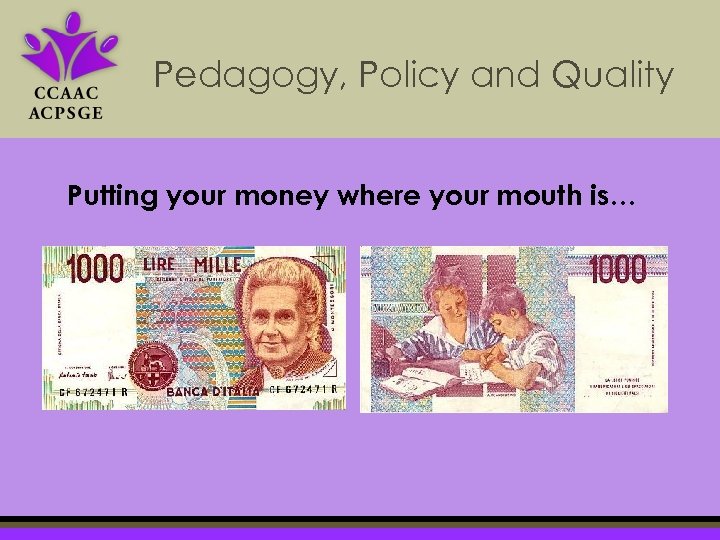 Pedagogy, Policy and Quality Putting your money where your mouth is…