


 Скачать презентацию Peculiarities of the English Culture and Language Formation
Peculiarities of the English Culture.pptx
- Количество слайдов: 16
 Peculiarities of the English Culture and Language Formation
 1. Old English (Anglo-Saxon language) A. D. 5 th – 10 th centuries “Gese, ic sprece Englisc. ”
 2. Middle English 11 th – 15 th centuries “Yis, I speke Englyssh. ”
 3. Early Modern English 15 th -16 th centuries “Yes, I speake English. ”
 4. Later Modern English 18 th -19 th centuries “Yes, I speak English. ”
 5. Present-day English 20 th century Present-day English is an international language spoken in most parts of the world.
 the english language The English language contains about 490, 000 words, plus another 300, 000 technical terms, the most in any language, but it is doubtful if any individual uses more than 60, 000.
 You must know that… • A native English speaking person knows between 10, 000 (uneducated) to 20, 000 (educated) word families. • Professor Paul Nation found that a person needs to know 8, 000 -9, 000 word families to enjoy reading a book. • Studying heritage language learners reveal that a person with a vocabulary size of 2, 500 passive word-families and 2, 000 active wordfamilies can speak a language fluently.
 GOOD NEWS If your goal is to speak English fluently, you are not required to study 10, 000 words. 2, 000 is enough to get you started.
 Did you know? • there are over 470 irregular verbs in english. the turkish language has only one irregular verb “olmak” (‘to be’) • English is an international language. It has so many grammar rules and each rule with many exceptions. Out of 25 English language speakers not a single one uses correct form of 3 rd conditional.
 Words used in plays by William Shakespeare current in: • Business: employer, manager, investment, retirement; • Law: conclusion, circumstantial evidence, foregone • Politics: negotiate, petition • Advertising: designs, exposure, marketable • Journalism: reword, misquote
 • More than one-tenth of English words are not spelled the way they sound. • Only 17 percent of native English speakers can spell the following six words correctly: height, necessary, accommodation, separate, sincerely, business. • Shakespeare’s name has been spelled eighty different ways.
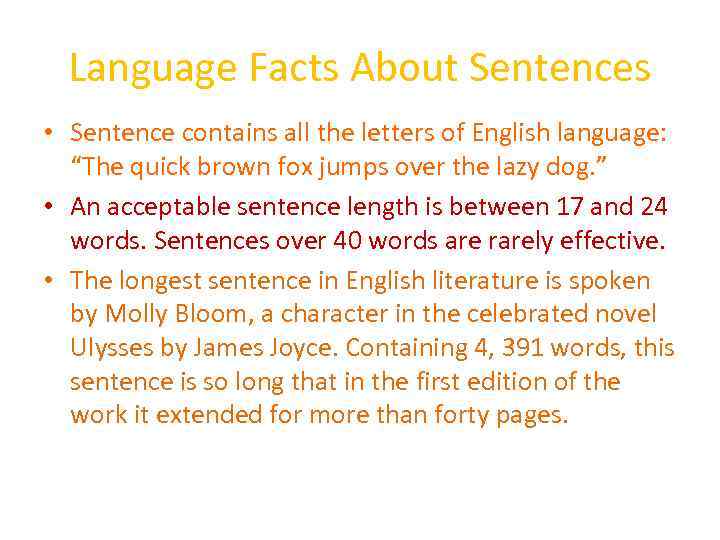 Language Facts About Sentences • Sentence contains all the letters of English language: “The quick brown fox jumps over the lazy dog. ” • An acceptable sentence length is between 17 and 24 words. Sentences over 40 words are rarely effective. • The longest sentence in English literature is spoken by Molly Bloom, a character in the celebrated novel Ulysses by James Joyce. Containing 4, 391 words, this sentence is so long that in the first edition of the work it extended for more than forty pages.
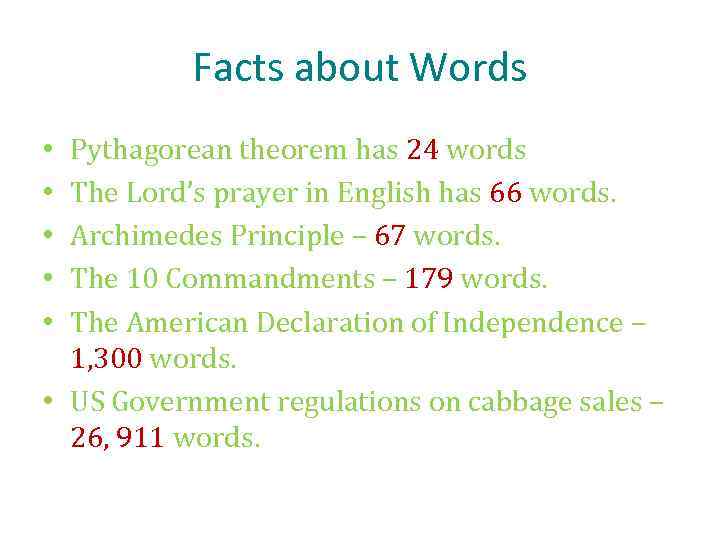 Facts about Words Pythagorean theorem has 24 words The Lord’s prayer in English has 66 words. Archimedes Principle – 67 words. The 10 Commandments – 179 words. The American Declaration of Independence – 1, 300 words. • US Government regulations on cabbage sales – 26, 911 words. • • •
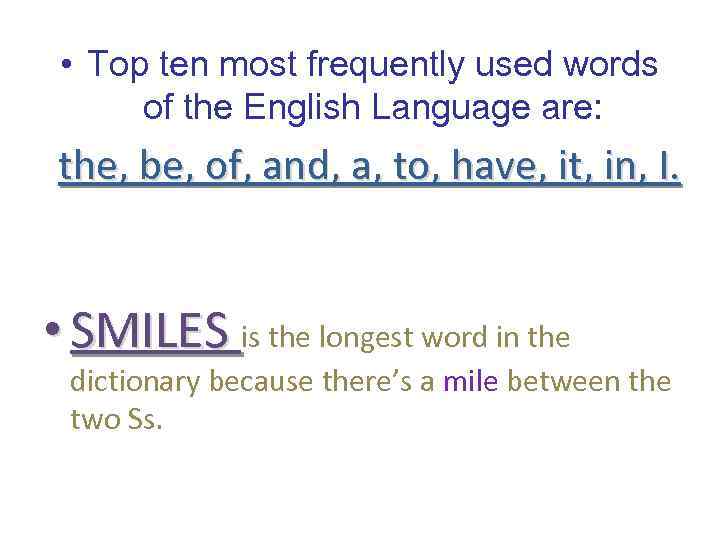 • Top ten most frequently used words of the English Language are: the, be, of, and, a, to, have, it, in, I. • SMILES is the longest word in the dictionary because there’s a mile between the two Ss.
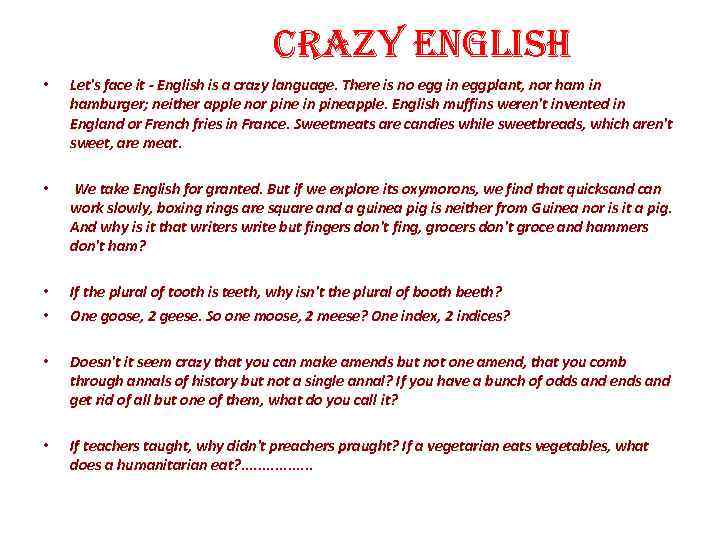 Crazy english • Let's face it - English is a crazy language. There is no egg in eggplant, nor ham in hamburger; neither apple nor pine in pineapple. English muffins weren't invented in England or French fries in France. Sweetmeats are candies while sweetbreads, which aren't sweet, are meat. • We take English for granted. But if we explore its oxymorons, we find that quicksand can work slowly, boxing rings are square and a guinea pig is neither from Guinea nor is it a pig. And why is it that writers write but fingers don't fing, grocers don't groce and hammers don't ham? • • If the plural of tooth is teeth, why isn't the plural of booth beeth? One goose, 2 geese. So one moose, 2 meese? One index, 2 indices? • Doesn't it seem crazy that you can make amends but not one amend, that you comb through annals of history but not a single annal? If you have a bunch of odds and ends and get rid of all but one of them, what do you call it? • If teachers taught, why didn't preachers praught? If a vegetarian eats vegetables, what does a humanitarian eat? . . . .