 Скачать презентацию PEACE AND STABILIZATION PROCESS IN THE AFRICAN GREAT
4d72b864de3159da8089460ef92834bd.ppt
- Количество слайдов: 20



PEACE AND STABILIZATION PROCESS IN THE AFRICAN GREAT LAKES REGION by Leonardo Baroncelli 1 3/16/2018
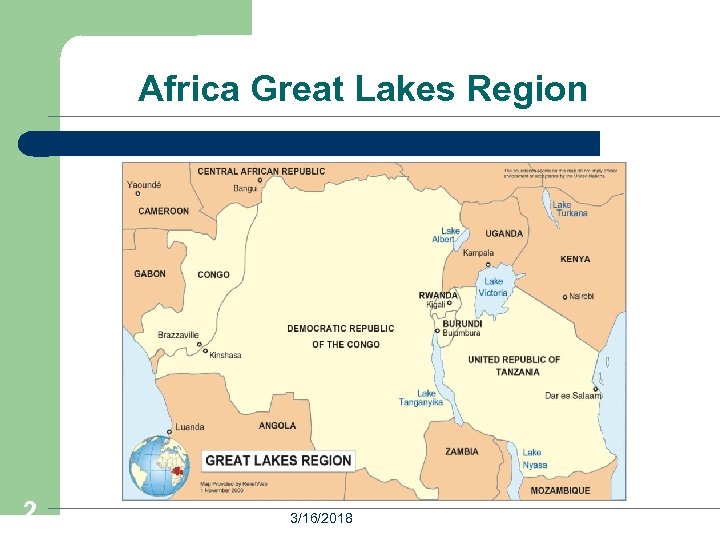
Africa Great Lakes Region 2 3/16/2018
Introduction l 3 Politically speaking the Great Lakes region is somewhat loose and conventionally covers the whole of Burundi, Rwanda, Uganda, the oriental parts of the Democratic Republic of Congo and some small parts of Kenya and Tanzania. The term is used in a wider sense to extend to all of Kenya, Tanzania and Uganda. Here I wish to define it as Burundi, Rwanda and Oriental parts of Democratic Republic of Congo, Uganda and Tanzania. Thus encompasses a vast area of more than 4 millions km 2 endowed with extraordinary agricultural and mineral resources, potentially one of Africa’s richest area and one of the continent’s key engines for growth. With mineral resources, water, forest, oil and fertile lands in abundance the region has more than 120 millions inhabitants and interesting attractions as a holiday destination. 3/16/2018
l 4 Because of the density of population and the agriculture surplus, in the precolonial era the area became highly organized into a number of small states where power was articulated around the institution of kingship. The most powerful of these monarchies were Rwanda, Burundi, Buganda and Bunyoro. Being the much-sought-after source of the Nile River, the region had long been of interest to Europeans. The first to arrive in any number were missionaries, who opened the area to later colonization. The increased contact with the rest of the world led to a series of devastating epidemics affecting both humans and livestocks. These decreased the region’s population dramatically, by up to 60 percent in some areas. The region did not return to its precolonial population until the 1950 s. Unusually for Subsaharian Africa the traditional borders were largely maintained by the colonial powers and during independence. 3/16/2018
l l l 5 The Great Lakes are recovering from a series of conflicts that occurred through most of the 1990 s, from which only Tanzania has largely escaped. However, developments since 2002 have been encouraging and with UN-sponsored peace processes in Burundi and RDC have witnessed the cessation of hostilities and a gradual although fragile return to security. Unfortunately the subregion is still looking for inclusive political institutions and democratic succession to power. Furthermore ethnical tensions are still regionalized and promote cross border affiliations. Finally the massive availability of natural resources in the DRC, estimated at $ 24 trillion of untapped mineral potential, continues to attract the illegal interest of local and foreign actors and remains a strong incentive to interfere in the internal affairs of Congo. 3/16/2018
l l 6 Lately we have witnessed a resurgence of leaders as those of Burundi, Rwanda and Uganda willing to prolong their power through constitutional changes or rigged elections. Burundi’s President has ignored the constitution and managed in 2015 to secure a third term in office through a very dubious election. In Uganda President Museveni has been in power for 35 years and has secured in 2016 another five years term through intimidation of opponents and not so fair elections. In Rwanda, where presidential elections are due this year, President Kagame will run again following a constitutional change to remove term limit. Also in Tanzania, where multiparty democracy has blossomed, President Magufuli is undermining independent institutions including Parliament and descenting into autoritarian rule, 3/16/2018
The Democratic Republic of Congo l l 7 In this context the DRC stands at a new critical juncture of its troubled history. Africa’s second largest country by area, the fourth largest by population and with the abundance of mineral resources above indicated is indeed in the middle of a political crisis and a deficit of democracy and good governance. Encouraged by the behaviour of other GL leaders President Kabila has maneuvered to cling to power beyond the end of his final term in office due on Dec. 19, 2016, as provided by the Constitution. He has explained his overstay with the government inability to hold proper elections due in 2016. The postponement of the elections is regarded by many inside and outside Congo as an illegal mean to extend his grip on Africa’s most mineral rich-nation. For its part the regime underlined the need to update previously the voter lists, considered as a challenging task in a massive country lacking enough financial resources and the most basic transport and telecommunication infrastructures. 3/16/2018
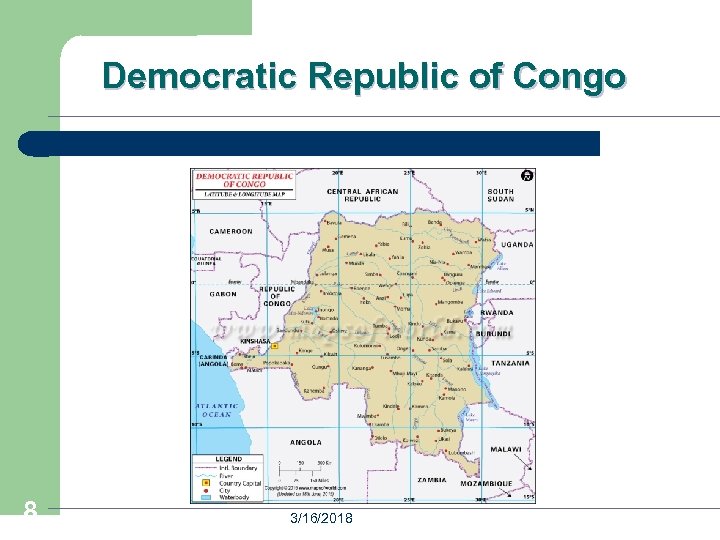
Democratic Republic of Congo 8 3/16/2018
l l 9 However what happens in the DRC has never been limited to a domestic political issue. Over the past two decades, conflict and instability in the country have tended to pull in both neighbouring countries and those further distant. From raisons ranging from security concerns to maintaining mineral resources illegal exploitation, various states have involved themselves in counterproductive ways by funding rebel groups and sending military troop. In particular Rwanda and Uganda have interfered in Congolese affairs and helped to destabilize the DRC in the process. 3/16/2018
Where we stand now l Kabila overstay in power has ignited a wave of protests, which have met with violent repression and many people reportedly have being killed and arrested since last September. To avoid further violence and eventually the country’s implosion, a mediation conducted by Catholic bishops managed to reach a deal at the end of 2016 requiring President Kabila to step down after general elections to be held this year. l While the accord was greeted as a critical step toward averting a slide into anarchy and civil war, many in the Congolese society expressed skepticism that the term of the deal will not be fulfilled and that Kabila will buy as much time as possible to defuse popular protest by lenghty and useless negotiations further needed to implement the deal. . 10 3/16/2018
l l Kabila’s strategy seems reminiscent of Mobutu in his later years. He too -rather successfully -tried to avoid elections by muddling the work of a constitution-drafting National Sovereign Conference even, at one time, appointing two simultaneous governments and parliaments. l 11 The main obstacle to the implementation of the deal include a disagreement over the composition of a council to monitor progress toward elections and whether the main opposition bloc must allow Kabila to choose from a multiple prime ministerial candidates. It is not surprising therefore that the governement has already claimed the lacking of budgetary resources-about $ 1. 7 billions –needed for conducting a fair election. The sudden death of DRC long-time opposition leader, Etienne Tshisekedi, may also delay the timely implementation of the deal. 3/16/2018
l l There is also a sense that his camp has safety concerns as it fears that handing over the power to opposition might lead to prosecution inside and outside the country for violations of rule of law and human rights. l 12 In fact the President and its allies are doing the utmost to protect the economic and political gains they have amassed over the past 15 years in power. He is in his mid-40 s and appears to have little interest in leaving the DRC for a position as an elder statesman. Kabila’desperate attempt to cling to power and the resolve of the political opposition and civil society to abide by the constitution can lead to an outbreak of a new major conflict with massive implications for the national and regional security. 3/16/2018
Regional security implications l l l 13 Renewed outbreak of violence in Congo could provide to neighbouring states another reason for intervening again in the country, as happened in the past, with riskful implications for the region as whole. In fact there already quarrels between South Sudan and Uganda and between Burundi and Rwanda, the latter country being accused by a 2016 UN Security Council report of recruiting and training Burundian refugees to oust Burundi’s President Kurunziza militarily and to restore Tutsi power. Furthermore recent reports suggest the likely existence of links of the so called Islamic State with groups active in the illegal exploitation of Congolese mineral wealth, including the Ugandan rebels called the Allied Democratic Forces(ADF), which is based on ethnic and Islamic identities and is launching from South Sudan raids over the western border of Uganda in an attempt to undermine President Museveni power. Their presence in the Eastern Congo is associated to smuggling and may create dangerous links among DRC, Uganda and Somalia. 3/16/2018
l l Much rest on a peaceful and legitimate outcome of the political situation in Congo. Burundi, which in the past has been held up as a model of effective international peacemaking and peacekeeping as well as African one, is close to implosion following the disregard of its leader for rule of law and human rights. l 14 The next step on the road to regional peace and security is the full and timely implementation of the agreement reached by President Kabila and the main opposition bloc. Congo could come next and ignite a new unpredictable and dangerous conflict in an area which has already been a battleground for the region several proxy conflict for land, mineral resources and immigration. 3/16/2018
The role of international community l l 15 The international community must now stand united and ready to increase financial and legal pressure on Kabila’s regime through antimoney laundering measures and high-level sanctions which would restrain the marge of maneuvering of his coalition and family. The highest international vigilance is critical to keep both sides committed to the last December agreement and to sanction the lack of political will needed to implement fully the deal. Generating and supporting the democratic transition in the DRC requires therefore a full commitment from regional and global powers to reconfigure the delivery of economic relations and development assistance so that they become instruments for promoting peaceful and democratic transition of power. 3/16/2018
l l 16 This effort should be accompanied by diplomatic pressure, both at bilateral and multilateral level, on Congolese politicians who seem to care more about ministerial posts to be kept or to be occupied than the superior interest of the nation. What responsability do foreign investors and development agencies have to ensure that abuses do not occur and that the delivery of investments and aid is predicated on democratic advances, rule of law and respect of human rights? What responsability do the donor countries have to ensure that their companies and their citizens are not involved in the illegal exploitation of mineral resources. In particular companies must make spare no effort to clean up chains and source of conflict-free minerals from Congo, especially now that the US legislation on conflict minerals is under threat of being repealed or weakened by the new administration. A coordinated international effort to stand firm on Congo is needed at such vital juncture and might prove to be the right answer to so many years of conflict, autoritarian rule and mismanagement. 3/16/2018
l l 17 The humanitarian cost of another GL war would be intolerable for the security and stability of the region and of Africa as whole. The Congolese people deserve a chance of better governance and welfare. By abiding by the Constitution President Kabila will send a strong message to all the leaders of the region who are clinging to power by all means. The risk of terrorism in Africa extends beyond countries currently suffering from active violence as Lybia, Somalia and Chad basin region. The emergency of Islamic State has spurred recruitment efforts in nations as diverse as Rwanda, South Africa and Morocco. Security and democracy in Congo as well in other post confict countries require an unity of purpose at domestic and international level to meet the legitimate aspirations of the people and to stand against the risks of implosion and terrorism. 3/16/2018
Looking ahead The international community has played a crucial role in the cessation of hostilities after more than a decade of savage war and in the holding of the first ever free and fair elections in the DRC in 2006. Now the same resolve is needed to keep alive the democratic momentum and the hope of a new era of an enduring peace and sustainable development in the Great Lakes region. Therefore it has called on Kabila’government : l l l 18 To organize by the end of this year free and fair presidential elections To relinquish power in accordance with the Constitution of the DRC. To respect human and political rights for the opposition and the civil society 3/16/2018
l l 19 In case of not compliance with the said calls, the European Union seems ready to impose targeted sanctions, including, visa bans and assets frezes on those officials of the government of the DRC who are responsible for violence and human rights violations and undermining the democratic processes or institutions in DRC. International financial and technical assistance should be provided only to support the organizing of the elections and the inclusion of civic education of youth, women and rural populations. Priority should be given to the assistance in support of improved democracy, governance and humanitarian needs. 3/16/2018
Thank you! 20 3/16/2018
Скачать презентацию PEACE AND STABILIZATION PROCESS IN THE AFRICAN GREAT
4d72b864de3159da8089460ef92834bd.ppt