 Скачать презентацию PDSF Status and Overview Eric Hjort LBNL STAR
9df3dd9c876e6898e49056fd935d3963.ppt
- Количество слайдов: 11



PDSF Status and Overview Eric Hjort, LBNL STAR Collaboration Meeting February 28, 2003 Eric Hjort
PDSF Overview • STAR has production facilities at RCF and PDSF – PDSF needs to transfer data: Replicate all DSTs and some raw data from RCF to PDSF – PDSF computing: Embedding production, data analysis, simulations • PDSF infrastructure people: – Doug Olson (STAR computing at PDSF coordinator) – Iwona Sakrejda (PDSF user support, STAR libraries, accounts, etc. ) Contact by filing a PDSF support request – Eric Hjort (Embedding, data management) Contact by email or hypernews: pdsf-hn@www. star. bnl. gov, etc. – PDSF oversight committee: P. Jacobs (chair), D. Olson, K. Schweda, D. Hardtke, I. Sakrejda, S. Canon (PDSF project leader), J. Lauret, E. Hjort February 28, 2003 Eric Hjort
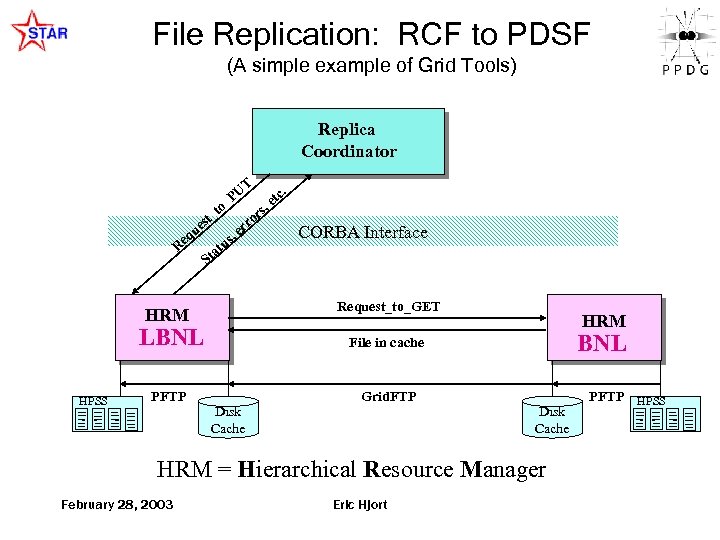
File Replication: RCF to PDSF (A simple example of Grid Tools) Replica Coordinator T U _P o t st_ e u eq R , us s or rr e at St c. t , e CORBA Interface Request_to_GET HRM LBNL HPSS File in cache PFTP Grid. FTP HRM Disk Cache BNL Disk Cache HRM = Hierarchical Resource Manager February 28, 2003 Eric Hjort PFTP HPSS
Grid computing • For STAR data transfer: – Authenticate with grid certificate • Convenient: not necessary to log in at RCF • Use grid-proxy-init (requires password) – Automatic caching of data by HRMs • large cache disk not necessary • enables continous automatic transfers – Result: Grid tools improve net transfer rate, reduce effort • What does it take to do grid computing? – – Get a DOE Science Grid certificate Get it installed on STAR grid nodes at RCF and PDSF Easy to do some simple, convenient things with Globus Alpha testers wanted – Iwona has prepared instructions February 28, 2003 Eric Hjort
Disk Resources at PDSF • High performance disk (1 TB on /aztera) – Heavily used datasets; embedding input files • Distributed disks (14 TB on 70 nodes) – For large Mu. Dst productions. – Data access by the STAR job scheduler. • Production data vaults (11 TB) – Embedding output; simulations data; selected Mu. Dst’s; etc. – Managed by production people • PWG data vaults (5. 3 TB) – Managed by PWG’s. – More space available on a by-request basis. • Scratch space (1 TB on pdsfdv 15) February 28, 2003 Eric Hjort
How to find STAR Data at PDSF New links on the STAR PDSF help page: Summary of STAR data at PDSF: Embedding data on disk Mu. Dst's and simulation data on disk Job scheduler instructions and data on distributed disks. These pages update automatically every 24 hours. If you can’t find it on these pages… email: ELHjort@lbl. gov. February 28, 2003 Eric Hjort
Job submission at PDSF • Job scheduler in use for data on distributed disks – No special queue for scheduler – Not fully function without a PDSF file catalog – Uses pre-made filelists • Job scheduler not used for data on NFS disks – Data is filtered for sanity=1 • Queues/priorities: – – Short (1 hr), medium (24 hr), long (5 days) Production account (user starofl) has a higher priority At present production is not run on distributed disk nodes Important to balance production vs. users’ resources February 28, 2003 Eric Hjort
Embedding Overview • Embedding production done at PDSF – “embed” simulated particles into real data at the raw data level – Reconstruction yields efficiencies – Important test of STAR software: simulations meet real data • 20 TB, 10 M events in 2002 • People involved: – Eric Hjort (infrastructure and development; spectra production) – Matt Lamont (strangeness-specific infrastructure, strangeness production) – Patricia Fachini (development; miscellaneous production) – Christina Markert (development; miscellaneous production) – Olga Barranikova (QA) – STAR collaborators (SOFI, calibrations, simulations, etc. ) February 28, 2003 Eric Hjort
Embedding Methods • Year 2 Au. Au TPC embedding – 20 Ge. V – 200 Ge. V (P 02 gd) running without problems for about 1 year • At least 29 different embedded particles • Central, minbias, both fields, various pt, y ranges, etc. • pp embedding – Hijing pp -> zerobias (vertex reconstruction studies) – Hijing pp + embedded particle -> zerobias (Jon G. ) – Embedded particle -> pp data (Matt/strangeness) • RICH embedding (Boris H. ): Tested and in production • d. Au embedding status – Working in a testing mode – Need to test/understand d. E/dx shift – Many d. Au and zerobias daq files are at PDSF – Initial production setup ready next week • d. Au FTPC (Frank S. ): Working; needs details + testing February 28, 2003 Eric Hjort
Embedding Requests • Ask your PWG convenor to submit request to Simulations Production Request Page: – – Organizes and documents the work Specifies job parameters for reference Allows for prioritization of jobs by Jamie Protects against resource misuse • If not prioritized, jobs order = submissions order, but… – Multiple operators mix order – Technical reasons mix order – Some requests take much longer than others February 28, 2003 Eric Hjort
Summary/Future plans • Data transfer – Grid tools serve us well – Data transfer needs are met in general – Goal for this year’s run: reduce latency to 1 week or less? • Data management – PDSF data discovery webpages overhauled – Job scheduler in use – Next big step: file catalog at PDSF • Embedding and Simulations – Au. Au, pp, RICH embedding all working – d. Au TPC and FTPC embedding almost in production – Future: new detectors, understand triggers, etc. • Bigger picture – Seamless, more automated data transfer RCF <-> PDSF – Distributed grid computing with the Job Scheduler. February 28, 2003 Eric Hjort
Скачать презентацию PDSF Status and Overview Eric Hjort LBNL STAR
9df3dd9c876e6898e49056fd935d3963.ppt