 Скачать презентацию Payments risky business security — liability Simon
132910d086aabca0622f17602cedc0f2.ppt
- Количество слайдов: 32



Payments: risky business ! (security - liability) Simon Lelieveldt S. Lelieveldt Consultancy

Simon Lelieveldt n Postbank (1989 -1995) – project manager / strategy planner n De Nederlandsche Bank (1995 -2001) – senior policy analist • BIS 1996: security of e-money, Supervision emoney (Chipper / Chipknip), BIS Reports (1999, 2000), Dutch policy report (1999) n Independent consultant (2001 -. . ) © S Lelieveldt SAFE-NL meeting June 13, 2003
Latest news…. . ten thousand Dutch credit cards were blocked last week by Interpay, following a fraud-attack from the US. Is this a security problem ? © S Lelieveldt SAFE-NL meeting June 13, 2003
Outline n n n Where is the security ? Regional differences Security as part of the business model Managing risk: cards on the web Future developments © S Lelieveldt SAFE-NL meeting June 13, 2003
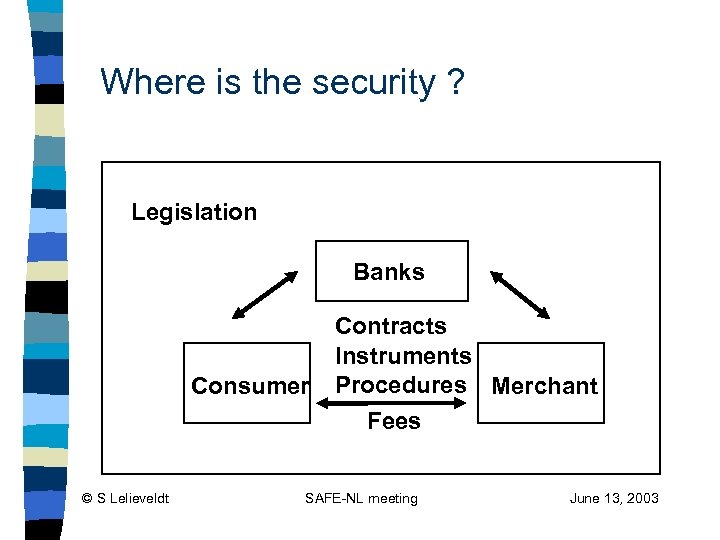
Where is the security ? Legislation Banks Consumer © S Lelieveldt Contracts Instruments Procedures Merchant Fees SAFE-NL meeting June 13, 2003
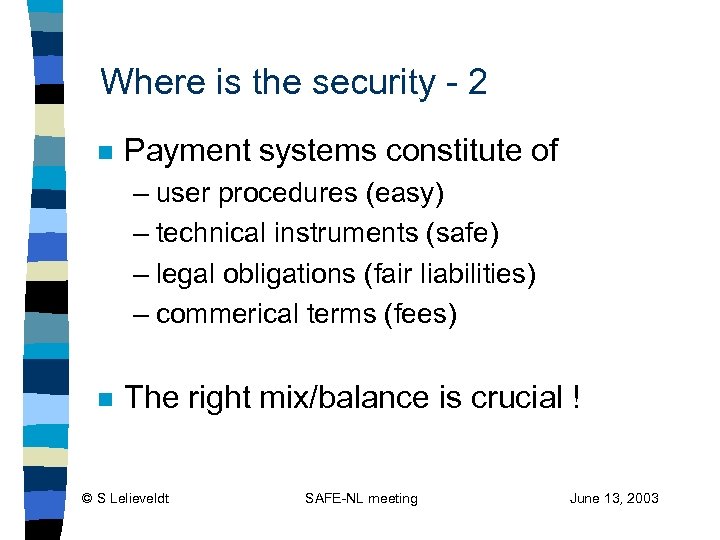
Where is the security - 2 n Payment systems constitute of – user procedures (easy) – technical instruments (safe) – legal obligations (fair liabilities) – commerical terms (fees) n The right mix/balance is crucial ! © S Lelieveldt SAFE-NL meeting June 13, 2003
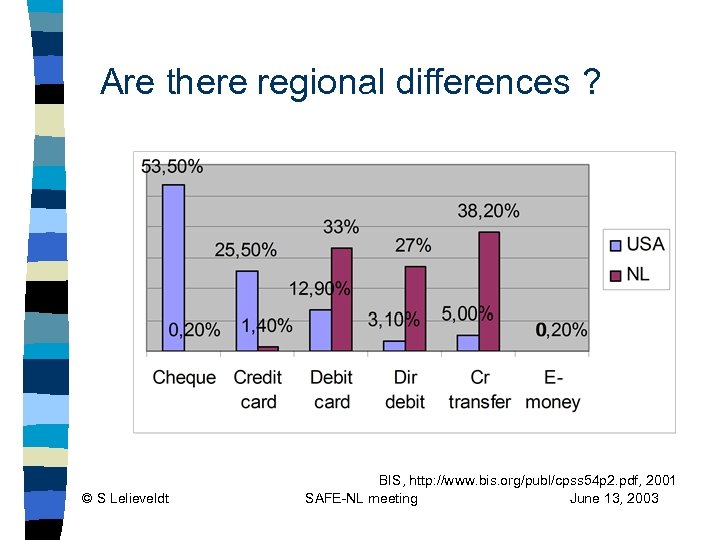
Are there regional differences ? © S Lelieveldt BIS, http: //www. bis. org/publ/cpss 54 p 2. pdf, 2001 SAFE-NL meeting June 13, 2003
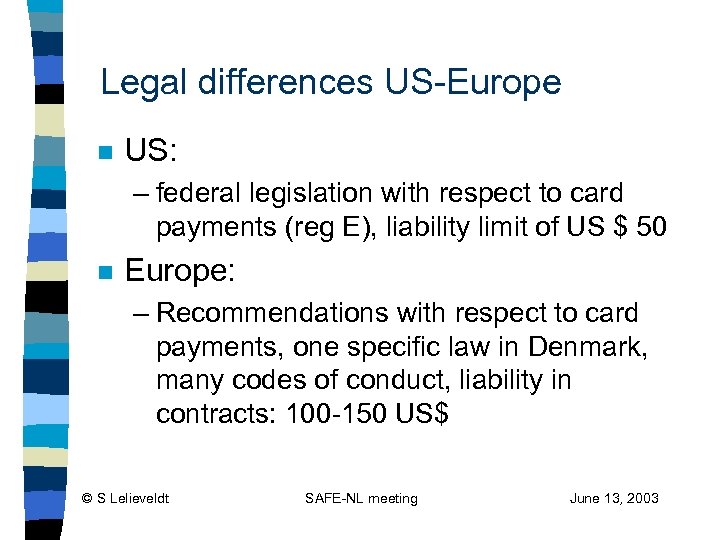
Legal differences US-Europe n US: – federal legislation with respect to card payments (reg E), liability limit of US $ 50 n Europe: – Recommendations with respect to card payments, one specific law in Denmark, many codes of conduct, liability in contracts: 100 -150 US$ © S Lelieveldt SAFE-NL meeting June 13, 2003
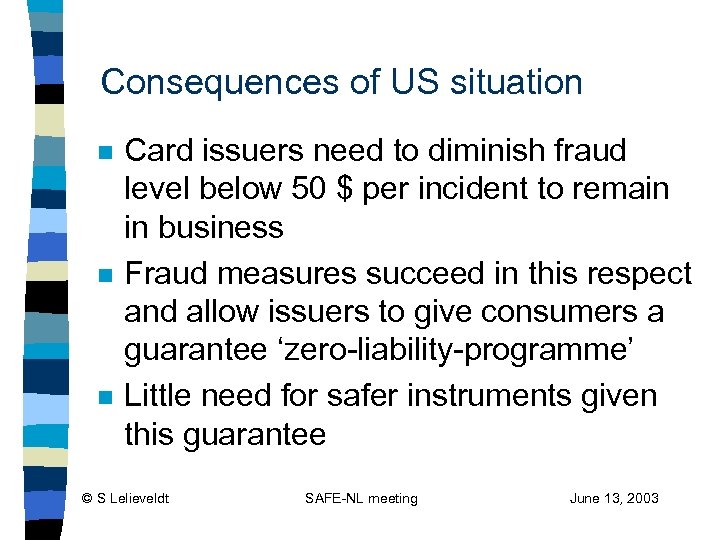
Consequences of US situation n Card issuers need to diminish fraud level below 50 $ per incident to remain in business Fraud measures succeed in this respect and allow issuers to give consumers a guarantee ‘zero-liability-programme’ Little need for safer instruments given this guarantee © S Lelieveldt SAFE-NL meeting June 13, 2003
Consequences in Europe n n n No federal or harmonised legislation No harmonisation of fraud measures Local solutions in Europe, different liability levels, based mostly on code of conduct and contract terms © S Lelieveldt SAFE-NL meeting June 13, 2003
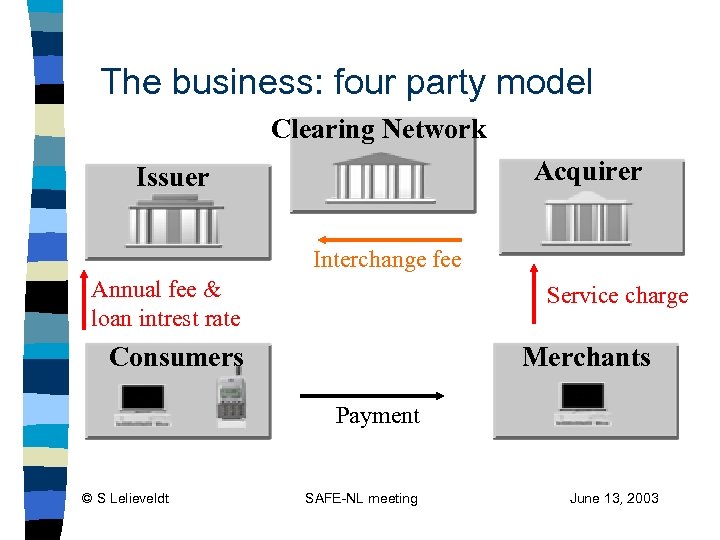
The business: four party model Clearing Network Acquirer Issuer Interchange fee Annual fee & loan intrest rate Service charge Consumers Merchants Payment © S Lelieveldt SAFE-NL meeting June 13, 2003
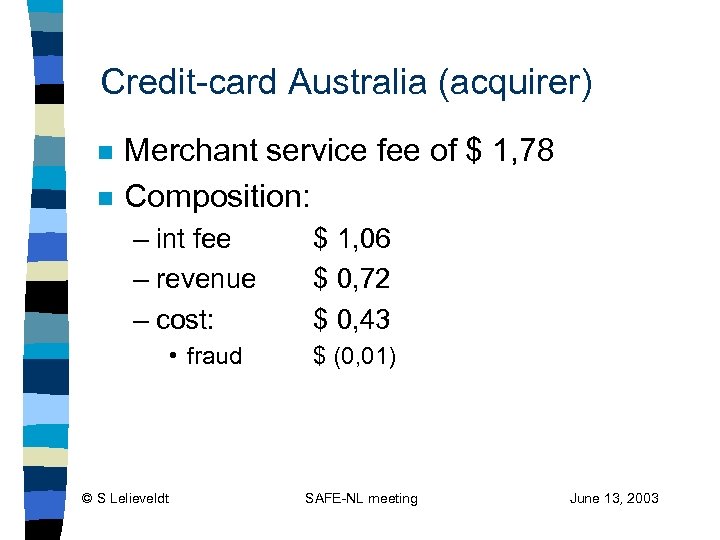
Credit-card Australia (acquirer) n n Merchant service fee of $ 1, 78 Composition: – int fee – revenue – cost: • fraud © S Lelieveldt $ 1, 06 $ 0, 72 $ 0, 43 $ (0, 01) SAFE-NL meeting June 13, 2003
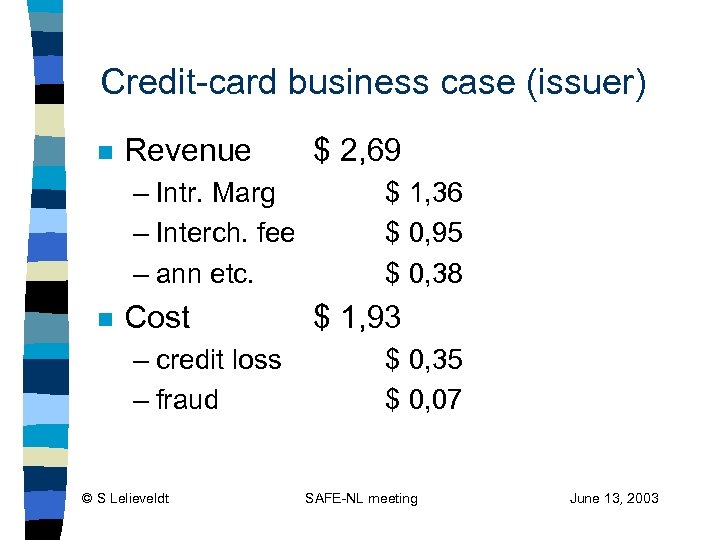
Credit-card business case (issuer) n Revenue – Intr. Marg – Interch. fee – ann etc. n Cost – credit loss – fraud © S Lelieveldt $ 2, 69 $ 1, 36 $ 0, 95 $ 0, 38 $ 1, 93 $ 0, 35 $ 0, 07 SAFE-NL meeting June 13, 2003
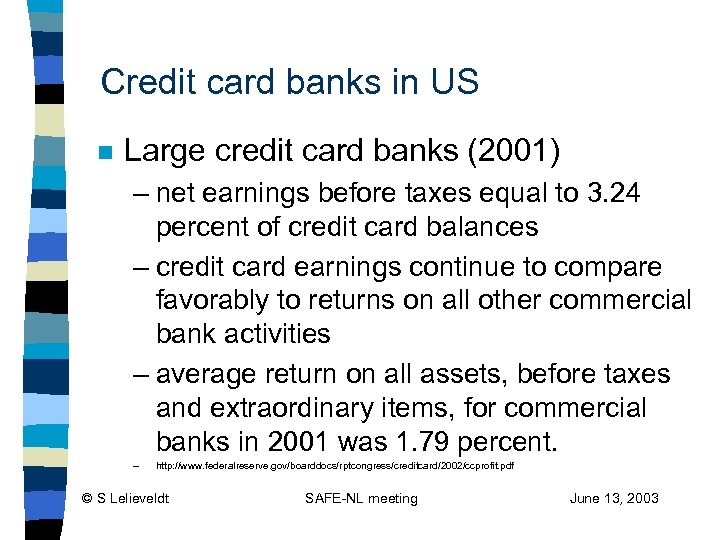
Credit card banks in US n Large credit card banks (2001) – net earnings before taxes equal to 3. 24 percent of credit card balances – credit card earnings continue to compare favorably to returns on all other commercial bank activities – average return on all assets, before taxes and extraordinary items, for commercial banks in 2001 was 1. 79 percent. – http: //www. federalreserve. gov/boarddocs/rptcongress/creditcard/2002/ccprofit. pdf © S Lelieveldt SAFE-NL meeting June 13, 2003
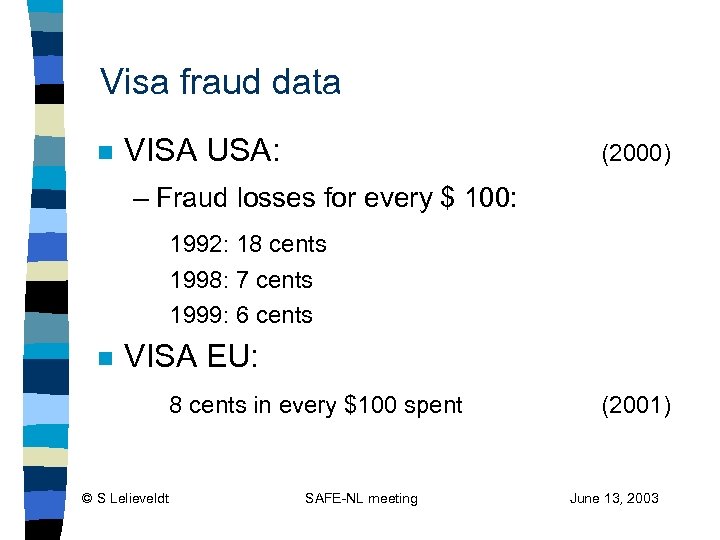
Visa fraud data n VISA USA: (2000) – Fraud losses for every $ 100: 1992: 18 cents 1998: 7 cents 1999: 6 cents n VISA EU: 8 cents in every $100 spent © S Lelieveldt SAFE-NL meeting (2001) June 13, 2003
First conclusion n Payments are a risky business but risk can be managed…. . © S Lelieveldt SAFE-NL meeting June 13, 2003
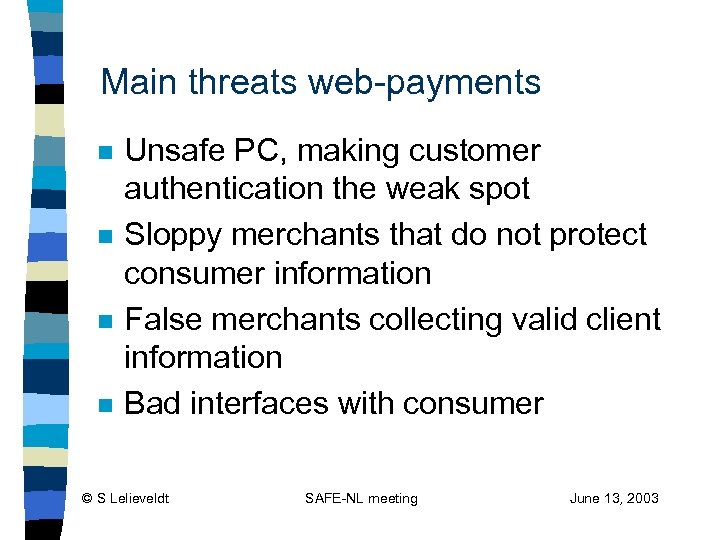
Main threats web-payments n n Unsafe PC, making customer authentication the weak spot Sloppy merchants that do not protect consumer information False merchants collecting valid client information Bad interfaces with consumer © S Lelieveldt SAFE-NL meeting June 13, 2003
Very first developments (1994) n n n Microsoft and Visa develop SETT (secure electronic transaction technology) Netscape and Mastercard working on SEPP (secure electronic payment protocol) 1995/1996: Visa/Mastercard develop SET (Secure Electronic Transaction) © S Lelieveldt SAFE-NL meeting June 13, 2003
Situation: 1995 -2000 n Merchants calculate, manage and accept the risks involved with chargebacks credit-cards n Banks and card industry: – Develop SET as a safer product © S Lelieveldt SAFE-NL meeting June 13, 2003
The ‘SET-development’ n Framing the issue as a security issue – 1: warn consumer about unsafety of ccpayments over the web – 2: forbid (if possible) cc-payments over web – 3: develop SET as a safe produkt n -->will force merchants to adopt SET © S Lelieveldt SAFE-NL meeting June 13, 2003
Results - 1 n Publicity campaign unsafe credit-card numbers worked n Research in 1999 showed: – 40 % won’t give cc number over phone – 60 % won’t give it over the web © S Lelieveldt SAFE-NL meeting June 13, 2003
Results - 2 n n n Creditcard works fine for US merchants and customers (zero liability) Dutch web-companies went abroad to acquiring banks Forbidding usage on the web does not work © S Lelieveldt SAFE-NL meeting June 13, 2003
Results - 3 n n I-pay with SET introduced in NL Some SET-solutions implemented – SET became heavy wallet-solution – Implementation costs merchant very high – Set up and install problems for consumer – Too few shops accepting product (80) n SSL became the standard © S Lelieveldt SAFE-NL meeting June 13, 2003
Reconsideration of approach n Cleanup to prevent misuse old files: – Mastercard and Visa UK announce 3 digit verification code to be used on web as of April 1, 2001 n n Emphasis best practices webmerchant Development of newer light-weight solutions in combination with three domain model and liability shift © S Lelieveldt SAFE-NL meeting June 13, 2003
New web-solutions n Disposable credit card numbers for online shopping – Amex, MBNA, ABN AMRO e-wallet n 3 D-secure – Visa: Verified by Visa – Mastercard: Secure code – in combination with liability shift © S Lelieveldt SAFE-NL meeting June 13, 2003
Liability shift n On 1 April 2002, chargebacks on the Internet ceased to be the sole responsibility of the Merchant. The liability for repudiated e-commerce transactions within the EU Region moved to the Issuer if the Merchant is protected by 'Verified by Visa'. © S Lelieveldt SAFE-NL meeting June 13, 2003
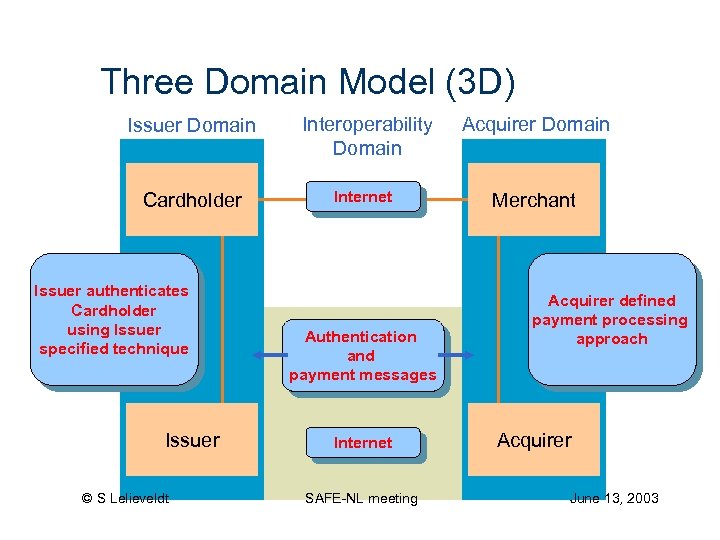
Three Domain Model (3 D) Issuer Domain Interoperability Domain Acquirer Domain Cardholder Internet Merchant Issuer authenticates Cardholder using Issuer specified technique Issuer © S Lelieveldt Authentication and payment messages Internet SAFE-NL meeting Acquirer defined payment processing approach Acquirer June 13, 2003
Additional supportive action: n n Elimination of sub-submerchants High fees and penalties for chargebacks Court cases if web merchant doesn’t pay back charge-backs Continued emphasis on best practices for webmerchants © S Lelieveldt SAFE-NL meeting June 13, 2003
What have we seen? n Security determined by: – regional context – legal context – business context – evolution / learning curve n Liability shift as a powerful incentive © S Lelieveldt SAFE-NL meeting June 13, 2003
What’s next ? n Major fraud concerns: – counterfeit cards – card not present transactions – lost and stolen cards n leading to – 3 D solutions on the web – implementation of EMV (IC-chip) © S Lelieveldt SAFE-NL meeting June 13, 2003
What’s next in the Netherlands ? n The liability shift as the solution for direct debit payments on the web – if not processed according to standardized rules, liability for erroneous/fraudulous payments shifts to acquirer / merchants n n Slow implementation of 3 D-solutions Very slow implementation of EMV – conference 18 th of June in Amsterdam © S Lelieveldt SAFE-NL meeting June 13, 2003
Questions ? © S Lelieveldt SAFE-NL meeting June 13, 2003
Скачать презентацию Payments risky business security — liability Simon
132910d086aabca0622f17602cedc0f2.ppt