


 Скачать презентацию Paying for Privacy Consumers Infrastructures Adam Shostack
accb6e104c4fa21dbd2baeb5d5cb006c.ppt
- Количество слайдов: 31
 Paying for Privacy: Consumers & Infrastructures Adam Shostack adam@informedsecurity. com Presented at 2 nd Workshop on Security and Economics Maryland, May 2003
 Privacy: Two Intertwined Views n Consumers and Privacy n n Identity Infrastructures n n What consumers want What governments want What we all get
 Does Privacy Matter to People? n n n Polls say that it does Media reports pay it huge attention People seem to care quite deeply
 They don’t act that way n n n Tell strangers all sorts of things Don’t object to intrusive searches Trade DNA for a Big Mac Don’t buy privacy products in great bulk Author worked for Zero-Knowledge for three years n n Still in business, not ruling the world. “People won’t pay for privacy”
 People Won’t Pay for Privacy n n Wrong Conclusion People won’t pay for things they don’t understand: n n n The problem a product solves The way it solves it Freedom Network had both those issues n People were amazingly excited by the idea
 Quick Review Freedom Net n Zero Knowledge’s Anonymous IP net n n n Real time Email, web, chat No single trust point Very expensive to operate (ZKS paid) No longer in operation
 What is Privacy? Confusing!
 Privacy means too much n n The word has too many meanings People use it sloppily The result is confusion over what people want and will pay for Privacy from the perspective of buyers n Important to answering the question “Will people pay? ”
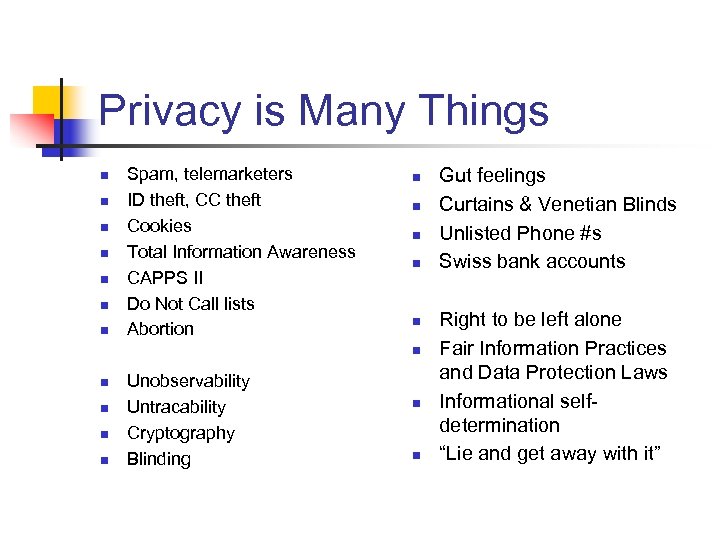 Privacy is Many Things n n n n Spam, telemarketers ID theft, CC theft Cookies Total Information Awareness CAPPS II Do Not Call lists Abortion n n Unobservability Untracability Cryptography Blinding n n Gut feelings Curtains & Venetian Blinds Unlisted Phone #s Swiss bank accounts Right to be left alone Fair Information Practices and Data Protection Laws Informational selfdetermination “Lie and get away with it”
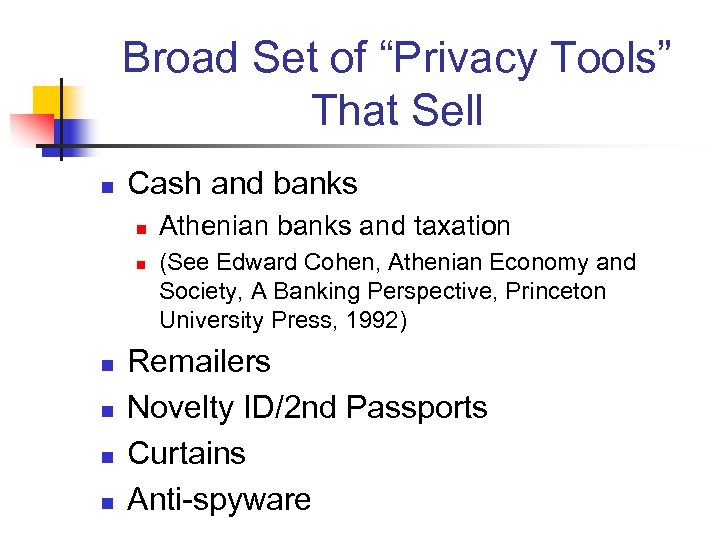 Broad Set of “Privacy Tools” That Sell n Cash and banks n n n Athenian banks and taxation (See Edward Cohen, Athenian Economy and Society, A Banking Perspective, Princeton University Press, 1992) Remailers Novelty ID/2 nd Passports Curtains Anti-spyware
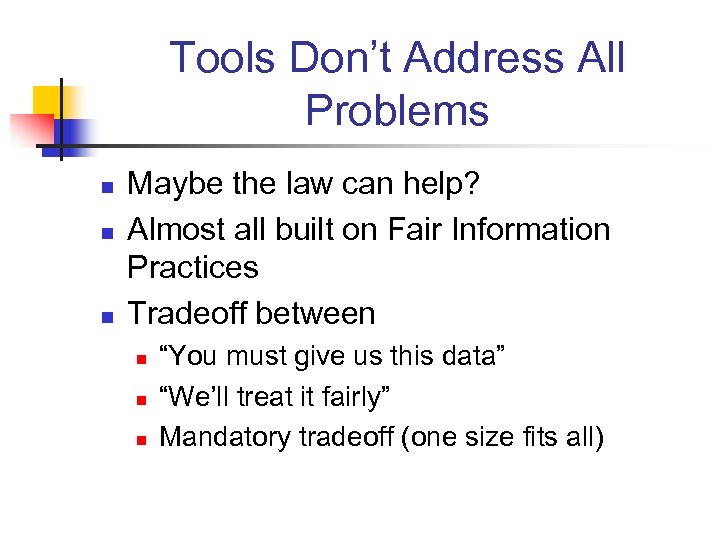 Tools Don’t Address All Problems n n n Maybe the law can help? Almost all built on Fair Information Practices Tradeoff between n “You must give us this data” “We’ll treat it fairly” Mandatory tradeoff (one size fits all)
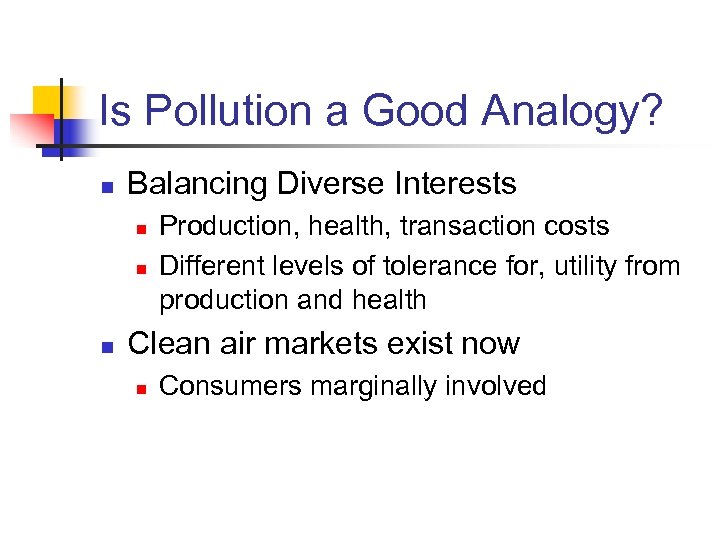 Is Pollution a Good Analogy? n Balancing Diverse Interests n n n Production, health, transaction costs Different levels of tolerance for, utility from production and health Clean air markets exist now n Consumers marginally involved
 Externalities n n A situation in which someone’s wellbeing is affected by another’s action, and they have no control of, or involvement in that action Pollution is a classic example
 Looking at the Externality n n n Storage of data creates privacy hazard (Computer security stinks) Users can’t insure privacy n n n Hard to measure value Hard to measure risk Risk is a likelihood of a hazard leading to damage ID Theft insurance available May lead to tort claims
 Risk & Externality n n n Business are not motivated to protect data as well as the individual who will be hurt by its release e. g. , AIDS patient lists Many people not comfortable with this tradeoff n “Privacy Extremists”
 Both Sides Are Rational n n n Business needs certain data to function Customer doesn’t trust the business Lets not even talk about secondary uses or default states
 Both Sides Are Emotional n People are tired of privacy invasions n n Ask the travel business about CAPPS II Businesses are tired of privacy complaints n Ask your HR person for privacy problem stories…but only over beer.
 Zero-Knowledge Analysis n n It didn’t do well in the market What can we learn from this? NOT: “People won’t pay for privacy” Service didn’t meet a meaningful threat the users cared about
 Overview ü ä Consumers and Privacy Identity and Infrastructure, or We’re from the government and we’re here to help someone pretend to be you.
 Identity n n n What’s in a name? A rose by any other name would smell as sweet… But try getting a new ID for Ms. Capulet Common law n Use any name you want as long as your intent is not to deceive or defraud
 Modern State n n n Welfare systems Immigration problems Require an identity infrastructure n n Unique identifiers Some biometrics
 Identity Infrastructures n Hard to build without coercion n Diffuse benefits to me of an ID card See Public Key Infrastructure (PKI) “industry” Businesses can use n n At least in USA US SSN, no restrictions Dutch passports, illegal to copy German ID cards, # changes every 5 years
 Risk Assignment n Easy to demand ID n n Everyone has one Hard not to demand ID n n If problem, need to justify Hard to check ID carefully n n Expensive Excludes customers whose money you want
 Fake IDs n Market driven by ease of demand, problems with checking n n Drinking laws Employment/Immigration laws
 Banks and ID Risk n Banks check ID to issue mortgage n n n Banks don’t check ID to issue credit cards n n n Rather than meet in the property Reasonable cost/risk tradeoff (for the bank) Consumer credit is useful Reasonable cost/risk tradeoff (for the bank) Rising costs of ID theft
 High security ID cards n n n Reduce forgery Increase value of issuance fraud Ignore privacy problems
 Forbid non-gov use n n n Aggressive solution Requires explicit cost/benefit analysis Bars hire police to check IDs? n n “Society pays” for benefits of stopping underage drinking (or) Tax bars so drinkers pay
 Air Travel Security n n TSA could check ID Other measures more effective? n n n Cockpit doors/tunnels Air Marshals? Focus on threat, not ID checking n n ID checking seems free Imposes societal privacy cost as ID becomes mandatory
 Hard to Forbid ID use n US Legal traditions n n Free speech Free association Free to demand ID Classify ID cards? n n n Exemption for card holder Requires government agencies to treat data carefully Prevents others from using it
 Hard to Forbid ID use (2) n Liability for storing information insecurely n n n Hard for consumer to find where problem happened Liability for government decision makers? Tax on ID requirement to discourage?
 Conclusions n n n ID theft as risk distribution Free riding Inappropriate distribution of risk Possible solutions More work could be interesting