


 Скачать презентацию Payday Lending Legal Summit Installment Lending Panel APR
8f60d7a2a7e39e6a10aa616ddff34e30.ppt
- Количество слайдов: 21
 Payday Lending Legal Summit Installment Lending Panel APR Misconceptions and Problems
 TILA Misconceptions n Loan Origination Systems—OK To Buy An Off-The-Shelf Product n “Buy Ours—We’ve done installment loans for years!” Like New! Problems: n Not Designed For Payments Tied To Paydays n Built for Long-Term Loans n n Lower Rates More Tolerance For Error
 TILA Misconceptions n If You Only Charge Interest—Then The APR Is I Always The “Interest Rate!” n It has to be : n There are no “Finance Charges” n e. g. , 250% Interest Rate n Fact Or Fiction? n Answer… Equals 250% APR
 Fact or Fiction? n Answer…That Depends n Depends On Your Tolerance To Risk n Depends On How Gutsy You Are
 Fact or Fiction? n Issue: n US Ruleversus Actuarial. Methods: US Rule: n APR Will Always. Be The Interest Rate If There Are No Other TILA “Finance Charges” n Actuarial Method: n APR Is Almost Never The Same As The Interest Rate —Even If No Other “Finance Charges” Are Imposed
 Gutsy? n Which Would You Rather Defend? US Rule Method n One Paragraph Authorization In Appendix J (3) In contrast, under the United States Rule method, at the end of each payment pe balance of the amount financed is increased by the finance charge earned during t period and is decreased by the payment made at the end of that payment period. I less than the finance charge earned, the adjustment of the unpaid balance of the a postponed until the end of the next payment period. If at that time the sum of the still less than the total earned finance charge for the two payment periods, the adju unpaid balance of the amount financed is postponed still another payment period n No Formulas or Other Support in Reg. Z
 Which Would You Rather Defend? US Rule Method n Not Used In APRWIN Software (Actuarial) n US Rule Produces Different Results n APRWIN Is Accepted Standard For Verification n. Regulators & Litigators n No Supporting Case Law
 Which Would You Rather Defend? Actuarial Method n Clearly Spelled-Out In Appendix J n 15 Pages of Formulas and Examples n Too Many To Show Here n Support in Official Staff Commentary n Exact Match With APRWIN n Provided There Is No “Garbage In”
 What’s The Difference? n n Both Take Into Account “Time Value of Money” n Based On Timing And Amounts Of Payments & Advances US Rule: n No Compounding Of Interest n No Negative Amortization Actuarial Method: n Allows For Compounding of Interest n May Have Negative Amortization Both Are “After The Fact” And Ignore Interest Accrual Method
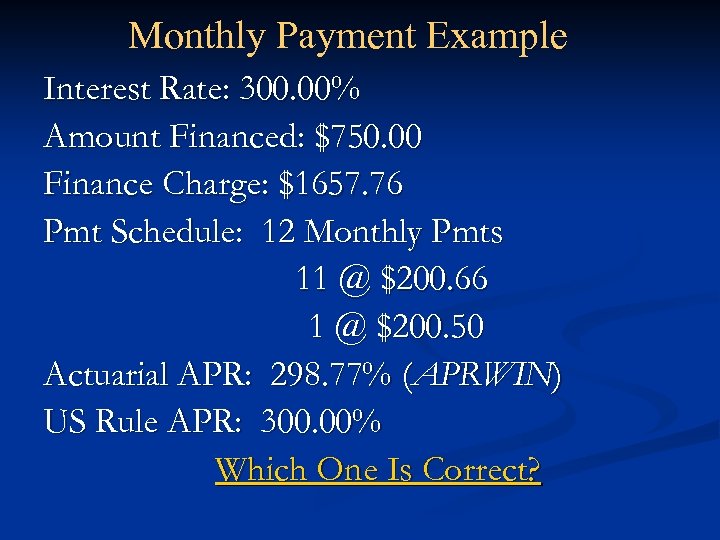 Monthly Payment Example Interest Rate: 300. 00% Amount Financed: $750. 00 Finance Charge: $1657. 76 Pmt Schedule: 12 Monthly Pmts 11 @ $200. 66 1 @ $200. 50 Actuarial APR: 298. 77% (APRWIN) US Rule APR: 300. 00% Which One Is Correct?
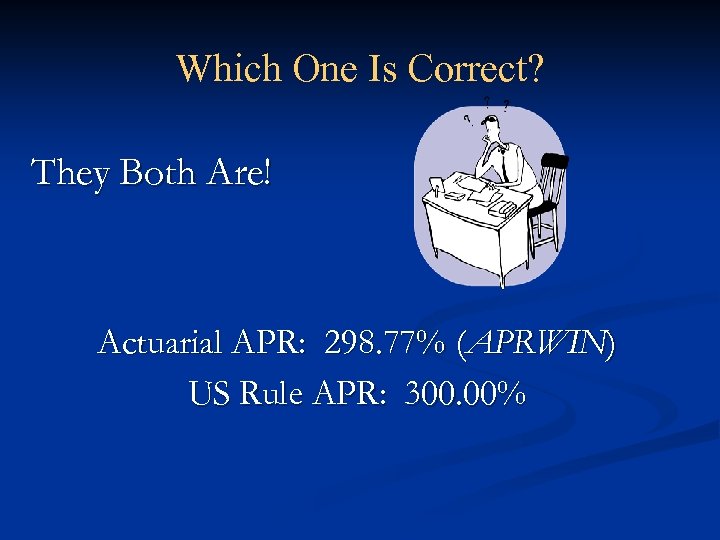 Which One Is Correct? They Both Are! Actuarial APR: 298. 77% (APRWIN) US Rule APR: 300. 00%
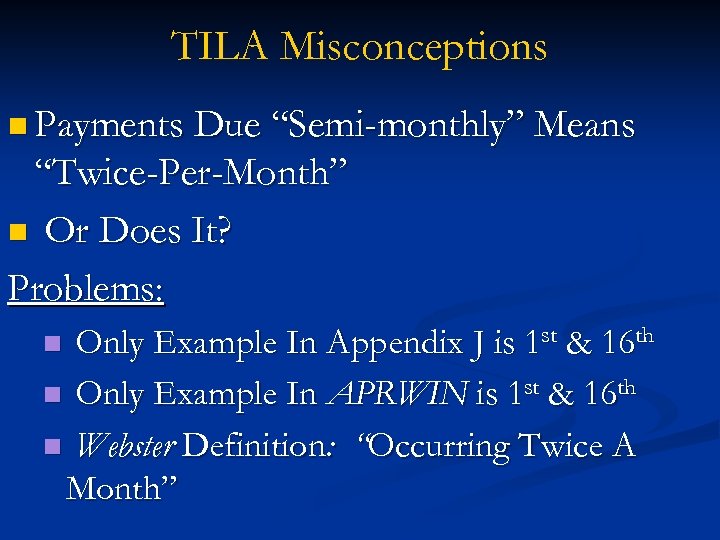 TILA Misconceptions n Payments Due “Semi-monthly” Means “Twice-Per-Month” n Or Does It? Problems: Only Example In Appendix J is 1 st & 16 th n Only Example In APRWIN is 1 st & 16 th n Webster Definition: “Occurring Twice A Month” n
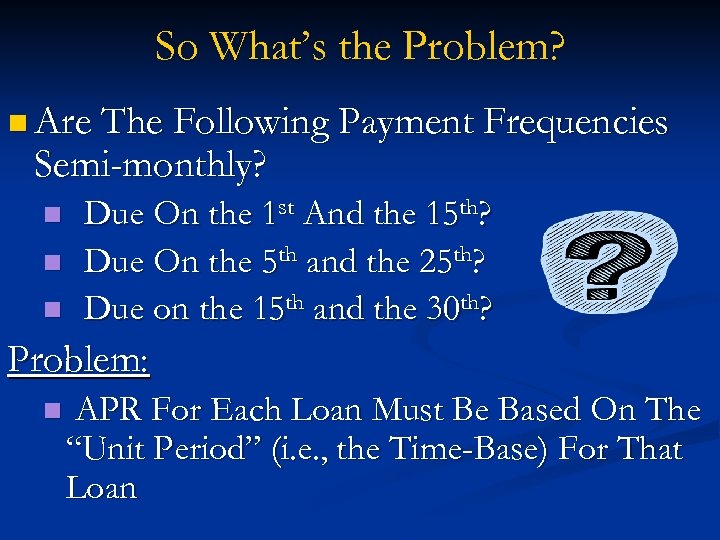 So What’s the Problem? n Are The Following Payment Frequencies Semi-monthly? n n n Due On the 1 st And the 15 th? Due On the 5 th and the 25 th? Due on the 15 th and the 30 th? Problem: n APR For Each Loan Must Be Based On The “Unit Period” (i. e. , the Time-Base) For That Loan
 What’s The Unit Period? n The Interval Of Time (Time-Base) That Best Fits The Pmt. Schedule Frequency n Unique To Each Loan n Identified By: & n (2) Determine The “Common Period” In The Loan n (1) Measure All “Periods” In The Loan, n Need To Know Before Proceeding With The Calculation Process
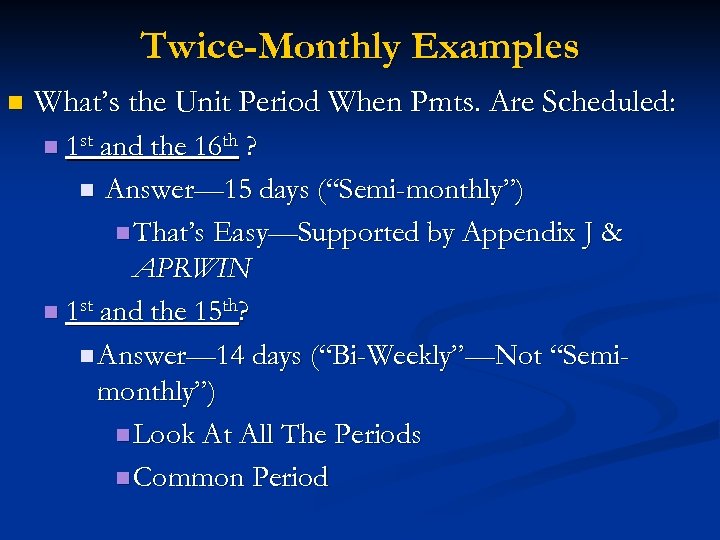 Twice-Monthly Examples n What’s the Unit Period When Pmts. Are Scheduled: n 1 st and the 16 th ? n Answer— 15 days (“Semi-monthly”) n That’s Easy—Supported by Appendix J & APRWIN n 1 st and the 15 th? n Answer— 14 days (“Bi-Weekly”—Not “Semimonthly”) n Look At All The Periods n Common Period
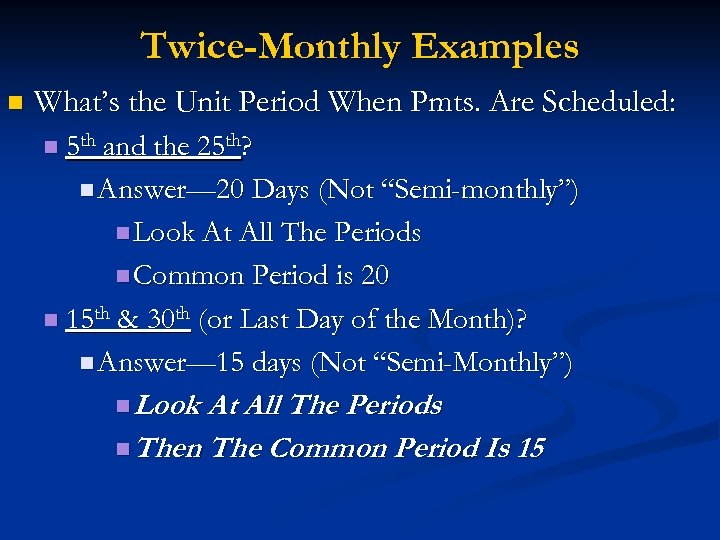 Twice-Monthly Examples n What’s the Unit Period When Pmts. Are Scheduled: n 5 th and the 25 th? n Answer— 20 Days (Not “Semi-monthly”) n Look At All The Periods n Common Period is 20 n 15 th & 30 th (or Last Day of the Month)? n Answer— 15 days (Not “Semi-Monthly”) n Look At All The Periods n The Common Period Is 15
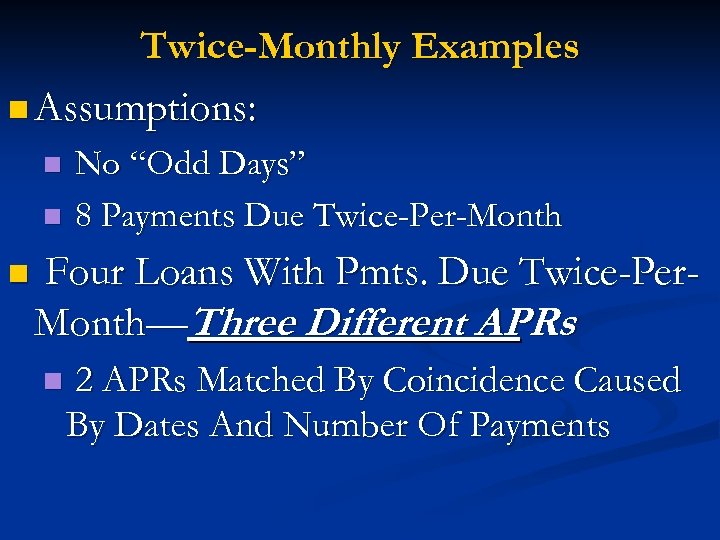 Twice-Monthly Examples n Assumptions: n n n No “Odd Days” 8 Payments Due Twice-Per-Month Four Loans With Pmts. Due Twice-Per. Month—Three Different APRs n 2 APRs Matched By Coincidence Caused By Dates And Number Of Payments
 Best Guess—“Semi-Monthly” If All Of The Following 3 Conditions Are Met, Then Always. Use 15 Days For the “Unit Period”: 1. Must Be 2 Scheduled Due Dates Within Each Full Month, 2. Due Dates Have The Same Two Anniversary Dates Within Each Full Month (e. g. , 5 th And 20 th Of Each Month), AND 3. There Are Exactly 15 Days Between The Two Payment Dates Within Each Month
 Best Guess—“Semi-Monthly” n All Other “Twice-Monthly” Payments, then: n n Look For Common Period If no Common Period—Then Use “Standard Interval of Time” As Defined By Appendix J n Another Topic For Another Conference
 RONALD D. GORSLINE CHAMBLISS, BAHNER & STOPHEL, P. C. 1000 TALLAN BUILDING CHATTNOOGA, TN 37402 423 -756 -3000 www. cbslawfirm. com
 CLIFF E. COOK COMPLIANCE SERVICES, INC. TACOMA, WASHINGTON (253) 756 -5767 ccook@aol. com