


 Скачать презентацию PAX AMERICANA IN THE 3 RD MILLENIUM WIDENING
c9a1435ef519ed2575afdb21f8f84ea9.ppt
- Количество слайдов: 55
 PAX AMERICANA IN THE 3 RD MILLENIUM: WIDENING US MILITARY AGGRESSION
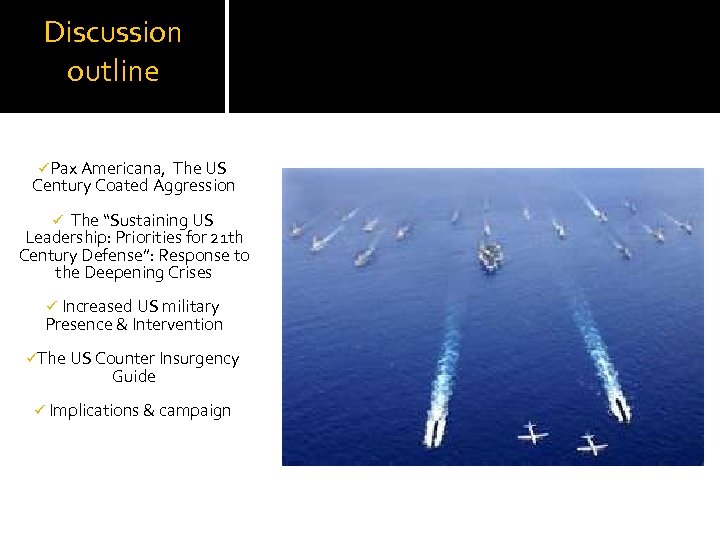 Discussion outline üPax Americana, The US Century Coated Aggression The “Sustaining US Leadership: Priorities for 21 th Century Defense”: Response to the Deepening Crises ü ü Increased US military Presence & Intervention üThe US Counter Insurgency Guide ü Implications & campaign
 PAX AMERICANA first articulated after the American Civil war Woodrow Wilson “make the world safe for democracy. ” April 2, 1917 “not a Pax Americana enforced on the world by American weapons of war. ” June 10, 1963, President John F. Kennedy delivered a commencement address at American University in Washington, D. C. "It is not a choice between preeminence today and preeminence tomorrow. Global leadership is not something exercised at our leisure, when the mood strikes us or when our core national security interests are directly threatened; then it is already too late. Rather, it is a choice whether or not to maintain American military preeminence, to secure American geopolitical leadership, and to preserve the American peace" (p. 76). Rebuilding America's Defenses
 Latest US defense strategy 16 -page strategic guidance document arising from review of US defense strategy in the light of changing geopolitical environment & fiscal circumstances
 Primary Missions of the U. S. Armed Forces Counter Terrorism and Irregular Warfare Deter and Defeat Aggression Project Power Despite Anti-Access/Area Denial Challenges Counter Weapons of Mass Destruction Operate Effectively in Cyberspace and Space Maintain a Safe, Secure, and Effective Nuclear Deterrent Defend the Homeland Provide Support to Civil Authorities Provide a Stabilizing Presence Conduct Stability and Counterinsurgency Operations. Conduct Humanitarian, Disaster Relief, and Other Operations
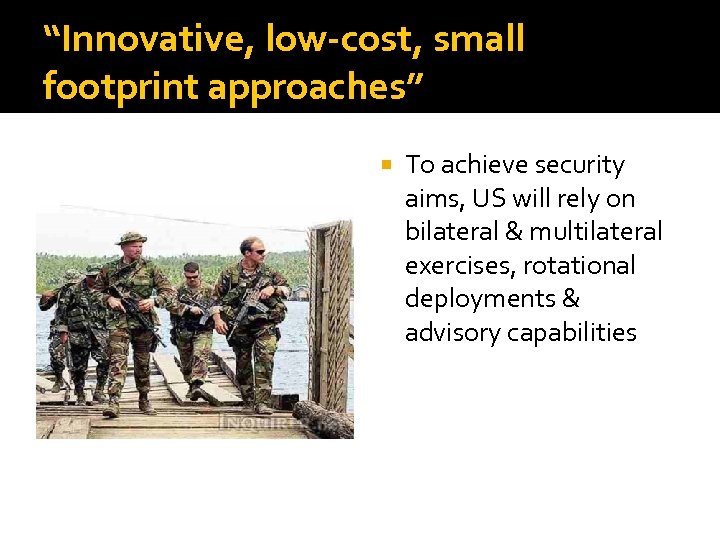 “Innovative, low-cost, small footprint approaches” To achieve security aims, US will rely on bilateral & multilateral exercises, rotational deployments & advisory capabilities
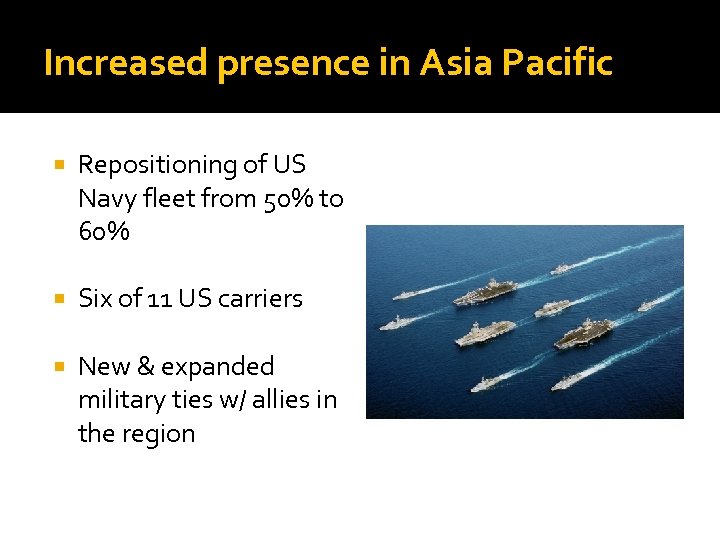 Increased presence in Asia Pacific Repositioning of US Navy fleet from 50% to 60% Six of 11 US carriers New & expanded military ties w/ allies in the region
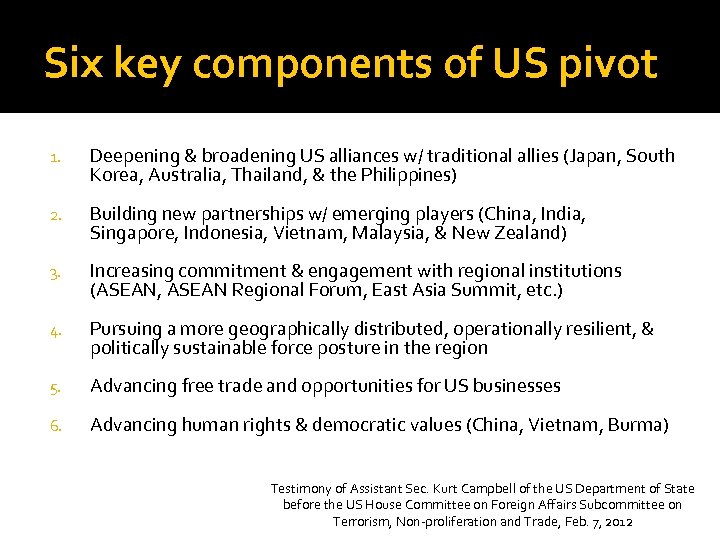 Six key components of US pivot 1. Deepening & broadening US alliances w/ traditional allies (Japan, South Korea, Australia, Thailand, & the Philippines) 2. Building new partnerships w/ emerging players (China, India, Singapore, Indonesia, Vietnam, Malaysia, & New Zealand) 3. Increasing commitment & engagement with regional institutions (ASEAN, ASEAN Regional Forum, East Asia Summit, etc. ) 4. Pursuing a more geographically distributed, operationally resilient, & politically sustainable force posture in the region 5. Advancing free trade and opportunities for US businesses 6. Advancing human rights & democratic values (China, Vietnam, Burma) Testimony of Assistant Sec. Kurt Campbell of the US Department of State before the US House Committee on Foreign Affairs Subcommittee on Terrorism, Non-proliferation and Trade, Feb. 7, 2012
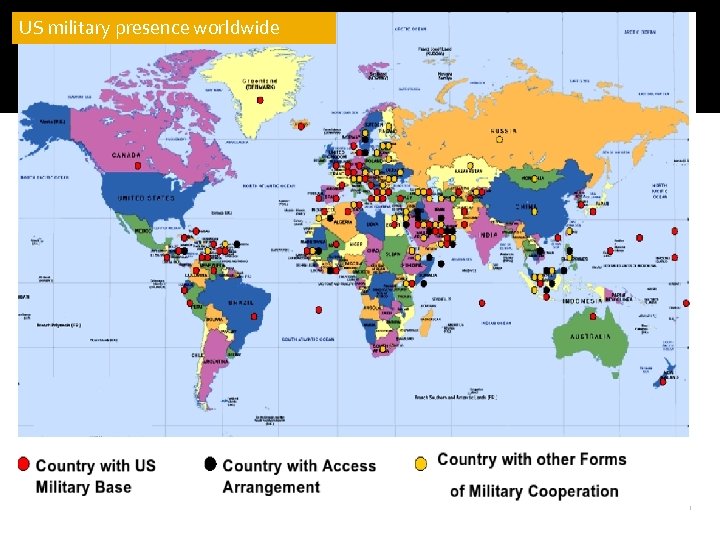 US military presence worldwide
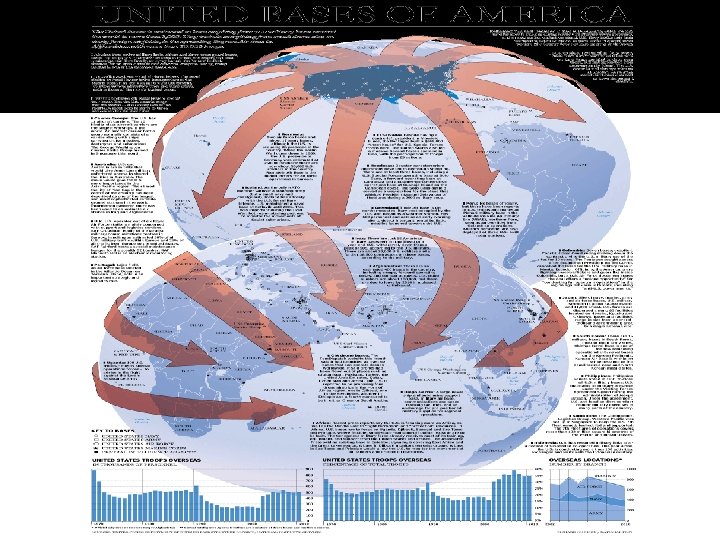
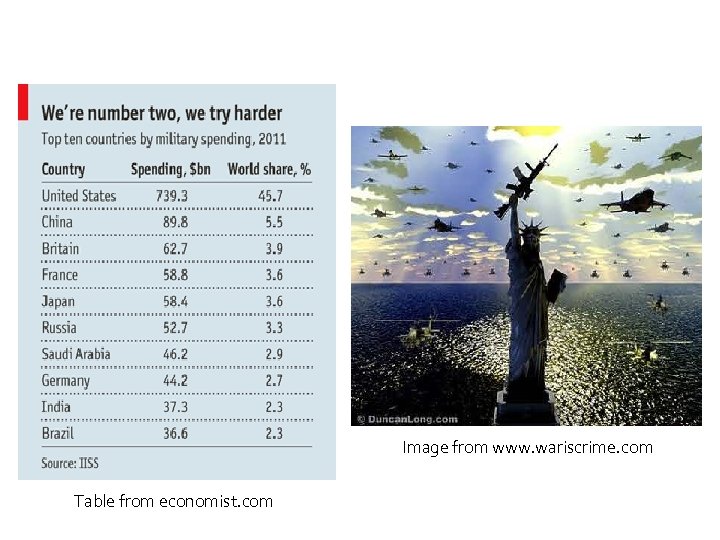 Image from www. wariscrime. com Table from economist. com
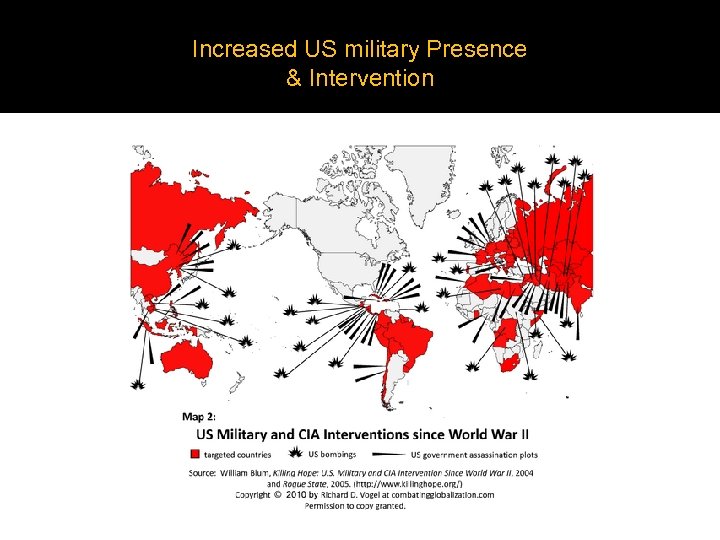 Increased US military Presence & Intervention
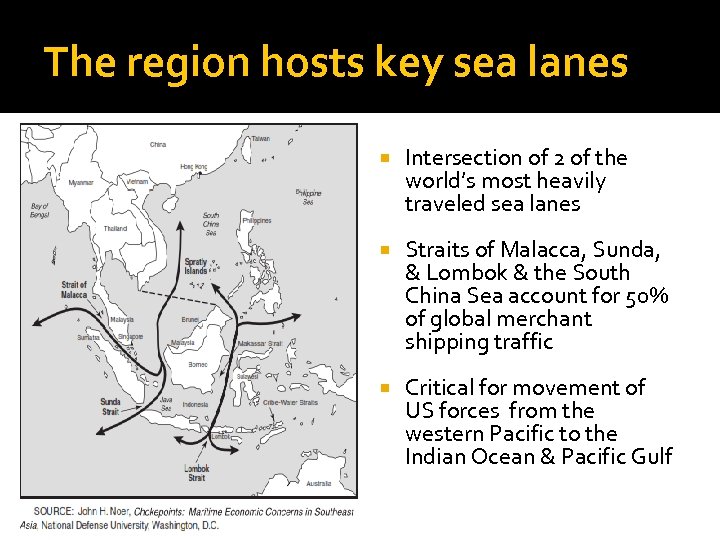 The region hosts key sea lanes Intersection of 2 of the world’s most heavily traveled sea lanes Straits of Malacca, Sunda, & Lombok & the South China Sea account for 50% of global merchant shipping traffic Critical for movement of US forces from the western Pacific to the Indian Ocean & Pacific Gulf
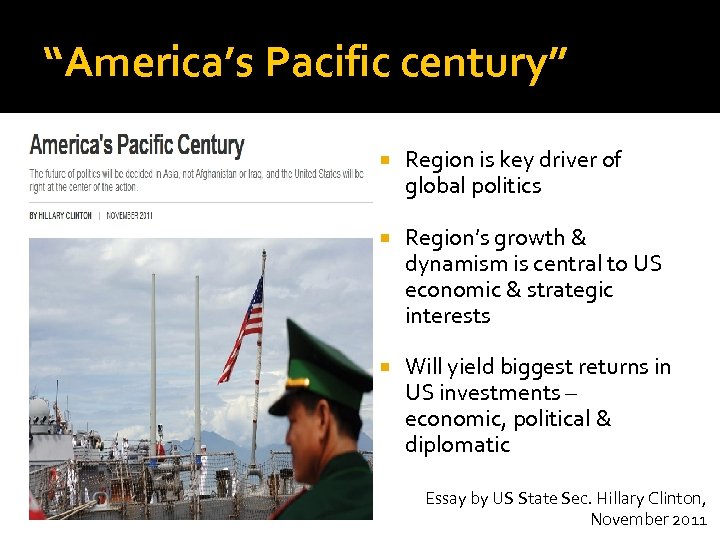 “America’s Pacific century” Region is key driver of global politics Region’s growth & dynamism is central to US economic & strategic interests Will yield biggest returns in US investments – economic, political & diplomatic Essay by US State Sec. Hillary Clinton, November 2011
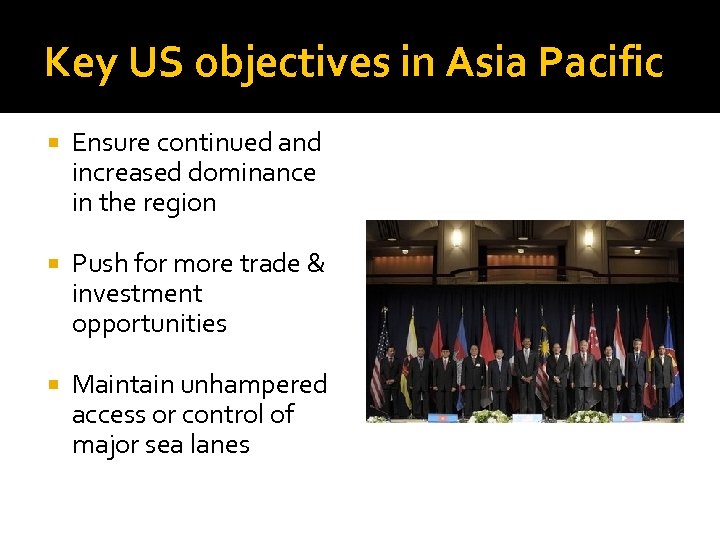 Key US objectives in Asia Pacific Ensure continued and increased dominance in the region Push for more trade & investment opportunities Maintain unhampered access or control of major sea lanes
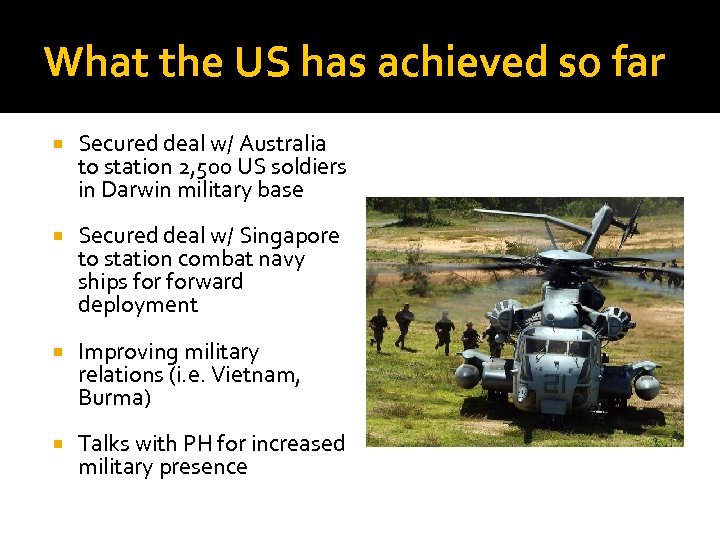 What the US has achieved so far Secured deal w/ Australia to station 2, 500 US soldiers in Darwin military base Secured deal w/ Singapore to station combat navy ships forward deployment Improving military relations (i. e. Vietnam, Burma) Talks with PH for increased military presence
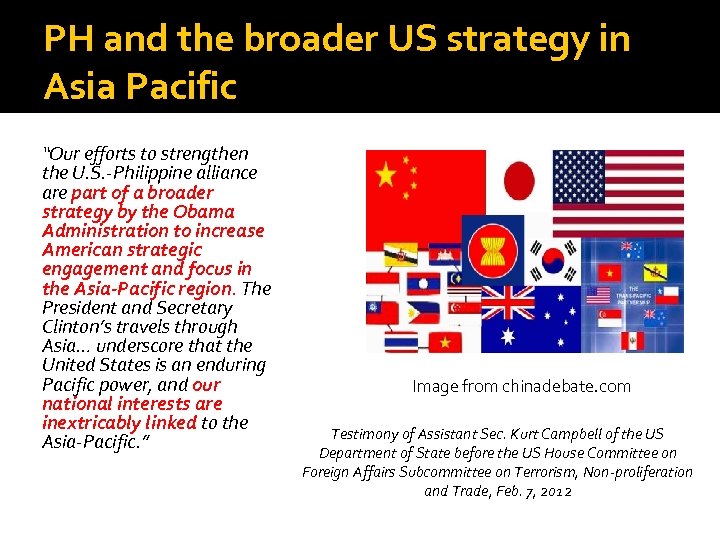 PH and the broader US strategy in Asia Pacific “Our efforts to strengthen the U. S. -Philippine alliance are part of a broader strategy by the Obama Administration to increase American strategic engagement and focus in the Asia-Pacific region. The President and Secretary Clinton’s travels through Asia… underscore that the United States is an enduring Pacific power, and our national interests are inextricably linked to the Asia-Pacific. ” Image from chinadebate. com Testimony of Assistant Sec. Kurt Campbell of the US Department of State before the US House Committee on Foreign Affairs Subcommittee on Terrorism, Non-proliferation and Trade, Feb. 7, 2012
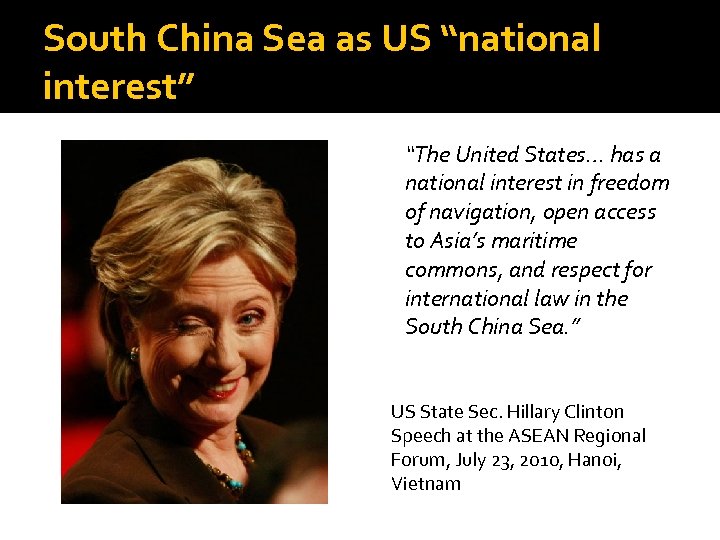 South China Sea as US “national interest” “The United States… has a national interest in freedom of navigation, open access to Asia’s maritime commons, and respect for international law in the South China Sea. ” US State Sec. Hillary Clinton Speech at the ASEAN Regional Forum, July 23, 2010, Hanoi, Vietnam
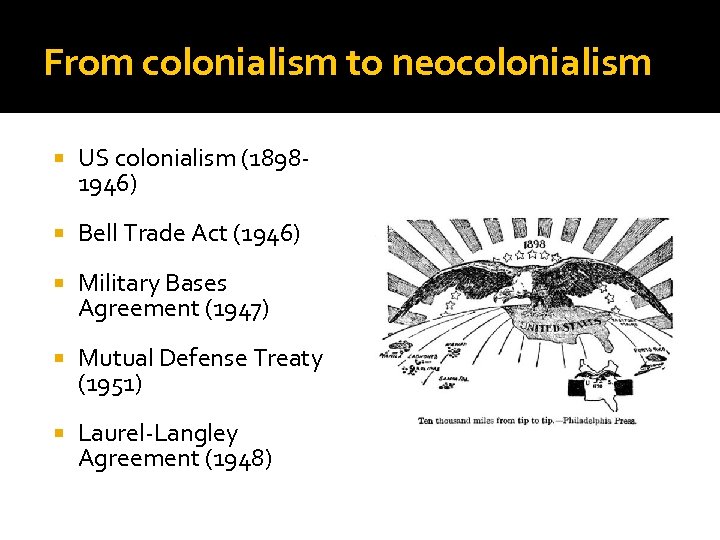 From colonialism to neocolonialism US colonialism (18981946) Bell Trade Act (1946) Military Bases Agreement (1947) Mutual Defense Treaty (1951) Laurel-Langley Agreement (1948)
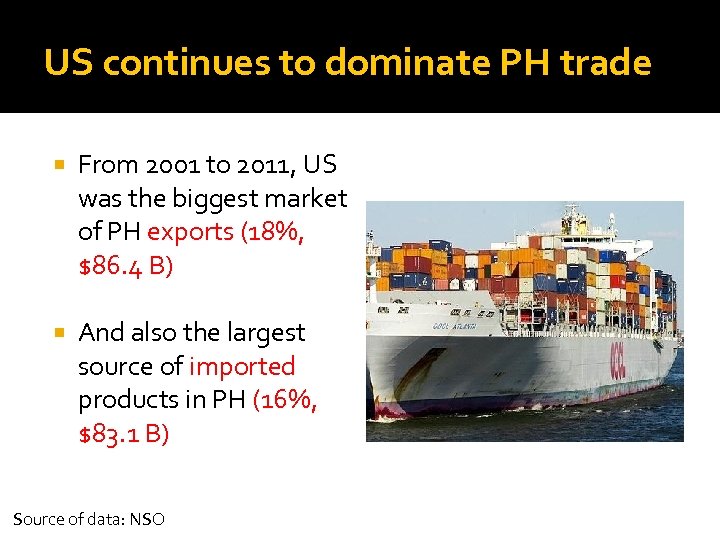 US continues to dominate PH trade From 2001 to 2011, US was the biggest market of PH exports (18%, $86. 4 B) And also the largest source of imported products in PH (16%, $83. 1 B) Source of data: NSO
 US continues to be the biggest source of foreign capital for PH From 2001 to 2011, American corporations accounted for largest foreign investments in PH with $3. 2 B, or 30% of the total Source of data: BSP
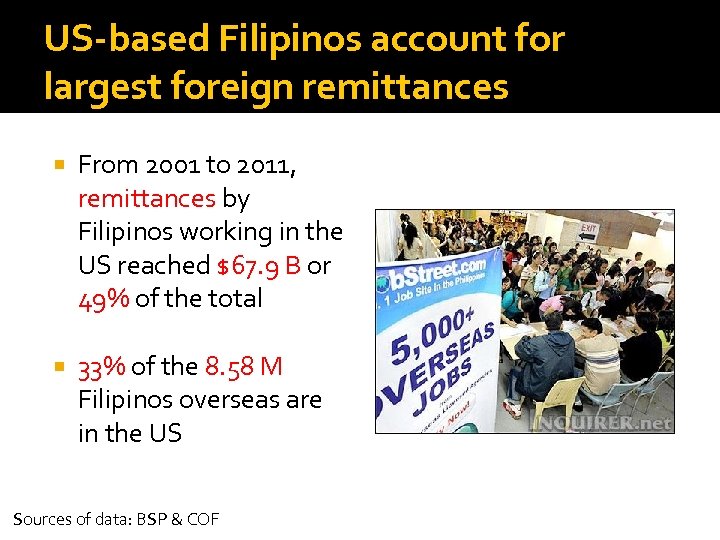 US-based Filipinos account for largest foreign remittances From 2001 to 2011, remittances by Filipinos working in the US reached $67. 9 B or 49% of the total 33% of the 8. 58 M Filipinos overseas are in the US Sources of data: BSP & COF
 US remains one of the biggest funders of PH “development” initiatives From 2001 to 2010, US economic aid disbursed to PH reached $1. 2 B Of w/c 50% went to food aid, population control & gov’t/civil society Source of data: USAID
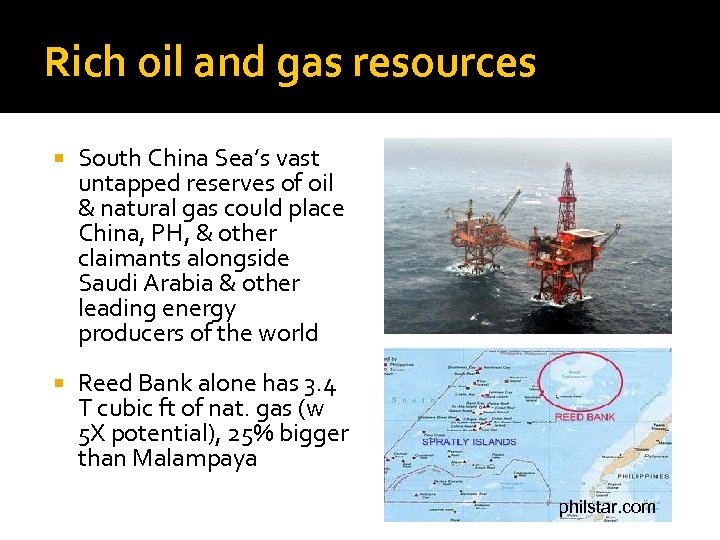 Rich oil and gas resources South China Sea’s vast untapped reserves of oil & natural gas could place China, PH, & other claimants alongside Saudi Arabia & other leading energy producers of the world Reed Bank alone has 3. 4 T cubic ft of nat. gas (w 5 X potential), 25% bigger than Malampaya philstar. com
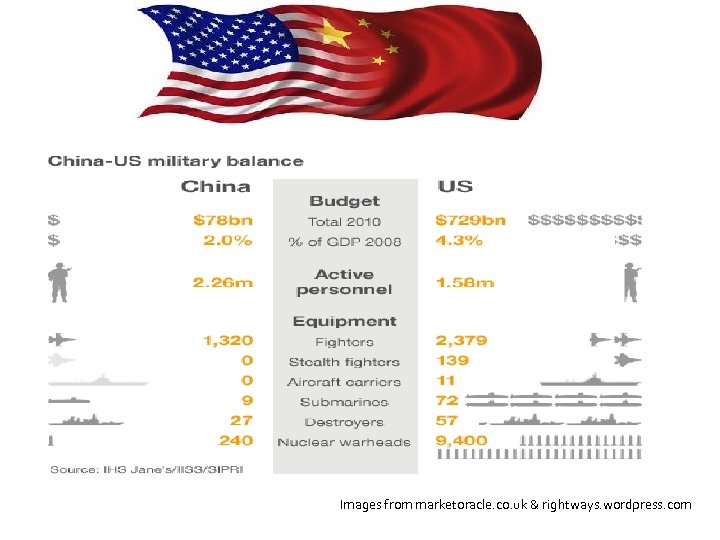
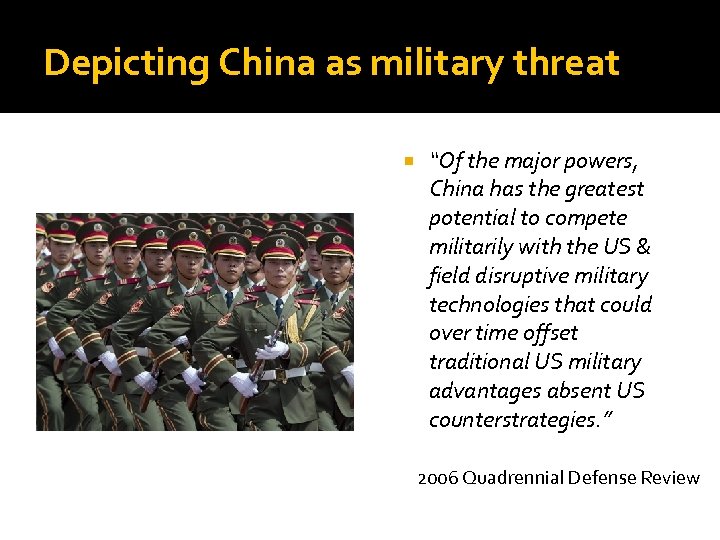 Depicting China as military threat “Of the major powers, China has the greatest potential to compete militarily with the US & field disruptive military technologies that could over time offset traditional US military advantages absent US counterstrategies. ” 2006 Quadrennial Defense Review
 Images from marketoracle. co. uk & rightways. wordpress. com
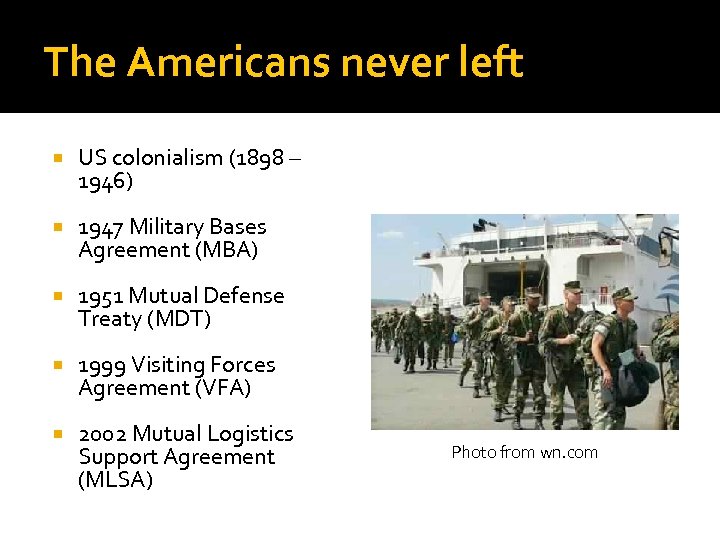 The Americans never left US colonialism (1898 – 1946) 1947 Military Bases Agreement (MBA) 1951 Mutual Defense Treaty (MDT) 1999 Visiting Forces Agreement (VFA) 2002 Mutual Logistics Support Agreement (MLSA) Photo from wn. com
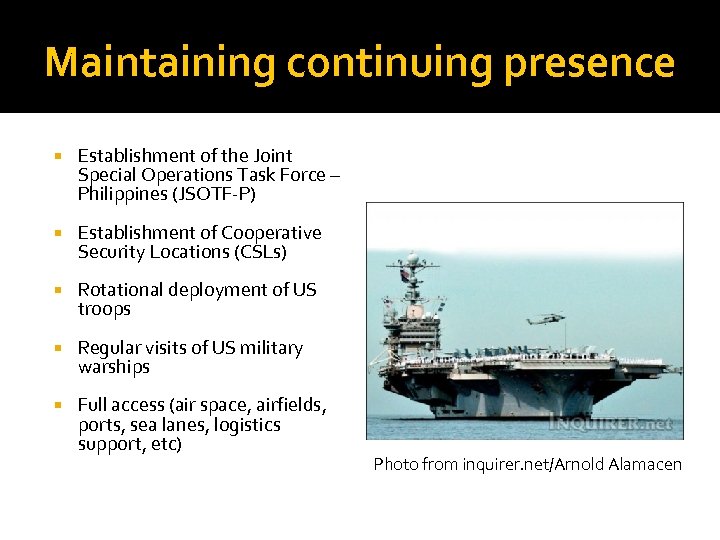 Maintaining continuing presence Establishment of the Joint Special Operations Task Force – Philippines (JSOTF-P) Establishment of Cooperative Security Locations (CSLs) Rotational deployment of US troops Regular visits of US military warships Full access (air space, airfields, ports, sea lanes, logistics support, etc) Photo from inquirer. net/Arnold Alamacen
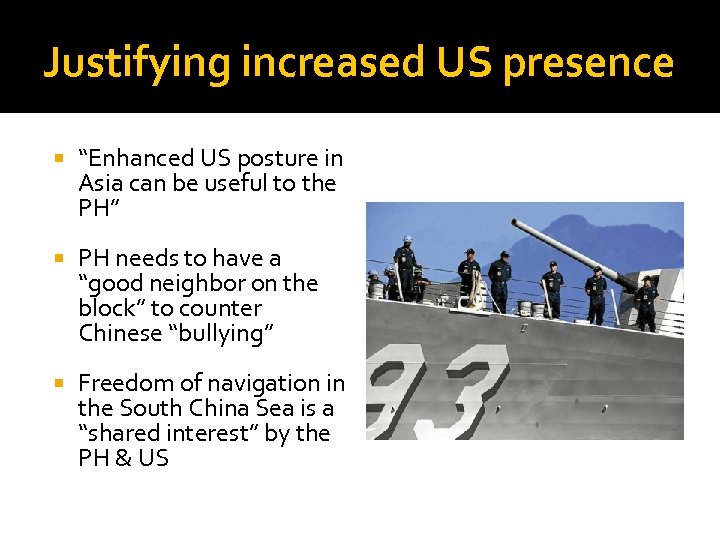 Justifying increased US presence “Enhanced US posture in Asia can be useful to the PH” PH needs to have a “good neighbor on the block” to counter Chinese “bullying” Freedom of navigation in the South China Sea is a “shared interest” by the PH & US
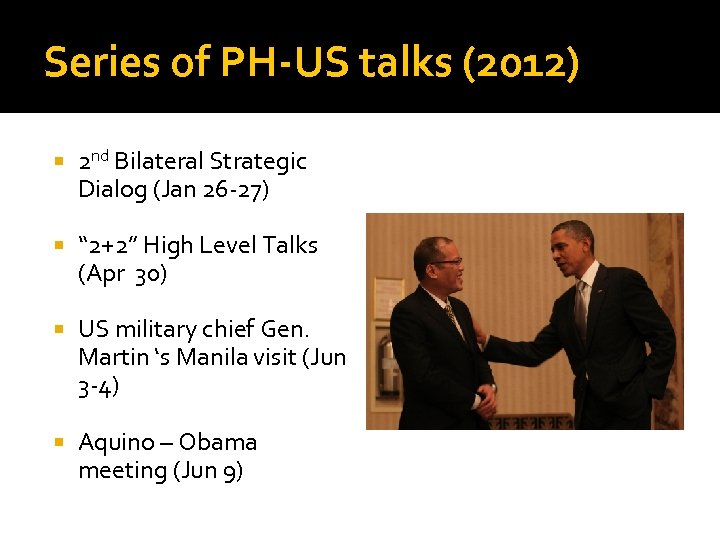 Series of PH-US talks (2012) 2 nd Bilateral Strategic Dialog (Jan 26 -27) “ 2+2” High Level Talks (Apr 30) US military chief Gen. Martin ‘s Manila visit (Jun 3 -4) Aquino – Obama meeting (Jun 9)
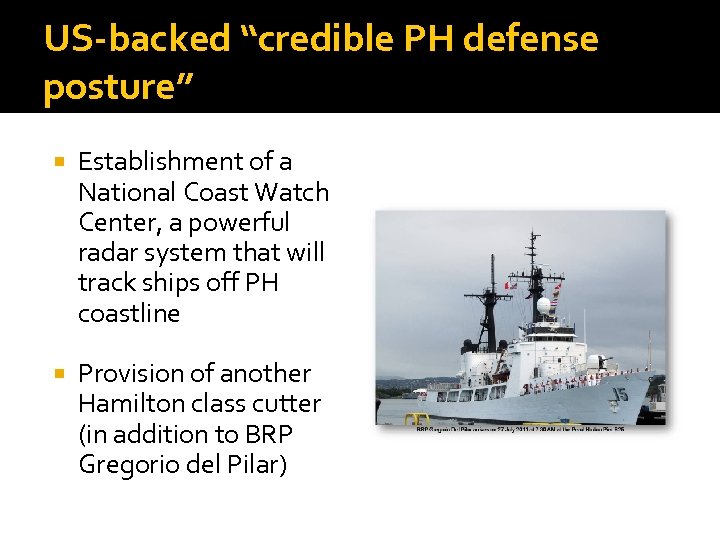 US-backed “credible PH defense posture” Establishment of a National Coast Watch Center, a powerful radar system that will track ships off PH coastline Provision of another Hamilton class cutter (in addition to BRP Gregorio del Pilar)
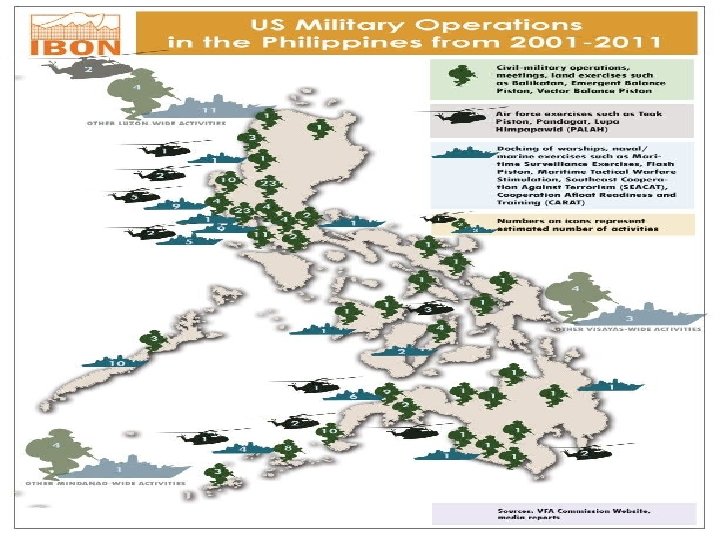
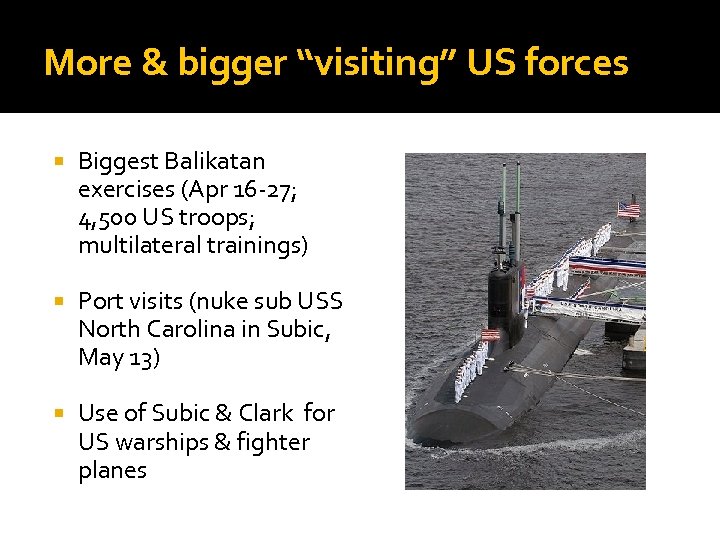 More & bigger “visiting” US forces Biggest Balikatan exercises (Apr 16 -27; 4, 500 US troops; multilateral trainings) Port visits (nuke sub USS North Carolina in Subic, May 13) Use of Subic & Clark for US warships & fighter planes
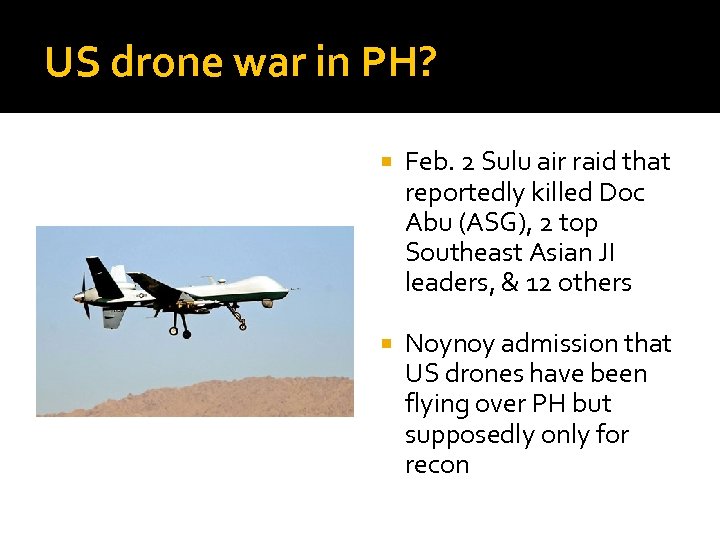 US drone war in PH? Feb. 2 Sulu air raid that reportedly killed Doc Abu (ASG), 2 top Southeast Asian JI leaders, & 12 others Noynoy admission that US drones have been flying over PH but supposedly only for recon
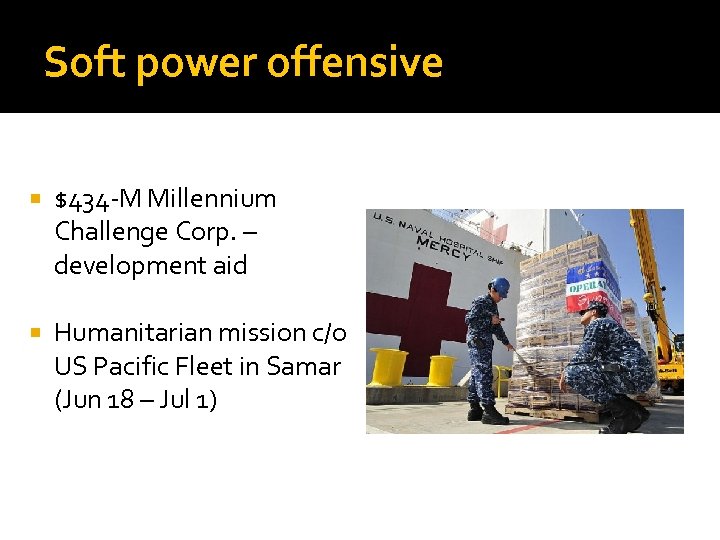 Soft power offensive $434 -M Millennium Challenge Corp. – development aid Humanitarian mission c/o US Pacific Fleet in Samar (Jun 18 – Jul 1)
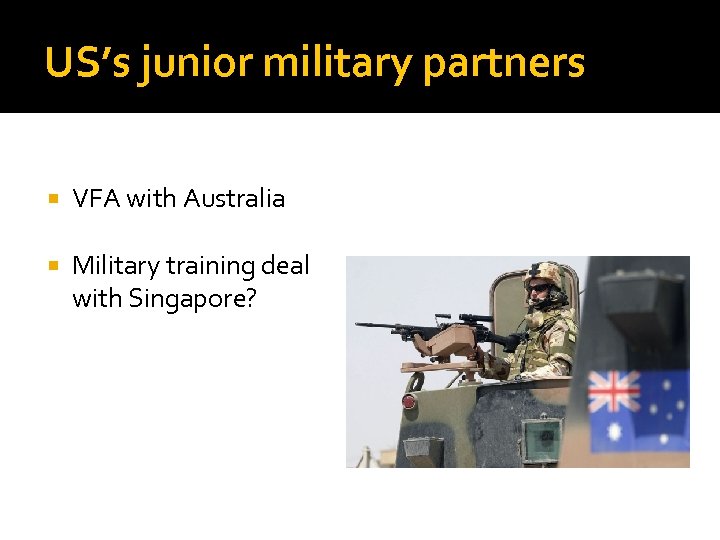 US’s junior military partners VFA with Australia Military training deal with Singapore?
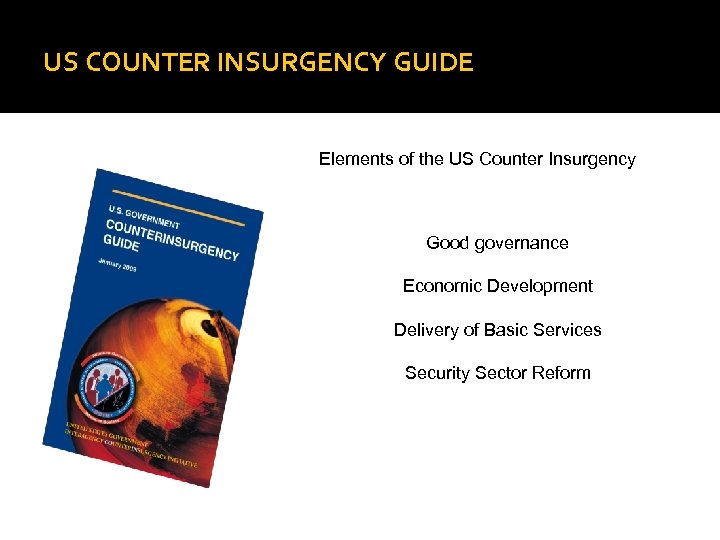 US COUNTER INSURGENCY GUIDE Elements of the US Counter Insurgency Good governance Economic Development Delivery of Basic Services Security Sector Reform
 National Security Policy “We must revive the peace process on the basis of a comprehensive understanding of the root causes of the conflict, under clear policies that pave and clear the way ahead, and driven by a genuine desire to attain a just and lasting peace. We shall endeavor to restore confidence in the peace process that is transparent and participatory, and renew our faith in our shared vision of a peaceful, secure and prosperous future under one sovereign flag. ” -President Benigno Aquino lll April 22, 2010, Mandarin Hotel, Makati
 National Security Policy on four (4) key elements: Governance Good governance entails being present and accountable to the citizens especially those living in the poorest and most remote areas. Further, this means putting an end to the long history of patronage politics and ensuring that our next leaders are freely elected by the people. As we help the people realize their power to vote, we strengthen their faith in democratic processes and the rule of law. Likewise, we enable them to hold their elected leaders accountable for the public trust they have given them. (An effective political strategy focuses on strengthening the government’s capability and capacity to respond—and be seen to be responding—to the needs of its people. p. 23 US COIN Guide)
 National Security Policy on four (4) key elements: Delivery of Basic Services Conflict resolution must be done along with delivery of basic services, particularly health and education, to depressed and vulnerable barangays in conflict areas, putting into place effective and transparent mechanisms to ensure that aid will reach those in need. Government programs that build access roads and school buildings for basic and adult education; provide potable water and sanitation facilities, basic health care, electricity; assist in shelter reconstruction, and provide temporary livelihood interventions must be renewed.
 National Security Policy on four (4) key elements: Economic Reconstruction and Sustainable Development No conflict area will be left behind. The economic reconstruction of conflict-affected areas, particularly the Autonomous Region in Muslim Mindanao (ARMM), should be fully-integrated in all national development plans to bring the blessings of peace to its people and set it on its way to sustainable development as a valuable contributor to our national movement towards progress. (The economic function seeks to provide essential services and stimulate long term economic growth, thereby generating confidence in the government while at the same time reducing the pool of frustrated, unemployed young men and women from which insurgents can readily recruit. )
 National Security Policy on four (4) key elements: Security Sector Reform Enhancing the Security Sector must begin with restoring the pride and honor of our uniformed services. This requires strong, capable and disciplined security forces serving under firm democratic civilian control to achieve and sustain peace and security in the country. (Physical security efforts must not focus too greatly on strengthening the military and police forces of the affected nation. Such capacity building should only be part of a broader process of Security Sector Reform (SSR) in which the whole system is developed, including the civil institutions that oversee the security forces and intelligence services, the legal framework and the justice institutions (prosecution services, judiciary and prisons) that implement it. It is particularly important that a sense of civil ownership and accountability should extend to the local level and that all elements of the security apparatus should be trusted by the population. )

 Risks for the PH Increased US presence and intervention in the Philippines are creating more risks and deepening old issues on security, sovereignty, & human rights
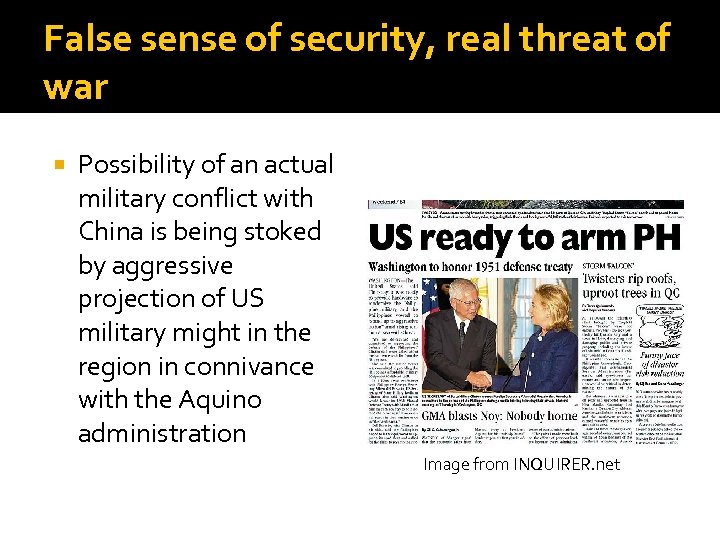 False sense of security, real threat of war Possibility of an actual military conflict with China is being stoked by aggressive projection of US military might in the region in connivance with the Aquino administration Image from INQUIRER. net
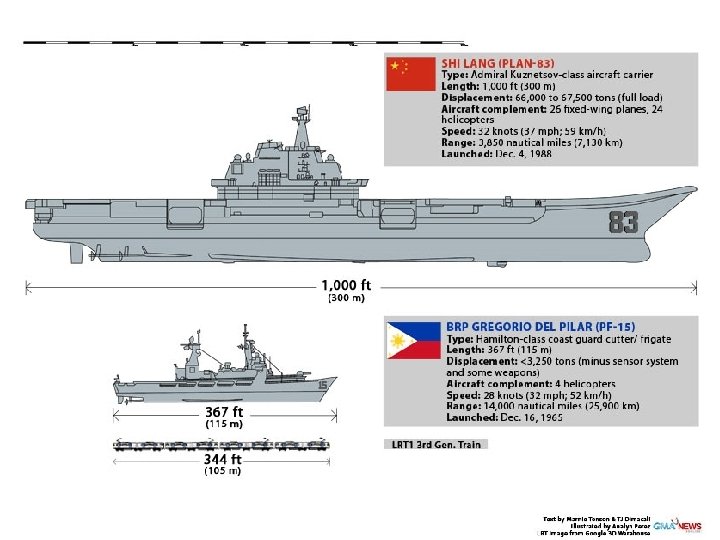
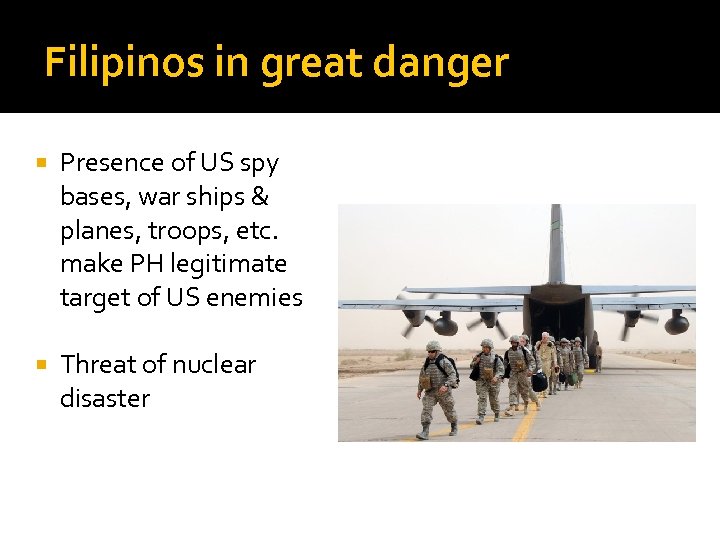 Filipinos in great danger Presence of US spy bases, war ships & planes, troops, etc. make PH legitimate target of US enemies Threat of nuclear disaster
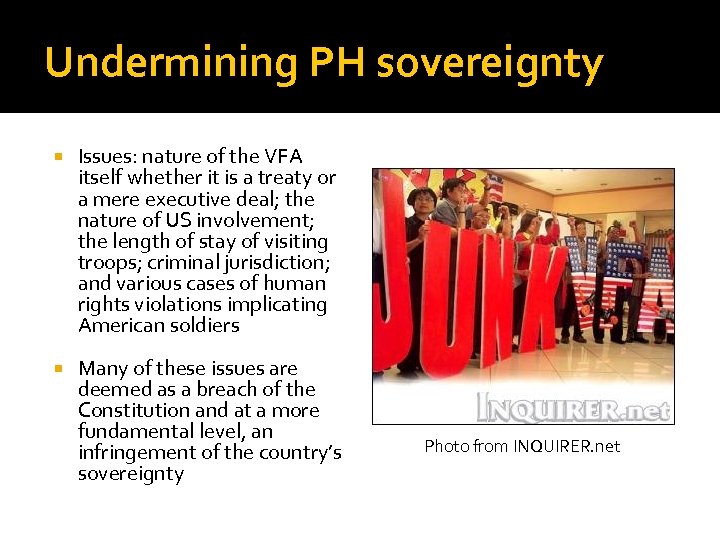 Undermining PH sovereignty Issues: nature of the VFA itself whether it is a treaty or a mere executive deal; the nature of US involvement; the length of stay of visiting troops; criminal jurisdiction; and various cases of human rights violations implicating American soldiers Many of these issues are deemed as a breach of the Constitution and at a more fundamental level, an infringement of the country’s sovereignty Photo from INQUIRER. net
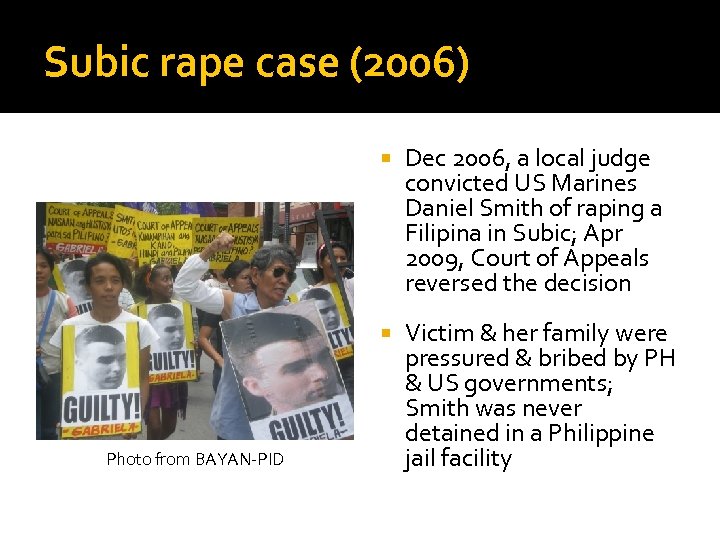 Subic rape case (2006) Photo from BAYAN-PID Dec 2006, a local judge convicted US Marines Daniel Smith of raping a Filipina in Subic; Apr 2009, Court of Appeals reversed the decision Victim & her family were pressured & bribed by PH & US governments; Smith was never detained in a Philippine jail facility
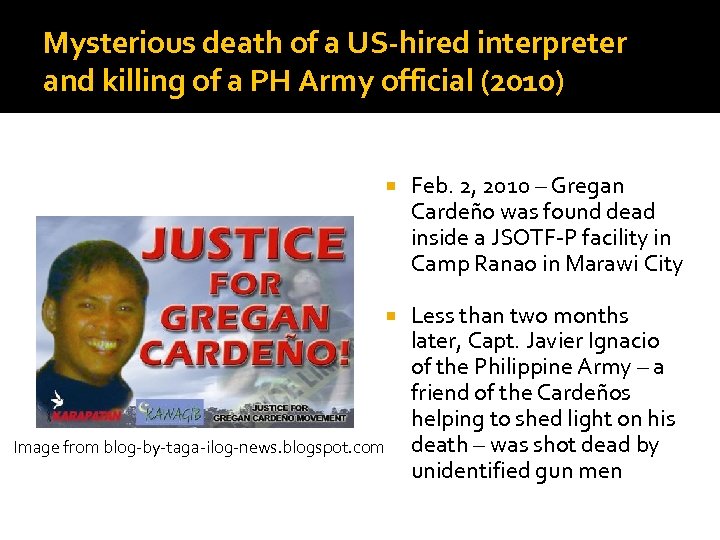 Mysterious death of a US-hired interpreter and killing of a PH Army official (2010) Image from blog-by-taga-ilog-news. blogspot. com Feb. 2, 2010 – Gregan Cardeño was found dead inside a JSOTF-P facility in Camp Ranao in Marawi City Less than two months later, Capt. Javier Ignacio of the Philippine Army – a friend of the Cardeños helping to shed light on his death – was shot dead by unidentified gun men
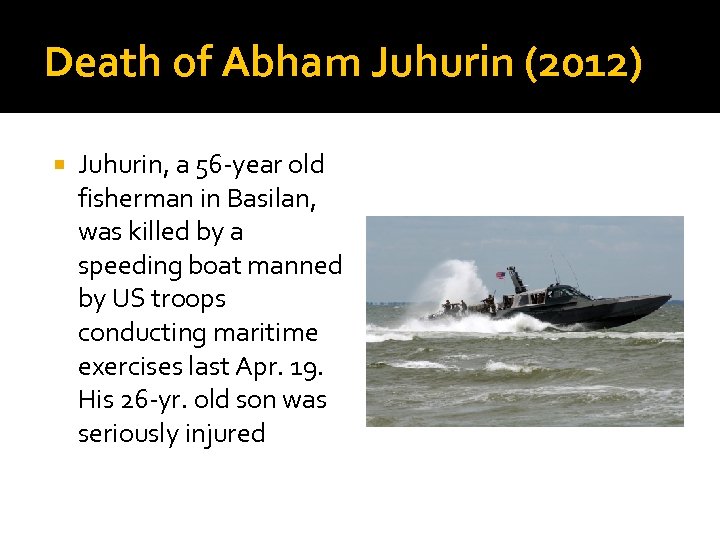 Death of Abham Juhurin (2012) Juhurin, a 56 -year old fisherman in Basilan, was killed by a speeding boat manned by US troops conducting maritime exercises last Apr. 19. His 26 -yr. old son was seriously injured
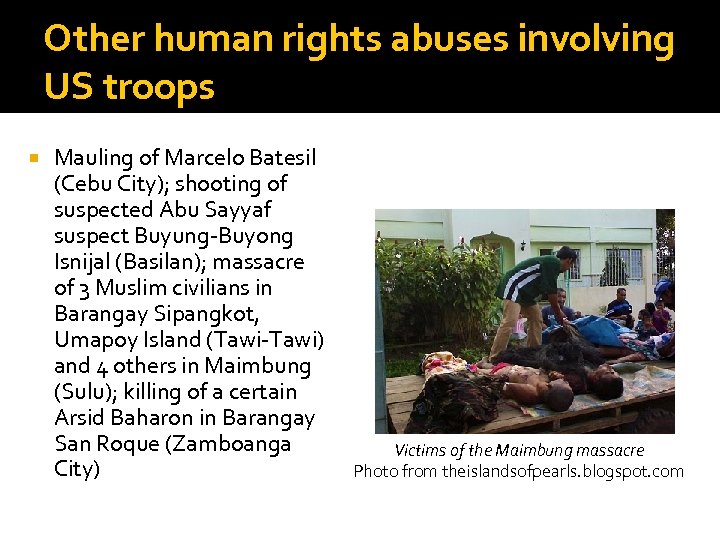 Other human rights abuses involving US troops Mauling of Marcelo Batesil (Cebu City); shooting of suspected Abu Sayyaf suspect Buyung-Buyong Isnijal (Basilan); massacre of 3 Muslim civilians in Barangay Sipangkot, Umapoy Island (Tawi-Tawi) and 4 others in Maimbung (Sulu); killing of a certain Arsid Baharon in Barangay San Roque (Zamboanga City) Victims of the Maimbung massacre Photo from theislandsofpearls. blogspot. com
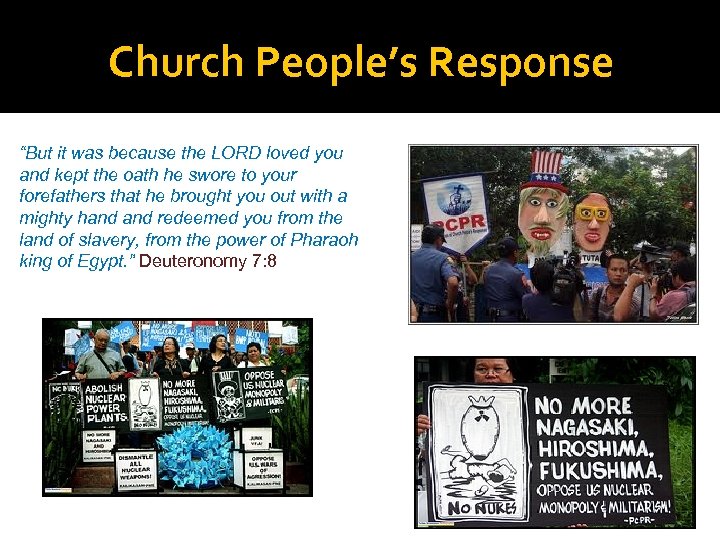 Church People’s Response “But it was because the LORD loved you and kept the oath he swore to your forefathers that he brought you out with a mighty hand redeemed you from the land of slavery, from the power of Pharaoh king of Egypt. ” Deuteronomy 7: 8
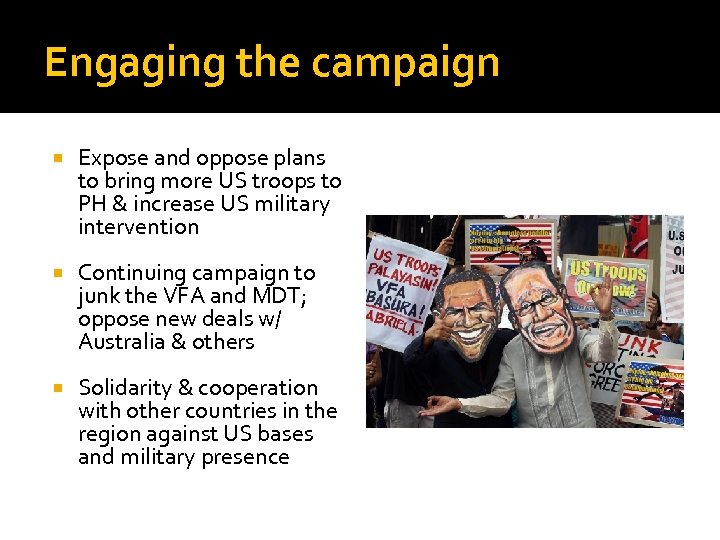 Engaging the campaign Expose and oppose plans to bring more US troops to PH & increase US military intervention Continuing campaign to junk the VFA and MDT; oppose new deals w/ Australia & others Solidarity & cooperation with other countries in the region against US bases and military presence
 Maraming salamat!