


 Скачать презентацию Paul Scherrer Institute Stefan Ritt Very Fast Waveform
4e34e778f1683250f93c70aa7f8151e7.ppt
- Количество слайдов: 37
 Paul Scherrer Institute Stefan Ritt Very Fast Waveform Recorders
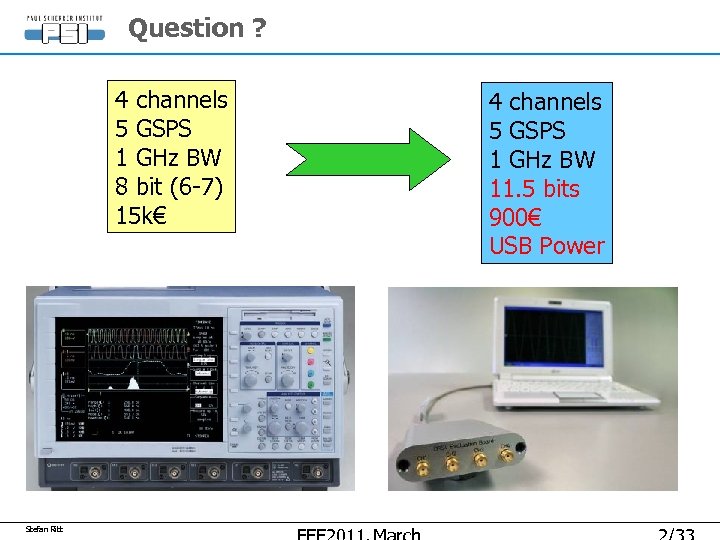 Question ? 4 channels 5 GSPS 1 GHz BW 8 bit (6 -7) 15 k€ Stefan Ritt 4 channels 5 GSPS 1 GHz BW 11. 5 bits 900€ USB Power
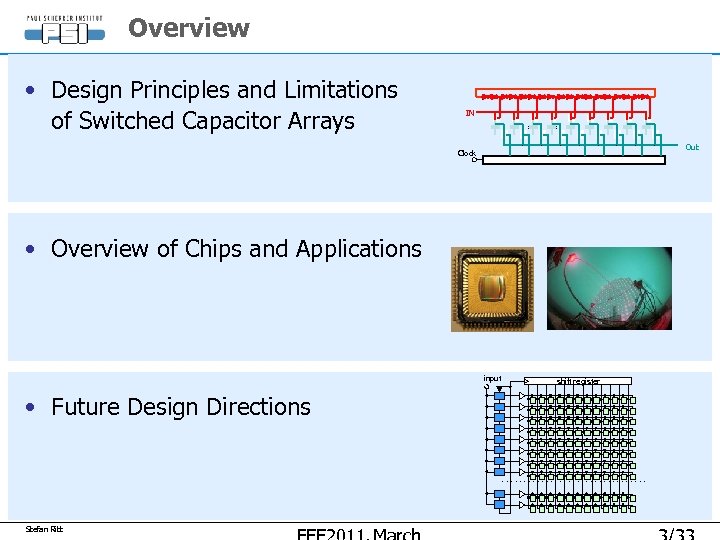 Overview • Design Principles and Limitations of Switched Capacitor Arrays IN Out Clock • Overview of Chips and Applications input shift register • Future Design Directions. . . . Stefan Ritt
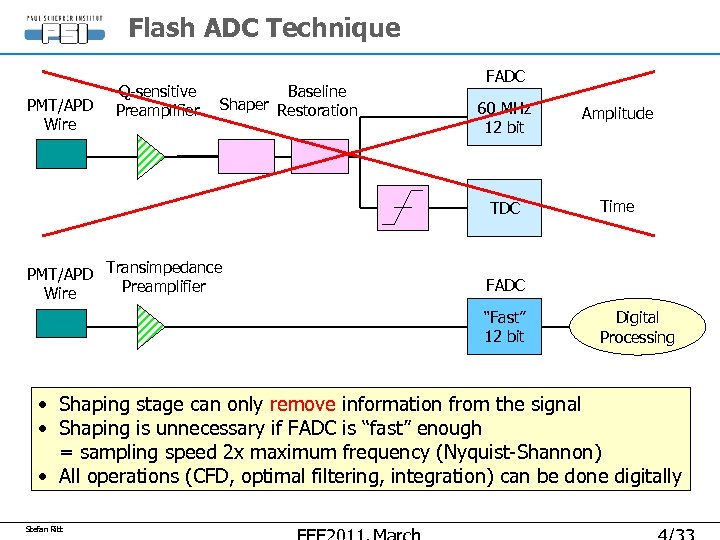 Flash ADC Technique PMT/APD Wire Q-sensitive Preamplifier Baseline Shaper Restoration FADC Amplitude TDC PMT/APD Transimpedance Preamplifier Wire 60 MHz 12 bit Time FADC “Fast” 12 bit Digital Processing • Shaping stage can only remove information from the signal • Shaping is unnecessary if FADC is “fast” enough = sampling speed 2 x maximum frequency (Nyquist-Shannon) • All operations (CFD, optimal filtering, integration) can be done digitally Stefan Ritt
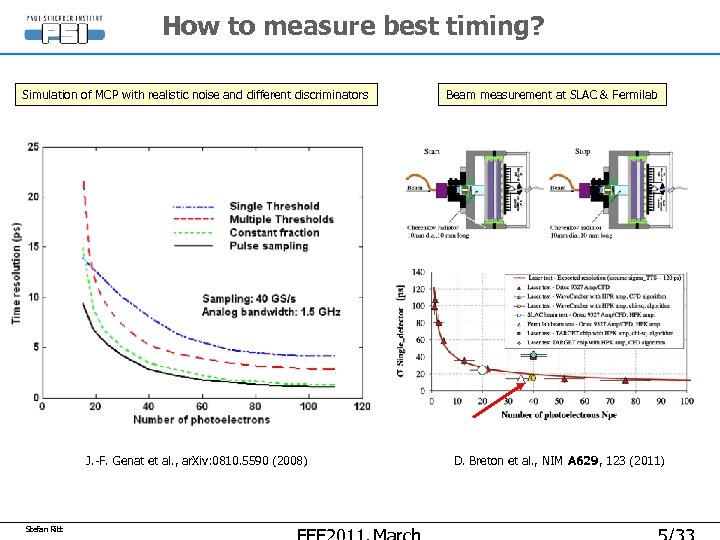 How to measure best timing? Simulation of MCP with realistic noise and different discriminators J. -F. Genat et al. , ar. Xiv: 0810. 5590 (2008) Stefan Ritt Beam measurement at SLAC & Fermilab D. Breton et al. , NIM A 629, 123 (2011)
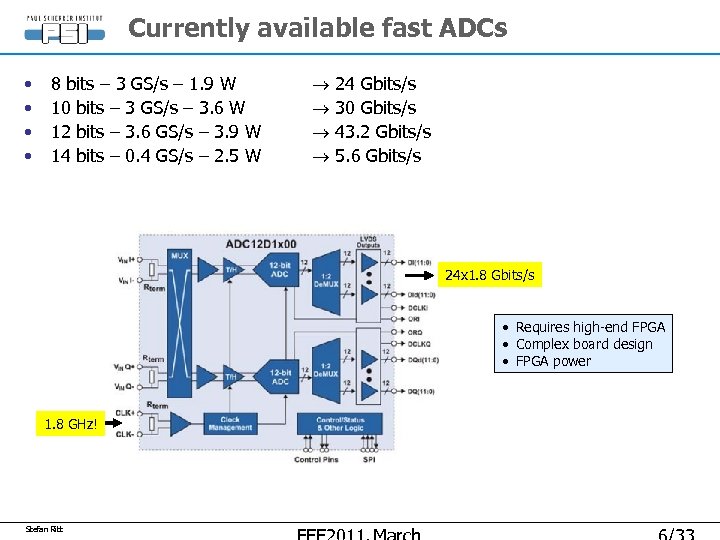 Currently available fast ADCs • • 8 bits – 3 GS/s – 1. 9 W 10 bits – 3 GS/s – 3. 6 W 12 bits – 3. 6 GS/s – 3. 9 W 14 bits – 0. 4 GS/s – 2. 5 W 24 Gbits/s 30 Gbits/s 43. 2 Gbits/s 5. 6 Gbits/s 24 x 1. 8 Gbits/s • Requires high-end FPGA • Complex board design • FPGA power 1. 8 GHz! Stefan Ritt
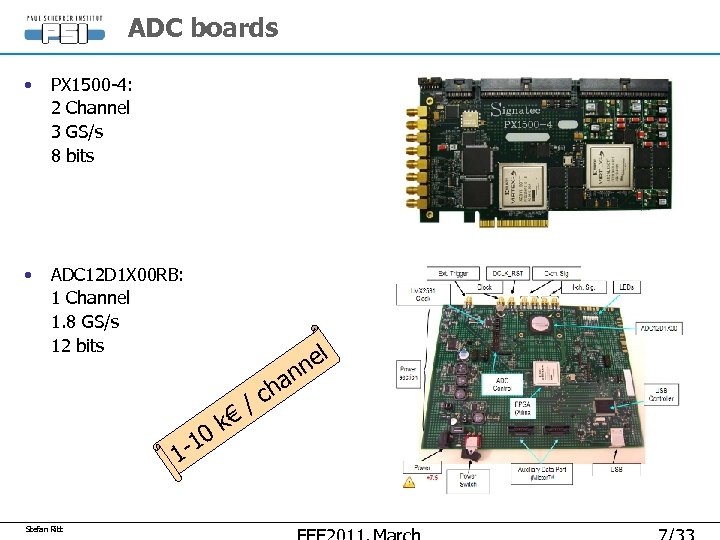 ADC boards • PX 1500 -4: 2 Channel 3 GS/s 8 bits • ADC 12 D 1 X 00 RB: 1 Channel 1. 8 GS/s 12 bits el nn a k€ 10 - 1 Stefan Ritt ch /
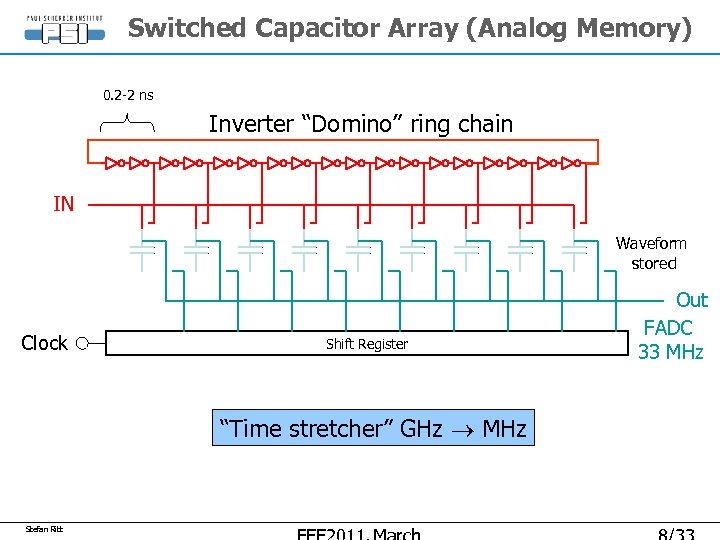 Switched Capacitor Array (Analog Memory) 0. 2 -2 ns Inverter “Domino” ring chain IN Waveform stored Clock Shift Register “Time stretcher” GHz MHz Stefan Ritt Out FADC 33 MHz
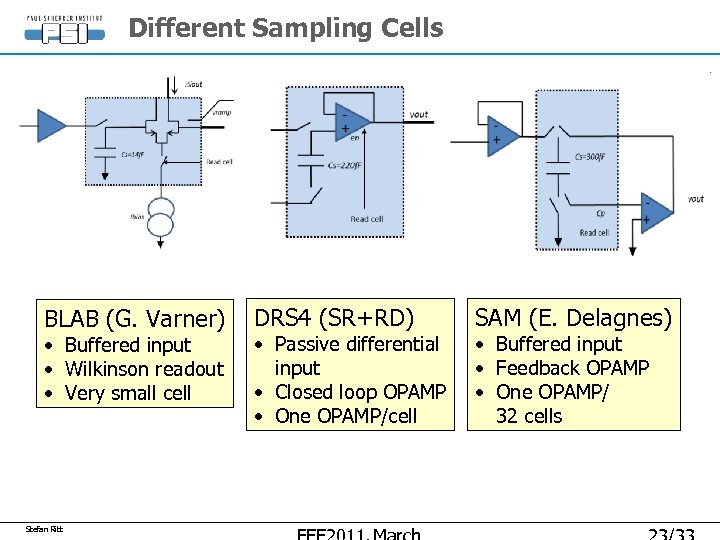
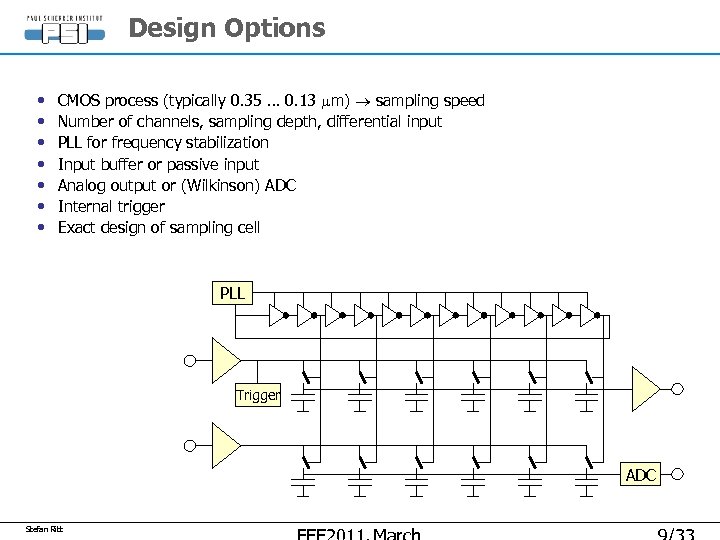 Design Options • • CMOS process (typically 0. 35 … 0. 13 mm) sampling speed Number of channels, sampling depth, differential input PLL for frequency stabilization Input buffer or passive input Analog output or (Wilkinson) ADC Internal trigger Exact design of sampling cell PLL Trigger ADC Stefan Ritt
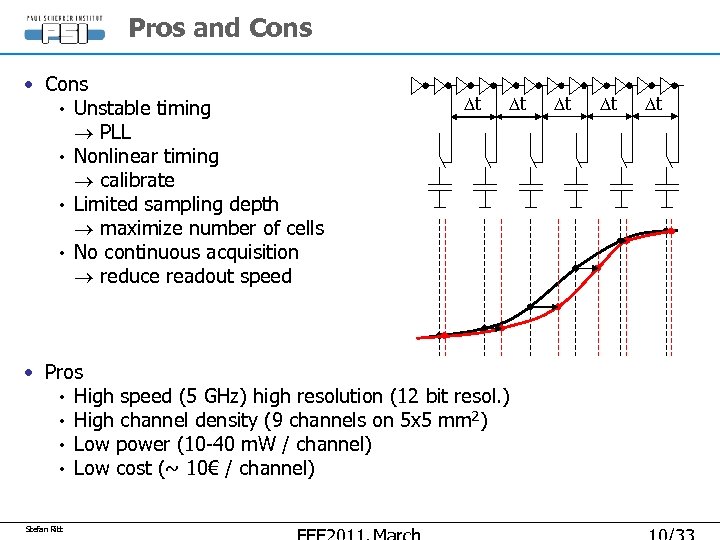 Pros and Cons • Unstable timing PLL • Nonlinear timing calibrate • Limited sampling depth maximize number of cells • No continuous acquisition reduce readout speed Dt Dt • Pros • High speed (5 GHz) high resolution (12 bit resol. ) • High channel density (9 channels on 5 x 5 mm 2) • Low power (10 -40 m. W / channel) • Low cost (~ 10€ / channel) Stefan Ritt Dt Dt Dt
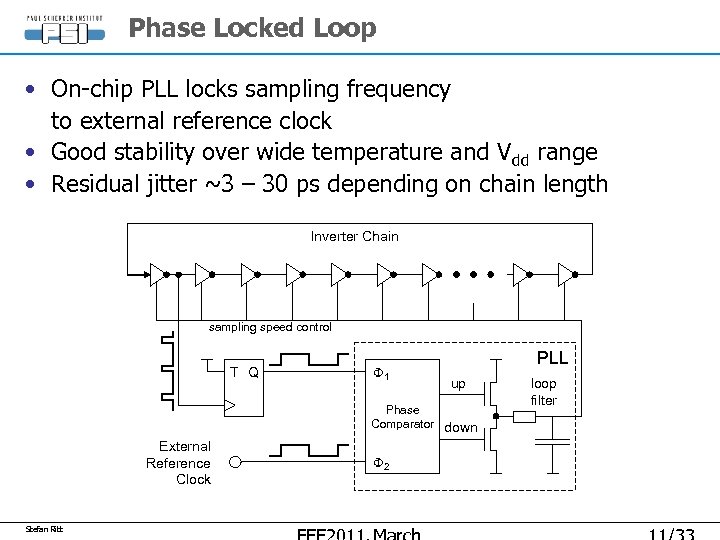 Phase Locked Loop • On-chip PLL locks sampling frequency to external reference clock • Good stability over wide temperature and Vdd range • Residual jitter ~3 – 30 ps depending on chain length Inverter Chain sampling speed control T Q F 1 PLL up Phase Comparator down External Reference Clock Stefan Ritt F 2 loop filter
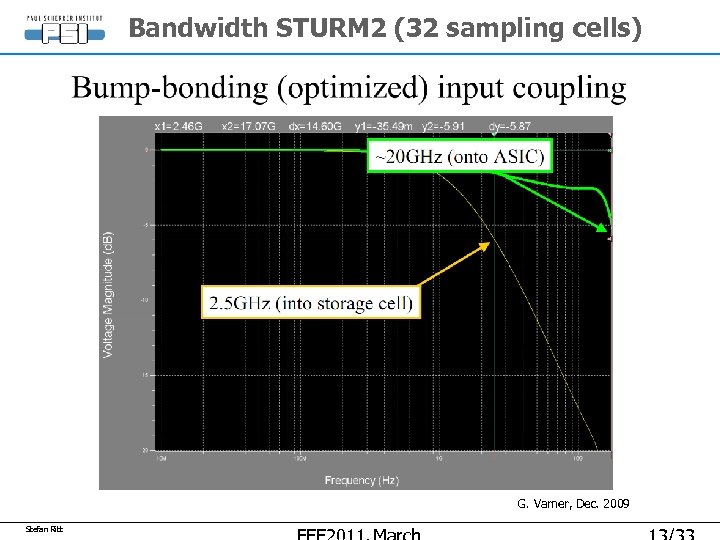
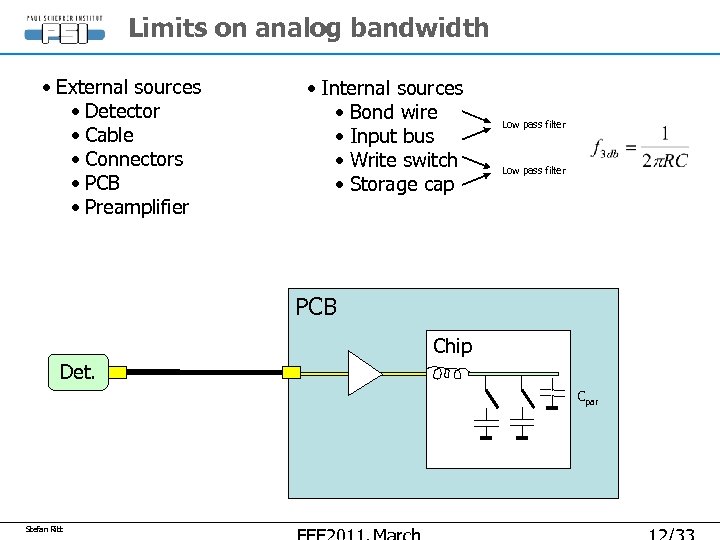 Limits on analog bandwidth • External sources • Detector • Cable • Connectors • PCB • Preamplifier • Internal sources • Bond wire • Input bus • Write switch • Storage cap Low pass filter PCB Chip Det. Cpar Stefan Ritt
 Bandwidth STURM 2 (32 sampling cells) G. Varner, Dec. 2009 Stefan Ritt
 Part 2 • Design Principles and Limitations IN Out Clock • Overview of Chips and Applications input shift register • Future Design Directions. . . . Stefan Ritt
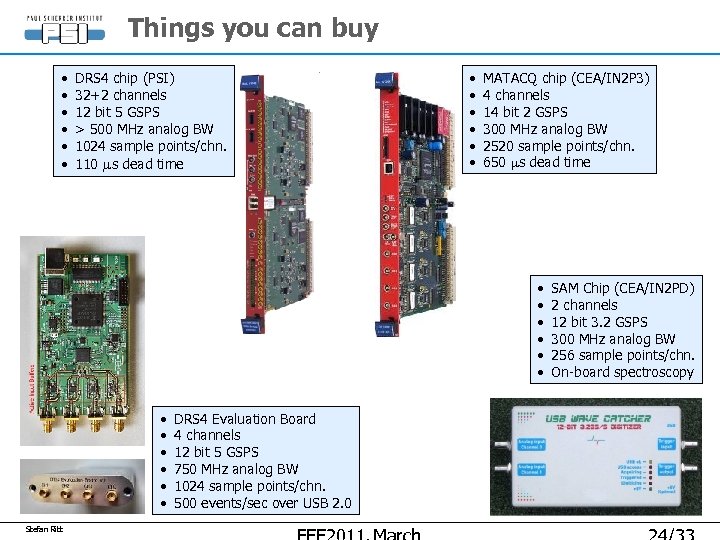
 Switched Capacitor Arrays for Particle Physics E. Delagnes D. Breton CEA Saclay G. Varner, Univ. of Hawaii STRAW 3 LABRADOR 3 TARGET AFTER • Many chips for different projects (Belle, Anita, Ice. Cube …) • Bufferend and unbuffered • Deep arrays (up to 64 k) • Wilkinson ADC on chip MATACQ • Buffered (f 3 db~300 MHz) • Low noise (~12 bits) • Short PLL good timing matacq. free. fr www. phys. hawaii. edu/~idlab/ DRS 1 DRS 2 DRS 3 DRS 4 2002 2004 2007 2008 Stefan Ritt SAM • • H. Frisch et al. , Univ. Chicago PSEC 1 - PSEC 4 • • • Goal: Measure 1 ps (!) 130 nm IBM 18 GSPS 256 sampling cells Influenced by G. Varner Wilkonson ADC on chip psec. uchicago. edu Universal chip for many applications 8+1 channels 1024 sampling cells 5 GSPS, 950 MHz analog BW 1 ms readout time for short pulses SR R. Dinapoli PSI, Switzerland drs. web. psi. ch
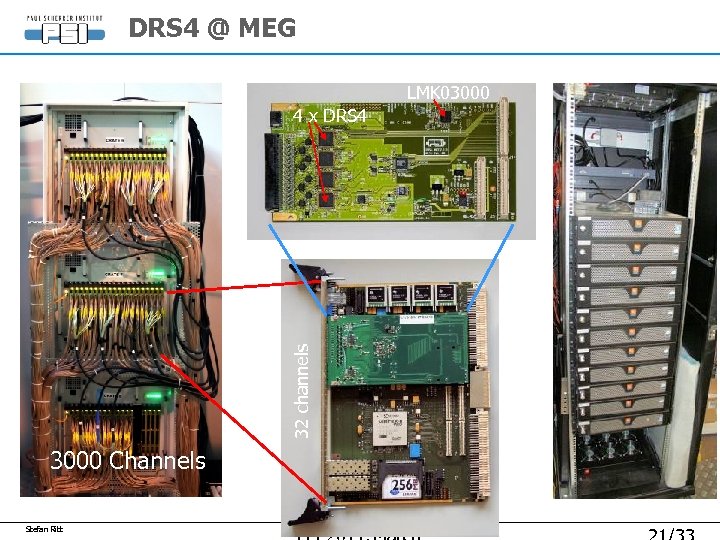
 MEG On-line waveform display m+ e+g “virtual oscilloscope” At 10 -13 level S 848 PMTs template fit 3000 Channels Digitized with DRS 4 chips at 1. 6 GSPS g Liq. Xe m PMT 1. 5 m Drawback: 600 TB data/year Stefan Ritt
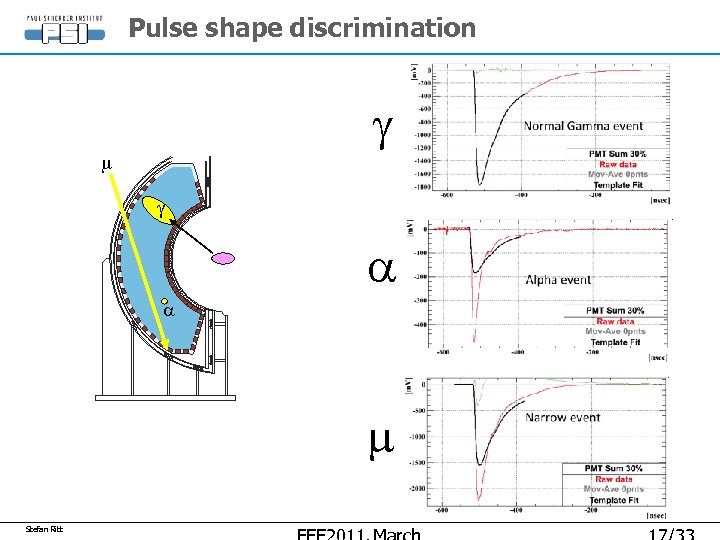 Pulse shape discrimination g m g a a m Stefan Ritt
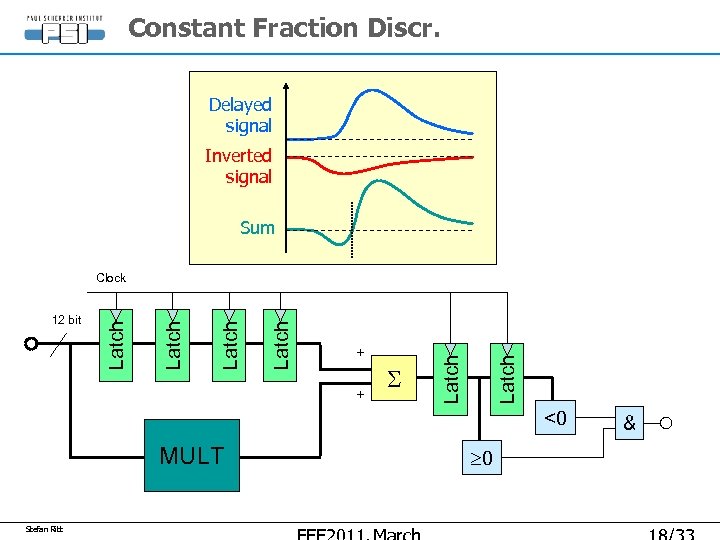 Constant Fraction Discr. Delayed signal Inverted signal Sum + S Latch + Latch 12 bit Latch Clock <0 MULT Stefan Ritt 0 &
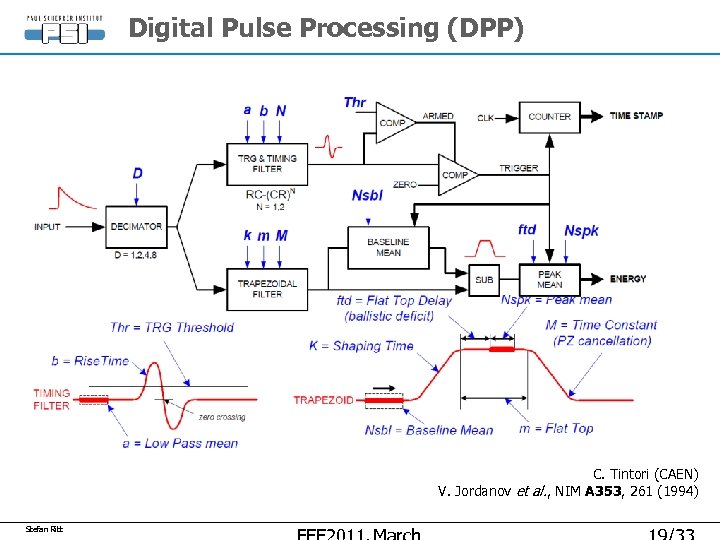 Digital Pulse Processing (DPP) C. Tintori (CAEN) V. Jordanov et al. , NIM A 353, 261 (1994) Stefan Ritt
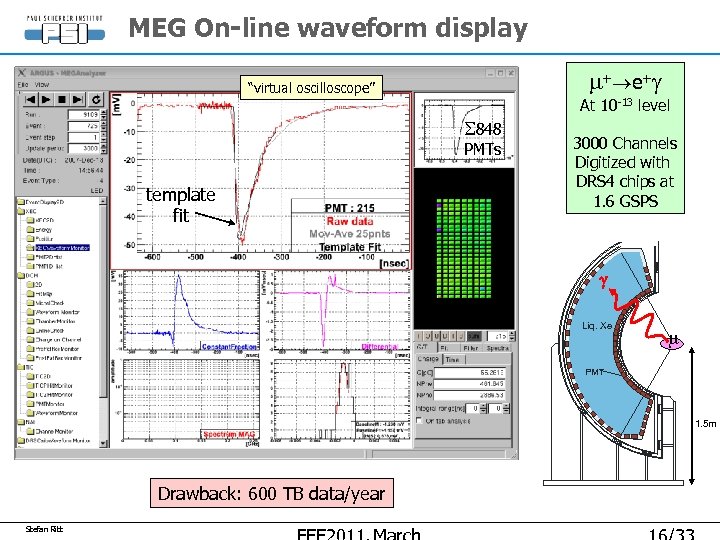
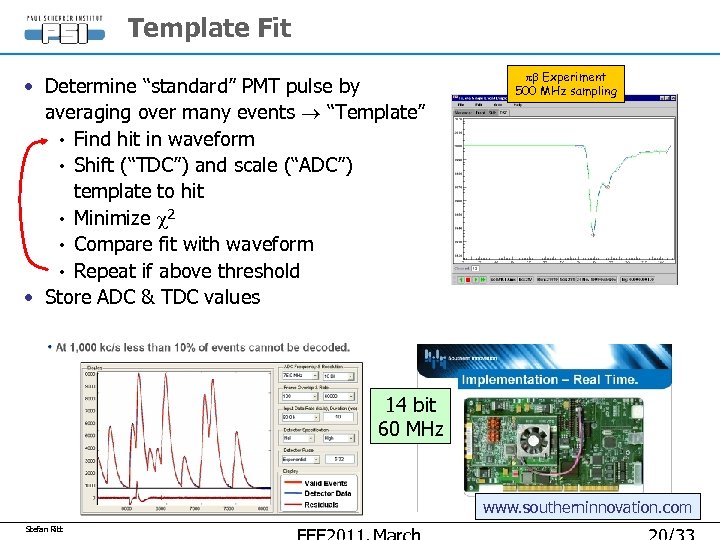 Template Fit • Determine “standard” PMT pulse by averaging over many events “Template” • Find hit in waveform • Shift (“TDC”) and scale (“ADC”) template to hit • Minimize c 2 • Compare fit with waveform • Repeat if above threshold • Store ADC & TDC values pb Experiment 500 MHz sampling 14 bit 60 MHz www. southerninnovation. com Stefan Ritt
 DRS 4 @ MEG LMK 03000 32 channels 4 x DRS 4 3000 Channels Stefan Ritt
 Applications Gamma-ray astronomy CTA 320 ps Magic Antares (Mediterranian) Antarctic Impulsive Transient Antenna (ANITA) Ice. Cube (Antarctica) To. F PET (Siemens) Stefan Ritt
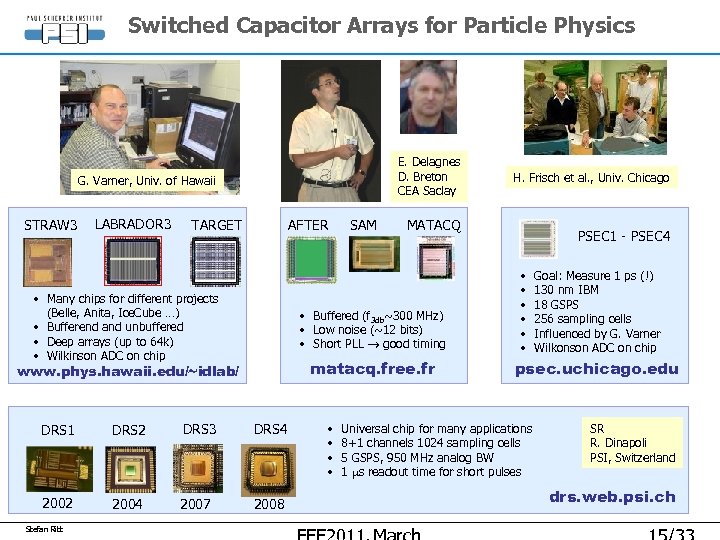
 Different Sampling Cells BLAB (G. Varner) • Buffered input • Wilkinson readout • Very small cell Stefan Ritt DRS 4 (SR+RD) • Passive differential input • Closed loop OPAMP • One OPAMP/cell SAM (E. Delagnes) • Buffered input • Feedback OPAMP • One OPAMP/ 32 cells
 Things you can buy • • • DRS 4 chip (PSI) 32+2 channels 12 bit 5 GSPS > 500 MHz analog BW 1024 sample points/chn. 110 ms dead time • • • MATACQ chip (CEA/IN 2 P 3) 4 channels 14 bit 2 GSPS 300 MHz analog BW 2520 sample points/chn. 650 ms dead time • • • Stefan Ritt DRS 4 Evaluation Board 4 channels 12 bit 5 GSPS 750 MHz analog BW 1024 sample points/chn. 500 events/sec over USB 2. 0 SAM Chip (CEA/IN 2 PD) 2 channels 12 bit 3. 2 GSPS 300 MHz analog BW 256 sample points/chn. On-board spectroscopy
 Part 3 • Design Principles and Limitations IN Out Clock • Overview of Chips and Applications input shift register • Future Design Directions. . . . Stefan Ritt
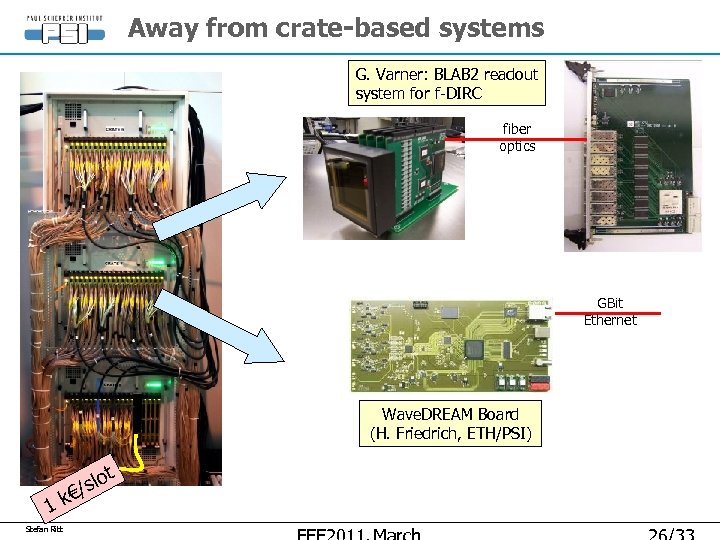 Away from crate-based systems G. Varner: BLAB 2 readout system for f-DIRC fiber optics GBit Ethernet Wave. DREAM Board (H. Friedrich, ETH/PSI) ot 1 Stefan Ritt /sl k€
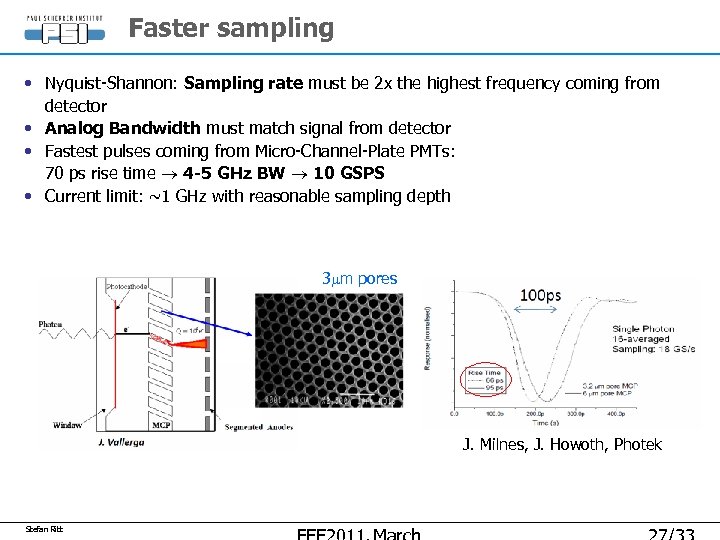 Faster sampling • Nyquist-Shannon: Sampling rate must be 2 x the highest frequency coming from detector • Analog Bandwidth must match signal from detector • Fastest pulses coming from Micro-Channel-Plate PMTs: 70 ps rise time 4 -5 GHz BW 10 GSPS • Current limit: ~1 GHz with reasonable sampling depth 3 mm pores J. Milnes, J. Howoth, Photek Stefan Ritt
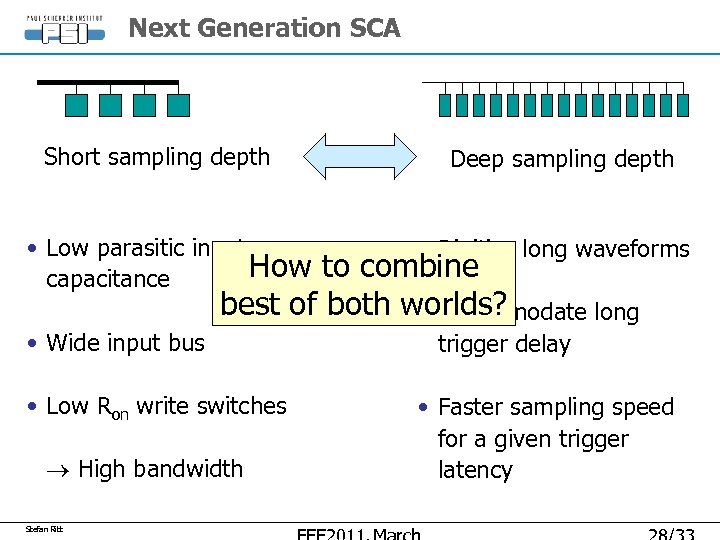 Next Generation SCA Short sampling depth • Low parasitic input How capacitance Deep sampling depth • Digitize long waveforms to combine best of both worlds? • Accommodate long • Wide input bus • Low Ron write switches High bandwidth Stefan Ritt trigger delay • Faster sampling speed for a given trigger latency
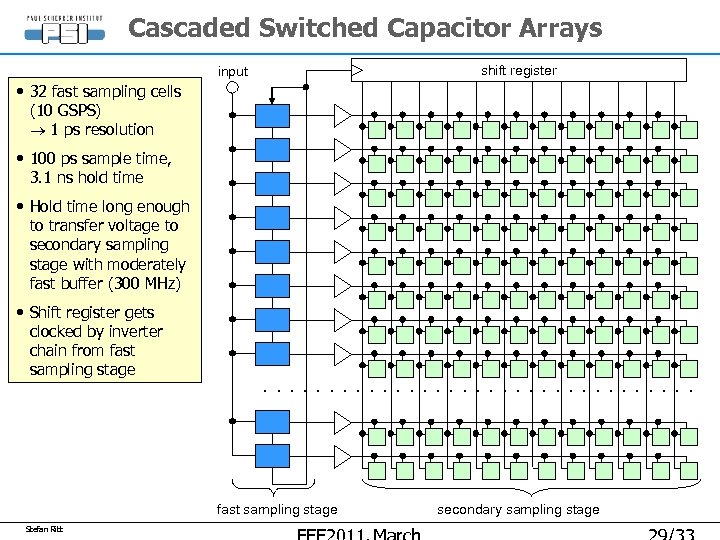 Cascaded Switched Capacitor Arrays shift register input • 32 fast sampling cells (10 GSPS) 1 ps resolution • 100 ps sample time, 3. 1 ns hold time • Hold time long enough to transfer voltage to secondary sampling stage with moderately fast buffer (300 MHz) • Shift register gets clocked by inverter chain from fast sampling stage . . . . fast sampling stage Stefan Ritt secondary sampling stage
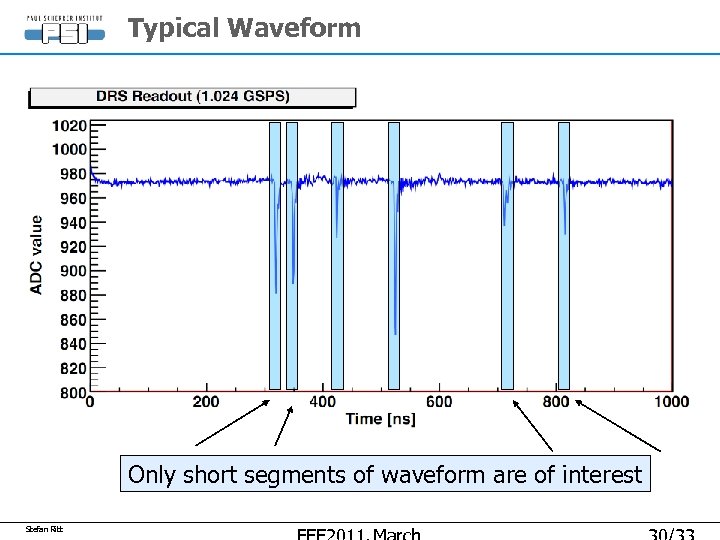 Typical Waveform Only short segments of waveform are of interest Stefan Ritt
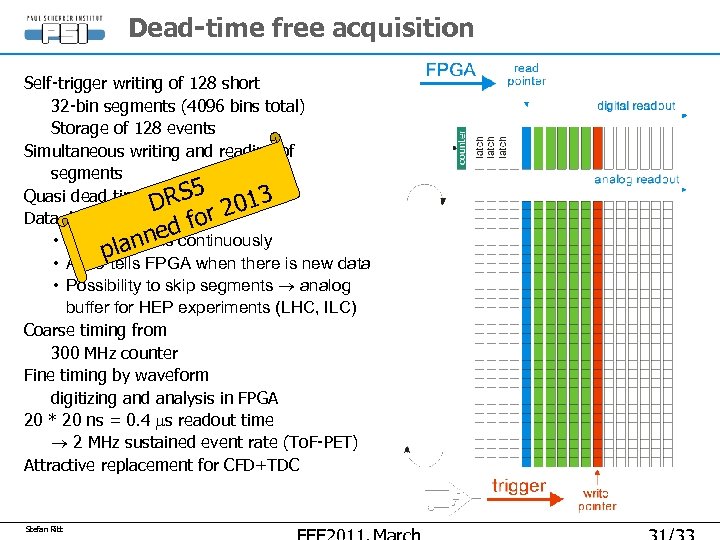 Dead-time free acquisition Self-trigger writing of 128 short 32 -bin segments (4096 bins total) Storage of 128 events Simultaneous writing and reading of segments Quasi dead time-free. S 5 DR r 2013 Data driven readout fo d • Ext. ADCnne continuously runs pla FPGA when there is new data • ASIC tells • Possibility to skip segments analog buffer for HEP experiments (LHC, ILC) Coarse timing from 300 MHz counter Fine timing by waveform digitizing and analysis in FPGA 20 * 20 ns = 0. 4 ms readout time 2 MHz sustained event rate (To. F-PET) Attractive replacement for CFD+TDC Stefan Ritt
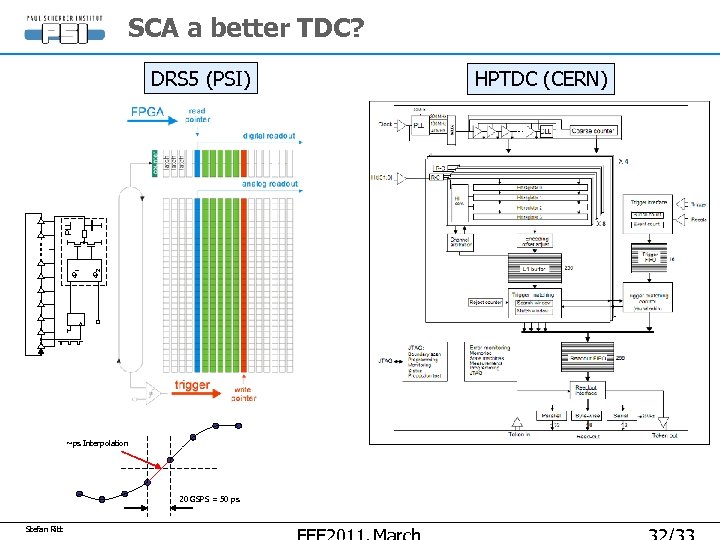 SCA a better TDC? F 2 F 1 PLL DRS 5 (PSI) ~ps Interpolation 20 GSPS = 50 ps Stefan Ritt HPTDC (CERN)
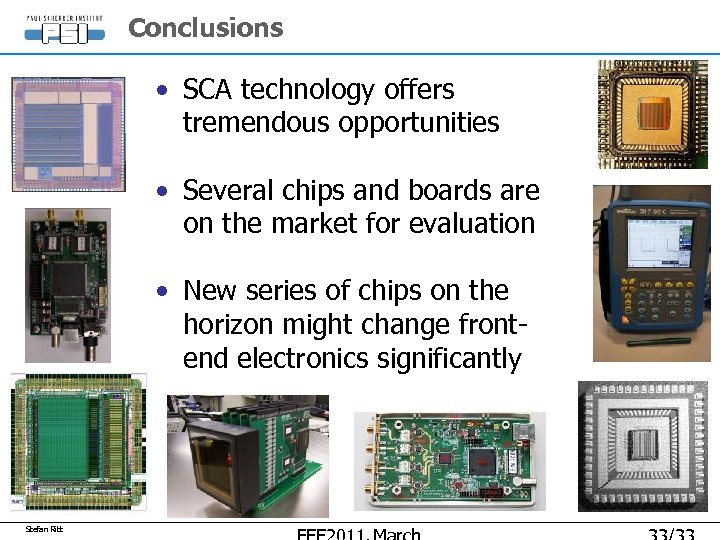 Conclusions • SCA technology offers tremendous opportunities • Several chips and boards are on the market for evaluation • New series of chips on the horizon might change frontend electronics significantly Stefan Ritt
 End of excursion Stefan Ritt
 Enjoy the “real” excursion Stefan Ritt Taken with www. photosynth. net
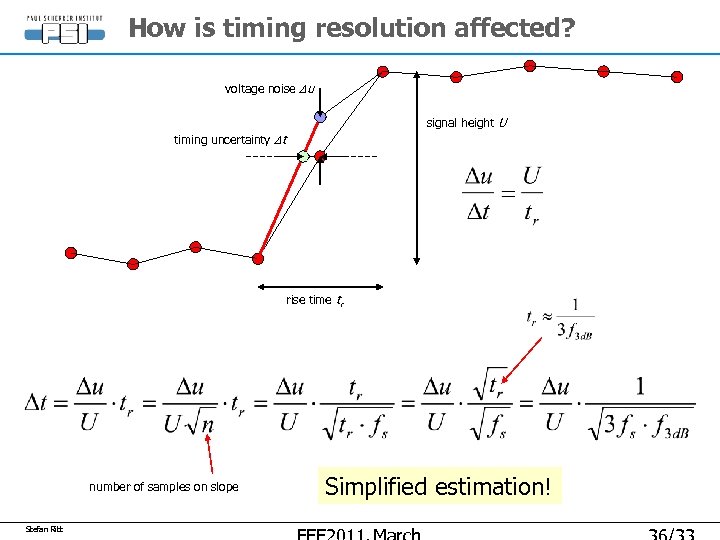 How is timing resolution affected? voltage noise Du signal height U timing uncertainty Dt rise time tr number of samples on slope Stefan Ritt Simplified estimation!
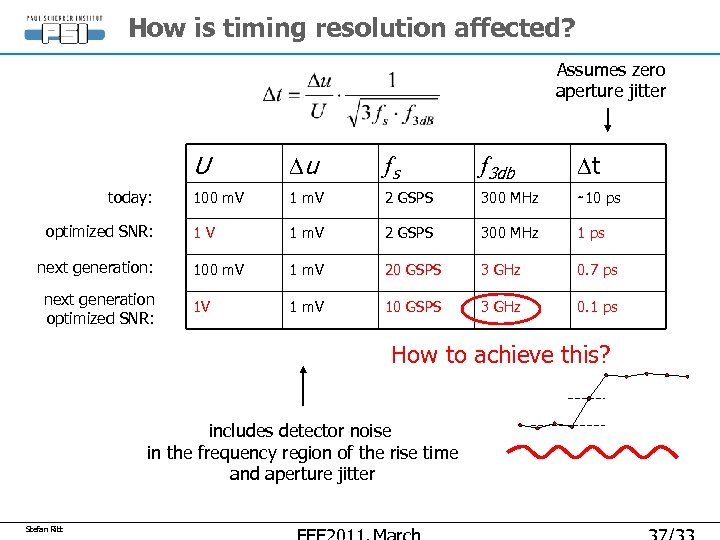 How is timing resolution affected? Assumes zero aperture jitter U today: optimized SNR: next generation optimized SNR: Du fs f 3 db Dt 100 m. V 1 m. V 2 GSPS 300 MHz ∼ 10 ps 1 V 1 m. V 2 GSPS 300 MHz 1 ps 100 m. V 1 m. V 20 GSPS 3 GHz 0. 7 ps 1 V 1 m. V 10 GSPS 3 GHz 0. 1 ps How to achieve this? includes detector noise in the frequency region of the rise time and aperture jitter Stefan Ritt