


 Скачать презентацию PAUL SCHERRER INSTITUT Future directions and current challenges
20d8cd3c61aec05c4fba0a9e6630d814.ppt
- Количество слайдов: 45
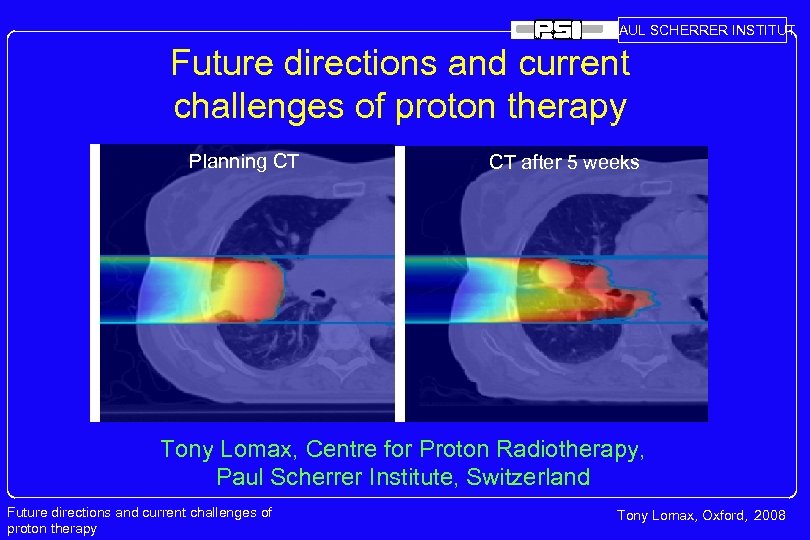 PAUL SCHERRER INSTITUT Future directions and current challenges of proton therapy Planning CT CT after 5 weeks Tony Lomax, Centre for Proton Radiotherapy, Paul Scherrer Institute, Switzerland Future directions and current challenges of proton therapy Tony Lomax, Oxford, 2008
 PAUL SCHERRER INSTITUT Overview of presentation 1. State-of-the-art proton delivery 2. Current challenges 3. New directions in proton therapy 4. Summary Future directions and current challenges of proton therapy Tony Lomax, Oxford, 2008
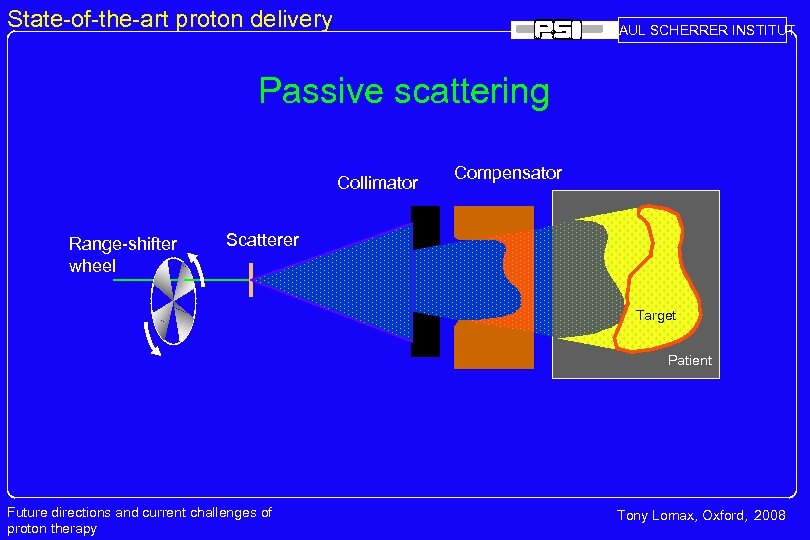 State-of-the-art proton delivery PAUL SCHERRER INSTITUT Passive scattering Collimator Range-shifter wheel Compensator Scatterer Target Patient Future directions and current challenges of proton therapy Tony Lomax, Oxford, 2008
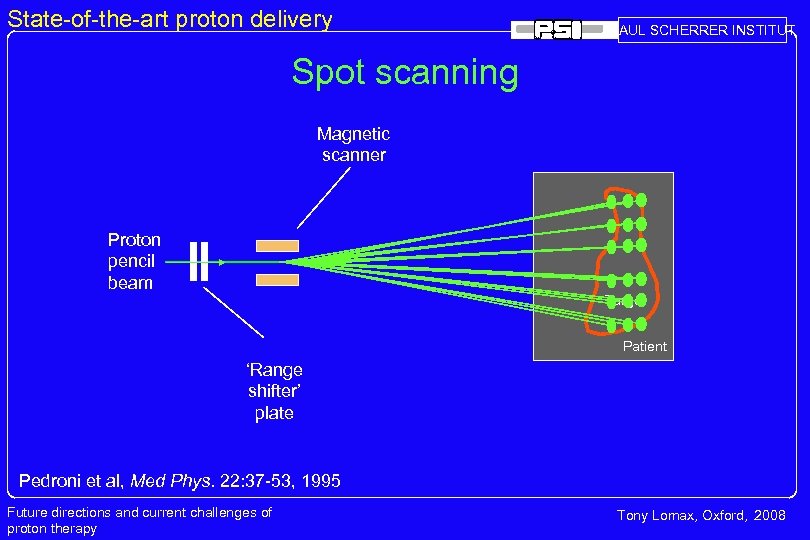 State-of-the-art proton delivery PAUL SCHERRER INSTITUT Spot scanning Magnetic scanner Proton pencil beam Target Patient ‘Range shifter’ plate Pedroni et al, Med Phys. 22: 37 -53, 1995 Future directions and current challenges of proton therapy Tony Lomax, Oxford, 2008
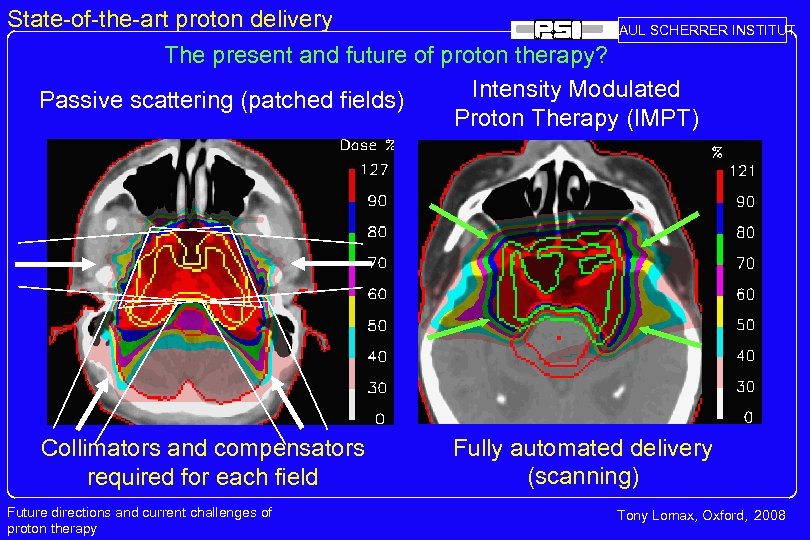 State-of-the-art proton delivery PAUL SCHERRER INSTITUT The present and future of proton therapy? Intensity Modulated Passive scattering (patched fields) Proton Therapy (IMPT) Collimators and compensators required for each field Future directions and current challenges of proton therapy Fully automated delivery (scanning) Tony Lomax, Oxford, 2008
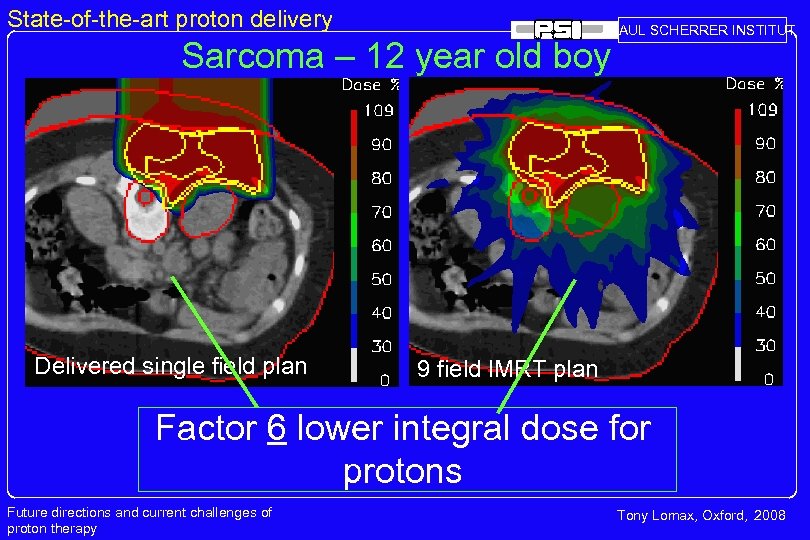 State-of-the-art proton delivery PAUL SCHERRER INSTITUT Sarcoma – 12 year old boy Delivered single field plan 9 field IMRT plan Factor 6 lower integral dose for protons Future directions and current challenges of proton therapy Tony Lomax, Oxford, 2008
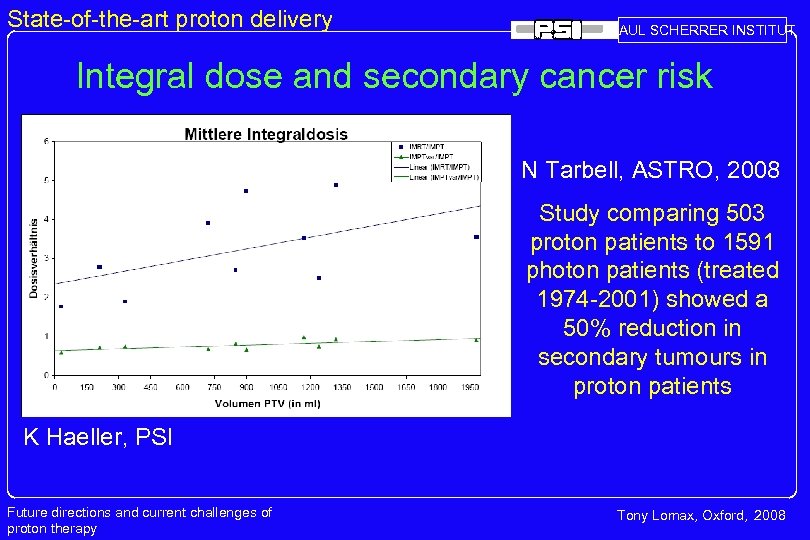 State-of-the-art proton delivery PAUL SCHERRER INSTITUT Integral dose and secondary cancer risk N Tarbell, ASTRO, 2008 Study comparing 503 proton patients to 1591 photon patients (treated 1974 -2001) showed a 50% reduction in secondary tumours in proton patients K Haeller, PSI Future directions and current challenges of proton therapy Tony Lomax, Oxford, 2008
 PAUL SCHERRER INSTITUT Overview of presentation 1. State-of-the-art proton delivery 2. Current challenges 3. New directions in proton therapy 4. Summary Future directions and current challenges of proton therapy Tony Lomax, Oxford, 2008
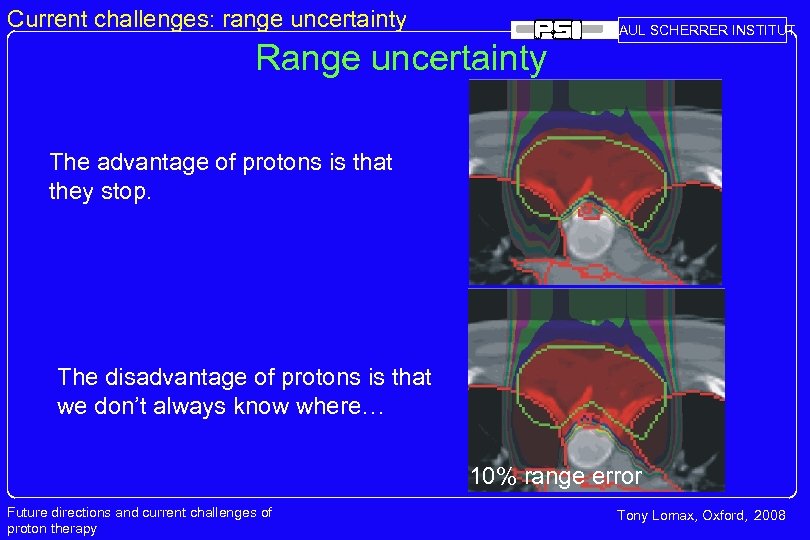 Current challenges: range uncertainty Range uncertainty PAUL SCHERRER INSTITUT The advantage of protons is that they stop. The disadvantage of protons is that we don’t always know where… 10% range error Future directions and current challenges of proton therapy Tony Lomax, Oxford, 2008
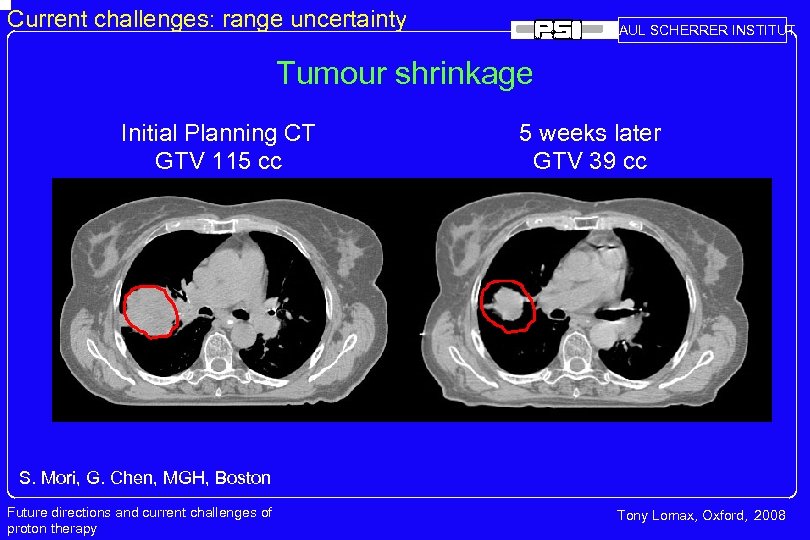 Current challenges: range uncertainty PAUL SCHERRER INSTITUT Tumour shrinkage Initial Planning CT GTV 115 cc 5 weeks later GTV 39 cc S. Mori, G. Chen, MGH, Boston Future directions and current challenges of proton therapy Tony Lomax, Oxford, 2008
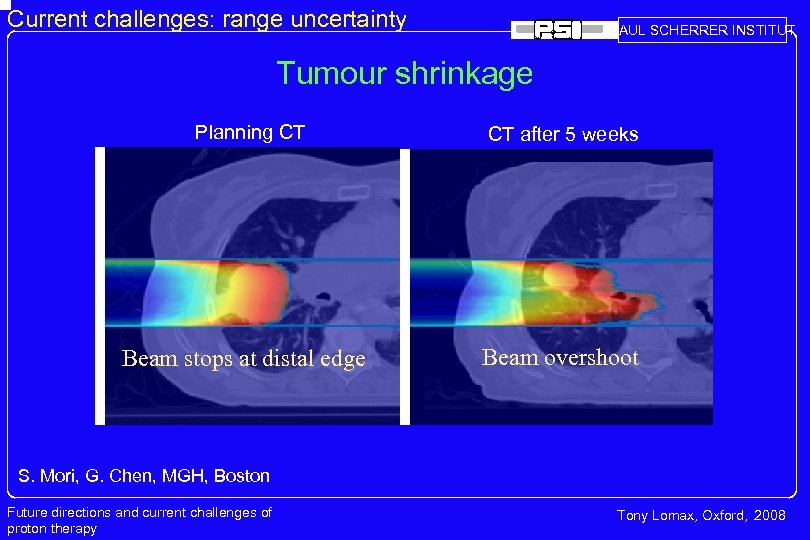 Current challenges: range uncertainty PAUL SCHERRER INSTITUT Tumour shrinkage Planning CT Beam stops at distal edge CT after 5 weeks Beam overshoot S. Mori, G. Chen, MGH, Boston Future directions and current challenges of proton therapy Tony Lomax, Oxford, 2008
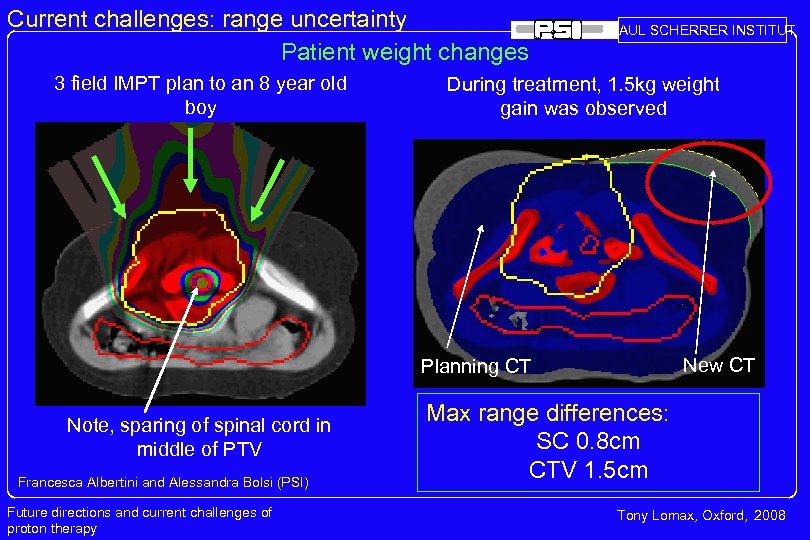 Current challenges: range uncertainty Patient weight changes 3 field IMPT plan to an 8 year old boy PAUL SCHERRER INSTITUT During treatment, 1. 5 kg weight gain was observed New CT Planning CT Note, sparing of spinal cord in middle of PTV Francesca Albertini and Alessandra Bolsi (PSI) Future directions and current challenges of proton therapy Max range differences: SC 0. 8 cm CTV 1. 5 cm Tony Lomax, Oxford, 2008
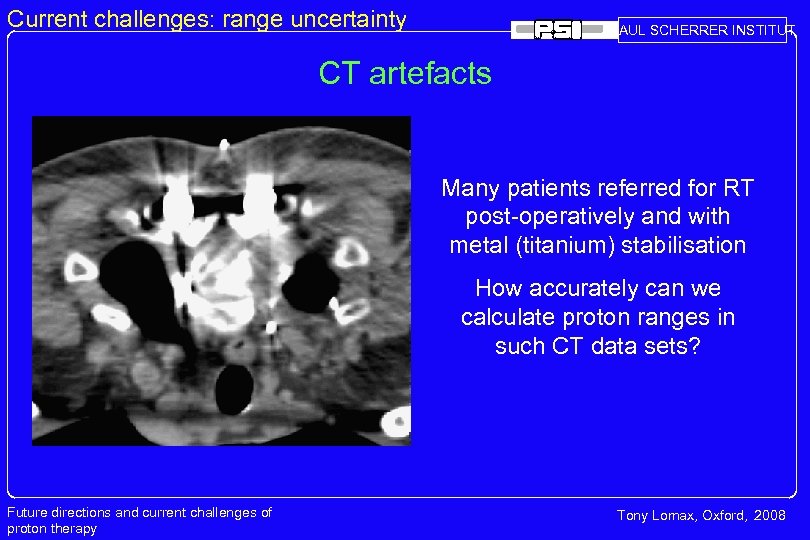 Current challenges: range uncertainty PAUL SCHERRER INSTITUT CT artefacts Many patients referred for RT post-operatively and with metal (titanium) stabilisation How accurately can we calculate proton ranges in such CT data sets? Future directions and current challenges of proton therapy Tony Lomax, Oxford, 2008
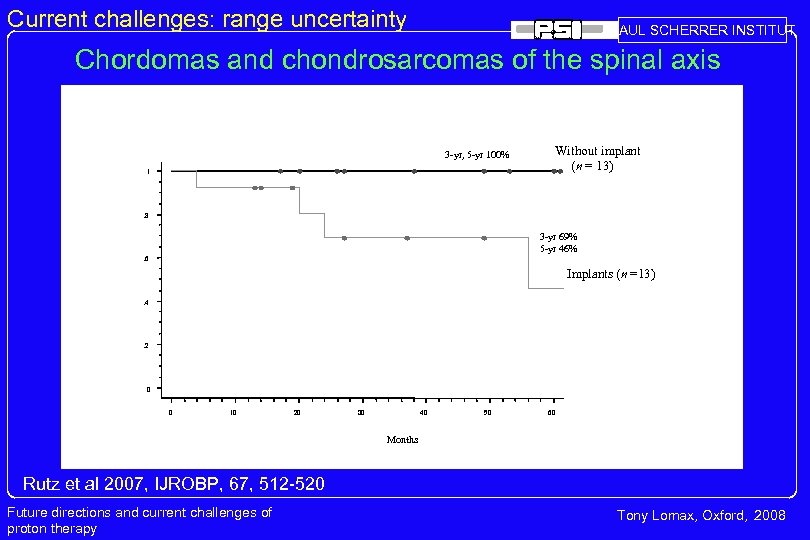 Current challenges: range uncertainty PAUL SCHERRER INSTITUT Chordomas and chondrosarcomas of the spinal axis 3 -yr, 5 -yr 100% 1 Without implant (n = 13) . 8 3 -yr 69% 5 -yr 46%. 6 Implants (n =13). 4 . 2 0 0 10 20 30 40 50 60 Months Rutz et al 2007, IJROBP, 67, 512 -520 Future directions and current challenges of proton therapy Tony Lomax, Oxford, 2008
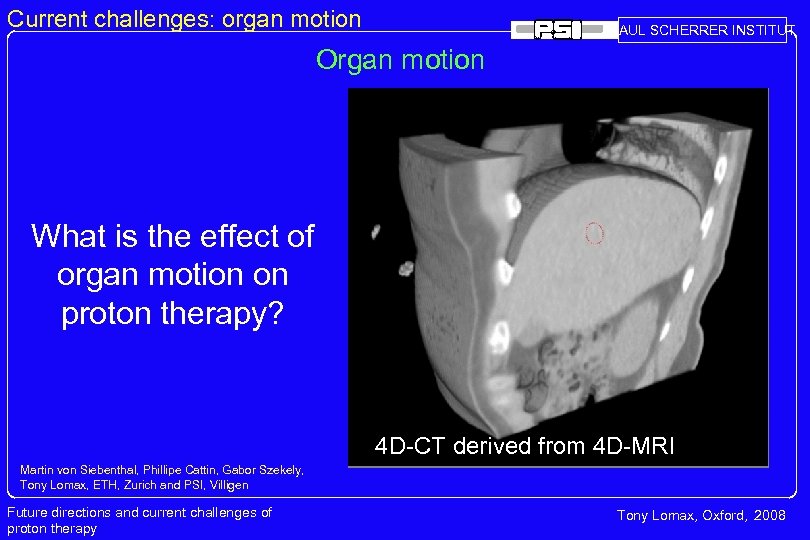 Current challenges: organ motion PAUL SCHERRER INSTITUT Organ motion What is the effect of organ motion on proton therapy? 4 D-CT derived from 4 D-MRI Martin von Siebenthal, Phillipe Cattin, Gabor Szekely, Tony Lomax, ETH, Zurich and PSI, Villigen Future directions and current challenges of proton therapy Tony Lomax, Oxford, 2008
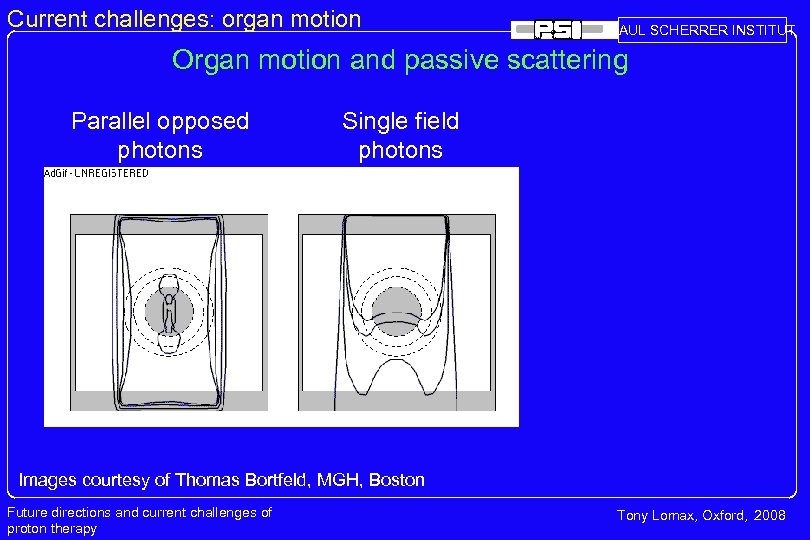 Current challenges: organ motion PAUL SCHERRER INSTITUT Organ motion and passive scattering Parallel opposed photons Single field protons Images courtesy of Thomas Bortfeld, MGH, Boston Future directions and current challenges of proton therapy Tony Lomax, Oxford, 2008
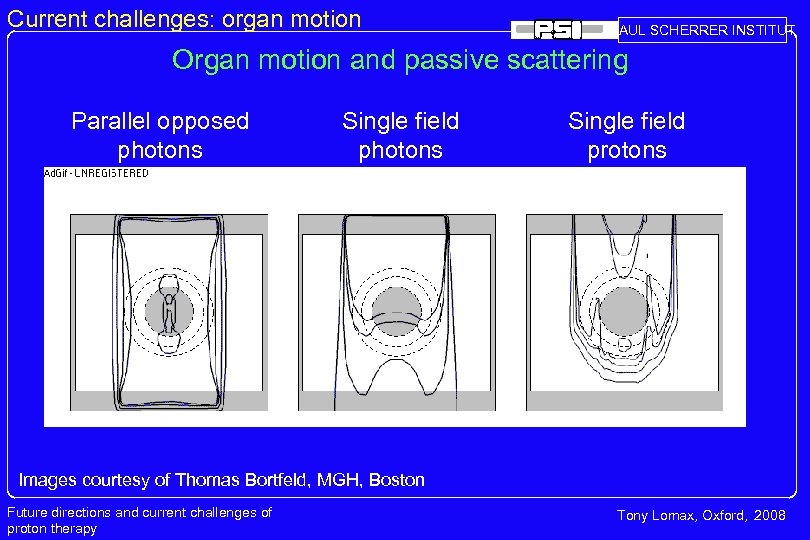 Current challenges: organ motion PAUL SCHERRER INSTITUT Organ motion and passive scattering Parallel opposed photons Single field protons Images courtesy of Thomas Bortfeld, MGH, Boston Future directions and current challenges of proton therapy Tony Lomax, Oxford, 2008
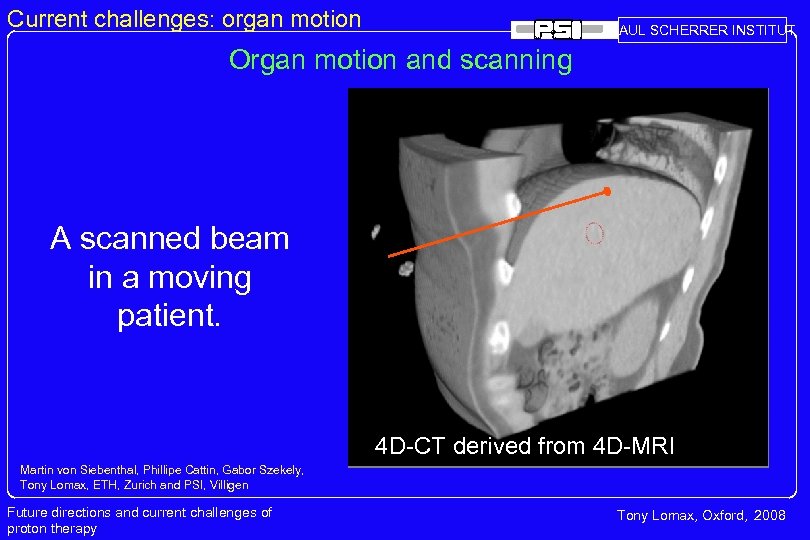 Current challenges: organ motion PAUL SCHERRER INSTITUT Organ motion and scanning A scanned beam in a moving patient. 4 D-CT derived from 4 D-MRI Martin von Siebenthal, Phillipe Cattin, Gabor Szekely, Tony Lomax, ETH, Zurich and PSI, Villigen Future directions and current challenges of proton therapy Tony Lomax, Oxford, 2008
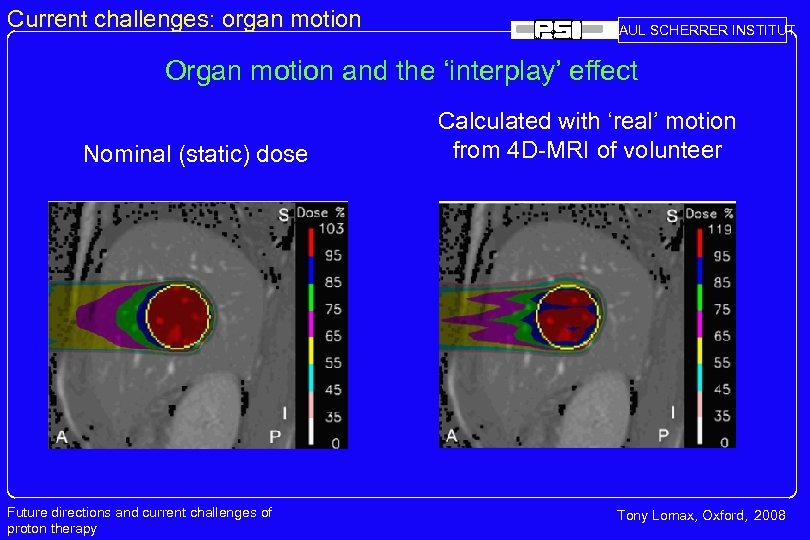 Current challenges: organ motion PAUL SCHERRER INSTITUT Organ motion and the ‘interplay’ effect Nominal (static) dose Future directions and current challenges of proton therapy Calculated with ‘real’ motion from 4 D-MRI of volunteer Tony Lomax, Oxford, 2008
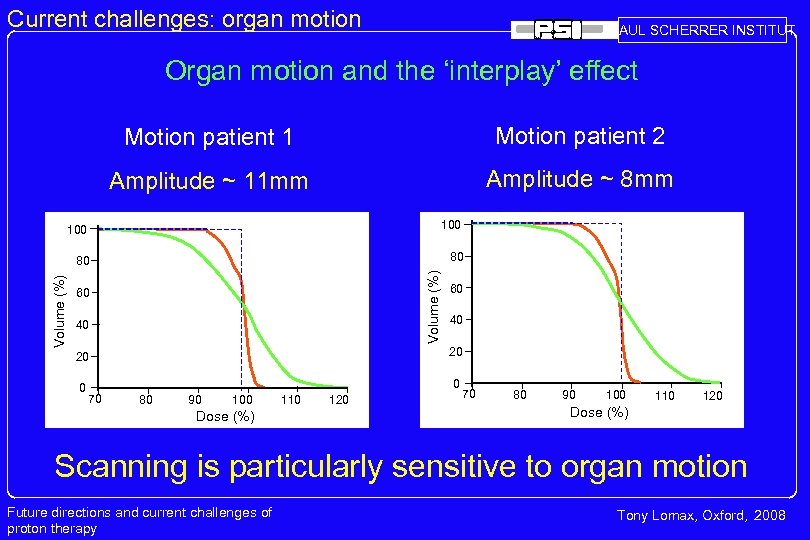 Current challenges: organ motion PAUL SCHERRER INSTITUT Organ motion and the ‘interplay’ effect Motion patient 1 Motion patient 2 Amplitude ~ 11 mm Amplitude ~ 8 mm 80 80 Volume (%) 100 60 40 20 20 0 0 70 80 90 100 Dose (%) 110 120 70 80 90 100 110 120 Dose (%) Scanning is particularly sensitive to organ motion Future directions and current challenges of proton therapy Tony Lomax, Oxford, 2008
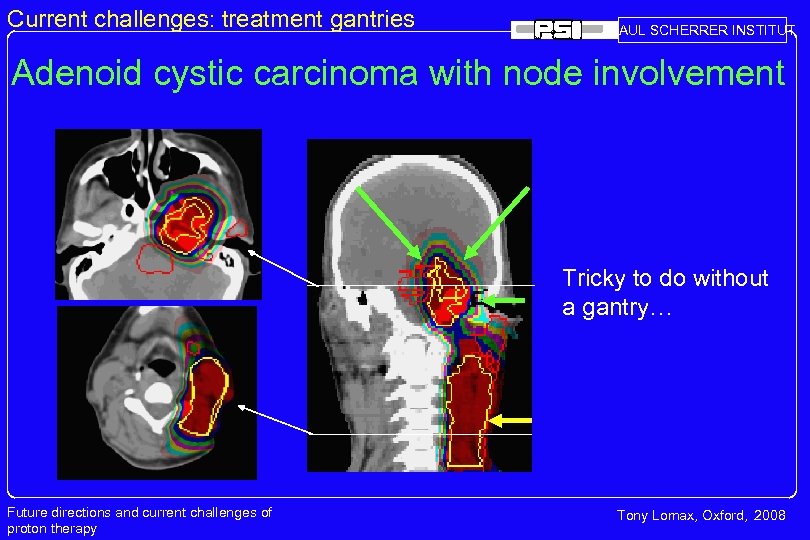 Current challenges: treatment gantries PAUL SCHERRER INSTITUT Adenoid cystic carcinoma with node involvement Tricky to do without a gantry… Future directions and current challenges of proton therapy Tony Lomax, Oxford, 2008
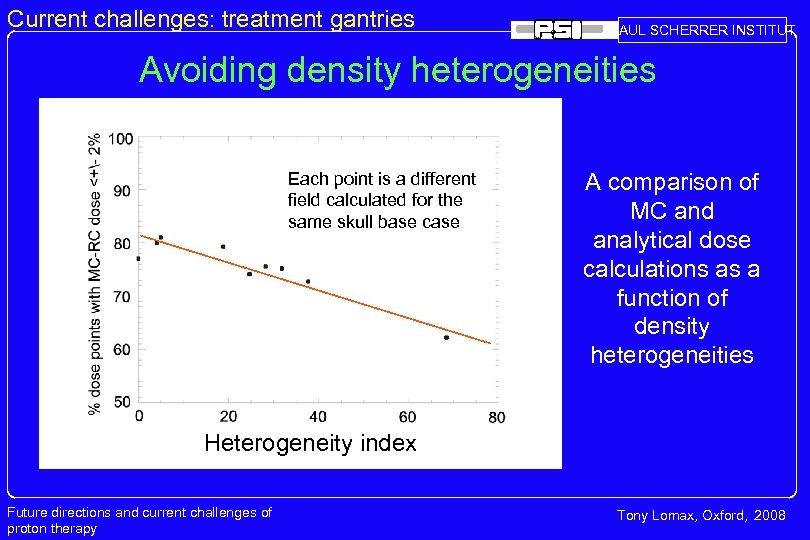 Current challenges: treatment gantries PAUL SCHERRER INSTITUT Avoiding density heterogeneities Each point is a different field calculated for the same skull base case A comparison of MC and analytical dose calculations as a function of density heterogeneities Heterogeneity index Future directions and current challenges of proton therapy Tony Lomax, Oxford, 2008
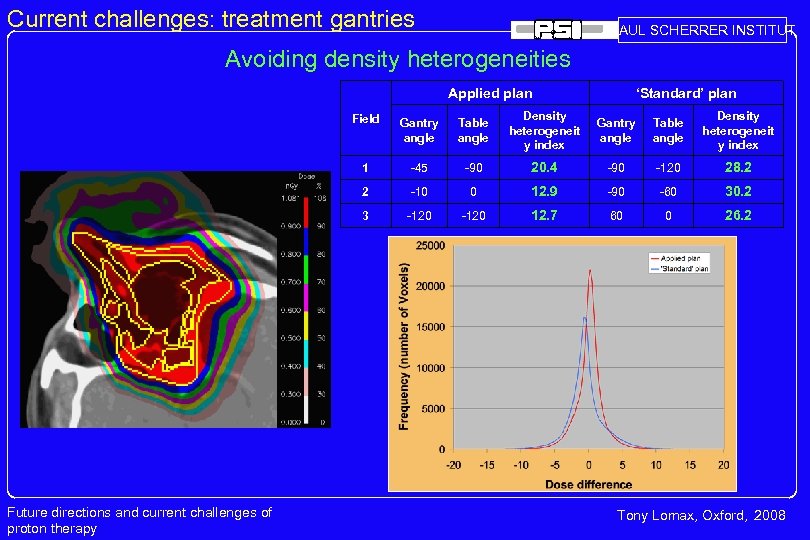 Current challenges: treatment gantries PAUL SCHERRER INSTITUT Avoiding density heterogeneities Applied plan ‘Standard’ plan Field Table angle Density heterogeneit y index Gantry angle Table angle Density heterogeneit y index 1 -45 -90 20. 4 -90 -120 28. 2 2 -10 0 12. 9 -90 -60 30. 2 3 Future directions and current challenges of proton therapy Gantry angle -120 12. 7 60 0 26. 2 Tony Lomax, Oxford, 2008
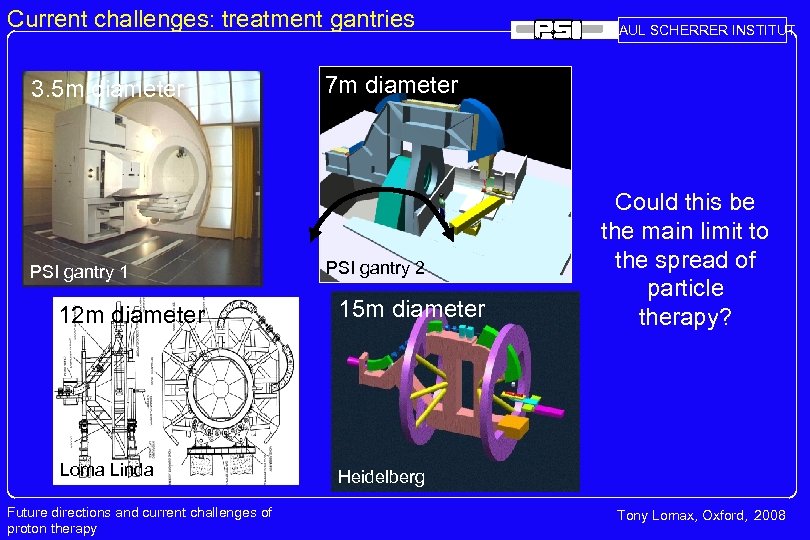 Current challenges: treatment gantries 3. 5 m diameter PSI gantry 1 PAUL SCHERRER INSTITUT 7 m diameter PSI gantry 2 12 m diameter 15 m diameter Loma Linda Could this be the main limit to the spread of particle therapy? Heidelberg Future directions and current challenges of proton therapy Tony Lomax, Oxford, 2008
 PAUL SCHERRER INSTITUT Overview of presentation 1. State-of-the-art proton delivery 2. Current challenges 3. New directions in proton therapy 4. Summary Future directions and current challenges of proton therapy Tony Lomax, Oxford, 2008
 PAUL SCHERRER INSTITUT New directions in proton therapy 1. Possible improvements to passive scattering 2. Dealing with range uncertainties 3. Organ motion and scanning Future directions and current challenges of proton therapy Tony Lomax, Oxford, 2008
 PAUL SCHERRER INSTITUT New directions in proton therapy 1. Dealing with range uncertainties 2. Organ motion and scanning 3. Gantry design Future directions and current challenges of proton therapy Tony Lomax, Oxford, 2008
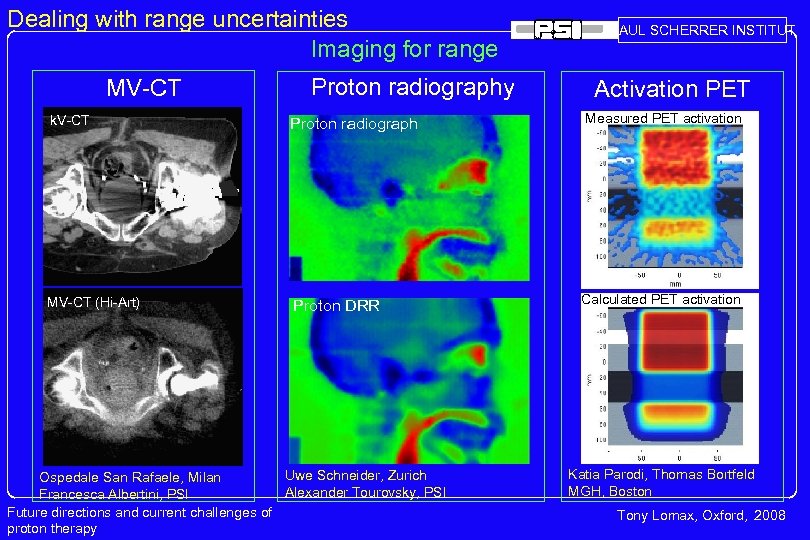 Dealing with range uncertainties Imaging for range MV-CT Proton radiography k. V-CT Proton radiograph MV-CT (Hi-Art) Proton DRR Uwe Schneider, Zurich Ospedale San Rafaele, Milan Alexander Tourovsky, PSI Francesca Albertini, PSI Future directions and current challenges of proton therapy PAUL SCHERRER INSTITUT Activation PET Measured PET activation Calculated PET activation Katia Parodi, Thomas Bortfeld MGH, Boston Tony Lomax, Oxford, 2008
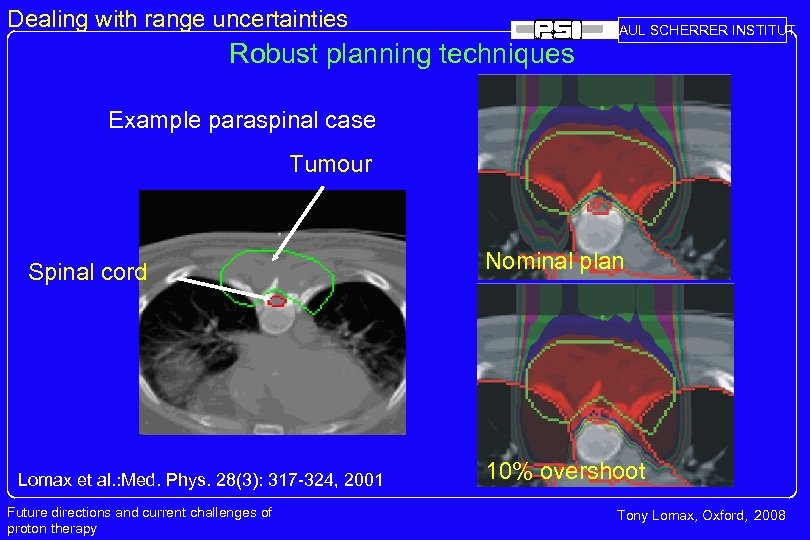 Dealing with range uncertainties Robust planning techniques PAUL SCHERRER INSTITUT Example paraspinal case Tumour Spinal cord Lomax et al. : Med. Phys. 28(3): 317 -324, 2001 Future directions and current challenges of proton therapy Nominal plan 10% overshoot Tony Lomax, Oxford, 2008
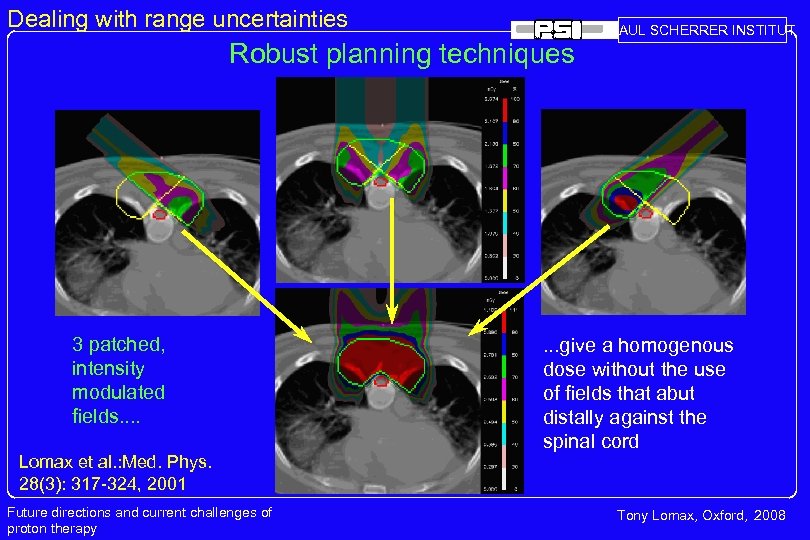 Dealing with range uncertainties Robust planning techniques 3 patched, intensity modulated fields. . PAUL SCHERRER INSTITUT . . . give a homogenous dose without the use of fields that abut distally against the spinal cord Lomax et al. : Med. Phys. 28(3): 317 -324, 2001 Future directions and current challenges of proton therapy Tony Lomax, Oxford, 2008
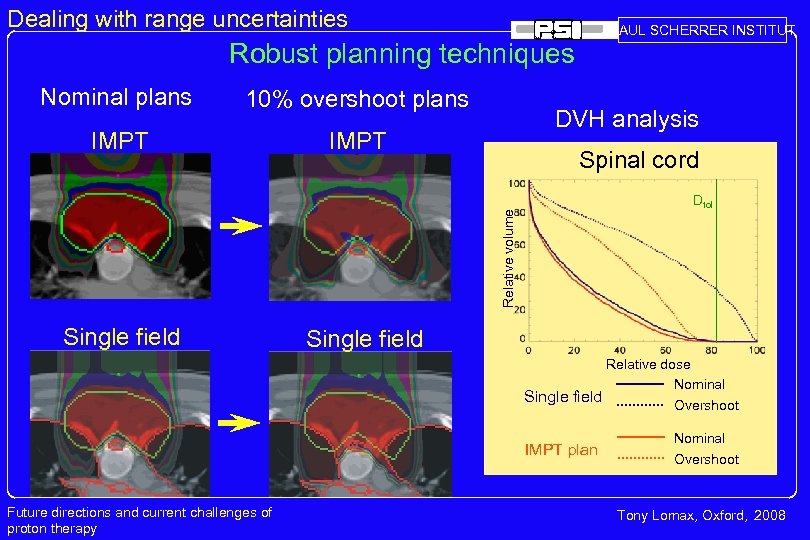 Dealing with range uncertainties PAUL SCHERRER INSTITUT Robust planning techniques 10% overshoot plans IMPT DVH analysis Spinal cord Dtol Relative volume Nominal plans Single field Relative dose Nominal Single field Overshoot IMPT plan Future directions and current challenges of proton therapy Nominal Overshoot Tony Lomax, Oxford, 2008
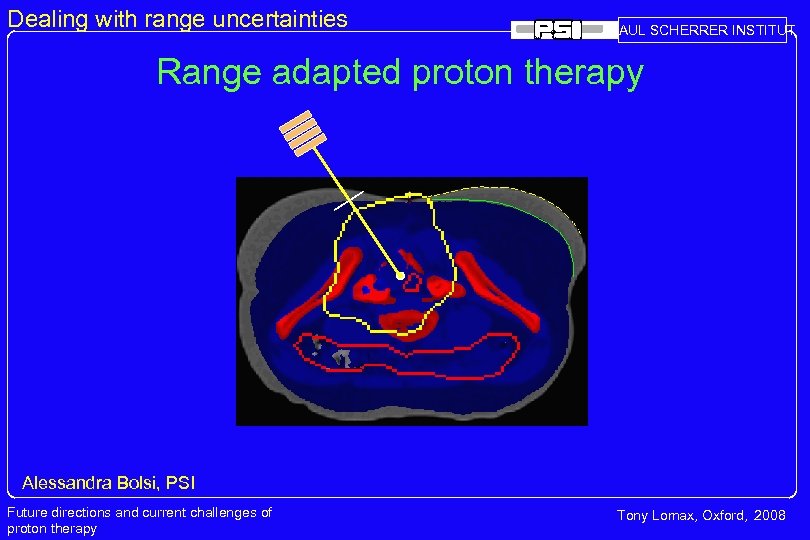 Dealing with range uncertainties PAUL SCHERRER INSTITUT Range adapted proton therapy Alessandra Bolsi, PSI Future directions and current challenges of proton therapy Tony Lomax, Oxford, 2008
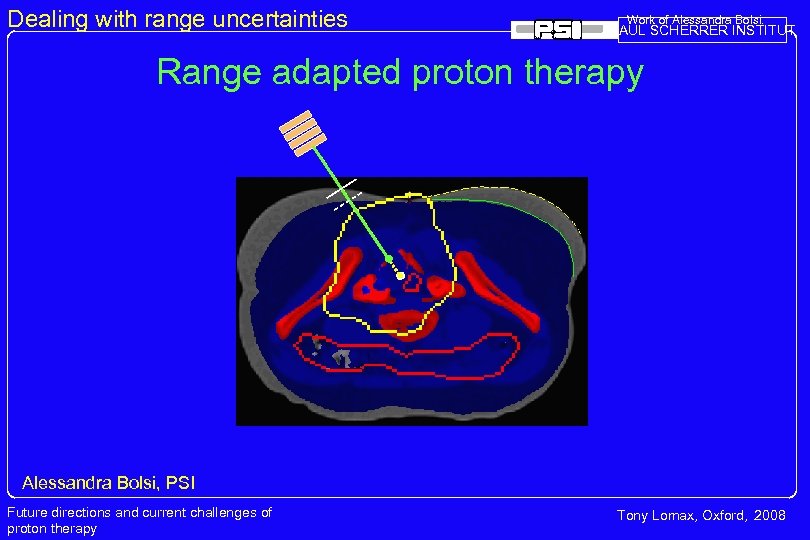 Dealing with range uncertainties Work of Alessandra Bolsi. PAUL SCHERRER INSTITUT Range adapted proton therapy Alessandra Bolsi, PSI Future directions and current challenges of proton therapy Tony Lomax, Oxford, 2008
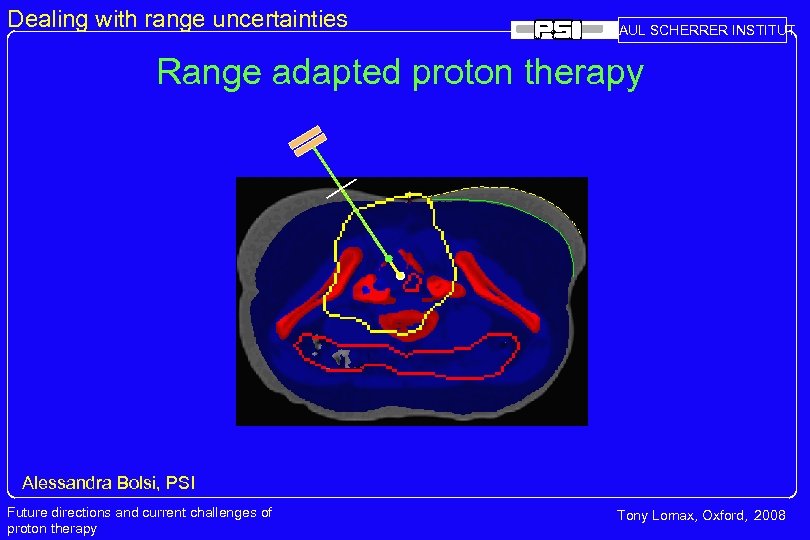 Dealing with range uncertainties PAUL SCHERRER INSTITUT Range adapted proton therapy Alessandra Bolsi, PSI Future directions and current challenges of proton therapy Tony Lomax, Oxford, 2008
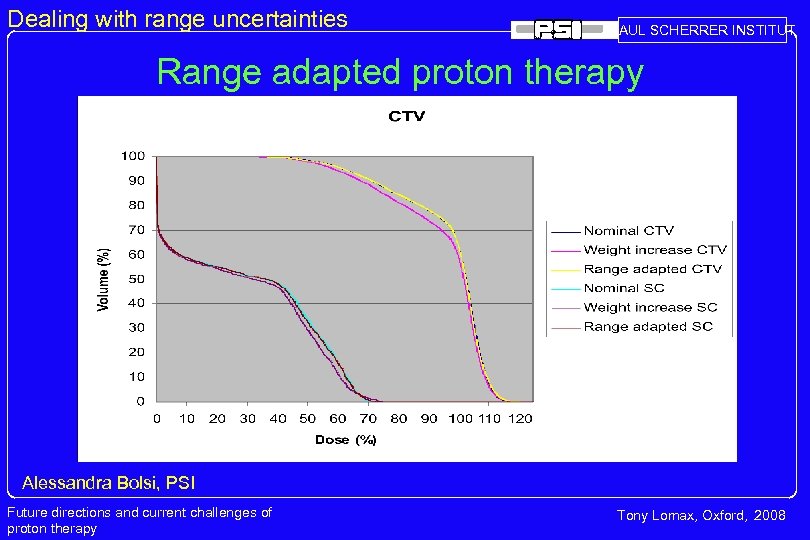 Dealing with range uncertainties PAUL SCHERRER INSTITUT Range adapted proton therapy Alessandra Bolsi, PSI Future directions and current challenges of proton therapy Tony Lomax, Oxford, 2008
 PAUL SCHERRER INSTITUT New directions in proton therapy 1. Dealing with range uncertainties 2. Organ motion and scanning 3. Gantry design Future directions and current challenges of proton therapy Tony Lomax, Oxford, 2008
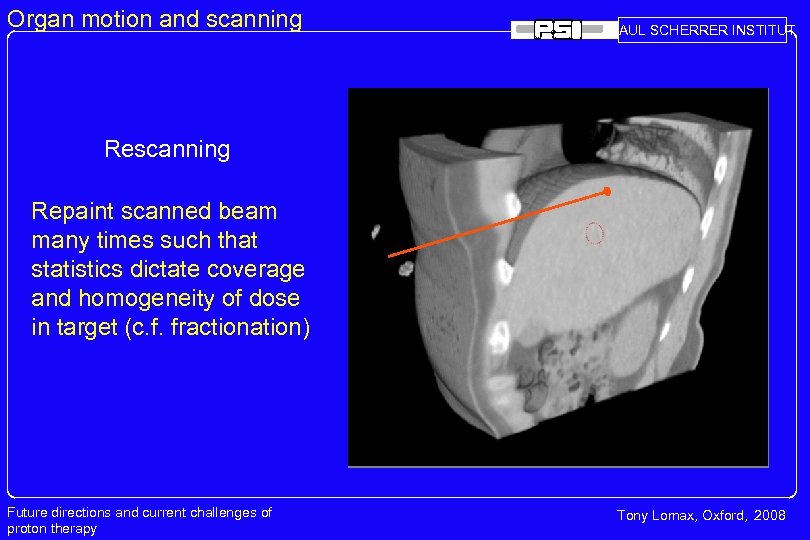 Organ motion and scanning PAUL SCHERRER INSTITUT Rescanning Repaint scanned beam many times such that statistics dictate coverage and homogeneity of dose in target (c. f. fractionation) Future directions and current challenges of proton therapy Tony Lomax, Oxford, 2008
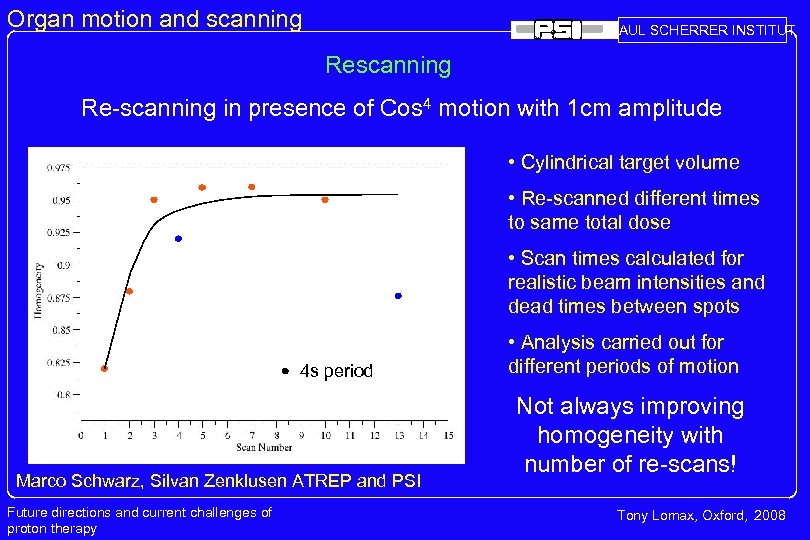 Organ motion and scanning PAUL SCHERRER INSTITUT Rescanning Re-scanning in presence of Cos 4 motion with 1 cm amplitude • Cylindrical target volume • Re-scanned different times to same total dose • Scan times calculated for realistic beam intensities and dead times between spots 4 s period Marco Schwarz, Silvan Zenklusen ATREP and PSI Future directions and current challenges of proton therapy • Analysis carried out for different periods of motion Not always improving homogeneity with number of re-scans! Tony Lomax, Oxford, 2008
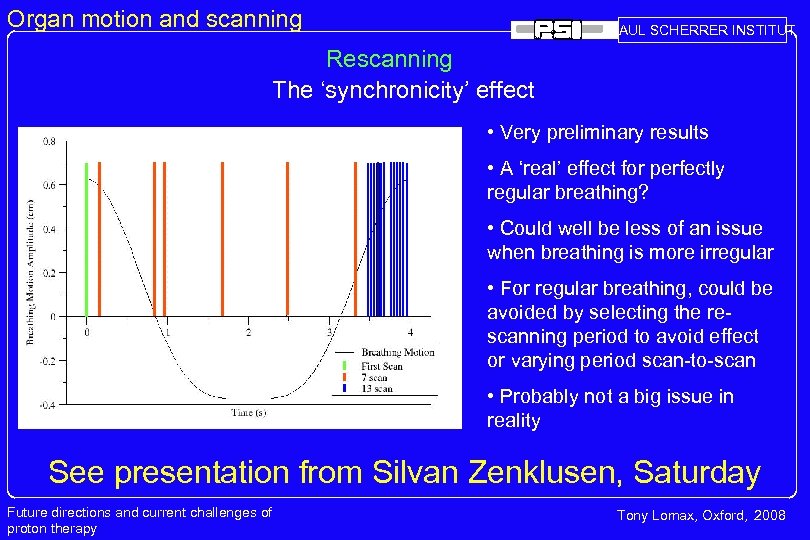 Organ motion and scanning PAUL SCHERRER INSTITUT Rescanning The ‘synchronicity’ effect • Very preliminary results • A ‘real’ effect for perfectly regular breathing? • Could well be less of an issue when breathing is more irregular • For regular breathing, could be avoided by selecting the rescanning period to avoid effect or varying period scan-to-scan • Probably not a big issue in reality See presentation from Silvan Zenklusen, Saturday Future directions and current challenges of proton therapy Tony Lomax, Oxford, 2008
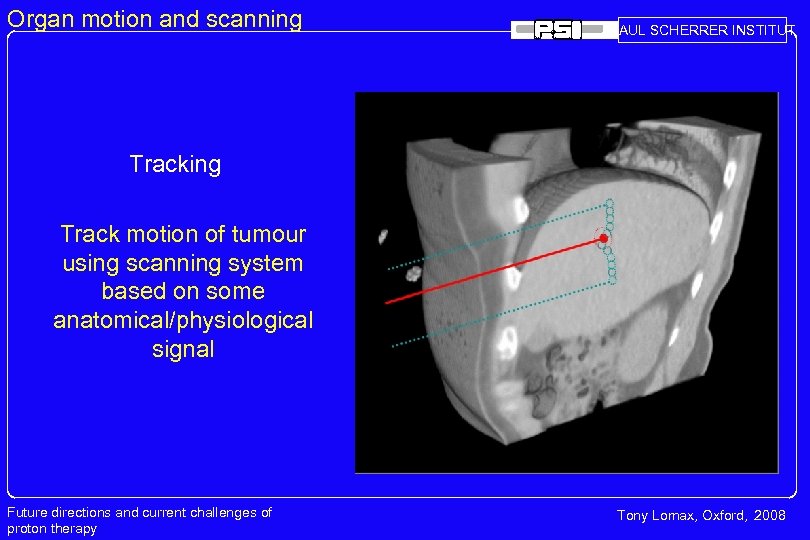 Organ motion and scanning PAUL SCHERRER INSTITUT Tracking Track motion of tumour using scanning system based on some anatomical/physiological signal Future directions and current challenges of proton therapy Tony Lomax, Oxford, 2008
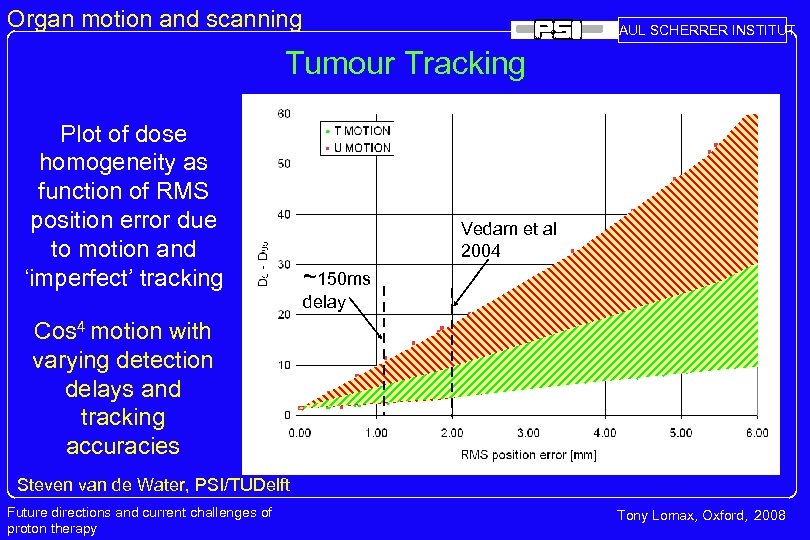 Organ motion and scanning PAUL SCHERRER INSTITUT Tumour Tracking Plot of dose homogeneity as function of RMS position error due to motion and ‘imperfect’ tracking Vedam et al 2004 ~150 ms delay Cos 4 motion with varying detection delays and tracking accuracies Steven van de Water, PSI/TUDelft Future directions and current challenges of proton therapy Tony Lomax, Oxford, 2008
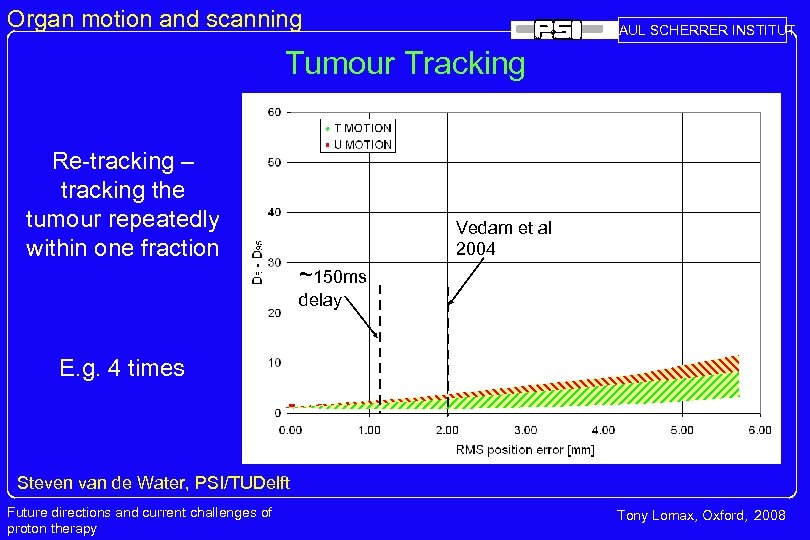 Organ motion and scanning PAUL SCHERRER INSTITUT Tumour Tracking Re-tracking – tracking the tumour repeatedly within one fraction Vedam et al 2004 ~150 ms delay E. g. 4 times Steven van de Water, PSI/TUDelft Future directions and current challenges of proton therapy Tony Lomax, Oxford, 2008
 PAUL SCHERRER INSTITUT New directions in proton therapy 1. Dealing with range uncertainties 2. Organ motion and scanning 3. Gantry design Future directions and current challenges of proton therapy Tony Lomax, Oxford, 2008
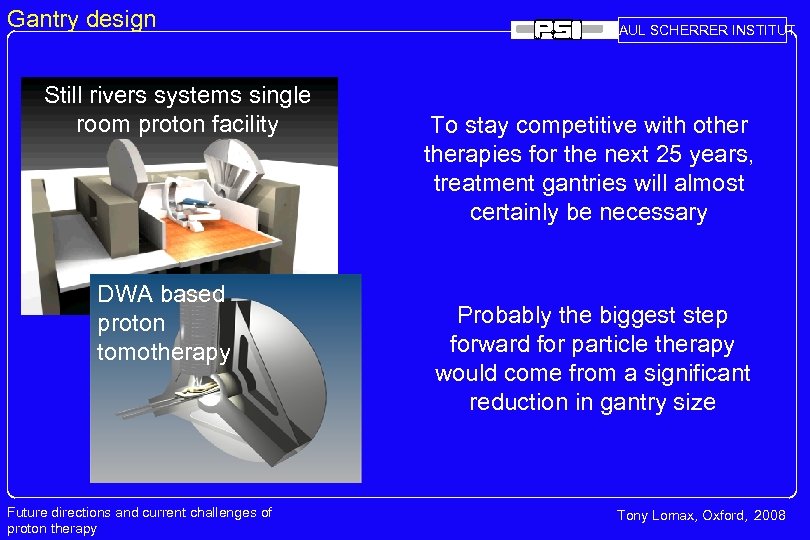 Gantry design Still rivers systems single room proton facility DWA based proton tomotherapy Future directions and current challenges of proton therapy PAUL SCHERRER INSTITUT To stay competitive with otherapies for the next 25 years, treatment gantries will almost certainly be necessary Probably the biggest step forward for particle therapy would come from a significant reduction in gantry size Tony Lomax, Oxford, 2008
 PAUL SCHERRER INSTITUT Summary • Although passive scattering is still the preferred choice for proton therapy, scanning and IMPT will become more widespread in the next years (c. f. MD Anderson) • To what extent can scattering be improved through the use of automated field hardware (MLC’s etc)? • Range uncertainty and organ motion (particularly for scanning) remain the main challenges to proton therapy and much interesting and exciting work is still to be done in organ management, range imaging and adaptive proton therapy • The field is ripe for new input, ideas and innovations… Future directions and current challenges of proton therapy Tony Lomax, Oxford, 2008