


 Скачать презентацию Patrick Murphy Executive Director International Laser Display Association
c31b1b3c46a77d42ebfb098346855539.ppt
- Количество слайдов: 68
 Patrick Murphy Executive Director, International Laser Display Association SAE G-10 T Committee Member LASERS AND AVIATION SAFETY
 Lasers and Aviation Safety • Laser pointer threat • Laser uses in airspace • Laser hazards in airspace o Hazard factors o Hazard reduction • Regulation and control International Laser Display Association
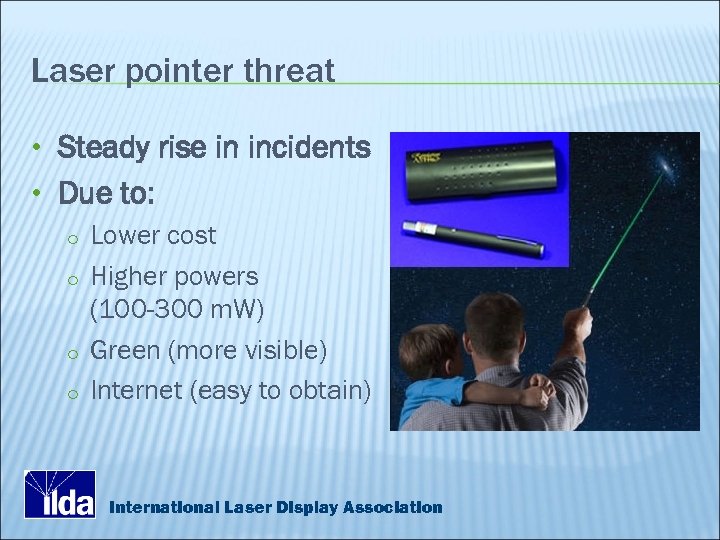 Laser pointer threat • Steady rise in incidents • Due to: o Lower cost o Higher powers (100 -300 m. W) o Green (more visible) o Internet (easy to obtain) International Laser Display Association
 Laser pointer threat • January 1 – February 23, 2009: 148 laser illuminations of aircraft in the U. S. alone o 2. 7 per day • February 22: 12 illuminations of aircraft landing at Sea-Tac International Laser Display Association
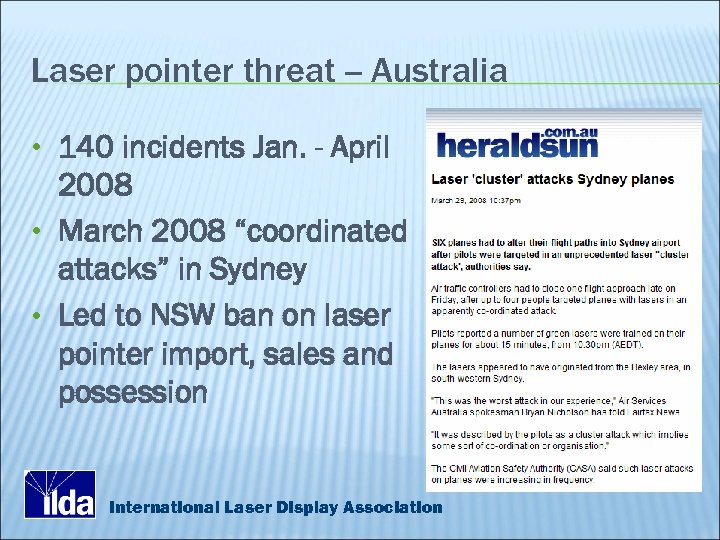 Laser pointer threat -- Australia • 140 incidents Jan. - April 2008 • March 2008 “coordinated attacks” in Sydney • Led to NSW ban on laser pointer import, sales and possession International Laser Display Association
 Why not ban laser beams from airspace?
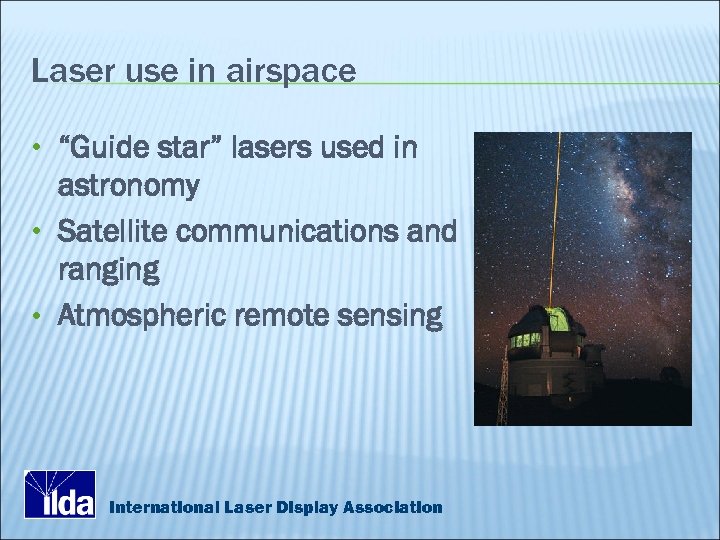 Laser use in airspace • “Guide star” lasers used in astronomy • Satellite communications and ranging • Atmospheric remote sensing International Laser Display Association
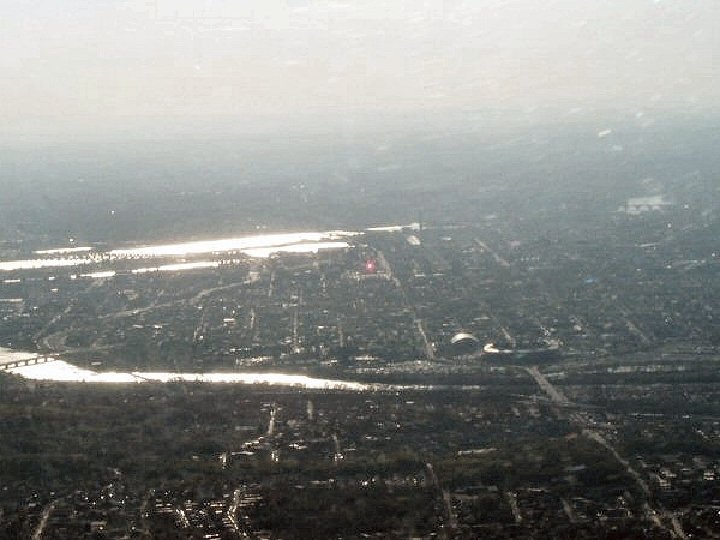
 Laser use in airspace • Aircraft warning o Visual Warning System used in Washington Metropolitan Air Defense Identification Zone (ADIZ) o 7 locations o Green and red lasers, 1. 5 watts o Visible up to 20 nautical miles away International Laser Display Association
 International Laser Display Association
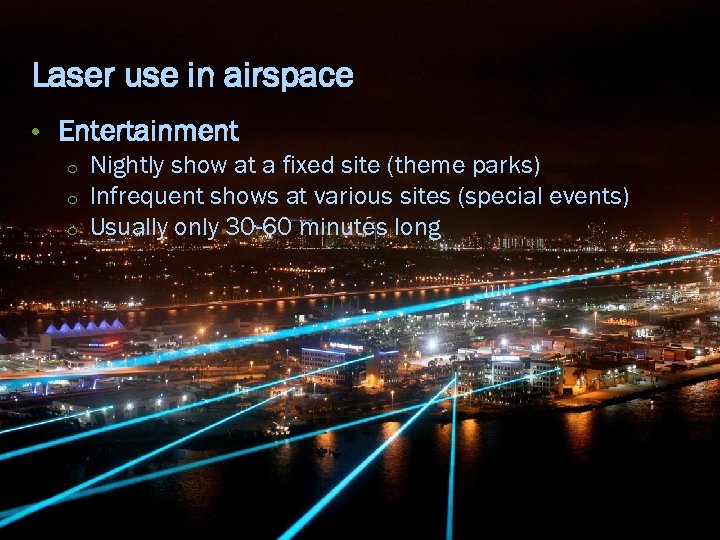 Laser use in airspace • Entertainment o o o Nightly show at a fixed site (theme parks) Infrequent shows at various sites (special events) Usually only 30 -60 minutes long International Laser Display Association
 Not practical to ban lasers from airspace • Unduly restricts legitimate users • Does not prevent accidental illumination incidents • Does not stop deliberate targeting of aircraft o o Ignorance – does not know effects Malice – trying to cause harm International Laser Display Association
 How are laser beams hazardous to aviation?
 Primary hazard is to pilots • From visible laser beams: o Visual interference during critical phases of flight • o Distraction, glare and flashblindness Potential eye damage during any phase of flight • From non-visible (infrared, ultraviolet) beams: o Potential eye damage during any phase of flight International Laser Display Association
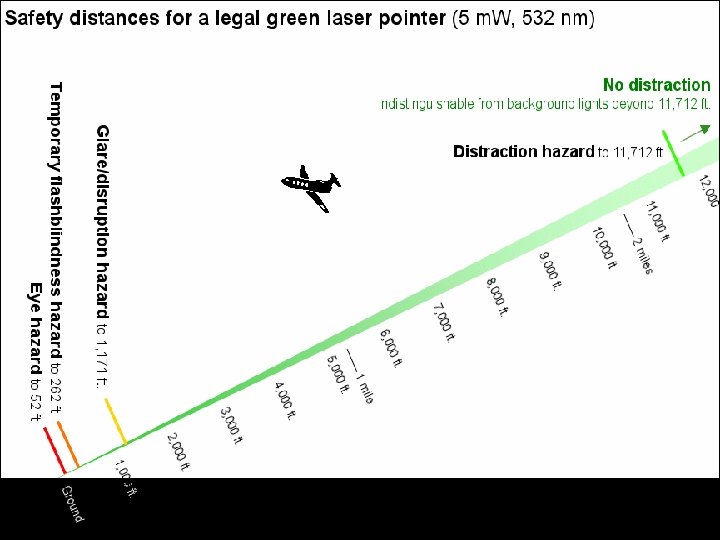
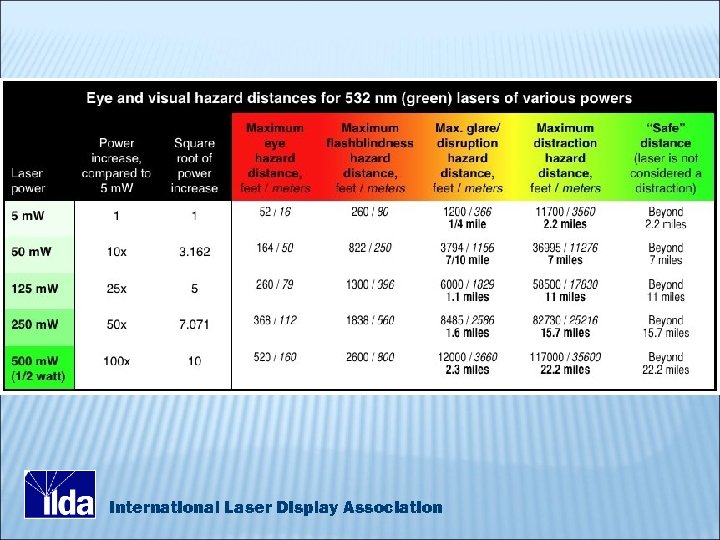
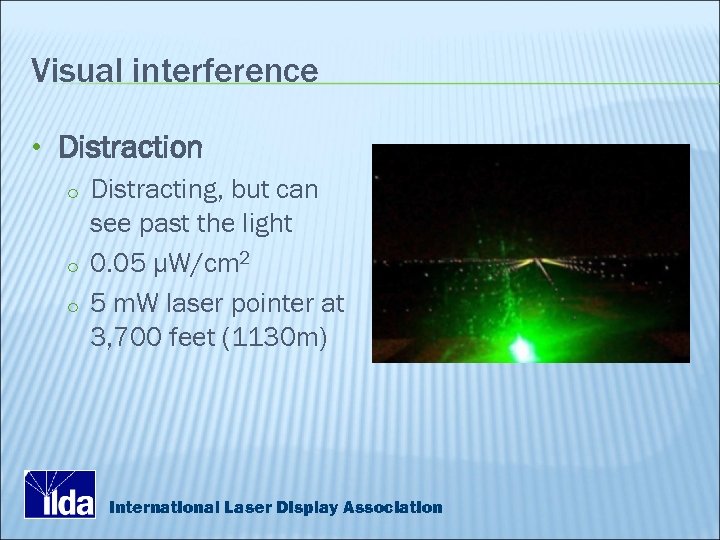 Visual interference • Distraction o Distracting, but can see past the light o 0. 05 μW/cm 2 o 5 m. W laser pointer at 3, 700 feet (1130 m) International Laser Display Association
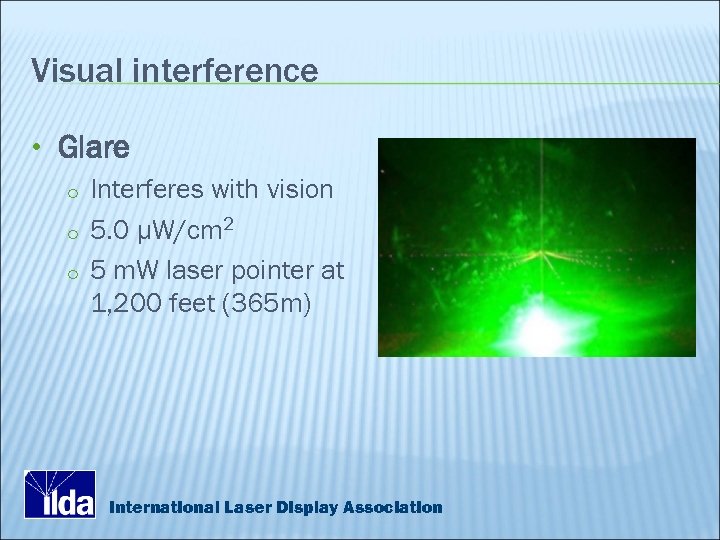 Visual interference • Glare o Interferes with vision o 5. 0 μW/cm 2 o 5 m. W laser pointer at 1, 200 feet (365 m) International Laser Display Association
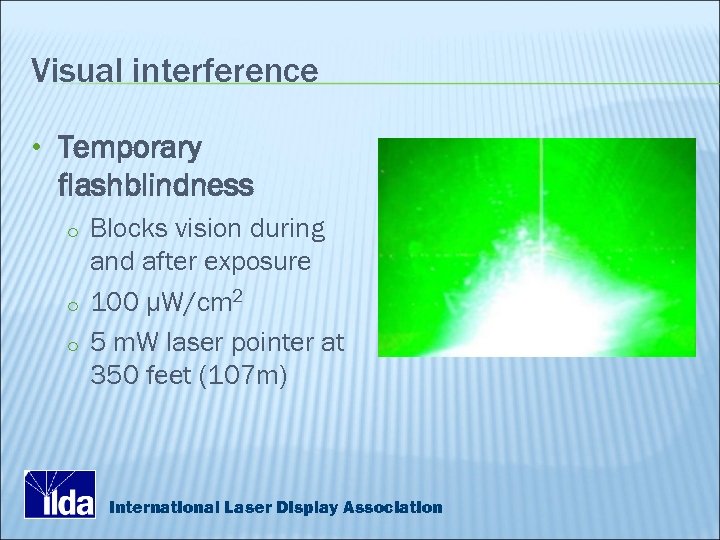 Visual interference • Temporary flashblindness o o o Blocks vision during and after exposure 100 μW/cm 2 5 m. W laser pointer at 350 feet (107 m) International Laser Display Association
 Visual interference does affect pilots • 2004 FAA simulator study o Pilots flew a challenging “short-final” approach o Glare and flashblindness significant • • Adverse effects for more than 50% of the approaches 20 -25% rate of aborted landings International Laser Display Association
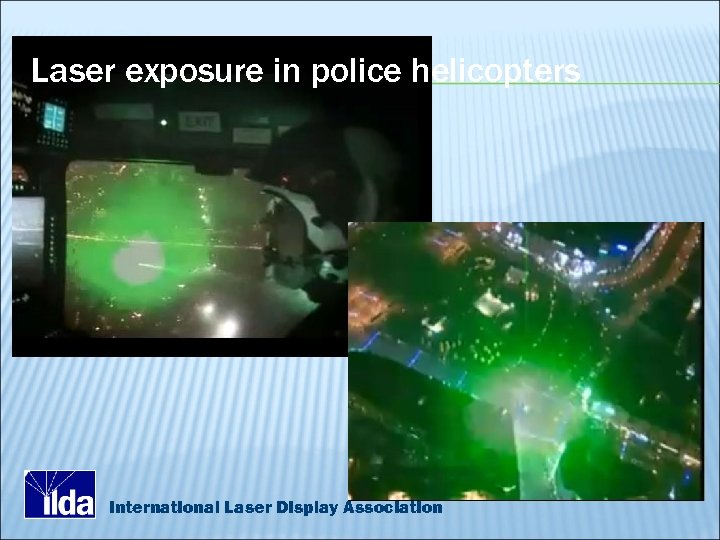 Laser exposure in police helicopters International Laser Display Association
 Potential eye damage • Can be caused by visible or non-visible laser beams, at power above the MPE • Unlikely, though possible • Few confirmed reports • “Damage” could be pre- or post-exposure o o Previous eye injuries or abormalities Rubbing the eye after exposure International Laser Display Association
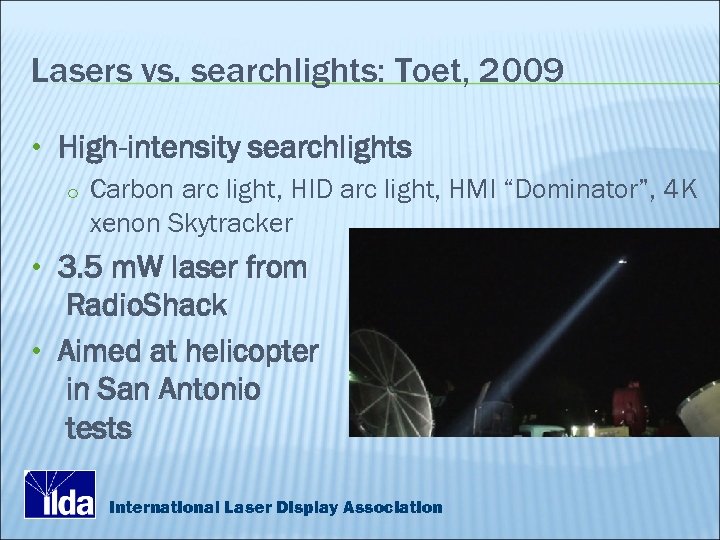 Lasers vs. searchlights: Toet, 2009 • High-intensity searchlights o Carbon arc light, HID arc light, HMI “Dominator”, 4 K xenon Skytracker • 3. 5 m. W laser from Radio. Shack • Aimed at helicopter in San Antonio tests International Laser Display Association
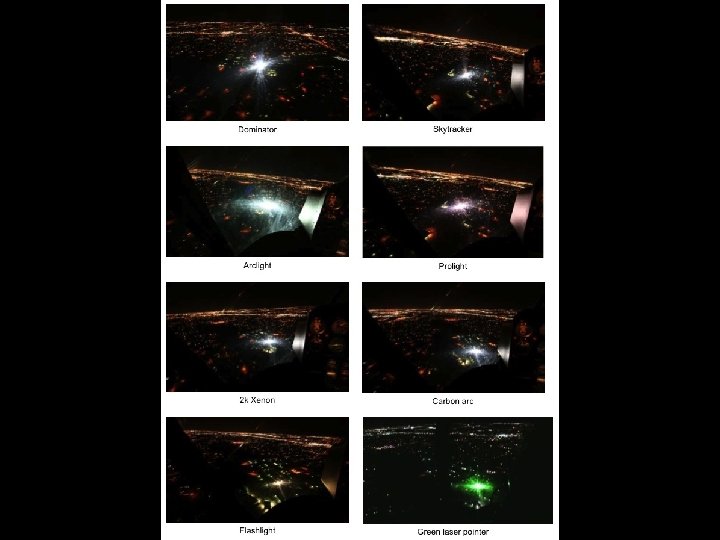
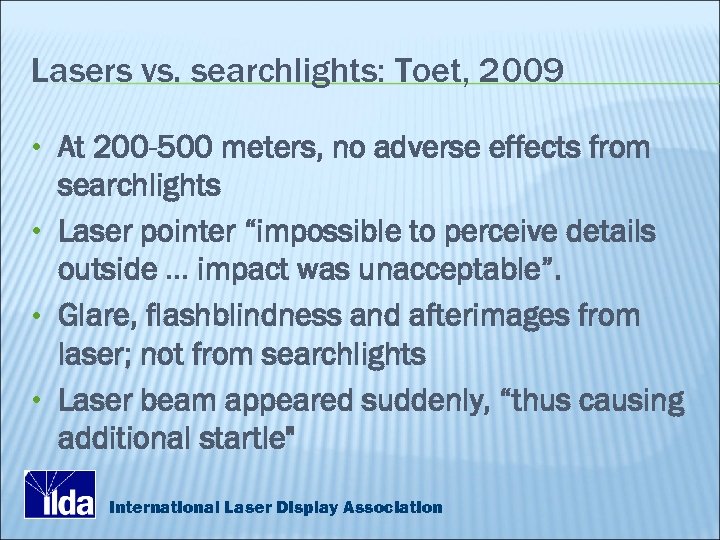 Lasers vs. searchlights: Toet, 2009 • At 200 -500 meters, no adverse effects from searchlights • Laser pointer “impossible to perceive details outside … impact was unacceptable”. • Glare, flashblindness and afterimages from laser; not from searchlights • Laser beam appeared suddenly, “thus causing additional startle" International Laser Display Association
 International Laser Display Association
 International Laser Display Association
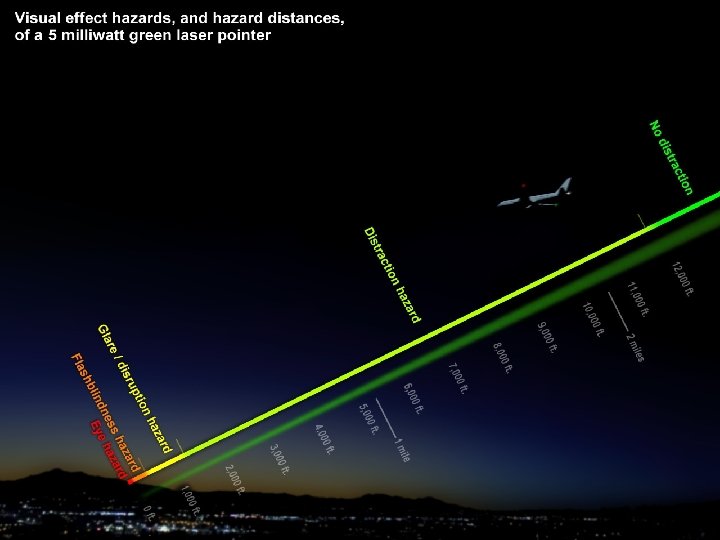 International Laser Display Association
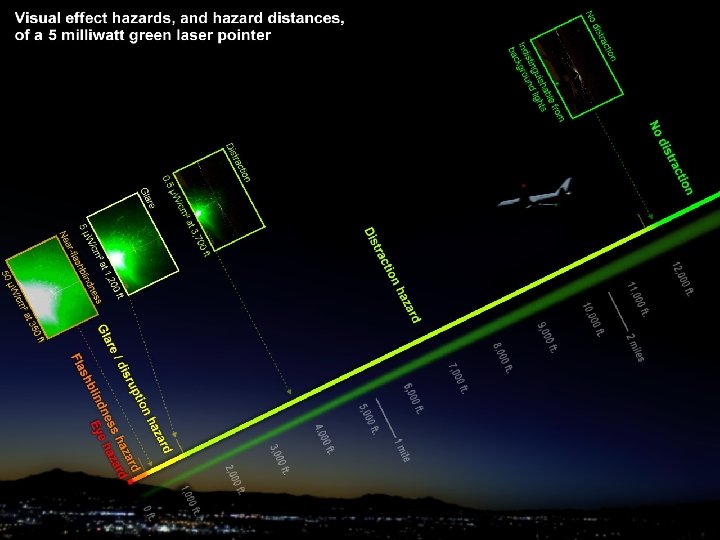 International Laser Display Association
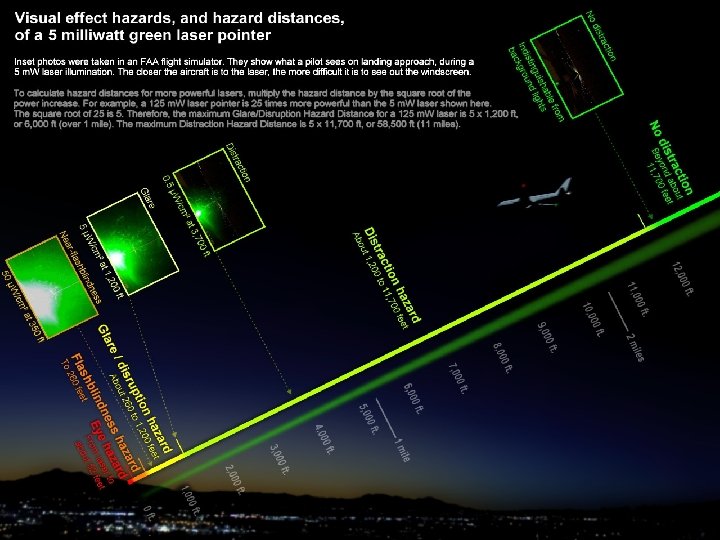 Hazards summary International Laser Display Association
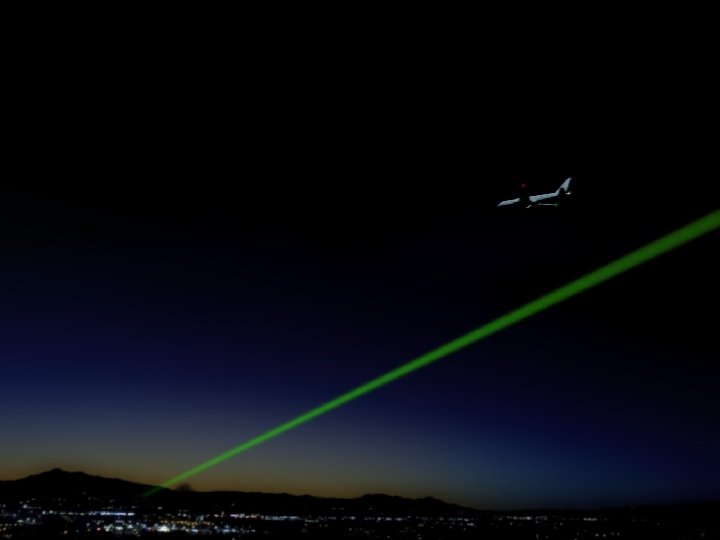
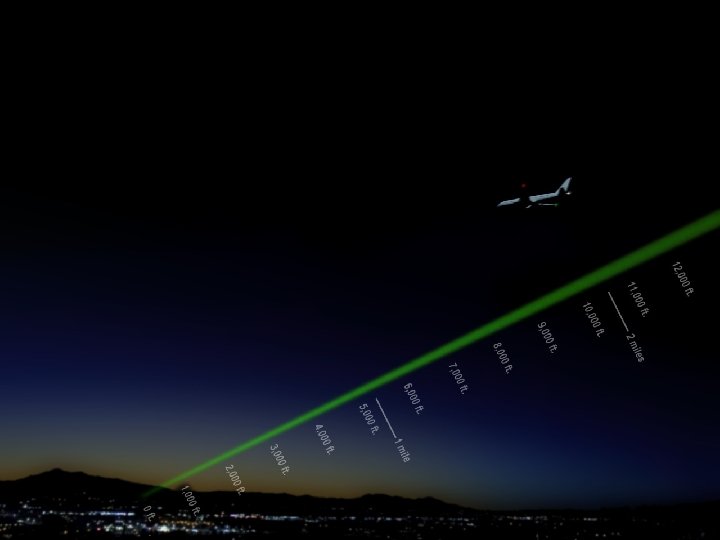
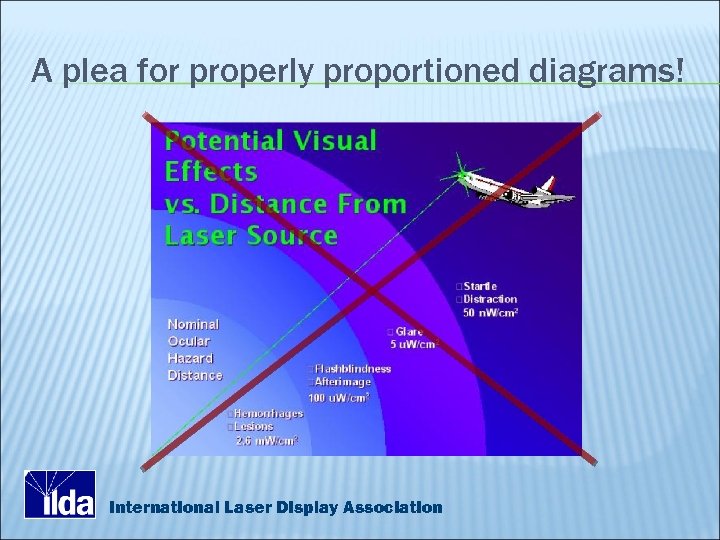 A plea for properly proportioned diagrams! International Laser Display Association
 International Laser Display Association
 International Laser Display Association
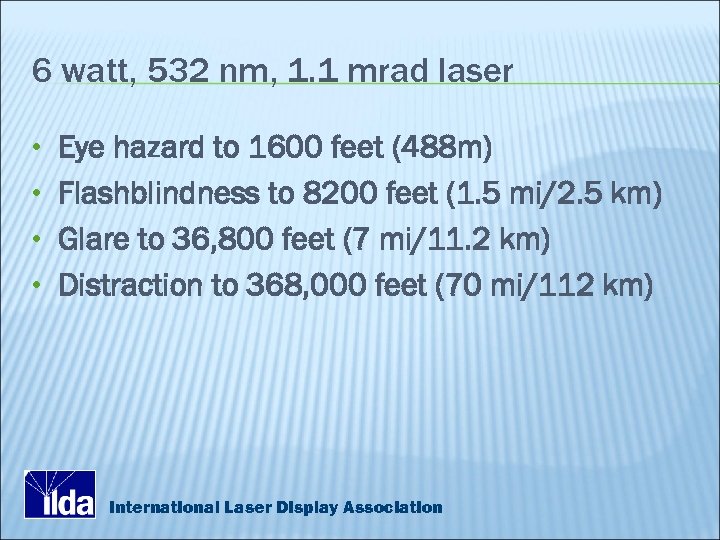 6 watt, 532 nm, 1. 1 mrad laser • Eye hazard to 1600 feet (488 m) • Flashblindness to 8200 feet (1. 5 mi/2. 5 km) • Glare to 36, 800 feet (7 mi/11. 2 km) • Distraction to 368, 000 feet (70 mi/112 km) International Laser Display Association
 What are the factors affecting the hazard level?
 Factors affecting hazard level • Laser factors o Power, divergence, visible/non-visible, wavelength, pulsed vs. CW • Operational factors o Area covered in sky (stationary vs. moving) o Location relative to airports o Terminated vs. non-terminated beams o Use of airspace observers (spotters) o Use of automated detection (radar, cameras) International Laser Display Association
 Factors affecting hazard level (cont. 1) • Situational factors o Day vs. night o Aircraft speed and distance (helicopters at risk) • Laser pointer user factors o Deliberate (longer and more exposures) vs. accidental (short, single event) International Laser Display Association
 Factors affecting hazard level (cont. 2) • Pilot factors o Read NOTAMs o Flight phase (takeoff, landing, emergency) o Pilot experience and training • • Recognizing a laser event Properly responding, to successfully avoid problems International Laser Display Association
 Factors affecting hazard level (cont. 3) • Legal and regulatory o Follow aviation authority procedures • o o FAA, CDRH in US Laws against interference Restrict the sale or use of laser devices • • • May not be practical May give false sense of security Does not guard against deliberate intent International Laser Display Association
 Single most effective way to reduce the hazard?
 Pilot training reduces the hazard • Laser illuminations can be managed with training • Effective against both accidental and deliberate exposures • Not a substitute for regulations and restrictions on law-abiding laser users International Laser Display Association
 Other important ways to reduce the hazard
 Laser sellers and manufacturers • Educate heavy laser pointer users o www. Laser. Pointer. Safety. com o Self-regulation/education by laser pointer sellers • Package inserts • Permanent labels on laser pointers • Laser pointer seller participation in regulatory efforts • Laser pointer seller trade association International Laser Display Association
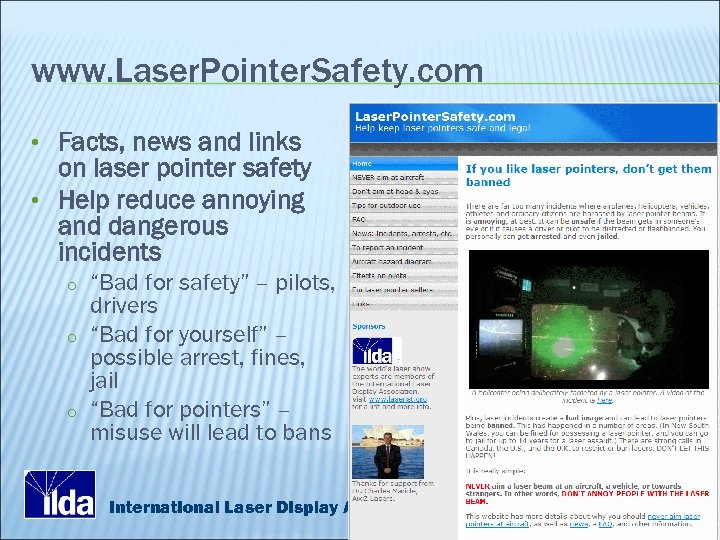 www. Laser. Pointer. Safety. com • Facts, news and links on laser pointer safety • Help reduce annoying and dangerous incidents o o o “Bad for safety” – pilots, drivers “Bad for yourself” – possible arrest, fines, jail “Bad for pointers” – misuse will lead to bans International Laser Display Association
 Regulatory and standards bodies • Require an “Aviation Safety Label” on appropriate lasers o Low cost and easy to implement • o o Labels are already required on lasers Addresses a hazard not on previous labels Provides legal notice to users • Helps establish willful intent International Laser Display Association
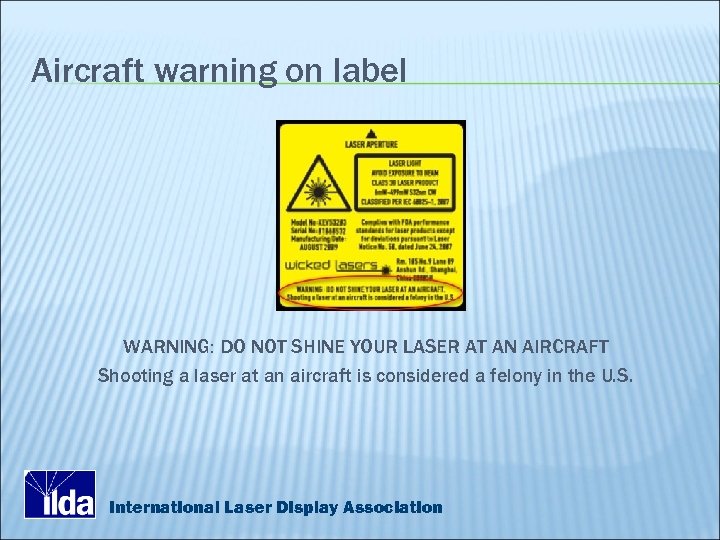 Aircraft warning on label WARNING: DO NOT SHINE YOUR LASER AT AN AIRCRAFT Shooting a laser at an aircraft is considered a felony in the U. S. International Laser Display Association
 ILDA’s Aviation Safety Label proposal • Label required on o Lasers with visible beams o Class 3 and Class 4 o Longest dimension is 15 inches or less: “handheld” International Laser Display Association
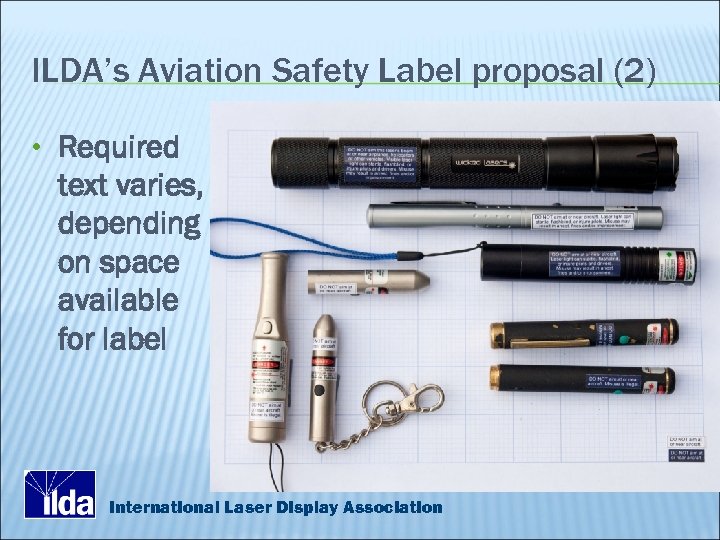 ILDA’s Aviation Safety Label proposal (2) • Required text varies, depending on space available for label International Laser Display Association
 ILDA’s Aviation Safety Label proposal (3) • Details required in User Manual • Label text can vary for special lasers o Laser Rescue Flare • o “DO NOT aim at or near aircraft, except to make your position known in an emergency situation or when a cooperating aircraft is looking for your signal. It is otherwise illegal to aim at aircraft and distract pilots. ” Lasers used by government to notify or aid pilots International Laser Display Association
 ILDA’s Aviation Safety Label proposal (4) • Exemptions: o Lasers larger than “handheld” o High-divergence or diffuse beam • o Visual equivalence formula • • o <5 µW/cm² at all distances beyond 500 feet Takes wavelength into account Equivalent of <5 µW/cm² at 500 feet at 555 nm Diffracted lasers (“star” projectors) International Laser Display Association
 ILDA’s Aviation Safety Label proposal (5) • How to require? o Easiest for CDRH to suggest voluntary “guidance” o ILDA prefers mandated regulation International Laser Display Association
 What regulations must be followed in the U. S. ?
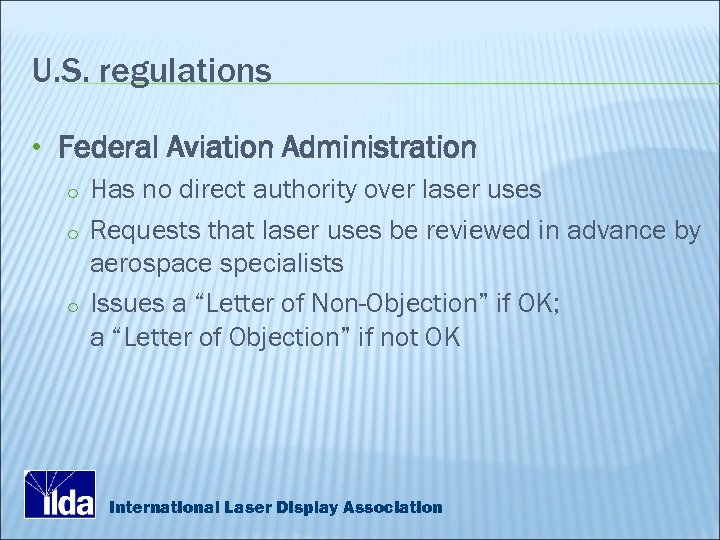 U. S. regulations • Federal Aviation Administration o Has no direct authority over laser uses o Requests that laser uses be reviewed in advance by aerospace specialists o Issues a “Letter of Non-Objection” if OK; a “Letter of Objection” if not OK International Laser Display Association
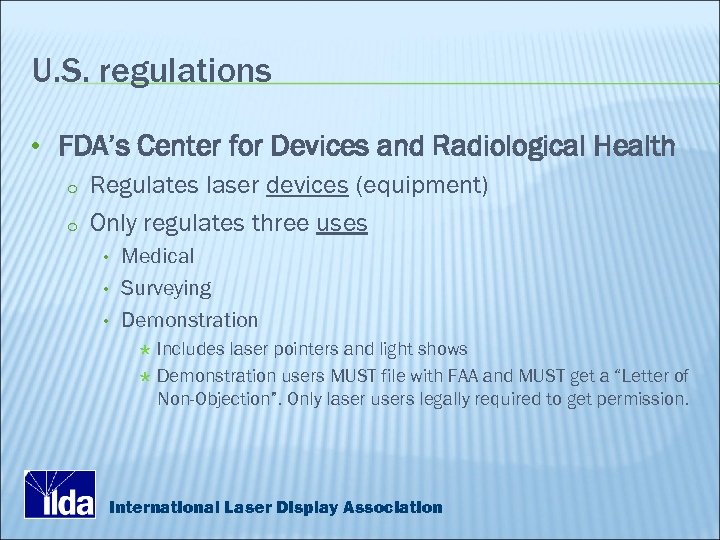 U. S. regulations • FDA’s Center for Devices and Radiological Health o o Regulates laser devices (equipment) Only regulates three uses • • • Medical Surveying Demonstration Includes laser pointers and light shows Demonstration users MUST file with FAA and MUST get a “Letter of Non-Objection”. Only laser users legally required to get permission. International Laser Display Association
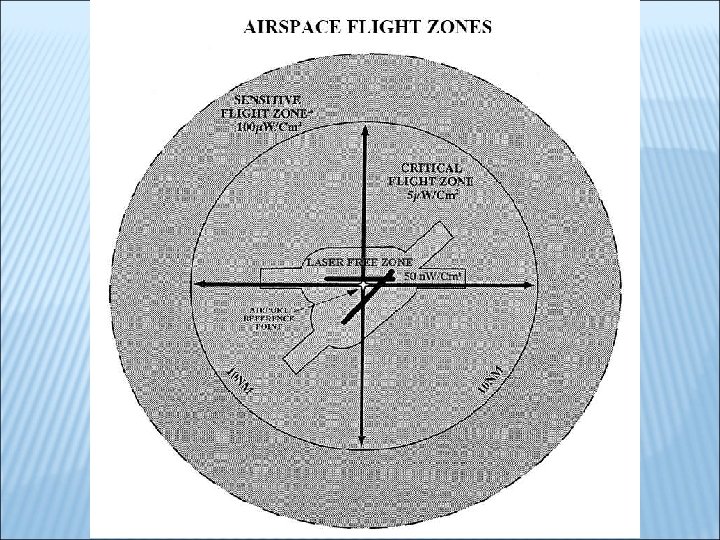
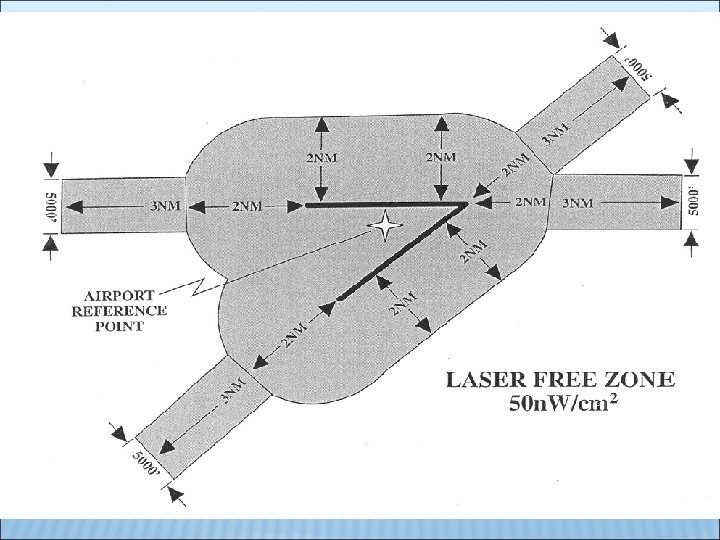
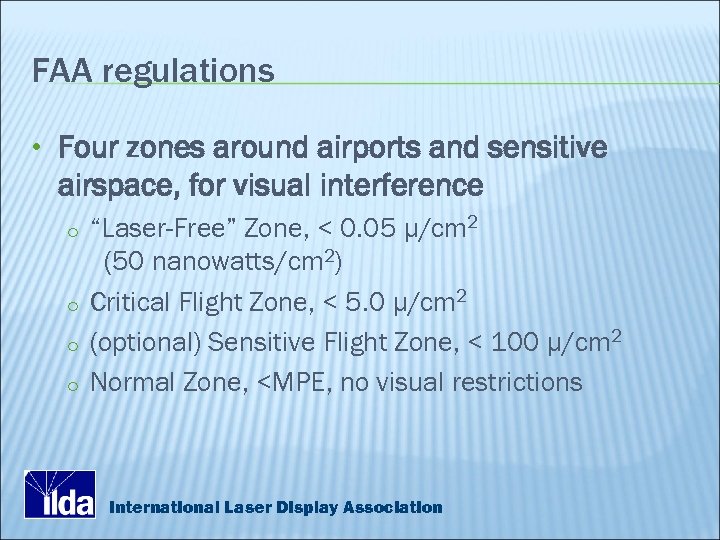 FAA regulations • Four zones around airports and sensitive airspace, for visual interference o o “Laser-Free” Zone, < 0. 05 μ/cm 2 (50 nanowatts/cm 2) Critical Flight Zone, < 5. 0 μ/cm 2 (optional) Sensitive Flight Zone, < 100 μ/cm 2 Normal Zone,
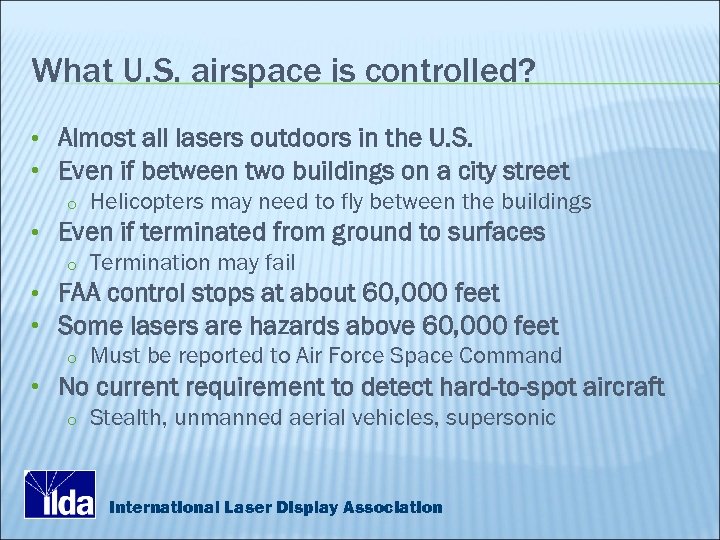 What U. S. airspace is controlled? • Almost all lasers outdoors in the U. S. • Even if between two buildings on a city street o Helicopters may need to fly between the buildings • Even if terminated from ground to surfaces o Termination may fail • FAA control stops at about 60, 000 feet • Some lasers are hazards above 60, 000 feet o Must be reported to Air Force Space Command • No current requirement to detect hard-to-spot aircraft o Stealth, unmanned aerial vehicles, supersonic International Laser Display Association
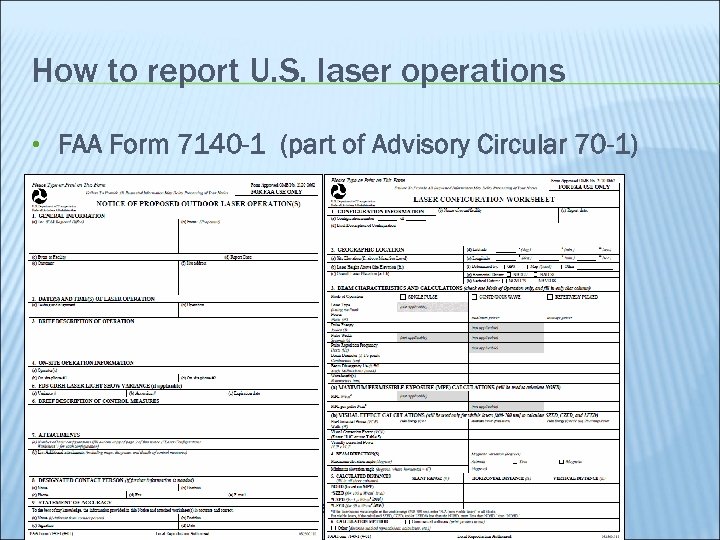 How to report U. S. laser operations • FAA Form 7140 -1 (part of Advisory Circular 70 -1) International Laser Display Association
 Current status
 Standards development • SAE G-10 T Laser Safety Hazards Subcommittee • ANSI Z 136. 6 Standard for Safe Use of Lasers Outdoors • Upcoming ILDA proposal for an Aviation Safety Label International Laser Display Association
 Current status • SAE G-10 T working on guidelines for automated detection and avoidance systems • Prominent laser users (e. g. , observatories) and laser shows follow FAA guidelines • Laser pointers now are the area of primary concern • Some concern over deliberate targeting to cause harm o Difficult to do, not very effective International Laser Display Association
 Resources for background, general public • This paper and its references • www. Laser. Pointer. Safety. com o Links page International Laser Display Association
 Questions

 (Note: Slides after this point are “leftovers” which did not fit into the main presentation, or which had material included in other slides. They are left for future versions which may find the leftover slides useful. )
 Hazard factors: Laser • Laser power • Beam divergence • Visible vs. non-visible (infrared and ultraviolet) • Color o Green can be 2 -10 times more visible than equal power red or blue lasers • Pulsed vs. continuous International Laser Display Association
 Hazard factors: Operational • Beam movement o Stationary: Smaller chance of flying through beam; easier to protect via spotters or automated methods o Moving (laser show): Greater chance of exposure • Location relative to airports and airlanes • Projector and laser stability International Laser Display Association
 Hazard factors: Situational • Day vs. night o Only dusk/night/dawn a problem for visible lasers o More visible lasers operate at night • Motion and speed of the aircraft o Helicopters are at greatest risk due to hovering • Distance to the aircraft o Low-flying planes and helicopters at greatest risk International Laser Display Association
 Hazard factors: Aircrew • Flight phase o Takeoff, approach, landing, emergency maneuvers • Pilot awareness o Prior exposure to laser illumination concepts • Pilot response o Overreaction vs. “fly the plane” International Laser Display Association
 Hazard factors: Laser pointers • Intent o Deliberate targeting • • o Longer exposure May be coordinated with others (Sydney, 2008) Easier to catch (though still not easy) May recur, hit multiple planes and/or multiple nights Accidental targeting • One-time-only accident International Laser Display Association