


 Скачать презентацию Patricia L Hale MD Ph D FACP CMIO
6d7ef2e95269cb5a3ad63d5e0fd44873.ppt
- Количество слайдов: 61
 Patricia L. Hale, MD, Ph. D, FACP CMIO, Glens Falls Hospital and CTO , Adirondack Regional Community Health Information Exchange pathale@pathalemd. com www. pathalemd. com E-PRESCRIBING CURRENT ISSUES AND THE ROAD AHEAD
 E-Prescribing – Current Issues and the Road Ahead Learning Objectives Impact of e-prescribing on patient safety and reduction of medication errors What’s new Explore the training requirements for physicians Explore the implementation differences between a small medical practice and an RHIN
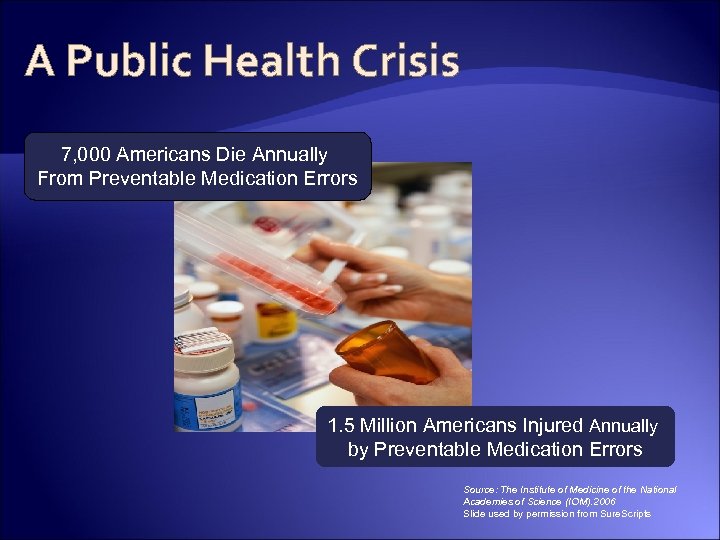 A Public Health Crisis 7, 000 Americans Die Annually From Preventable Medication Errors 1. 5 Million Americans Injured Annually by Preventable Medication Errors Source: The Institute of Medicine of the National Academies of Science (IOM). 2006 Slide used by permission from Sure. Scripts
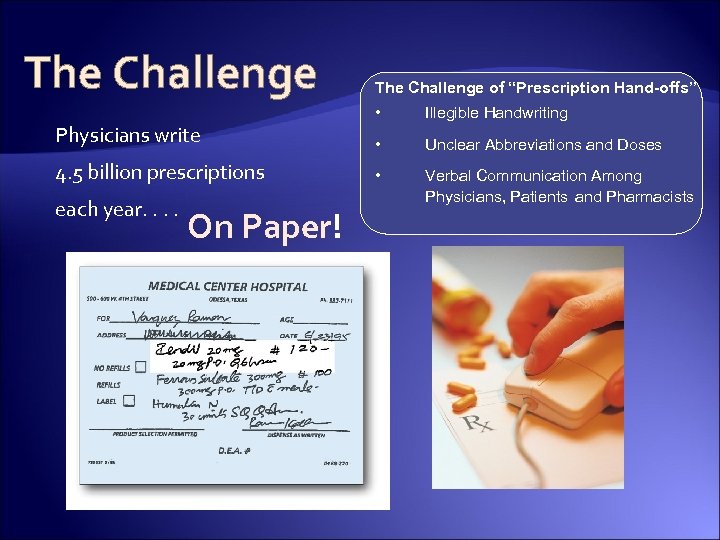 The Challenge Physicians write 4. 5 billion prescriptions each year. . On Paper! The Challenge of “Prescription Hand-offs” • Illegible Handwriting • Unclear Abbreviations and Doses • Verbal Communication Among Physicians, Patients and Pharmacists
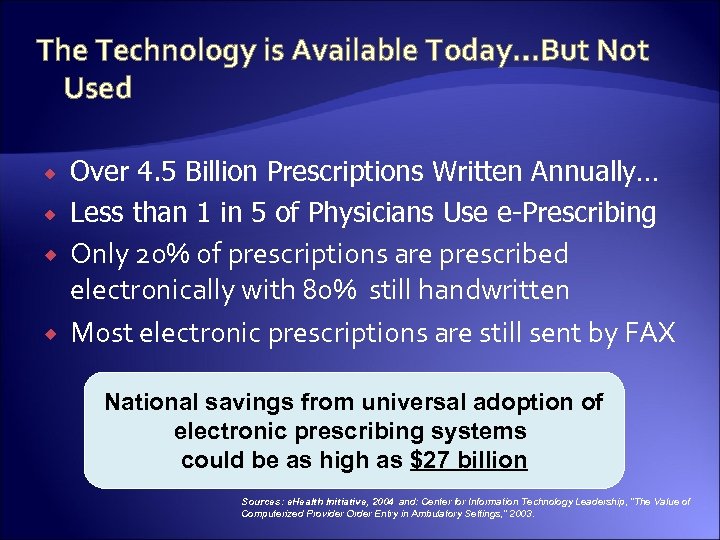 The Technology is Available Today…But Not Used Over 4. 5 Billion Prescriptions Written Annually… Less than 1 in 5 of Physicians Use e-Prescribing Only 20% of prescriptions are prescribed electronically with 80% still handwritten Most electronic prescriptions are still sent by FAX National savings from universal adoption of electronic prescribing systems could be as high as $27 billion Sources: e. Health Initiative, 2004 and: Center for Information Technology Leadership, “The Value of Computerized Provider Order Entry in Ambulatory Settings, ” 2003.
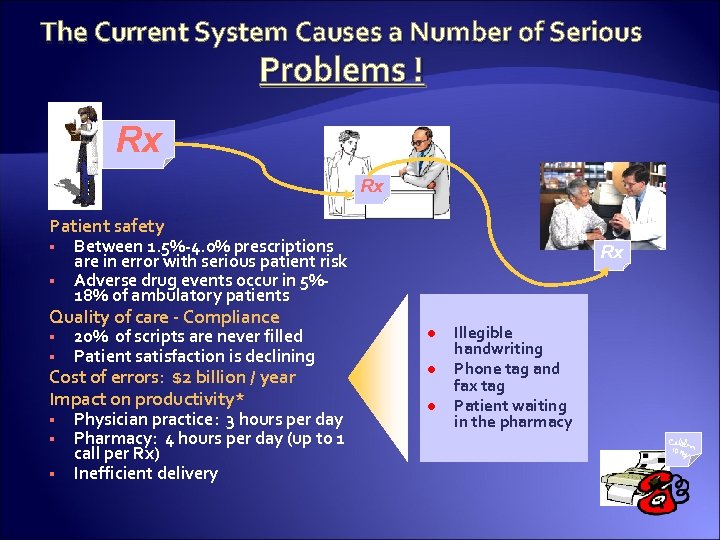 The Current System Causes a Number of Serious Problems ! Rx Rx Patient safety § § Between 1. 5%-4. 0% prescriptions are in error with serious patient risk Adverse drug events occur in 5%18% of ambulatory patients Quality of care - Compliance § § 20% of scripts are never filled Patient satisfaction is declining Cost of errors: $2 billion / year Impact on productivity* § § § Physician practice: 3 hours per day Pharmacy: 4 hours per day (up to 1 call per Rx) Inefficient delivery Rx l l l Illegible handwriting Phone tag and fax tag Patient waiting in the pharmacy
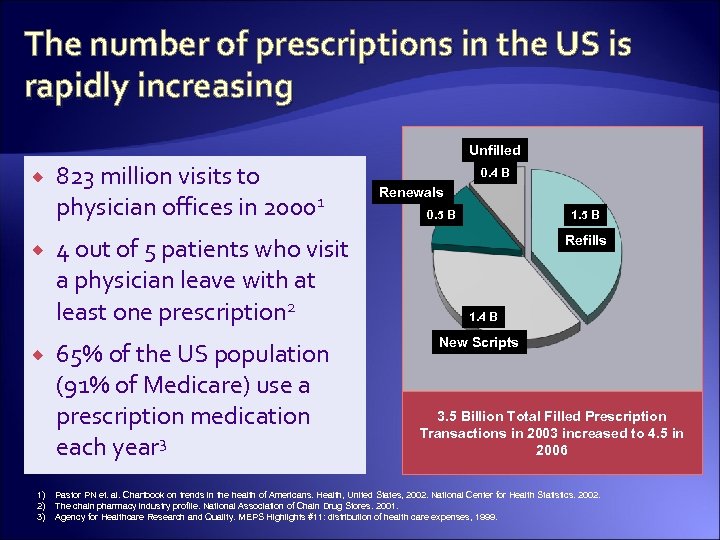 The number of prescriptions in the US is rapidly increasing Unfilled 1) 2) 3) 823 million visits to physician offices in 20001 4 out of 5 patients who visit a physician leave with at least one prescription 2 65% of the US population (91% of Medicare) use a prescription medication each year 3 0. 4 B Renewals 0. 5 B 1. 5 B Refills 1. 4 B New Scripts 3. 5 Billion Total Filled Prescription Transactions in 2003 increased to 4. 5 in 2006 Pastor PN et. al. Chartbook on trends in the health of Americans. Health, United States, 2002. National Center for Health Statistics. 2002. The chain pharmacy industry profile. National Association of Chain Drug Stores. 2001. Agency for Healthcare Research and Quality. MEPS Highlights #11: distribution of health care expenses, 1999.
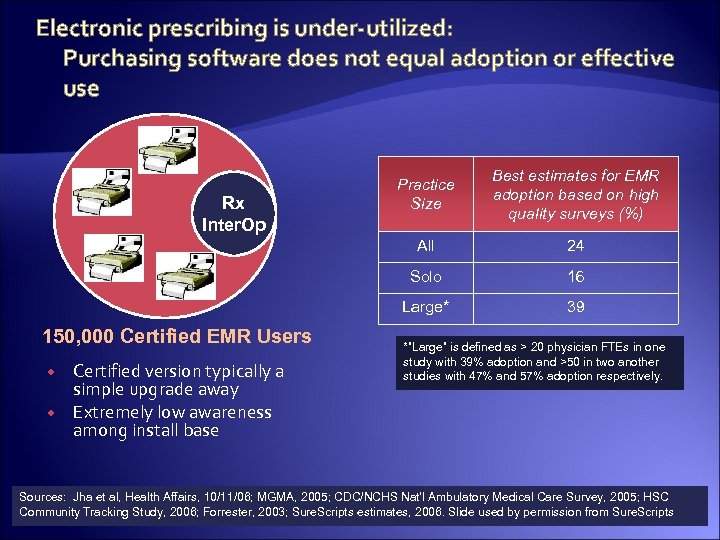 Electronic prescribing is under-utilized: Purchasing software does not equal adoption or effective use Certified version typically a simple upgrade away Extremely low awareness among install base 16 Large* 24 Solo 150, 000 Certified EMR Users Best estimates for EMR adoption based on high quality surveys (%) All Rx Inter. Op Practice Size 39 *”Large” is defined as > 20 physician FTEs in one study with 39% adoption and >50 in two another studies with 47% and 57% adoption respectively. Sources: Jha et al, Health Affairs, 10/11/06; MGMA, 2005; CDC/NCHS Nat’l Ambulatory Medical Care Survey, 2005; HSC Community Tracking Study, 2006; Forrester, 2003; Sure. Scripts estimates, 2006. Slide used by permission from Sure. Scripts
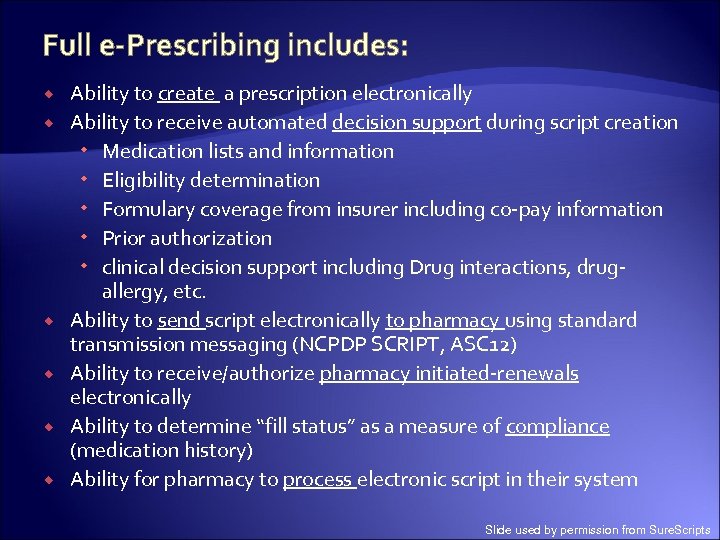 Full e-Prescribing includes: Ability to create a prescription electronically Ability to receive automated decision support during script creation Medication lists and information Eligibility determination Formulary coverage from insurer including co-pay information Prior authorization clinical decision support including Drug interactions, drugallergy, etc. Ability to send script electronically to pharmacy using standard transmission messaging (NCPDP SCRIPT, ASC 12) Ability to receive/authorize pharmacy initiated-renewals electronically Ability to determine “fill status” as a measure of compliance (medication history) Ability for pharmacy to process electronic script in their system Slide used by permission from Sure. Scripts
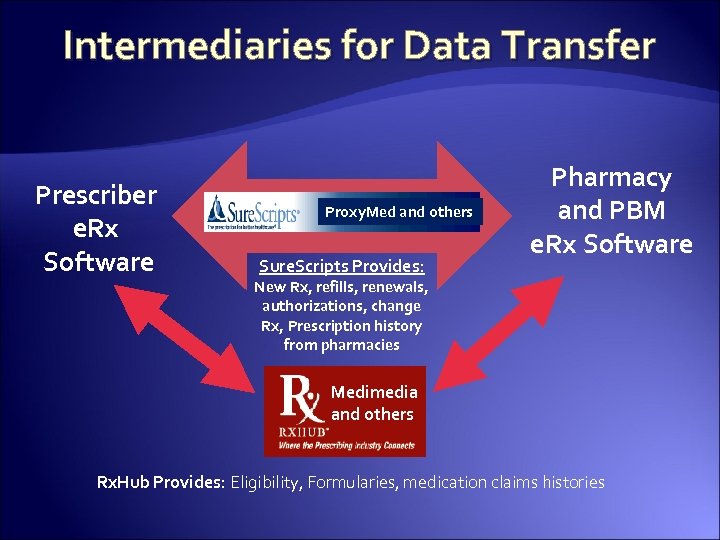 Intermediaries for Data Transfer Prescriber e. Rx Software Proxy. Med and others Sure. Scripts Provides: Pharmacy and PBM e. Rx Software New Rx, refills, renewals, authorizations, change Rx, Prescription history from pharmacies Medimedia and others Rx. Hub Provides: Eligibility, Formularies, medication claims histories
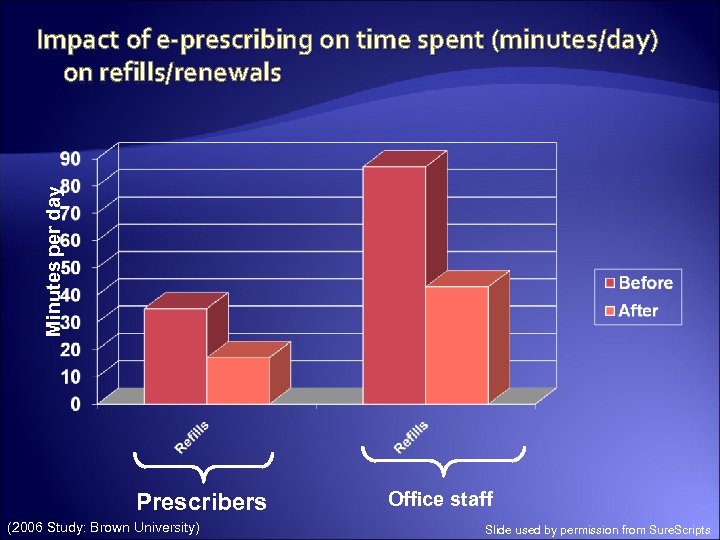 Minutes per day Impact of e-prescribing on time spent (minutes/day) on refills/renewals Prescribers (2006 Study: Brown University) Office staff Slide used by permission from Sure. Scripts
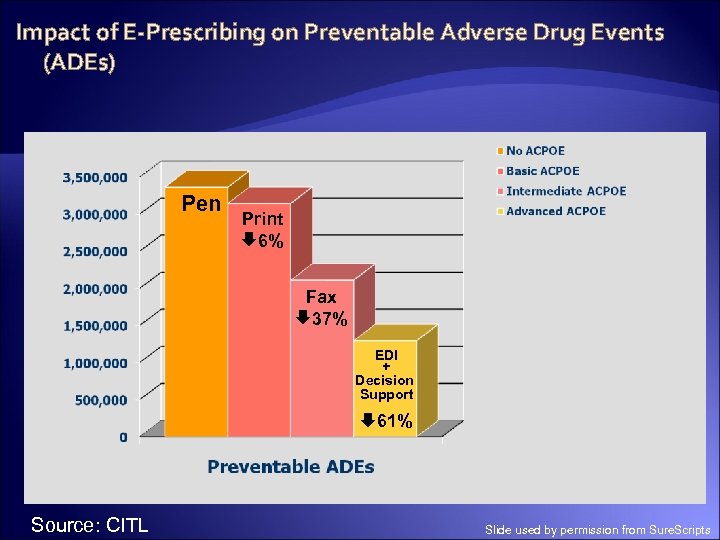 Impact of E-Prescribing on Preventable Adverse Drug Events (ADEs) Pen Print 6% Fax 37% EDI + Decision Support 61% Source: CITL Slide used by permission from Sure. Scripts
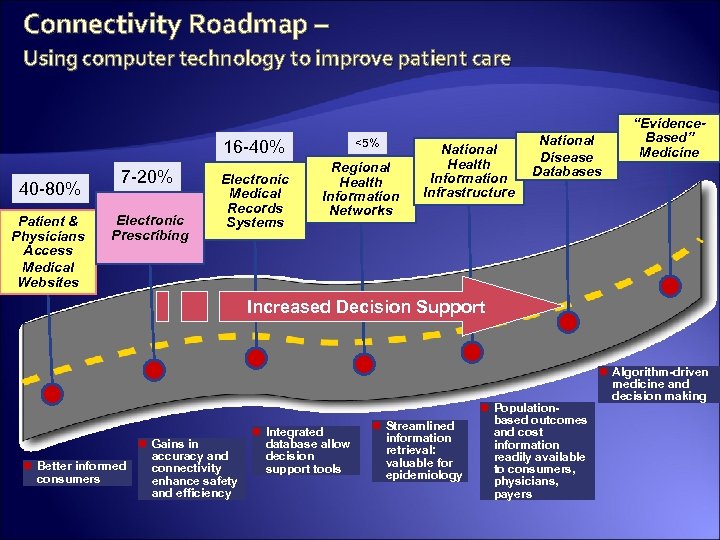 Connectivity Roadmap – Using computer technology to improve patient care <5% 16 -40% 40 -80% Patient & Physicians Access Medical Websites 7 -20% Electronic Prescribing Electronic Medical Records Systems Regional Health Information Networks National Health Information Infrastructure National Disease Databases “Evidence. Based” Medicine Increased Decision Support n Algorithm-driven n Populationn Gains in n Better informed consumers accuracy and connectivity enhance safety and efficiency n Integrated database allow decision support tools n Streamlined information retrieval: valuable for epidemiology based outcomes and cost information readily available to consumers, physicians, payers medicine and decision making
 WHO BENEFITS FROM ERX?
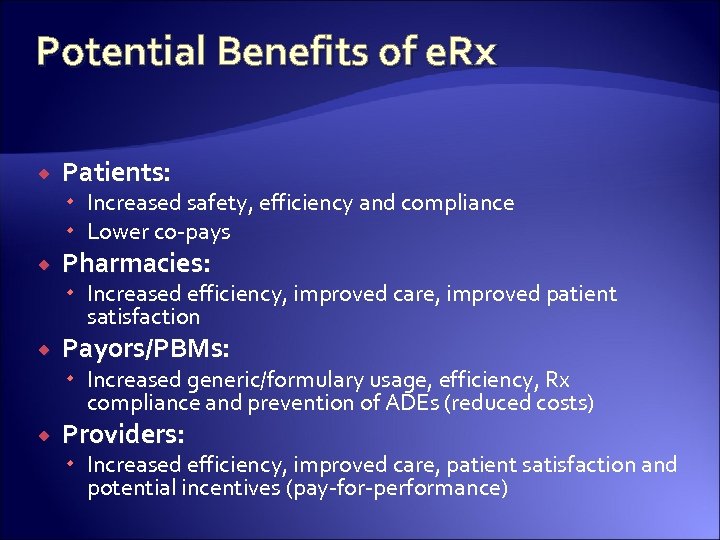 Potential Benefits of e. Rx Patients: Increased safety, efficiency and compliance Lower co-pays Pharmacies: Increased efficiency, improved care, improved patient satisfaction Payors/PBMs: Increased generic/formulary usage, efficiency, Rx compliance and prevention of ADEs (reduced costs) Providers: Increased efficiency, improved care, patient satisfaction and potential incentives (pay-for-performance)
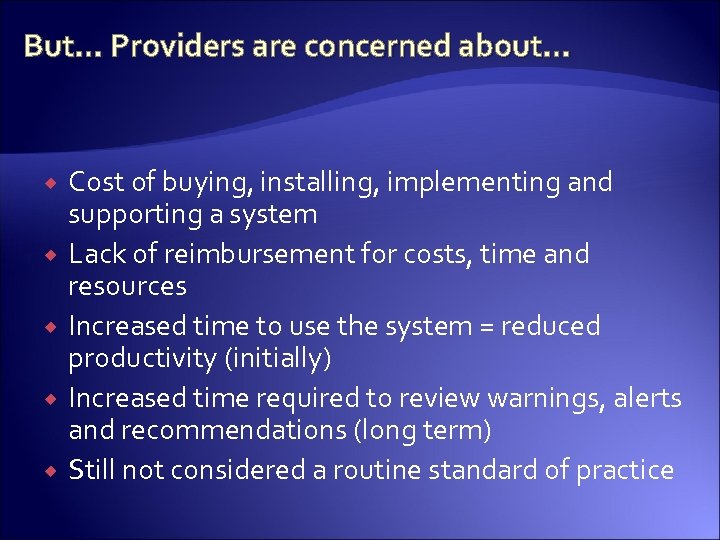 But… Providers are concerned about… Cost of buying, installing, implementing and supporting a system Lack of reimbursement for costs, time and resources Increased time to use the system = reduced productivity (initially) Increased time required to review warnings, alerts and recommendations (long term) Still not considered a routine standard of practice
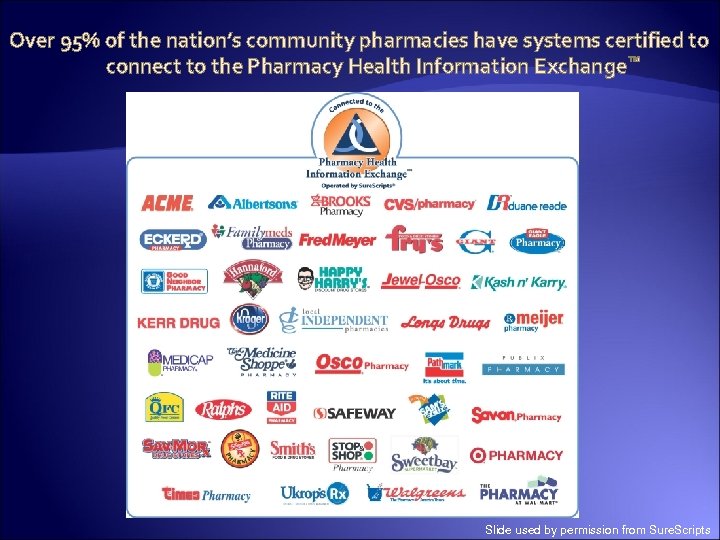
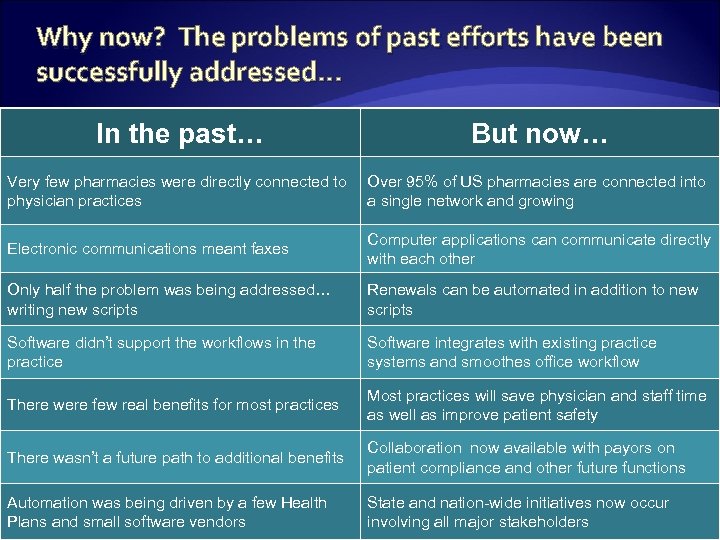 Why now? The problems of past efforts have been successfully addressed… In the past… But now… Very few pharmacies were directly connected to physician practices Over 95% of US pharmacies are connected into a single network and growing Electronic communications meant faxes Computer applications can communicate directly with each other Only half the problem was being addressed… writing new scripts Renewals can be automated in addition to new scripts Software didn’t support the workflows in the practice Software integrates with existing practice systems and smoothes office workflow There were few real benefits for most practices Most practices will save physician and staff time as well as improve patient safety There wasn’t a future path to additional benefits Collaboration now available with payors on patient compliance and other future functions Automation was being driven by a few Health Plans and small software vendors State and nation-wide initiatives now occur involving all major stakeholders
 WHAT INITIATIVES AND INCENTIVES WILL DRIVE FUTURE ADOPTION OF ERX?
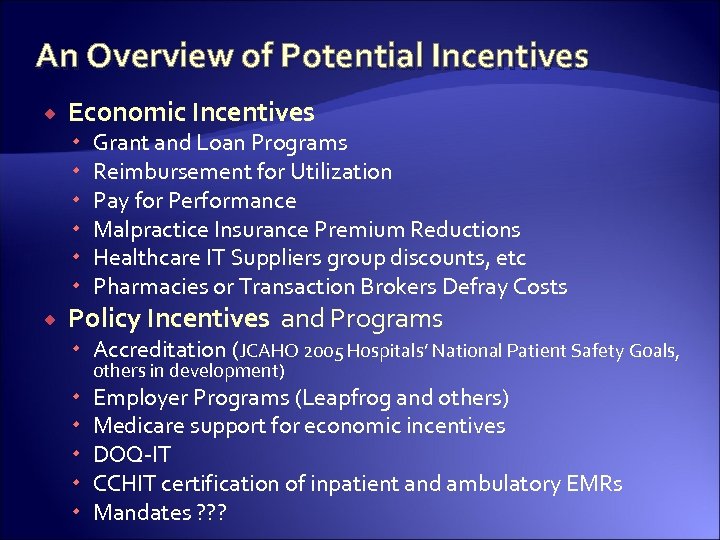 An Overview of Potential Incentives Economic Incentives Grant and Loan Programs Reimbursement for Utilization Pay for Performance Malpractice Insurance Premium Reductions Healthcare IT Suppliers group discounts, etc Pharmacies or Transaction Brokers Defray Costs Policy Incentives and Programs Accreditation (JCAHO 2005 Hospitals’ National Patient Safety Goals, others in development) Employer Programs (Leapfrog and others) Medicare support for economic incentives DOQ-IT CCHIT certification of inpatient and ambulatory EMRs Mandates ? ? ?
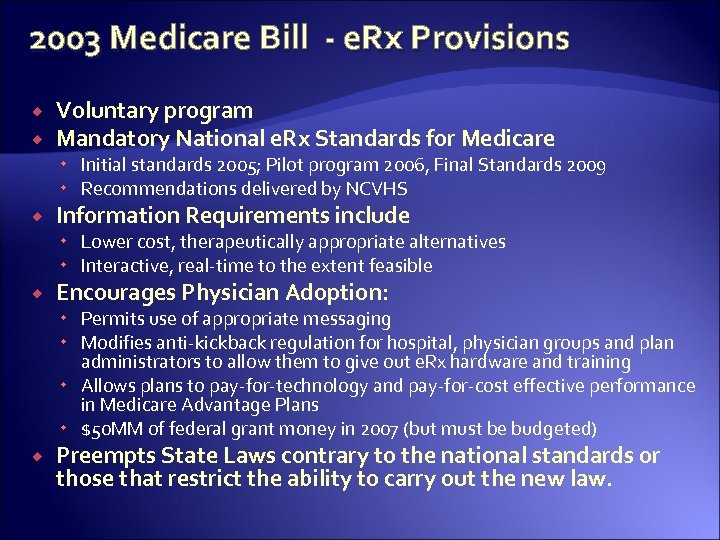 2003 Medicare Bill - e. Rx Provisions Voluntary program Mandatory National e. Rx Standards for Medicare Initial standards 2005; Pilot program 2006, Final Standards 2009 Recommendations delivered by NCVHS Information Requirements include Lower cost, therapeutically appropriate alternatives Interactive, real-time to the extent feasible Encourages Physician Adoption: Permits use of appropriate messaging Modifies anti-kickback regulation for hospital, physician groups and plan administrators to allow them to give out e. Rx hardware and training Allows plans to pay-for-technology and pay-for-cost effective performance in Medicare Advantage Plans $50 MM of federal grant money in 2007 (but must be budgeted) Preempts State Laws contrary to the national standards or those that restrict the ability to carry out the new law.
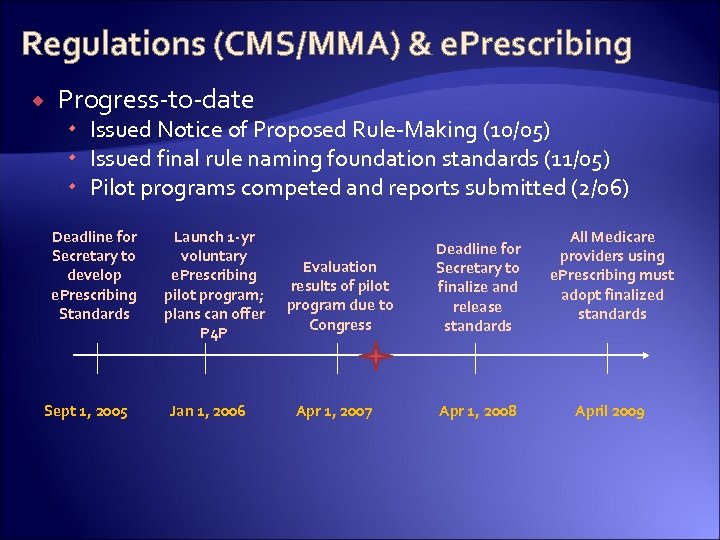 Regulations (CMS/MMA) & e. Prescribing Progress-to-date Issued Notice of Proposed Rule-Making (10/05) Issued final rule naming foundation standards (11/05) Pilot programs competed and reports submitted (2/06) Deadline for Secretary to develop e. Prescribing Standards Sept 1, 2005 Launch 1 -yr voluntary e. Prescribing pilot program; plans can offer P 4 P Jan 1, 2006 Evaluation results of pilot program due to Congress Apr 1, 2007 Deadline for Secretary to finalize and release standards Apr 1, 2008 All Medicare providers using e. Prescribing must adopt finalized standards April 2009
 WHAT’S NEW?
 INTERIM RESULTS FROM CMS E-PRESCRIBING PILOTS
 e-Prescribing Pilot Participants RAND – New Jersey BCBS NJ, Caremark mail order, Walgreen retail pharmacy Brigham & Women’s Hospital - Care. Group Health system in Boston use in EMR and e-prescribing “Gateway” utility Achieve – tech vendor for long term care industry in Midwest with it’s own pharmacies Ohio University Hospital Health System and Ohio Ke. PRO QIO - 300 hospital physician practices Surescripts - with practices in Florida, Mass, Nevada, New Jersey and Tennessee with a variety of software vendor systems and assortment of chain and independent pharmacies
 Interim Results Med History – recommended to be included as ready for adoption. Main challenge is ensuring the data is collected and reconciled from a large number of sources to be sure history is complete. Formulary and Benefits – recommended to be included as ready for adoption. Issues: Systems must adequately match patient to health plan Payers vary in the level of information provided making data difficult to interpret Should support real-time changes in patient status as patient moves between benefit plans
 Interim Results Prescription Fill Status Notification – recommended to be included as ready for adoption. However many pharmacies do not currently have the ability to track patient pick-up status accurately and questionable prescriber demand for this if the info is already available in the med history. Prior Authorization – NOT recommended for implementation – Limited experience at pilot sites to evaluate this function and there are work flow and other issues which suggest a need to have more work done to improve the standard. Structured and Codified Sig - NOT recommended for implementation – needs additional work with reference to field definitions and examples as well as naming conventions and clarification of field use.
 Interim Results Rx. Norm – (standard for name, dose and form of drugs) – Not recommended for implementation – Dictionary standard requires further evaluation and refinement. Recommended updates to SCRIPT v 8. 1 – Need to further refine the standard to be able to: update prescriptions without having to create a new order, send a refill from the facility to the pharmacy without physician intervention, update patient information outside the context of prescriptions
 Interim Results Prescriber staff (“surrogate prescribers”) played a much more important role in the process than anticipated. Never fully replaces need for paper-based prescribing Causes a shift in pharmacy work flow Poor adoption and use of medication history Long term care site reported a reduction in new prescription rate which may indicate reduction in accumulation of multiple medication Not enough data yet on effects on safety or change in use of generic medications.
 NEW AND EXPANDED PROGRAMS TO PROMOTE ELECTRONIC PRESCRIBING
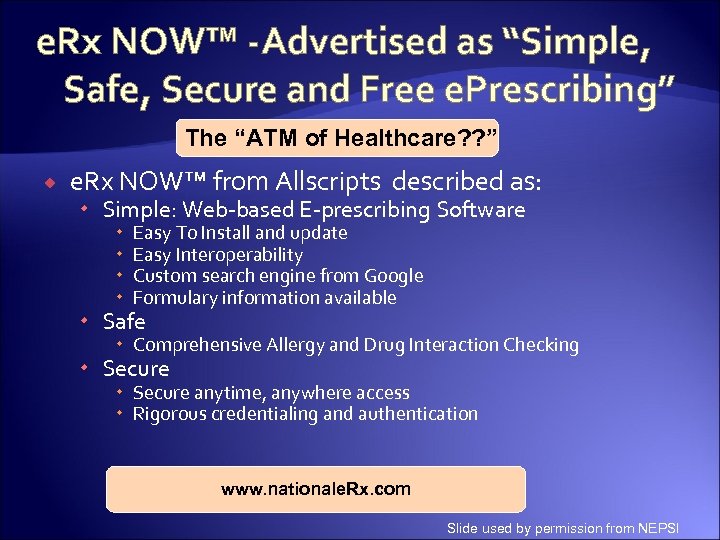
 New Efforts to Increase e. Rx Adoption The National e. Prescribing Patient Safety Initiative (NEPSI) A Coalition of the Nation’s Most Prominent Technology Companies, Healthcare Benefit And Medical Provider Organizations “Dedicated to improving patient safety by providing free electronic prescribing for every physician in America” Slide used by permission from NEPSI
 NEPSI Coalition Sponsors National Sponsors Technology Sponsors Health Benefit Sponsors Search Sponsor Connectivity Sponsors
 e. Rx NOW™ -Advertised as “Simple, Safe, Secure and Free e. Prescribing” The “ATM of Healthcare? ? ” e. Rx NOW™ from Allscripts described as: Simple: Web-based E-prescribing Software Easy To Install and update Easy Interoperability Custom search engine from Google Formulary information available Safe Comprehensive Allergy and Drug Interaction Checking Secure anytime, anywhere access Rigorous credentialing and authentication www. nationale. Rx. com Slide used by permission from NEPSI
 SURESCRIPTS NETWORK
 Over 95% of the nation’s community pharmacies have systems certified to connect to the Pharmacy Health Information Exchange™ Slide used by permission from Sure. Scripts
 All major physician technology vendors in the United States are certified on the Pharmacy Health Information Exchange™ Slide used by permission from Sure. Scripts
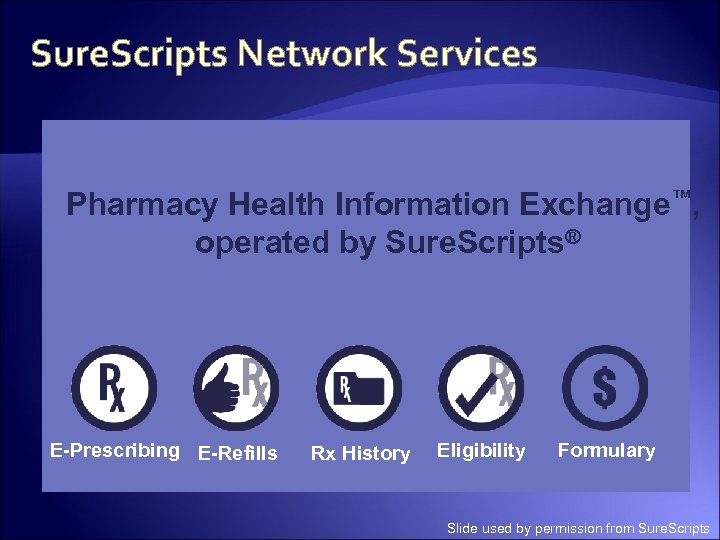 Sure. Scripts Network Services Pharmacy Health Information Exchange™, operated by Sure. Scripts® E-Prescribing E-Refills Rx History Eligibility Formulary Slide used by permission from Sure. Scripts
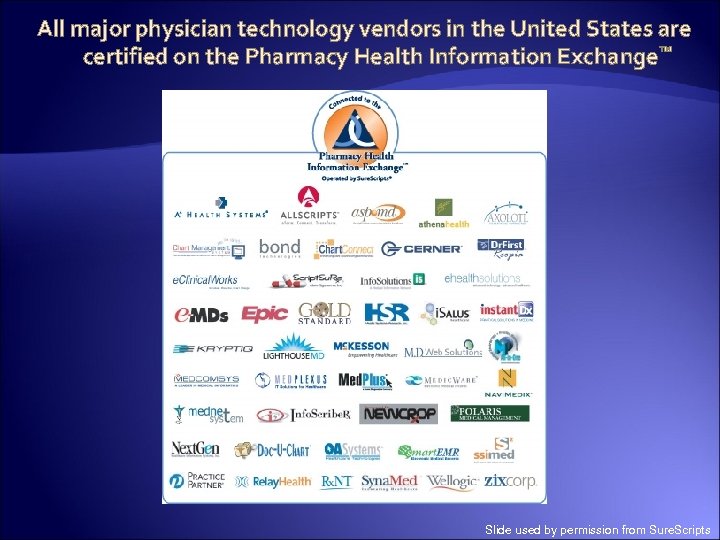
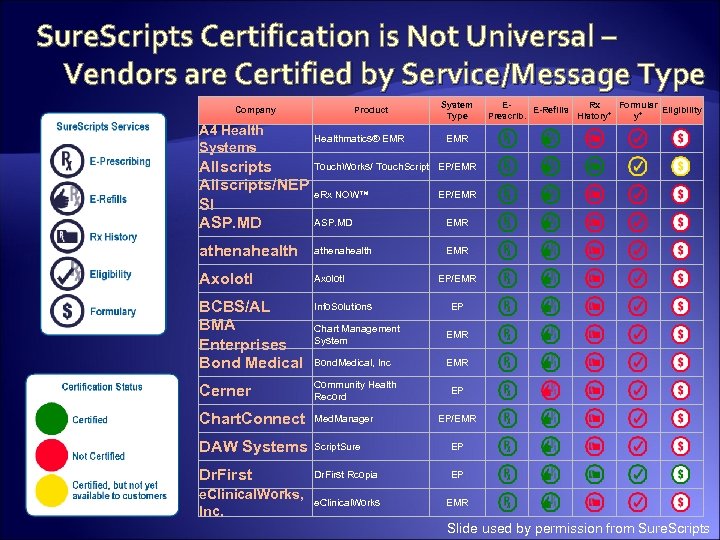 Sure. Scripts Certification is Not Universal – Vendors are Certified by Service/Message Type Company A 4 Health Systems Product Healthmatics® EMR Touch. Works/ Touch. Script Allscripts/NEP e. Rx NOW™ SI ASP. MD System Type ERx Formular E-Refills Eligibility Prescrib. History* y* EMR EP/EMR athenahealth Axolotl BCBS/AL BMA Enterprises Bond Medical Info. Solutions Cerner Community Health Record Chart. Connect Med. Manager DAW Systems Script. Sure EP Dr. First Rcopia EP e. Clinical. Works, Inc. e. Clinical. Works EMR EP/EMR EP Chart Management System EMR Bond. Medical, Inc EMR EP EP/EMR Slide used by permission from Sure. Scripts
 “Granting physician software and service providers a uniform certification for pharmacy interoperability is no longer adequate” Gold. Rx certification status No longer based on just compliance to standards Identifies which vendors are not just testing and marketing interoperability but are truly delivering and committed to: Customer Education Proven Pharmacy Interoperability Advanced Medication Management Workflow Enhancements & Demonstrable Expert Experience with Electronic Prescribing Process Slide used by permission from Sure. Scripts
 “Granting physician software and service providers a uniform certification for pharmacy interoperability is no longer adequate” The first products to achieve Gold. Rx certification announced in Feb 2007: Touch. Works EHR(Allscripts) Chart. Connect EMR Rcopia (Dr. First) Next. Gen EMR e. Script (Relay. Health) Pocketscript (Zix) Slide used by permission from Sure. Scripts
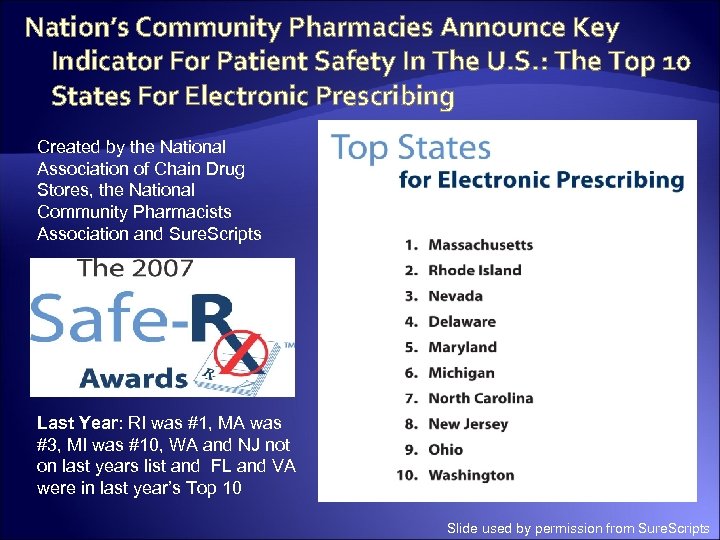 Nation’s Community Pharmacies Announce Key Indicator For Patient Safety In The U. S. : The Top 10 States For Electronic Prescribing Created by the National Association of Chain Drug Stores, the National Community Pharmacists Association and Sure. Scripts Last Year: RI was #1, MA was #3, MI was #10, WA and NJ not on last years list and FL and VA were in last year’s Top 10 Slide used by permission from Sure. Scripts
 Certification Commission for Health Information Technology (CCHIT) CERTIFICATION BY CCHIT
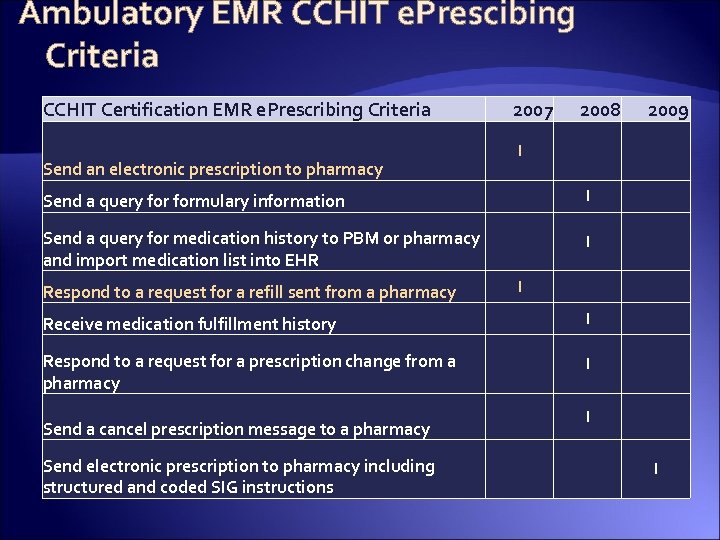 Ambulatory EMR CCHIT e. Prescibing Criteria CCHIT Certification EMR e. Prescribing Criteria Send an electronic prescription to pharmacy 2007 2008 2009 l Send a query formulary information l Send a query for medication history to PBM or pharmacy and import medication list into EHR l Respond to a request for a refill sent from a pharmacy l Receive medication fulfillment history l Respond to a request for a prescription change from a pharmacy l Send a cancel prescription message to a pharmacy Send electronic prescription to pharmacy including structured and coded SIG instructions l l
 MEDICATION HISTORY
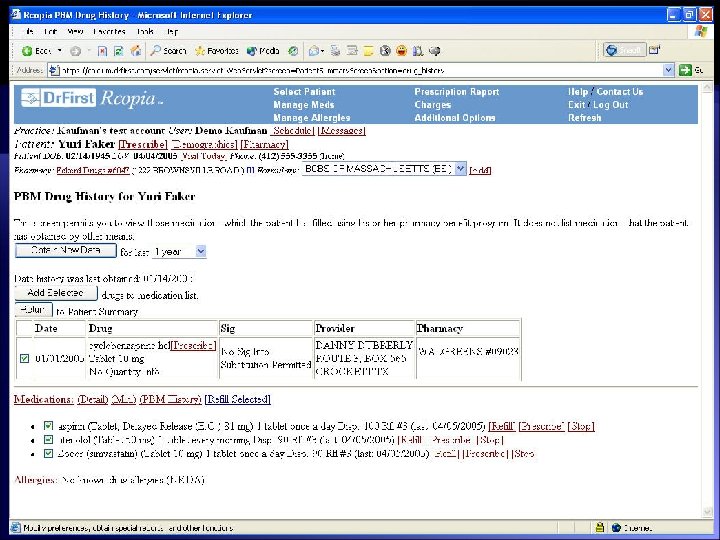
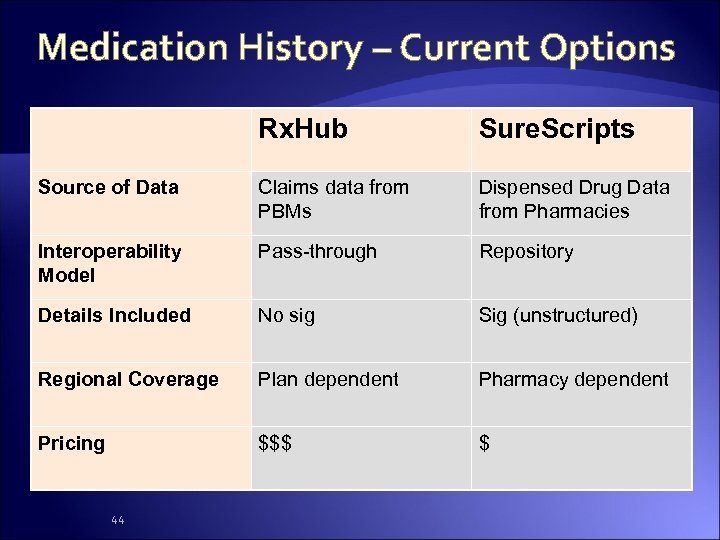 Medication History – Current Options Rx. Hub Sure. Scripts Source of Data Claims data from PBMs Dispensed Drug Data from Pharmacies Interoperability Model Pass-through Repository Details Included No sig Sig (unstructured) Regional Coverage Plan dependent Pharmacy dependent Pricing $$$ $ 44
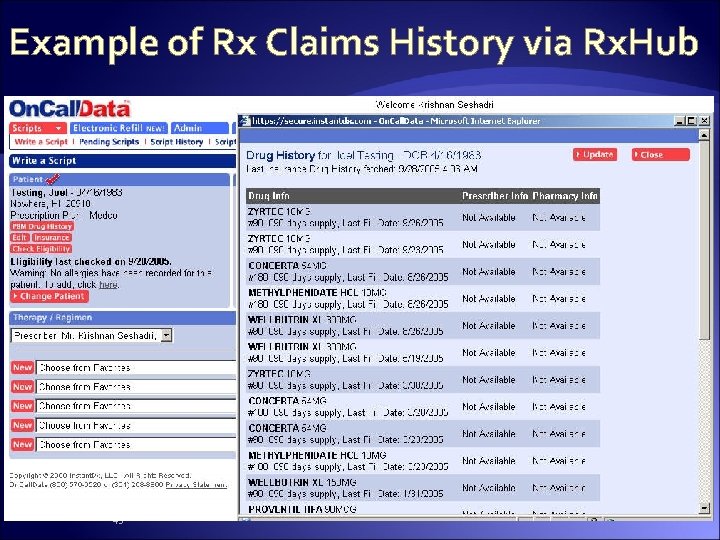 Example of Rx Claims History via Rx. Hub 45
 46
46
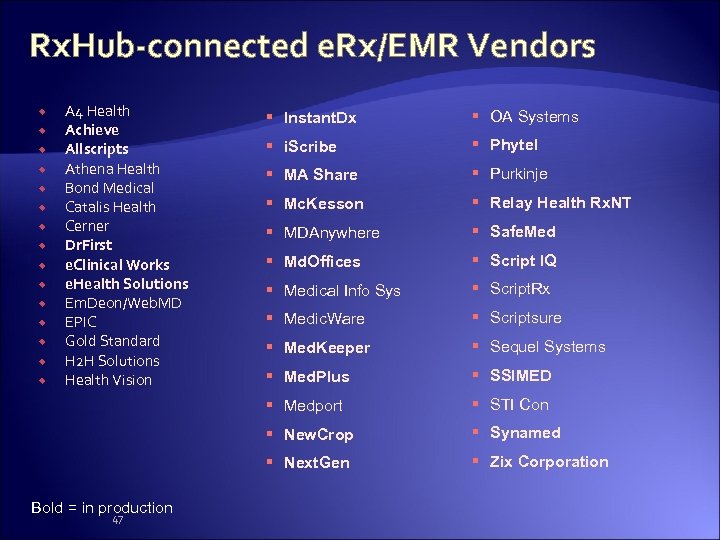 Rx. Hub-connected e. Rx/EMR Vendors A 4 Health Achieve Allscripts Athena Health Bond Medical Catalis Health Cerner Dr. First e. Clinical Works e. Health Solutions Em. Deon/Web. MD EPIC Gold Standard H 2 H Solutions Health Vision Bold = in production 47 § i. Scribe § Phytel § MA Share § Purkinje § Mc. Kesson § Relay Health Rx. NT § MDAnywhere § Safe. Med § Md. Offices § Script IQ § Medical Info Sys § Script. Rx § Medic. Ware § Scriptsure § Med. Keeper § Sequel Systems § Med. Plus § SSIMED § STI Con § Synamed § Next. Gen § OA Systems § New. Crop § Instant. Dx § Medport § Zix Corporation
 Health care professionals can register for an ICERx. org account at www. icerx. org or call 1. 888. ICERX. 50 (888 -423 -7950). ICERX. ORG
 ICERx. org During periods of emergency, licensed health care professionals who have registered on ICERx. org can login to the online prescription database, where they will have access to: Evacuee prescription history information and the name of the provider who wrote the prescription and the pharmacy that filled it Available patient clinical alerts, including drug interaction, therapeutic duplication and elderly alerts Clinical pharmacology drug reference information, including drug monographs, interaction reports and the drug identifier tool
 EVIDENCE OF INCREASED ADOPTION
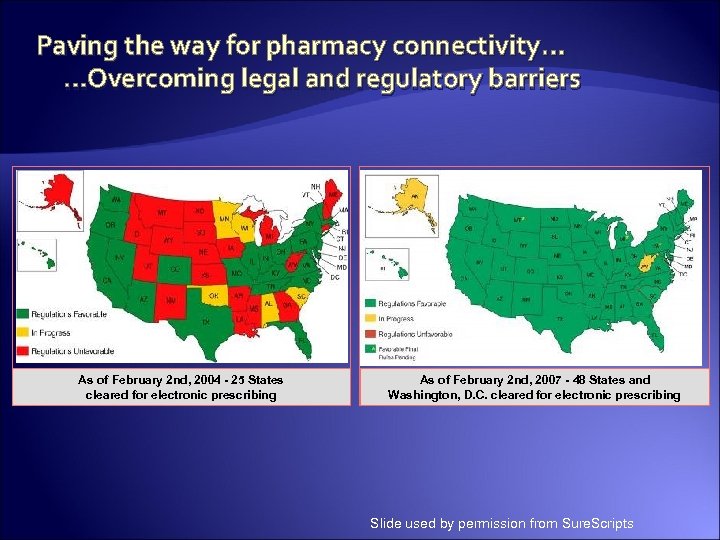 Paving the way for pharmacy connectivity… …Overcoming legal and regulatory barriers As of February 2 nd, 2004 - 25 States cleared for electronic prescribing As of February 2 nd, 2007 - 48 States and Washington, D. C. cleared for electronic prescribing Slide used by permission from Sure. Scripts
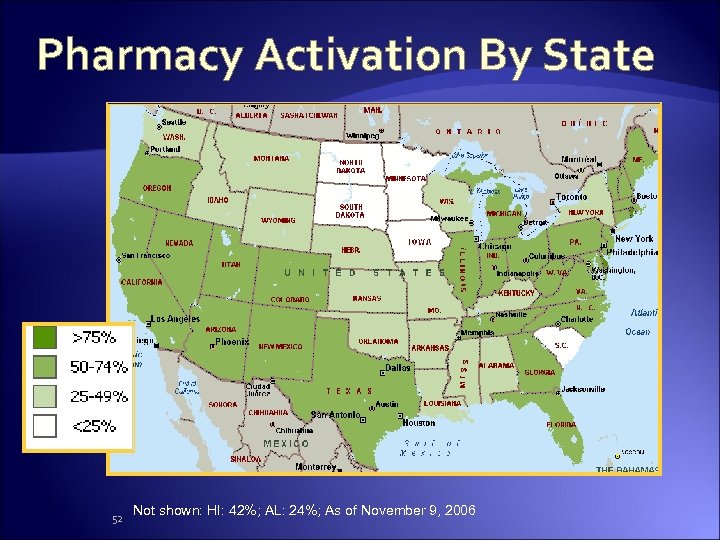 Pharmacy Activation By State 52 Not shown: HI: 42%; AL: 24%; As of November 9, 2006
 Rx. Hub Adoption Data Access to more than 160 million patient prescription information records via payers and PBMs, through the growing list of Rx. Hub certified technology partners. Direct contracts with payers and PBMs represent additional access to more than 50 million patients. An increase in transaction volumes of 50% from 29 million transactions in 2005 to more than 43 million transactions in 2006. These transactions were real-time requests for patient eligibility and benefits, formulary, and medication history information, made at the point-of-care in the ambulatory and acute care settings from clinicians across the United States. A ten-fold increase in true electronic prescriptions, which includes the transmission of patient-specific clinical decision support information at the point of prescribing, to retail and mail order pharmacy locations of the patient’s choice.
 TRAINING REQUIREMENTS FOR PHYSICIANS
 Training Requirements for Physicians No two medical practices are alike – evaluation of current processes is critical in determining best product and implementation plan Physicians learn by apprentice model – be sure there is a physician champion Evaluate requirements for physician training early and plan schedules to accommodate decreased productivity Workflow is a critical factor in success
 Training Requirements for Physicians Staff roll in the prescribing process is a major influence on potential success and usually underestimated Time for training and implementation should be maximized (consider vendor recommendations as a MINIMUM)
 Differences in Implementation in a Small Practice or a RHIN When implementation of electronic prescribing is through a regional health information network new issues arise which include: Management of shared medication lists Management of shared problems lists Opportunity for aggregated medication history data Increased concerns about secondary use of prescriber data
 Why Is Now the Right Time to e. Prescribe? More options for stand alone, certified EMR and information network based electronic prescribing products Increased connectivity of pharmacies and PBMs Increased functionality to improve office efficiency (electronic refills) Support for implementation through programs like DOQ-IT and others Grant, P 4 P and other funding opportunities New educational material and resources are available
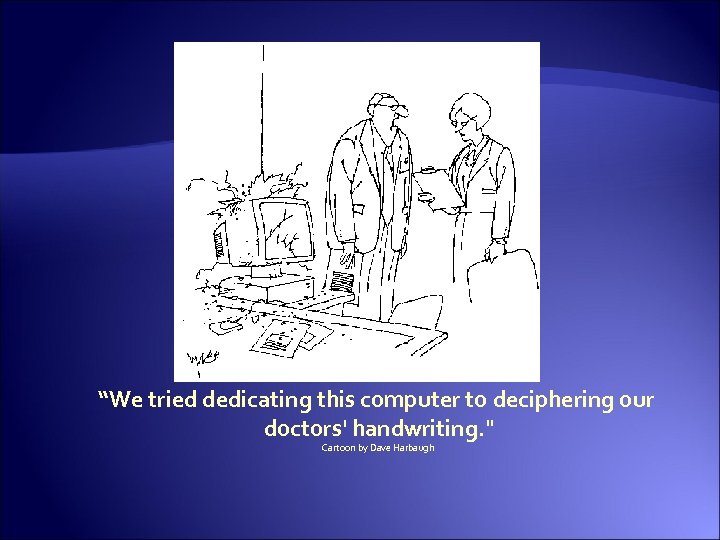 “We tried dedicating this computer to deciphering our doctors' handwriting. " Cartoon by Dave Harbaugh
 QUESTIONS? Contact me at: pathale@pathalemd. com Web site with further information and links: www. pathalemd. com