


 Скачать презентацию Patient Centered Medical Home- what it can do
730d11c8cbccf20084a54426bfce2cd4.ppt
- Количество слайдов: 52
 Patient Centered Medical Home- what it can do for you and your patients! Jennifer K. Phillips MD Associate Professor UNM FCM NMAFP Ruidoso 7/18/2015
 What we want to accomplish today History Key concepts Data Change Management Our Vision Team formation Ease of practice Pre-visit Information Planning Visits Managing registries Final Thoughts
 Origins of the Medical Home 1967 • American Academy of Pediatrics • Enhance the care of children with special needs Community Oriented Primary Care • Plan ahead for the needs of the population served • Partner with the community and family Chronic Care Model • Enable patients • Proactive rather than reactive care Tollman, Soc Sci Med, 1991; Longlett, J Am Bd Fam Pract, 2001; Wagner 3
 Joint Principles PCMH • • Personal physician relationship based care Physician directed medical practice Whole person orientation Care is coordinated and integrated Quality and safety Enhanced access Payment AAFP, AAP, ACP, AOA: March 2007
 Key concepts § PCMH was developed by primary care providers to encourage comprehensive health care, improve patient outcomes, and lower medical costs. § Patients in states with a greater number of primary care providers have better health outcomes. § The PCMH model emphasizes functional multidisciplinary teams that partner with patients as advisors. § Community connections and health care navigators can play an important role in the multidisciplinary team. § Evidence-based medicine guides clinical decision making. § Outcomes are measured and quality and safety are our goals.
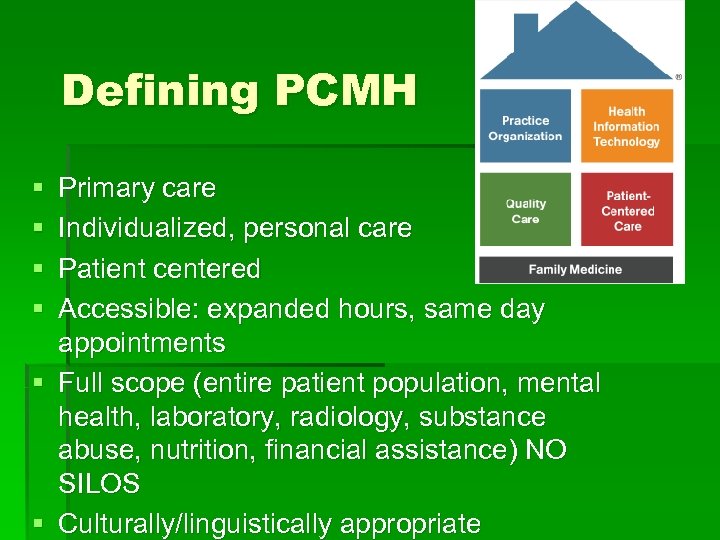 Defining PCMH § § Primary care Individualized, personal care Patient centered Accessible: expanded hours, same day appointments § Full scope (entire patient population, mental health, laboratory, radiology, substance abuse, nutrition, financial assistance) NO SILOS § Culturally/linguistically appropriate
 NCQA requirements for PCMH § Written standards for patient access and patient communication § Use of data to show standards for patient access and communication are met § Use of paper or electronic charting tools to organize clinical information § Use of data to identify important diagnoses and conditions in practice § Adoption and implementation of evidence-based guidelines for three chronic conditions § Active patient self-management support § Systematic tracking of test results and identification of abnormal results § Referral tracking, using a paper or electronic system § Clinical and or service performance measurement, by physician or across the practice § Performance reporting, by physician or across the practice
 Practice Organization: § Establish team, define goals, follow and monitor progress § Staffing-team based care, define roles and responsibilities § Train staff on team based care § Risk-stratified care management
 Quality Care § Transition of care team § Performance measures to evaluate and improve care transitions § Build community relationships § EHR-population health management
 Patient-Centered Care § § § Same day appointments Extended hours Self management: support and education, Patient care action plans, home monitoring, Motivational Interviewing § Communication with patients through email, web portal § Shared decision making, health coach
 LESSONS: 1. Team approach is critical-every team member performing at the “top of their license” • Providers-providing evidence based medical care, medical reconciliation, multiple methods of communication/follow up • Medical Assistants-giving vaccines, checking on health maintenance, providing health maintenance, following up on referrals, tests • Nurses-following up for coordination of care (ER visit, hospitalization, specialist), providing education • Warm handoff to counselors, nutrition, other health professionals
 2. Community Health workers are vitalprovide trust in organization, education, community ties, help with language/cultural barriers 3. Process-like a QI project-define problem, select goals and how to change it, implement as team and then study outcome
 CHALLENGES: § Employee turn over, availability § Team members and administration all have to have buy in § Cost- increased staff § Access in rural communities
 The data and nothing but the data § Our data- We do great work! And we have room for improvement. § Why the team approach works to improve outcomes and quality of our care.
 Why teams? § Our main task is organizational! § The team approach works to improve outcomes and quality of care. § Patients value relationships with their health care workers above all else- smaller teams promote stronger relationships and improved continuity. § Interpersonal continuity of care is important to a majority of patients, particularly those from vulnerable groups. § We had a “team” of 75 people- now broken into teams of 7 -8 people
 More functional teams- for improved patient centered care § Everybody can’t be on one big team! 3 -5 attendings, 9 -10 residents, 4 -5 PAs/nurse practitioners, 5 nurses, 20 MAs: about 50+ people!! § Teams of 7 -10 people are most functional § Functional units are characterized by “a small set of nodes with disproportionately high connectedness. ” § You can build this how we think it will work for your clinic § The goal is effective coordination of care
 What does the literature say? § The literature supports a positive correlation between contact with primary care and demonstrated health benefits. § North Carolina saved >$200 million per year in health care costs from 2003 -2006 after instituting models of PCMH which was attributed to effective coordination of care and a focus on preventative care. § Practice characteristics such as patient registries, continuity, coordination and community orientation are associated with improved population health.
 Quit putting out fires, prevent fires § “Rather than uncoordinated, episodic care, we need to offer care that is well organized, coordinated, integrated, characterized by effective communication, and based on continuous healing relationships. ” § -Eric Larson
 We have room to improve § We can work with less stress! § We can improve patient outcomes and the quality of our work with more coordination. § Work smarter not harder!
 Hgb. A 1 C § Diabetes DX Hgb. A 1 C performed in last 6 months in our diabetic patients in 2010 59% § Out of 896 patients with Diabetes at UNM SEH clinic in 2015 it is now 65. 5% and at some of our UNM clinics it has reached as high at 76%! And still rising.
 Lipids § Diabetes DX LDL performed in last 12 months in 2010 59% § Out of 896 patients with Diabetes at UNM SEH clinic in 2015 it is now 67. 4% and at some of our UNM clinics it has reached as high at 77. 7%! And still rising.
 Change
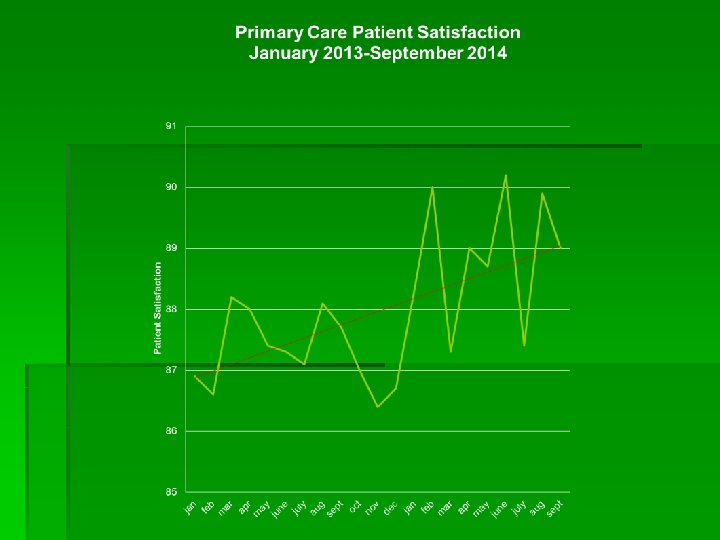
 Why change? § Improved patient outcomes and patient satisfaction. § This may help us enjoy our work more! § Primary care could be abandoned by US medical students who see it as a path to difficulty. § Family Medicine should be leaders in implementing new and innovative ways to deliver high-quality care.
 Yes We Can!
 Dream big! § Our Vision of the Patient Centered Medical Home
 How? § § § § Chronic care model vs. acute care model Planned visits Advanced access Patient Centered vs. Doctor Centered Prevention integrated into all visit types Warm handoffs to teammates IT support
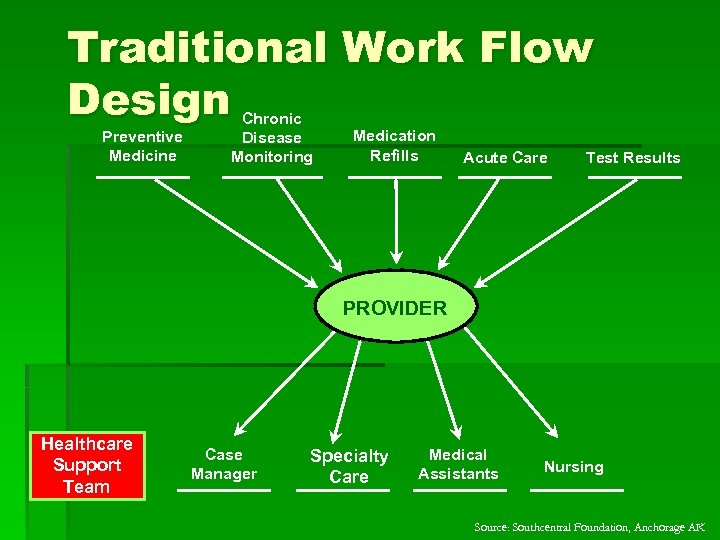 Traditional Work Flow Design Preventive Medicine Chronic Disease Monitoring Medication Refills Acute Care Test Results PROVIDER Healthcare Support Team Case Manager Specialty Care Medical Assistants Nursing Source: Southcentral Foundation, Anchorage AK
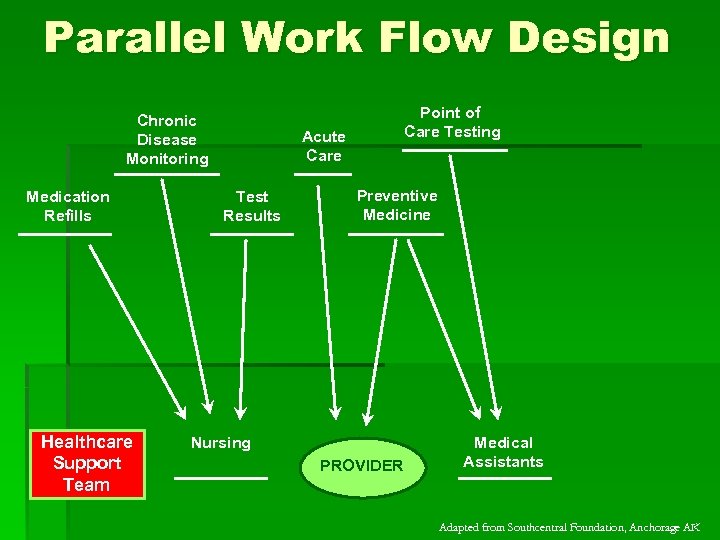 Parallel Work Flow Design Chronic Disease Monitoring Medication Refills Healthcare Support Team Point of Care Testing Acute Care Test Results Preventive Medicine Nursing Provider PROVIDER Medical Assistants Adapted from Southcentral Foundation, Anchorage AK
 It takes a village § We are all important members of the healthcare team- we need optimize the role of each team member while maintaining our flexibility. § We should strive for less complexity. § We need to consider the needs of our population.
 Essential Concepts § Each health care professional works to the “top of their license” § “Do today’s work today” § “Max Packing” each visit § Integrate not just co-locate services, especially behavioral health and pharmacy § Between visit care as important as during visit care § Joy in the work place!
 Components of Planned Visit 1. 2. 3. 4. 5. 6. 7. 8. 9. Pre-Visit data collection Pre-Visit patient call Standing orders Visit pre-work includes Health Maintenance, Condition Management, Previous encounter notes Huddle Activity setting before or after clinician encounter Summary of visit to patient Enrollment in Patient Portal Tracking referrals and ordered tests
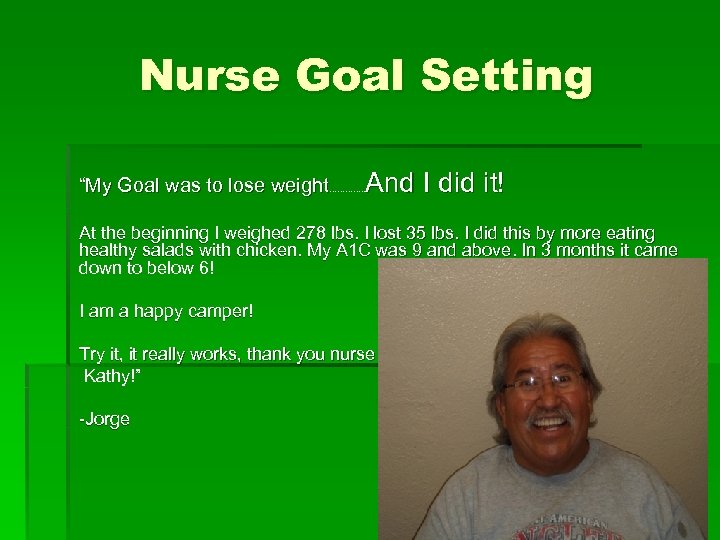 Nurse Goal Setting “My Goal was to lose weight And I did it! …………. . At the beginning I weighed 278 lbs. I lost 35 lbs. I did this by more eating healthy salads with chicken. My A 1 C was 9 and above. In 3 months it came down to below 6! I am a happy camper! Try it, it really works, thank you nurse Kathy!” -Jorge
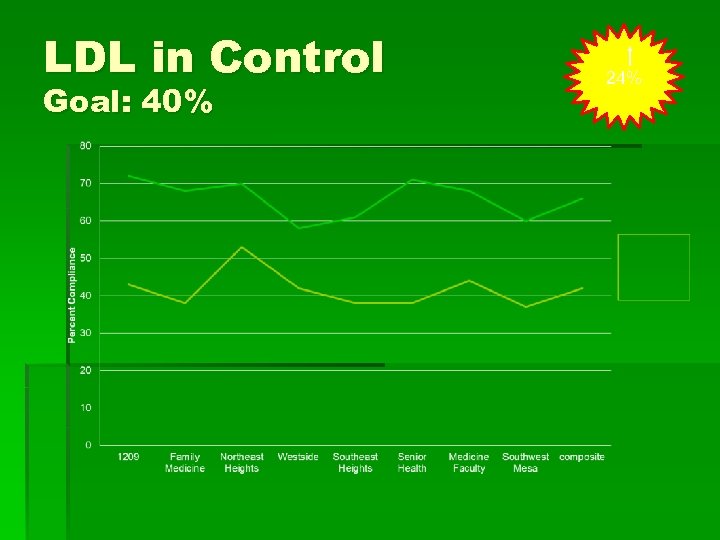 LDL in Control Goal: 40% 24%
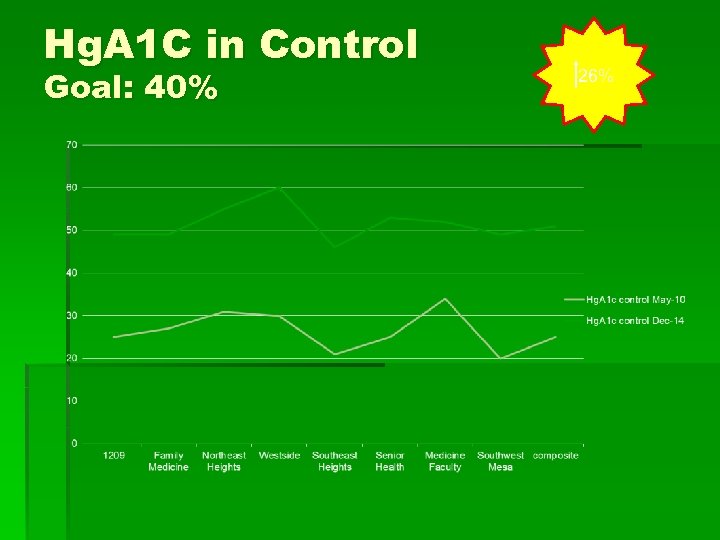 Hg. A 1 C in Control Goal: 40% 26%
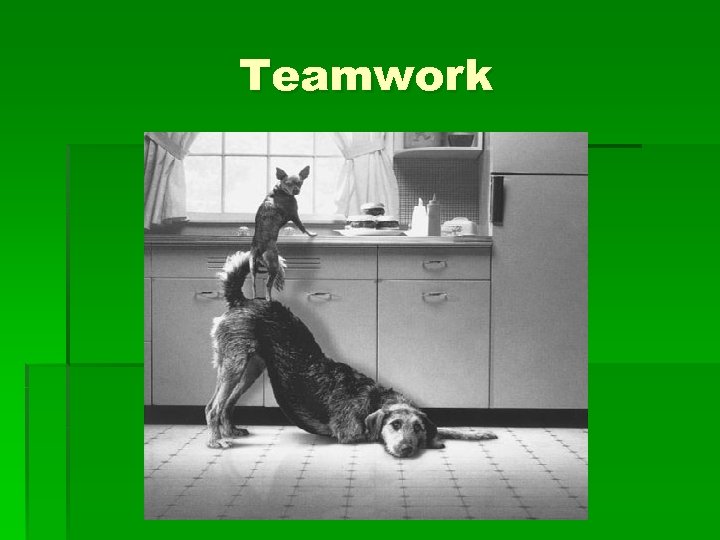 Teamwork
 Teams § Team formation § What makes up a functional unit? - usually no more that 7 -10 people § Physician, midlevel (PA/NP), RN, Mas--- patient in the center!
 Ease of practice § Help us! what can the system do to help providers be more efficient and patient centered? § Every team member is functioning to the very top of their ability. § Providers are left with work that only they can do. § Providers don’t triage the messages! § Providers don’t discharge patients!
 Pre-visit Information § Diagnosis- problem list is being updated § Patient registry-problem list gets people on registry § Look at future patient list together? When? § Standardized orders for HCM § Standardized visits on each team § Labs ordered before visit- patients called § How can this work? § Preventative Maintenance protocols
 What’s next for you? § § § Start date Motivational interviewing training? Group visits? DM 2, depression, prenatal, well child § Constant quality improvement (QI) in areas of diabetes, dyslipidemia, hypertension, obesity and metabolic syndrome. § Education for nurses in chronic care management- nurse education visits
 NCQA PCMH Recognition 2010 12 UNMH Clinics Level 1
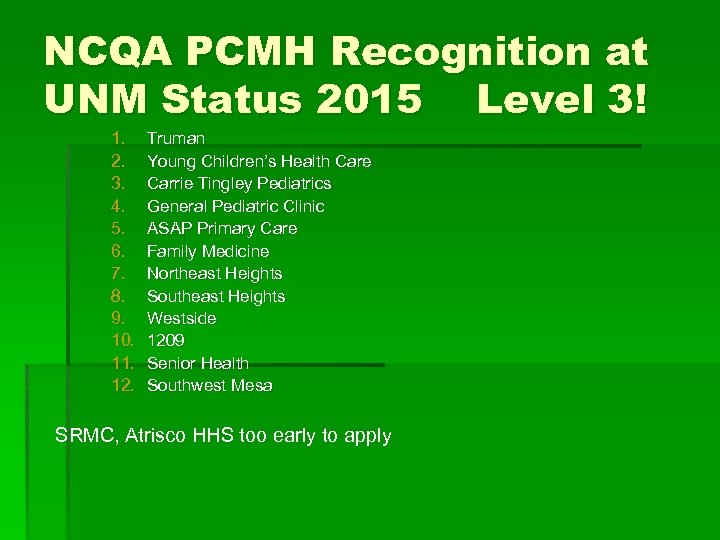 NCQA PCMH Recognition at UNM Status 2015 Level 3! 1. 2. 3. 4. 5. 6. 7. 8. 9. 10. 11. 12. Truman Young Children’s Health Care Carrie Tingley Pediatrics General Pediatric Clinic ASAP Primary Care Family Medicine Northeast Heights Southeast Heights Westside 1209 Senior Health Southwest Mesa SRMC, Atrisco HHS too early to apply
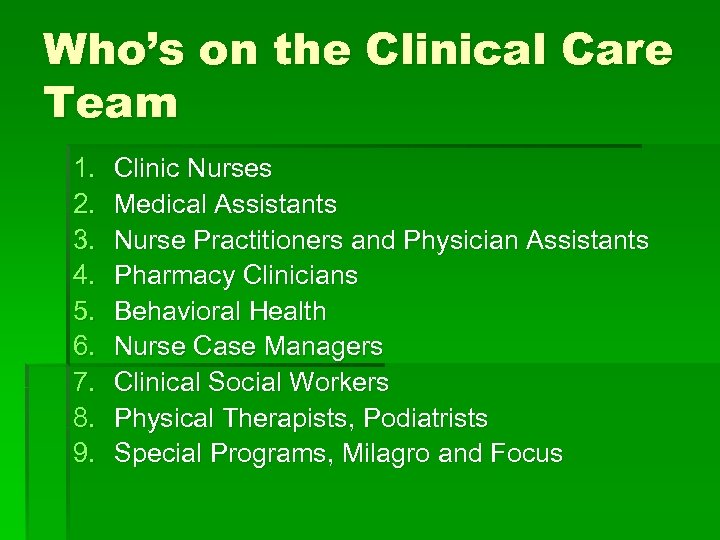 Who’s on the Clinical Care Team 1. 2. 3. 4. 5. 6. 7. 8. 9. Clinic Nurses Medical Assistants Nurse Practitioners and Physician Assistants Pharmacy Clinicians Behavioral Health Nurse Case Managers Clinical Social Workers Physical Therapists, Podiatrists Special Programs, Milagro and Focus
 Why Recognize PCMH? 1. 2. 3. 4. Patient satisfaction Doctor satisfaction Demand for primary care expanding Current system rewards high volume acute care, specialized care and procedures not coordinated, comprehensive, continuous 5. Triple Aim + Ease of Practice= quadruple aim
 91% believe it is important to have one place or doctor responsible for their primary care and for coordinating care between practitioners
 Political Support § PPACA, State funding § Insurance § Business Endorsement § AMA Joint Principles § Specialty Organizations
 Specialty Organizations Endorse PCMH 1. The American Academy of Chest Physicians 2. The American Academy of Hospice and Palliative Medicine 3. The American Academy of Neurology 4. The American College of Cardiology 5. The American College of Osteopathic Family Physicians 6. The American College of Osteopathic Internists 7. The American Geriatrics Society 8. The American Medical Directors Association 9. The American Society of Addiction Medicine 10. The American Society of Clinical Oncology 11. The Society for Adolescent Medicine 12. The Society of Critical Care Medicine 13. The Society of General Internal Medicine
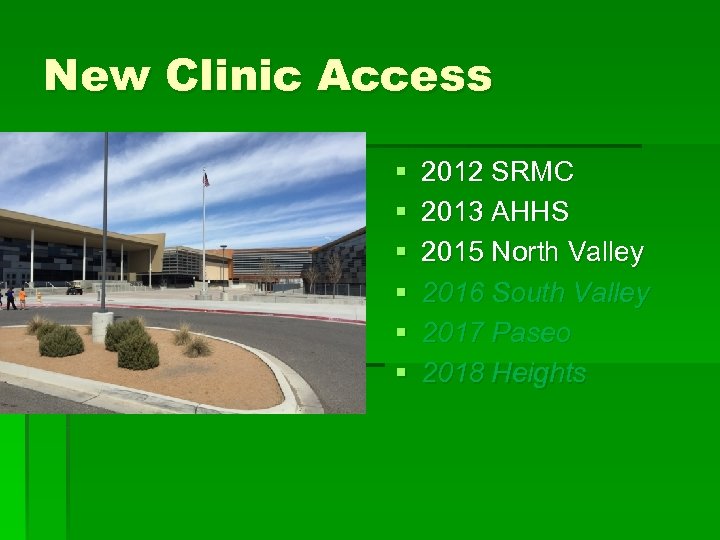 New Clinic Access § § § 2012 SRMC 2013 AHHS 2015 North Valley 2016 South Valley 2017 Paseo 2018 Heights
 Questions and Comments
 Impact on Triple Aim + Satisfaction • Cost • ED, UCC, Readmit • Population health • Preventive services • Access • Patient satisfaction • Doctor satisfaction Patient-Centered Primary Care Collaborative Annual Update January 2015
 References: § J Ark Med Soc. 2012 Jun; 108(13): 300 -3. § Bringing home the patient centered medical home: lessons learned from an academic family medical center. § Howard J 1, White P, Chronister K, Balamurugan A. § PCMH model AAFP
 Key Resources § AHRQ PCMH Resource Center, See handout Foundational Articles http: //www. pcmh. ahrq. gov/portal/server. pt/community/pcmh__hom e/1483 § AAFP and Transfor. Med www. aafp. org § Patient Centered Primary Care Collaborative http: //pcpcc. net/what -we-do § NCQA http: //ncqa. org/tabid/631/Default. aspx § Summary of the National Demonstration Project and Recommendations for the PCMH