 Скачать презентацию Patient Care Ergonomics Remember l Through Ergonomics
014a848c88d8cc6633238f1ed5cc3885.ppt
- Количество слайдов: 132



Patient Care Ergonomics Remember… l Through Ergonomics • Job can be redesigned • Jobs can be improvedto be within reasonable limits of human capabilities l However, ergonomics is not a magical solution… • To be effective, a well thought out system of implementation must be developed
Here’s A Successful Solution using Patient Car Ergonomics…
Successful Solution using Patient Care Ergonomics… VISN 8 Patient Safety Center Research Project: VISN-Wide Deployment of a Back Injury Prevention Program for Nurses: Safe Patient Handling and Movement (2001 -2002)
Results: Incidence (#) of Injuries Decreased 31% (144 to 99 injuries)
Results: Injury Rates* l Decreased from 24 to 16. 9 l Difference was significant at 0. 036 level *Defined as # reported injuries per 100 workers per year
Results: Light Duty Days Decreased 70% (1777 to 539 days) Significant at 0. 05 level
Results: Lost Work Days Decreased 18%, from 256 to 209 days
Results: Job Satisfaction • Pay • Professional Status * • Task Requirements * • Autonomy • Organization Policy • Interaction • Overall *Denotes Significance
Successful Solutions Overview of a Safe Patient Handling & Movement Program
Safe Patient Handling & Movement Program For success, required infrastructure MUST be in place prior to implementing SPHM Program • Management Support • Champion • SPHM Team • Program Elements • Equipment • Knowledge Transfer Mechanisms • Technical Support
SPHM Champion l Clout l Mover/Shaker l Interest l Nursing, Therapy, Safety…
SPHM Team Responsibilities l l l Implements Program Writes Policy Reviews/Trends Data Ensures incidents/injuries are investiga Facilitates Equipment Purchases
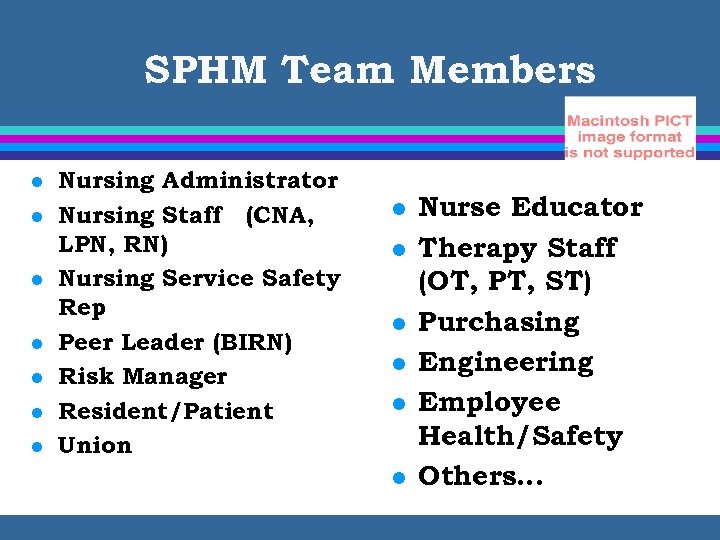
SPHM Team Members l l l l Nursing Administrator Nursing Staff (CNA, LPN, RN) Nursing Service Safety Rep Peer Leader (BIRN) Risk Manager Resident/Patient Union l l l Nurse Educator Therapy Staff (OT, PT, ST) Purchasing Engineering Employee Health/Safety Others…
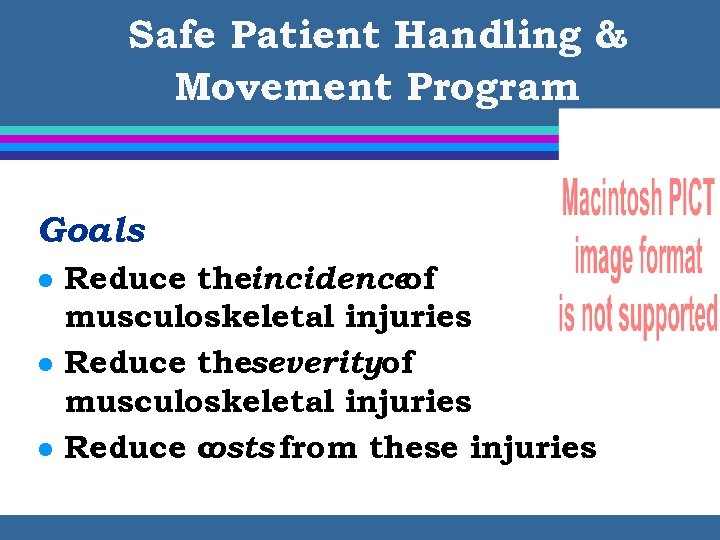
Safe Patient Handling & Movement Program Goals l l l Reduce theincidence of musculoskeletal injuries Reduce theseverityof musculoskeletal injuries Reduce c osts from these injuries
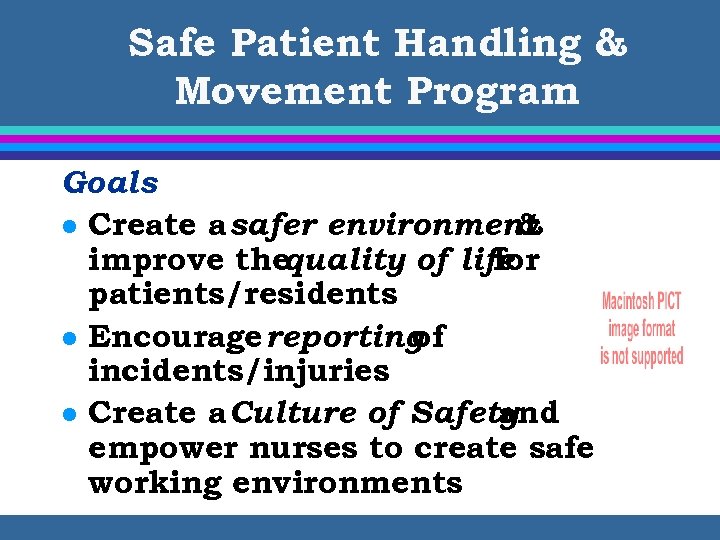
Safe Patient Handling & Movement Program Goals l Create a safer environment & improve the quality of life for patients/residents l Encourage reporting of incidents/injuries l Create a Culture of Safety and empower nurses to create safe working environments
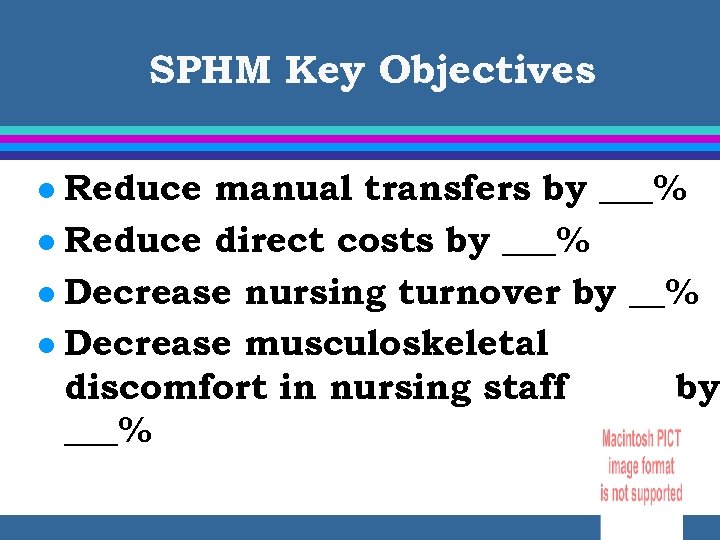
SPHM Key Objectives Reduce manual transfers by ___% l Reduce direct costs by ___% l Decrease nursing turnover by __% l Decrease musculoskeletal discomfort in nursing staff by ___% l
SPHM Key Objectives Reduce # of lost workdays due to patient handling tasks by ___% l Reduce # of light duty days due to patient handling tasks by ___% l l Note: Best to NOT measure success by # of reported injuries…
Safe Patient Handling & Movement Program What goals do you want to achieve for yourself, your co-workers, and your unit? What specific Program Objectives you want to attain? do (Complete “A” & “B” of Handout A-1, Developing a Safe Patient Handling & Movement Action Plan)
Safe Patient Handling & Movement Program SPHM Program Elements l l l Peer Leaders – BIRNS/Ergo Rangers After Action Review Process Patient Assessment, Care Plan, Algorithms for Safe Patient Handling & Movement SPHM Policy Ergonomic & Hazard Assessment of Patient Care Environment Equipment
Safe Patient Handling Movement Program Elements & Back Injury Resource Nurses Chapter 7
Safe Patient Handling & Movement Program BIRNS are the Key to Program Success… • Implement Program • Continue. Program
Back Injury Resource Nurses l RN, LPN, CNA l Informal Leader/ Respected l Safety Interest l Ergo Experience Not Required l Enthusiastic/ Out -going l Good Time/ Mgmt Skills
Back Injury Resource Nurses Roles/Responsibilities 1. 2. 3. 4. 5. Implement/Continue SPHM Program Act as Resource, Coach, and Team Leader for Peers, NM, Facility Share/Transfer Knowledge Perform Continual Hazard/Risk Monitoring Monitor and Evaluate Program
BIRNS Roles & Responsibilities 1. Implement/Continue SPHM Program BIRNS activities and involvement depend on what program elements are included in your Program.
BIRNS Roles & Responsibilities 2. Act as Resource, Coach, and Team Leader l l l Share expertise use of. Program in elements Motivateuse of Programelements Listento Ideas & Concerns Demonstrate Care & Concern Staff for Well-Being Support and promote “Culture of a Safety” Cheer on Safety Successes!!
BIRNS Roles & Responsibilities 3. Share/Transfer Knowledge BIRNS-BIRNS l l l Within Units, Facilities, Organization… With Others Organizations Monthly Conference Calls Outlook Email Groups National Conferences
BIRNS Roles & Responsibilities 3. Share/Transfer Knowledge BIRNS-STAFF l AAR Meetings l On-the-Job • Co-workers • New Employees l Staff Meetings l Skills Check-off Training/In-services
BIRNS Roles & Responsibilities 4. Perform Continual Hazard/Risk Monitoring Two Levels of Hazard/Risk Evaluations • Formal Ergonomic Hazard Evaluation – Ch. 3 • Ongoing Workplace Hazard Evaluations • Of the Environment • Of Patients/Residents • Of Patient Handling Tasks
BIRNS Roles & Responsibilities 5. Monitor and Evaluate Program l l l Assist in Collecting/Analyzing Injury Data Complete Checklists for Safe Use of Lifting Equipment Evaluate Ability to use Algorithms & Complete Care Plan
BIRNS Roles & Responsibilities 5. Monitor and Evaluate Program l Weekly BIRN Process Log (p. 89) • BIRNS Activity Level • BIRNS and Program Status • Effectiveness • Adherence • Support
What Helps Make a BIRNS Successful? l Personality • • l Natural Leader Positive Outlook Team Player Proactive Cooperation & Support
What Helps Make a BIRNS Successful? Cooperation & Support l l l Nurse Manager Nursing Administration Facility Management Facility Safety Champion Engineering & Housekeeping
What Helps Make a BIRNS Successful? Management Support l TIME to fulfill BIRNS role (especially during implementation phase) • Coverage during meeting times, staff inservices & BIRNS training • Lighter case-load l TIME for. Staffto attend In-Services
Back Injury Resource Nurses Outcomes for Staff l l Staff are empowered • Channel to voice ideas/suggestions • Opportunity to have input in making work environment safer Increased competence in performing job Increased sharing of knowledge/best practices Fosters Culture of Safety
Back Injury Resource Nurses Examples of Problems Identified l Lifts not being used on night shifts. • Why? Batteries were being charged on night shifts because no back-up batteries. • Solution: Buy extra battery packs so lifts can be used 24 hours per day.
Safe Patient Handling & Movement Program BIRNS are the Key to… • Implement SPHM Program • Continue. SPHM Program
Safe Patient Handling Movement Program Elements & After Action Review Process Chapter 9
After Action Review An After Action Review is for transferring knowledge a team has learned from doing a task in one setting, to the next time that team does the task in different setting. (Dixon, 2000)
AAR and Risk Reduction l l Provides mechanism for whole team to learn from the experiences of one individual Involvesfront line staff identifying in problems and SOLUTIONS
Guidelines for AAR Use l l l Used for injuries AND “near-misses” After an incident has occurred bring staff together to discussthe incident No notes are taken Involve as many staff as possible Hold AAR in location of incident, if possible Non-punitive approach with no faultfinding/blaming
Guidelines for AAR Use l l Keep meetings brief - less than 15 minutes Staff-driven Assign one or two persons to ensure corrective actions are taken At next AAR, follow-up if needed
Guidelines for AAR Use l The AAR group asks (1) What happened? (2) What was supposed to happen? (3) What accounts for the difference? (4) How could the same outcome be avoided the next time? (5) What is the follow-up plan?
Training Staff on AAR Minimal Training required l Staff In-service – review purpose, need for trust, benefits, etc. l Training Tools l • Handout A-2, AAR Brochure • My AAR slides
AAR Case Study A nurse manager of a long term care unit decides to implement after action reviews after she notices an increase in musculoskeletal injuries among the staff.
AAR Case Study After hearing an explanation of the process, staff decide to schedule AAR meetings on Monday, Wednesday, and Friday at 11 AM. This time was selected because most of the morning care is completed by 11: 00 and it is before lunch time.
AAR Case Study During the first meeting, group members ask staff to think about what happened during the morning. Did anything happen (near-miss or injury) that could have put them or their co-workers at risk of injury that everyone could learn from?
What Happened? Sue, an LPN, begins. I had to get Mr. Walker up because he was lying in a wet bed. . I was late with my meds and I knew I needed to get to the inservice. Then, I couldn’t find a sling, so I just got him up myself. While I was lifting him I kept thinking… ‘Don’t’ hurt yourself…’ I guess I was lucky I didn’t! So. . What happened was that I lifted Mr. Walker without help, without using a lift.
What Was Supposed to Happen? Nancy: OK. . So, what should have happened? Sue: I should have found the sling and used the lift, but I was in such a hurry. Nancy: I know… It’s so frustrating to have all of these new lifts but not have the slings where you need them. I know I’ve had trouble finding slings, too. Others discuss their experiences related to the lifts and slings.
What Accounts for the Difference? Nancy: Let’s see… What accounts for the difference? Well. . . The sling wasn’t available. For starters, the sling should have been in the room and on the bed side stand, where we agreed to keep them.
What Accounts for the Difference? Ron: You’re right, but there's not always room to put them there… That’s where patients place their things too… Because of that a lot of times I put slings places where ‘I’ can find them when ‘I’ come back in the room, but I guess that makes it hard for you guys to find them when I’m not around….
What Accounts for the Difference? After more discussion, the group decides that the problems of ‘inaccessible slings’ is caused by no good location for the slings in patient rooms.
How can the same outcome be avoided the next time? ? Nancy: OK… We’re always running around looking for slings. What do you think about placing a sling ‘hook’ in every patient room, right at the door, so you can easily pick the sling up on entering and put it back on leaving? Fred: That’s a good idea! I also think it would help if we had more slings… How many more do you think we need?
How can the same outcome be avoided the next time? ? Brad: I’ll request a work order to install the hooks and after they’re installed I’ll make sure everyone gets the message on the new procedure. Ron: I’ll add the process to the new employee orientation packet. Fred: I’ll put in a request to order 6 slings.
What’s the Follow-up Plan? Sue: Let’s see if I have all of our recommendations… Put in a work order for installation of the hooks, buy more slings, spread the word, and the add process to the unit orientation packet for new employees. Brad: Since this has been a continual problem, let’s see how we’re doing on the sling issue at an AAR in one month.
After Action Review Study Case AAR Case Study l l l BIRN noticed friction reducing devices (FRDs) weren’t being used on her Unit Held staff AAR Determined FRD’s too narrow Solution: BIRN contacted manufacturer who made new, wider FRD’s. Outcome: New, wider FRD’s used on Unit
AAR Practice Break into groups l Think of a problem common to your group l Perform an AAR using the AAR questions. l
Safe Patient Handling Movement Program Elements & Patient Assessment, Care Plan, & Algorithms for Safe Patient Handling & Movement Chapter 5
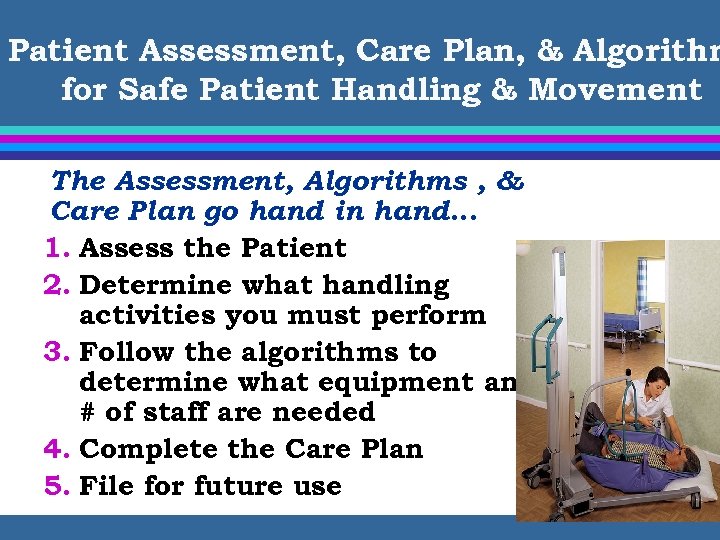
Patient Assessment, Care Plan, & Algorithm for Safe Patient Handling & Movement The Assessment, Algorithms , & Care Plan go hand in hand. . . 1. Assess the Patient 2. Determine what handling activities you must perform 3. Follow the algorithms to determine what equipment and # of staff are needed 4. Complete the Care Plan 5. File for future use
What Tasks Do the Care Plan & Algorithms Cover? 1. 2. 3. 4. 5. 6. Transfer To and From: Bed to Chair, Chair to Toilet, Chair to Chair, or Car to Chair Lateral Transfer To and From: Bed to Stretcher, Trolley Transfer To and From: Chair to Stretcher, Chair to Chair, or Chair to Exam Table Reposition in Bed: Side to Side, Up in Bed Reposition in Chair: Wheelchair or Dependency Chair Transfer a Patient Up from the Floor
What Tasks Do the. Bariatric Care Plan & Algorithms Cover? 1. 2. 3. 4. 5. 6. 7. 8. Transfer To and From: Bed to Chair, Chair to Toilet, Chair to Chair, or Car to Chair Lateral Transfer To and From: Bed to Stretcher, Trolley Reposition in Bed: Side to Side, Up in Bed Reposition in Chair: Wheelchair or Dependency Cha Tasks Requiring Sustained Holding of Limb/s or Access to Body Parts Transporting (stretcher, w/c, walker) Toileting Transfer Patient Up from Floor
Patient Assessment & Plan – Page 71 l l l Completed on all patients Takes into consideration: • Patient Characteristics • Patient Handling Task • Equipment Uses Algorithms Care
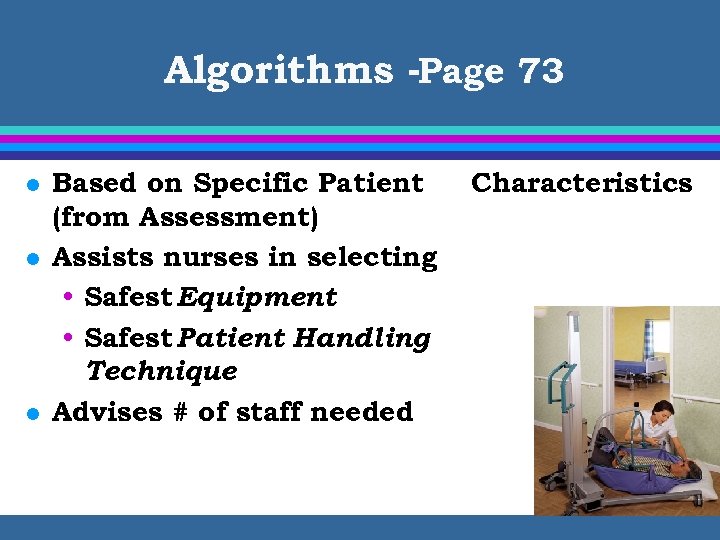
Algorithms -Page 73 l l l Based on Specific Patient (from Assessment) Assists nurses in selecting • Safest Equipment • Safest Patient Handling Technique Advises # of staff needed Characteristics
How were these Algorithms Developed? l l Developed by a group of nursing experts Tested with different patient populations in a variety of settings
When Should The Algorithms be Used? l Use the Algorithms for every patient/resident who needs help moving l Remember…. • The Algorithms provide generaldirection • Caregiver must use their professional judgmentin applying Algorithms
How Do We Lift This Resident?
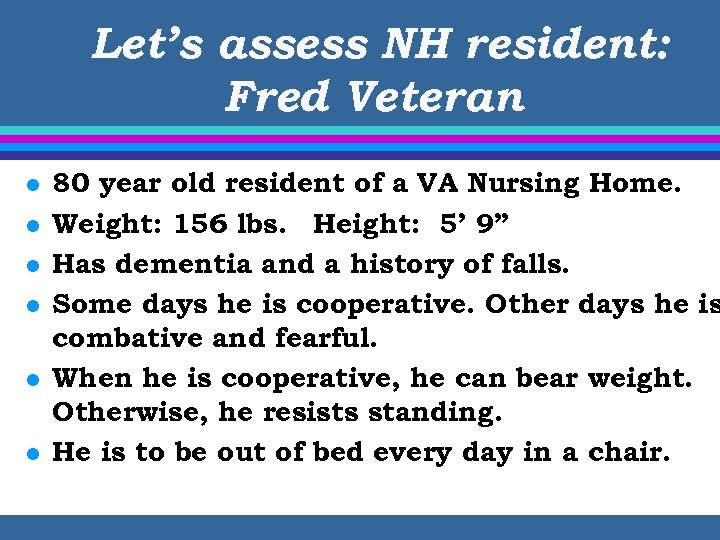
Let’s assess NH resident: Fred Veteran l l l 80 year old resident of a VA Nursing Home. Weight: 156 lbs. Height: 5’ 9” Has dementia and a history of falls. Some days he is cooperative. Other days he is combative and fearful. When he is cooperative, he can bear weight. Otherwise, he resists standing. He is to be out of bed every day in a chair.
Assessing Fred V. Take a few minutes and complete a Patient Handling Care Plan for Fred Veteran. (Use Handout A-3, Patient Assessment & Care Plan)
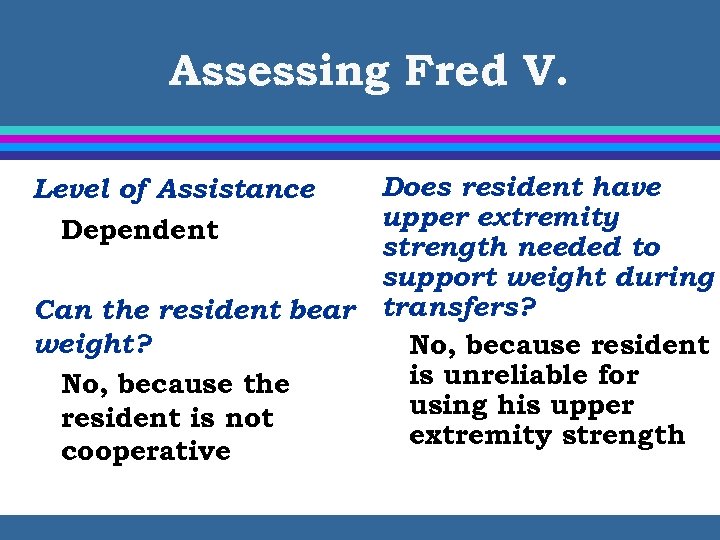
Assessing Fred V. Does resident have upper extremity strength needed to support weight during Can the resident bear transfers? weight? No, because resident is unreliable for No, because the using his upper resident is not extremity strength cooperative Level of Assistance Dependent
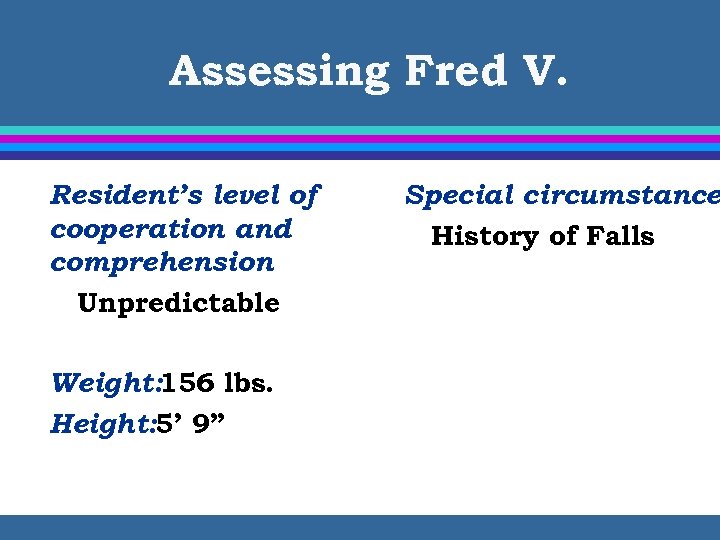
Assessing Fred V. Resident’s level of cooperation and comprehension Unpredictable Weight: 156 lbs. Height: 5’ 9” Special circumstance History of Falls
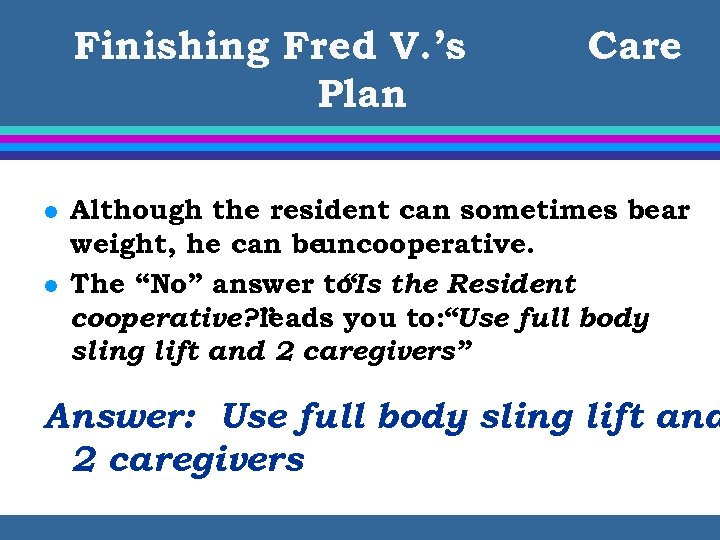
Finishing Fred V. ’s Plan l l Care Although the resident can sometimes bear weight, he can be uncooperative. The “No” answer to the Resident “Is cooperative? ” leads you to: “Use full body sling lift and 2 caregivers” Answer: Use full body sling lift and 2 caregivers
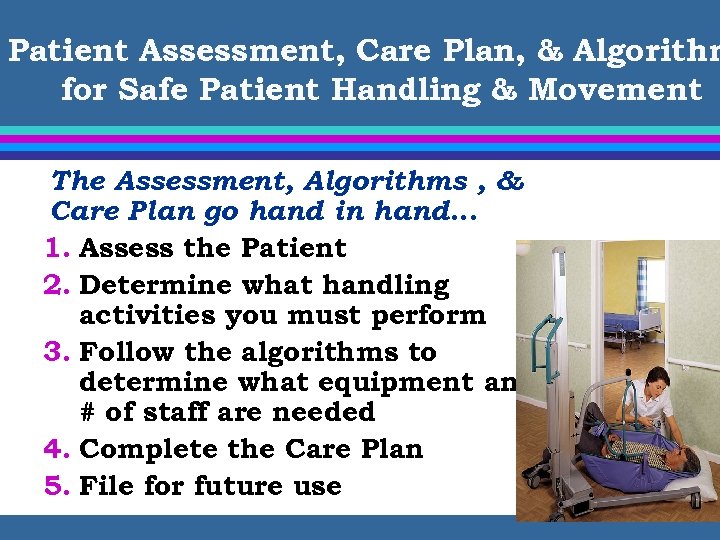
Patient Assessment, Care Plan, & Algorithm for Safe Patient Handling & Movement The Assessment, Algorithms , & Care Plan go hand in hand. . . 1. Assess the Patient 2. Determine what handling activities you must perform 3. Follow the algorithms to determine what equipment and # of staff are needed 4. Complete the Care Plan 5. File for future use
Algorithms Practice l l l Break into groups Have one person give a clinical description of a recent patient requiring moving/handling Develop a patient handling Care Plan using the assessment tool and algorithms.
Safe Patient Handling Movement Program Elements Safe Patient Handling & Movement Policy Chapter 6 &
Safe Patient Handling & Movement Policy SPHM Policy Ties all Program Elements Together… l Based on UK Policy l Implemented in high-risk units l Focus on creating a safe workplace for caregivers rather than on punitive action for mistakes
Safe Patient Handling & Movement Policy SPHM Policy Ties all Program Element Together… l Says to avoid hazardous Patient handling tasks. l If can’t avoid, carefully assess hazard, & if possible, always use Patient handling equipment
Safe Patient Handling & Movemen Program BUT…. l Patient Handling Equipment/Aids MUST be in place first before implementing a SPHM , Program. l So, a systematic process is needed to ensure the right equipment is in place…
Safe Patient Handling Movement Program Elements & 9 Step Ergonomic Workplace Assessment of Nursing Environments Chapter 3
Patient Care Ergonomic Hazard/Risk Evaluation Two Levels of Hazard/Risk Evaluations • Formal Ergonomic Hazard Evaluation – Ch. 3 • Ongoing Workplace Hazard Evaluations • Of the Environment • Of Patients/Residents • Of Patient Handling Tasks
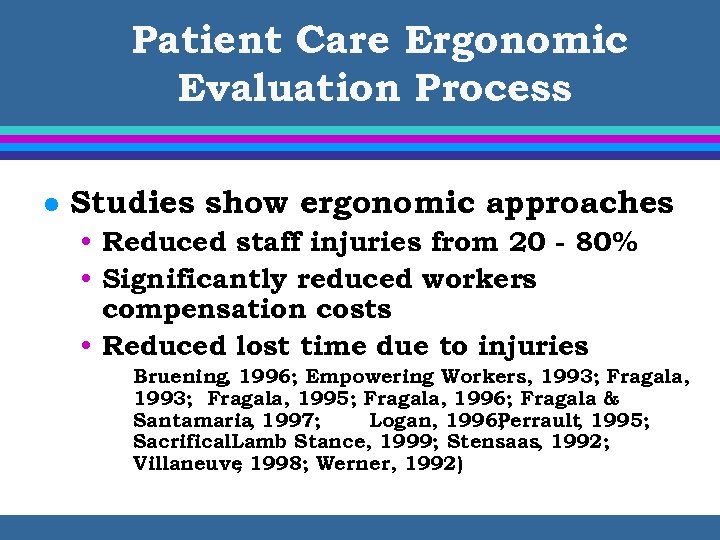
Patient Care Ergonomic Evaluation Process l Studies show ergonomic approaches • Reduced staff injuries from 20 - 80% • Significantly reduced workers compensation costs • Reduced lost time due to injuries Bruening, 1996; Empowering Workers, 1993; Fragala, 1995; Fragala, 1996; Fragala & Santamaria 1997; , Logan, 1996; Perrault 1995; , Sacrifical. Lamb Stance, 1999; Stensaas, 1992; Villaneuve 1998; Werner, 1992) ,
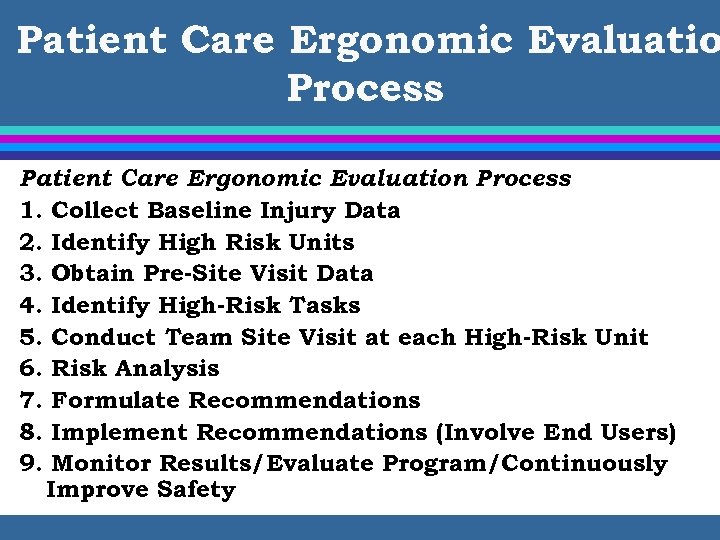
Patient Care Ergonomic Evaluatio Process Patient Care Ergonomic Evaluation Process 1. Collect Baseline Injury Data 2. Identify High Risk Units 3. Obtain Pre-Site Visit Data 4. Identify High-Risk Tasks 5. Conduct Team Site Visit at each High-Risk Unit 6. Risk Analysis 7. Formulate Recommendations 8. Implement Recommendations (Involve End Users) 9. Monitor Results/Evaluate Program/Continuously Improve Safety
Step 1. Collect Baseline Injury Data *Be sure to note which source is used on your Injury Log
Step 1. Collect Baseline Data l l l Injury Cause: Patient Handling Tasks Target Population/s : Nursing Staff (Radiology, Therapy Staff – PT, OT, ST, Others? ) Type: Strains/Sprains (Struck, Fall. . ? ) (Best to include all types of injuries, then analyze those of interest. ) l Duration: Minimum of 1 year of data
Step 1. Collect Baseline Data l Injury Collect by. Unit(will also use later during risk analysis) l Sources : • Risk Manager/Safety/Human Resources • Facility Injury Logs/Statistics, Unit Records OSHA 200/300 Logs • Patient Care Incident/Injury Profile l Note which source is used on your Injury Log
Step 2. Identify High-Risk Units What units have the • Most Patient handling injuries/ incidents? • Most severe injuries/incidents? (by lost time or modified duty days) • Highest concentration of staff on modified duty?
Step 2. Identify High-Risk Units Common Characteristics: • High proportion of dependent patients/residents • High frequency of patients/residents getting in & out of bed • High frequency of transfers from one surface to another, e. g. w/c to toilet or bed
Step 4. Identify High-Risk Tasks ‘Tool for Prioritizing High Risk Tasks’ – p. 30 l Rank Tasks from 1 to 10 1 = highest risk l 10 = lowest risk When ranking, consider: • Frequency & Musculoskeletal Stress l l Delete Tasks not usually performed on Unit Completed by • Each Staff member • Collectively by Shift
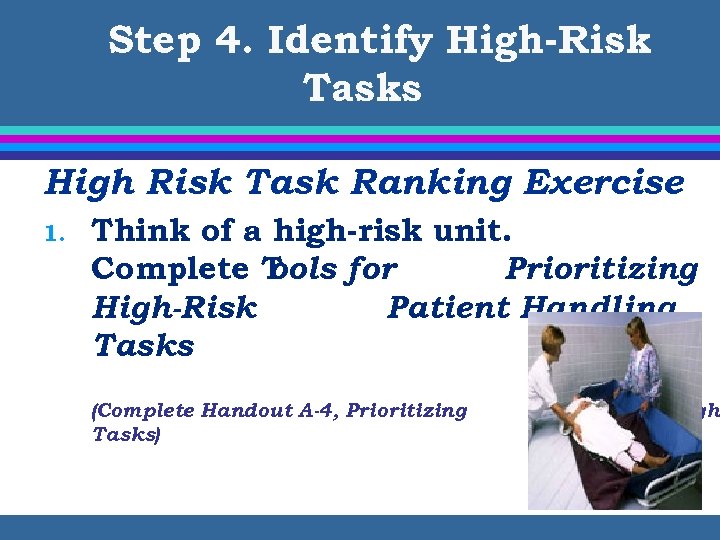
Step 4. Identify High-Risk Tasks High Risk Task Ranking Exercise 1. Think of a high-risk unit. Complete T ools for Prioritizing High-Risk Patient Handling Tasks (Complete Handout A-4, Prioritizing Tasks) High
Step 4. Identify High-Risk Tasks Let’s compare high risk tasks identified by you and others… If there were differences… Why? ? What factors play a role in rankin tasks?
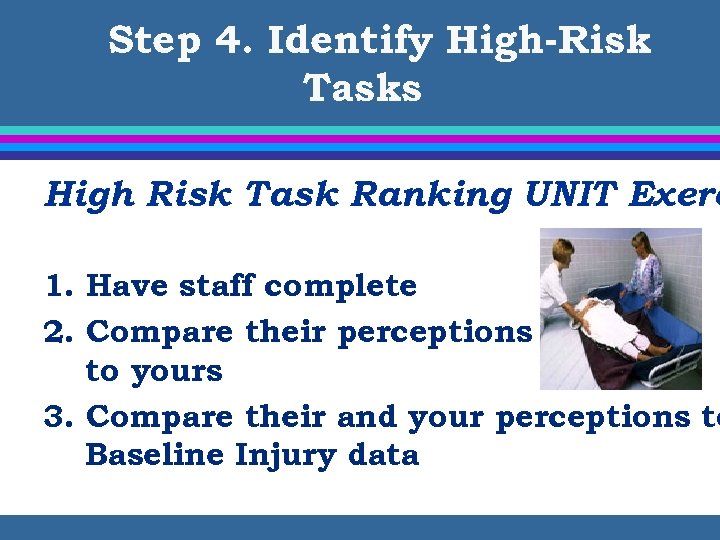
Step 4. Identify High-Risk Tasks High Risk Task Ranking UNIT Exerc 1. Have staff complete 2. Compare their perceptions to yours 3. Compare their and your perceptions to Baseline Injury data
3. Obtain Pre-Site Visit Data on High-Risk Units Use ‘Pre site Visit Unit Profile’ – p. 24 • Space issues • Storage availability • Maintenance/repair issues • Patient population • Staffing characteristics • Equipment inventory/issues l Will use when performing site visit and for making recommendations
Step 3. Obtain Pre-Site Visit Data Remember… Involve as many staff as possibl and as much as possible…
Step 3. Obtain Pre-Site Visit Data Now… think of one of your high-risk units from your facility and complete cursory “Unit Data Collection Tool” fo that unit. * Complete. Unit Data Collection Tool Profile (Handout A-5)
Step 5. Conduct Site Visit Walk-through • • Patient room sizes/configurations Ceiling Characteristics/AC vents/TVs Showering/bathing facilities Toileting process
Step 5. Conduct Site Visit Walk-through • Equipment • Availability • Use • Storage • Staff attitudes Accessibility Condition
Step 5. Conduct Site Visit After Site Visit… l Organize data by entering into Site Vis Summary Data Sheet (p. 34 and Handout A-6) l Use during Risk Analysis in order to make Recommendations
9 Step Ergonomic Workplace Assessment of Nursing Environments Step 6. Perform Risk Analysis
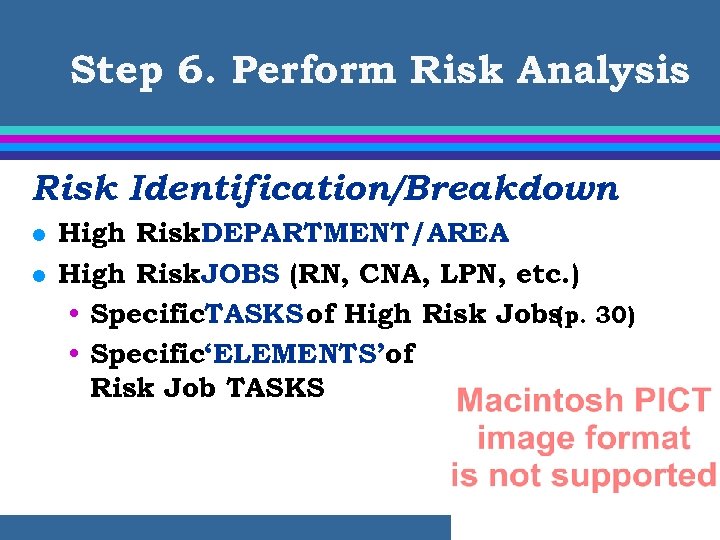
Step 6. Perform Risk Analysis Risk Identification/Breakdown l l High Risk. DEPARTMENT/AREA High Risk. JOBS (RN, CNA, LPN, etc. ) • Specific. TASKS of High Risk Jobs 30) (p. • Specific‘ELEMENTS’of High Risk Job TASKS
Step 6. Perform Risk Analysis What do we need to look at to identify Specific RISKS of ‘ELEMENTS’ of High Risk Job TASKS?
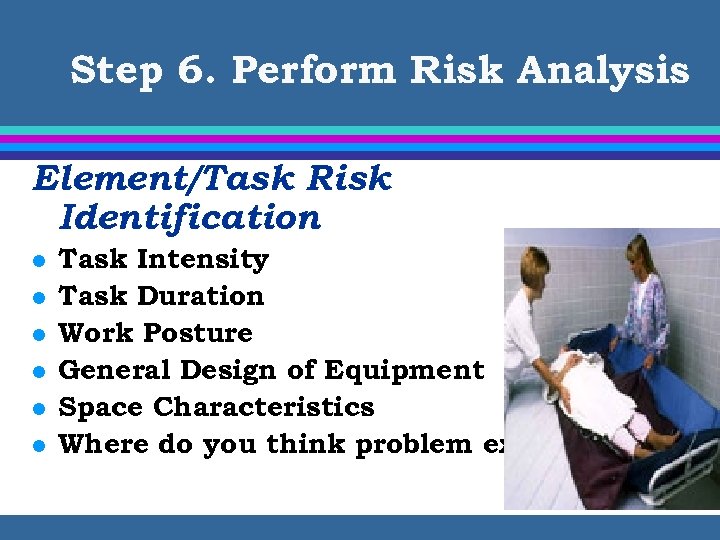
Step 6. Perform Risk Analysis Element/Task Risk Identification l l l Task Intensity Task Duration Work Posture General Design of Equipment Space Characteristics Where do you think problem exists?
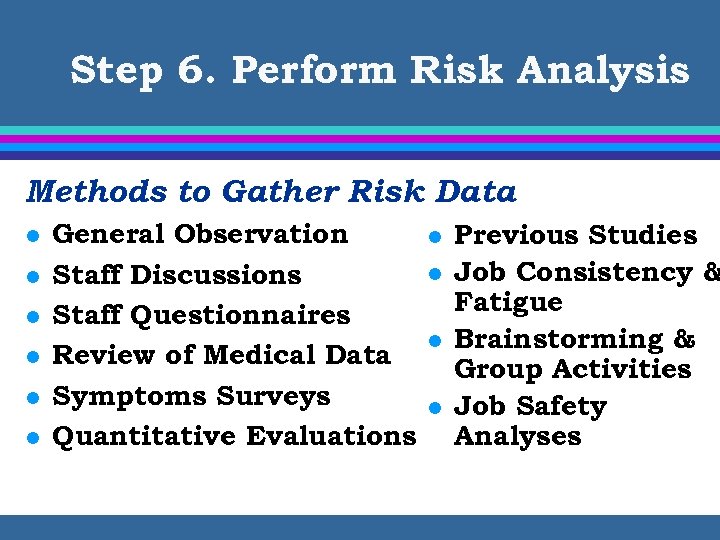
Step 6. Perform Risk Analysis Methods to Gather Risk Data l l l General Observation Staff Discussions Staff Questionnaires Review of Medical Data Symptoms Surveys Quantitative Evaluations l l Previous Studies Job Consistency & Fatigue Brainstorming & Group Activities Job Safety Analyses
Step 6. Perform Risk Analysis Job Safety Analysis (JSA) l l l Break down job into steps Identify hazards associated with each step Determine actions necessary to eliminate or minimize hazards
Step 6. Perform Risk Analysis Job Safety Analysis (JSA) Let’s try it!!! See Job Safety Analysis Worksheet (Handout A-7)
Step 6. Perform Risk Analysis is used to find Risk Factor that may cause injury. There are three categories of Risk Factors Patient Care Environment. . . What do you think they are? ?
Step 6. Perform Risk Analysis Risk can come from: l l l Patient Handling Tasks Health Care. Environment Patient Once risks are identified, steps can be taken to protect Staff and Patients!
Step 6. Perform Risk Analysis What Risk Factors are related to the Health Care Environment ?
Step 6. Perform Risk Analysis Health Care Environment Risk Factors l l l Slip, trip, and fall hazards Uneven work surfaces (stretchers, beds, chairs, toilets at different heights) Uneven Floor Surfaces (thresholds) Narrow Doorways Poor bathing area design
Step 6. Perform Risk Analysis Health Care Environment Risk Factors l l Space limitations • Small rooms • Lots of equipment • Clutter • Cramped working space Poor placement of room furnishings
Step 6. Perform Risk Analysis Health Care Environment Risk Factors l l Broken Equipment Inefficient Equipment (non-electric, slowmoving, bed rails) Not enough or Inconvenient Storage Space Staff who don’t help each other or don’t communicate
‘The Far Side’ Safety Humor…
Step 6. Perform Risk Analysis What Risk Factors are related Patients ?
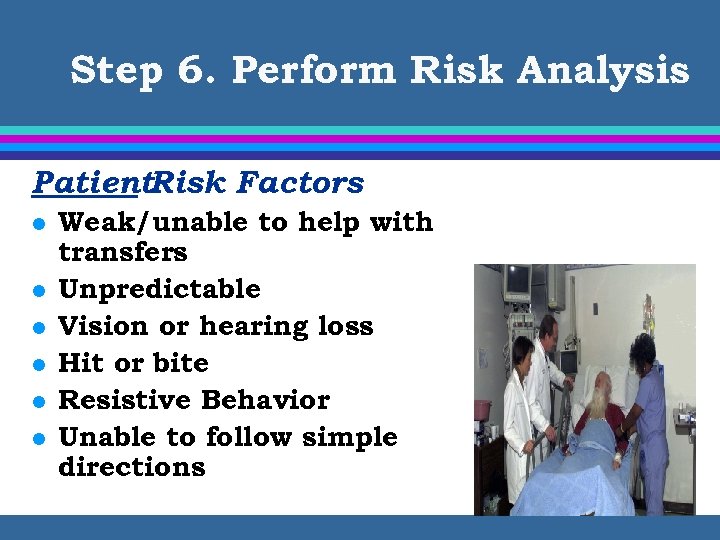
Step 6. Perform Risk Analysis Patient. Risk Factors l l l Weak/unable to help with transfers Unpredictable Vision or hearing loss Hit or bite Resistive Behavior Unable to follow simple directions
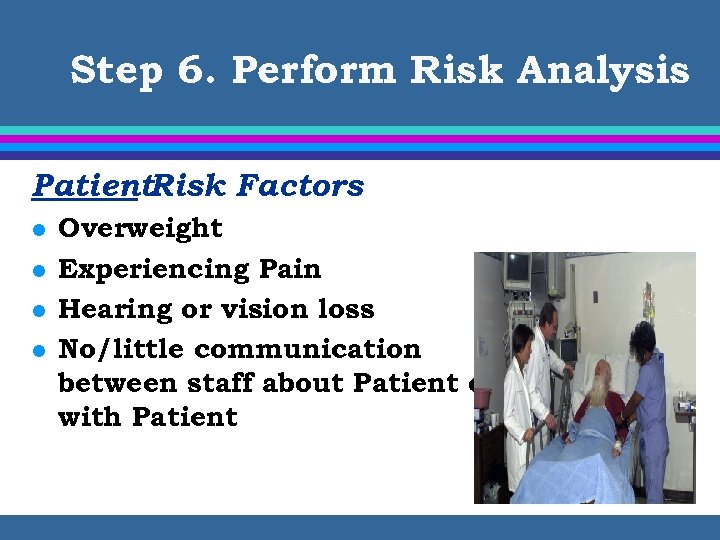
Step 6. Perform Risk Analysis Patient. Risk Factors l l Overweight Experiencing Pain Hearing or vision loss No/little communication between staff about Patient or with Patient
Step 6. Perform Risk Analysis What Risk Factors are found in Patient Handling Tasks ?
Step 6. Perform Risk Analysis Patient Handling Tasks Risk Factors l l l Reaching and lifting with loads far the body Lifting heavy loads Twisting while lifting Unexpected changes in load during lift Reaching Long Duration from demand
Step 6. Perform Risk Analysis Patient Handling Tasks Risk Factors l l l Moving or carrying a load significant distance Awkward Posture Pushing/Pulling Completing activity with wrong height Frequent/repeated moving a bed lifting
Step 6. Perform Risk Analysis Now, it’s time to tie… Patient Handling Task Risks Health Care Environment Risks Patient Risks to Site Visit Data This will show us what to consider in making recommendations.
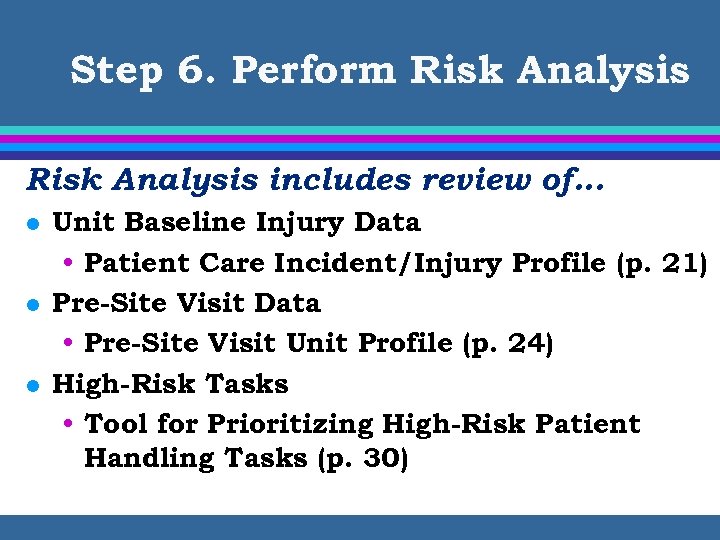
Step 6. Perform Risk Analysis includes review of… l l l Unit Baseline Injury Data • Patient Care Incident/Injury Profile (p. 21) Pre-Site Visit Data • Pre-Site Visit Unit Profile (p. 24) High-Risk Tasks • Tool for Prioritizing High-Risk Patient Handling Tasks (p. 30)
Step 6. Perform Risk Analysis includes review of… l l Site Visit Information • Site Visit Summary Data Sheet (p. 34) Observations & Additional Information from Site Visit
Step 6. Perform Risk Analysis Analyzing Unit Baseline Injury Data • Will provide direction when making ergonomic recommendations • Determine: • #1 & 2 Causes of Injuries • #1 & 2 Activities being performed when staff are injured • What’s going on? What trends are seen?
Step 6. Perform Risk Analysis Analyzing Unit Baseline Injury Data Activity Let’s try it… Use Injury Incidence Profile (Handout A-8) 1. For the NHCU, what are the: • • #1 & 2 Causes of injuries? #1 & 2 Activities involved in the injuries? 2. What trends do you see?
Step 6. Perform Risk Analysis Analyzing Unit Baseline Injury Data What does the unit injury data tell you?
Step 6. Perform Risk Analysis Data to Direct Recommendations l l l l Incidence (# injuries per unit) Severity (defined by # of lost and modified du days) 1 - 2 Primarytask/s involved in injuries 1 - 2 Primarycause/s of injuries on unit Patient Dependency Levels Number/configuration of rooms Whatever is significant to your needs
Step 6. Perform Risk Analysis Information from the Risk Analysis drives formation of Recommendations…
9 Step Ergonomic Workplace Assessment o Nursing Environments Step 7. Formulate Recommendations
Step 7. Formulate Recommendations Solutions involve: #1 Hazard Elimination #2 Engineering Controls #3 Administrative Controls
Step 7. Formulate Recommendations Hazard Elimination Examples?
Step 7. Formulate Recommendations Hazard Elimination l l Scale in sling lift Transfer Bed
Step 7. Formulate Recommendations Administrative Controls Examples?
Step 7. Formulate Recommendations Administrative Controls l l l l Changes in Scheduling Minimizing # times transfers are required Job Rotation Redistribution of Workload Based on Acuity Lifting Teams Procedures for repair/maintenance Allot Storage Space to make equipment more accessible
Step 7. Formulate Recommendations Engineering Control Examples?
Step 7. Formulate Recommendations Engineering Controls l Result: Caregivers conduct their job in a new way • Physical Change to the way a job/task is conducted • Utilization of an aid/equipment to reduce the hazard • Modifications to the Workplace
Step 7. Formulate Recommendations Engineering Controls are the keys to improving safety in a health care environment…. Let’s see some examples.
Скачать презентацию Patient Care Ergonomics Remember l Through Ergonomics
014a848c88d8cc6633238f1ed5cc3885.ppt