


 Скачать презентацию Pathology Visions 2007 Amsterdam Marriott Hotel 4 -5
63b0e2ada77f434a81e1498ad399cb25.ppt
- Количество слайдов: 24
 Pathology Visions 2007 Amsterdam Marriott Hotel 4 -5 December 2007 Advances in Automated Cytology Screening Nikolai Ptitsyn N. Ptitsyn@microsharp. co. uk Innovators in Light Management Technology 52 Shrivenham Hundred Business Park Watchfield, Oxfordshire, SN 6 8 TY. UK www. microsharp. co. uk
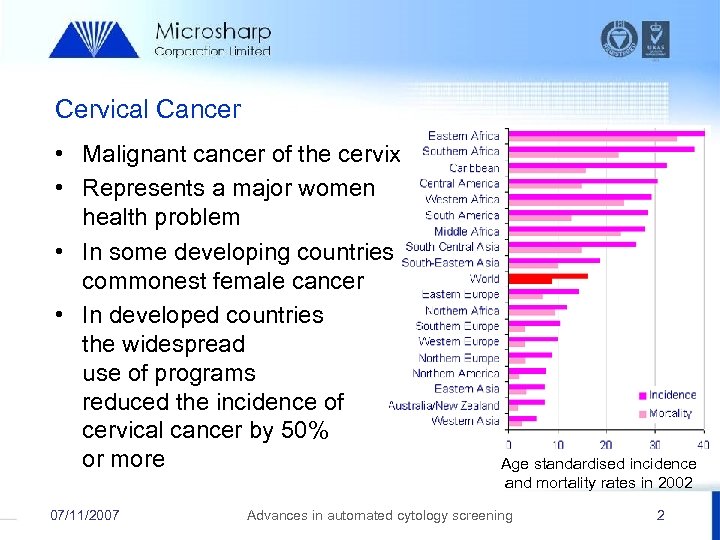 Cervical Cancer • Malignant cancer of the cervix • Represents a major women health problem • In some developing countries commonest female cancer • In developed countries the widespread use of programs reduced the incidence of cervical cancer by 50% or more 07/11/2007 Age standardised incidence and mortality rates in 2002 Advances in automated cytology screening 2
 Cervical Cancer Screening in England 2006 • • 4. 4 million women were invited for screening 3. 6 million women were screened 4 million samples examined 75% of cancer cases prevented in women who attend regularly cervical screening • £ 150 millions is the overall cost to NHS • Recent introduction of the vaccine against HPV requires making more cost-effective use of limited resources – Eduardo Franco, "Process of care failures in invasive cervical cancer: Systematic review and meta-analysis", Elsevier, Preventive Medicine, Volume 45, number 2 -3, August-September 2007 07/11/2007 Advances in automated cytology screening 3
 St George’s Healthcare Project Summary • Phase 1 : January 2005 – September 2007 – – digitise and analyse 3 500 cervical slides at 20 -40 X develop methodology, algorithms and software build the integrated screening system on top of Scanscope complete a clinical study • Phase 2 : October 2007 – December 2007 – – switch from class-based to regression-based model extend the training dataset fix recognition problems repeat the tests against the existing dataset 07/11/2007 Advances in automated cytology screening 4
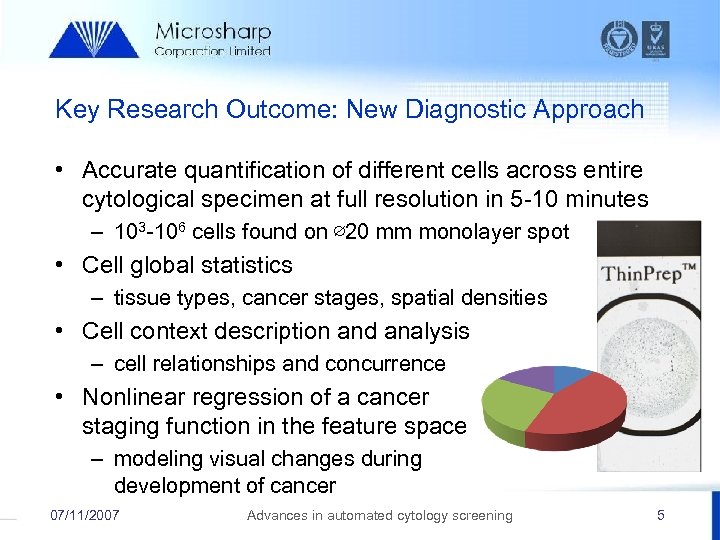 Key Research Outcome: New Diagnostic Approach • Accurate quantification of different cells across entire cytological specimen at full resolution in 5 -10 minutes – 103 -106 cells found on ∅20 mm monolayer spot • Cell global statistics – tissue types, cancer stages, spatial densities • Cell context description and analysis – cell relationships and concurrence • Nonlinear regression of a cancer staging function in the feature space – modeling visual changes during development of cancer 07/11/2007 Advances in automated cytology screening 5
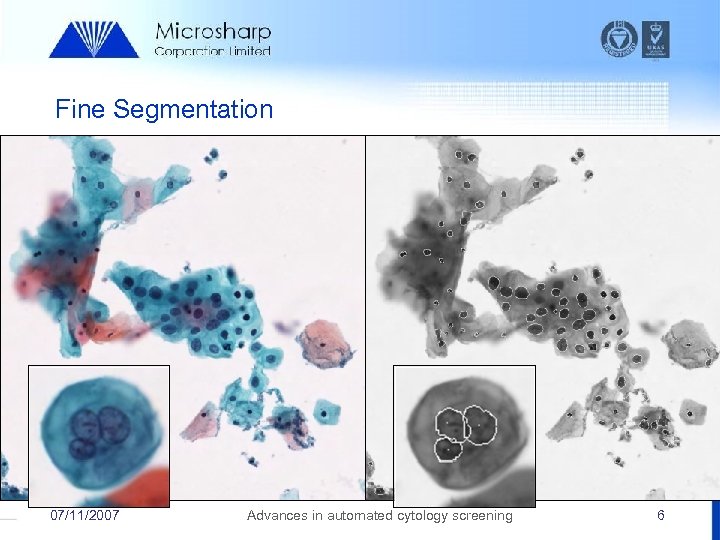 Fine Segmentation 07/11/2007 Advances in automated cytology screening 6
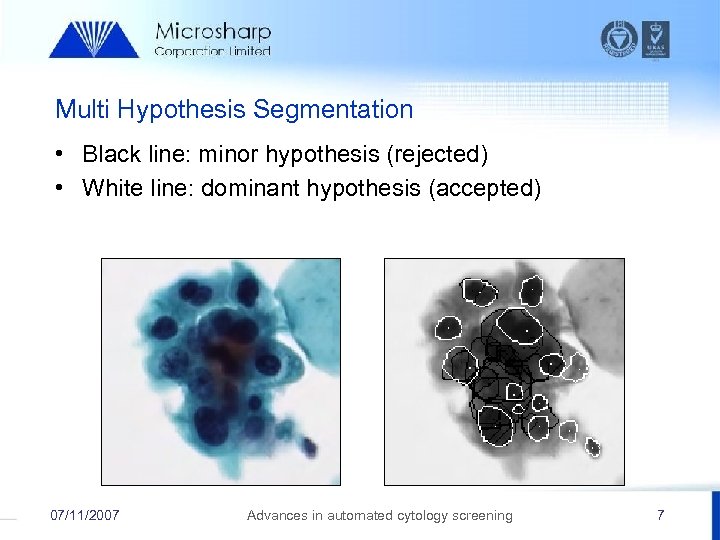 Multi Hypothesis Segmentation • Black line: minor hypothesis (rejected) • White line: dominant hypothesis (accepted) 07/11/2007 Advances in automated cytology screening 7
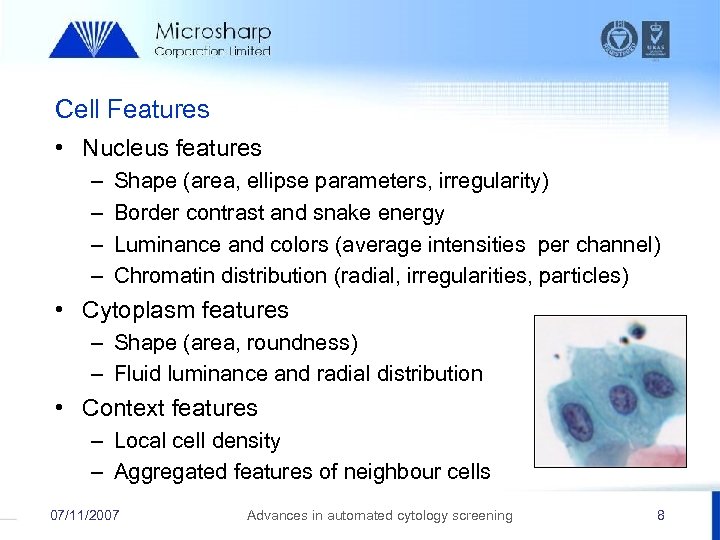 Cell Features • Nucleus features – – Shape (area, ellipse parameters, irregularity) Border contrast and snake energy Luminance and colors (average intensities per channel) Chromatin distribution (radial, irregularities, particles) • Cytoplasm features – Shape (area, roundness) – Fluid luminance and radial distribution • Context features – Local cell density – Aggregated features of neighbour cells 07/11/2007 Advances in automated cytology screening 8
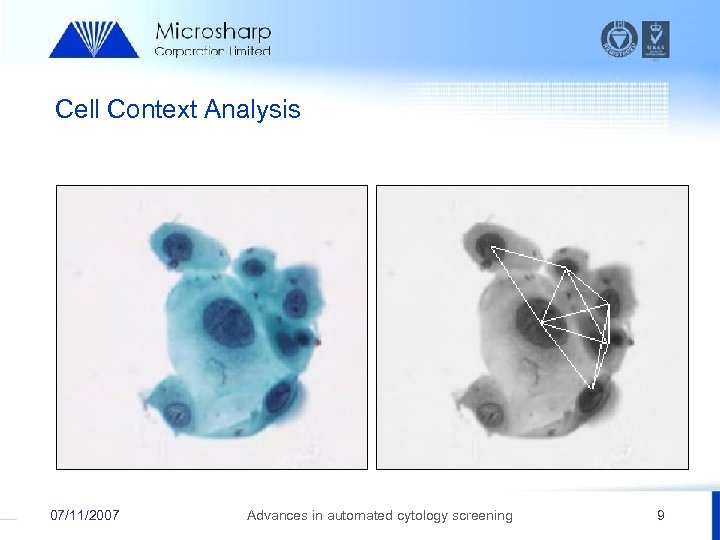 Cell Context Analysis 07/11/2007 Advances in automated cytology screening 9
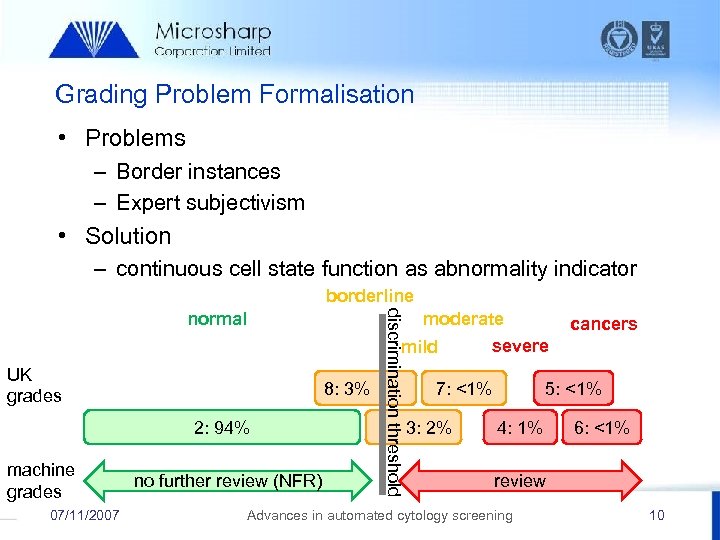 Grading Problem Formalisation • Problems – Border instances – Expert subjectivism • Solution – continuous cell state function as abnormality indicator borderline discrimination threshold normal moderate mild UK grades 8: 3% 2: 94% machine grades 07/11/2007 no further review (NFR) severe 7: <1% 3: 2% cancers 5: <1% 4: 1% 6: <1% review Advances in automated cytology screening 10
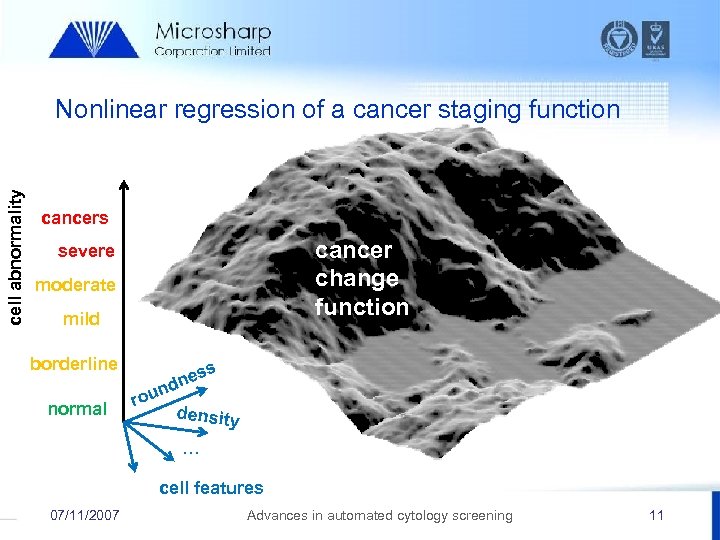 cell abnormality Nonlinear regression of a cancer staging function cancers cancer change function severe moderate mild borderline normal s nes nd rou density … cell features 07/11/2007 Advances in automated cytology screening 11
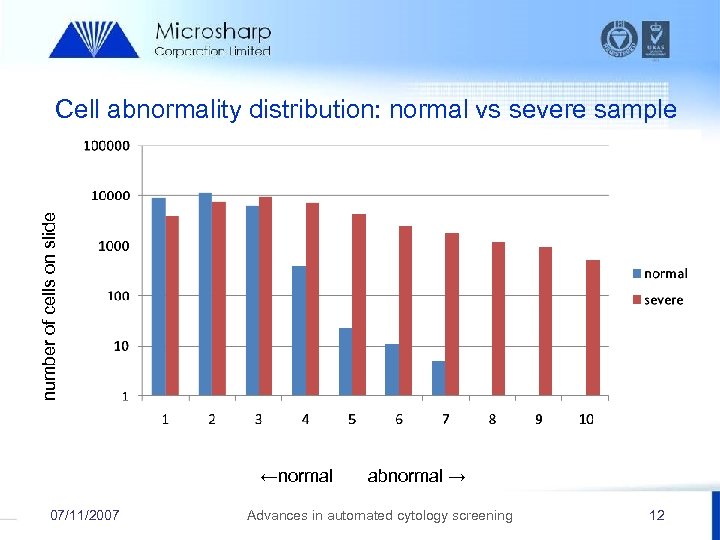 number of cells on slide Cell abnormality distribution: normal vs severe sample ←normal 07/11/2007 abnormal → Advances in automated cytology screening 12
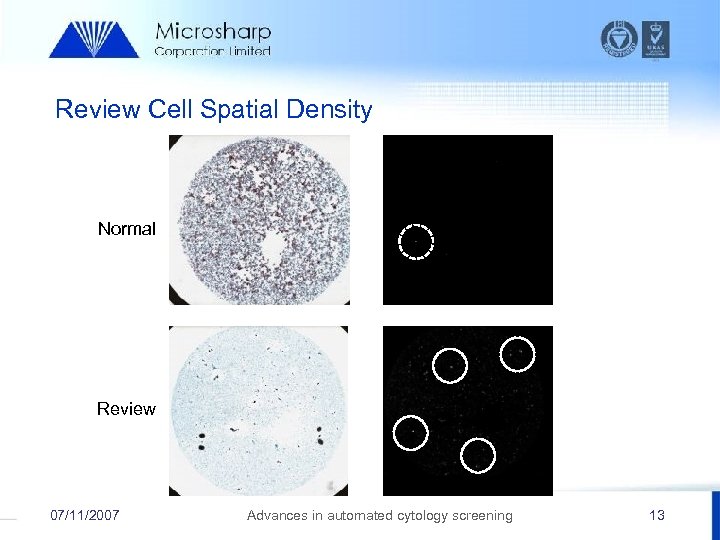 Review Cell Spatial Density Normal Review 07/11/2007 Advances in automated cytology screening 13
 Knowledge Database Problems Solved • Unbalanced dataset – majority normals taking over important reviews • False positive and false negative error types are not assigned different weights during classifier optimization • Lack of ground truth, highly variable image quality • Borderline objects – on one side: are very important for earlier diagnostics – on the other side: cannot be used for training and system optimization 07/11/2007 Advances in automated cytology screening 14
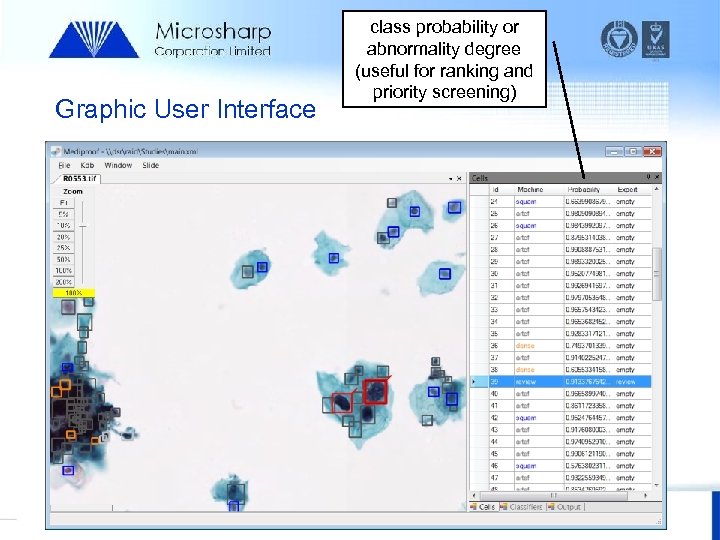 Graphic User Interface 07/11/2007 class probability or abnormality degree (useful for ranking and priority screening) Advances in automated cytology screening 15
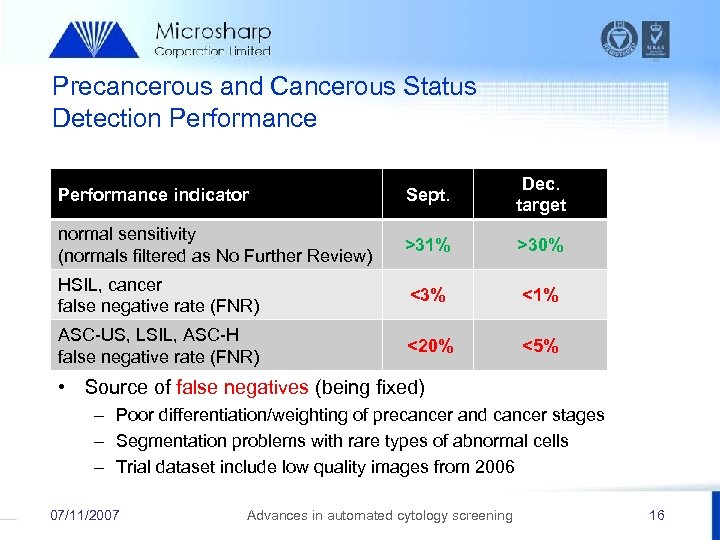 Precancerous and Cancerous Status Detection Performance indicator Sept. Dec. target normal sensitivity (normals filtered as No Further Review) >31% >30% HSIL, cancer false negative rate (FNR) <3% <1% ASC-US, LSIL, ASC-H false negative rate (FNR) <20% <5% • Source of false negatives (being fixed) – Poor differentiation/weighting of precancer and cancer stages – Segmentation problems with rare types of abnormal cells – Trial dataset include low quality images from 2006 07/11/2007 Advances in automated cytology screening 16
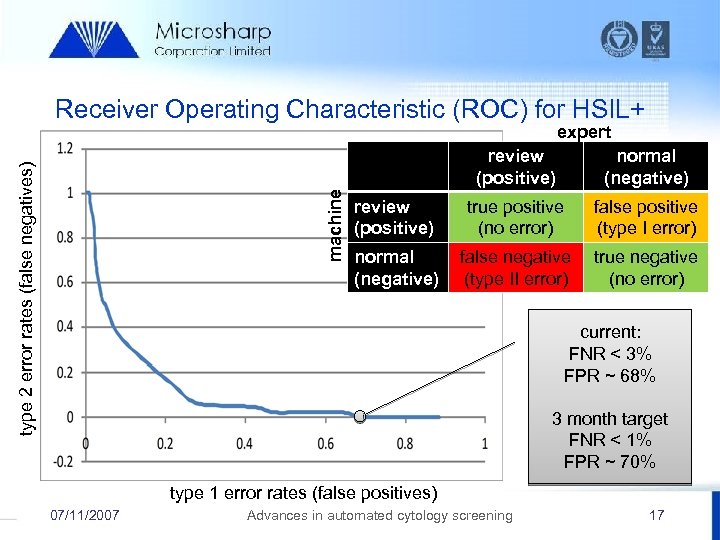 Receiver Operating Characteristic (ROC) for HSIL+ expert machine type 2 error rates (false negatives) review (positive) normal (negative) review (positive) true positive (no error) false positive (type I error) normal (negative) false negative (type II error) true negative (no error) current: FNR < 3% FPR ~ 68% 3 month target FNR < 1% FPR ~ 70% type 1 error rates (false positives) 07/11/2007 Advances in automated cytology screening 17
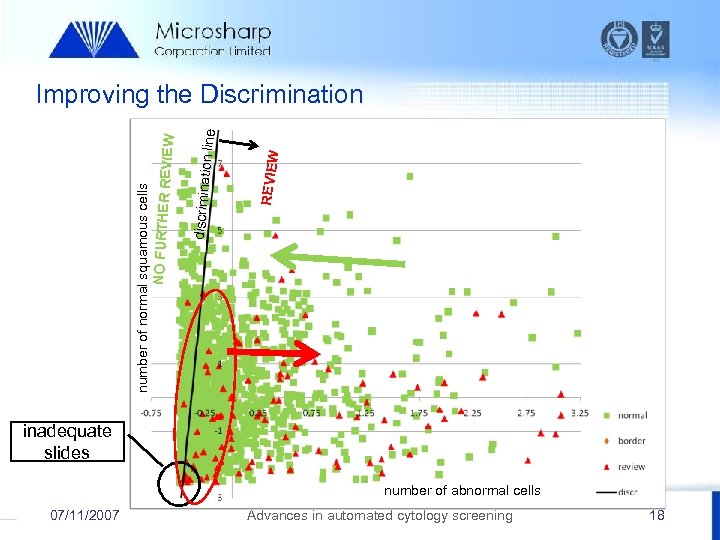 REVIEW discrim inati on line number of normal squamous cells NO FURTHER R EVIEW Improving the Discrimination inadequate slides number of abnormal cells 07/11/2007 Advances in automated cytology screening 18
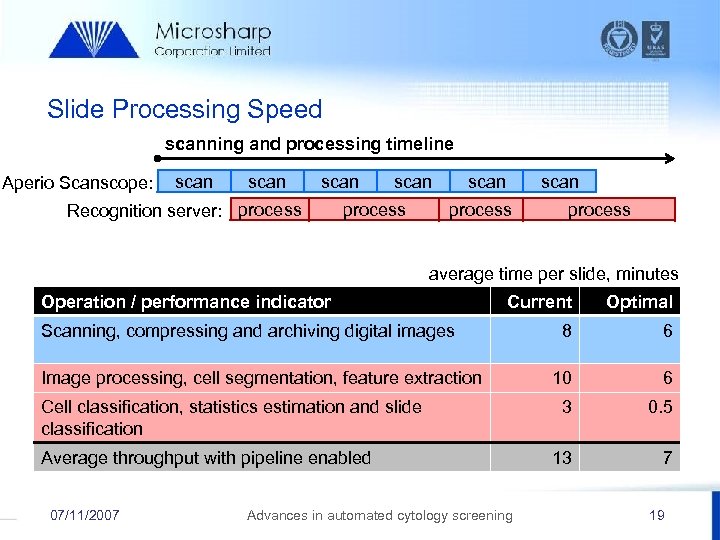 Slide Processing Speed scanning and processing timeline Aperio Scanscope: scan Recognition server: process scan process average time per slide, minutes Operation / performance indicator Current Optimal 8 6 10 6 3 0. 5 13 7 Scanning, compressing and archiving digital images Image processing, cell segmentation, feature extraction Cell classification, statistics estimation and slide classification Average throughput with pipeline enabled 07/11/2007 Advances in automated cytology screening 19
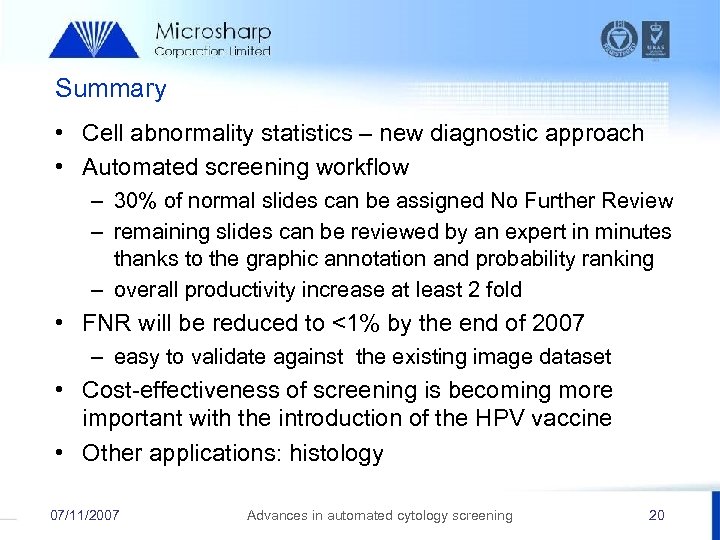 Summary • Cell abnormality statistics – new diagnostic approach • Automated screening workflow – 30% of normal slides can be assigned No Further Review – remaining slides can be reviewed by an expert in minutes thanks to the graphic annotation and probability ranking – overall productivity increase at least 2 fold • FNR will be reduced to <1% by the end of 2007 – easy to validate against the existing image dataset • Cost-effectiveness of screening is becoming more important with the introduction of the HPV vaccine • Other applications: histology 07/11/2007 Advances in automated cytology screening 20
 Summary: Digital Era Solution • Compact and flexible storage of clinical data • Remote access over a standard broadband – remote screening – easier multi-peer review and multi-site collaboration • Ideal for clinical studies and education • Feasible solution for the developing world and sparse/remote countries 07/11/2007 Advances in automated cytology screening 21
 BACKUP SLIDES 07/11/2007 Advances in automated cytology screening 22
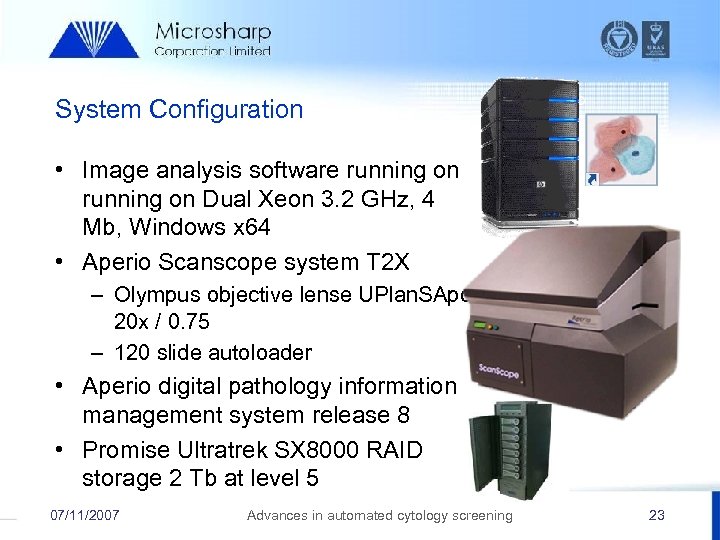 System Configuration • Image analysis software running on Dual Xeon 3. 2 GHz, 4 Mb, Windows x 64 • Aperio Scanscope system T 2 X – Olympus objective lense UPlan. SApo 20 x / 0. 75 – 120 slide autoloader • Aperio digital pathology information management system release 8 • Promise Ultratrek SX 8000 RAID storage 2 Tb at level 5 07/11/2007 Advances in automated cytology screening 23
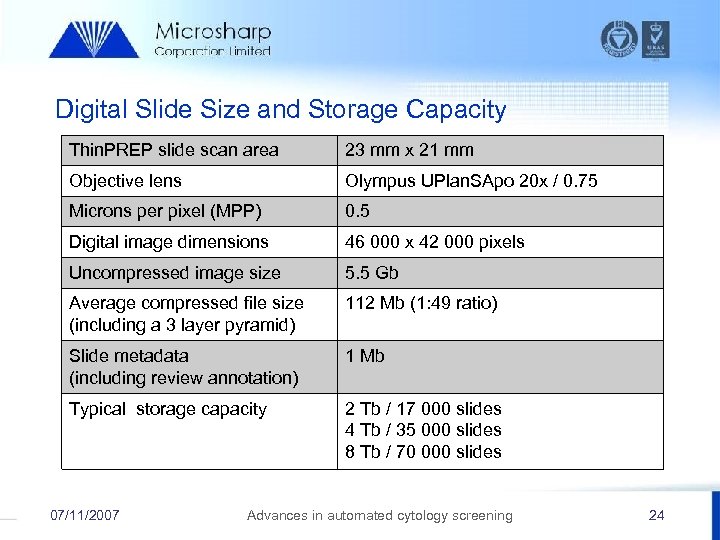 Digital Slide Size and Storage Capacity Thin. PREP slide scan area 23 mm x 21 mm Objective lens Olympus UPlan. SApo 20 x / 0. 75 Microns per pixel (MPP) 0. 5 Digital image dimensions 46 000 x 42 000 pixels Uncompressed image size 5. 5 Gb Average compressed file size (including a 3 layer pyramid) 112 Mb (1: 49 ratio) Slide metadata (including review annotation) 1 Mb Typical storage capacity 2 Tb / 17 000 slides 4 Tb / 35 000 slides 8 Tb / 70 000 slides 07/11/2007 Advances in automated cytology screening 24