


 Скачать презентацию Pathologies of Congressional Elections Large districts
0407443133a56ddefa2f5a94a5371038.ppt
- Количество слайдов: 23
 Pathologies of Congressional Elections • Large districts – Solution? Increase number of members in House • Benefit: more responsiveness/more contact • Costs: More collective action problems • Incumbency advantage – Solution: term limits • Benefit: more turnover • Costs: lose experience/expertise; official would have little incentive to be responsive during last term • Pork Barrel Politics • Special Interest Influence
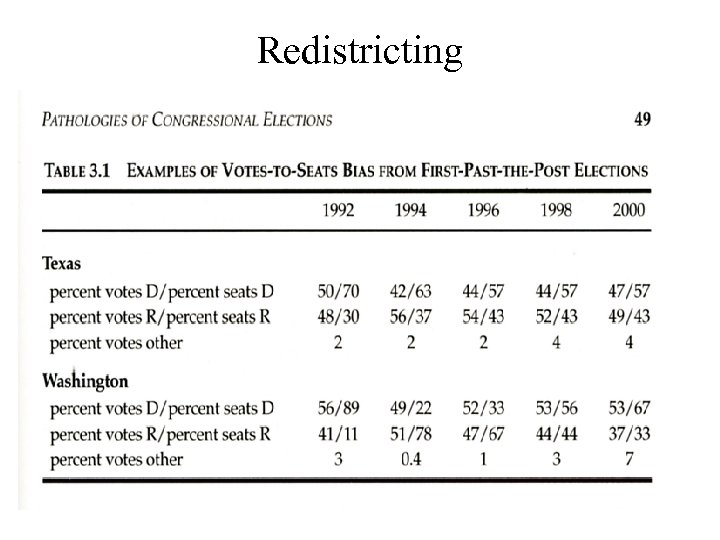 Redistricting
 Are there better ways to elect Congress? • • • Nebraska Model: Team Ticket: Term Limits: Proportional Representation: Increasing the size of the U. S. House:
 Nebraska Model: Unicameral Legislature Why have a bicameral legislature? County Representation? Gridlock
 Team Ticket: -Vote for Party, not candidate -Party/Issue centered campaigns -Easier to vote, less information required -Women and Minorities may find it easier to get elected
 Term Limits -Creates more “open” seats, therefore increases electoral competitions -Women and Minorities have found it easier to get elected (more open seats) -Legislators more likely to support policies for the good of their state, not just their district -Only wealthy people can take time off of career and server for 2 terms. -Do we want to make popular, hard working legislators leave? -If you know you have to find a job next year, do you support legislation helpful to corporations hoping you will get a job? -Weakens Parties, who becomes the party leader if you only stay on for 2, 3 terms. No one with institutional history of how things are done. Strengthens bureaucracy
 Proportional Representation What is it? : What would need to be done? : Multiple members per district (at least 3) Types of PR: Mixed Member Proportional (SMPD & PR seats) Single Transferable Vote (rank order) Cumulative voting (multiple votes)
 More Parties (oh no!!!) Higher voter turnout More perspectives included More distinctive parties Party/Issue centered elections/campaigns More descriptive representation Citizens more satisfied More polarized MORE GRIDLOCK Give smaller parties too much influence Unstable Coalitions
 Increase # of members in U. S. House • Germany, Brazil, Russia, Japan, Mexico, Fance, Italy, UK, Poland, all have more members even though they have smaller populations • Prior to 1915, the House grew in tandem with the population • Only India (a nation of over 1 billion people) has more constituents per representative than the U. S. • Has the U. S. become the second most “underrepresentative” democracy in the world?
 Why did the U. S. House stop growing? • House stopped growing in order to dilute the growing influence of immigrant voters (so new districts wouldn’t be created that might contain a majority of immigrants) • Members felt they would have less influence if the House kept growing. Better to be one voice in a group of 435 then a voice in a group of 650. • Must divide the “pie” into more pieces
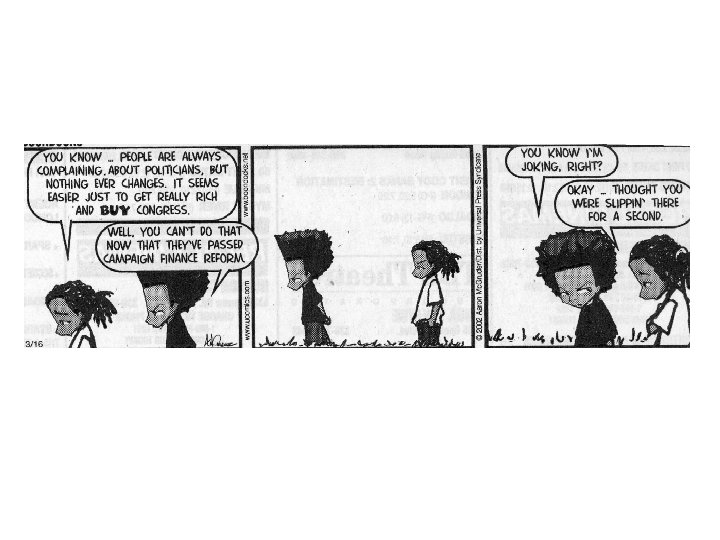
 Types of Reforms • Transparency: Disclosure of sources of money and information • Public Subsidies to parties • Limits on expenditures and contributions • Force networks to give reduced cost/free TV time
 Transparency • Citizens need to know the source of money and info to judge the legitimacy of information or policies (Quality information) • Non-profit groups (527 groups) not required to follow disclosure requirements. (this may be changing) • Issue ads – Republicans for Clean Air, Coalition for Student Loan Reform
 Public Subsidies • Benefit: Reduce dependence on large contributions to individuals • Costs: Makes parties creatures of the state? • Example: Minnesota – 53% of publicly funded candidates win – Citizen control ($50 rebate) – Helpful to third parties (Jesse “the body” Ventura)
 Limits on Spending and Expenditures • Bipartisan Campaign Finance Reform Act – No issue ads within 60 days of election – Disclosure of source of funds for ads – Limits contributions from certain PACs to candidates and parties • Enforcement? : 1974 Federal Election Campaign Act • Benefits:
 Free TV ads • Networks made almost $1 billion in 2000 • Charge candidates more than the standard rates • So? supply & demand or Airwaves belong to the people. • Senator Torecelli (D-NY) proposal approved by Senate • Broadcasters donated over $1. 5 million and the House kills the proposal.
 The American Policy Context A. Separation of Powers B. Limits to Popular Sovereignty - Electoral College - Indirect election of Senators - Difficult to Amend Constitution - Supreme Court – appointed/life term C. Judicial Review
 Decentralization vs. Centralization of Power • Separation of Executive/Legislature • Federalism • Independent Courts
 Separation of Power A. Fragmentation of power -Legislature, executive, judicial branches -Most western democracies have a more centralized form of government -Presidential vs. Parliamentary system -Judicial Review B. Federalism: -Powers are also shared with the state and local governments -In contrast – Unitary system (e. g. Germany) -Fed. Govt. has ”enumerated” or delegated powers -What does that mean (heart of political debate)
 Who do you trust? • • • National State Local Elected/Unelected Reform/Changes?
 ANALYIZING FEDERALISM A. Alexis de Tocqueville (1831 -2) - nations need centralized power - people prefer one central government - too complicated to understand - Majority of the Tyranny - Reduces Military capacity - Government too weak to intervene in internal conflicts (almost right) -Incapable of adapting to growing diverse population
 B. Ramifications of Federalism - could increase representation - reverse could be true (lower govt. captured) - less quality/visible information on lower govts. - less accountability - lack of national standards = inequality - “Laboratory of Democracy” - Dispersed Costs/Concentrated Benefits - Multiple Access Points – enhance democracy?
 C. Federalism and Modern Politics - Eisenhower and the dictatorial centralization - Johnson’s Great Society - Nixon’s New Federalism - Carter – new agencies (Energy & Education) - Reagan and General Revenue Sharing - Clinton – National Health Care - Centralized solutions to problems v. Devolution