


 Скачать презентацию Pathologic Protozoa CHARACTERISTICS OF PROTOZOA 1 Unicellular
Trypanosoma_Lieushmania.ppt
- Количество слайдов: 65
 Pathologic Protozoa
 CHARACTERISTICS OF PROTOZOA 1. Unicellular 2. Chemoheterotrophs (get their energy by breaking down organic matter). 3. Most ingest their food; thus, they have special structures for this.
 CHARACTERISTICS OF PROTOZOA 4. The vegetative form is the TROPHOZOA (tropho = movement; zoite = animal; they move like an animal). Trophozoa have special organelles for movement. 5. Capable of reproduction A. Asexual: fission, budding, or schizogony (produces a large number of trophozoites) B. Sexual: conjugation
 CHARACTERISTICS OF PROTOZOA 6. Some produce cysts. These are not tissue cysts like a human gets under their skin; protozoa cysts are cellular. They have a thick cell wall that allows for survival in harsh environments better than the trophozoite form.
 PROTOZOA CYSTS Cysts are not as resistant as a bacterial endospore. You can kill cysts by boiling them. They can live in the soil or water for months. A cyst is no motile, so it is not trophozoic. A cyst does not procure its nutrients or ingest food, but it can absorb nutrients. It has no organelles to ingest food.
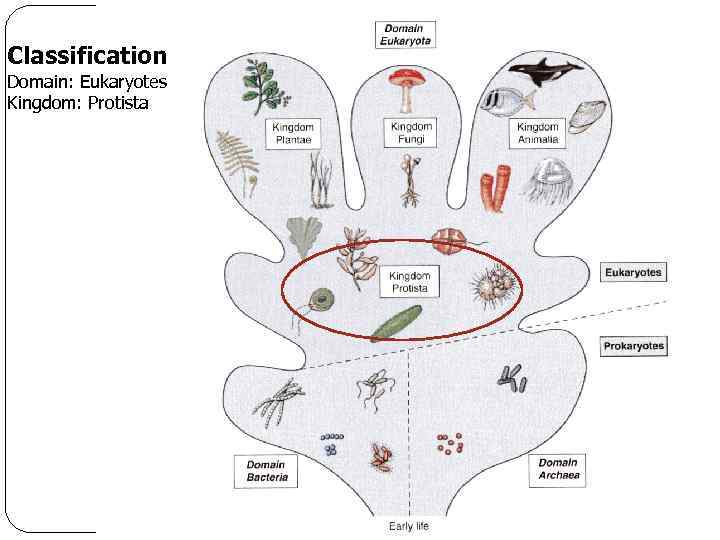 Classification Domain: Eukaryotes Kingdom: Protista
 Classification Traditional classification of protozoa phylae was based on mode of locomotion. MASTIGOPHORA (flagella) CILIOPHORA (cilia) SARCODINA (amoebas) SPOROZOA (spore-formers) Apicomplexa (attachment organ)
 Modern Classification Modern classification of protozoa is based on how they evolved and how closely related they are (phylogenetic taxonomy), as determined by their ribosomal RNA. The human pathogenic protozoa may be classified as follows: METAMONADA (multiple flagella with feeding grooves) AMOEBOZOA (amoebas) APICOMPLEXA (attachment organ) CILIOPHORA (cilia) EUGLENOZOA (flagella and disc-shaped cristae in mitochondria)
 EUGLENOZOA (older classification = Mastigophora): has flagella and its mitochondria have disc-shaped cristae Organisms Trypanosoma Disease: Trypanosomiasis Leishmania donovani Disease: Leishmaniasis
 MASTIGOPHORA DISEASES Trypanosomiasis Leishmaniasis
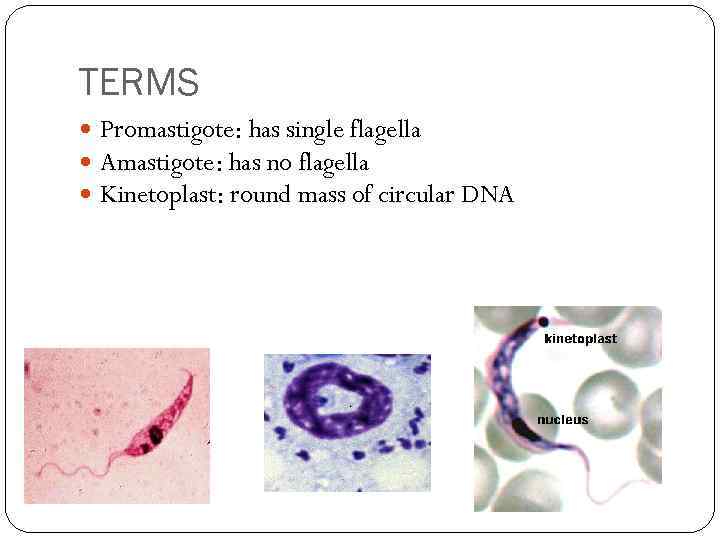 TERMS Promastigote: has single flagella Amastigote: has no flagella Kinetoplast: round mass of circular DNA
 Leishmania donovani Domain: Kingdom: Phylum: Class: Order: Genus: Species: Eukaryota Protista Mastigophora Kinetoplastida Trypanosomatida Leishmania donovani
 Leishmania donovani Disease: Leishmaniasis Vector-borne disease transmitted by sandflies.
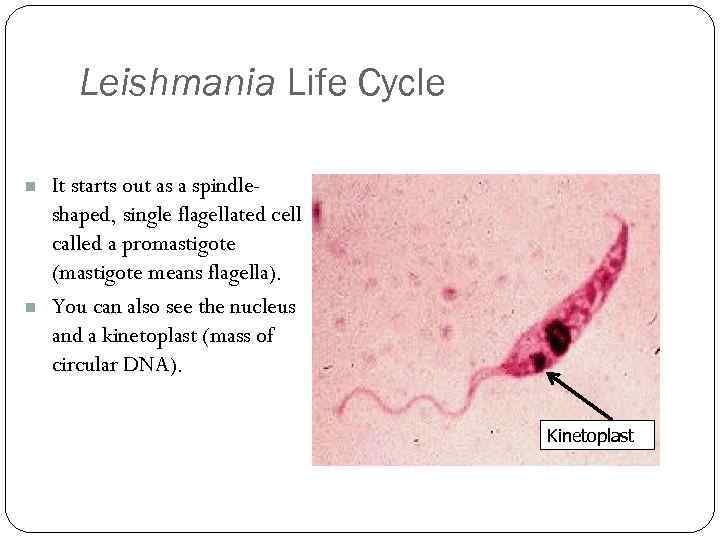 Leishmania Life Cycle It starts out as a spindleshaped, single flagellated cell called a promastigote (mastigote means flagella). You can also see the nucleus and a kinetoplast (mass of circular DNA). Kinetoplast
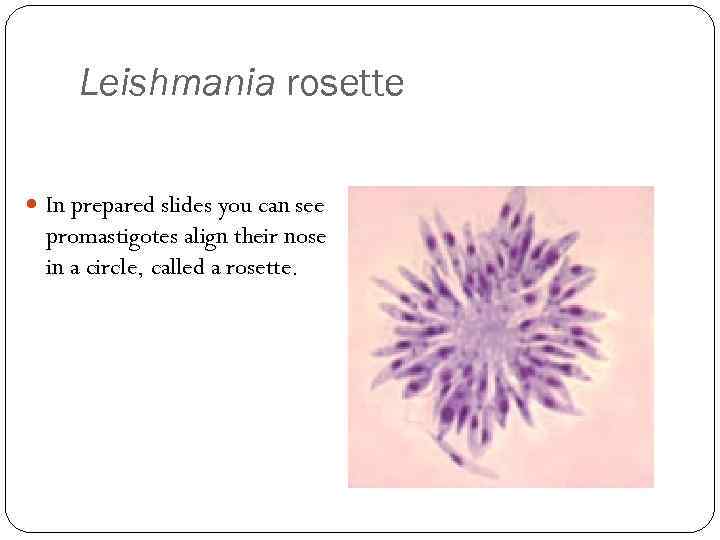 Leishmania rosette In prepared slides you can see promastigotes align their nose in a circle, called a rosette.
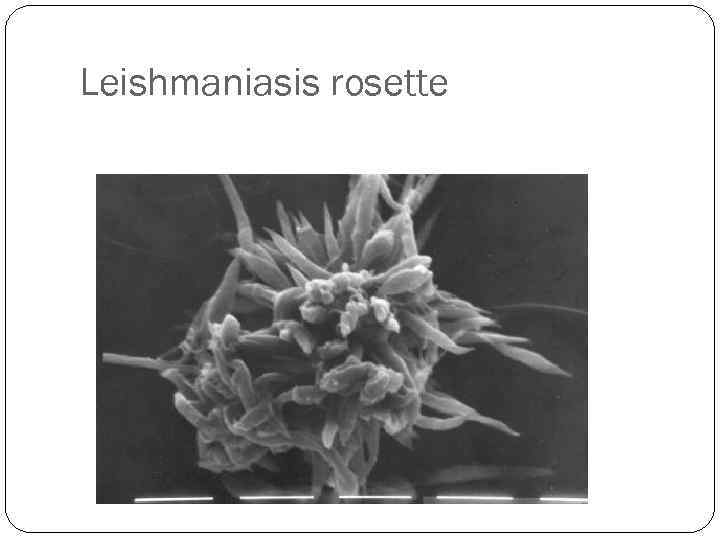 Leishmaniasis rosette
 Leishmania Life Cycle It reproduces in the gut of a female sandfly, and migrates to her proboscis (mouth part). It is introduced into the human by her bite. It then enters a macrophage and becomes intracellular. Here, it loses its flagella and is now known as an amastigote.
 Leishmaniasis These amastigotes multiply in various organs including the spleen, liver, and lymph nodes. Symptoms include lymph adenopathy, fever, weight loss, and a decrease in all blood cells. The treatment is almost as bad as the disease because of the side effects. It is best to catch it early.
 Leishmania Life Cycle The female sandflies inject the infective stage, promastigotes, during blood meals. Macrophages phagocytize them and they transform into amastigotes. Other sandflies become infected during blood meals when they ingest infected macrophages. In the sandfly's midgut, the parasites differentiate into promastigotes, which multiply and migrate to the proboscis.
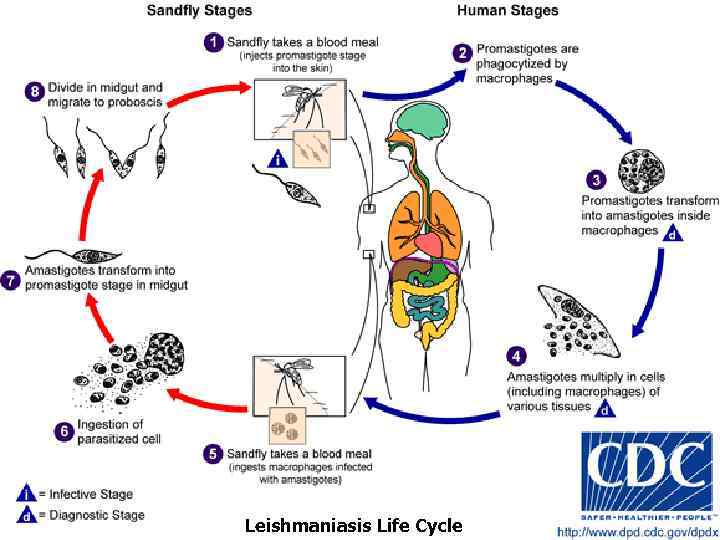 Leishmaniasis Life Cycle
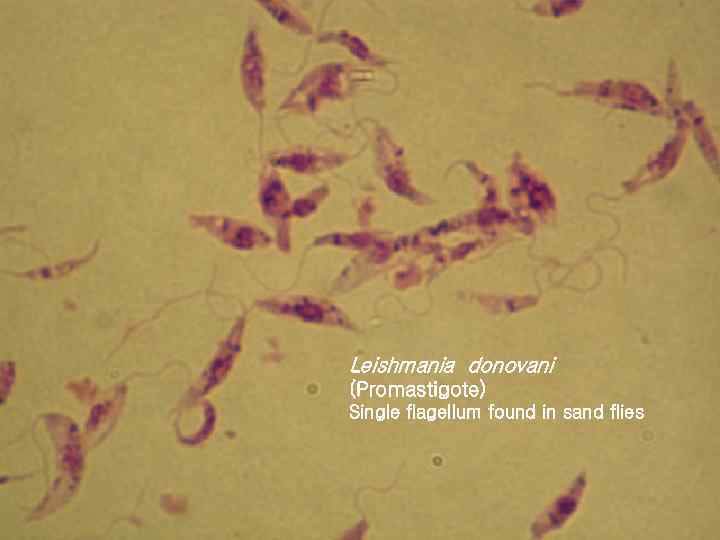 Leishmania donovani (Promastigote) Single flagellum found in sand flies
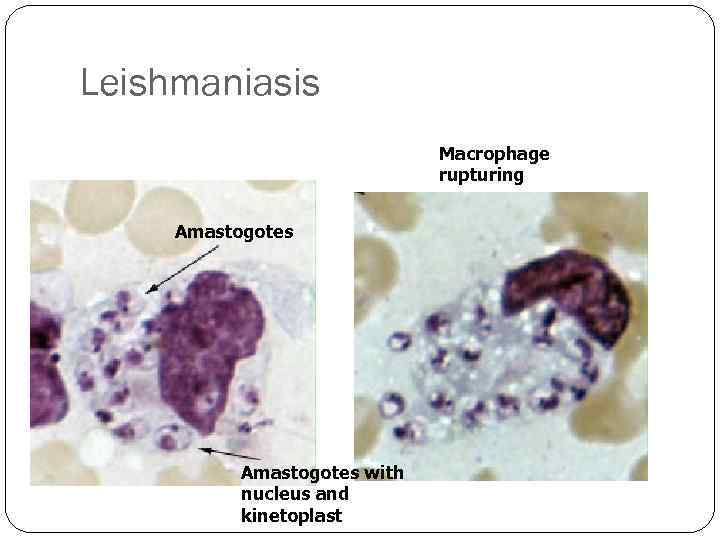 Leishmaniasis Macrophage rupturing Amastogotes with nucleus and kinetoplast
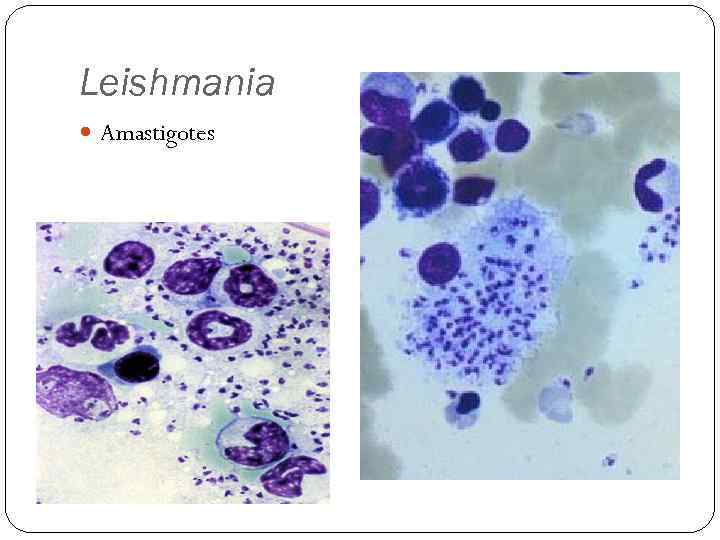 Leishmania Amastigotes
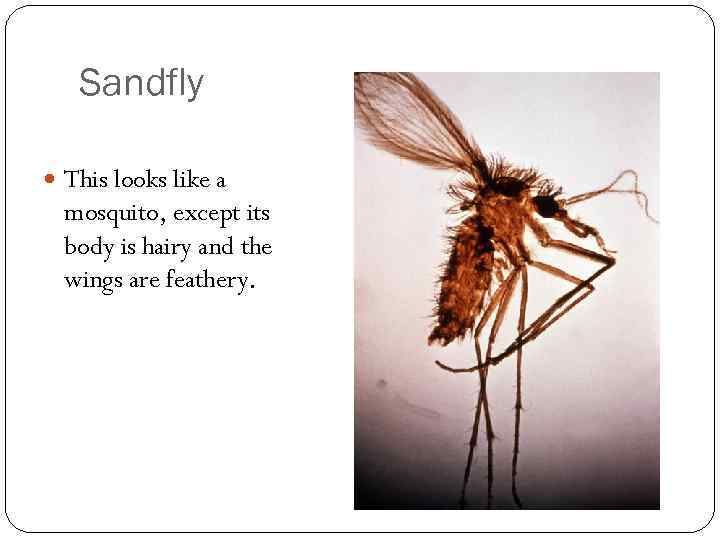 Sandfly This looks like a mosquito, except its body is hairy and the wings are feathery.
 Leishmaniasis Geographic Distribution: More than 90 percent of the world's cases of visceral leishmaniasis are in India, Bangladesh, Nepal, Sudan, and Brazil. Leishmaniasis is also found in Mexico, Central America, and South America, southern Europe, Asia, the Middle East, and Africa.
 Leishmaniasis There are three forms of Leishmaniasis: Cutaneous Mucocutaneus Visceral
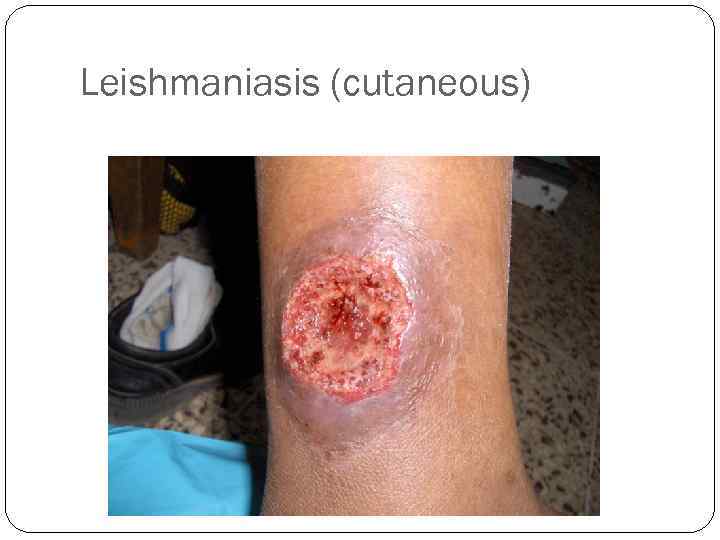
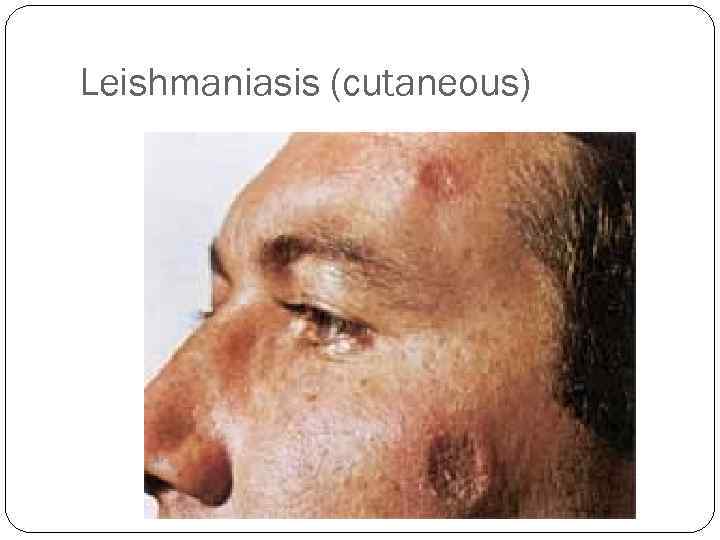
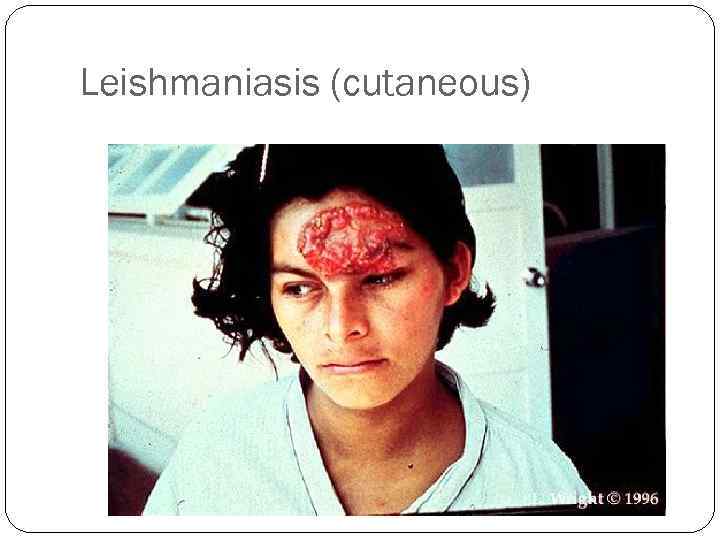
 Cutaneous Leishmaniasis The disease is only at the site of the bite. This form is seen in Texas, Mexico, Asia, and the Middle East (our Iraq troops are coming down with this form). It manifests as a large, wet sore with raised edges. It looks like a volcano with weepy serum coming out of the center. The wound is not contagious, just the sandfly bite. Dogs can get this disease, too.
 Leishmaniasis (cutaneous)
 Leishmaniasis (cutaneous)
 Leishmaniasis (cutaneous)
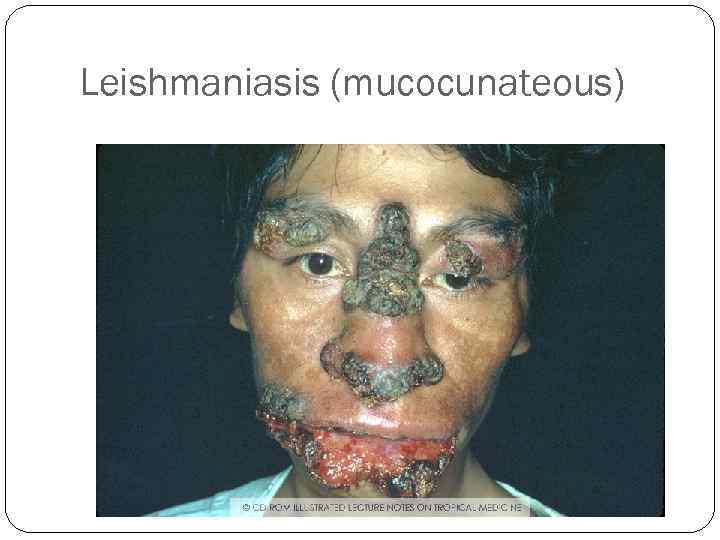
 Leishmaniasis (mucocunateous) This is when the disease located in the mucous membranes of the nose and mouth. The most gruesome photos are of this form.
 Leishmaniasis (mucocunateous)
 Leishmaniasis (visceral) This is the most serious form. It occurs especially in immunocompromised people, especially HIV patients. The amastagotes reproduce inside macrophages. Only T-cells can kill infected macrophages, but HIV is a disease that infects T-cells. This form is known as Kala Azar.
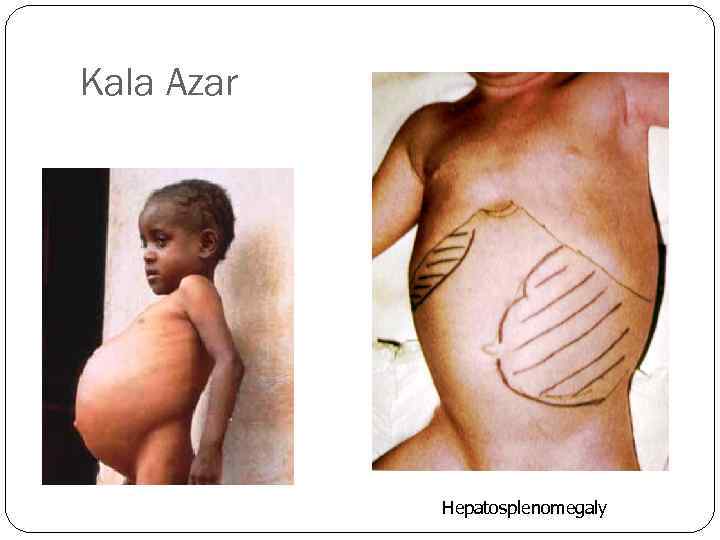 Kala Azar Hepatosplenomegaly
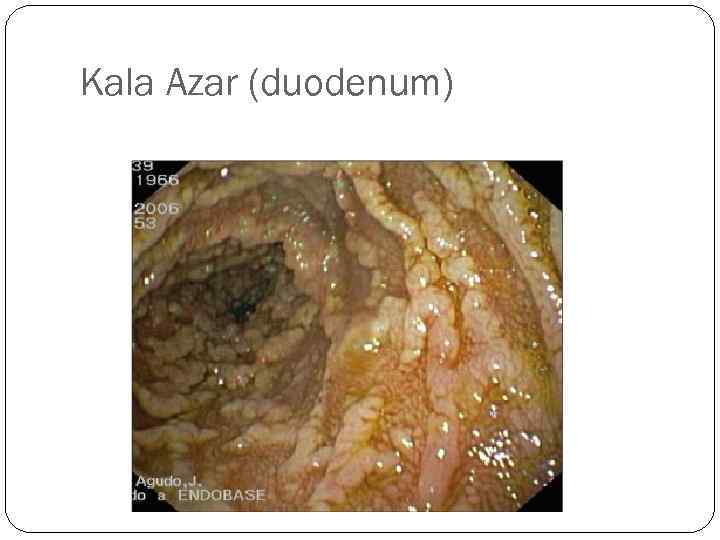 Kala Azar (duodenum)
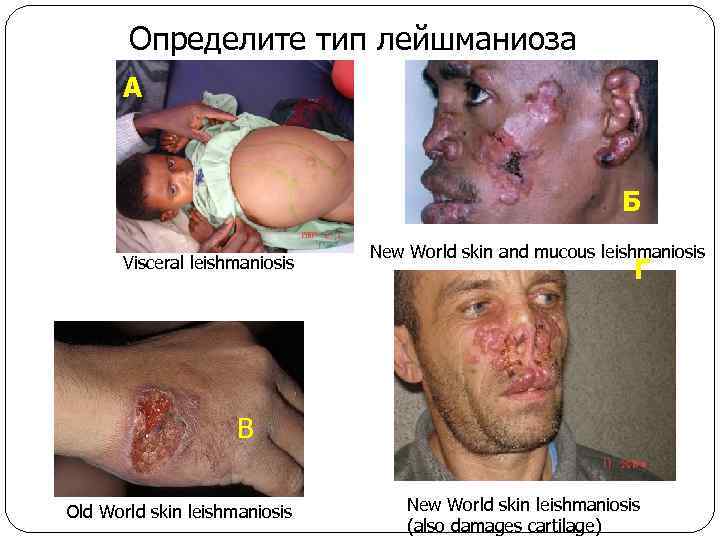 Определите тип лейшманиоза А Б Visceral leishmaniosis New World skin and mucous leishmaniosis Г В Old World skin leishmaniosis New World skin leishmaniosis (also damages cartilage)
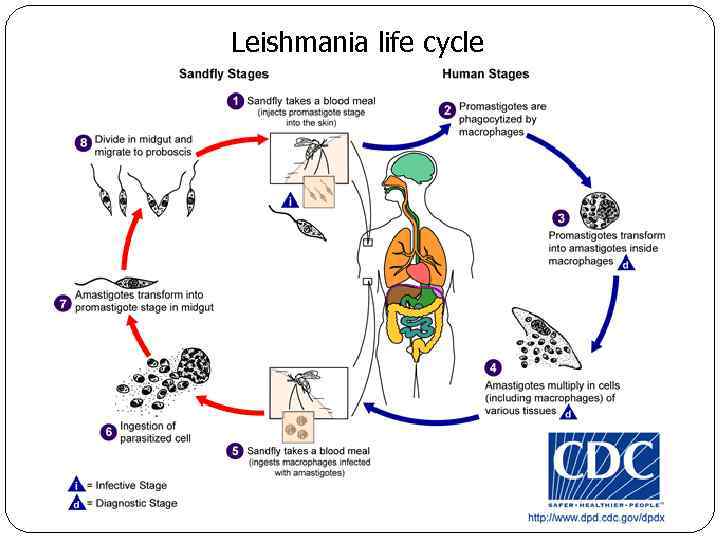 Leishmania life cycle
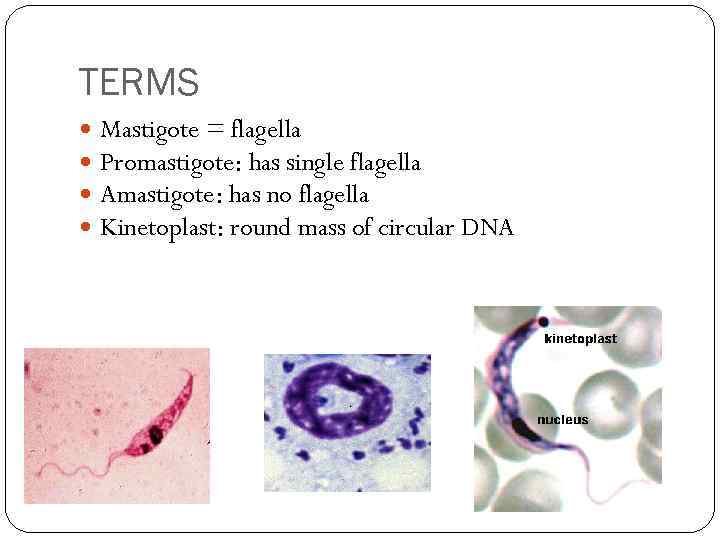 TERMS Mastigote = flagella Promastigote: has single flagella Amastigote: has no flagella Kinetoplast: round mass of circular DNA
 Trypanosomiasis African Trypanosomiasis (African Sleeping Sickness) American Trypanosomiasis (Chaga’s Disease)
 “African Sleeping Sickness” Disease: African Tryptanosomiasis Causal Agents: Trypanosoma brucei gambiense Trypanosoma brucei rhodesiense
 Geographic Distribution T. b. gambiense is found in foci in large areas of West and Central Africa. Humans are the main reservoir for Trypanosoma brucei gambiense, but this species can also be found in animals. T. b. rhodesiense is found in East and Southeast Africa. Wild game animals are the main reservoir of T. b. rhodesiense.
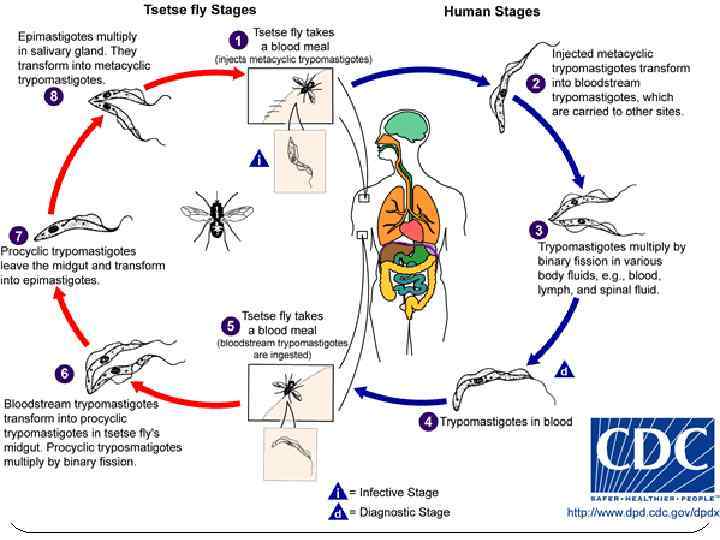
 Trypanosomiasis has a biological vector, the tsetse (pronounced “set-see”) fly. Wild animals may also be a reservoir (Zooinotic is when a disease is transmitted to animals as well as humans. )
 Trypanosomiasis The tsetse fly bites a human and injects the trypanomastigotes into the skin. This causes a chanchre (pronounced “shanker”), which is an ulcer on the skin. Then it enters the lymphatic system.
 Trypanosomiasis It is characterized by Winterbottom’s Sign: swelling of the cervical lymph nodes in the head and neck area. CNS symptoms include a shuffling gait (like a stroke victim), slurred speech, and malaise (needing to sleep longer and longer each day). They are also restless at night.
 Trypanosomiasis CNS symptoms Shuffling gait Slurred speech Malaise (sleeping all day) Treatment Melarsoprol: which has dangerous side-effects like chemostherapy. This drug requires administration with a substance called ethylene glycol, which will break down regular plastic tubing, so the drug must be administered with special plastic iv tubing.
 Trypanosoma brucei Trypomastigote stages are the only form found in patients. Posterior kinetoplast Centrally located nucleus Undulating membrane Anterior flagellum
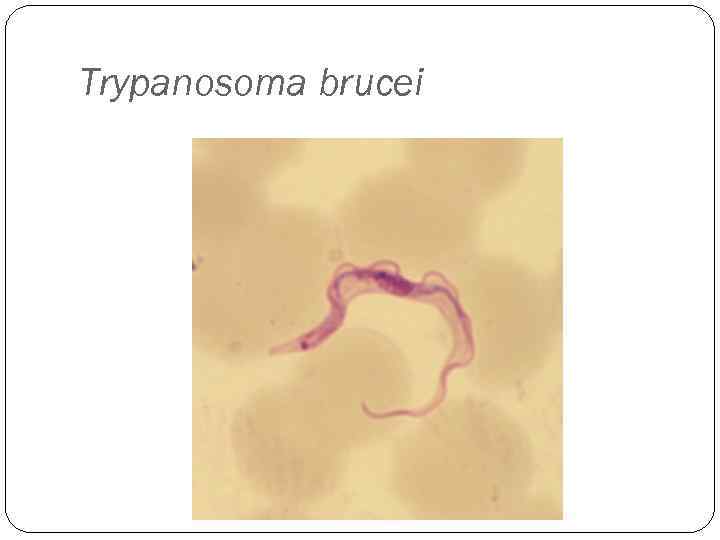 Trypanosoma brucei
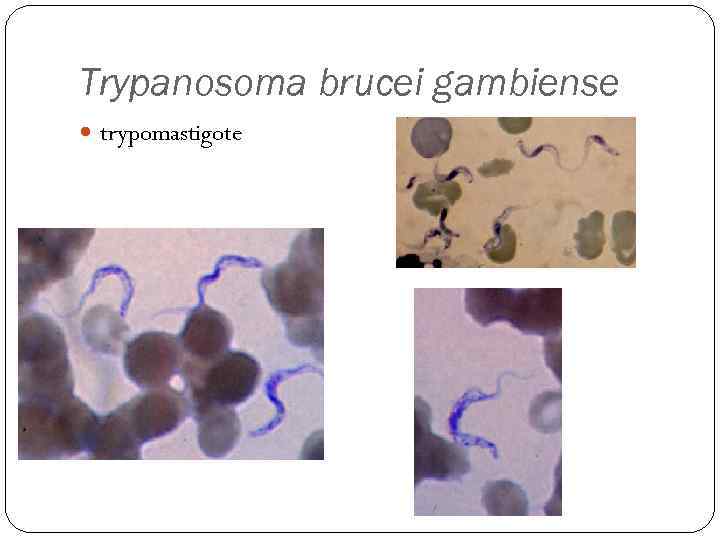 Trypanosoma brucei gambiense trypomastigote
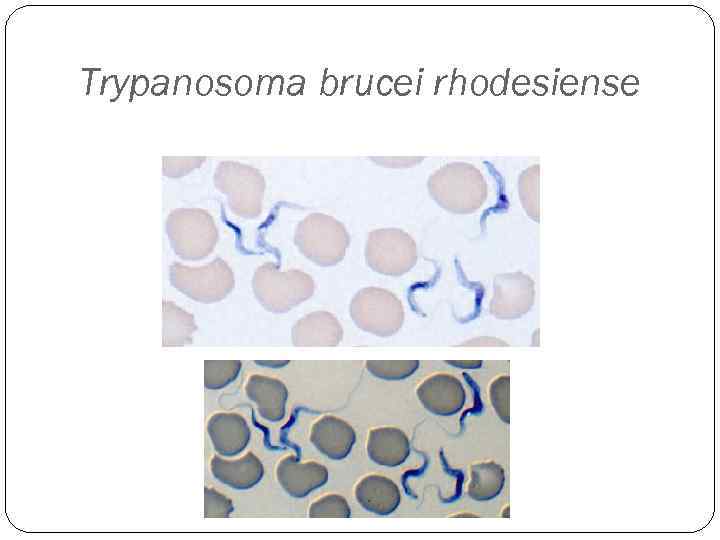 Trypanosoma brucei rhodesiense
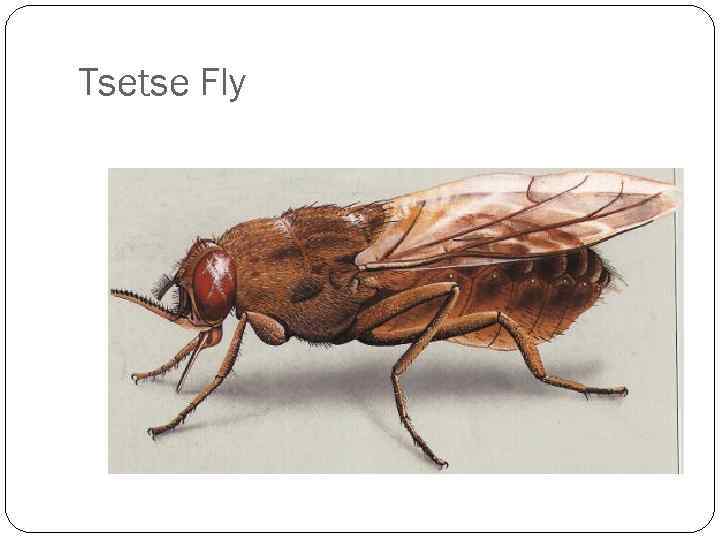 Tsetse Fly
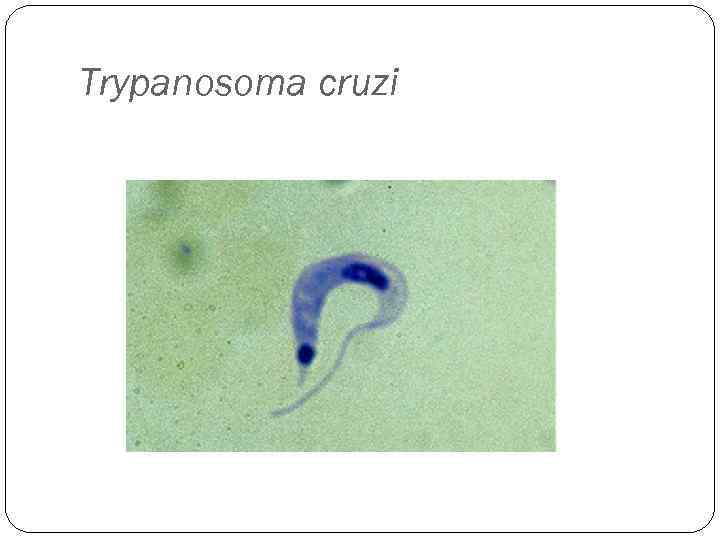
 “Chaga’s Disease” Disease: American Tryptanosomiasis A zoonotic disease (can infect animals) that can be transmitted to humans by blood-sucking bugs. Causal Agent: Trypanosoma cruzi This organism is a little smaller than T. bruceii and has a pronounced gametoplast.
 “Chaga’s Disease” This disease is NOT found in Africa. This disease is also zoonotic; it can infect animals as well as humans. The vector is a large bug called the “Kissing Bug”. It is found in warm regions and crowded areas, especially in the cracks of adobe huts. It comes out at night and crawls on a human while they sleep.
 “Chaga’s Disease” It prefers the lips because the blood supply is close to the surface. It sucks the blood there, but they don’t transmit the organism this way. When they suck the blood, they also defecate, and the organism is in the feces. When the human wakes up to scratch the itch, feces get into the tiny wound. This is a fecal blood route.
 “Chaga’s Disease” Symptoms include fever, anorexia, swollen lymph nodes, hepatosplenomegally (enlarged liver and spleen), and myocarditis (inflammation of the heart), which usually causes death. They also have megacolon (large colon) and megaesophagus (large esophagus).
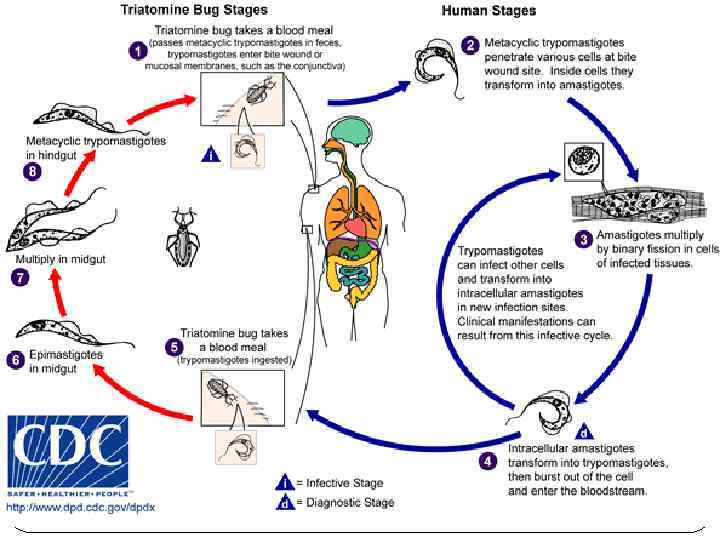
 Trypanosoma cruzi Insect vector is the “kissing” bug. It takes a blood meal and releases trypomastigotes in its feces near the site of the bite wound. Trypomastigotes enter the host through the wound or through intact mucosal membranes, such as the conjunctiva. Trypanosoma cruzi can also be transmitted through blood transfusions, organ transplantation, transplacentally, and in laboratory accidents.
 Trypanosoma cruzi Geographic Distribution: The Americas from the southern United States to southern Argentina. Mostly in poor, rural areas of Central and South America. Chronic Chagas disease is a major health problem in many Latin American countries. With increased population movements, the possibility of transmission by blood transfusion has become more substantial in the United States.
 Trypanosoma cruzi
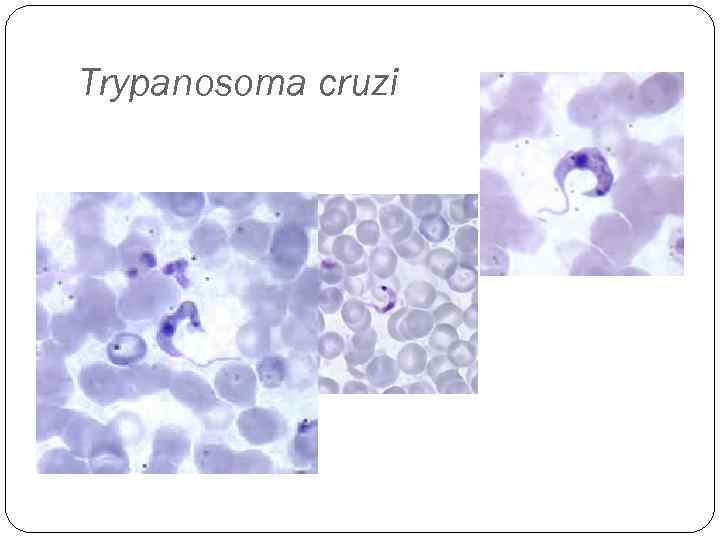 Trypanosoma cruzi
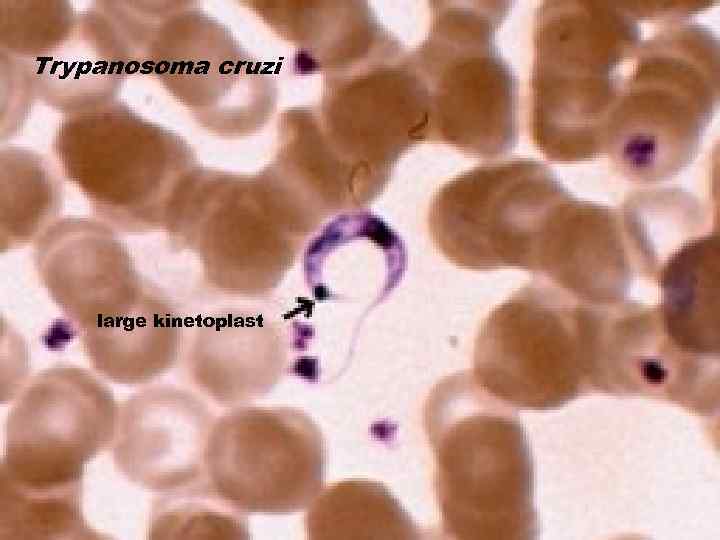 Trypanosoma cruzi large kinetoplast
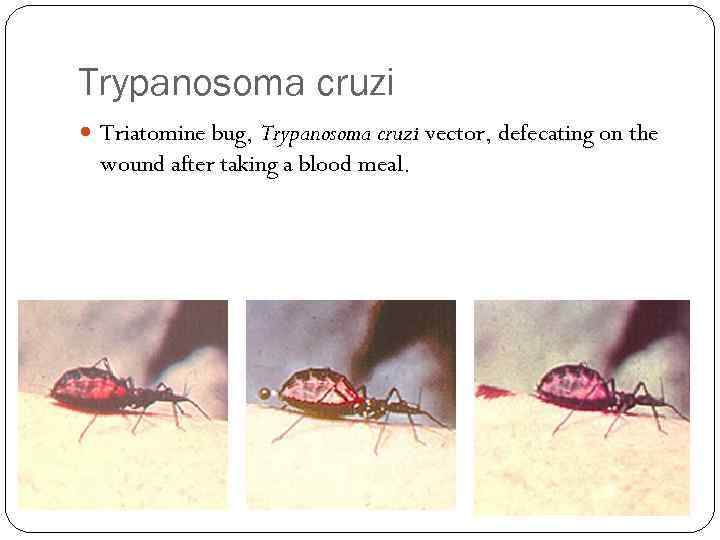 Trypanosoma cruzi Triatomine bug, Trypanosoma cruzi vector, defecating on the wound after taking a blood meal.
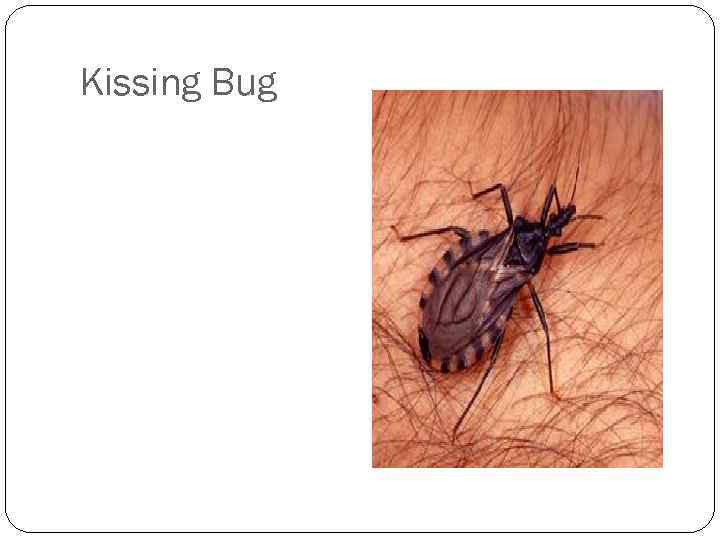 Kissing Bug
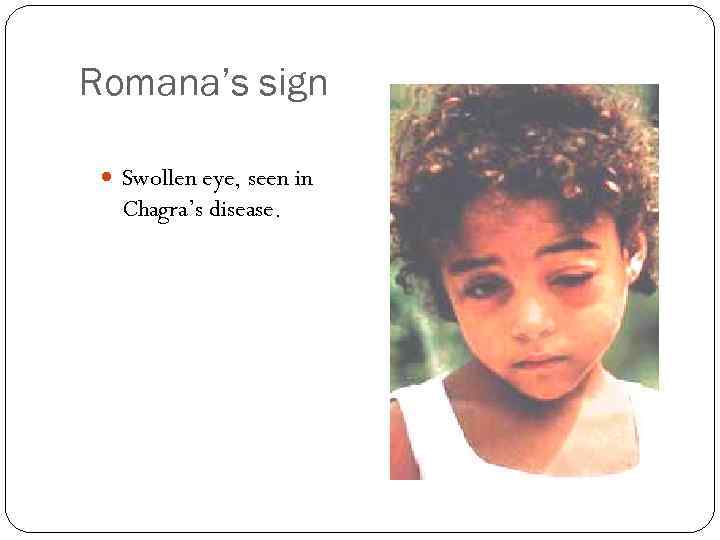 Romana’s sign Swollen eye, seen in Chagra’s disease.
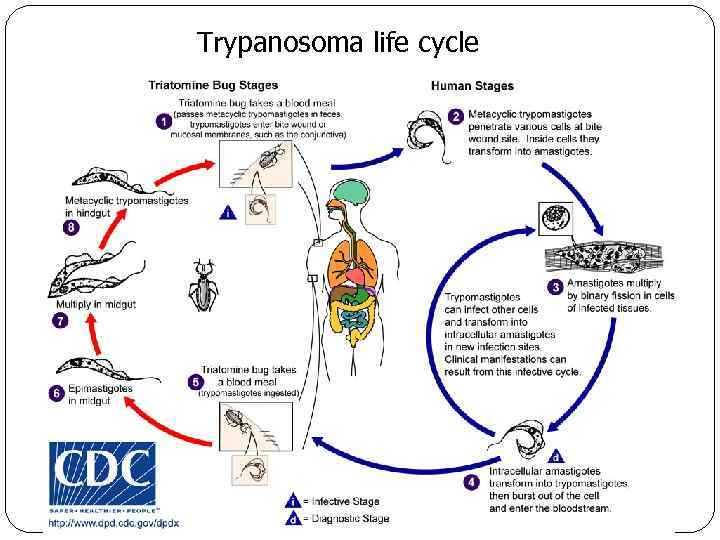 Trypanosoma life cycle