


 Скачать презентацию PATH Research on Truck Automation Technology Steven E
d2a2964859944fbdf29798807a49de65.ppt
- Количество слайдов: 45
 PATH Research on Truck Automation Technology Steven E. Shladover, Sc. D. ITFVHA Meeting Troy, MI, July 2004 1
 Outline • Motivations for truck automation research • Automatic steering for lane keeping accuracy • Automated vehicle following in platoon for lane capacity, drag reduction • Aerodynamic drag reduction results • Fuel and emissions savings 2
 Motivations for PATH Truck Research • Trucking is vital to California’s shipping industry (major ports – LA/Long Beach, Oakland) • Major ports are in most congested urban regions, imposing serious delays and unreliability into goods movement • Trucks have economic incentives to be early adopters of ITS technologies (productivity and safety) • Dedicated truck lanes under study in Los Angeles region could facilitate use of new technologies and operations 3
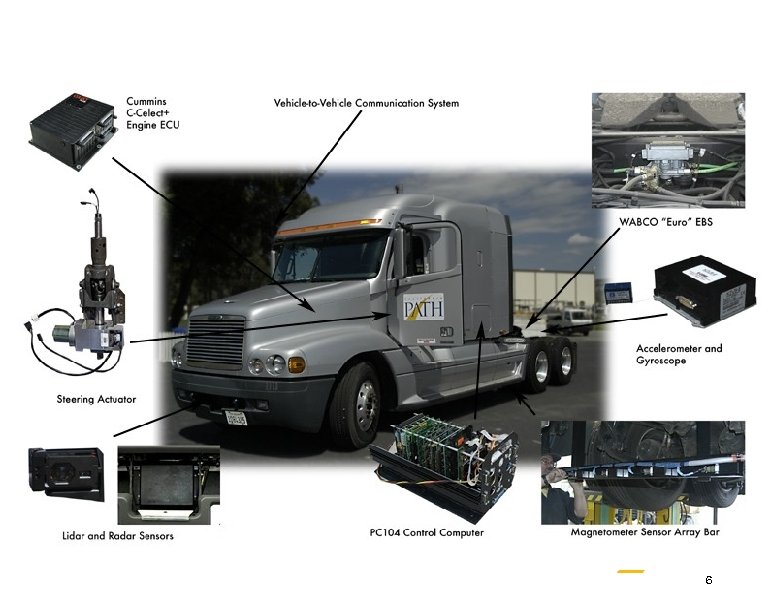
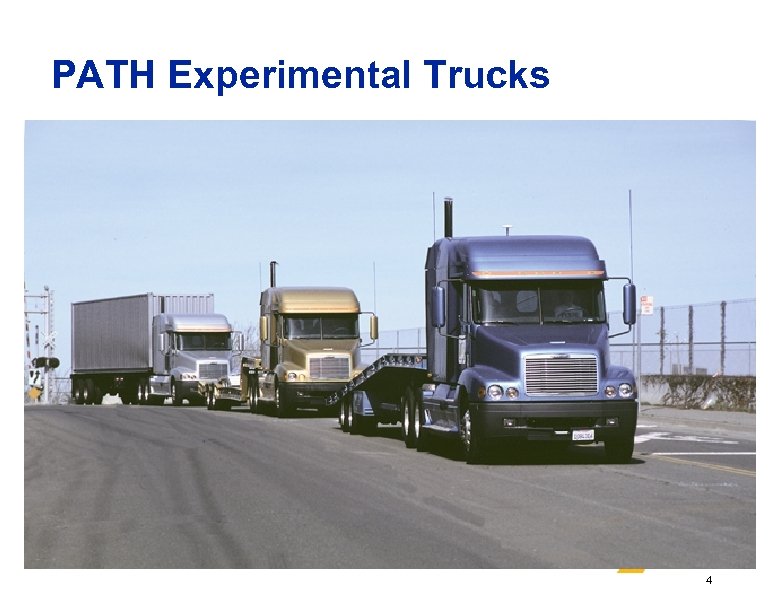 PATH Experimental Trucks 4
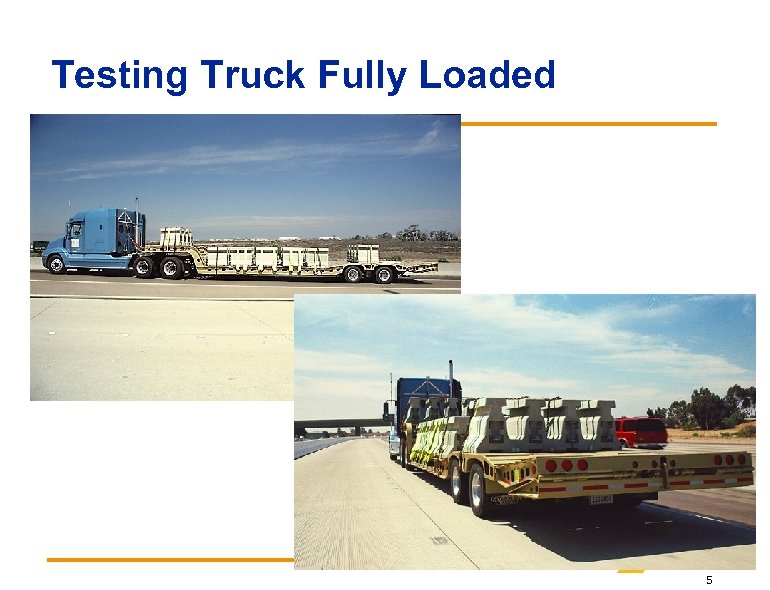 Testing Truck Fully Loaded 5
 6
6
 Automatic Steering Control • Accurate lane tracking permitting narrower dedicated truck lanes – Fit in former rail rights of way – Lower land construction costs • Enabler for fully automated driving Results • Testing on old truck at Crows Landing • Accurate lane tracking with same controller, with and without trailer 7
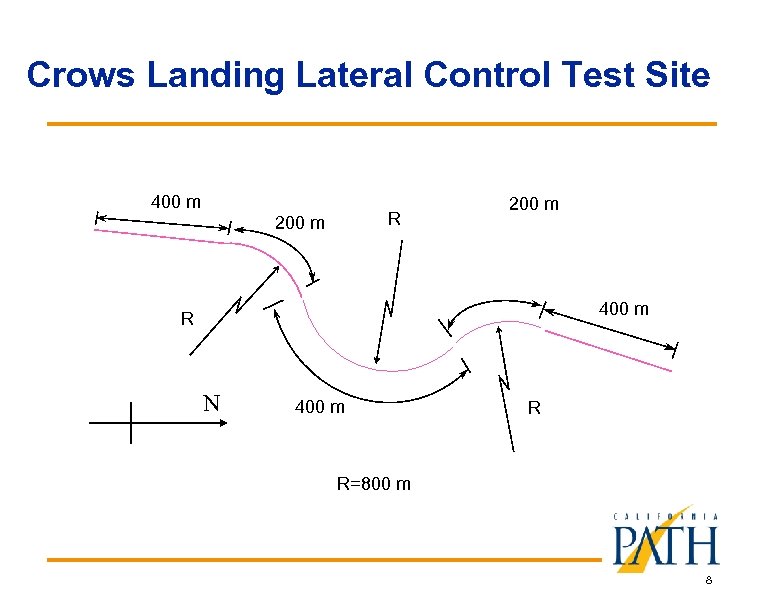 Crows Landing Lateral Control Test Site 400 m R 200 m 400 m R N 400 m R R=800 m 8
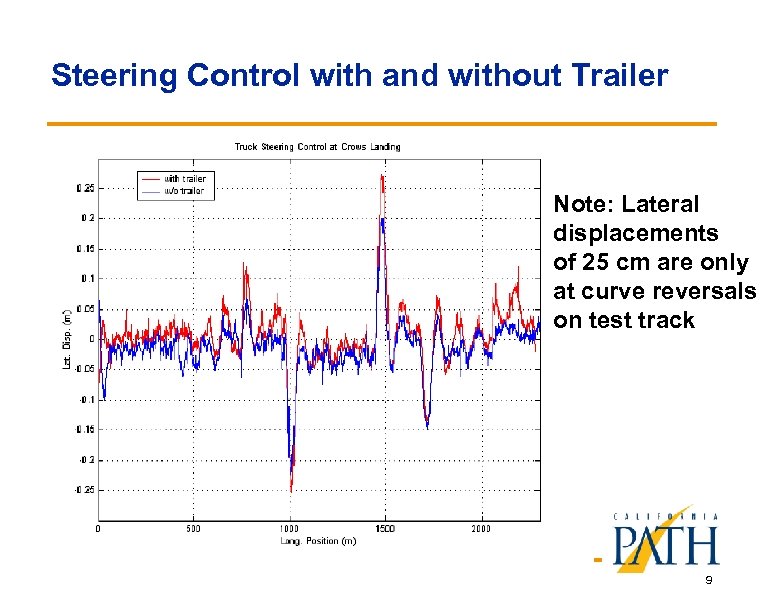 Steering Control with and without Trailer Note: Lateral displacements of 25 cm are only at curve reversals on test track 9
 Automatic Speed and Spacing Control • Cluster trucks in close-formation platoons to increase truck lane capacity (doubling of capacity using 3 -truck platoons) • Close separation has added benefits: – Drag reduction saves fuel – Drag reduction reduces emissions as well • Extensive testing of truck longitudinal control in 2003 10
 Truck Power Limitations • Maximum engine power can only provide 0. 035 g acceleration for loaded truck • Highway grades can exceed 6% • Disturbances produce serious losses of available power: – Transmission shifts (~1 sec. loss of torque) – Engine cooling fan (42 Hp) – Air conditioner (5. 2 Hp) – Air compressor, water pump, generator (>2 Hp each) 11
 Truck Braking Challenges • Pneumatic foundation brakes – Slow response (600 -800 ms) – Large, continuously variable torque after initial step – Applied at each wheel • Transmission retarder – Slow response (1000 ms) – Limited, continuously variable torque, depending on drive line speed – Applied through drive line to drive wheels • Compression (Jake) brake – Fast response (20 ms) – Limited, discrete torque steps (2, 4 or 6 cylinders) – Torque depends on engine speed (>800 rpm) 12
 Accurate Longitudinal Control • Truck following speed profile command – Speed errors less than 0. 5 m/s – Position errors generally less than 1 m • Robust to loading variations • Current experimental work: – Accurate longitudinal control of 2 -truck platoon, – – coordinated via 802. 11 wireless Integrated control of WABCO EBS, compression brake and transmission retarder Direct measurements of fuel and emissions Smooth manual/automatic/manual transitions Limited fault detection and identification 13
 14
14
 Two-Truck Platoon Test Scenarios • Vehicle following – 1 st Truck: Fully loaded (M=31, 795 kg) – 2 nd Truck: Half loaded (M=22, 226 kg) • Speed range tested: 45 ~ 55[mph] – 72 – 88 km/h • Inter-vehicle distance: 4~10 m • Flat test track with total length ~ 2250 m • Combined braking system tested – Air brake (EBS) + Jake brake + Transmission retarder – 2 nd truck has modified EBS Box with 0 initial value – 1 st truck has default initial value for deceleration of 0. 25 m/s^2 15
 Truck Platoon Maneuvers • • 1 st truck speed to follow a predefined profile (following a virtual vehicle) 2 nd truck to follow the 1 st to keep constant inter-vehicle distance Maximum accelerations tested – a = 0. 55 m/(s^2) when v = 2 m/s – a = 0. 24 m/(s^2) when v = 14 m/s – a = 0. 06 m/(s^2) when v = 25 m/s Maximum deceleration range tested – 0. 9 m/(s^2) 16
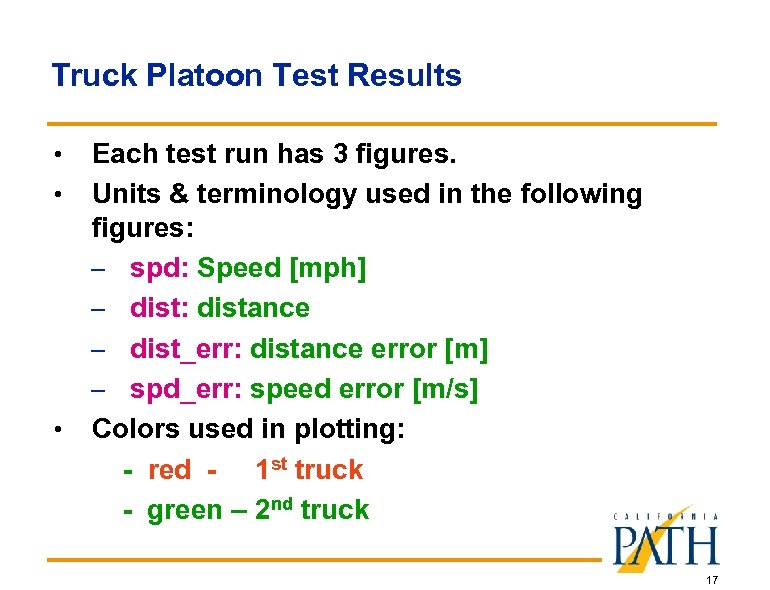 Truck Platoon Test Results • • • Each test run has 3 figures. Units & terminology used in the following figures: – spd: Speed [mph] – dist: distance – dist_err: distance error [m] – spd_err: speed error [m/s] Colors used in plotting: - red - 1 st truck - green – 2 nd truck 17
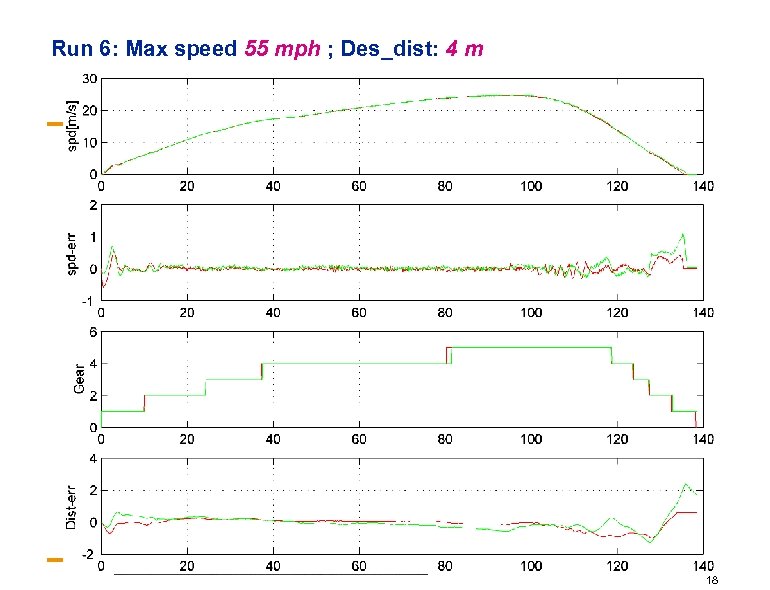 Run 6: Max speed 55 mph ; Des_dist: 4 m 18
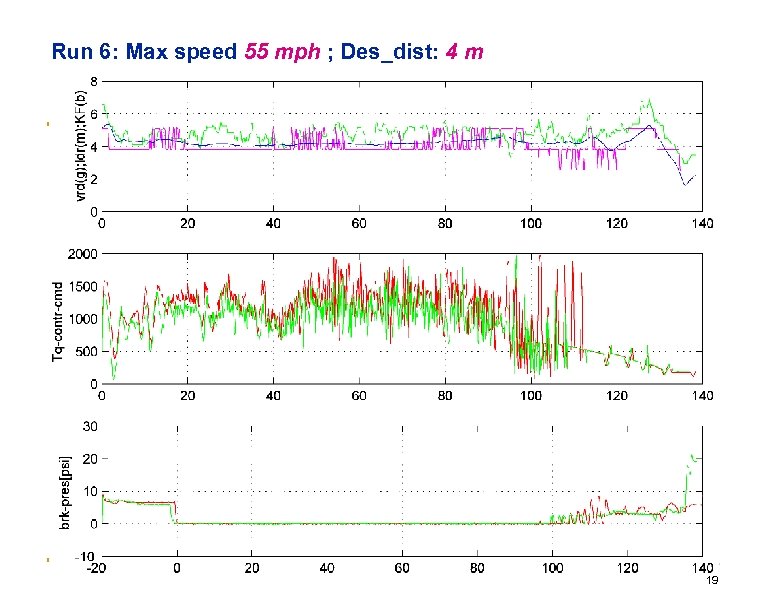 Run 6: Max speed 55 mph ; Des_dist: 4 m 19
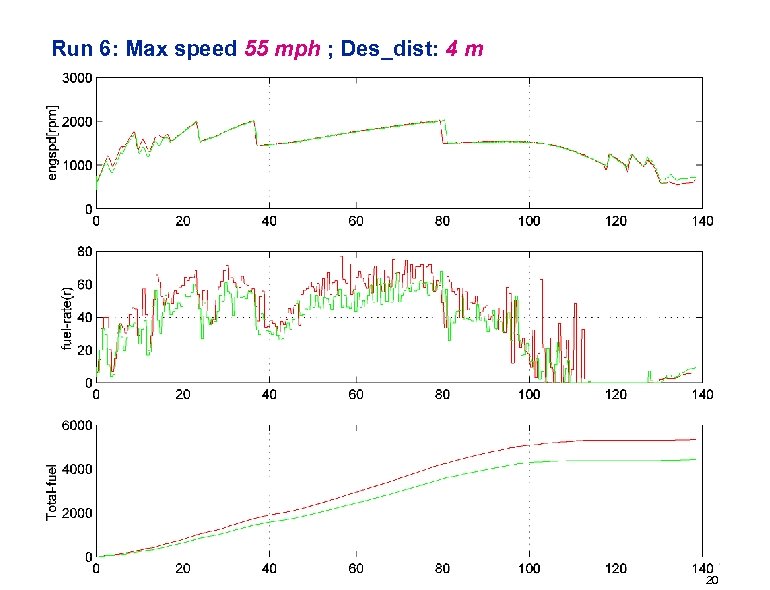 Run 6: Max speed 55 mph ; Des_dist: 4 m 20
 Aerodynamics of Class-8 Tractor-Trailer Trucks • Research led by Prof. Fred Browand, USC • Scale-model tests in wind tunnel, then full- scale tests on track • Measuring effects on aerodynamic drag of: – Separation between trucks (primary purpose) – Cross-wind components – Tractor-trailer spacing • Strong effects seen on separation between trucks and on shape of front of truck 21
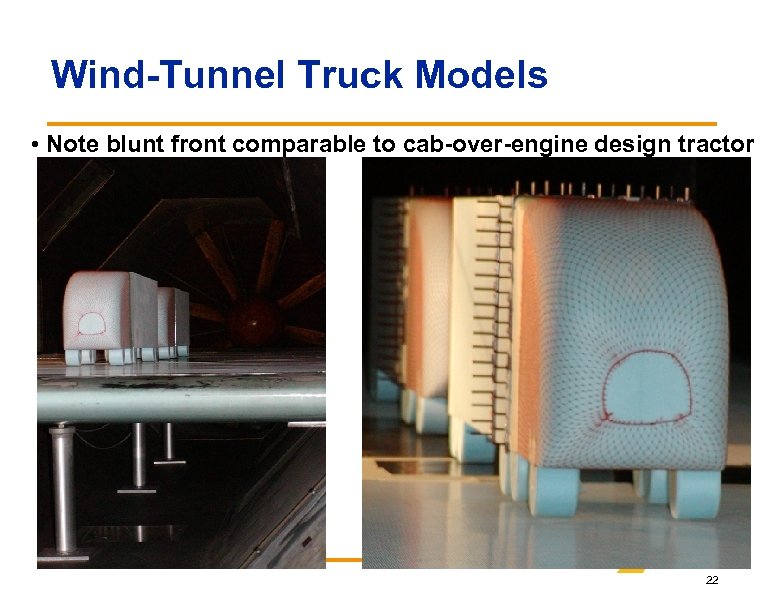 Wind-Tunnel Truck Models • Note blunt front comparable to cab-over-engine design tractor 22
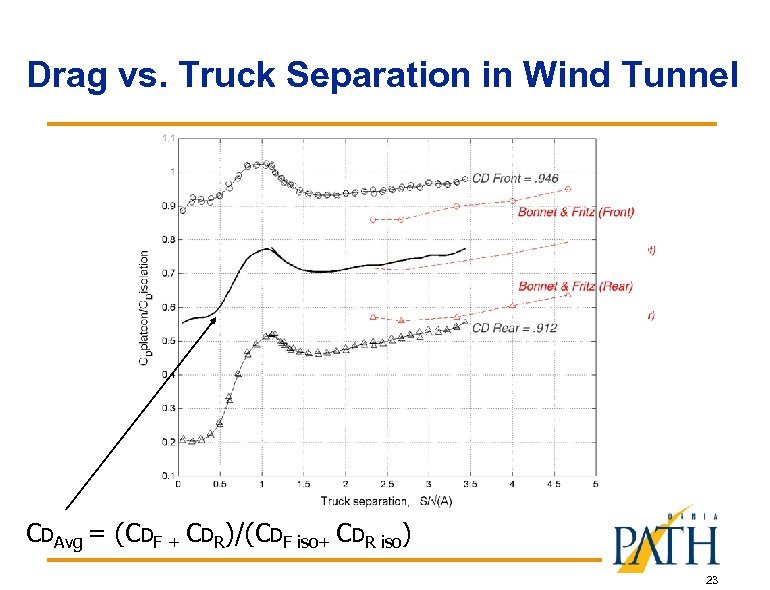 Drag vs. Truck Separation in Wind Tunnel Blunt - Blunt CDAvg = (CDF + CDR)/(CDF iso+ CDR iso) 23
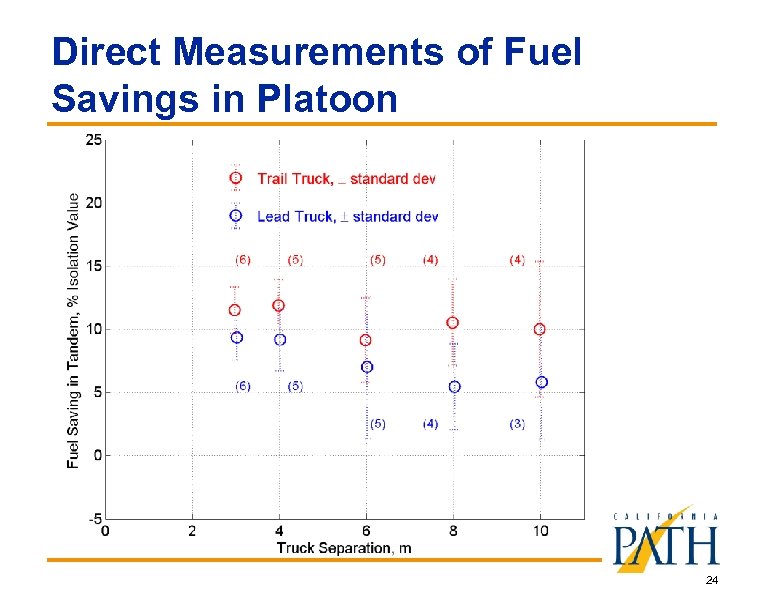 Direct Measurements of Fuel Savings in Platoon 24
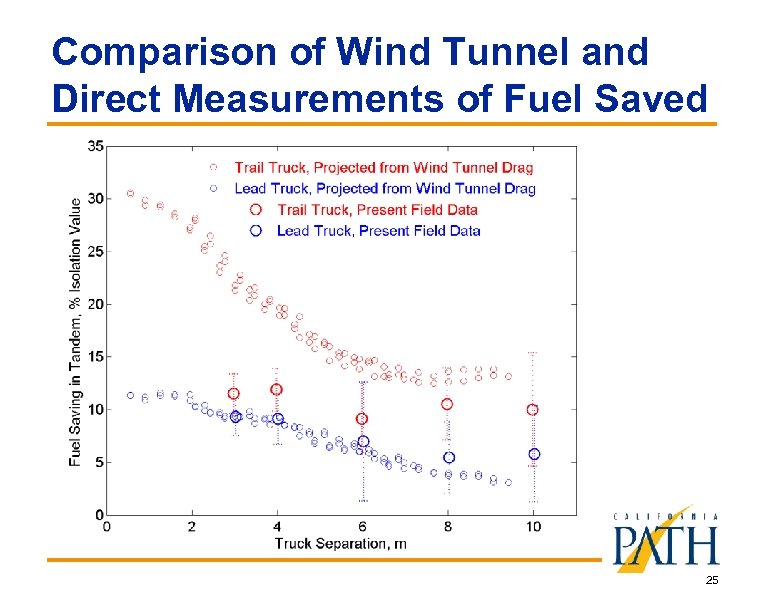 Comparison of Wind Tunnel and Direct Measurements of Fuel Saved 25
 Heavy-Duty Diesel Truck Energy and Emissions • Research led by Prof. Matthew Barth (UCR) • Modal Emissions Research Lab (MERL) trailer developed for EPA, CARB and engine manufacturers • Data collection on automated trucks at Crows Landing, individually and as platoon leader and follower – Platoon results compared to baseline case of individual truck at same speed 26
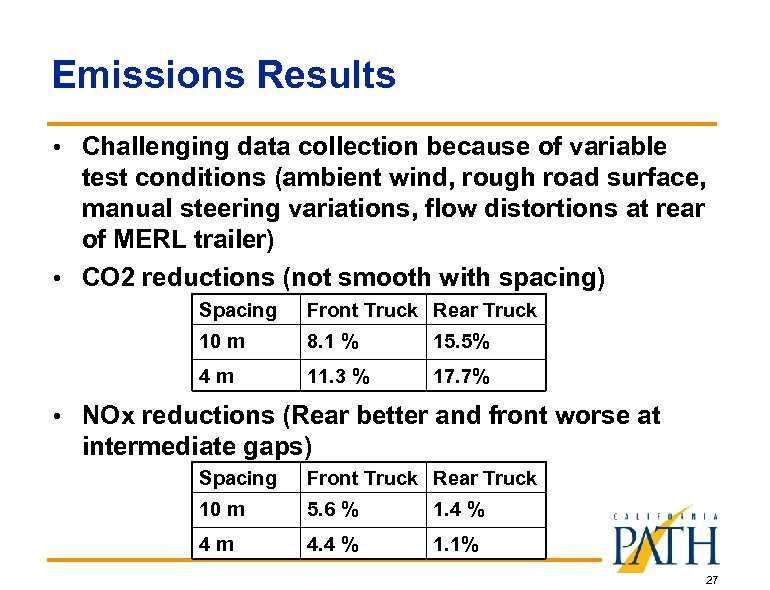 Emissions Results • Challenging data collection because of variable test conditions (ambient wind, rough road surface, manual steering variations, flow distortions at rear of MERL trailer) • CO 2 reductions (not smooth with spacing) Spacing Front Truck Rear Truck 10 m 8. 1 % 15. 5% 4 m 11. 3 % 17. 7% • NOx reductions (Rear better and front worse at intermediate gaps) Spacing Front Truck Rear Truck 10 m 5. 6 % 1. 4 % 4 m 4. 4 % 1. 1% 27
 Summary • Truck automation is significantly more • • difficult than automation of cars – Power limitations and slow responses Successful automatic steering and speed control have been demonstrated under a limited range of conditions Very close separations have been achieved between trucks on test track Fuel consumption savings are significant, but emissions effects are less certain More refinements and testing are needed 28
 Assessment of the Applicability of Cooperative Vehicle-Highway Automation Systems (CVHAS) to Freight Movement in Dedicated Lanes in Chicago Steven E. Shladover, Sc. D. California PATH Program University of California, Berkeley ITFVHA Meeting, July 2004 29
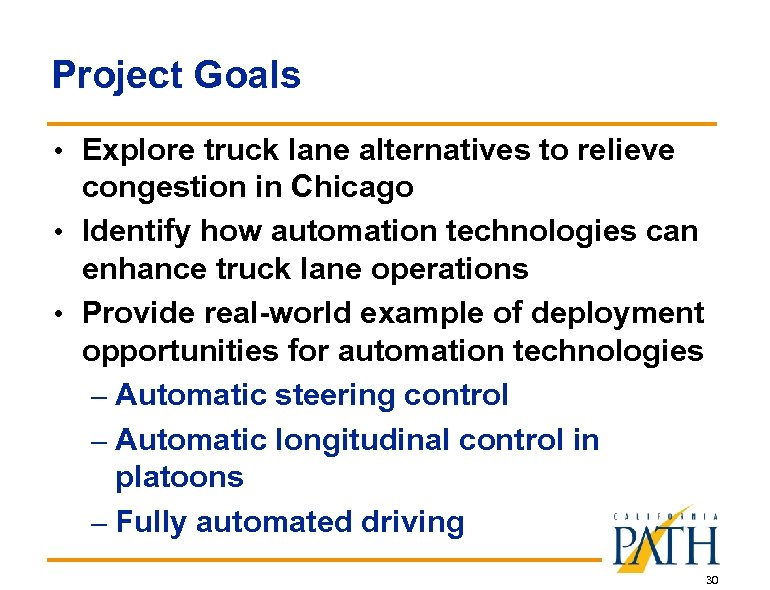 Project Goals • Explore truck lane alternatives to relieve congestion in Chicago • Identify how automation technologies can enhance truck lane operations • Provide real-world example of deployment opportunities for automation technologies – Automatic steering control – Automatic longitudinal control in platoons – Fully automated driving 30
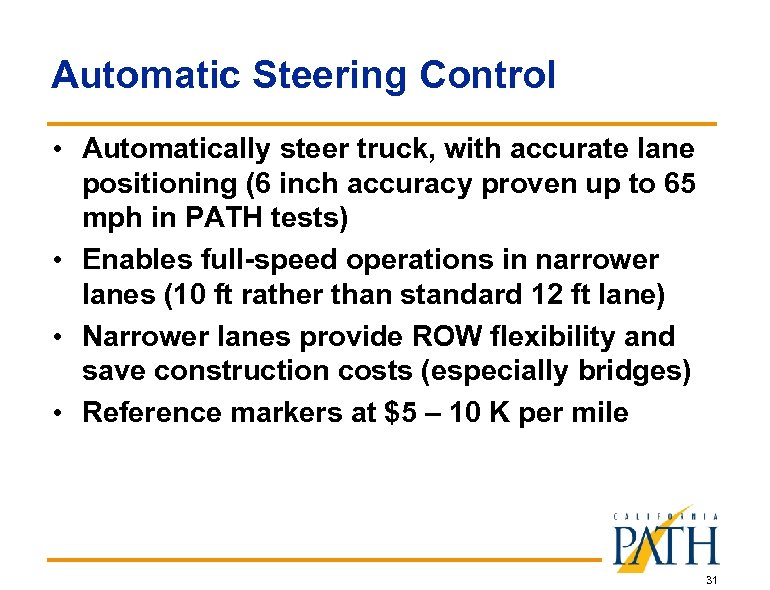 Automatic Steering Control • Automatically steer truck, with accurate lane positioning (6 inch accuracy proven up to 65 mph in PATH tests) • Enables full-speed operations in narrower lanes (10 ft rather than standard 12 ft lane) • Narrower lanes provide ROW flexibility and save construction costs (especially bridges) • Reference markers at $5 – 10 K per mile 31
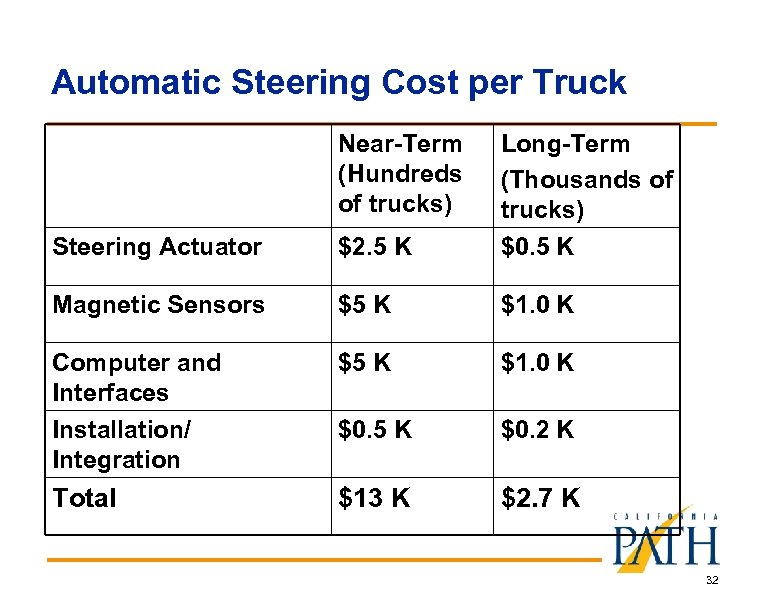 Automatic Steering Cost per Truck Near-Term (Hundreds of trucks) Steering Actuator $2. 5 K Long-Term (Thousands of trucks) $0. 5 K Magnetic Sensors $5 K $1. 0 K Computer and Interfaces Installation/ Integration $5 K $1. 0 K $0. 5 K $0. 2 K Total $13 K $2. 7 K 32
 Automatic Longitudinal Control in Platoons • Accurately control truck speed and spacing • • behind lead truck, using sensors and wireless communication between trucks Significantly increase capacity per lane, avoiding need to build extra lanes Reduce aerodynamic drag, saving fuel and emissions Smooth out accel/decel cycles to save fuel, emissions and wear and tear on truck and cargo Benefits only gained in exclusive lane 33
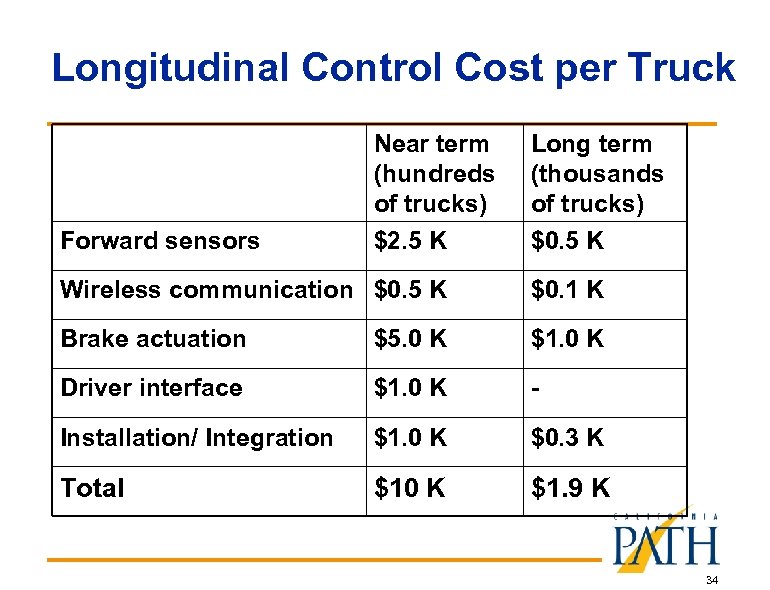 Longitudinal Control Cost per Truck Forward sensors Near term (hundreds of trucks) $2. 5 K Long term (thousands of trucks) $0. 5 K Wireless communication $0. 5 K $0. 1 K Brake actuation $5. 0 K $1. 0 K Driver interface $1. 0 K - Installation/ Integration $1. 0 K $0. 3 K Total $10 K $1. 9 K 34
 Fully Automated Driving • Combine automatic steering, speed and spacing control • Combine benefits and costs of above systems • Must operate in dedicated, protected lanes • Potentially eliminate need for drivers in following trucks of platoon (or greatly reduce their workload), but would then need staging areas for transitioning between automation and normal driving 35
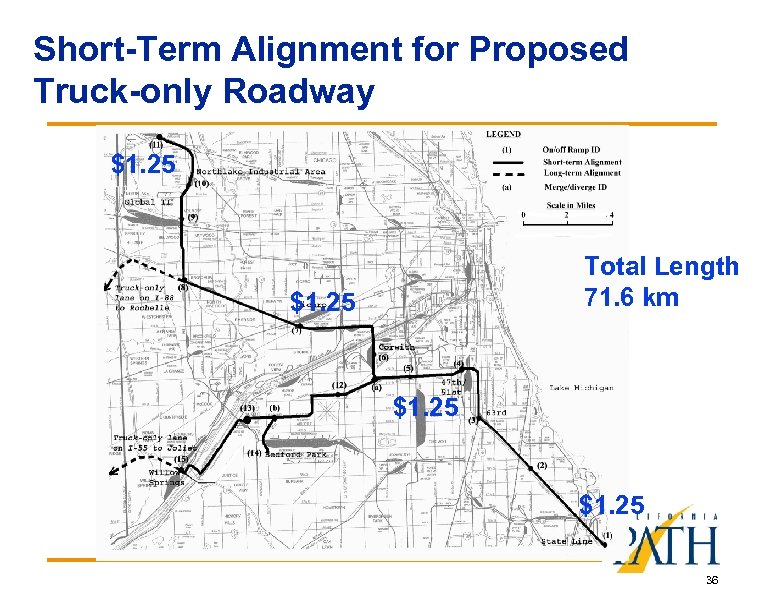 Short-Term Alignment for Proposed Truck-only Roadway $1. 25 Total Length 71. 6 km $1. 25 36
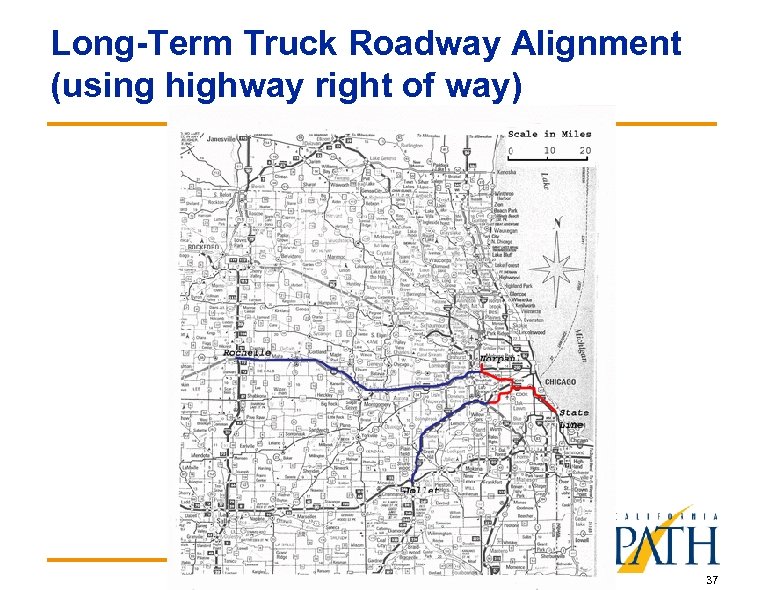 Long-Term Truck Roadway Alignment (using highway right of way) 37
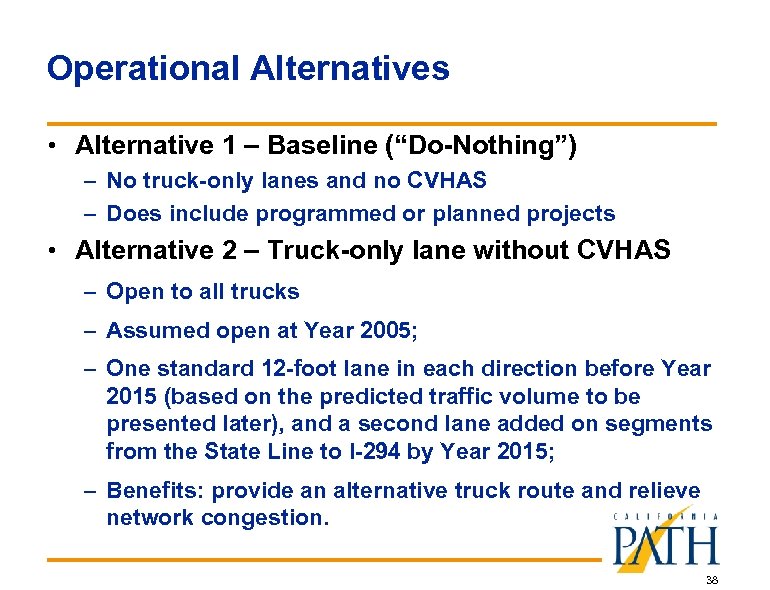 Operational Alternatives • Alternative 1 – Baseline (“Do-Nothing”) – No truck-only lanes and no CVHAS – Does include programmed or planned projects • Alternative 2 – Truck-only lane without CVHAS – Open to all trucks – Assumed open at Year 2005; – One standard 12 -foot lane in each direction before Year 2015 (based on the predicted traffic volume to be presented later), and a second lane added on segments from the State Line to I-294 by Year 2015; – Benefits: provide an alternative truck route and relieve network congestion. 38
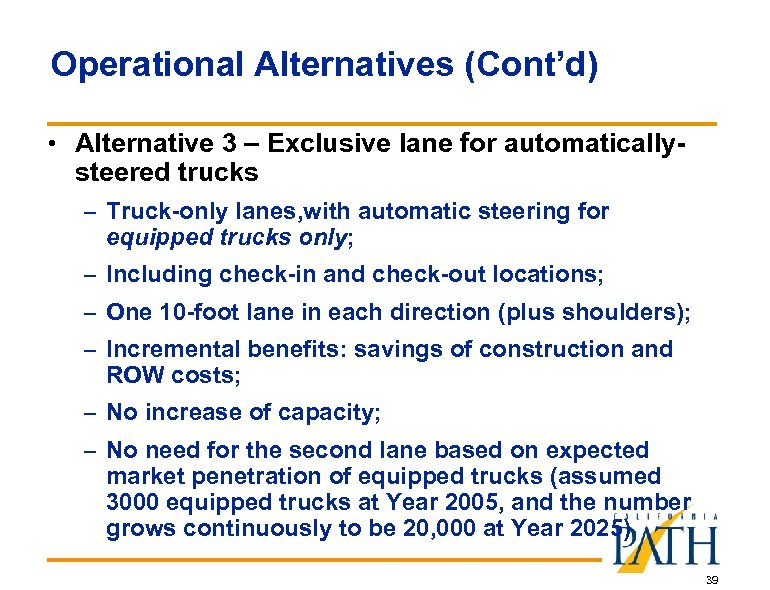 Operational Alternatives (Cont’d) • Alternative 3 – Exclusive lane for automatically- steered trucks – Truck-only lanes, with automatic steering for equipped trucks only; – Including check-in and check-out locations; – One 10 -foot lane in each direction (plus shoulders); – Incremental benefits: savings of construction and ROW costs; – No increase of capacity; – No need for the second lane based on expected market penetration of equipped trucks (assumed 3000 equipped trucks at Year 2005, and the number grows continuously to be 20, 000 at Year 2025) 39
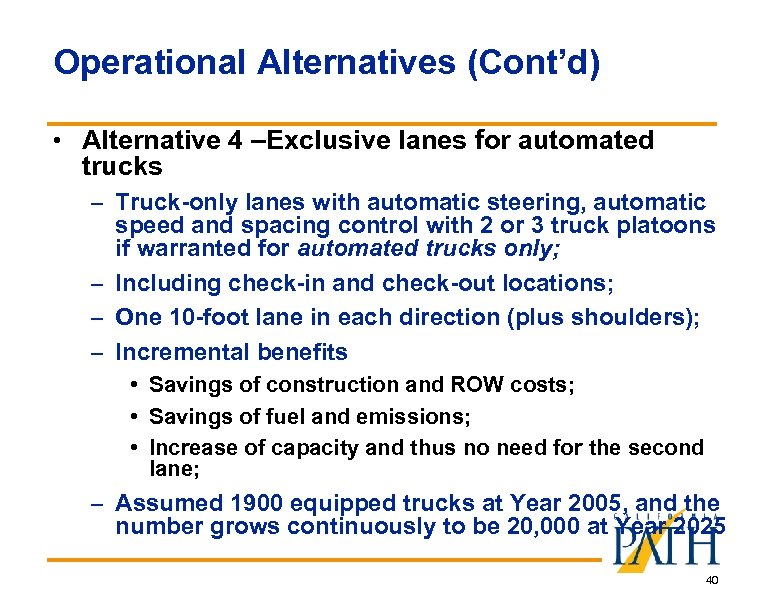 Operational Alternatives (Cont’d) • Alternative 4 –Exclusive lanes for automated trucks – Truck-only lanes with automatic steering, automatic speed and spacing control with 2 or 3 truck platoons if warranted for automated trucks only; – Including check-in and check-out locations; – One 10 -foot lane in each direction (plus shoulders); – Incremental benefits • Savings of construction and ROW costs; • Savings of fuel and emissions; • Increase of capacity and thus no need for the second lane; – Assumed 1900 equipped trucks at Year 2005, and the number grows continuously to be 20, 000 at Year 2025 40
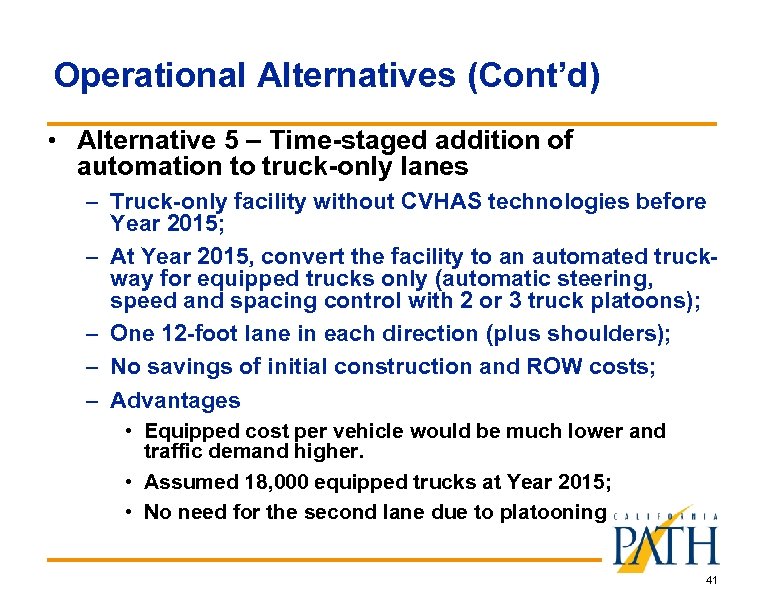 Operational Alternatives (Cont’d) • Alternative 5 – Time-staged addition of automation to truck-only lanes – Truck-only facility without CVHAS technologies before – – Year 2015; At Year 2015, convert the facility to an automated truckway for equipped trucks only (automatic steering, speed and spacing control with 2 or 3 truck platoons); One 12 -foot lane in each direction (plus shoulders); No savings of initial construction and ROW costs; Advantages • Equipped cost per vehicle would be much lower and traffic demand higher. • Assumed 18, 000 equipped trucks at Year 2015; • No need for the second lane due to platooning 41
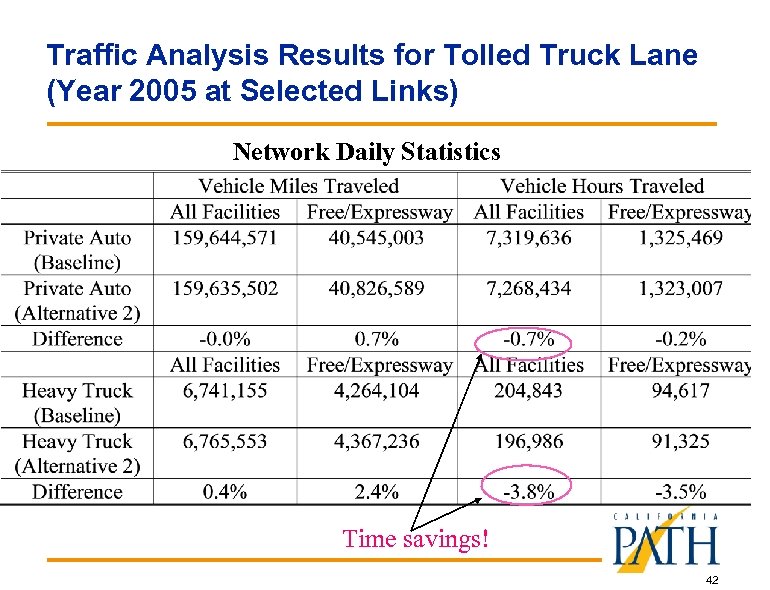 Traffic Analysis Results for Tolled Truck Lane (Year 2005 at Selected Links) Network Daily Statistics Time savings! 42
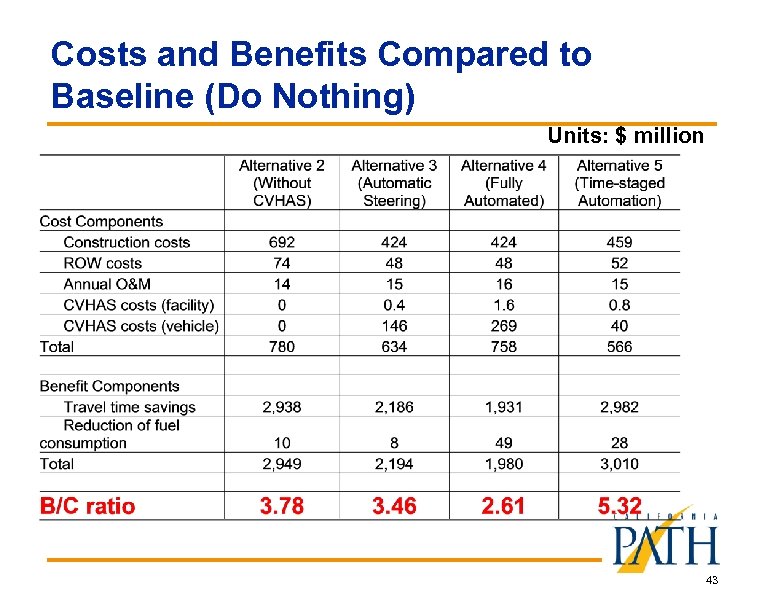 Costs and Benefits Compared to Baseline (Do Nothing) Units: $ million 43
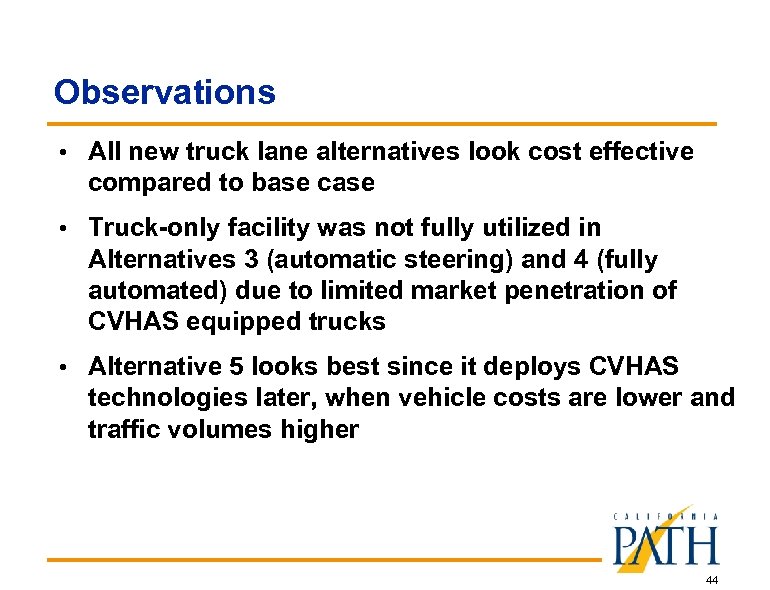 Observations • All new truck lane alternatives look cost effective compared to base case • Truck-only facility was not fully utilized in Alternatives 3 (automatic steering) and 4 (fully automated) due to limited market penetration of CVHAS equipped trucks • Alternative 5 looks best since it deploys CVHAS technologies later, when vehicle costs are lower and traffic volumes higher 44
 Conclusions • Compared with the baseline, all dedicated truck lane alternatives should be cost effective (B/C ratios between 2. 61 and 5. 32) • Alternative 5 was evaluated as the best because it deployed CVHAS technologies later, when their costs were lower and the traffic volumes larger. The incremental CVHAS B/C ratio is 7. 57 relative to the truck-only lane without CVHAS technologies. • CVHAS technologies are able to help improve the performance of the freight system. However, the times and ways of deploying CVHAS technologies are important to their efficiency and success. 45