 Скачать презентацию Patent Law A Brief Overview for Clinical Research
1e9aea5791d186cf6e9b73be8b9f9501.ppt
- Количество слайдов: 58



Patent Law A Brief Overview for Clinical Research Thomas Goodness, Ph. D. , J. D. Intellectual Property Development & Technology Transfer Office
Introduction • Intellectual property (IP) will become an issue at some point in your professional life • Decisions must be made by you or the UK administration • Governing law and its application – Federal – UK Administrative – State Intellectual Property Development & Technology Transfer Office
Purpose • Set your expectations about the IP • process expectations about the process Set your – Promote mutual understanding between you and UK Administration – Minimize surprise during the process • Help you make informed decisions Intellectual Property Development & Technology Transfer Office
Outline • When will IP become an issue? • For each situation – What decisions will be made? – What law guides those decisions? – Examples Intellectual Property Development & Technology Transfer Office
Definitions • IP = “Patent Rights” • “Patent Rights” refers to a right to stop others from – Making – Using – Selling – Importing (sometimes) – Your invention Intellectual Property Development & Technology Transfer Office
Definitions (continued) • Clinical Research involves both – Human subjects – Pre-Clinical research using animals Intellectual Property Development & Technology Transfer Office
When will IP become an issue? • Terms of agreements that precede clinical research • IP created by you during research • IP (owned by others) that you use during research Intellectual Property Development & Technology Transfer Office
When will IP become an issue? • Terms of agreements that precede clinical research • IP created by you during research • IP (owned by others) that you use during research Intellectual Property Development & Technology Transfer Office
Terms of agreements • Who owns future IP developed during research • University owns the IP by default • Frequently the other party wants UK to transfer ownership to them • Conflict between UK and Sponsor • Conflict between UK and the Research Scientist Intellectual Property Development & Technology Transfer Office
How UK Gets Ownership of IP • Federal law, ownership of patentable inventions starts with the inventor (you). • UK AR’s, the University owns employee IP – developed using University Resources, and/or – developed within the scope of employment • This is enforceable under state contract law • This is a common arrangement – At other Universities – In Industry Intellectual Property Development & Technology Transfer Office
UK’s Terms for Future IP • UK owns IP developed solely by UK employees during sponsored research • Sponsor owns IP developed solely by Sponsor employees • If employees of UK and Sponsor jointly develop IP, the IP is owned jointly by UK and Sponsor. Intellectual Property Development & Technology Transfer Office
Terms Proposed by Sponsor • Sponsor owns all IP developed by Scientist during the Sponsored Research • All means – Inventions necessary to use the results of research – Inventions that are only peripheral to the research Intellectual Property Development & Technology Transfer Office
The Problem: UK vs. the Sponsor • IP is property – Transfer of UK property is regulated by state law – Compliance with state law is impossible when transferring “future” IP to another • UK’s IP terms are the norm, make deviations difficult to explain to the authorities Intellectual Property Development & Technology Transfer Office
How do we resolve? • Types of Agreements – Federal Research Grants – Clinical Trials Agreement – Pre-clinical Research • Privately Sponsored Projects Agreement • Material Transfer • Arranged in increasing order of conflict potential • Resolution differs somewhat by type of agreement Intellectual Property Development & Technology Transfer Office
Federal Research Grants • Applies to research sponsored, in whole or in part, by a federal agency • Bayh-Dole Act – – University owns IP by default May be transferred to Principal Investigator Federal Government reserves rights Transfer to third parties is expressly forbidden Intellectual Property Development & Technology Transfer Office
Clinical Trials Agreements • We may offer to transfer future IP that will never exist (Unique to CTA) • Scientist must perform a rigidly defined protocol, leaving little room for invention • We offer to transfer future IP necessary to practice Sponsors technology Intellectual Property Development & Technology Transfer Office
Pre-clinical Research • These solutions also apply to Clinical Trials • We always offer an option to license future IP to the other party • Rarely, we offer a royalty-free nonexclusive license to the other party Intellectual Property Development & Technology Transfer Office
When will IP become an issue? • Terms of agreements that precede clinical research • IP created by you during research • IP that you use during research Intellectual Property Development & Technology Transfer Office
IP created during research • Am I ready disclose my IP? • Who are the inventors? • Will a patent application be filed on my IP? Intellectual Property Development & Technology Transfer Office
IP created during research • Am I ready disclose my IP? • Who are the inventors? • Will a patent application be filed on my IP? Intellectual Property Development & Technology Transfer Office
Am I ready disclose my IP? • Disclose when your invention is ready for a patent application • Your invention has two parts – Conception (Idea) – Reduction to practice • Actual reduction to practice • Constructive reduction to practice • Your invention is ready to file when you have both Intellectual Property Development & Technology Transfer Office
Actual Reduction to Practice • Means you have data suggesting your invention works • Human medicine, animal/cell culture data is sufficient when there is a known reasonable correlation between models and humans • Actual reduction to practice is required when it is not apparent that your invention will work when you describe your idea Intellectual Property Development & Technology Transfer Office
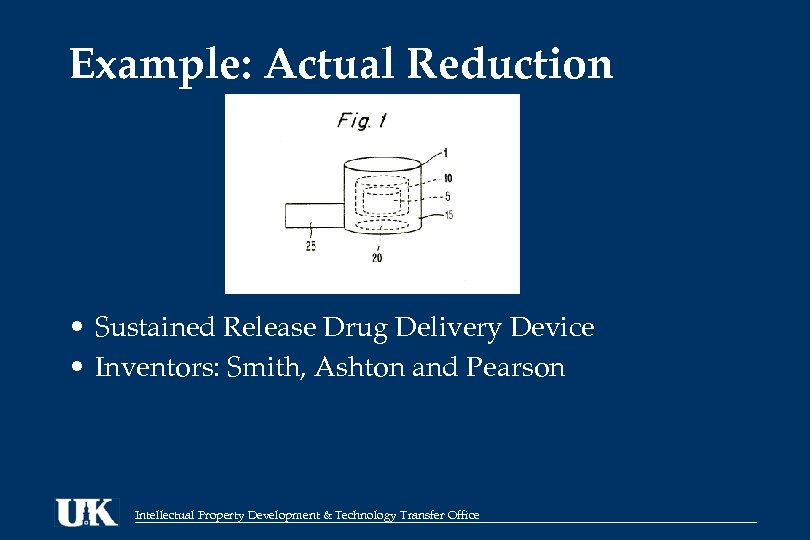
Example: Actual Reduction • Sustained Release Drug Delivery Device • Inventors: Smith, Ashton and Pearson Intellectual Property Development & Technology Transfer Office
Constructive Reduction to Practice • Means you have no data, not really reduced to practice • Considered reduced to practice when it is described (with drawings) in a patent application • Constructive reduction to practice is acceptable when it is obvious that your invention will work solely from its description • Does not apply to most clinical inventions Intellectual Property Development & Technology Transfer Office
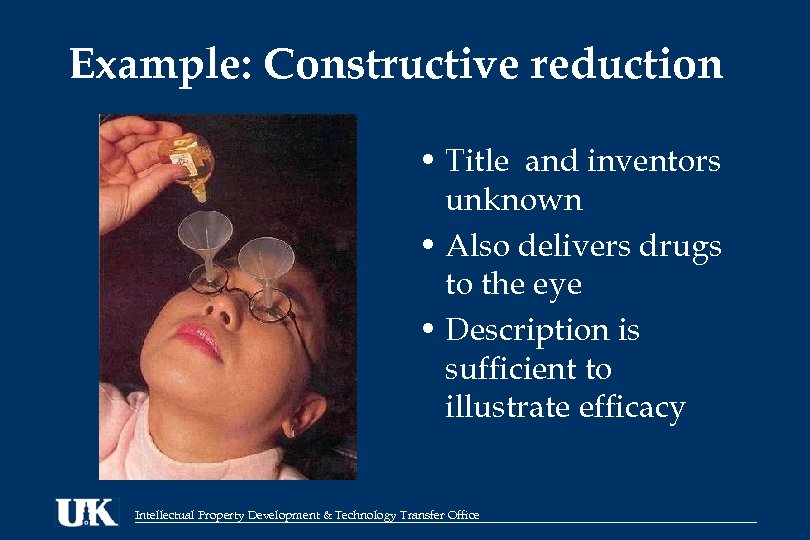
Example: Constructive reduction • Title and inventors unknown • Also delivers drugs to the eye • Description is sufficient to illustrate efficacy Intellectual Property Development & Technology Transfer Office
Hypothetical example: Readiness • Facts: Scientist has a great idea for a drug candidate that should ameliorate the long term effects following hemorrhagic stroke , and wants to file a patent before disclosing in a grant application • Result: No disclosure is necessary, the invention is not reduced to practice, so no patent application can be filed Intellectual Property Development & Technology Transfer Office
Hypothetical example : Readiness • Facts: Scientist has data showing that drug ameliorates the effects of hemorrhagic stroke in an accepted mouse model of human stroke • Result: Ready for disclosure, the data was generated in a model known to be reasonably correlated with human condition Intellectual Property Development & Technology Transfer Office
Hypothetical example : Readiness • Facts: Scientist has data showing that drug ameliorates the effects of hemorrhagic stroke in a controversial zebra fish model of human stroke • Result: Not yet ready for disclosure, but a close call Intellectual Property Development & Technology Transfer Office
IP created during research • Am I ready disclose my IP? • Who are the inventors? • Will a patent application be filed on my IP? Intellectual Property Development & Technology Transfer Office
Who are the Inventors? • Deceptively simple concept • University inventors often draw on their concept of authorship • Criteria for inventorship is different from authorship • Getting it wrong can have harsh consequences Intellectual Property Development & Technology Transfer Office
Authorship of Journal Articles • Major contributors to the content • Principal Investigator • Technical assistants performing the majority of the actual work • Sources of important material Intellectual Property Development & Technology Transfer Office
Inventorship • Definition dictated by Federal law • Anyone who contributed an idea – That forms the basis of an element of the invention – Without which there would be no invention • Correct inventorship is a precondition for a valid patent. Intellectual Property Development & Technology Transfer Office
Inventorship • Definition dictated by Federal law • Anyone who contributed an idea – That forms the basis of an element of the invention – Without which there would be no invention Intellectual Property Development & Technology Transfer Office
Bad News about Inventorship • A technical assistant who does all the work, but merely followed directions is not an inventor • A technical assistant who does all the work, but solves problems which do not relate to an element of the invention is not an inventor • A PI who pays for all the work, but does not contribute an idea is not an inventor Intellectual Property Development & Technology Transfer Office
Bad News about Inventorship • An inventor is often presented with the difficult choice between – Dealing with the hurt feelings of non-inventors, or – An invalid patent (and the lost income from that patent) Intellectual Property Development & Technology Transfer Office
IP created during research • Am I ready disclose my IP? • Who are the inventors? • Will a patent application be filed on my IP? Intellectual Property Development & Technology Transfer Office
Will a patent application be filed? • An application will not be filed if the invention does not meets the criteria for patentability. • Three criteria for a patentable invention – Useful – Novel (New) – Non-obvious Intellectual Property Development & Technology Transfer Office
Meaning of Novelty • United States – No person invented before you, and – Publication/Sale • Either you have not published or offered to sell the invention before filing a patent application OR • Your invention – – was in public use, or appeared in a “printed publication” or was offered for sale, one year has not elapsed Intellectual Property Development & Technology Transfer Office
Meaning of Novelty • Rest of the World – “Absolute novelty” – Prior to filing a patent application, the invention did not appear in a printed publication or in public use – You are the first to file a patent application claiming the invention • Initial filing can be in the US Intellectual Property Development & Technology Transfer Office
Novelty: Meaning and Relevance of Public Use • Using the completed invention in the presence of people who have no confidential relationship with the inventor • If there is public use of the invention, please disclose your invention to us before one year has passed. • If disclosed later, your invention cannot be patented (will not be novel) Intellectual Property Development & Technology Transfer Office
Novelty: Meaning and Relevance of Printed Publication • Must be – be in a fixed form (not an oral presentation) – disclosed to those not in a confidential relationship – have sufficient detail about the invention to enable the invention to be practiced. • Can be a poster presentation! • Starts the one-year novelty clock! Intellectual Property Development & Technology Transfer Office
Preserving Novelty • Worldwide – Maintain confidentiality until you file a patent application • Only in the United States – File a patent application – Before one year has passed – After publication or offer for sale Intellectual Property Development & Technology Transfer Office
Preserving Novelty • Procedure for impending publication – File a detailed disclosure with us • Including a statement of usefulness • Reveals everything needed to make and/or use your invention – Notify us that publication is imminent – We can file a “cover sheet” provisional patent application – Deemed filed the day we place it in the mail Intellectual Property Development & Technology Transfer Office
Will a patent application be filed? • An application will not be filed if the invention does not meets the criteria for patentability. • Three criteria for a patentable invention – Useful – Novel (New) – Non-obvious Intellectual Property Development & Technology Transfer Office
Obviousness • When we tell inventors that their invention is not novel, – they take it pretty well – they understand that their invention may have appeared in some obscure journal • When we tell inventors that their invention is obvious – they take offense – “Your baby is ugly” Intellectual Property Development & Technology Transfer Office
Meaning of Obviousness • Not an insult • Legal term • All of the pieces of your invention are in the public domain • Someone (in an obscure journal) has suggested putting the pieces together to make your invention • No remedy (but you can attack the elements) Intellectual Property Development & Technology Transfer Office
When will IP become an issue? • Terms of agreements that precede clinical research • IP created by you during research • IP (owned by others) that you use during research Intellectual Property Development & Technology Transfer Office
IP owned by others • Patent infringement • Unauthorized – Making – Using – Selling – Importing • The patented invention of another Intellectual Property Development & Technology Transfer Office
Remedies for Infringement • Injunction, stopping you from practicing the technology • Money damages – Willful Infringement • You know you are infringing • Treble damages Intellectual Property Development & Technology Transfer Office
Avoiding Infringement • Buy the technology you need for your research from an authorized dealer, or • Enter into a license agreement with the inventor Intellectual Property Development & Technology Transfer Office
Avoiding Infringement • “Physicians’ Immunity” Statute • Activities in preparation of an NDA Intellectual Property Development & Technology Transfer Office
Physicians’ Immunity (Good) • A patent on a medical procedure cannot be enforced against a medical practitioner using that medical procedure on a body. – “Body” includes a human body, organ or cadaver, or a nonhuman animal used in medical research or instruction directly relating to the treatment of humans. – Provides immunity to those working at the direction of the practitioner • Provides immunity to the institution affiliated with the practitioner Intellectual Property Development & Technology Transfer Office
Physicians’ Immunity (Bad) • Does not apply – When the procedure involves the use of a patented medical device. – The provision of pharmacy or clinical laboratory services, unless provided in a physicians office. – To patents applied for before September 30, 1996 Intellectual Property Development & Technology Transfer Office
![Preparation of an NDA it is not "an act of [patent] infringement to …](https://present5.com/presentation/1e9aea5791d186cf6e9b73be8b9f9501/image-54.jpg "Preparation of an NDA it is not \"an act of [patent] infringement to …")
Preparation of an NDA it is not "an act of [patent] infringement to … use … or import into the United States a patented invention … solely for uses reasonable related to the development and submission of information under a Federal law which regulates the … use … of drugs. ” Interpreted very broadly Intellectual Property Development & Technology Transfer Office
Preparation of an NDA • To be entitled to this defense you must: – have a reasonable basis for believing that a patented compound may work, – through a particular biological process, – to produce a particular physiological effect, – use the compound in research that would be appropriate to include in a submission to the FDA. Intellectual Property Development & Technology Transfer Office
Preparation of an NDA • You are entitled to this defense even though: – the drug is not yet the subject of an FDA submission or – a patented compound is used in experiments that are not ultimately submitted to the FDA Intellectual Property Development & Technology Transfer Office
Summary • There are legal constraints preventing UK from transferring IP to a sponsor • File your disclosures with us when you have data • Be ruthless in naming the correct inventors • Keep in mind that some technology you use may be patented Intellectual Property Development & Technology Transfer Office
Where to Get More Information • Our web site: http: //www. rgs. uky. edu/IP • Patent office web site: http: //www. uspto. gov Intellectual Property Development & Technology Transfer Office
Скачать презентацию Patent Law A Brief Overview for Clinical Research
1e9aea5791d186cf6e9b73be8b9f9501.ppt