


 Скачать презентацию Pasture Rangeland Forage Rainfall Index Plan of Insurance
c092f163663c08ccd992d7611520661f.ppt
- Количество слайдов: 121
 Pasture, Rangeland, Forage Rainfall Index Plan of Insurance This presentation does not replace or supersede any procedures or modify any provisions contained in the complete insurance policy. 1
 Introduction and Program Overview Introduction and Overview Science Behind the Program Basics Detailed Example Additional Tools and Information 2
 Program Overview Purpose o The intent of this section: n n o Introduction to program and unique topics Provide background and basic philosophy Details of the program provided in following sections 3
 History o History n n The Agricultural Risk Protection Act of 2000 (ARPA) mandates programs to cover pasture and rangeland Two new pilot programs approved for 2007 Crop Year o Pasture, Rangeland, Forage (PRF) – Rainfall Index n o Covered in this training Pasture, Rangeland, Forage (PRF) – Vegetation Index 4
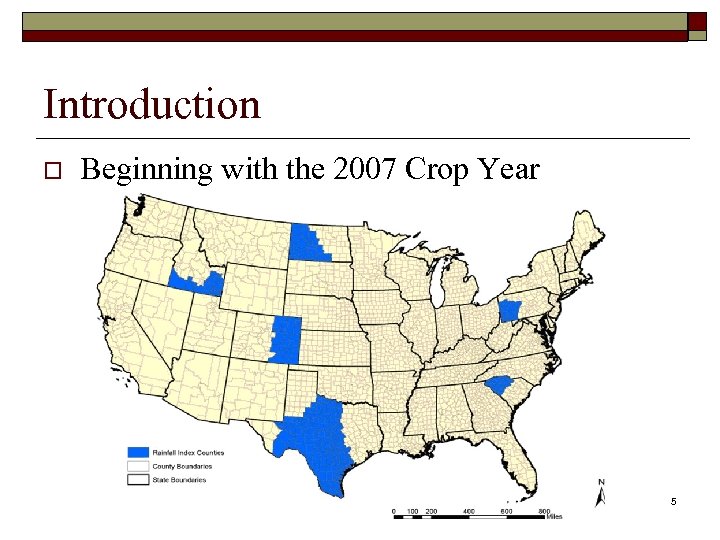 Introduction o Beginning with the 2007 Crop Year 5
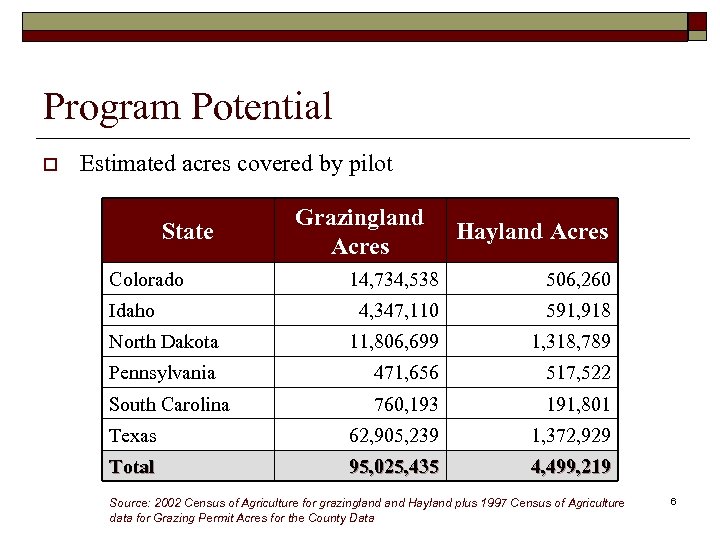 Program Potential o Estimated acres covered by pilot State Colorado Grazingland Acres Hayland Acres 14, 734, 538 506, 260 4, 347, 110 591, 918 North Dakota 11, 806, 699 1, 318, 789 Pennsylvania 471, 656 517, 522 South Carolina 760, 193 191, 801 Texas 62, 905, 239 1, 372, 929 Total 95, 025, 435 4, 499, 219 Idaho Source: 2002 Census of Agriculture for grazingland Hayland plus 1997 Census of Agriculture data for Grazing Permit Acres for the County Data 6
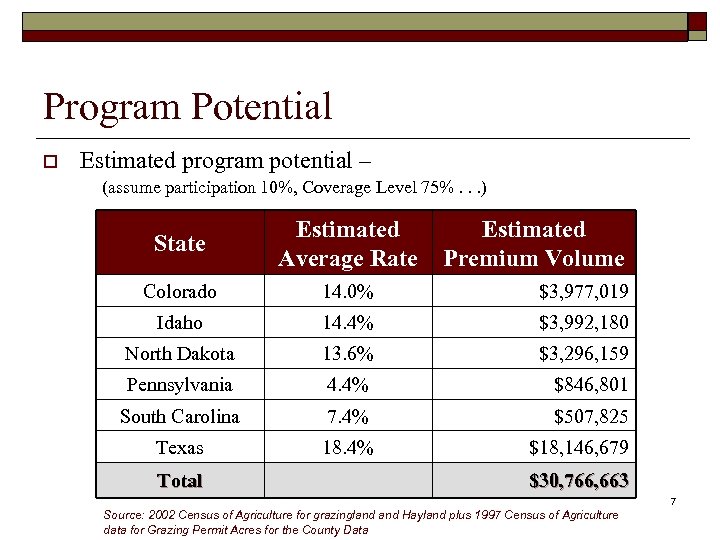 Program Potential o Estimated program potential – (assume participation 10%, Coverage Level 75%. . . ) State Estimated Average Rate Colorado 14. 0% $3, 977, 019 Idaho 14. 4% $3, 992, 180 North Dakota 13. 6% $3, 296, 159 Pennsylvania 4. 4% $846, 801 South Carolina 7. 4% $507, 825 Texas 18. 4% $18, 146, 679 Total Estimated Premium Volume $30, 766, 663 7 Source: 2002 Census of Agriculture for grazingland Hayland plus 1997 Census of Agriculture data for Grazing Permit Acres for the County Data
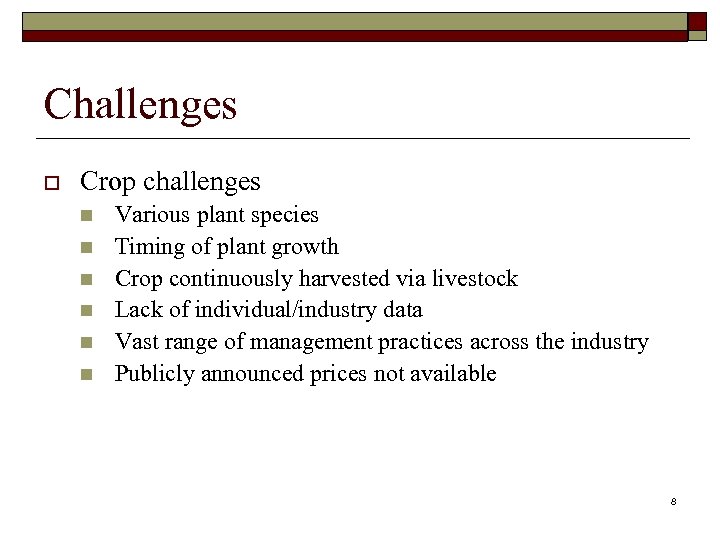 Challenges o Crop challenges n n n Various plant species Timing of plant growth Crop continuously harvested via livestock Lack of individual/industry data Vast range of management practices across the industry Publicly announced prices not available 8
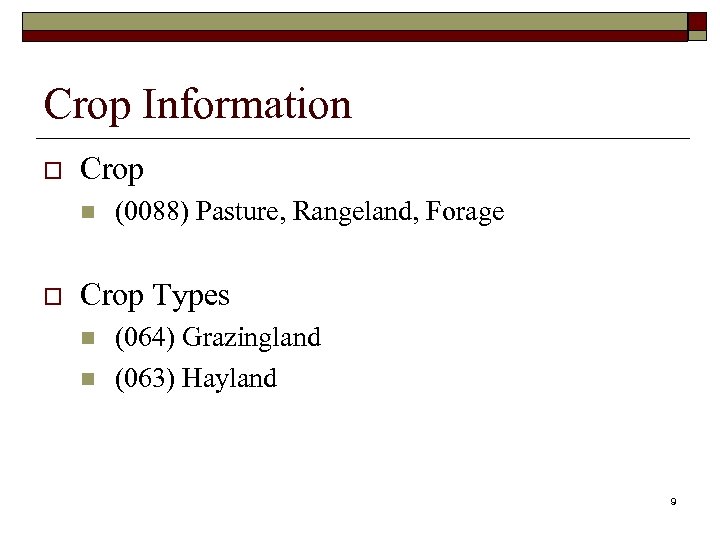 Crop Information o Crop n o (0088) Pasture, Rangeland, Forage Crop Types n n (064) Grazingland (063) Hayland 9
 Crop Types o Grazingland n n n Established acreage of perennial forage Intended for grazing by livestock Acreage must be suitable for grazing 10
 Crop Types o Hayland n n n Established acreage of perennial forage Intended for haying Acreage must be suitable for haying o Program covers all types of grazing and haying forage (i. e. not just for alfalfa) 11
 Program Overview o GRP program o Goal – utilize an existing policy type n n o Capitalize on current program familiarity Increase marketability and effectiveness The resulting design is based on the principals of the existing GRP program 12
 Program Overview o Index background o o o Lack of actual producer/industry production data No consistent and sound methodology for measuring production for the crop The deviation from long-term normal precipitation is used to establish the index n o SINGLE PERIL COVERAGE Precipitation has a high degree of correlation to forage production 13
 Program Overview o Index driven – NOAA data o Primary index difference n o o o Based on NOAA data vs. NASS county yields Reports precipitation data Widely used source of precipitation information Dependable source Long data history – since 1948 Consistent and universal coverage through a grid system n Grid boundaries vs. county boundaries 14
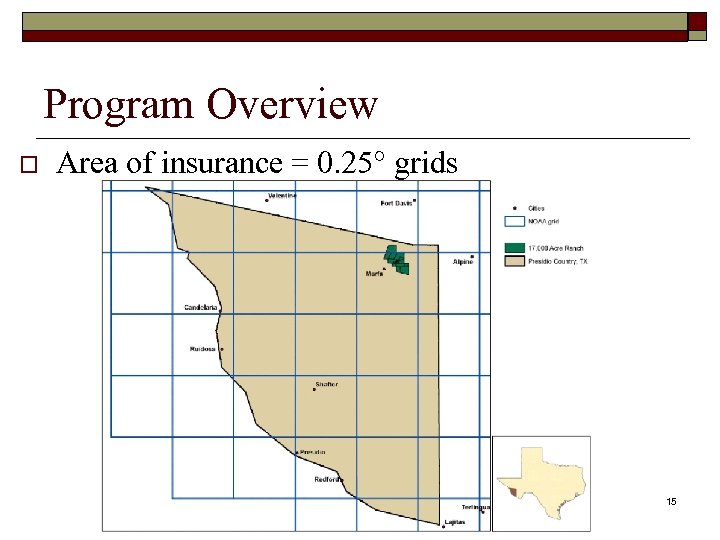 Program Overview o Area of insurance = 0. 25° grids 15
 Program Overview o Area of insurance = 0. 25° grids o o o Grids vs. County Grids are approximately 12 x 12 miles in size Provides for a consistent program across the United States Counties vary in size, but the grids do not Grid size reduces basis risk vs. county size n o Allows for closer correlation to individual experience Grids will cross county and state lines 16
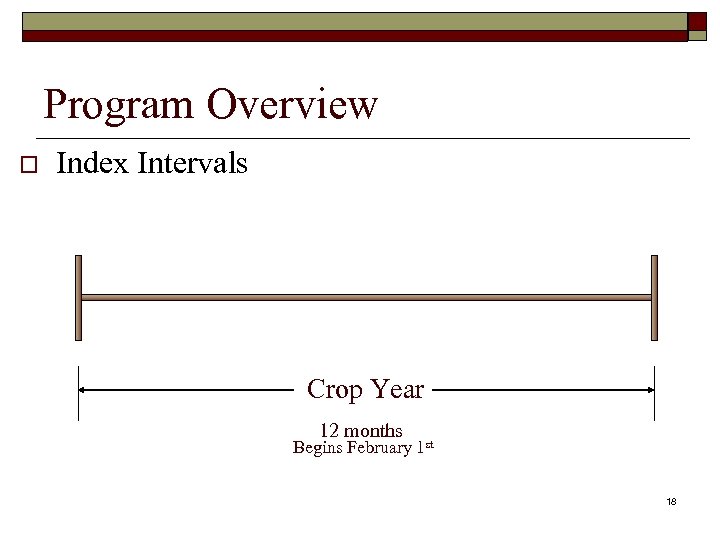
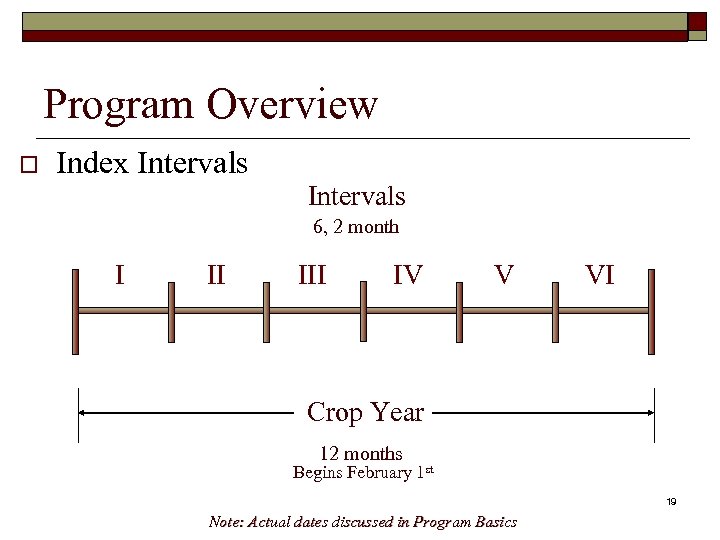
 Program Overview o Index Intervals o Multiple intervals offered – 6 o Crop year divided into 6, 2 -month intervals for each grid o Similar to Crop Practices o Ability for producers to manage appropriate timing risks n Correlate to individual growth patterns and production seasons o The 2 -month intervals provide for greater reaction to precipitation events vs. a yearly average 17
 Program Overview o Index Intervals Crop Year 12 months Begins February 1 st 18
 Program Overview o Index Intervals 6, 2 month I II IV V VI Crop Year 12 months Begins February 1 st 19 Note: Actual dates discussed in Program Basics
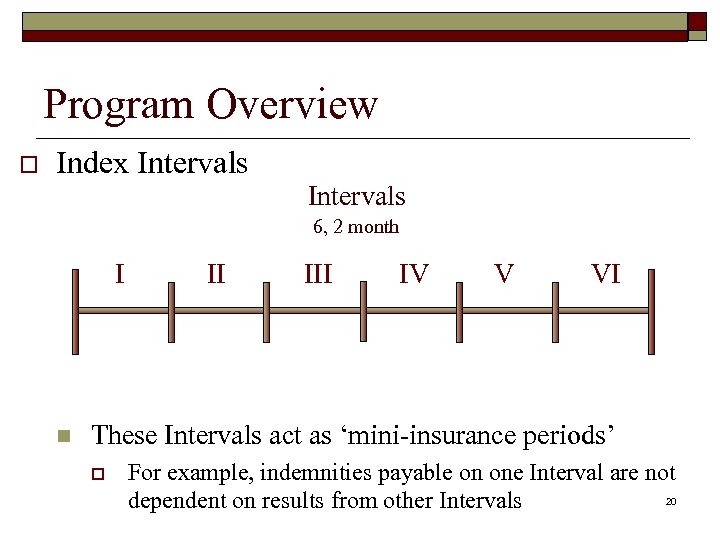 Program Overview o Index Intervals 6, 2 month I n II IV V VI These Intervals act as ‘mini-insurance periods’ o For example, indemnities payable on one Interval are not 20 dependent on results from other Intervals
 Program Overview o Index Intervals o Minimizes dependency on subjective pre-determined forage growing seasons o Maintains consistency across the country n n o Allows for regional and local variances Allows individual freedom to select appropriate intervals Index intervals are mutually exclusive n n One index does not effect the others All rated separately 21
 Program Overview o Index Intervals n Producers must select at least 2 intervals o The purpose of the program is to insure annual forage production n Total annual forage production is influenced by precipitation in more than one 2 -month interval; therefore, producers are required to insure in more than one interval Maximum percentages are region specific n Based on growing season (50 – 70%) 22
 Program Overview o Coverage Levels o o o Percentages available: 90, 85, 80, 75, and 70 Consistent with other GRP programs Higher coverage levels reduce basis risk n o Correlates closer to individual experience Catastrophic Risk Protection (CAT) o o Not currently available Producers are still eligible for NAP coverage 23
 Program Overview o Rating n Each grid, index interval, and coverage level is individually rated o Minimizes adverse selection n n o No economic advantage of insuring in one scenario vs. another Encourages producers to select a scenario that best mitigates their operation/production risks Adequate data permits the individual rating n Allowing the rates to accurately reflect the risks of each scenario 24
 Program Overview o Not required to insure 100% of acreage o o Forage utilized in the annual grazing or hay cycle can be insured without insuring all acreage All acres within a property may not be productive, e. g. , rocky areas, submerged areas Provides additional flexibility for the insured to design the coverage to his specific needs Because the program is a group program and other programs are not available, there is no opportunity to ‘move’ production 25
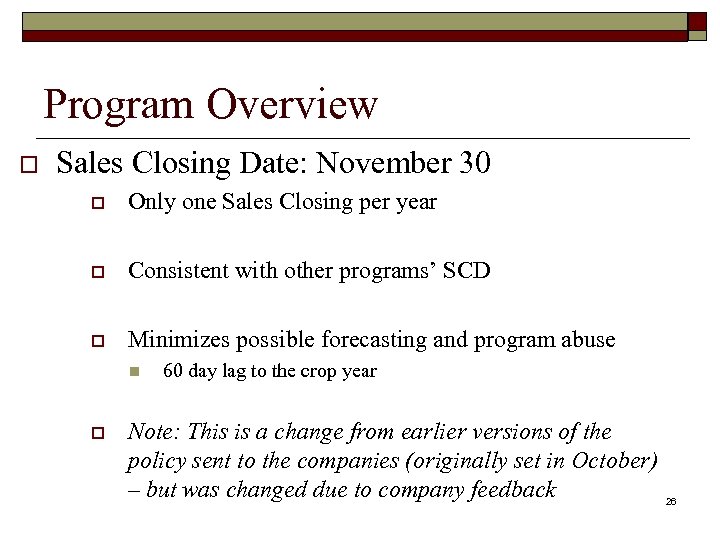 Program Overview o Sales Closing Date: November 30 o Only one Sales Closing per year o Consistent with other programs’ SCD o Minimizes possible forecasting and program abuse n o 60 day lag to the crop year Note: This is a change from earlier versions of the policy sent to the companies (originally set in October) – but was changed due to company feedback 26
 Program Overview o Program supported via internet o Provides the most efficient and effective way to deliver the program o Allows access to the mapping tools n Locate grazing areas and associated Grid ID numbers o Provides access to the historical rainfall indices o Allows access to all relevant data, materials, and tools associated with the program 27
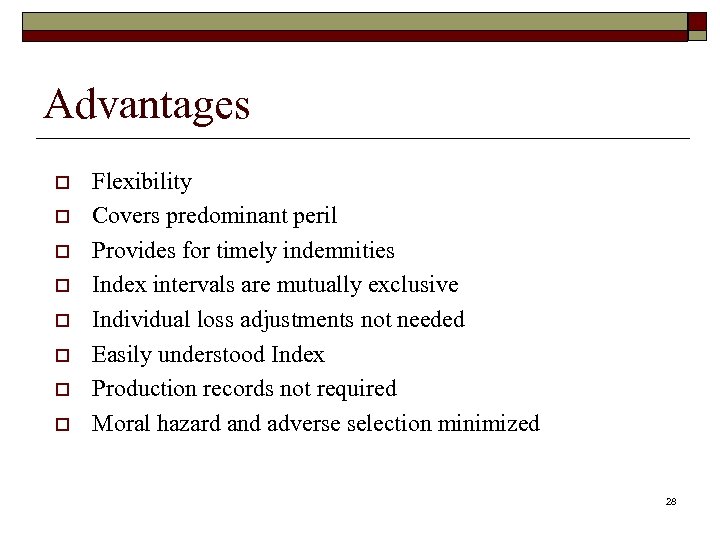 Advantages o o o o Flexibility Covers predominant peril Provides for timely indemnities Index intervals are mutually exclusive Individual loss adjustments not needed Easily understood Index Production records not required Moral hazard and adverse selection minimized 28
 Disadvantages o Individual losses/experiences not covered o Slight terminology differences from other GRP programs 29
 Questions 30
 Science and Technology Behind the Program 31
 Crop Biology o The program addresses forage-based production systems on land areas producing primarily perennial vegetation o Comprised of diverse plant communities and mixtures: o o o Perennial and annual Warm season and cool season Different growth habits over extended time periods 32
 Crop Biology o Forage may be harvested directly by grazing animals, harvested for hay, or a combination of both: o Continual harvest and/or single haying o Capacity to live and reproduce from year to year o Because of the nature of forage-based systems, the program is designed to insure annual production 33
 Program Technology o Precipitation is highly correlated with forage production, but does not directly predict actual forage production o Index starts accumulating on the first day of the specified interval through the last day of the same interval n n Influence of extreme precipitation events is effectively reduced At the end of each 2 -month interval the percent of normal is calculated 34
 Program Technology o Daily historical data since 1948 o Data updated daily o Data is interpolated by NOAA into weather grids nationwide n ~ 12 x 12 miles in size (0. 25 o data), and used in many other national programs 35
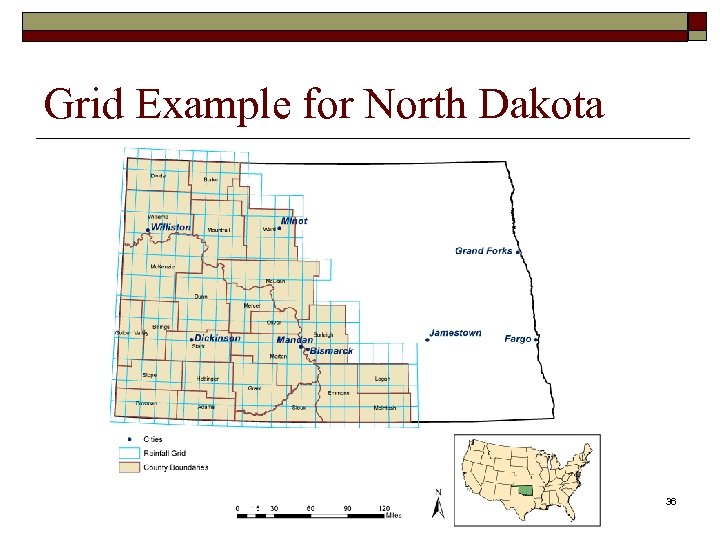 Grid Example for North Dakota 36
 Questions 37
 Program Basics 38
 Terminology and Other Differences o o o o Grid and Grid ID in addition to County Insurable and Insured acres versus Planted acres Index versus Yields Web based No current CAT coverage Not required to insure 100% of acres Must select two Index Intervals Grid IDs, crop types, acreage, and Index Intervals will be determined prior to the Sales Closing Date 39
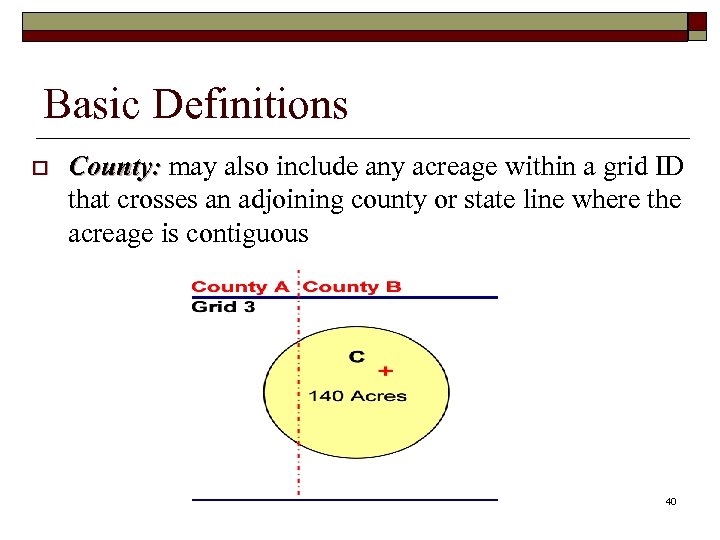 Basic Definitions o County: may also include any acreage within a grid ID that crosses an adjoining county or state line where the acreage is contiguous 40
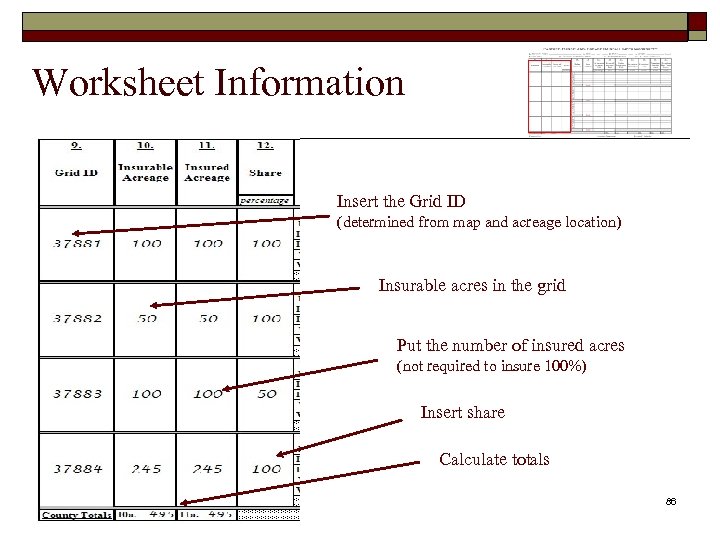
 Basic Definitions o Insurable Acreage: Hayland grazingland that is not planted annually n n n Overseeding into acreage of existing forage crops is acceptable Annually planted crops currently not insurable Insurable acres will consist of the total number of acres suitable for insurance under these crop provisions o Includes both insured acres and uninsured acres 41
 Basic Definitions o Insured Acres: The number of insurable acres selected to be insured by a producer n May choose to insure either Grazingland, Hayland, or both n Not required to insure 100% of the crop type(s) o If the insured chooses to insure the crop types under this policy they cannot insure the same crop under any other FCIC subsidized program 42
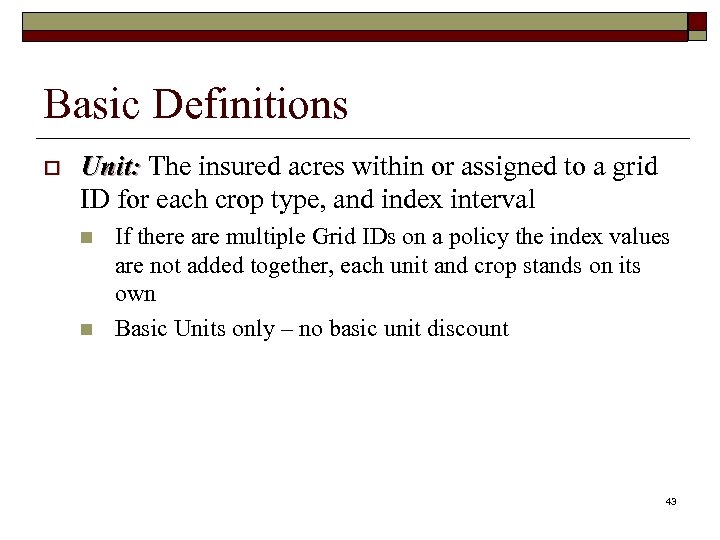 Basic Definitions o Unit: The insured acres within or assigned to a grid ID for each crop type, and index interval n n If there are multiple Grid IDs on a policy the index values are not added together, each unit and crop stands on its own Basic Units only – no basic unit discount 43
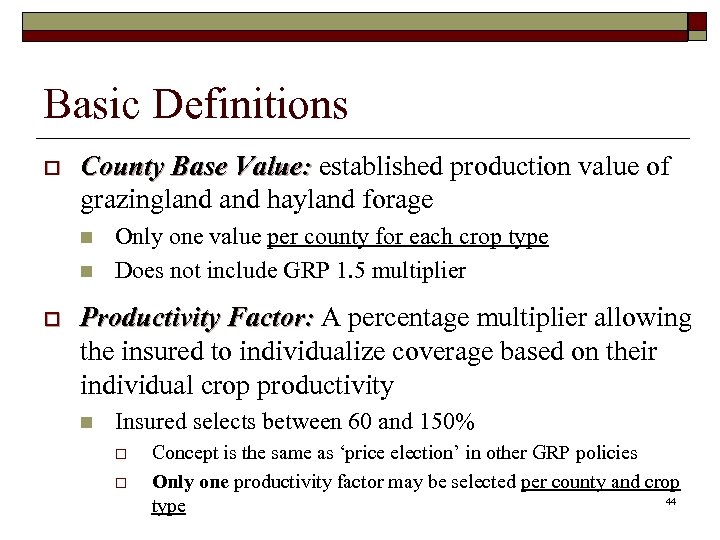 Basic Definitions o County Base Value: established production value of grazingland hayland forage n n o Only one value per county for each crop type Does not include GRP 1. 5 multiplier Productivity Factor: A percentage multiplier allowing the insured to individualize coverage based on their individual crop productivity n Insured selects between 60 and 150% o o Concept is the same as ‘price election’ in other GRP policies Only one productivity factor may be selected per county and crop 44 type
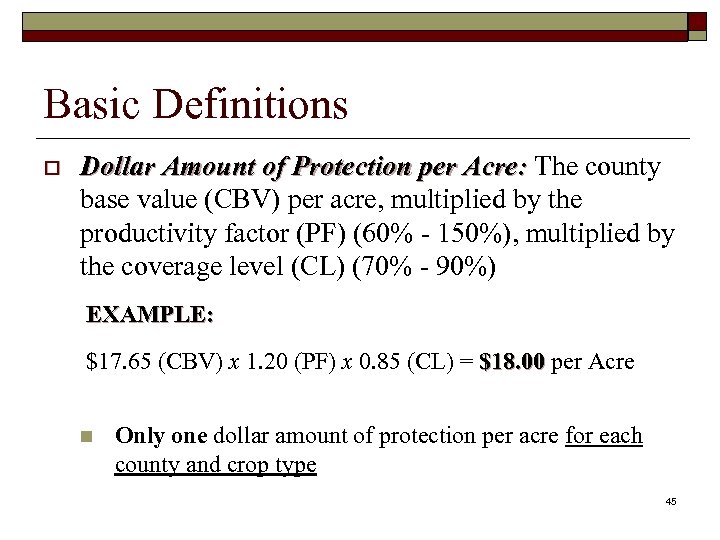 Basic Definitions o Dollar Amount of Protection per Acre: The county base value (CBV) per acre, multiplied by the productivity factor (PF) (60% - 150%), multiplied by the coverage level (CL) (70% - 90%) EXAMPLE: $17. 65 (CBV) x 1. 20 (PF) x 0. 85 (CL) = $18. 00 per Acre n Only one dollar amount of protection per acre for each county and crop type 45
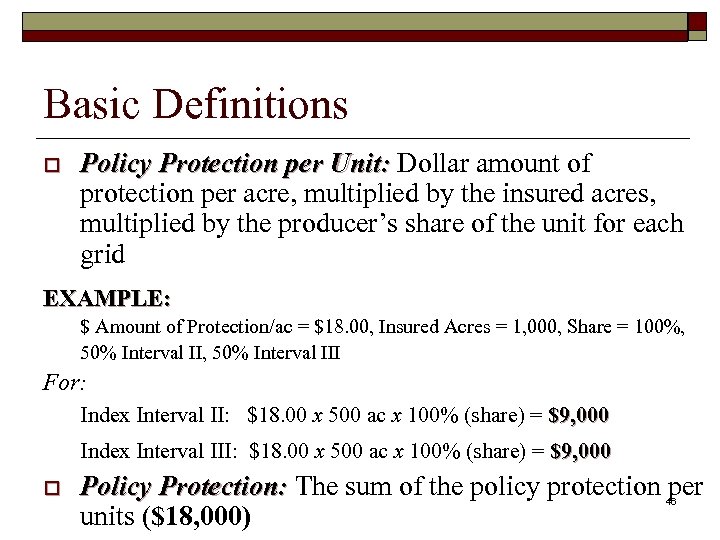 Basic Definitions o Policy Protection per Unit: Dollar amount of protection per acre, multiplied by the insured acres, multiplied by the producer’s share of the unit for each grid EXAMPLE: $ Amount of Protection/ac = $18. 00, Insured Acres = 1, 000, Share = 100%, 50% Interval III For: Index Interval II: $18. 00 x 500 ac x 100% (share) = $9, 000 Index Interval III: $18. 00 x 500 ac x 100% (share) = $9, 000 o Policy Protection: The sum of the policy protection per units ($18, 000) 46
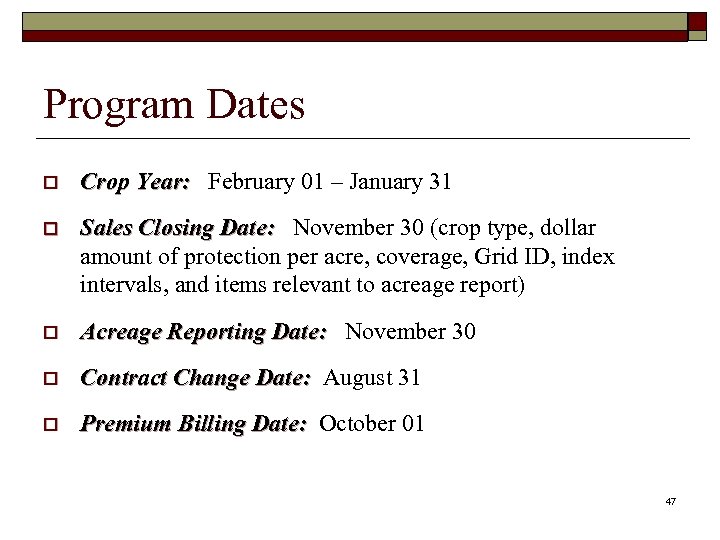 Program Dates o Crop Year: February 01 – January 31 o Sales Closing Date: November 30 (crop type, dollar amount of protection per acre, coverage, Grid ID, index intervals, and items relevant to acreage report) o Acreage Reporting Date: November 30 o Contract Change Date: August 31 o Premium Billing Date: October 01 47
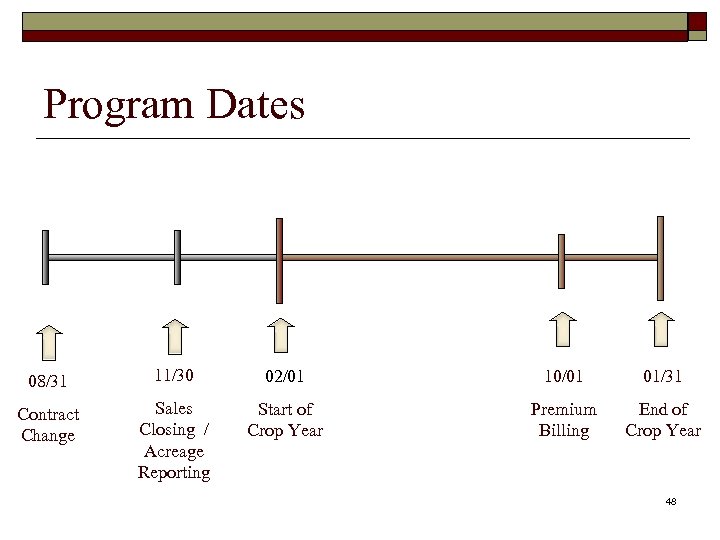 Program Dates 08/31 11/30 02/01 10/01 01/31 Contract Change Sales Closing / Acreage Reporting Start of Crop Year Premium Billing End of Crop Year 48
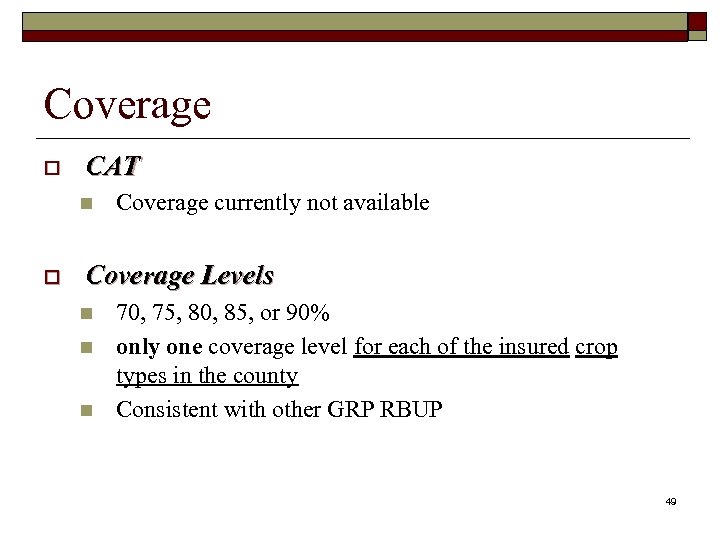 Coverage o CAT n o Coverage currently not available Coverage Levels n n n 70, 75, 80, 85, or 90% only one coverage level for each of the insured crop types in the county Consistent with other GRP RBUP 49
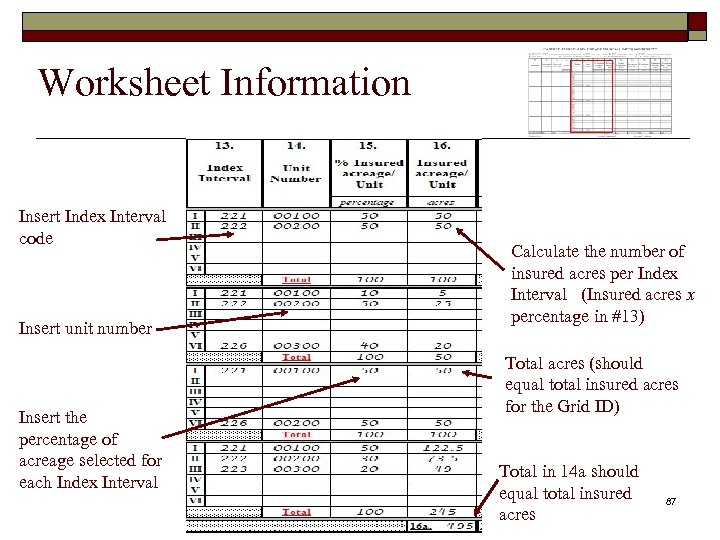
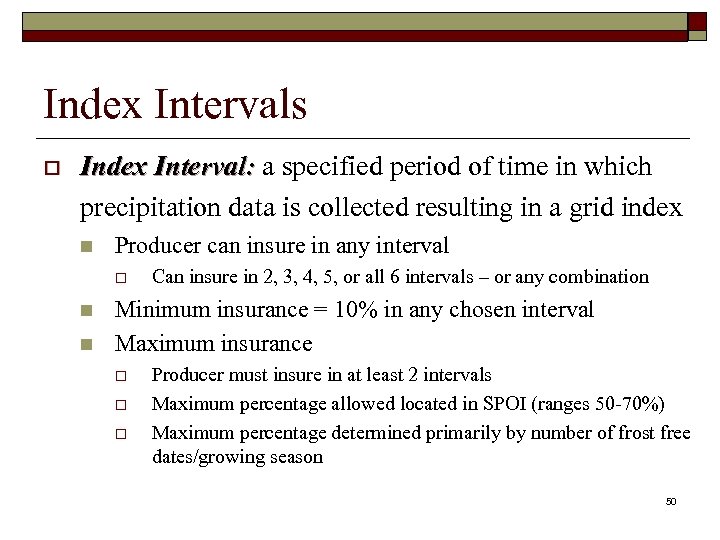 Index Intervals o Index Interval: a specified period of time in which precipitation data is collected resulting in a grid index n Producer can insure in any interval o n n Can insure in 2, 3, 4, 5, or all 6 intervals – or any combination Minimum insurance = 10% in any chosen interval Maximum insurance o o o Producer must insure in at least 2 intervals Maximum percentage allowed located in SPOI (ranges 50 -70%) Maximum percentage determined primarily by number of frost free dates/growing season 50
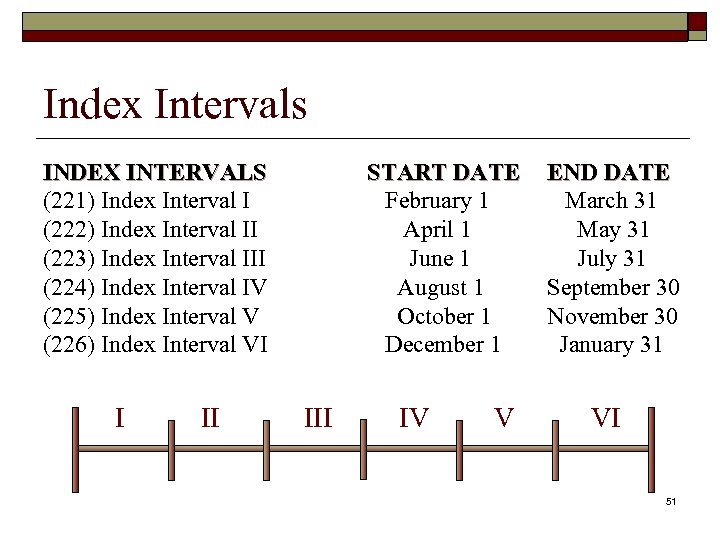 Index Intervals INDEX INTERVALS (221) Index Interval I (222) Index Interval II (223) Index Interval III (224) Index Interval IV (225) Index Interval V (226) Index Interval VI I II START DATE February 1 April 1 June 1 August 1 October 1 December 1 III IV V END DATE March 31 May 31 July 31 September 30 November 30 January 31 VI 51
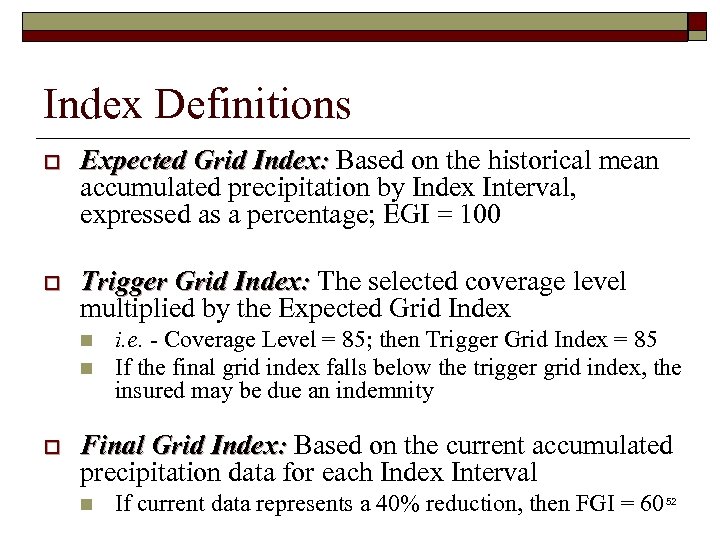 Index Definitions o Expected Grid Index: Based on the historical mean accumulated precipitation by Index Interval, expressed as a percentage; EGI = 100 o Trigger Grid Index: The selected coverage level multiplied by the Expected Grid Index n n o i. e. - Coverage Level = 85; then Trigger Grid Index = 85 If the final grid index falls below the trigger grid index, the insured may be due an indemnity Final Grid Index: Based on the current accumulated precipitation data for each Index Interval n If current data represents a 40% reduction, then FGI = 60 52
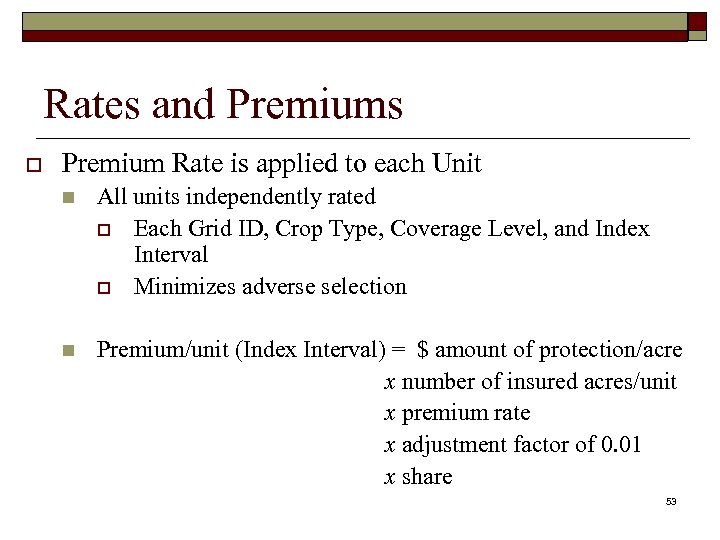 Rates and Premiums o Premium Rate is applied to each Unit n All units independently rated o Each Grid ID, Crop Type, Coverage Level, and Index Interval o Minimizes adverse selection n Premium/unit (Index Interval) = $ amount of protection/acre x number of insured acres/unit x premium rate x adjustment factor of 0. 01 x share 53
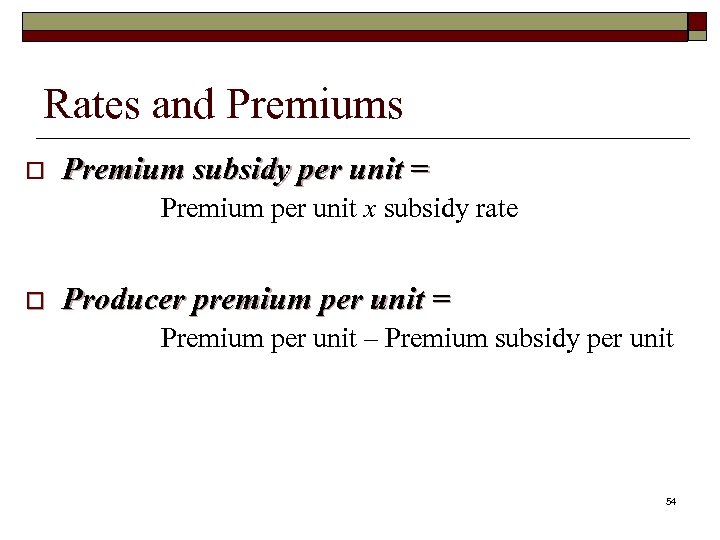 Rates and Premiums o Premium subsidy per unit = Premium per unit x subsidy rate o Producer premium per unit = Premium per unit – Premium subsidy per unit 54
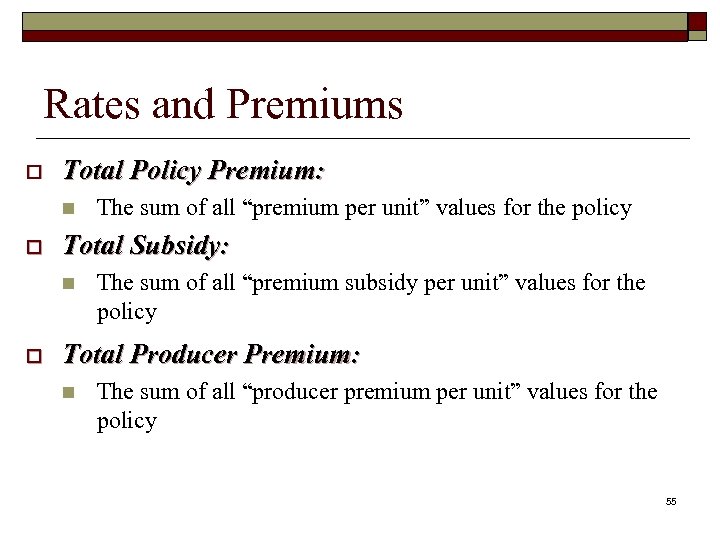 Rates and Premiums o Total Policy Premium: n o Total Subsidy: n o The sum of all “premium per unit” values for the policy The sum of all “premium subsidy per unit” values for the policy Total Producer Premium: n The sum of all “producer premium per unit” values for the policy 55
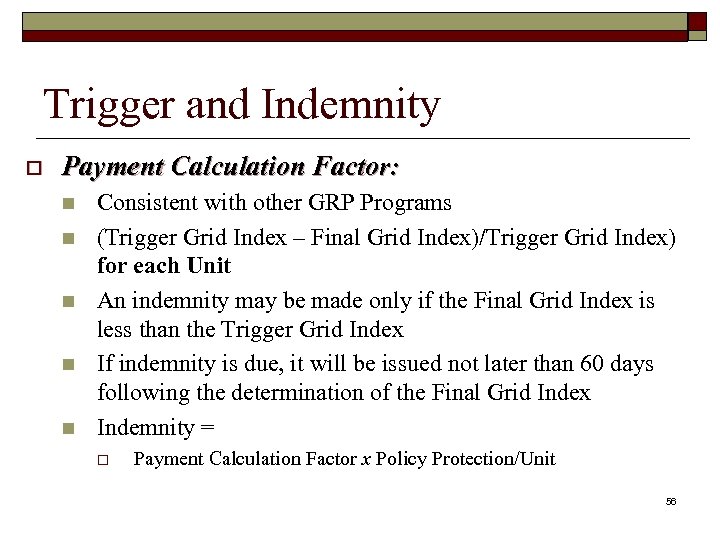 Trigger and Indemnity o Payment Calculation Factor: n n n Consistent with other GRP Programs (Trigger Grid Index – Final Grid Index)/Trigger Grid Index) for each Unit An indemnity may be made only if the Final Grid Index is less than the Trigger Grid Index If indemnity is due, it will be issued not later than 60 days following the determination of the Final Grid Index Indemnity = o Payment Calculation Factor x Policy Protection/Unit 56
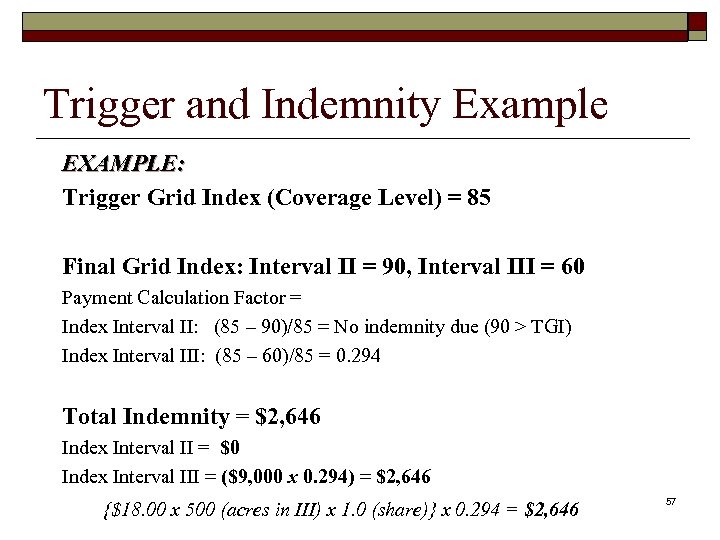 Trigger and Indemnity Example EXAMPLE: Trigger Grid Index (Coverage Level) = 85 Final Grid Index: Interval II = 90, Interval III = 60 Payment Calculation Factor = Index Interval II: (85 – 90)/85 = No indemnity due (90 > TGI) Index Interval III: (85 – 60)/85 = 0. 294 Total Indemnity = $2, 646 Index Interval II = $0 Index Interval III = ($9, 000 x 0. 294) = $2, 646 {$18. 00 x 500 (acres in III) x 1. 0 (share)} x 0. 294 = $2, 646 57
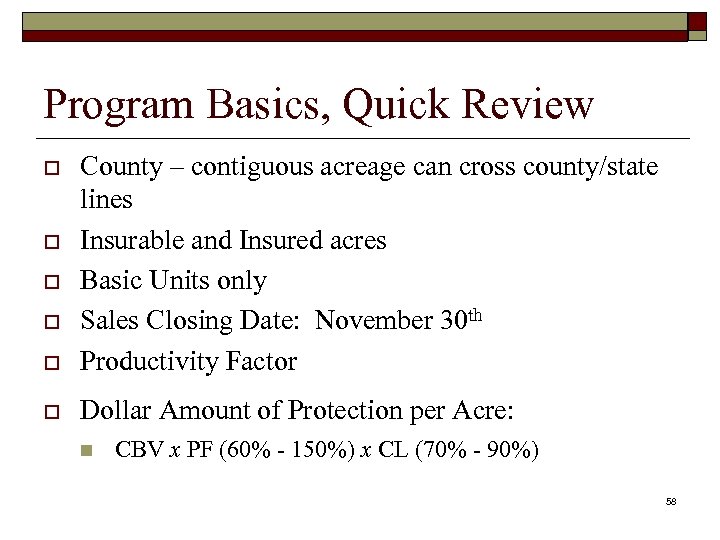 Program Basics, Quick Review o County – contiguous acreage can cross county/state lines Insurable and Insured acres Basic Units only Sales Closing Date: November 30 th Productivity Factor o Dollar Amount of Protection per Acre: o o n CBV x PF (60% - 150%) x CL (70% - 90%) 58
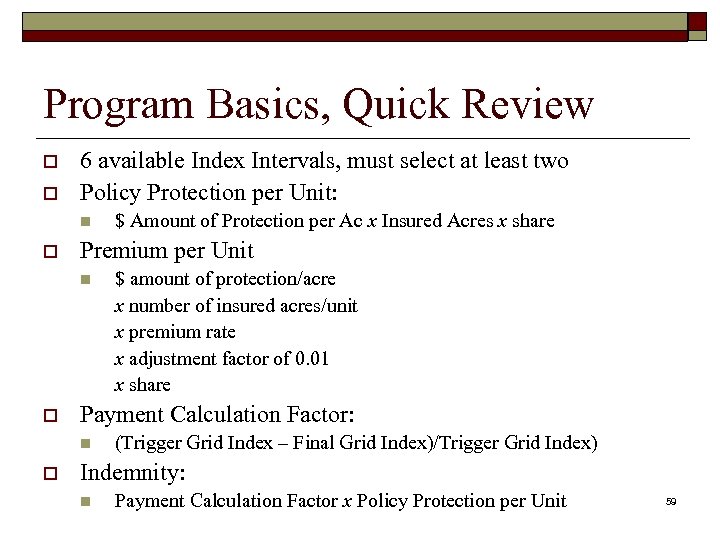 Program Basics, Quick Review o o 6 available Index Intervals, must select at least two Policy Protection per Unit: n o Premium per Unit n o $ amount of protection/acre x number of insured acres/unit x premium rate x adjustment factor of 0. 01 x share Payment Calculation Factor: n o $ Amount of Protection per Ac x Insured Acres x share (Trigger Grid Index – Final Grid Index)/Trigger Grid Index) Indemnity: n Payment Calculation Factor x Policy Protection per Unit 59
 Questions 60
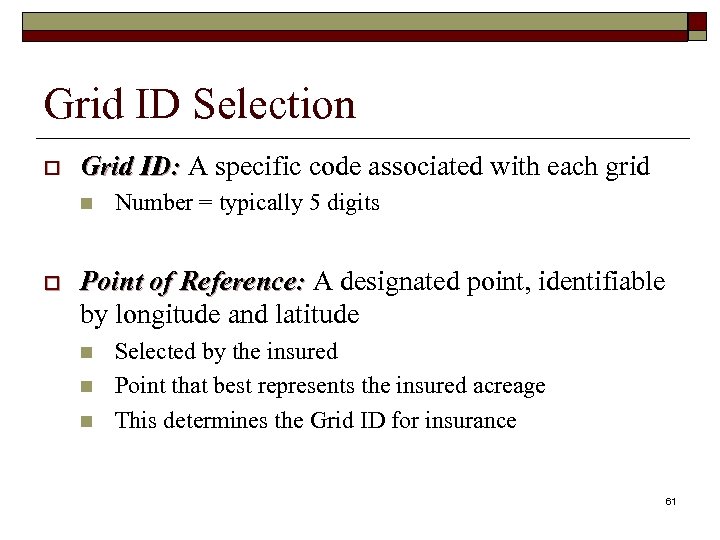 Grid ID Selection o Grid ID: A specific code associated with each grid n o Number = typically 5 digits Point of Reference: A designated point, identifiable by longitude and latitude n n n Selected by the insured Point that best represents the insured acreage This determines the Grid ID for insurance 61
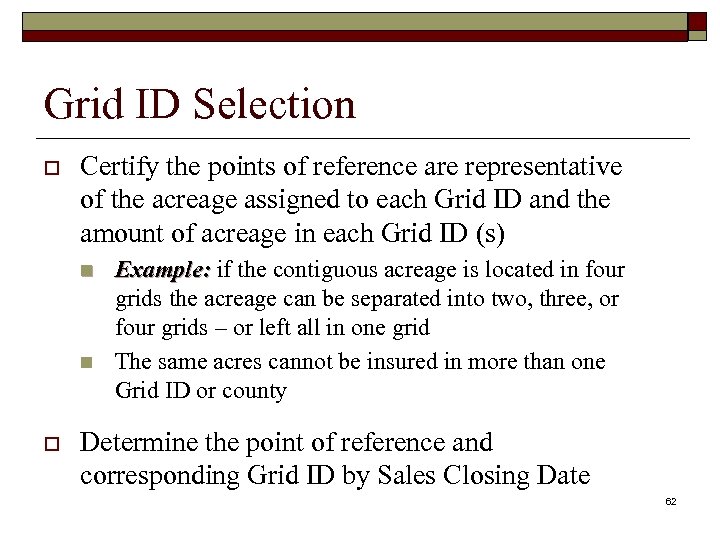 Grid ID Selection o Certify the points of reference are representative of the acreage assigned to each Grid ID and the amount of acreage in each Grid ID (s) n n o Example: if the contiguous acreage is located in four grids the acreage can be separated into two, three, or four grids – or left all in one grid The same acres cannot be insured in more than one Grid ID or county Determine the point of reference and corresponding Grid ID by Sales Closing Date 62
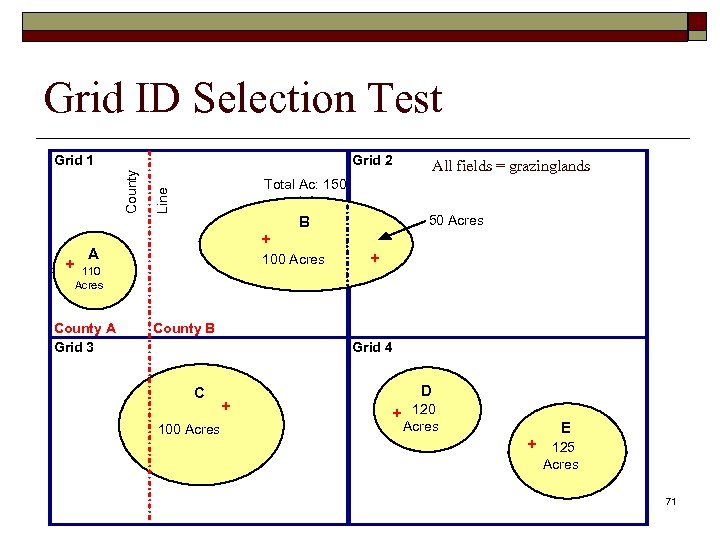
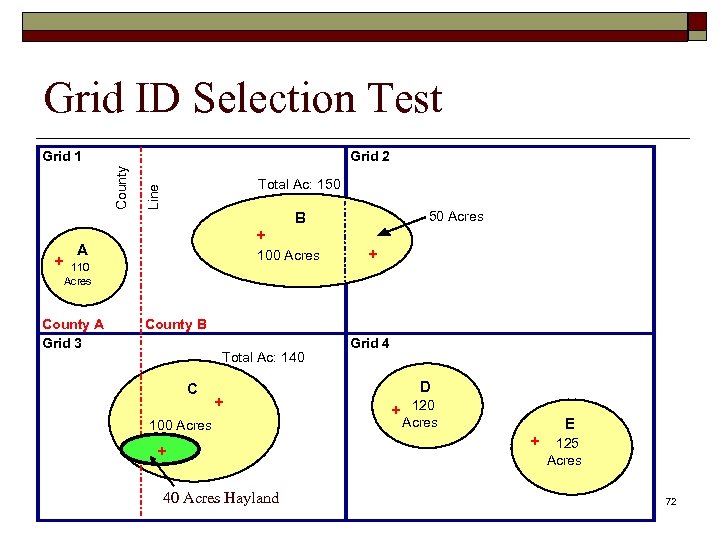
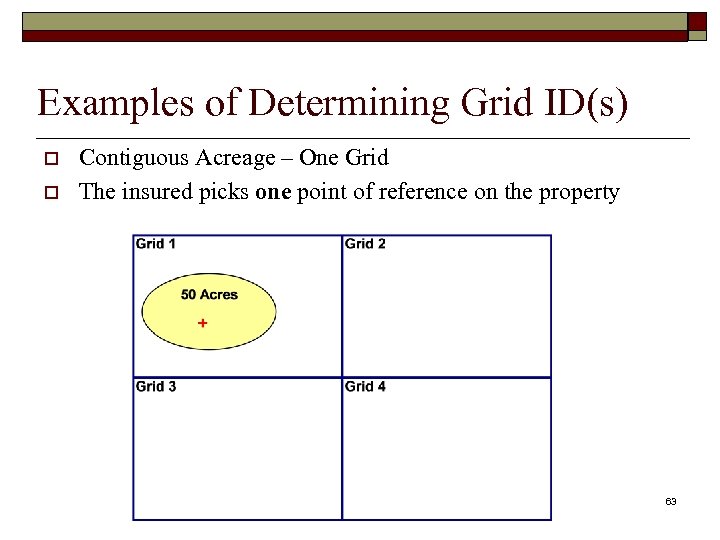 Examples of Determining Grid ID(s) o o Contiguous Acreage – One Grid The insured picks one point of reference on the property 63
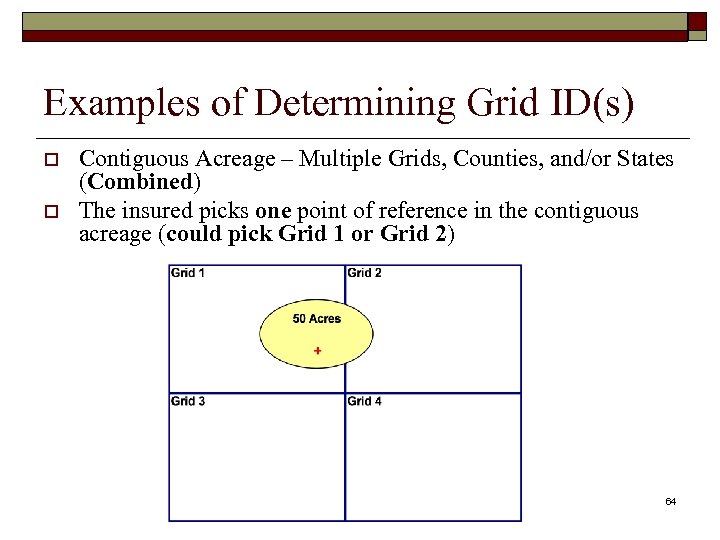 Examples of Determining Grid ID(s) o o Contiguous Acreage – Multiple Grids, Counties, and/or States (Combined) The insured picks one point of reference in the contiguous acreage (could pick Grid 1 or Grid 2) 64
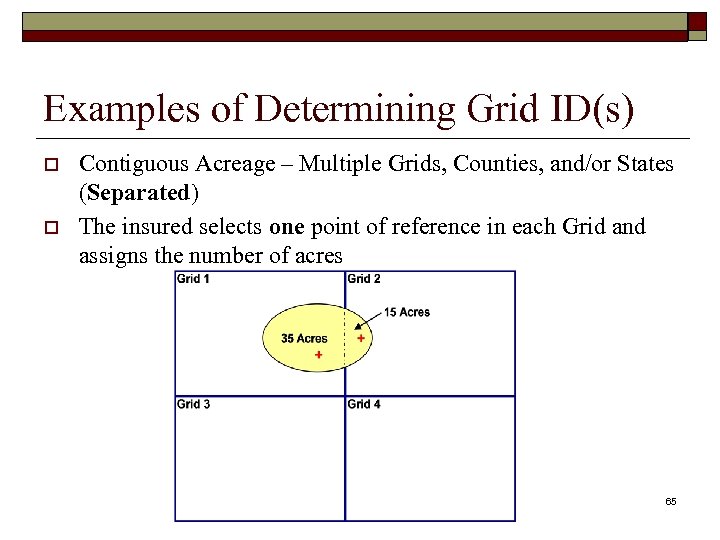 Examples of Determining Grid ID(s) o o Contiguous Acreage – Multiple Grids, Counties, and/or States (Separated) The insured selects one point of reference in each Grid and assigns the number of acres 65
 Examples of Determining Grid ID(s) o Determining the Grid ID (s) for Non-Contiguous Acreage (multiple properties) n n A point of reference must be selected for each separate, non-contiguous acreage The steps in determining the point of reference are similar to the steps outlined for contiguous acreage, simply repeated for each non-contiguous acreage to be insured 66
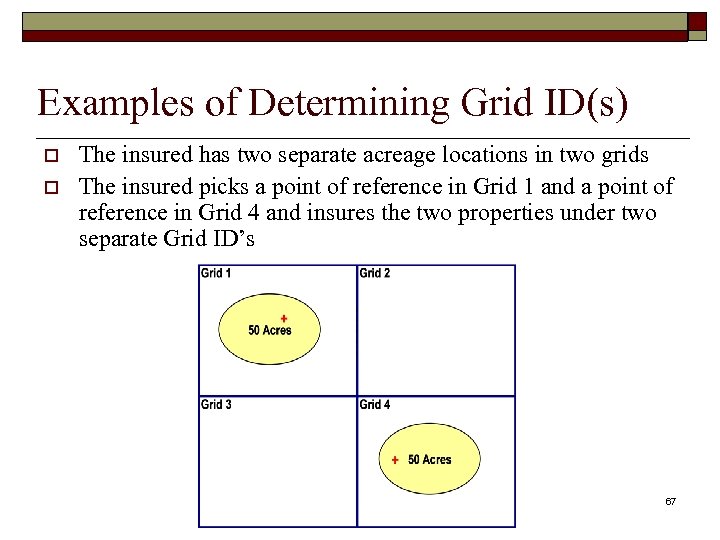 Examples of Determining Grid ID(s) o o The insured has two separate acreage locations in two grids The insured picks a point of reference in Grid 1 and a point of reference in Grid 4 and insures the two properties under two separate Grid ID’s 67
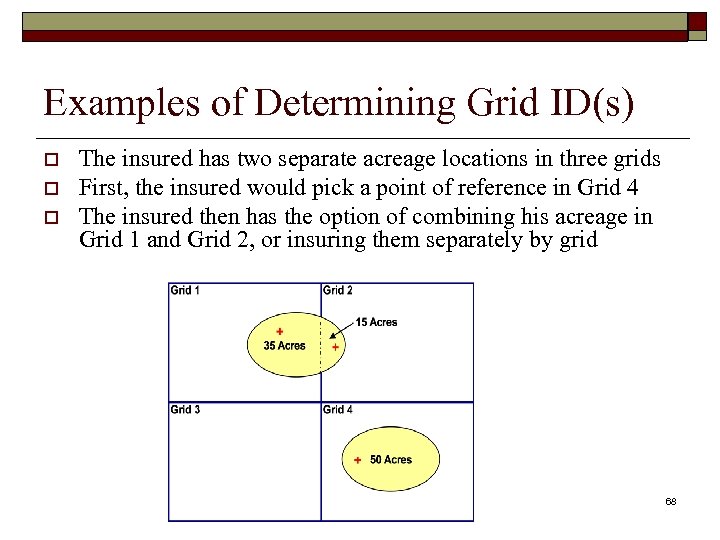 Examples of Determining Grid ID(s) o o o The insured has two separate acreage locations in three grids First, the insured would pick a point of reference in Grid 4 The insured then has the option of combining his acreage in Grid 1 and Grid 2, or insuring them separately by grid 68
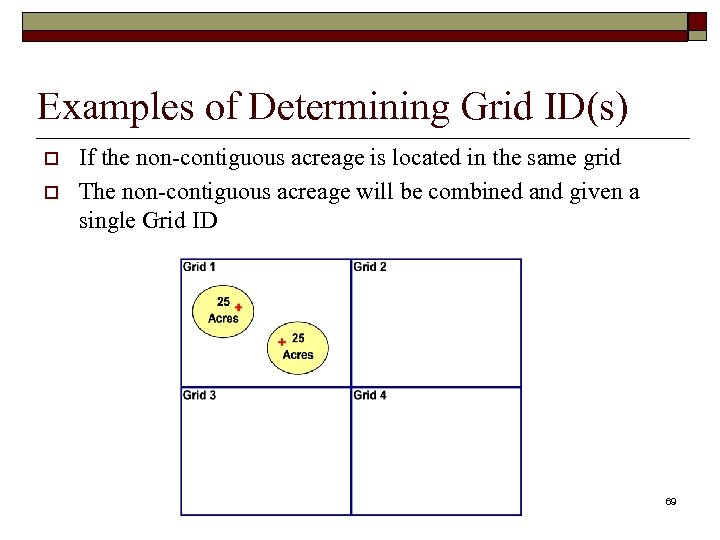 Examples of Determining Grid ID(s) o o If the non-contiguous acreage is located in the same grid The non-contiguous acreage will be combined and given a single Grid ID 69
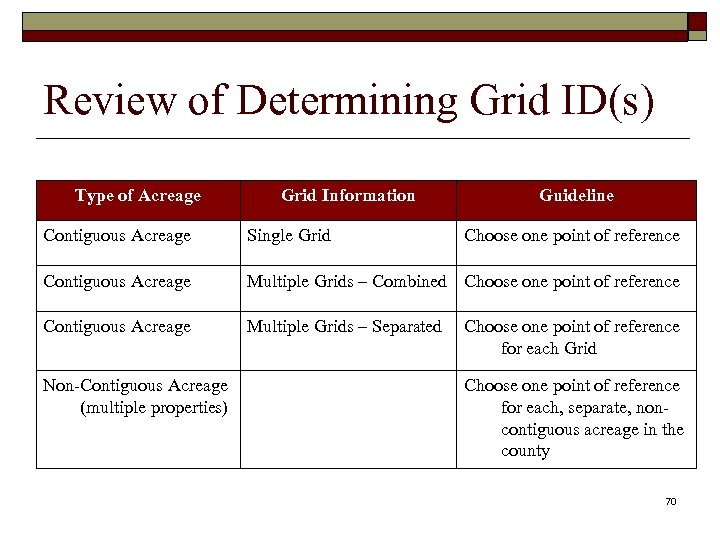 Review of Determining Grid ID(s) Type of Acreage Grid Information Guideline Contiguous Acreage Single Grid Contiguous Acreage Multiple Grids – Combined Choose one point of reference Contiguous Acreage Multiple Grids – Separated Non-Contiguous Acreage (multiple properties) Choose one point of reference for each Grid Choose one point of reference for each, separate, noncontiguous acreage in the county 70
 Grid ID Selection Test Grid 2 + + A 50 Acres B 100 Acres 110 Acres County A Grid 3 All fields = grazinglands Total Ac: 150 Line County Grid 1 + County B Grid 4 C + 100 Acres D + 120 Acres E + 125 Acres 71
 Grid ID Selection Test Grid 2 + Total Ac: 150 Line County Grid 1 + A 100 Acres 110 Acres County A Grid 3 50 Acres B + County B Total Ac: 140 C + 100 Acres + 40 Acres Hayland Grid 4 D + 120 Acres E + 125 Acres 72
 Questions 73
 Use of the Website and Information Needed 74
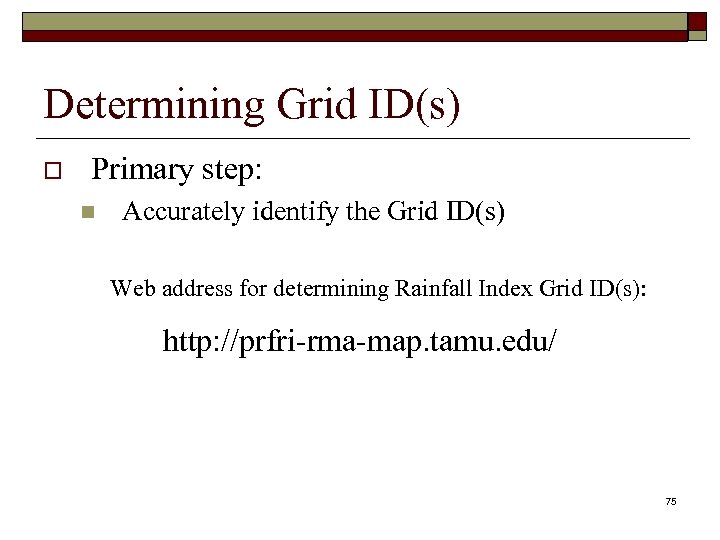 Determining Grid ID(s) o Primary step: n Accurately identify the Grid ID(s) Web address for determining Rainfall Index Grid ID(s): http: //prfri-rma-map. tamu. edu/ 75
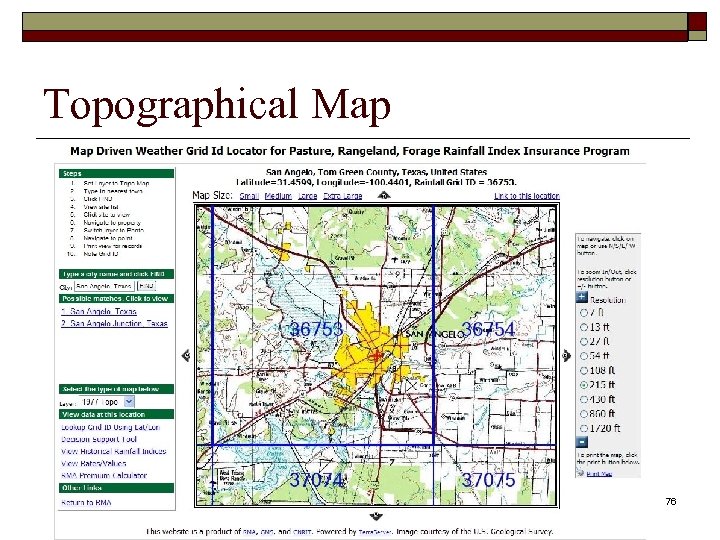 Topographical Map 76
 Determining Grid ID(s) – Basic Steps o Type in the city and/or county name where the property is located o Select the city or county from the possible matches, a topo map for the area will be displayed o Narrow the search by selecting an area near the actual location of the insured’s property o Once the applicant has located the general area, it is recommended they continue to refine the search by switching to the photo maps o Using the topo map, photo map, or combination of both, choose an appropriate resolution for proper identification of the property boundaries and corresponding Grid ID(s) 77
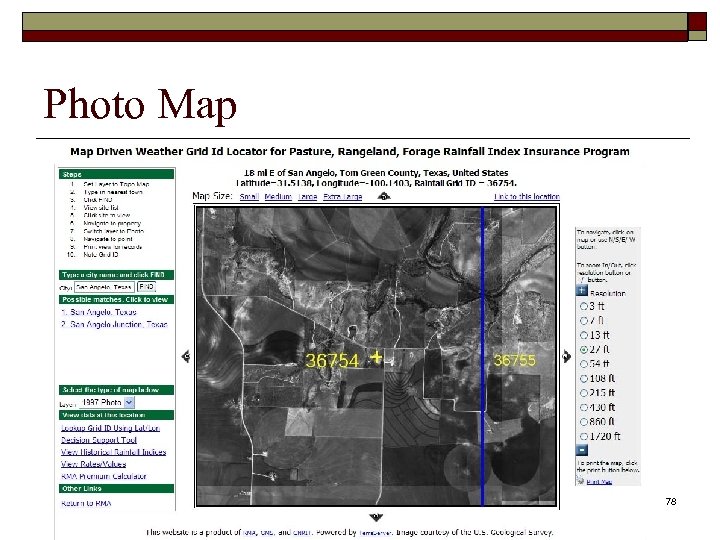 Photo Map 78
 Determining Grid ID(s) – Additional Steps o The insured then selects one point of reference on the property by moving the cross marker (‘+’) to that location n o A Print Icon is in the lower right hand corner of the screen n n o Grid ID is listed at the top of the screen (and on the map itself) This printed map can be used as a record to verify the Grid ID Once printed, the property boundary can also be outlined and initialed by the insured for verification purposes The insured must certify the point of reference 79
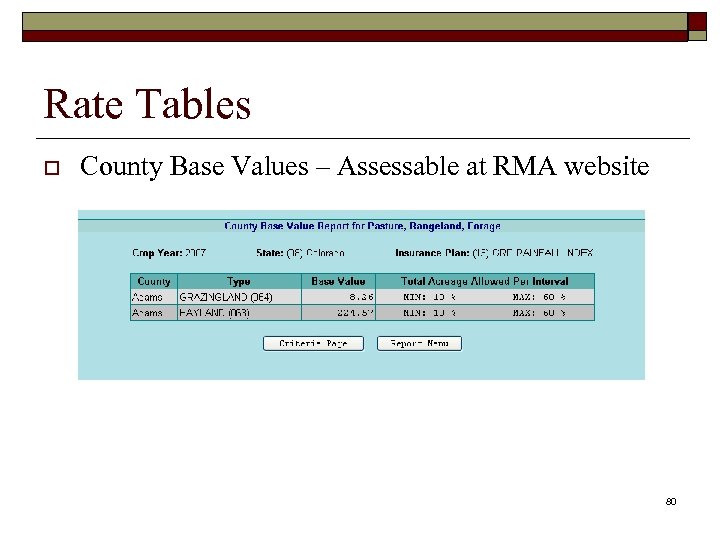 Rate Tables o County Base Values – Assessable at RMA website 80
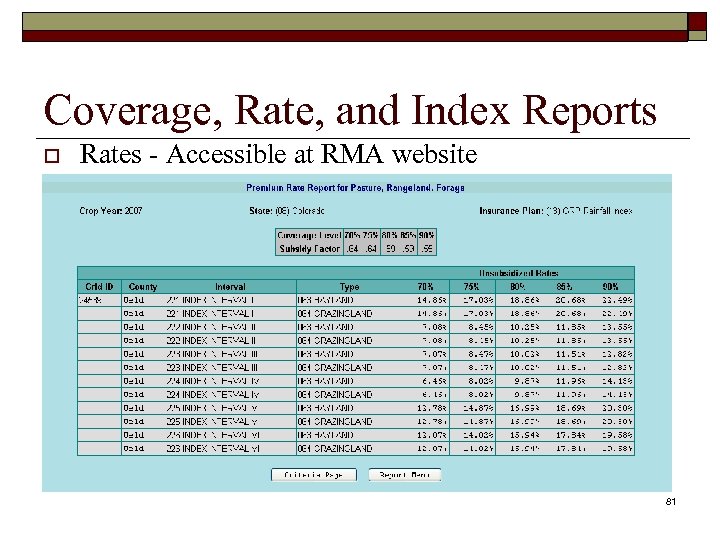 Coverage, Rate, and Index Reports o Rates - Accessible at RMA website 81
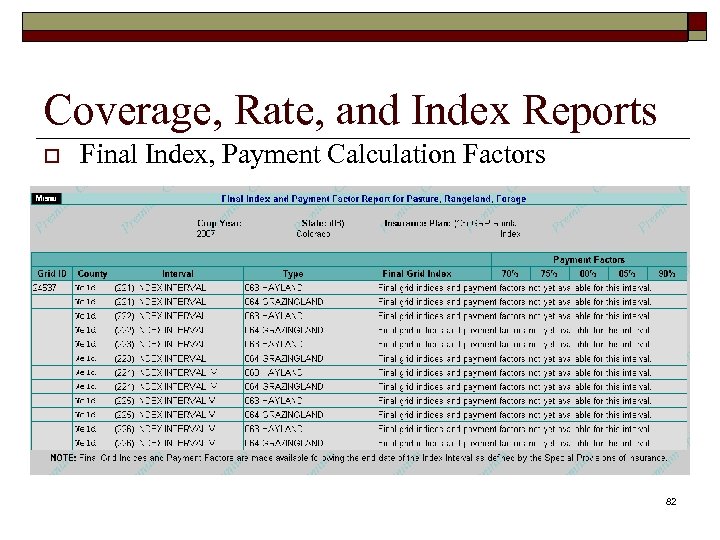 Coverage, Rate, and Index Reports o Final Index, Payment Calculation Factors 82
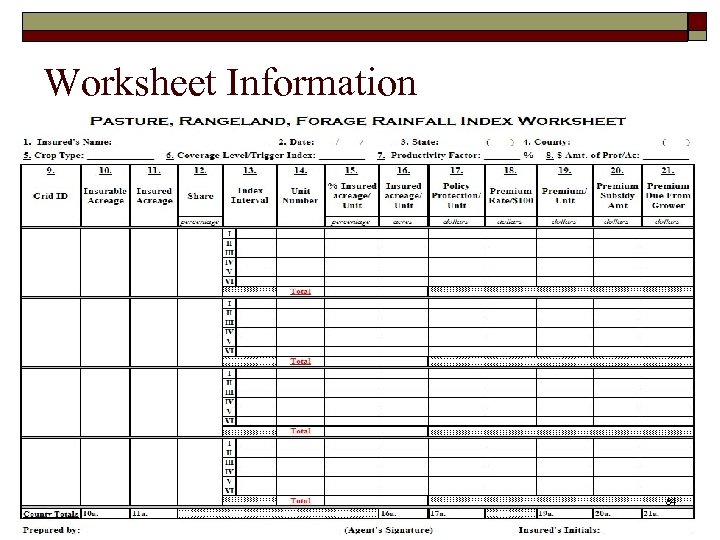
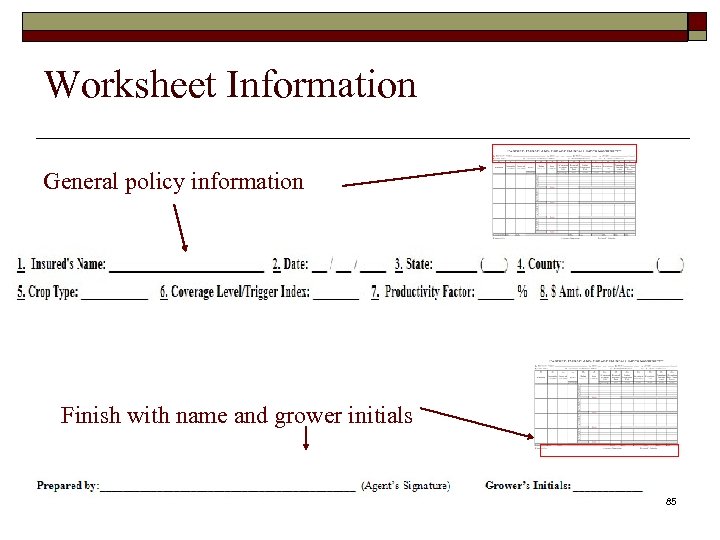
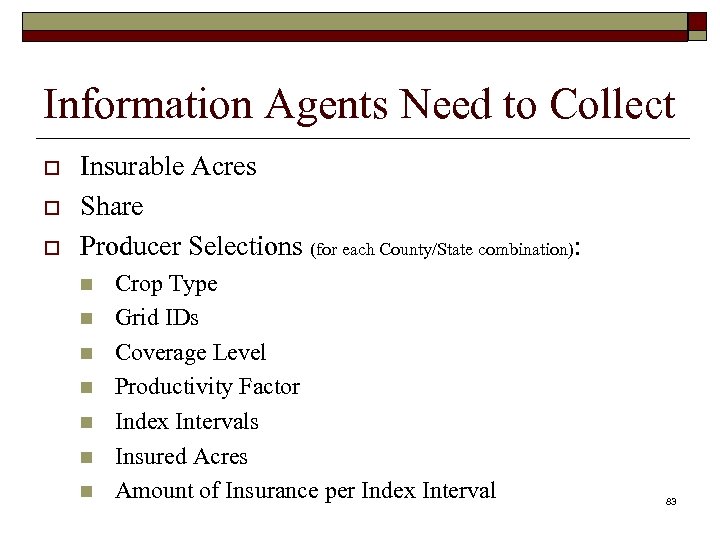 Information Agents Need to Collect o o o Insurable Acres Share Producer Selections (for each County/State combination): n n n n Crop Type Grid IDs Coverage Level Productivity Factor Index Intervals Insured Acres Amount of Insurance per Index Interval 83
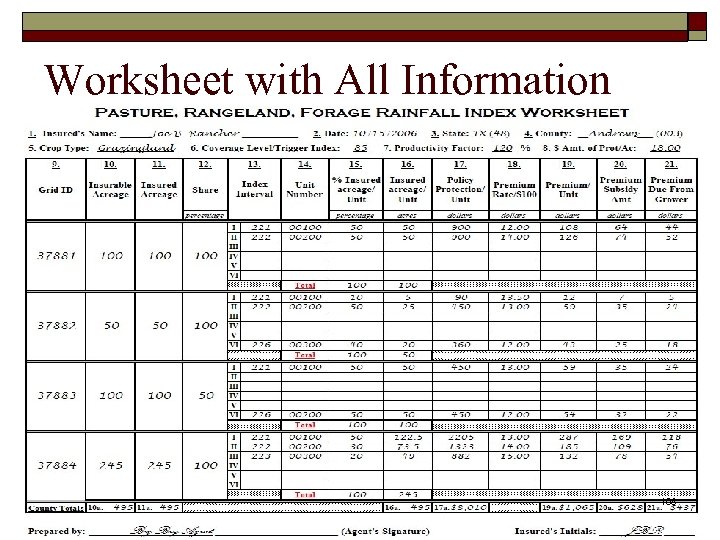
 Worksheet Information 84
 Worksheet Information General policy information Finish with name and grower initials 85
 Worksheet Information Insert the Grid ID (determined from map and acreage location) Insurable acres in the grid Put the number of insured acres (not required to insure 100%) Insert share Calculate totals 86
 Worksheet Information Insert Index Interval code Insert unit number Insert the percentage of acreage selected for each Index Interval Calculate the number of insured acres per Index Interval (Insured acres x percentage in #13) Total acres (should equal total insured acres for the Grid ID) Total in 14 a should equal total insured acres 87
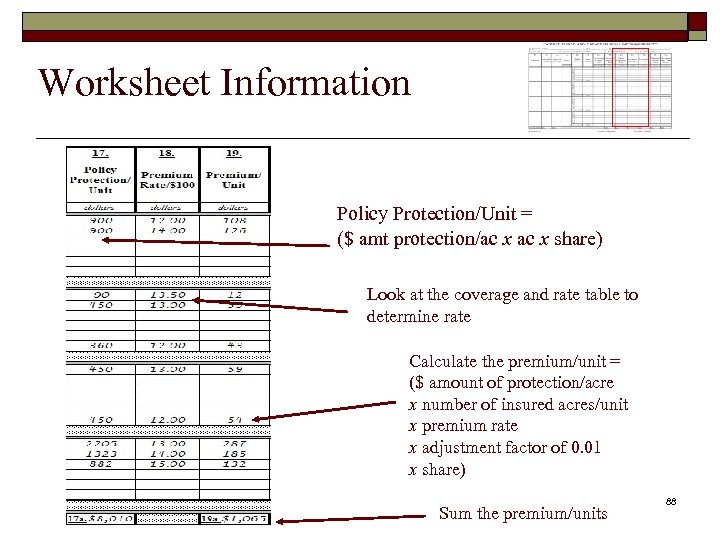 Worksheet Information Policy Protection/Unit = ($ amt protection/ac x share) Look at the coverage and rate table to determine rate Calculate the premium/unit = ($ amount of protection/acre x number of insured acres/unit x premium rate x adjustment factor of 0. 01 x share) Sum the premium/units 88
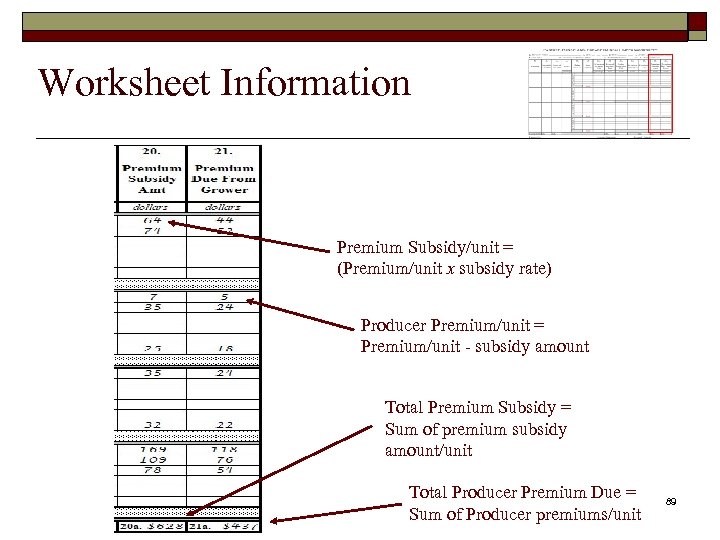 Worksheet Information Premium Subsidy/unit = (Premium/unit x subsidy rate) Producer Premium/unit = Premium/unit - subsidy amount Total Premium Subsidy = Sum of premium subsidy amount/unit Total Producer Premium Due = Sum of Producer premiums/unit 89
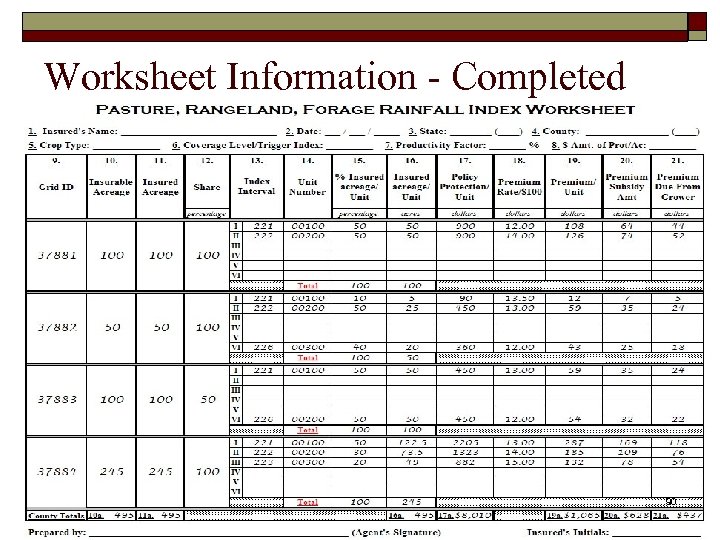 Worksheet Information - Completed 90
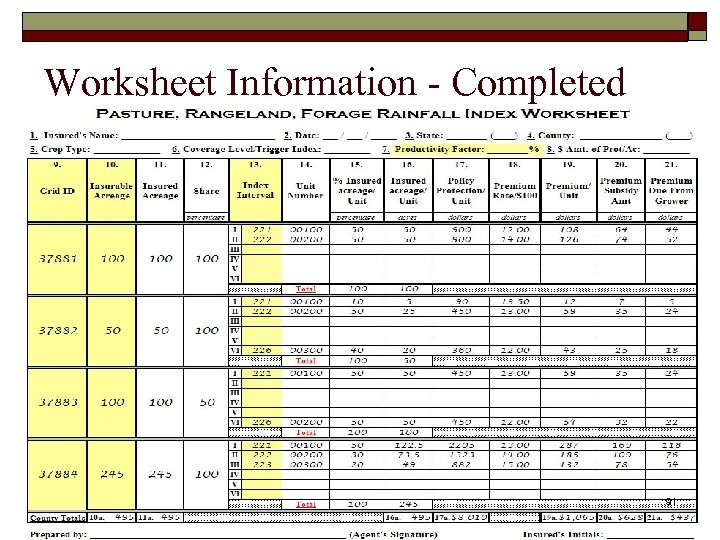 Worksheet Information - Completed 91
 How the Index is Reported o The Final Grid Index will be available on the RMA website following the end date of each index interval 92
 Questions 93
 Joe Rancher Contacts His Agent A step-by-step example 94
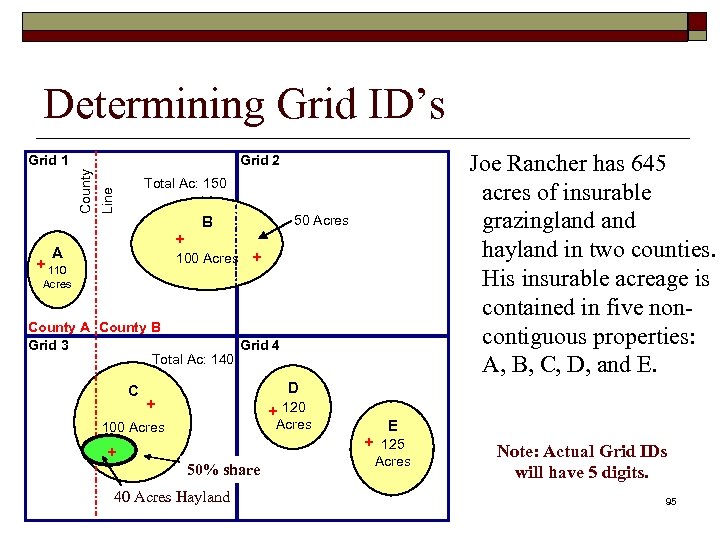 Determining Grid ID’s Joe Rancher has 645 acres of insurable grazingland hayland in two counties. His insurable acreage is contained in five noncontiguous properties: A, B, C, D, and E. Grid 2 Total Ac: 150 Line County Grid 1 + A 100 Acres + 110 50 Acres B + Acres County A County B Grid 3 Grid 4 Total Ac: 140 C D + + 120 Acres 100 Acres + E + 125 50% share 40 Acres Hayland Acres Note: Actual Grid IDs will have 5 digits. 95
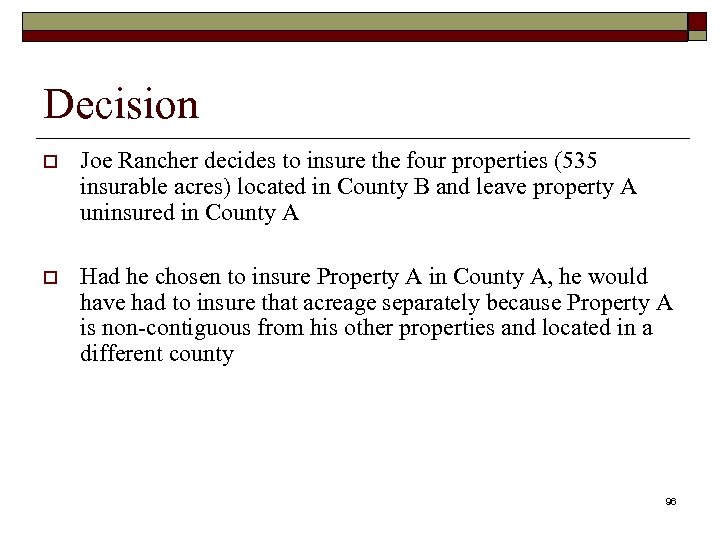 Decision o Joe Rancher decides to insure the four properties (535 insurable acres) located in County B and leave property A uninsured in County A o Had he chosen to insure Property A in County A, he would have had to insure that acreage separately because Property A is non-contiguous from his other properties and located in a different county 96
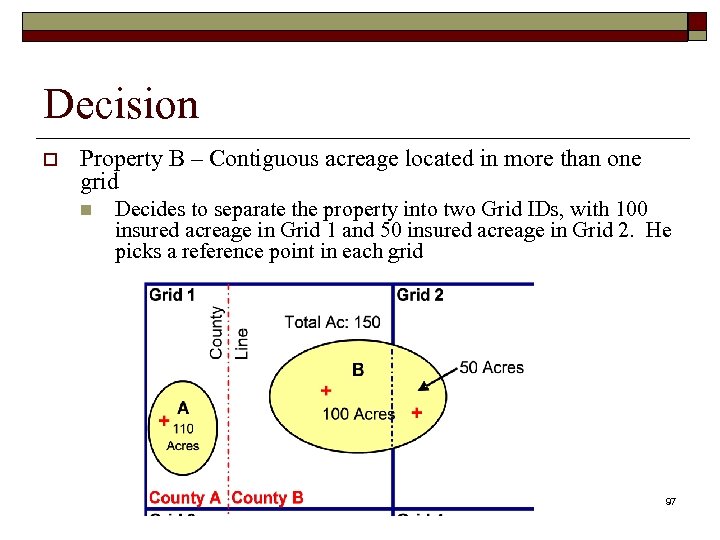 Decision o Property B – Contiguous acreage located in more than one grid n Decides to separate the property into two Grid IDs, with 100 insured acreage in Grid 1 and 50 insured acreage in Grid 2. He picks a reference point in each grid 97
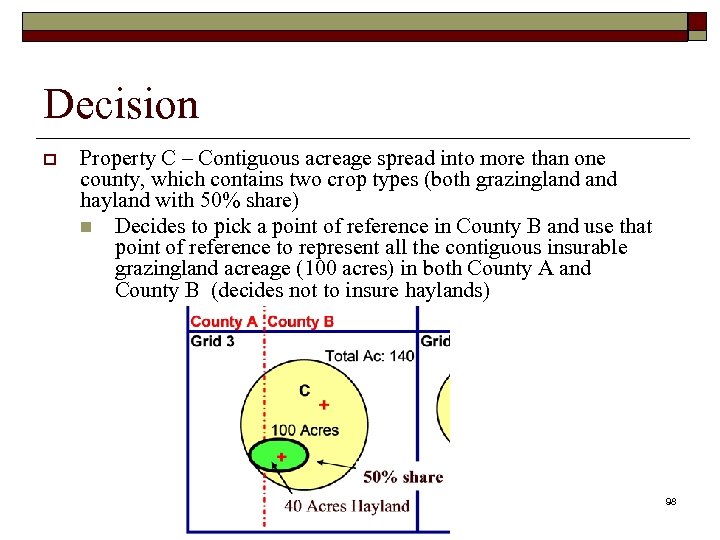 Decision o Property C – Contiguous acreage spread into more than one county, which contains two crop types (both grazingland hayland with 50% share) n Decides to pick a point of reference in County B and use that point of reference to represent all the contiguous insurable grazingland acreage (100 acres) in both County A and County B (decides not to insure haylands) 98
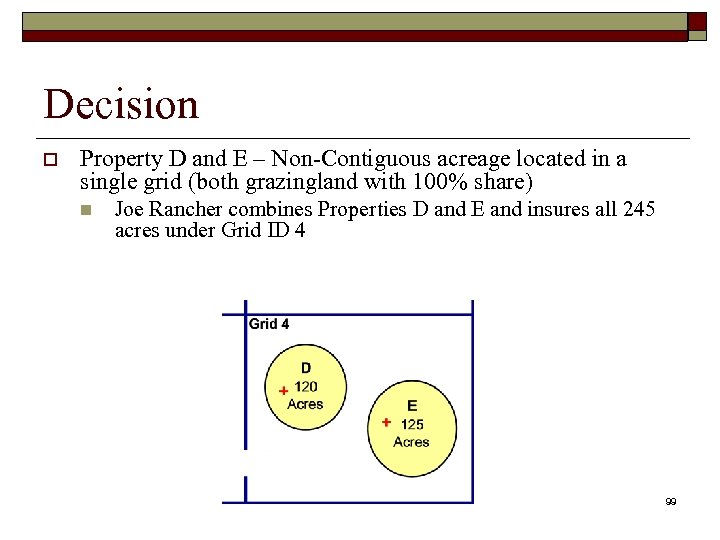 Decision o Property D and E – Non-Contiguous acreage located in a single grid (both grazingland with 100% share) n Joe Rancher combines Properties D and E and insures all 245 acres under Grid ID 4 99
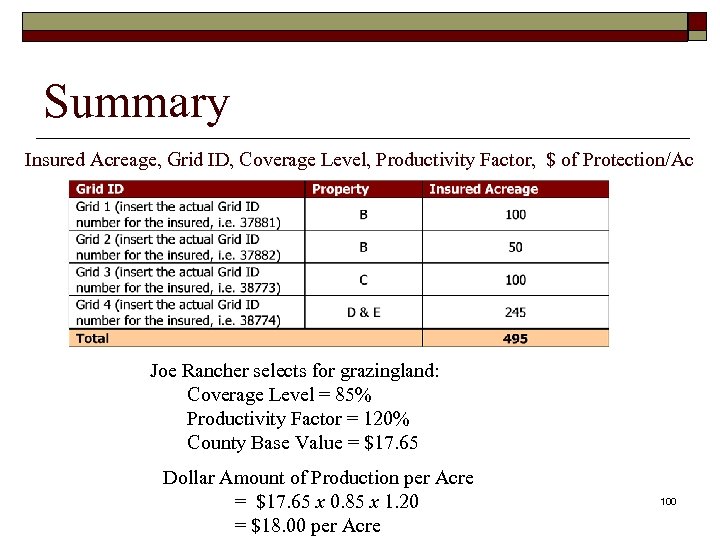 Summary Insured Acreage, Grid ID, Coverage Level, Productivity Factor, $ of Protection/Ac Joe Rancher selects for grazingland: Coverage Level = 85% Productivity Factor = 120% County Base Value = $17. 65 Dollar Amount of Production per Acre = $17. 65 x 0. 85 x 1. 20 = $18. 00 per Acre 100
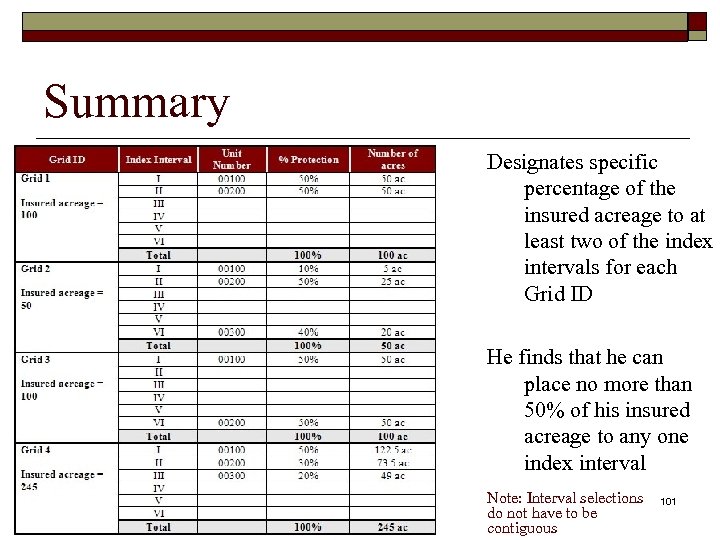 Summary Designates specific percentage of the insured acreage to at least two of the index intervals for each Grid ID He finds that he can place no more than 50% of his insured acreage to any one index interval Note: Interval selections do not have to be contiguous 101
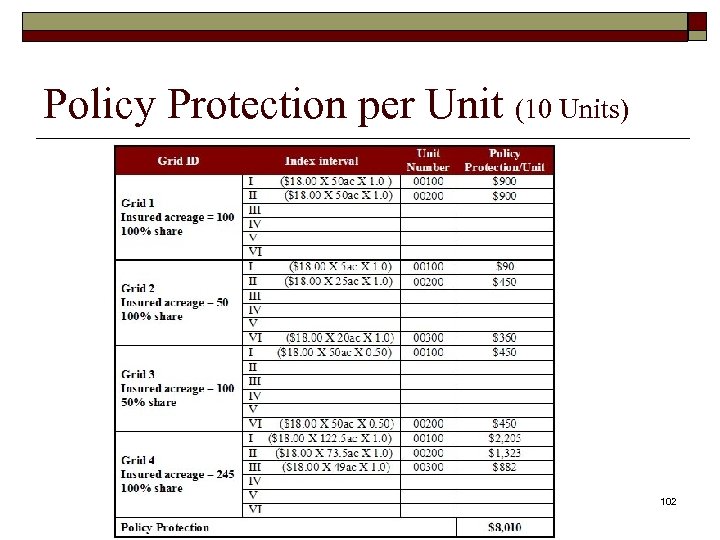 Policy Protection per Unit (10 Units) 102
 Premium o Joe Rancher and his agent look up the applicable premium rates using the premium rate tables o Premium/unit (Index Interval) = $ amount of protection/acre x number of insured acres/unit x premium rate x adjustment factor of 0. 01 x share 103
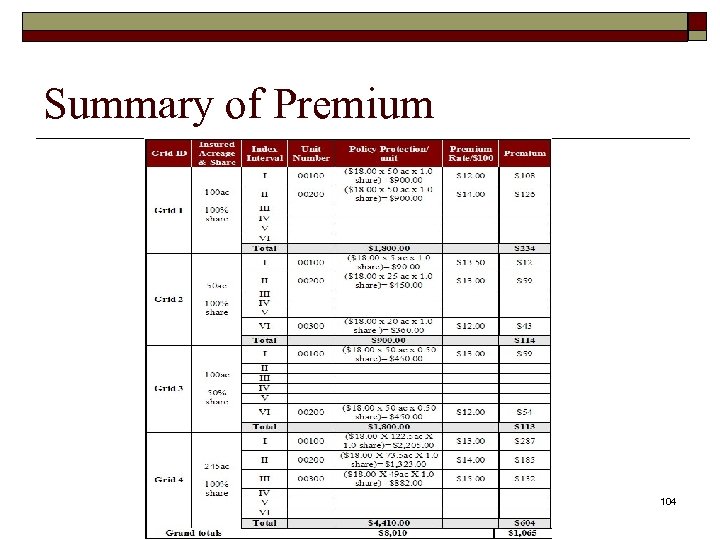 Summary of Premium 104
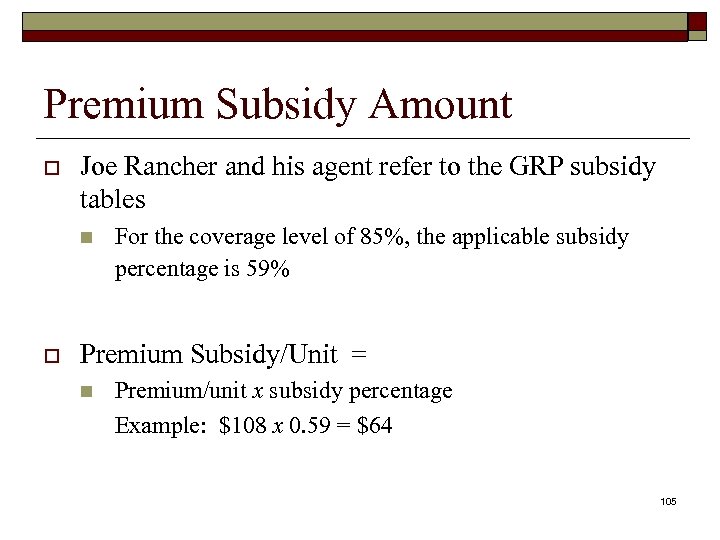 Premium Subsidy Amount o Joe Rancher and his agent refer to the GRP subsidy tables n o For the coverage level of 85%, the applicable subsidy percentage is 59% Premium Subsidy/Unit = n Premium/unit x subsidy percentage Example: $108 x 0. 59 = $64 105
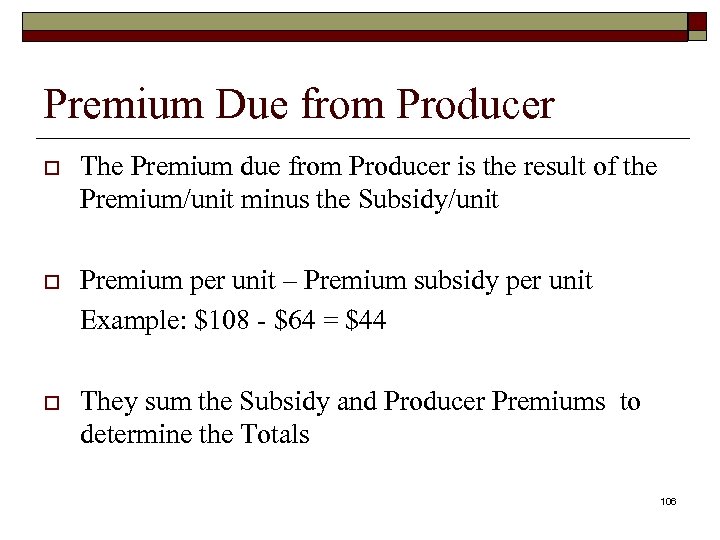 Premium Due from Producer o The Premium due from Producer is the result of the Premium/unit minus the Subsidy/unit o Premium per unit – Premium subsidy per unit Example: $108 - $64 = $44 o They sum the Subsidy and Producer Premiums to determine the Totals 106
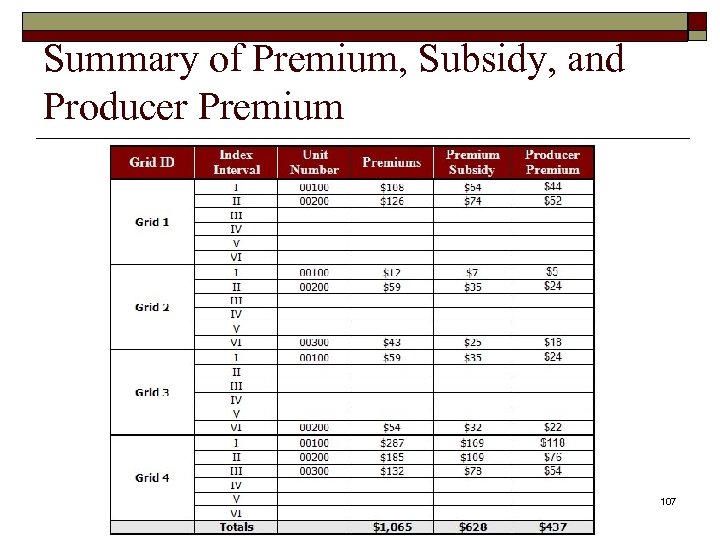 Summary of Premium, Subsidy, and Producer Premium 107
 Worksheet with All Information 108
 Final Grid Index and Indemnities 109
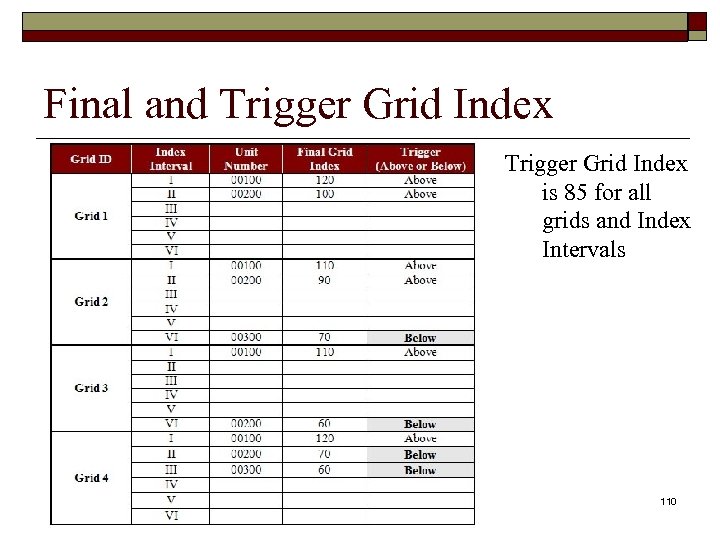 Final and Trigger Grid Index is 85 for all grids and Index Intervals 110
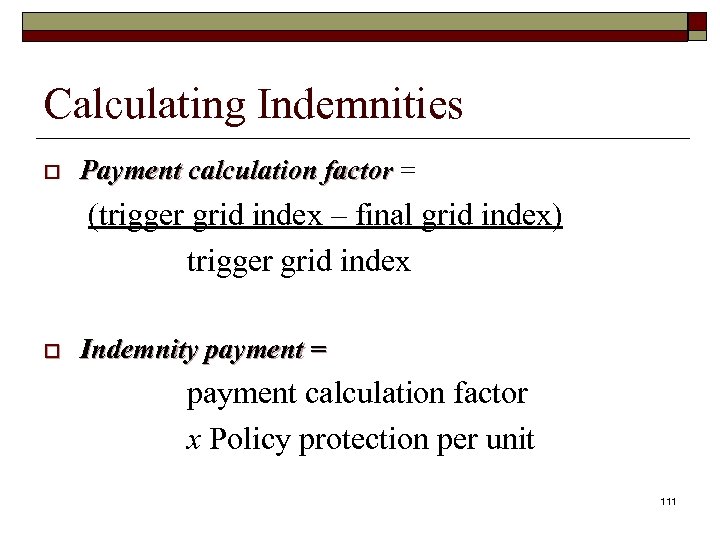 Calculating Indemnities o Payment calculation factor = (trigger grid index – final grid index) trigger grid index o Indemnity payment = payment calculation factor x Policy protection per unit 111
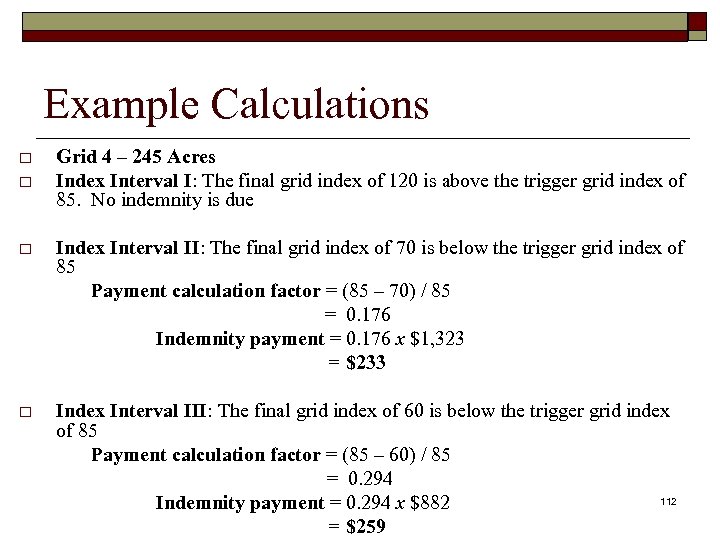 Example Calculations o o Grid 4 – 245 Acres Index Interval I: The final grid index of 120 is above the trigger grid index of 85. No indemnity is due o Index Interval II: The final grid index of 70 is below the trigger grid index of 85 Payment calculation factor = (85 – 70) / 85 = 0. 176 Indemnity payment = 0. 176 x $1, 323 = $233 o Index Interval III: The final grid index of 60 is below the trigger grid index of 85 Payment calculation factor = (85 – 60) / 85 = 0. 294 112 Indemnity payment = 0. 294 x $882 = $259
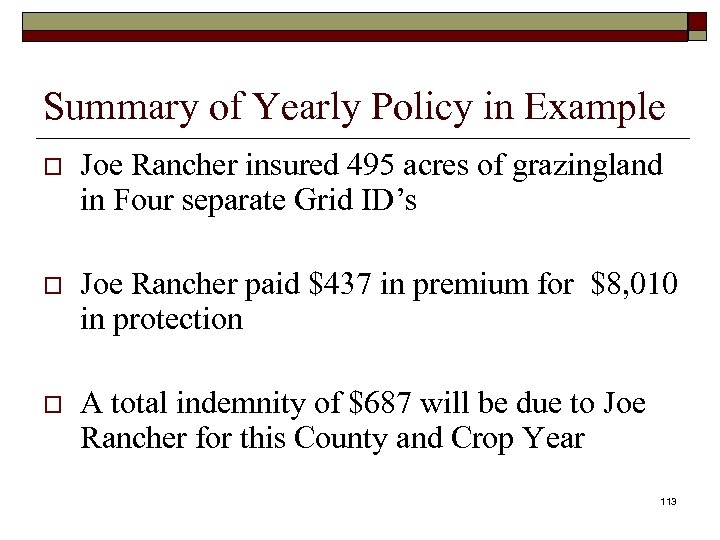 Summary of Yearly Policy in Example o Joe Rancher insured 495 acres of grazingland in Four separate Grid ID’s o Joe Rancher paid $437 in premium for $8, 010 in protection o A total indemnity of $687 will be due to Joe Rancher for this County and Crop Year 113
 Questions 114
 Additional Program Tools and Information 115
 PRF - Rainfall Index Decision Tool o The calculator is not part of the program n n n Not required to buy insurance Provides estimates Values are based on current information to derive historical estimates of indemnity, premium, and subsidy numbers May not match the official figures released by FCIC in past years Contact a qualified insurance agent for actual premium quotes 116
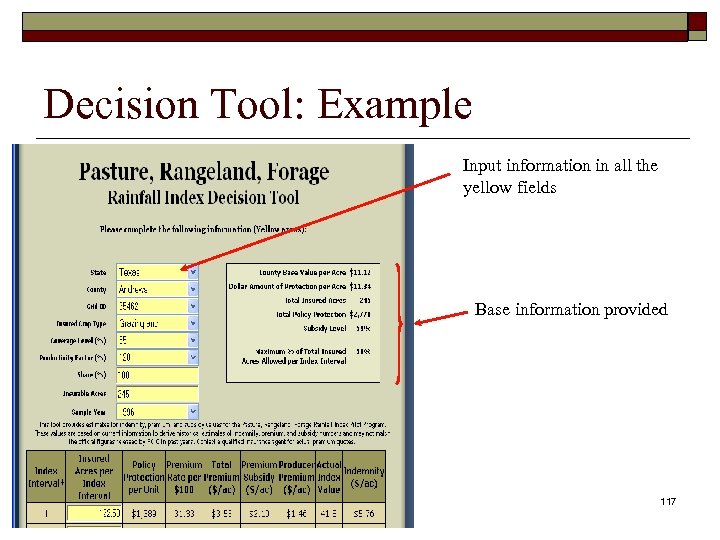 Decision Tool: Example Input information in all the yellow fields Base information provided 117
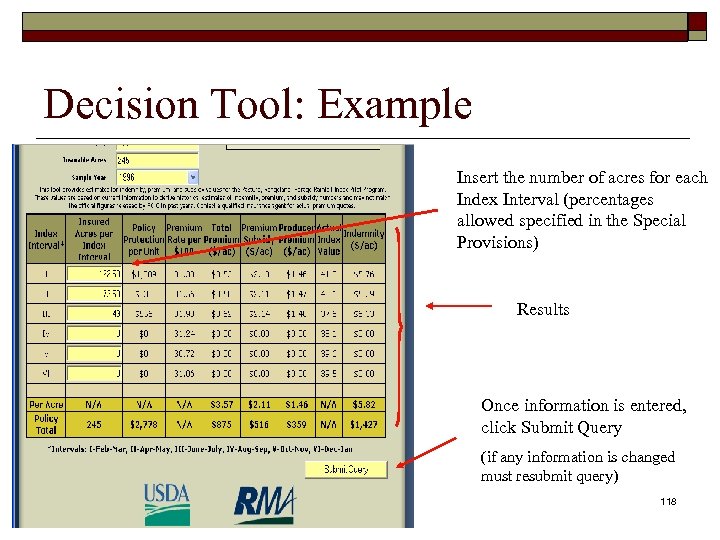 Decision Tool: Example Insert the number of acres for each Index Interval (percentages allowed specified in the Special Provisions) Results Once information is entered, click Submit Query (if any information is changed must resubmit query) 118
 Additional Information o Historical Index n o Lookup Grid ID using Longitude/Latitude n o Lookup values since 1948 Must be submitted in the correct data format RMA premium calculator 119
 Summary o o o A new program for a commodity with little or no history of crop insurance GRP based program Losses determined by index (not individual production) Terminology differences Producer is allowed or required to make choices Can tailor the program to producer risk management needs 120
 Questions 121