


 Скачать презентацию Past Accomplishments Future Architecture An Integrated Strategy R Zurek
6656e811bef910c9492880a1e9e3ff54.ppt
- Количество слайдов: 20
 Past Accomplishments/Future Architecture: An Integrated Strategy R. Zurek JPL Mars Program Office September 9 -10, 2009
 Science Needs for the Next Decade: Process • • The MEPAG Goals, Objectives and Investigations document provides the basis for the science of Mars exploration 1 MEPAG has distilled a set of science questions 2 to be addressed in the next decade; these lead to a specific set of proposed science objectives 2 that take into account: – Priority within the context of Solar System Exploration, including comparison with Earth, and a judgment as to how the greatest advance can be made in the next decade – Technical feasibility of achieving the objectives • • Measurement objectives 2 flow from the science objectives; Missions are defined to make the measurements, 2, 3 but must take into account: – Cost envelopes and technical maturity of spacecraft systems and instruments – Celestial mechanics: Launch opportunities vary in terms of difficulty – Synergy of missions for reducing risk and leveraging capability; one mission typically addresses several objectives; achieving one objective might require several missions • These considerations can be addressed by an integrated strategy 2, 3 *References 1 J. Johnson--MEPAG (2008); 2 J. Mustard Presentation—Mars; Current State of Knowledge & Future Plans and Strategies (July, 2009; MEPAG meeting) 3 P. Christensen et al. —MATT Reports to NASA (2007, 2008) Mars Panel Meeting Sept. 9 -10 2009 Pre-decisional – for planning and discussion purposes only 2
 MEPAG: Mars Science Priorities within Planetary Exploration 1. Early evolution of the terrestrial planets, including our own Earth; • • Evidence of planetary evolution, especially during the first billion years after formation of the solid crust, is preserved (perhaps uniquely) on Mars During this period there were major changes in the Martian climate and in the geological and chemical processes altering its surface; similar processes were in play for the other terrestrial planets 2. A means to approach, and possibly answer, questions about the origin and evolution of life; • • Evidence of multiple, diverse aqueous environments raises the potential for ancient life and for preservation of biosignatures or pre-biotic chemical activity Detection of short-lived trace gases (e. g. , methane) points to subsurface activity even today; whether biochemical or geochemical remains to be determined 3. The nature of short & long-term climate change as driven by orbital variations; • Detection of internal layering in polar ice caps and of subsurface ice deposits at non-polar latitudes point to cyclic change in recent geologic times 4. The internal structure and origin of the terrestrial planets. • Early shifts in mineral deposition during a period of magnetic field transition point to additional roles of interior dynamics in evolution of Mars Source: MEPAG (2009), Why Mars Remains a Compelling Target for Planetary Exploration, J. S. Mustard, ed. , 7 p. white paper posted September, 2009 by the Mars Exploration Program Analysis Group (MEPAG) at http: //mepag. jpl. nasa. gov/decadal/index. html. Mars Panel Meeting Sept. 9 -10 2009 Pre-decisional – for planning and discussion purposes only 3
 MEPAG: Scientific Questions for the Next Decade Integrating the MEPAG science priorities and the programmatic factors, these specific questions are highest priority for the next decade. • What is the diversity and nature of aqueous geologic environments? (Goal I, III--MSL will contribute) • What is the detailed mineralogy of the diverse suite of geologic units and what are their absolute ages? (Goal II, III) • Are reduced carbon compounds preserved and, if so, in what geologic environments? (Goal I--MSL may contribute) • What is the complement of trace gases in the atmosphere and what are the processes that govern their origin, evolution, and fate? (Goal I, III) • How does the planet interact with the space environment, and how has that affected its evolution? (Goal II—would be addressed by MAVEN mission in formulation) • What is the record of climate change over the past 10, 100, and 1000 Myrs? (Goal II, III) • What is the internal structure and activity? (Goal III) Mars Panel Meeting Sept. 9 -10 2009 Pre-decisional – for planning and discussion purposes only 4
 Specific Mission Objectives Proposed for the Next Decade’s Science Questions (1 of 2) • Quantify current processes causing loss of volatiles to space* – Plan to address by the MAVEN mission (in formulation) • Test hypotheses relating to the origin of trace gases in the atmosphere, and the processes that may cause their concentrations to vary in space and time – Ref: M. Smith et al. -- Trace Gas Mission SDT/SAG – Would also extend the current record of present climate variability • Explore a new site with high potential for habitability and geological discovery. At that site, evaluate past environmental conditions, the potential for preservation of the signs of life, and seek candidate biosignatures. – Ref: L. Pratt et al. -- MEPAG’s MRR SAG *Identified as a high priority in the previous Solar System Exploration Decadal Survey Mars Panel Meeting Sept. 9 -10 2009 Pre-decisional – for planning and discussion purposes only 5
 Specific Mission Objectives Proposed for the Next Decade’s Science Questions (2 of 2) • Establish at least one (and preferably more) solid planet geophysical monitoring station with a primary purpose of measuring seismic activity* – Ref: Banerdt, Spohn, et al. , -- MEPAG’s NET-SAG • Take specific steps to achieve the possible return of a set of highquality samples from Mars to Earth* as early in the 2020’s as possible: – Well-funded MSR technology development program in the 2010’s – Establishment of a cache of samples on Mars that could be returned to Earth *Identified as a high priority in the previous Solar System Exploration Decadal Survey Mars Panel Meeting Sept. 9 -10 2009 Pre-decisional – for planning and discussion purposes only 6
 Exploration Program Strategic Factors • Budget – The budgets for NASA’s Science Mission Directorate and its Mars Exploration Program have each been reduced in recent years – Major scientific progress frequently requires complex, advanced missions (e. g. , sample return) which are inherently more expensive • Technical – Major scientific progress requires sustained technology developments to provide the needed system capabilities – Major past and current developments (e. g. , MSL “skycrane” EDL system) provide the heritage needed to reduce cost and technical risk of future missions – Efficient use of multiple spacecraft can enhance science (e. g. , relay) and reduce risk (e. g. , site certification, critical event coverage, environment monitoring) for any one mission, particularly landers • International Collaboration – International joint development could enable the missions required to the extent that there are common goals and acceptable approaches – This would introduce multiple political drivers (space agencies, project management and procedures, etc. ) Mars Panel Meeting Sept. 9 -10 2009 Pre-decisional – for planning and discussion purposes only 7
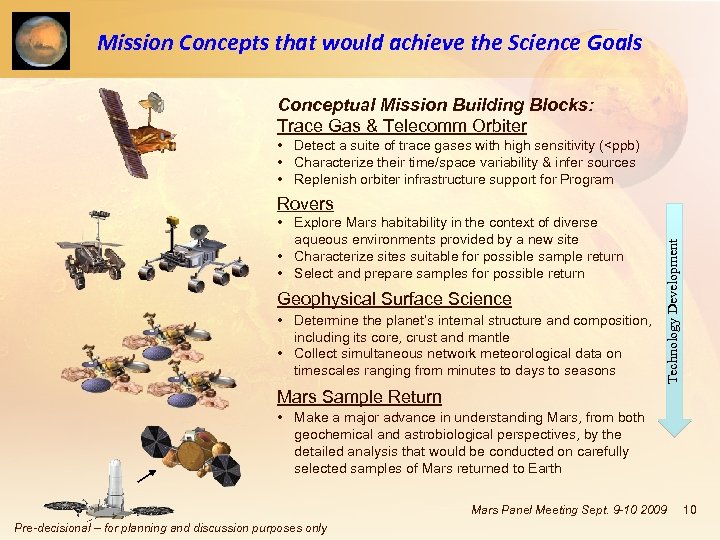
 Possible Mission Building Blocks • The following conceptual mission building blocks would address the next decade’s highest-priority science objectives. The strategic significance of most of these mission concepts was first recognized by MAPG (2006). These conclusions have been reinforced and refined by MSSSAG (2008) and by three reports from MATT (2007 -2008). – Trace Gas Orbiter (evolved from Mars Science Orbiter SAG and SDT) – Mars Astrobiology Explorer-Cacher (nee: Mars mid-rovers; Mars Prospector Rover; Mid-Range Rover) – Mars Network – Mars Sample Return – Presented and discussed at MEPAG meetings (e. g. , September, 2008) • MEPAG has further refined the mission concepts – Mars Prospector Rover/Mid-Range Rover was studied by a SAG • Mars Astrobiology Explorer -- Cache (MAX-C) has emerged – Network science priorities are being reviewed by a SAG and will report at the next Mars panel meeting • These inputs form the building blocks of an integrated strategy Mars Panel Meeting Sept. 9 -10 2009 Pre-decisional – for planning and discussion purposes only 8
 MATT/MART Guidance to Mission Architects The sequencing of these conceptual mission building blocks follows guidelines and suggestions most recently provided the Mars Architecture Tiger Team (MATT) and Mars Architecture Review Team (MART). These are: • Conduct a Mars Sample Return Mission (MSR) campaign at the earliest opportunity while recognizing that the timing of MSR is budget driven. Proposed actions include: – Reducing cost by taking advantage of MSL technology developments; – Requiring the next rover missions to implement sample selection, acquisition and caching as the first step of a multiple-flight-element Mars Sample Return campaign; – Providing the technology program needed to address remaining technological challenges for sample return. • MEP should proceed with a balanced scientific program while taking specific steps toward the possible return of samples from Mars to Earth. Proposed actions include: – Providing long-lived orbiters to observe the atmosphere and seasonal surface change, and to provide telecom and critical event support; – Responding to recent discoveries of atmospheric methane and of diverse aqueous environments with a renewed focus on the “life question”; – Conducting the network mission recommended previously by the NRC. Mars Panel Meeting Sept. 9 -10 2009 Pre-decisional – for planning and discussion purposes only 9
 Mission Concepts that would achieve the Science Goals Conceptual Mission Building Blocks: Trace Gas & Telecomm Orbiter • Detect a suite of trace gases with high sensitivity (
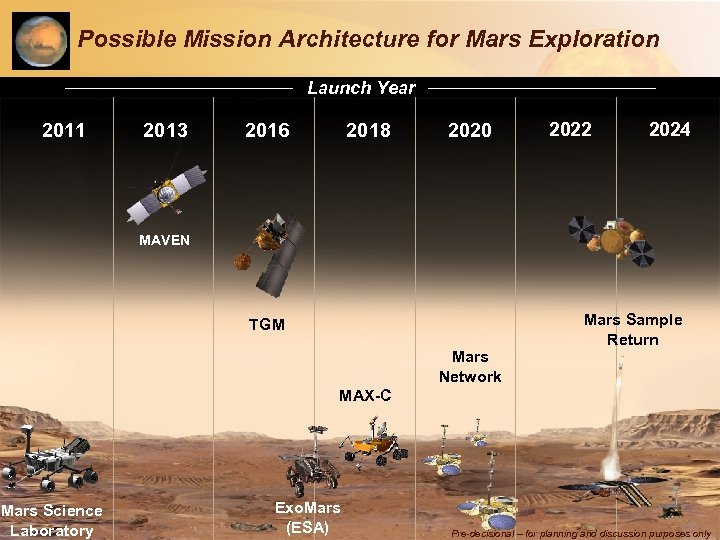 Possible Mission Architecture for Mars Exploration Launch Year 2011 2013 2016 2018 2020 2022 2024 MAVEN TGM Mars Network Mars Sample Return MAX-C Exo. Mars Science Pre-decisional MATT-3 Interim– for planning and discussion purposes only Laboratory Report: for discussion purposes (ESA) Mars Panel Meeting Sept. 9 -10 2009 11 11 Pre-decisional – for planning and discussion purposes only
 MEPAG’s Program-Level Science Strategies • Introduced 2000: FOLLOW THE WATER* [MGS, ODY, MER, MRO, PHX] • Introduced 2004: UNDERSTAND MARS AS A SYSTEM [All] • Introduced 2005 -6: SEEK HABITABLE ENVIRONMENTS* [MSL] Ready for a new thrust? • Discussion opened by MEPAG at its Feb. 2009 meeting. Several candidate strategies debated. • Proposed by MART June, 2009: SEEK THE SIGNS OF LIFE – Reflects the need and opportunity to focus on the life question. Life is both “first among equals” for MEPAG, and a high-level NASA strategic goal. – This scientific strategy is well-aligned with the goals of multiple potential international partners. – Would explicitly capitalizes on discoveries from prior missions. Seeking the signs of life is what we want to do in habitable environments, once we find them. • Discussed and endorsed by MEPAG at its July, 2009 meeting. *Bold => stated Level 1 mission or program requirement Mars Panel Meeting Sept. 9 -10 2009 Pre-decisional – for planning and discussion purposes only 12
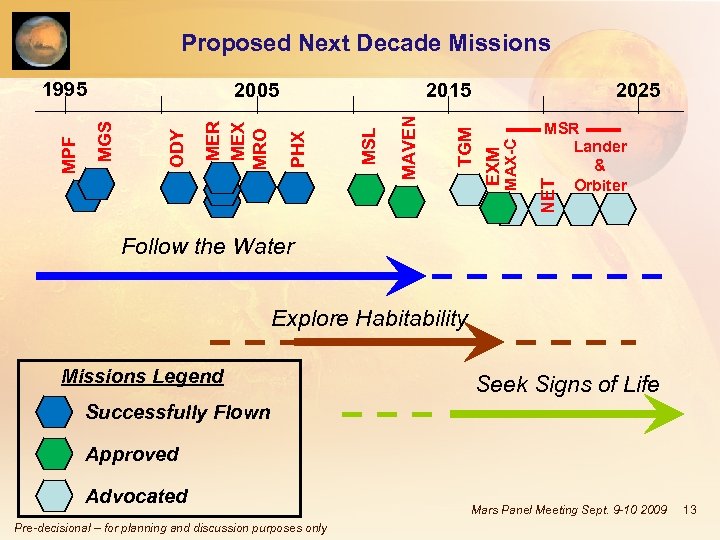 Proposed Next Decade Missions MSR Lander & Orbiter NET EXM MAX-C 2025 TGM MAVEN MSL 2015 PHX MER MEX MRO ODY 2005 MGS MPF 1995 Follow the Water Explore Habitability Missions Legend Seek Signs of Life Successfully Flown Approved Advocated Pre-decisional – for planning and discussion purposes only Mars Panel Meeting Sept. 9 -10 2009 13
 Back-Up Pre-decisional – for planning and discussion purposes only
 MATT/MART: Sample Return Priority within the Proposed Strategy • Return of samples from a single site, no matter how carefully chosen, can not address all of the high-priority scientific objectives for Mars. – The diversity of Martian environments, now and in the past, and the complexity of the processes at work would require a broader program of exploration. However, the first sample return from a well-characterized site is believed to be the way to make the greatest progress at this point in planetary exploration. • The proposed return of samples is challenging enough that a campaign of several flight elements should be considered. – – • This spreads cost and a step-by-step approach would reduce both scientific & technical risk A sustained technology development program is still required for key elements (e. g. , the proposed Mars Ascent Vehicle or MAV) Analysis of returned samples could revolutionize our understanding of Mars, both across multiple disciplines and as the integrated understanding of a complex planet and of Solar System processes. We need to go forward and achieve this challenging step. The following actions are proposed: – Build on the MSL EDL system and MER experience for future MSR landers – Complete acquisition of data necessary to choose candidate sites; a MAX-C in 2018 could go to a new or previously visited site depending on discoveries – Maintain the MAX-C dual role of in situ science (also needed for sample selection) and sample caching for potential future return Mars Panel Meeting Sept. 9 -10 2009 Pre-decisional – for planning and discussion purposes only 15
 Rationale for Proposed Mars Sample Return • Analysis of returned samples would advance our understanding of most Mars scientific disciplines — Biogeochemistry, prebiotic and geochemical processes, geochronology, volatile evolution, regolith history — Only returned samples could be analyzed with full suite of analytic capabilities developed on Earth — Only returned samples would permit the application of new analytic techniques and technologies, including response to discoveries • As with past sample return and sample analysis (meteorites, Moon, Stardust), analysis of sample returned from Mars is expected to revolutionize our understanding of Mars in ways that in situ or remote sensing techniques do not — Sample return is presently regarded as a necessary step toward potential human Mars missions • Sample sites must be characterized in situ, whether or not the proposed caching mission goes to a previously visited site or to a new site — Precursor missions might “buy down” risk but are not required • Detection of complex organics is not required for returned samples to be valuable — Reasonable possibility of biosignatures would be sufficient — Approach to life questions and other disciplines is much broader than single litmus test of detecting complex organics — Complex organics may not be accessible at the surface even if life had developed in the past Mars Panel Meeting Sept. 9 -10 2009 Pre-decisional – for planning and discussion purposes only 16
 Technology Progress towards a Proposed Mars Sample Return Program • The Mars Exploration Program has made some progress in developing the technologies needed: – MPF and MER have demonstrated the surface mobility and much of the basic instrumentation needed to acquire high-priority samples; – MER and PHX have provided valuable experience in sample handling and surface preparations; MSL will do more; – The MSL EDL system design should accommodate a proposed MSR Lander / Rover with a Mars Ascent Vehicle (MAV); – The assets for certifying site safety (e. g. , MRO Hi. RISE) continue to operate and have already scrutinized a number of scientifically exciting sites; – Orbital relay assets to support routine operations by landed craft and for critical events continue to be emplaced. • This productive interplay of missions has resulted from the Program approach. • More needs to be done (e. g. , Mars Ascent Vehicle development) Mars Panel Meeting Sept. 9 -10 2009 Pre-decisional – for planning and discussion purposes only 17
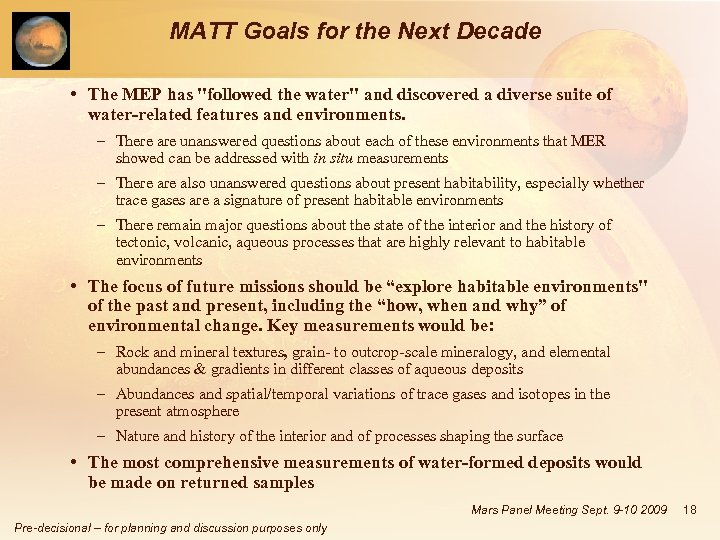 MATT Goals for the Next Decade • The MEP has "followed the water" and discovered a diverse suite of water-related features and environments. – There are unanswered questions about each of these environments that MER showed can be addressed with in situ measurements – There also unanswered questions about present habitability, especially whether trace gases are a signature of present habitable environments – There remain major questions about the state of the interior and the history of tectonic, volcanic, aqueous processes that are highly relevant to habitable environments • The focus of future missions should be “explore habitable environments" of the past and present, including the “how, when and why” of environmental change. Key measurements would be: – Rock and mineral textures, grain- to outcrop-scale mineralogy, and elemental abundances & gradients in different classes of aqueous deposits – Abundances and spatial/temporal variations of trace gases and isotopes in the present atmosphere – Nature and history of the interior and of processes shaping the surface • The most comprehensive measurements of water-formed deposits would be made on returned samples Mars Panel Meeting Sept. 9 -10 2009 Pre-decisional – for planning and discussion purposes only 18
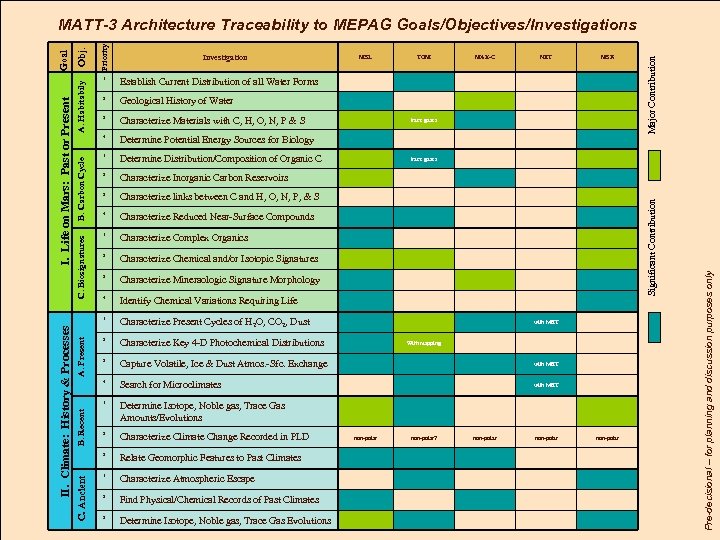 Investigation MSL TGM MAX-C NET Determine Distribution/Composition of Organic C 2 Characterize Inorganic Carbon Reservoirs 3 Characterize links between C and H, O, N, P, & S 4 Characterize Reduced Near-Surface Compounds 1 Characterize Complex Organics 2 Characterize Chemical and/or Isotopic Signatures 3 Characterize Mineraologic Signature Morphology 4 Identify Chemical Variations Requiring Life Characterize Present Cycles of H 2 O, CO 2, Dust 2 Characterize Key 4 -D Photochemical Distributions 3 Capture Volatile, Ice & Dust Atmos. -Sfc. Exchange with MET Search for Microclimates with MET Determine Isotope, Noble gas, Trace Gas Amounts/Evolutions 2 Characterize Climate Change Recorded in PLD Relate Geomorphic Features to Past Climates 1 Characterize Atmospheric Escape 2 Find Physical/Chemical Records of Past Climates 3 Determine Isotope, Noble gas, Trace Gas Evolutions trace gases with MET With mapping non-polar? non-polar Mars Panel Meeting Sept. 9 -10 2009 19 Pre-decisional – for planning and discussion purposes only trace gases Significant Contribution A. Habitabily B. Carbon Cycle 1 3 C. Biosignatures Determine Potential Energy Sources for Biology 1 A. Present Characterize Materials with C, H, O, N, P & S 4 B. Recent Geological History of Water 3 4 C. Ancient I. Life on Mars: Past or Present Establish Current Distribution of all Water Forms 2 1 II. Climate: History & Processes 1 MSR Major Contribution Priority Obj. Goal MATT-3 Architecture Traceability to MEPAG Goals/Objectives/Investigations
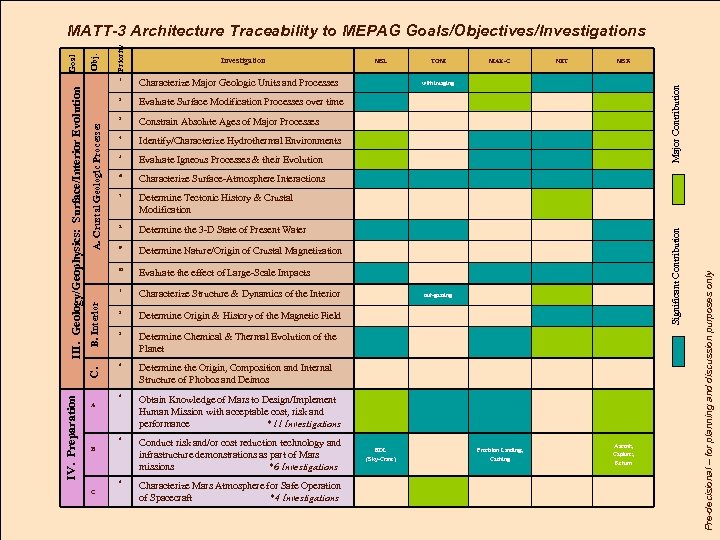 Priority Investigation Determine Tectonic History & Crustal Modification 8 Determine the 3 -D State of Present Water 9 Determine Nature/Origin of Crustal Magnetization Evaluate the effect of Large-Scale Impacts Characterize Structure & Dynamics of the Interior 2 Determine Origin & History of the Magnetic Field 3 Determine Chemical & Thermal Evolution of the Planet * Determine the Origin, Composition and Internal Structure of Phobos and Deimos * Obtain Knowledge of Mars to Design/Implement Human Mission with acceptable cost, risk and performance *11 Investigations * Conduct risk and/or cost reduction technology and infrastructure demonstrations as part of Mars missions *6 Investigations A B * C with imaging Major Contribution 7 1 A. Crustal Geologic Processes Characterize Surface-Atmosphere Interactions 10 B. Interior Evaluate Igneous Processes & their Evolution 6 MSR Identify/Characterize Hydrothermal Environments 5 NET Constrain Absolute Ages of Major Processes 4 MAX-C Evaluate Surface Modification Processes over time 3 TGM out-gassing EDL (Sky-Crane) Precision Landing; Caching Ascent; Capture; Return Characterize Mars Atmosphere for Safe Operation of Spacecraft *4 Investigations Mars Panel Meeting Sept. 9 -10 2009 Pre-decisional – for planning and discussion purposes only 20 Pre-decisional – for planning and discussion purposes only IV. Preparation Characterize Major Geologic Units and Processes 2 C. III. Geology/Geophysics: Surface/Interior Evolution 1 MSL Significant Contribution Obj. Goal MATT-3 Architecture Traceability to MEPAG Goals/Objectives/Investigations