


 Скачать презентацию PASSIVE VOICE Gradovskaya Angelina 2 IT FUNCTIONS
Gradovskaya_Angelina_PASSIVE VOICE.pptx
- Количество слайдов: 9
 PASSIVE VOICE Gradovskaya Angelina, 2 IT
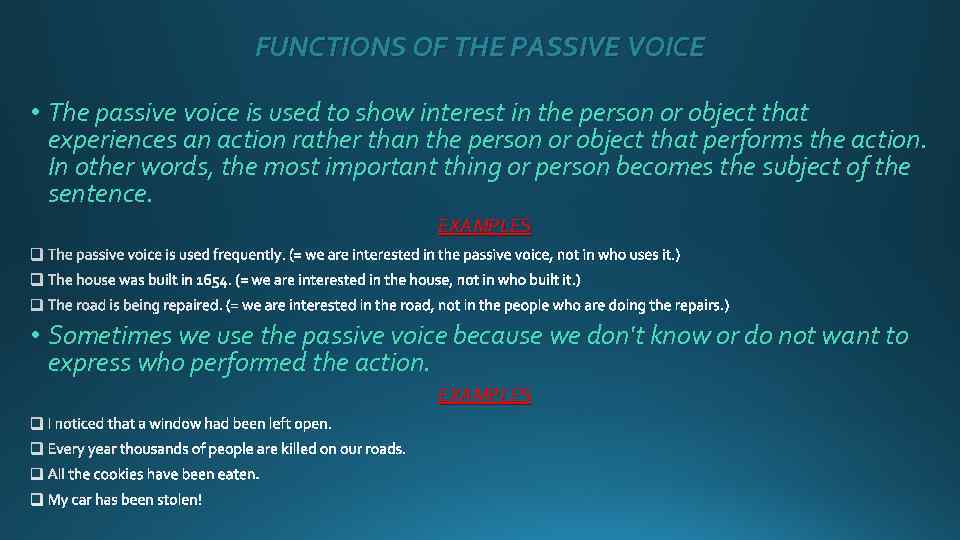 FUNCTIONS OF THE PASSIVE VOICE • The passive voice is used to show interest in the person or object that experiences an action rather than the person or object that performs the action. In other words, the most important thing or person becomes the subject of the sentence. EXAMPLES • Sometimes we use the passive voice because we don't know or do not want to express who performed the action. EXAMPLES
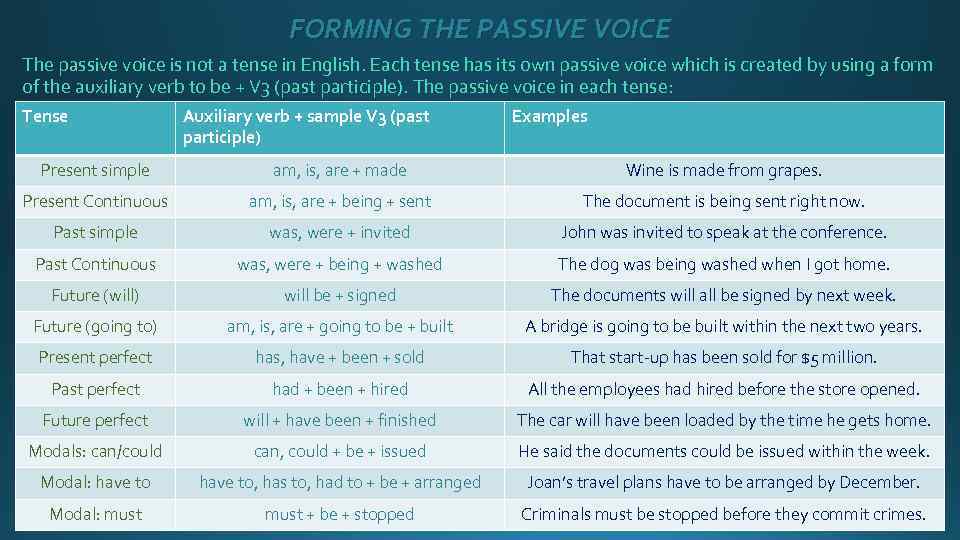 FORMING THE PASSIVE VOICE The passive voice is not a tense in English. Each tense has its own passive voice which is created by using a form of the auxiliary verb to be + V 3 (past participle). The passive voice in each tense: Tense Auxiliary verb + sample V 3 (past participle) Examples Present simple am, is, are + made Wine is made from grapes. Present Continuous am, is, are + being + sent The document is being sent right now. Past simple was, were + invited John was invited to speak at the conference. Past Continuous was, were + being + washed The dog was being washed when I got home. Future (will) will be + signed The documents will all be signed by next week. Future (going to) am, is, are + going to be + built A bridge is going to be built within the next two years. Present perfect has, have + been + sold That start-up has been sold for $5 million. Past perfect had + been + hired All the employees had hired before the store opened. Future perfect will + have been + finished The car will have been loaded by the time he gets home. Modals: can/could can, could + be + issued He said the documents could be issued within the week. Modal: have to, has to, had to + be + arranged Joan’s travel plans have to be arranged by December. Modal: must + be + stopped Criminals must be stopped before they commit crimes.
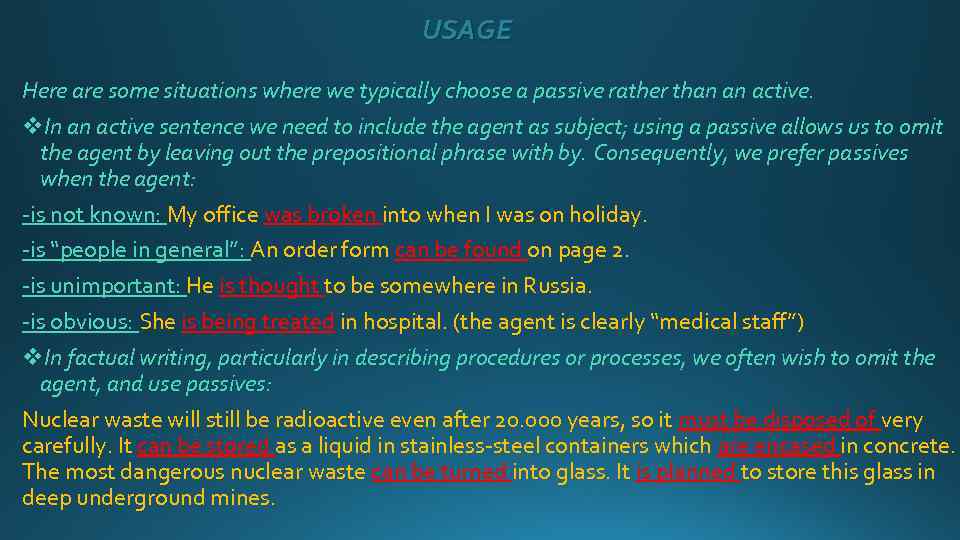 USAGE Неrе are some situations where we typically choose a passive rather than an active. v. In an active sentence we need to include the agent as subject; using a passive allows us to omit the agent by leaving out the prepositional phrase with by. Consequently, we prefer passives when the agent: -is not known: My office was broken into when I was on holiday. -is “people in general”: An order form can be found on page 2. -is unimportant: He is thought to be somewhere in Russia. -is obvious: She is being treated in hospital. (the agent is clearly “medical staff”) v. In factual writing, particularly in describing procedures or processes, we often wish to omit the agent, and use passives: Nuclear waste will still be radioactive even after 20. 000 years, so it must be disposed of very carefully. It can be stored as a liquid in stainless-steel containers which are encased in concrete. The most dangerous nuclear waste can be turned into glass. It is planned to store this glass in deep underground mines.
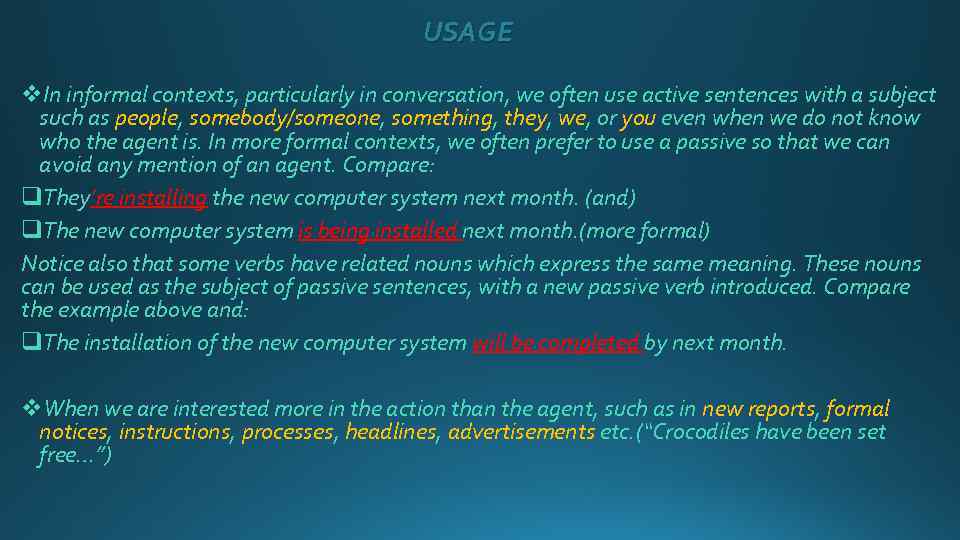 USAGE v. In informal contexts, particularly in conversation, we often use active sentences with a subject such as people, somebody/someone, something, they, we, or you even when we do not know who the agent is. In more formal contexts, we often prefer to use a passive so that we can avoid any mention of an agent. Compare: q. They’re installing the new computer system next month. (and) q. The new computer system is being installed next month. (more formal) Notice also that some verbs have related nouns which express the same meaning. These nouns can be used as the subject of passive sentences, with a new passive verb introduced. Compare the example above and: q. The installation of the new computer system will be completed by next month. v. When we are interested more in the action than the agent, such as in new reports, formal notices, instructions, processes, headlines, advertisements etc. (“Crocodiles have been set free…”)
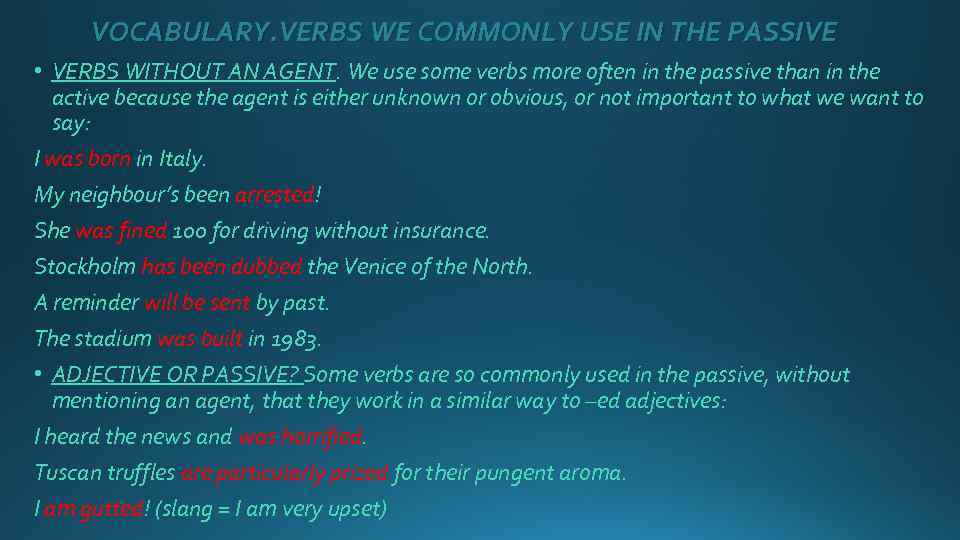 VOCABULARY. VERBS WE COMMONLY USE IN THE PASSIVE • VERBS WITHOUT AN AGENT. We use some verbs more often in the passive than in the active because the agent is either unknown or obvious, or not important to what we want to say: I was born in Italy. My neighbour’s been arrested! She was fined 100 for driving without insurance. Stockholm has been dubbed the Venice of the North. A reminder will be sent by past. The stadium was built in 1983. • ADJECTIVE OR PASSIVE? Some verbs are so commonly used in the passive, without mentioning an agent, that they work in a similar way to –ed adjectives: I heard the news and was horrified. Tuscan truffles are particularly prized for their pungent aroma. I am gutted! (slang = I am very upset)
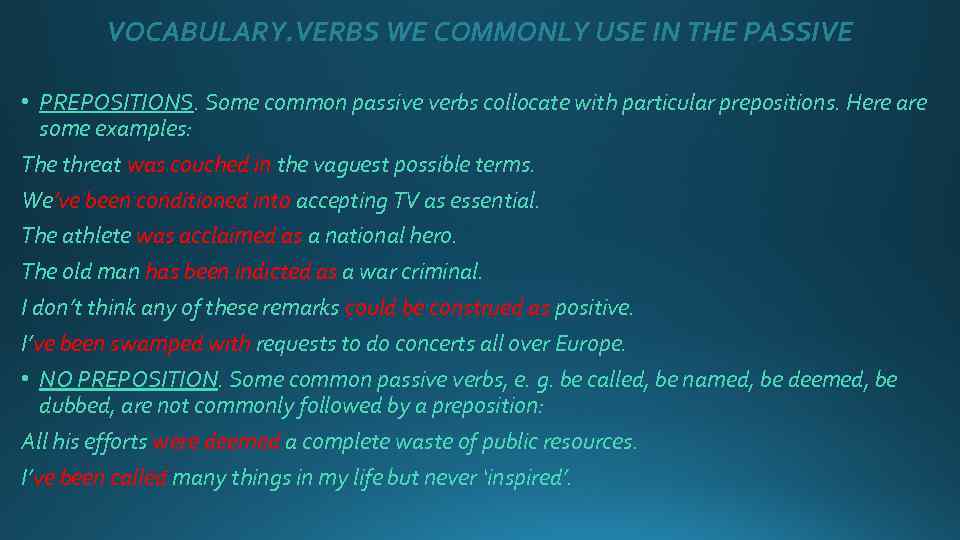 VOCABULARY. VERBS WE COMMONLY USE IN THE PASSIVE • PREPOSITIONS. Some common passive verbs collocate with particular prepositions. Here are some examples: The threat was couched in the vaguest possible terms. We’ve been conditioned into accepting TV as essential. The athlete was acclaimed as a national hero. The old man has been indicted as a war criminal. I don’t think any of these remarks could be construed as positive. I’ve been swamped with requests to do concerts all over Europe. • NO PREPOSITION. Some common passive verbs, e. g. be called, be named, be deemed, be dubbed, are not commonly followed by a preposition: All his efforts were deemed a complete waste of public resources. I’ve been called many things in my life but never ‘inspired’.
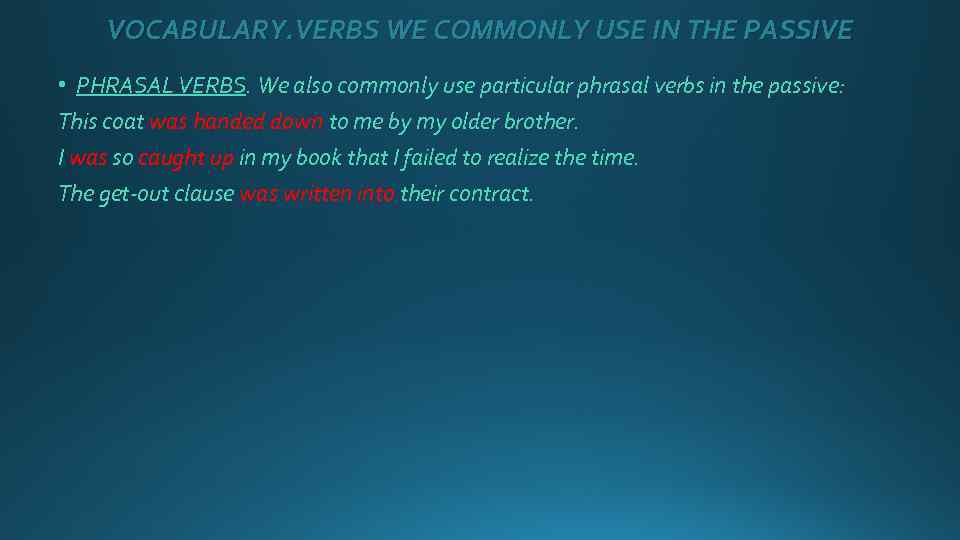 VOCABULARY. VERBS WE COMMONLY USE IN THE PASSIVE • PHRASAL VERBS. We also commonly use particular phrasal verbs in the passive: This coat was handed down to me by my older brother. I was so caught up in my book that I failed to realize the time. The get-out clause was written into their contract.
 Thank you for attention!