


 Скачать презентацию Passive seismic monitoring of CO 2 sequestration James
398134e7fe50ab9dbc50eb0609dd6850.ppt
- Количество слайдов: 20
 Passive seismic monitoring of CO 2 sequestration James Verdon, Michael Kendall Department of Earth Sciences, University of Bristol, BS 8 1 RJ UKCCSC Meeting Newcastle, UK 17. 09. 2007
 Microseismic Monitoring - talk outline • • • What is passive seismic monitoring? Motivation for passive seismic monitoring. The passive seismic toolbox: Examples from passive seismic monitoring in other fields – – • Event location Focal mechanisms Anisotropy and fractures Temporal variations due to stress changes Example from Weyburn CO 2 injection project.
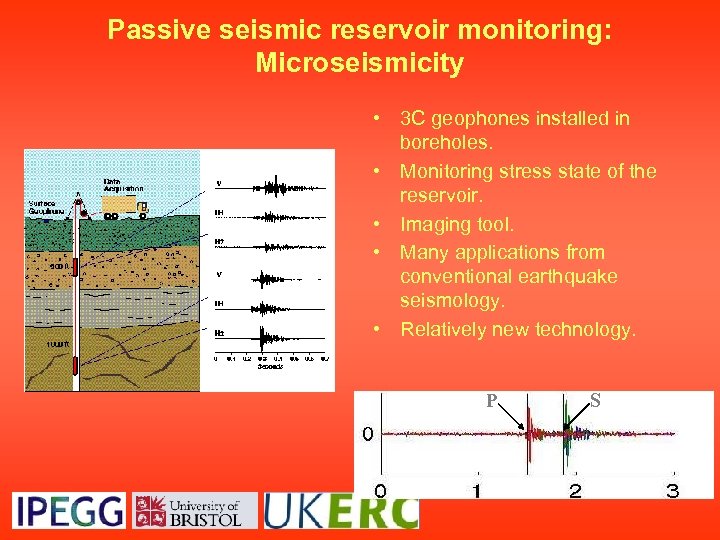 Passive seismic reservoir monitoring: Microseismicity • 3 C geophones installed in boreholes. • Monitoring stress state of the reservoir. • Imaging tool. • Many applications from conventional earthquake seismology. • Relatively new technology. P S
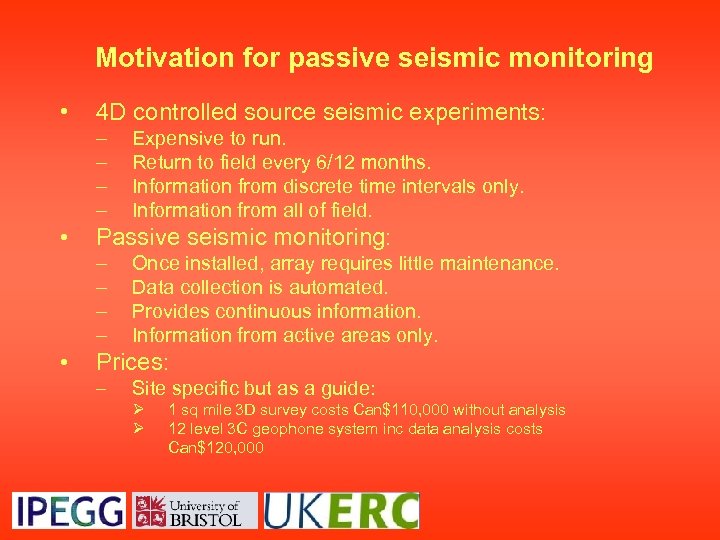 Motivation for passive seismic monitoring • 4 D controlled source seismic experiments: – – • Passive seismic monitoring: – – • Expensive to run. Return to field every 6/12 months. Information from discrete time intervals only. Information from all of field. Once installed, array requires little maintenance. Data collection is automated. Provides continuous information. Information from active areas only. Prices: – Site specific but as a guide: Ø Ø 1 sq mile 3 D survey costs Can$110, 000 without analysis 12 level 3 C geophone system inc data analysis costs Can$120, 000
 Long-term CO 2 monitoring objectives • Identify zones of CO 2 saturation. • Identify fracture networks - flow pathways. • Assess the risk of fault/fracture formation and activation and loss of top-seal integrity.
 The microseismic toolbox - examples from other fields • Location of events and clustering. • Focal mechanisms. • Anisotropy and fractures – Fracture orientation – Frequency dependence and fracture size – Temporal variations.
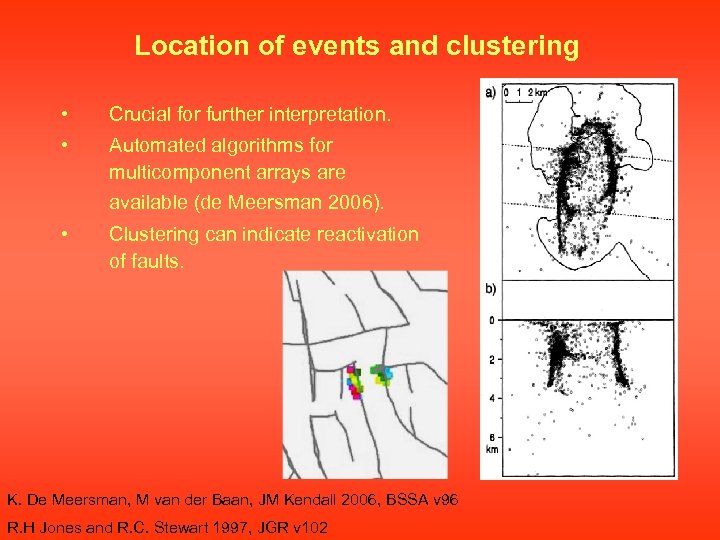 Location of events and clustering • Crucial for further interpretation. • Automated algorithms for multicomponent arrays are available (de Meersman 2006). • Clustering can indicate reactivation of faults. K. De Meersman, M van der Baan, JM Kendall 2006, BSSA v 96 R. H Jones and R. C. Stewart 1997, JGR v 102
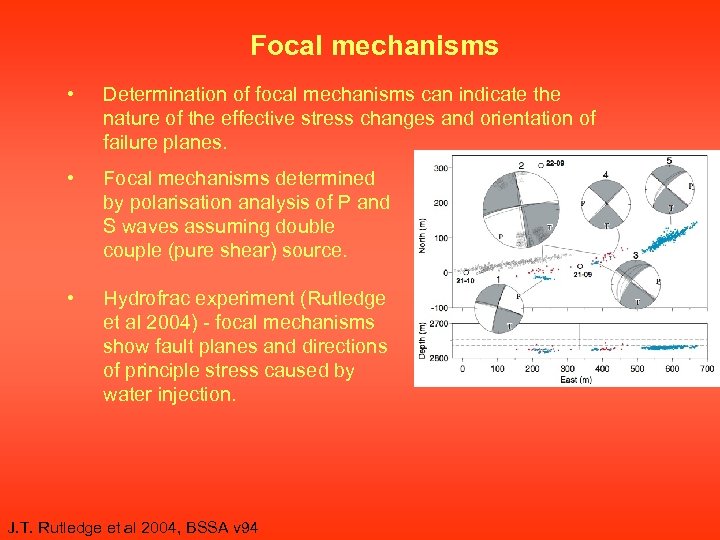 Focal mechanisms • Determination of focal mechanisms can indicate the nature of the effective stress changes and orientation of failure planes. • Focal mechanisms determined by polarisation analysis of P and S waves assuming double couple (pure shear) source. • Hydrofrac experiment (Rutledge et al 2004) - focal mechanisms show fault planes and directions of principle stress caused by water injection. J. T. Rutledge et al 2004, BSSA v 94
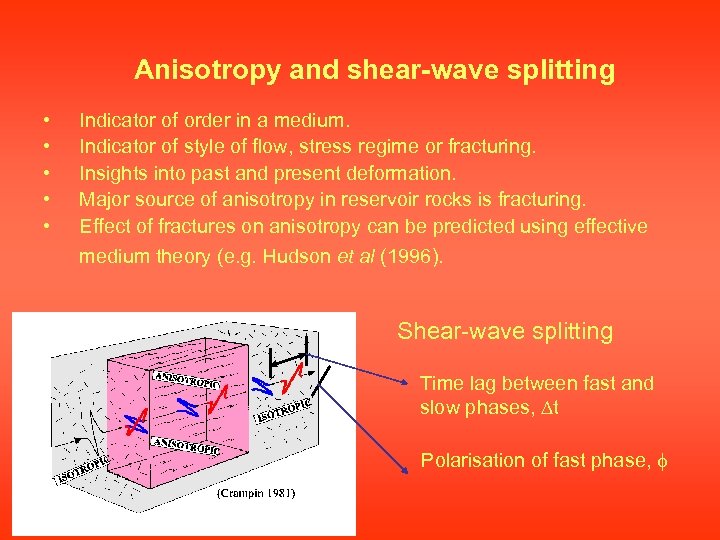 Anisotropy and shear-wave splitting • • • Indicator of order in a medium. Indicator of style of flow, stress regime or fracturing. Insights into past and present deformation. Major source of anisotropy in reservoir rocks is fracturing. Effect of fractures on anisotropy can be predicted using effective medium theory (e. g. Hudson et al (1996). Shear-wave splitting Time lag between fast and slow phases, t Polarisation of fast phase,
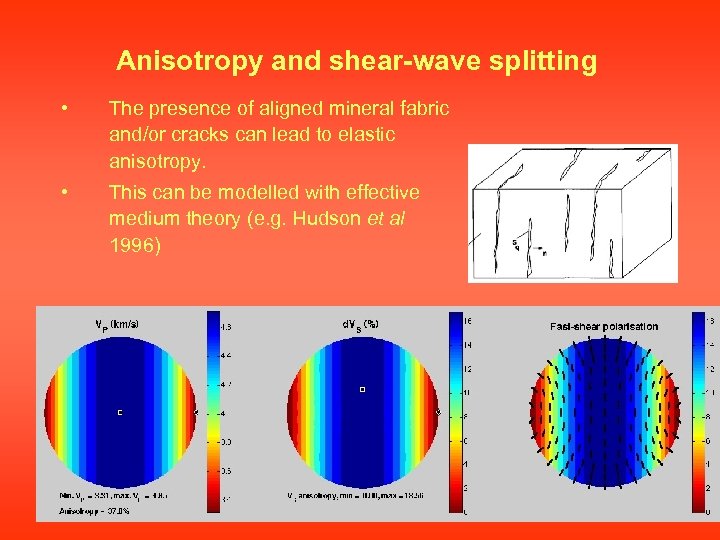 Anisotropy and shear-wave splitting • The presence of aligned mineral fabric and/or cracks can lead to elastic anisotropy. • This can be modelled with effective medium theory (e. g. Hudson et al 1996)
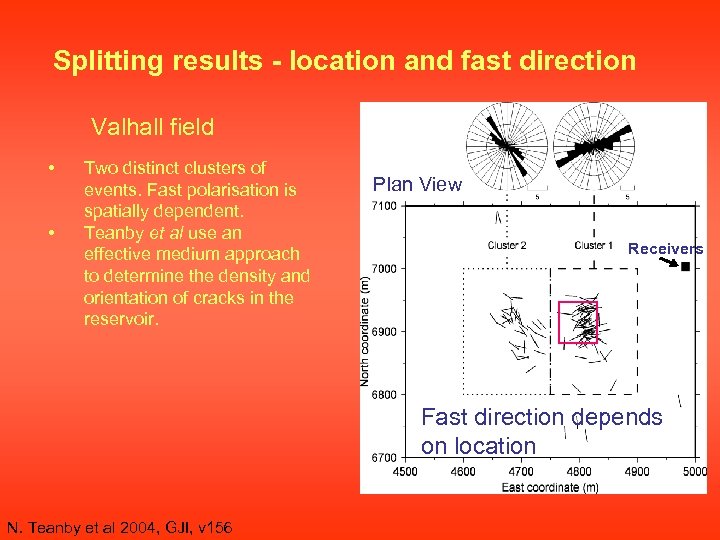 Splitting results - location and fast direction Valhall field • • Two distinct clusters of events. Fast polarisation is spatially dependent. Teanby et al use an effective medium approach to determine the density and orientation of cracks in the reservoir. Plan View Receivers Fast direction depends on location N. Teanby et al 2004, GJI, v 156
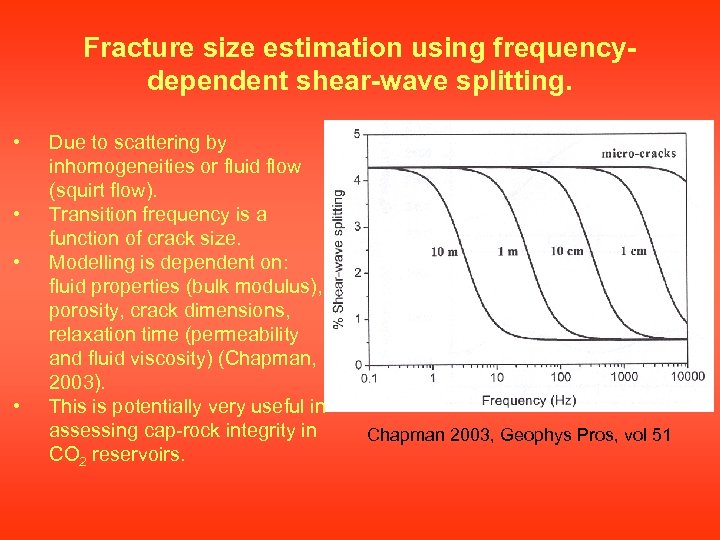 Fracture size estimation using frequencydependent shear-wave splitting. • • Due to scattering by inhomogeneities or fluid flow (squirt flow). Transition frequency is a function of crack size. Modelling is dependent on: fluid properties (bulk modulus), porosity, crack dimensions, relaxation time (permeability and fluid viscosity) (Chapman, 2003). This is potentially very useful in assessing cap-rock integrity in CO 2 reservoirs. Chapman 2003, Geophys Pros, vol 51
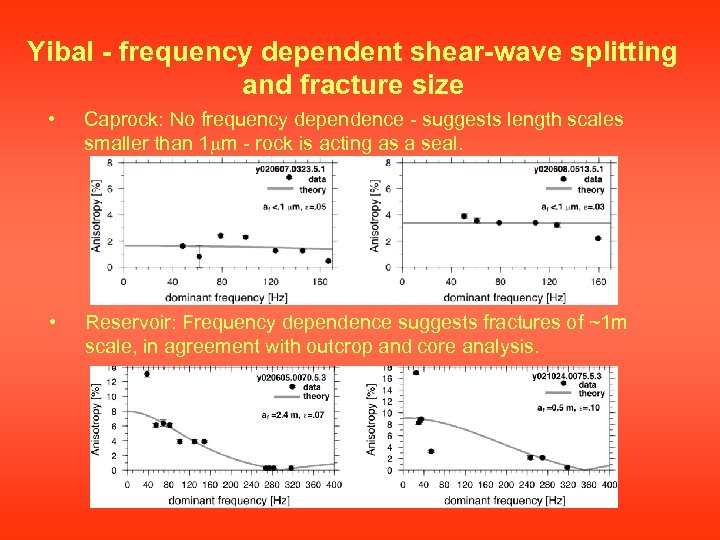 Yibal - frequency dependent shear-wave splitting and fracture size • Caprock: No frequency dependence - suggests length scales smaller than 1 m - rock is acting as a seal. • Reservoir: Frequency dependence suggests fractures of ~1 m scale, in agreement with outcrop and core analysis.
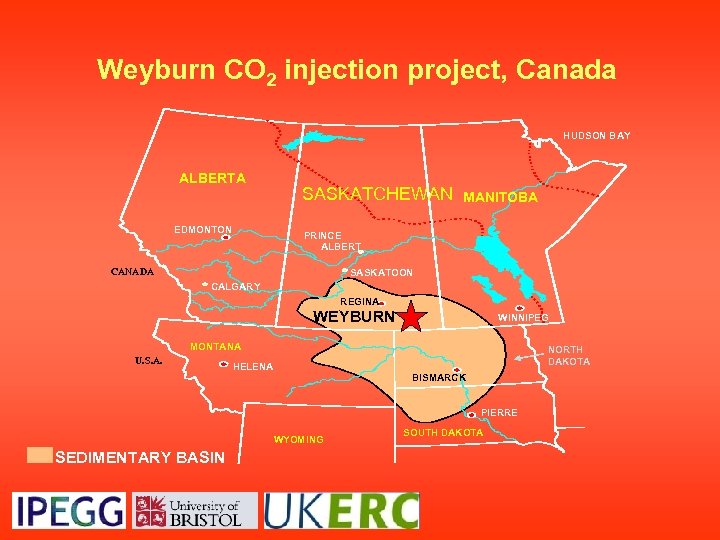 Weyburn CO 2 injection project, Canada HUDSON BAY ALBERTA EDMONTON SASKATCHEWAN MANITOBA PRINCE ALBERT CANADA SASKATOON CALGARY REGINA WEYBURN WINNIPEG MONTANA U. S. A. NORTH DAKOTA HELENA BISMARCK PIERRE WYOMING SEDIMENTARY BASIN SOUTH DAKOTA
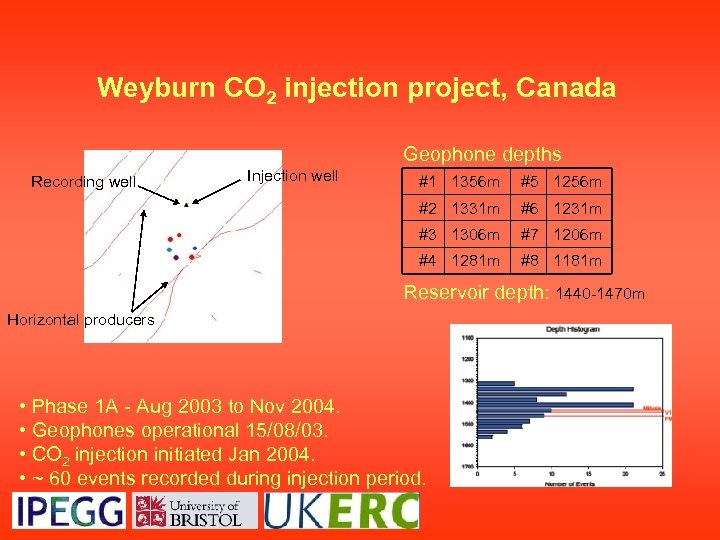 Weyburn CO 2 injection project, Canada Geophone depths Injection well #1 1356 m #5 1256 m #2 1331 m #6 1231 m #3 1306 m #7 1206 m #4 1281 m Recording well #8 1181 m Reservoir depth: 1440 -1470 m Horizontal producers • Phase 1 A - Aug 2003 to Nov 2004. • Geophones operational 15/08/03. • CO 2 injection initiated Jan 2004. • ~ 60 events recorded during injection period.
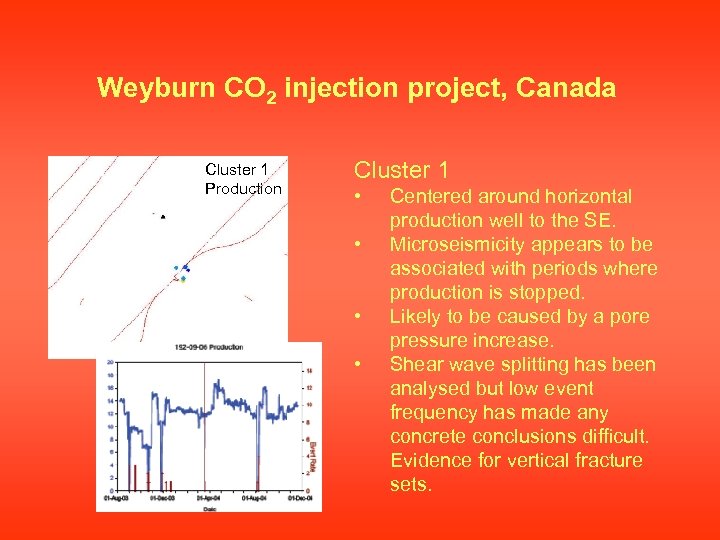 Weyburn CO 2 injection project, Canada Cluster 1 Production Cluster 1 • • Centered around horizontal production well to the SE. Microseismicity appears to be associated with periods where production is stopped. Likely to be caused by a pore pressure increase. Shear wave splitting has been analysed but low event frequency has made any concrete conclusions difficult. Evidence for vertical fracture sets.
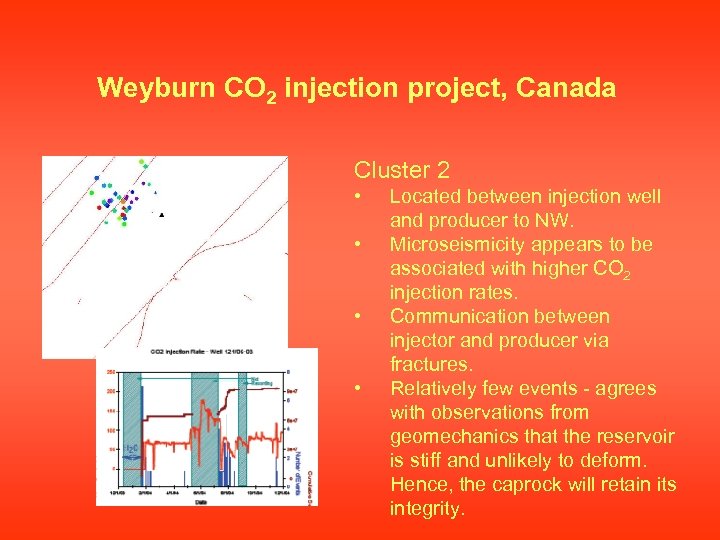 Weyburn CO 2 injection project, Canada Cluster 2 • • Located between injection well and producer to NW. Microseismicity appears to be associated with higher CO 2 injection rates. Communication between injector and producer via fractures. Relatively few events - agrees with observations from geomechanics that the reservoir is stiff and unlikely to deform. Hence, the caprock will retain its integrity.
 Future Work - The Next Step • Currently working with IPEGG to generate geomechanical models of CO 2 injection. • Developing realistic rock physics models to map geomechanical predictions into changes in seismic properties - building 3 D fully anisotropic elastic models that incorporate the effects of stress (or strain) on elasticity. • Geomechanical models should allow us to anticipate deformation and assess the risk of fractures/faulting pentrating the top-seal. We hope to compare these predictions with observed microseismic activity.
 Conclusions • After initial installation, can monitor cheaply for long periods. • Most hydrocarbon companies have some passive seismic capability. • Of particular concern for CO 2 sequestration is deformation and/or fracture networks leading to loss of overburden integrity. • The passive seismic monitoring toolbox contains many useful mechanisms for assessing reservoir dynamics, and hence has the potential assess the risk of CO 2 leakage. • At Weyburn, activity rates are very low, suggesting that any stress changes are well within the yield envelope.
 Thanks, any questions? N. Teanby, J-M. Kendall, R. H. Jones, O. Barkved, Stress-induced temporal variations in seismic anisotropy observed in microseismic data, GJI, vol 156, p 459 -466. 2004. K. De Meersman, M. van der Baan, J-M. Kendall, Signal Extraction and Automated Polarisation Analysis of Multicomponent Array Data, BSSA, vol 96, p 2415 -2430. 2006. R. H. Jones, R. C. Stewart, A method for determining significant structures in a cloud of earthquakes, JGR, vol 102, p 8245 -8254. 1997. J. T. Rutledge, W. S. Phillips, M. J. Mayerhofer, Faulting Induced by Forced Fluid Injection and Fluid Flow Forced by Faulting: An Interpretation of Hydraulic-Fracture Microseismicity, Carthage Cotton Valley Gas Field, Texas, BSSA, vol 94, p 1817 -1830. 2004. J. A. Hudson, E. Liu, S. Crampin, The mechanical properties of materials with interconnected cracks and pores, GJI, vol 124, p 105 -112. 1996. M. Chapman, Frequency-dependent anisotropy due to meso-scale fractures in the presence of equant porosity, Geophys. Pros. , vol 51, p 369 -379. 2003.