


 Скачать презентацию Passive agents prototypical vs canonical passives Anna Siewierska
cc30ad739bba96dae57563eaa5d19e84.ppt
- Количество слайдов: 53
 Passive agents: prototypical vs. canonical passives Anna Siewierska & Dik Bakker Lancaster University Canonical Passive
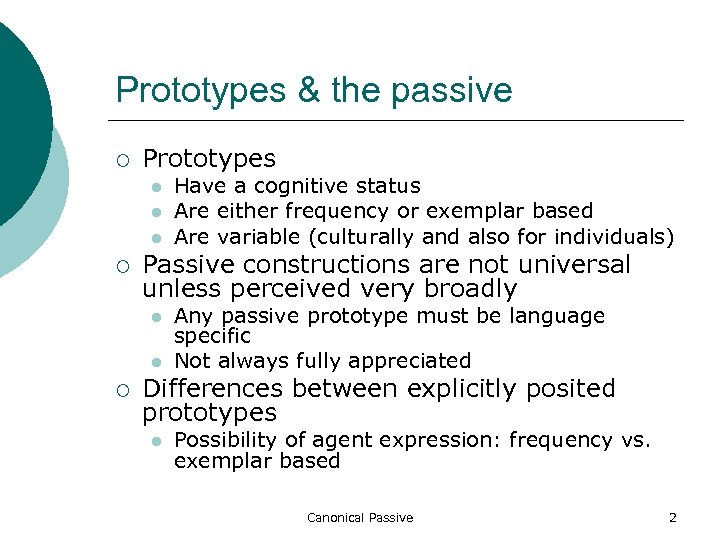 Prototypes & the passive ¡ Prototypes l l l ¡ Passive constructions are not universal unless perceived very broadly l l ¡ Have a cognitive status Are either frequency or exemplar based Are variable (culturally and also for individuals) Any passive prototype must be language specific Not always fully appreciated Differences between explicitly posited prototypes l Possibility of agent expression: frequency vs. exemplar based Canonical Passive 2
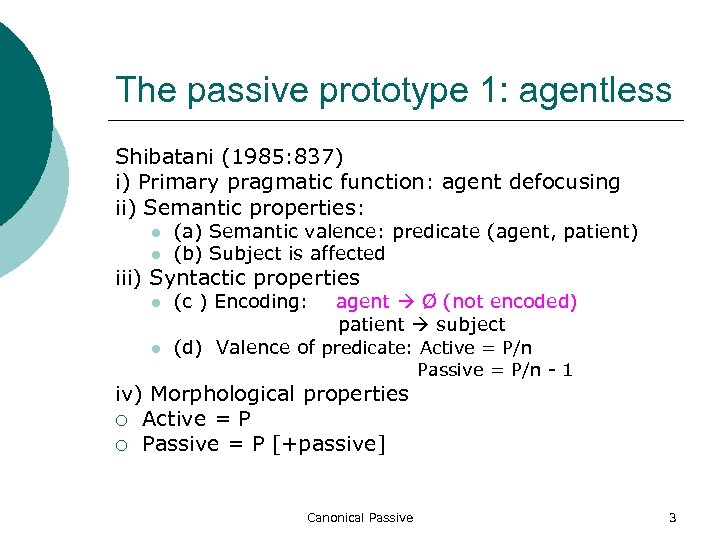 The passive prototype 1: agentless Shibatani (1985: 837) i) Primary pragmatic function: agent defocusing ii) Semantic properties: l l (a) Semantic valence: predicate (agent, patient) (b) Subject is affected iii) Syntactic properties l (c ) Encoding: agent Ø (not encoded) patient subject l (d) Valence of predicate: Active = P/n iv) Morphological properties ¡ Active = P ¡ Passive = P [+passive] Canonical Passive = P/n - 1 3
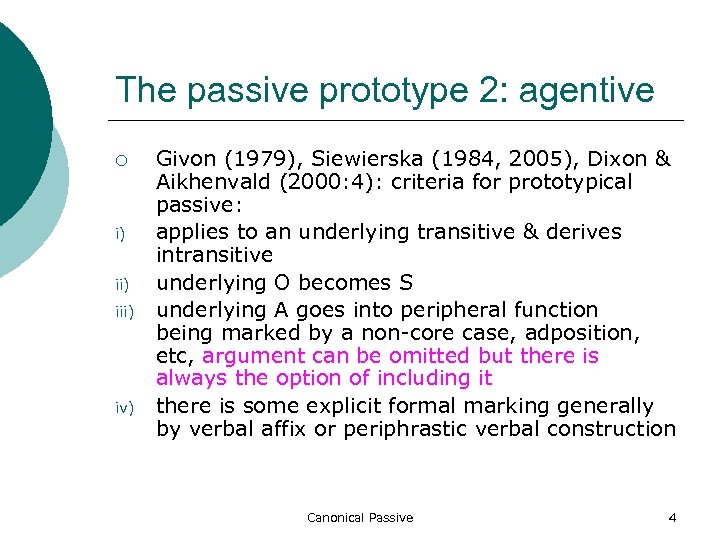 The passive prototype 2: agentive ¡ i) iii) iv) Givon (1979), Siewierska (1984, 2005), Dixon & Aikhenvald (2000: 4): criteria for prototypical passive: applies to an underlying transitive & derives intransitive underlying O becomes S underlying A goes into peripheral function being marked by a non-core case, adposition, etc, argument can be omitted but there is always the option of including it there is some explicit formal marking generally by verbal affix or periphrastic verbal construction Canonical Passive 4
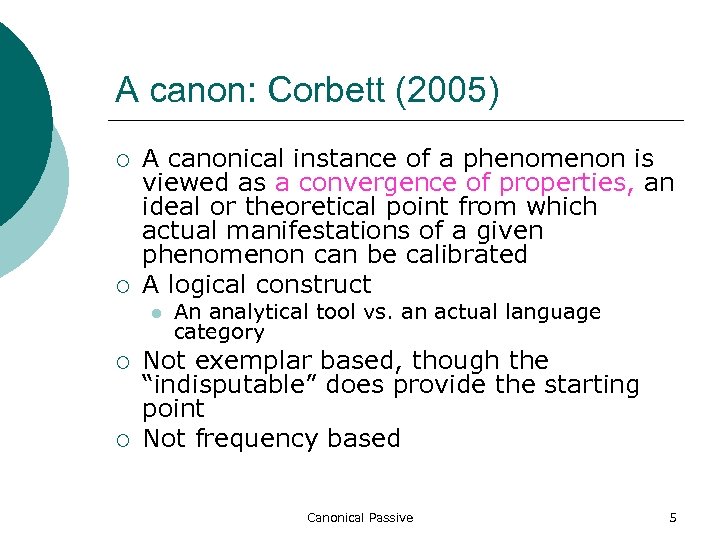 A canon: Corbett (2005) ¡ ¡ A canonical instance of a phenomenon is viewed as a convergence of properties, an ideal or theoretical point from which actual manifestations of a given phenomenon can be calibrated A logical construct l ¡ ¡ An analytical tool vs. an actual language category Not exemplar based, though the “indisputable” does provide the starting point Not frequency based Canonical Passive 5
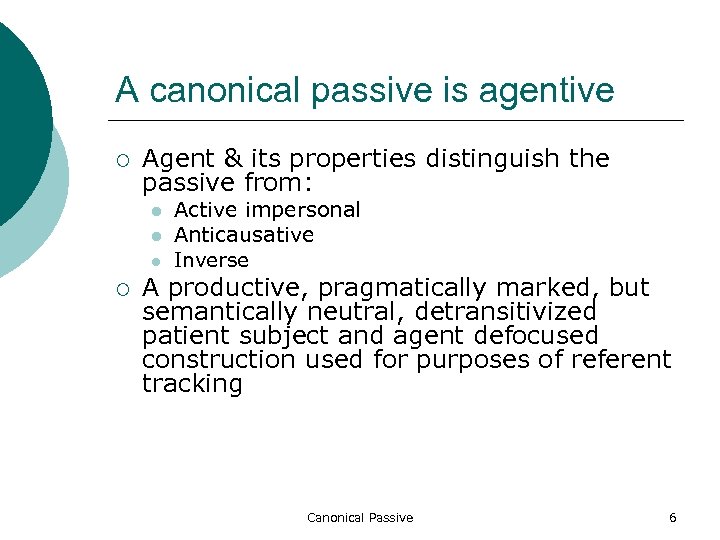 A canonical passive is agentive ¡ Agent & its properties distinguish the passive from: l l l ¡ Active impersonal Anticausative Inverse A productive, pragmatically marked, but semantically neutral, detransitivized patient subject and agent defocused construction used for purposes of referent tracking Canonical Passive 6
 Convergence of features ¡ The possibility of agent expression coincides with other features of the passive canon Canonical Passive 7
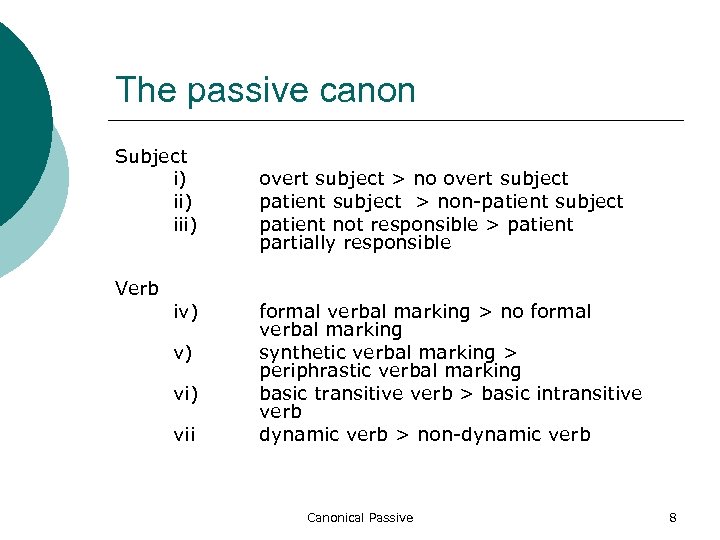 The passive canon Subject i) iii) Verb iv) v) vii overt subject > no overt subject patient subject > non-patient subject patient not responsible > patient partially responsible formal verbal marking > no formal verbal marking synthetic verbal marking > periphrastic verbal marking basic transitive verb > basic intransitive verb dynamic verb > non-dynamic verb Canonical Passive 8
 Features of passive agents Some types of passive agents are more canonical than others ¡ Which? ¡ l Semantic and referential properties ¡ l Agentivity, humanness, specificity, pronominality Encoding properties ¡ Oblique encoding Canonical Passive 9
 Convergence of features ¡ ? Passives with more canonical agents tend to have other more canonical features Canonical Passive 10
 Agent overtly expressible > not overtly expressible A. B. C. Frequency of agent expression Agent expression and the passive subject Agent expression and the passive verb Canonical Passive
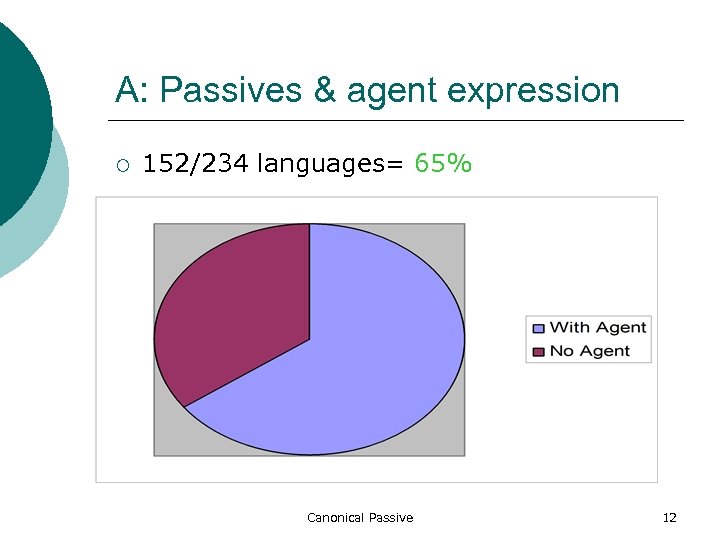 A: Passives & agent expression ¡ 152/234 languages= 65% Canonical Passive 12
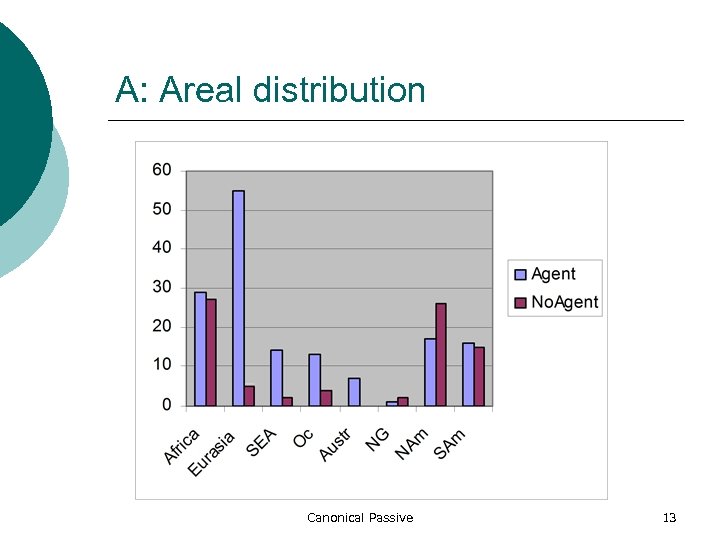 A: Areal distribution Canonical Passive 13
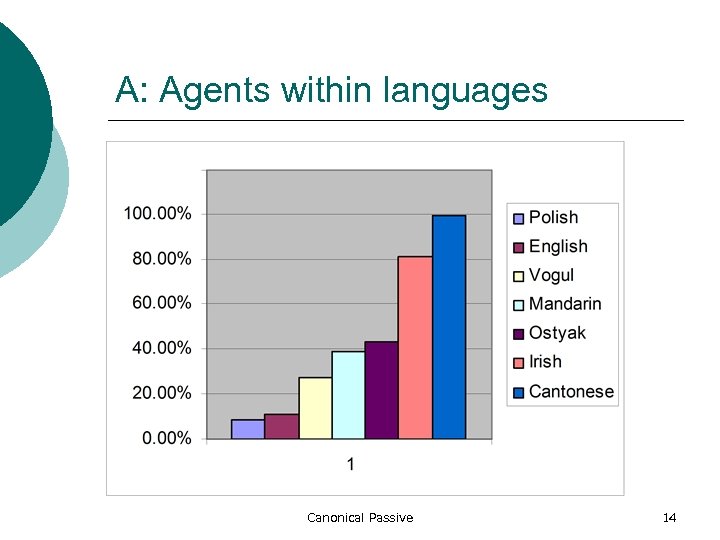 A: Agents within languages Canonical Passive 14
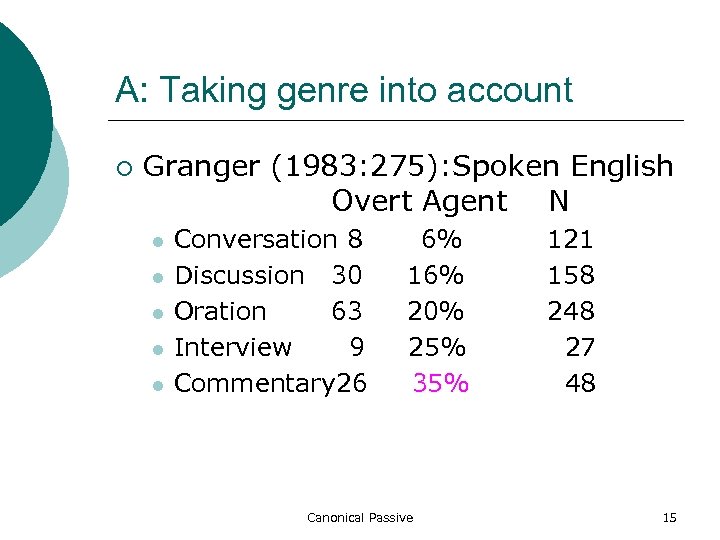 A: Taking genre into account ¡ Granger (1983: 275): Spoken English Overt Agent N l l l Conversation 8 Discussion 30 Oration 63 Interview 9 Commentary 26 6% 16% 20% 25% 35% Canonical Passive 121 158 248 27 48 15
 B: The passive subject: impersonal vs. personal passives ¡ Personal passives (with a lexical subject) are more likely to be agentive than impersonal ones (without a lexical subject) l l In languages with personal and impersonal passives, if one is agentless it is the impersonal, e. g. Amharic, Evenki, Swedish, Kanada, Turkish, Mojave In languages with personal and impersonal passives, if the expression of the agent is highly restricted it is in the impersonal Canonical Passive 16
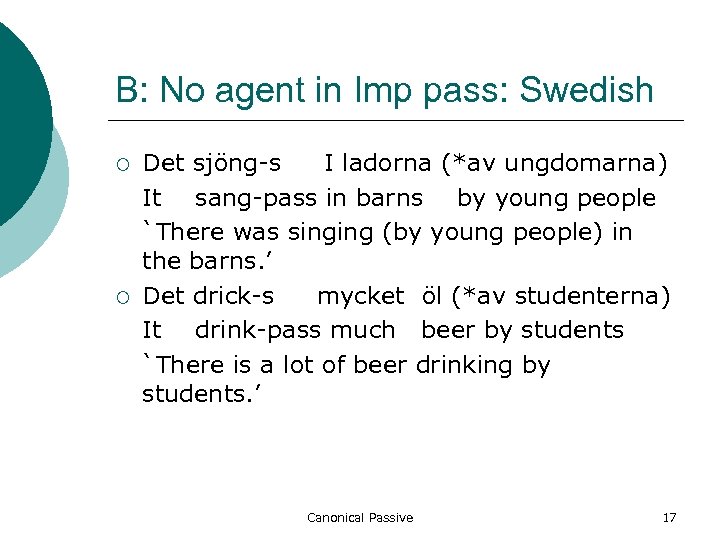 B: No agent in Imp pass: Swedish ¡ ¡ Det sjöng-s I ladorna (*av ungdomarna) It sang-pass in barns by young people `There was singing (by young people) in the barns. ’ Det drick-s mycket öl (*av studenterna) It drink-pass much beer by students `There is a lot of beer drinking by students. ’ Canonical Passive 17
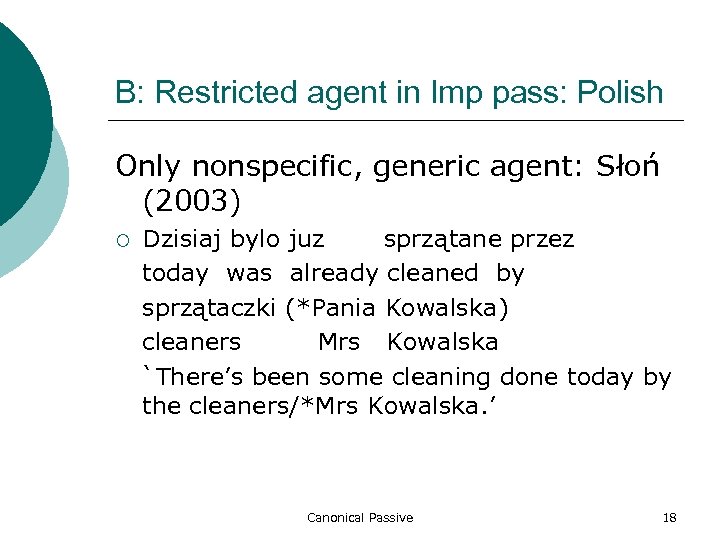 B: Restricted agent in Imp pass: Polish Only nonspecific, generic agent: Słoń (2003) ¡ Dzisiaj bylo juz sprzątane przez today was already cleaned by sprzątaczki (*Pania Kowalska) cleaners Mrs Kowalska `There’s been some cleaning done today by the cleaners/*Mrs Kowalska. ’ Canonical Passive 18
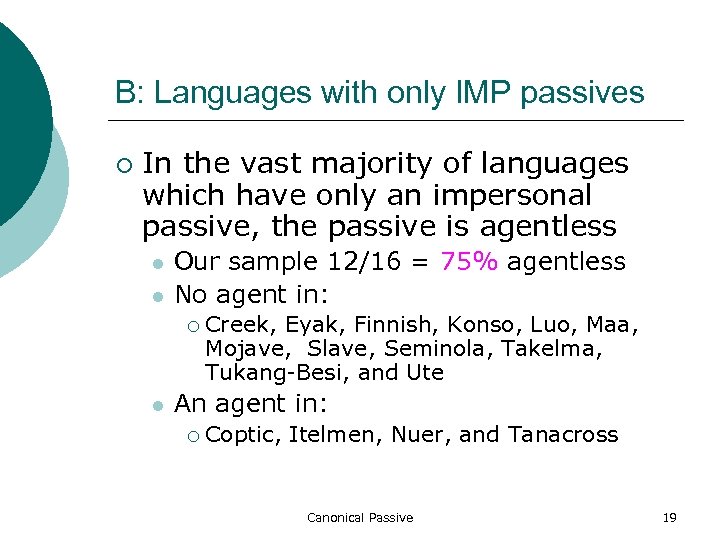 B: Languages with only IMP passives ¡ In the vast majority of languages which have only an impersonal passive, the passive is agentless l l Our sample 12/16 = 75% agentless No agent in: ¡ l Creek, Eyak, Finnish, Konso, Luo, Maa, Mojave, Slave, Seminola, Takelma, Tukang-Besi, and Ute An agent in: ¡ Coptic, Itelmen, Nuer, and Tanacross Canonical Passive 19
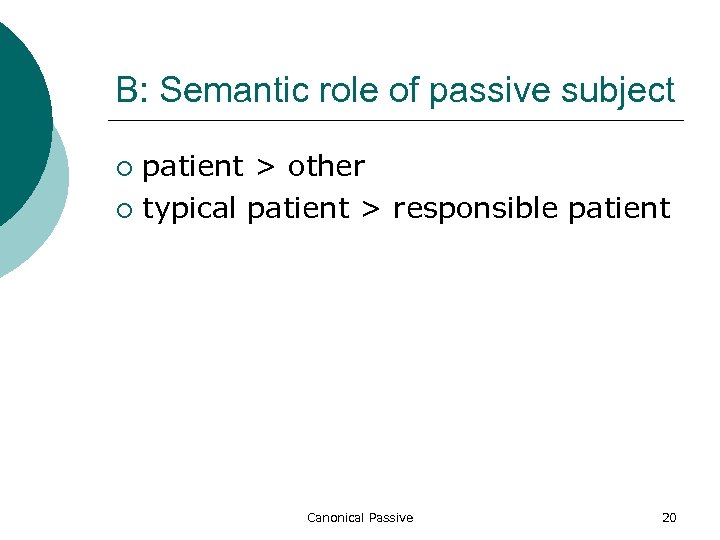 B: Semantic role of passive subject patient > other ¡ typical patient > responsible patient ¡ Canonical Passive 20
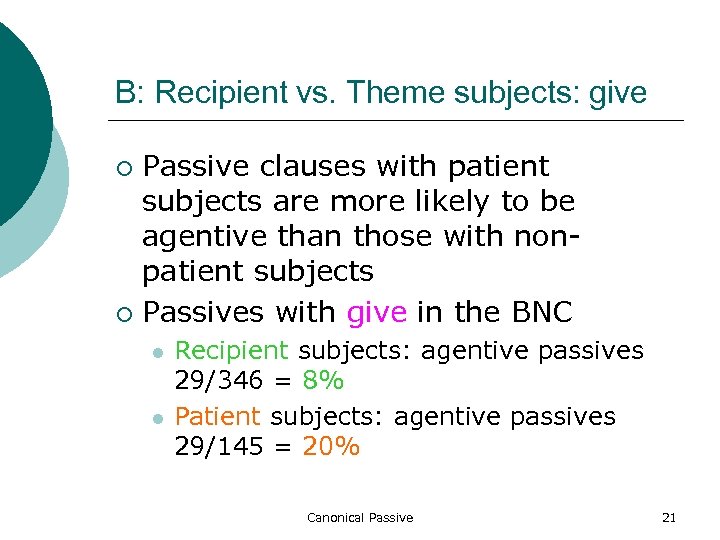 B: Recipient vs. Theme subjects: give Passive clauses with patient subjects are more likely to be agentive than those with nonpatient subjects ¡ Passives with give in the BNC ¡ l l Recipient subjects: agentive passives 29/346 = 8% Patient subjects: agentive passives 29/145 = 20% Canonical Passive 21
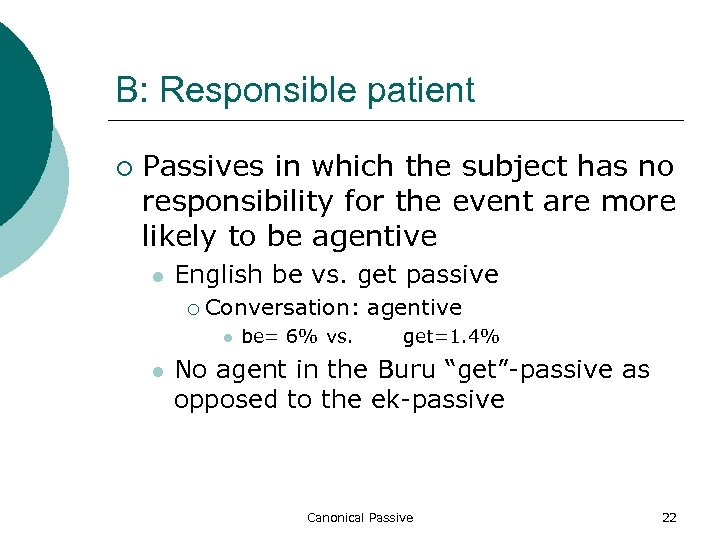 B: Responsible patient ¡ Passives in which the subject has no responsibility for the event are more likely to be agentive l English be vs. get passive ¡ Conversation: agentive l l be= 6% vs. get=1. 4% No agent in the Buru “get”-passive as opposed to the ek-passive Canonical Passive 22
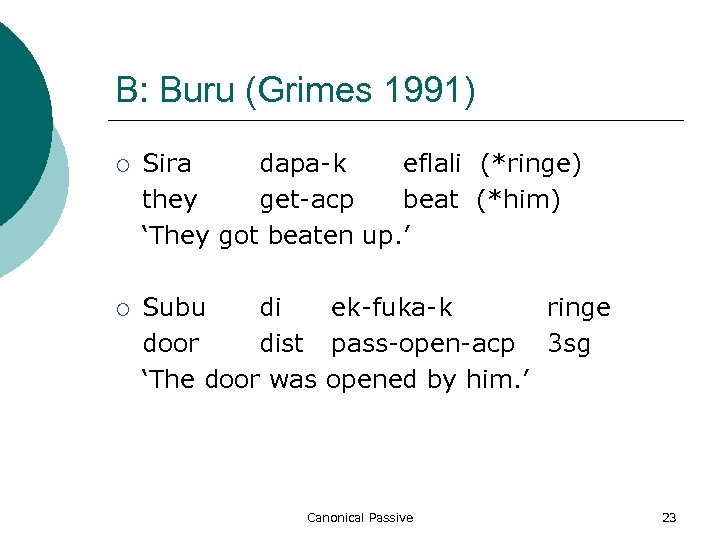 B: Buru (Grimes 1991) ¡ Sira dapa-k eflali (*ringe) they get-acp beat (*him) ‘They got beaten up. ’ ¡ Subu di ek-fuka-k ringe door dist pass-open-acp 3 sg ‘The door was opened by him. ’ Canonical Passive 23
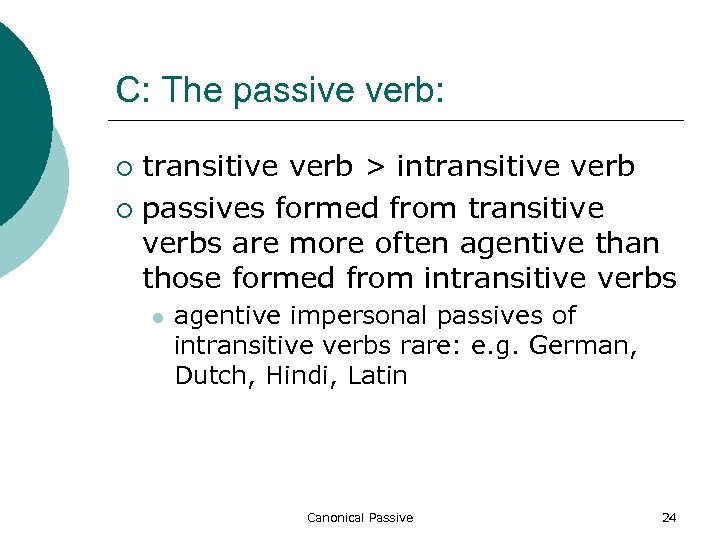 C: The passive verb: transitive verb > intransitive verb ¡ passives formed from transitive verbs are more often agentive than those formed from intransitive verbs ¡ l agentive impersonal passives of intransitive verbs rare: e. g. German, Dutch, Hindi, Latin Canonical Passive 24
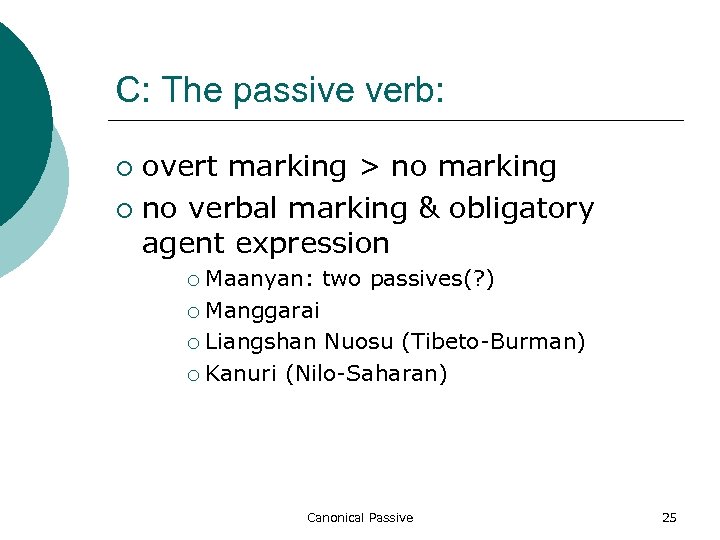 C: The passive verb: overt marking > no marking ¡ no verbal marking & obligatory agent expression ¡ Maanyan: two passives(? ) ¡ Manggarai ¡ Liangshan Nuosu (Tibeto-Burman) ¡ Kanuri (Nilo-Saharan) ¡ Canonical Passive 25
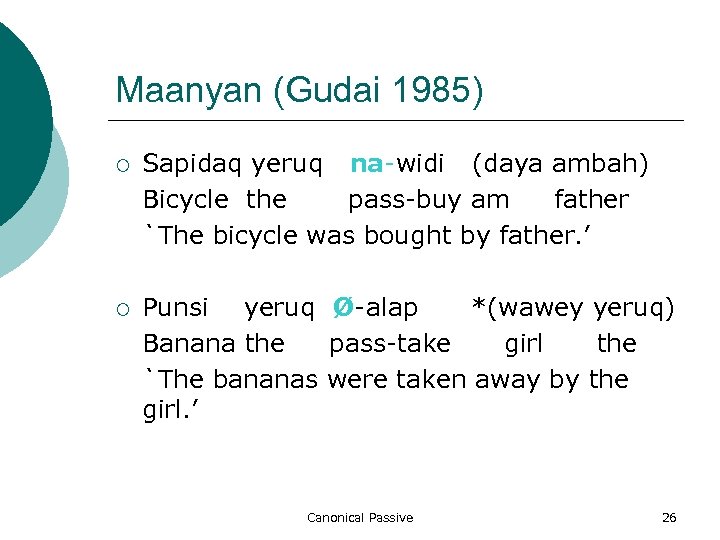 Maanyan (Gudai 1985) ¡ Sapidaq yeruq na-widi (daya ambah) Bicycle the pass-buy am father `The bicycle was bought by father. ’ ¡ Punsi yeruq Ø-alap *(wawey yeruq) Banana the pass-take girl the `The bananas were taken away by the girl. ’ Canonical Passive 26
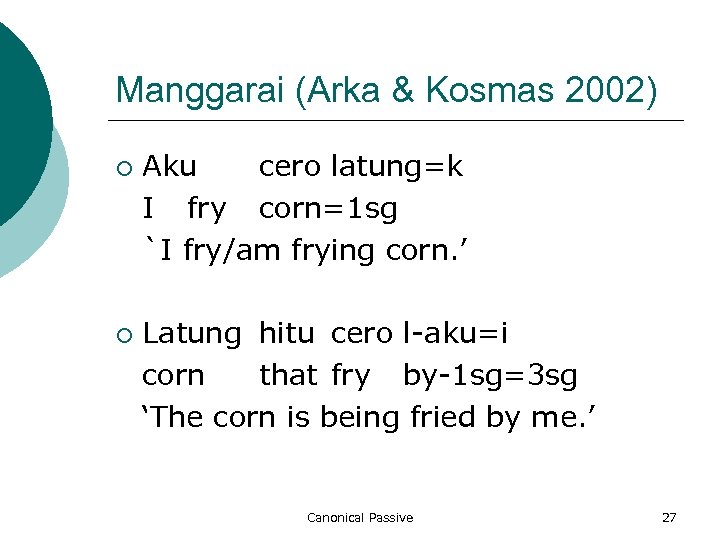 Manggarai (Arka & Kosmas 2002) ¡ ¡ Aku cero latung=k I fry corn=1 sg `I fry/am frying corn. ’ Latung hitu cero l-aku=i corn that fry by-1 sg=3 sg ‘The corn is being fried by me. ’ Canonical Passive 27
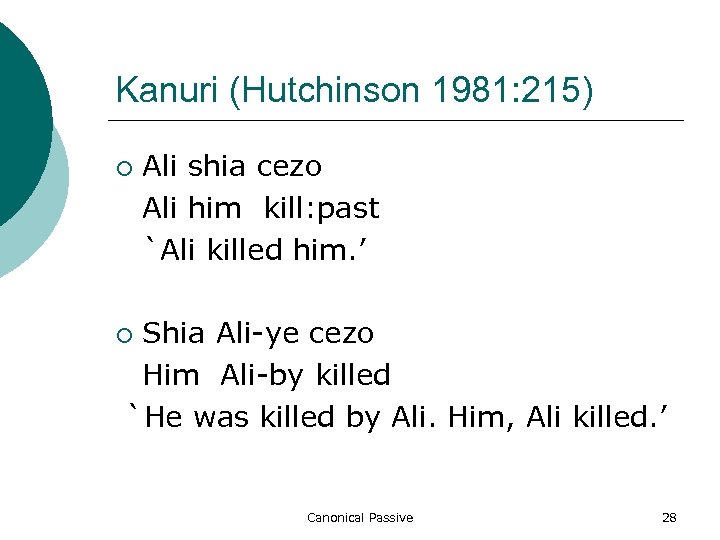 Kanuri (Hutchinson 1981: 215) ¡ Ali shia cezo Ali him kill: past `Ali killed him. ’ Shia Ali-ye cezo Him Ali-by killed `He was killed by Ali. Him, Ali killed. ’ ¡ Canonical Passive 28
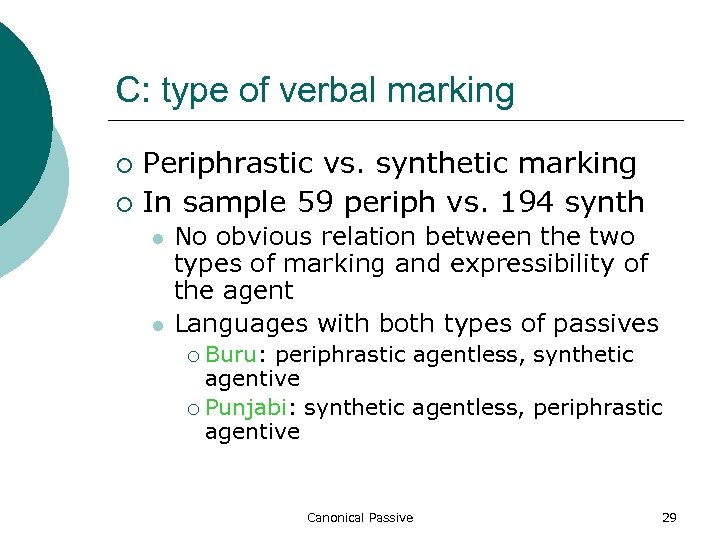 C: type of verbal marking Periphrastic vs. synthetic marking ¡ In sample 59 periph vs. 194 synth ¡ l l No obvious relation between the two types of marking and expressibility of the agent Languages with both types of passives Buru: periphrastic agentless, synthetic agentive ¡ Punjabi: synthetic agentless, periphrastic agentive ¡ Canonical Passive 29
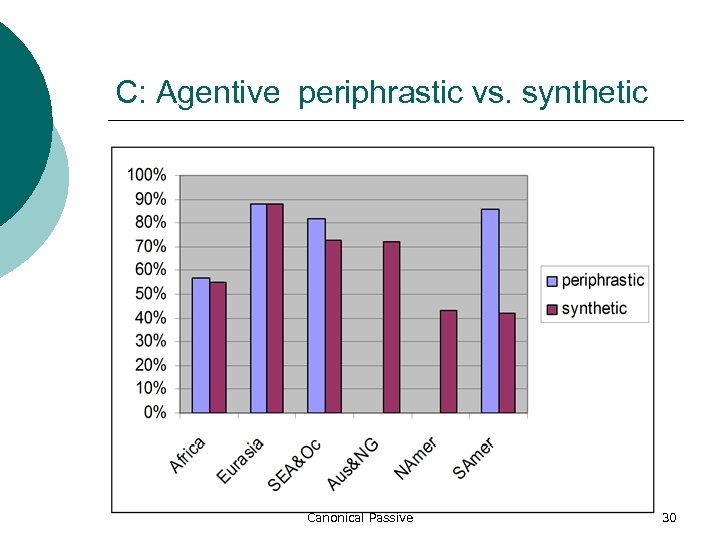 C: Agentive periphrastic vs. synthetic Canonical Passive 30
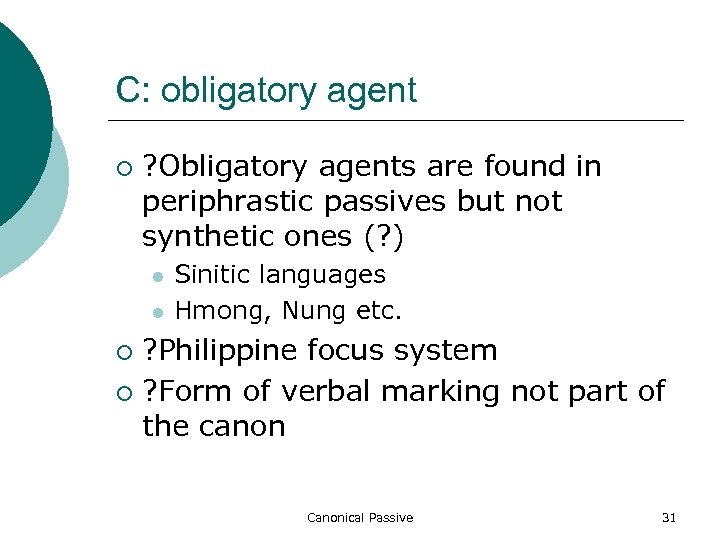 C: obligatory agent ¡ ? Obligatory agents are found in periphrastic passives but not synthetic ones (? ) l l Sinitic languages Hmong, Nung etc. ? Philippine focus system ¡ ? Form of verbal marking not part of the canon ¡ Canonical Passive 31
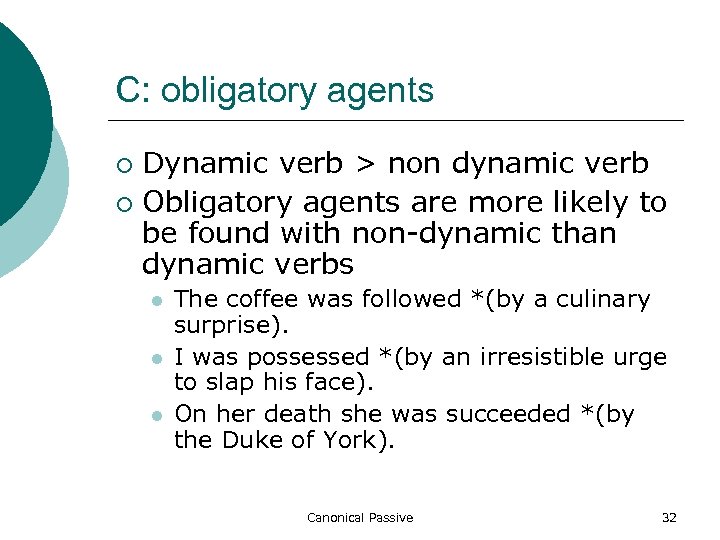 C: obligatory agents Dynamic verb > non dynamic verb ¡ Obligatory agents are more likely to be found with non-dynamic than dynamic verbs ¡ l l l The coffee was followed *(by a culinary surprise). I was possessed *(by an irresistible urge to slap his face). On her death she was succeeded *(by the Duke of York). Canonical Passive 32
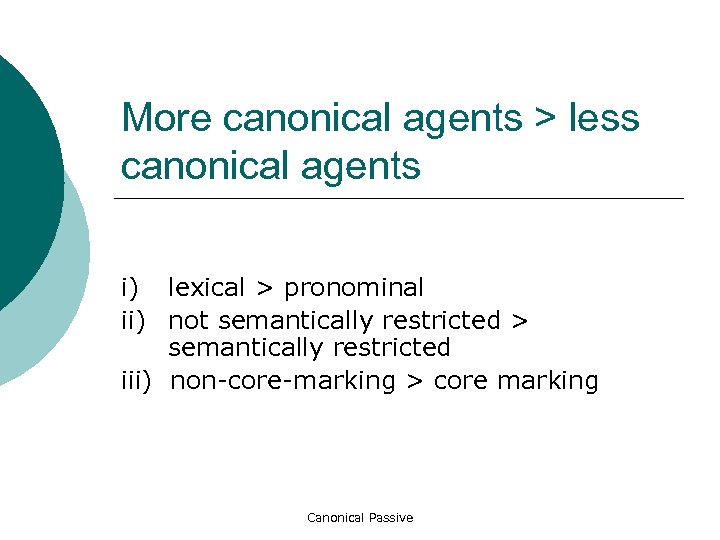 More canonical agents > less canonical agents i) lexical > pronominal ii) not semantically restricted > semantically restricted iii) non-core-marking > core marking Canonical Passive
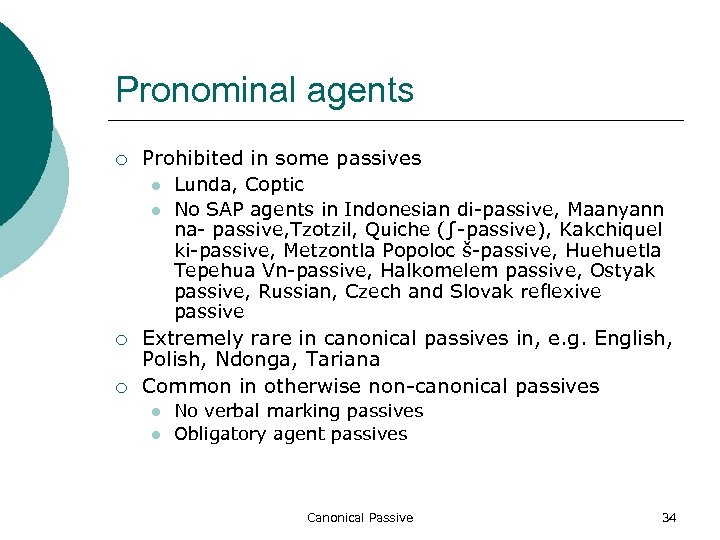 Pronominal agents ¡ Prohibited in some passives l l ¡ ¡ Lunda, Coptic No SAP agents in Indonesian di-passive, Maanyann na- passive, Tzotzil, Quiche (∫-passive), Kakchiquel ki-passive, Metzontla Popoloc š-passive, Huehuetla Tepehua Vn-passive, Halkomelem passive, Ostyak passive, Russian, Czech and Slovak reflexive passive Extremely rare in canonical passives in, e. g. English, Polish, Ndonga, Tariana Common in otherwise non-canonical passives l l No verbal marking passives Obligatory agent passives Canonical Passive 34
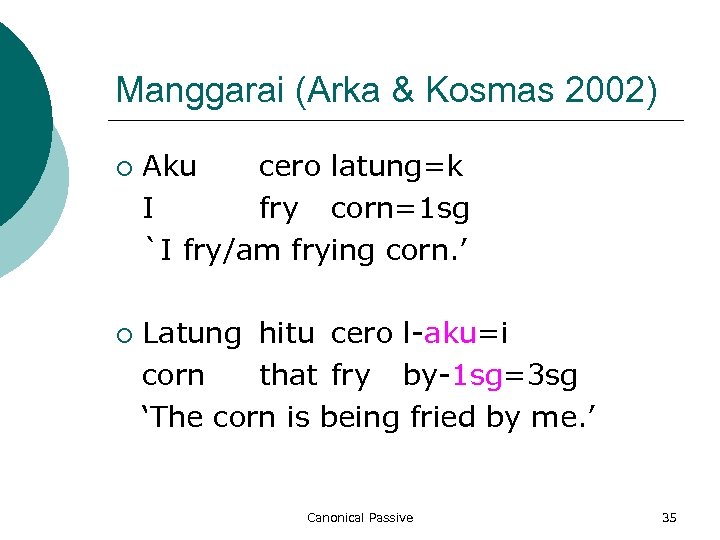 Manggarai (Arka & Kosmas 2002) ¡ ¡ Aku cero latung=k I fry corn=1 sg `I fry/am frying corn. ’ Latung hitu cero l-aku=i corn that fry by-1 sg=3 sg ‘The corn is being fried by me. ’ Canonical Passive 35
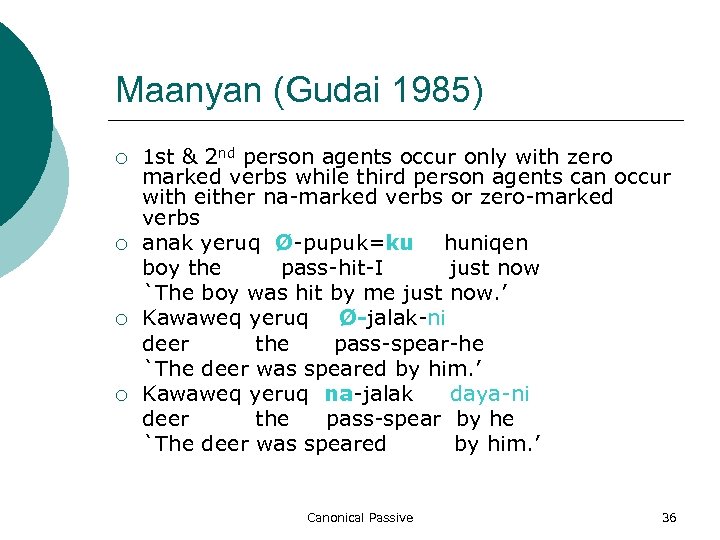 Maanyan (Gudai 1985) ¡ ¡ 1 st & 2 nd person agents occur only with zero marked verbs while third person agents can occur with either na-marked verbs or zero-marked verbs anak yeruq Ø-pupuk=ku huniqen boy the pass-hit-I just now `The boy was hit by me just now. ’ Kawaweq yeruq Ø-jalak-ni deer the pass-spear-he `The deer was speared by him. ’ Kawaweq yeruq na-jalak daya-ni deer the pass-spear by he `The deer was speared by him. ’ Canonical Passive 36
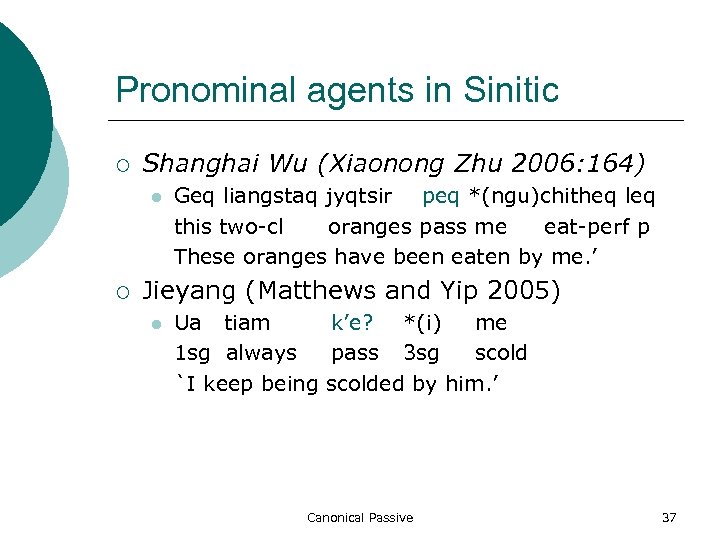 Pronominal agents in Sinitic ¡ Shanghai Wu (Xiaonong Zhu 2006: 164) l ¡ Geq liangstaq jyqtsir peq *(ngu)chitheq leq this two-cl oranges pass me eat-perf p These oranges have been eaten by me. ’ Jieyang (Matthews and Yip 2005) l Ua tiam k’e? *(i) me 1 sg always pass 3 sg scold `I keep being scolded by him. ’ Canonical Passive 37
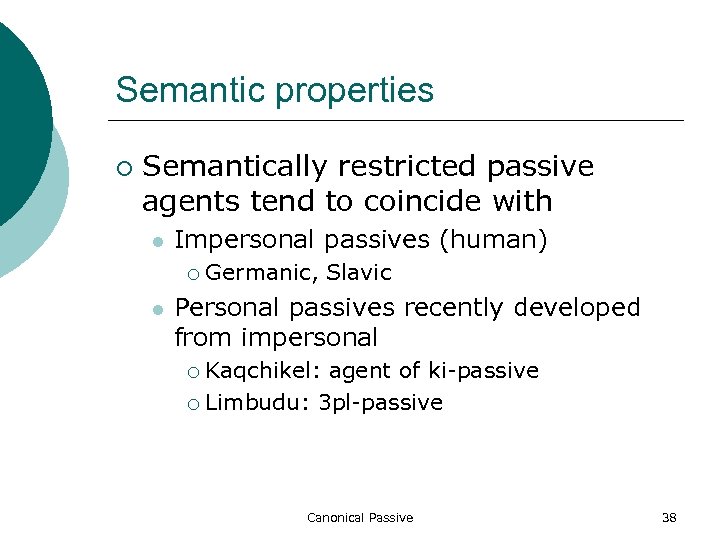 Semantic properties ¡ Semantically restricted passive agents tend to coincide with l Impersonal passives (human) ¡ l Germanic, Slavic Personal passives recently developed from impersonal Kaqchikel: agent of ki-passive ¡ Limbudu: 3 pl-passive ¡ Canonical Passive 38
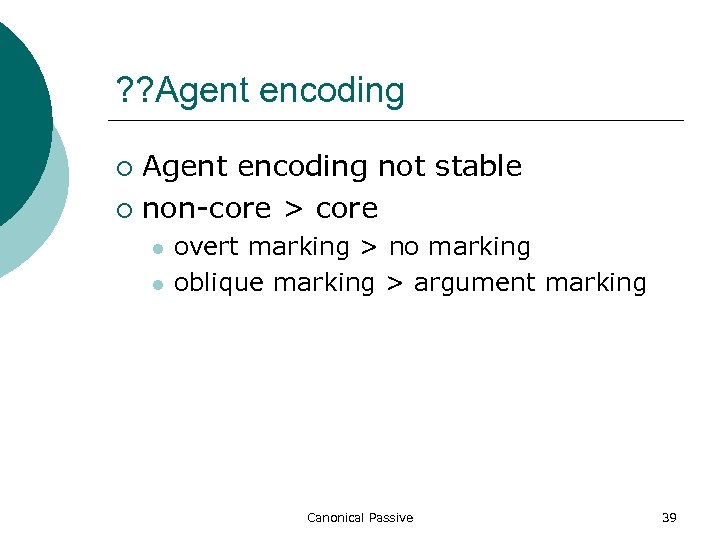 ? ? Agent encoding not stable ¡ non-core > core ¡ l l overt marking > no marking oblique marking > argument marking Canonical Passive 39
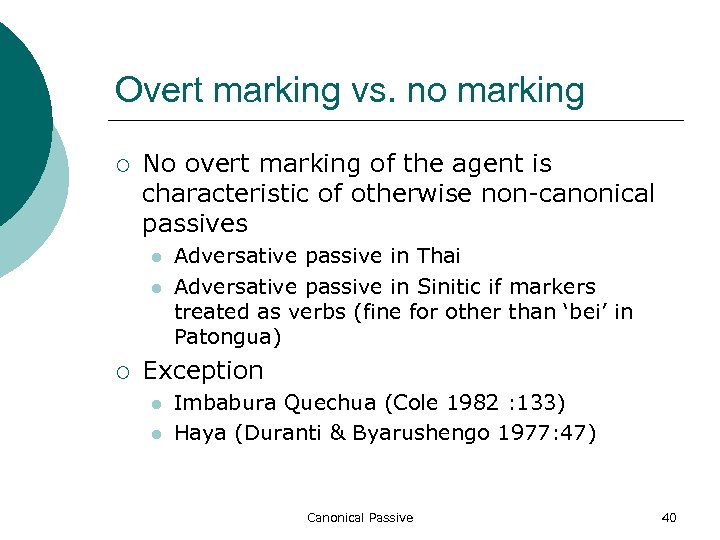 Overt marking vs. no marking ¡ No overt marking of the agent is characteristic of otherwise non-canonical passives l l ¡ Adversative passive in Thai Adversative passive in Sinitic if markers treated as verbs (fine for other than ‘bei’ in Patongua) Exception l l Imbabura Quechua (Cole 1982 : 133) Haya (Duranti & Byarushengo 1977: 47) Canonical Passive 40
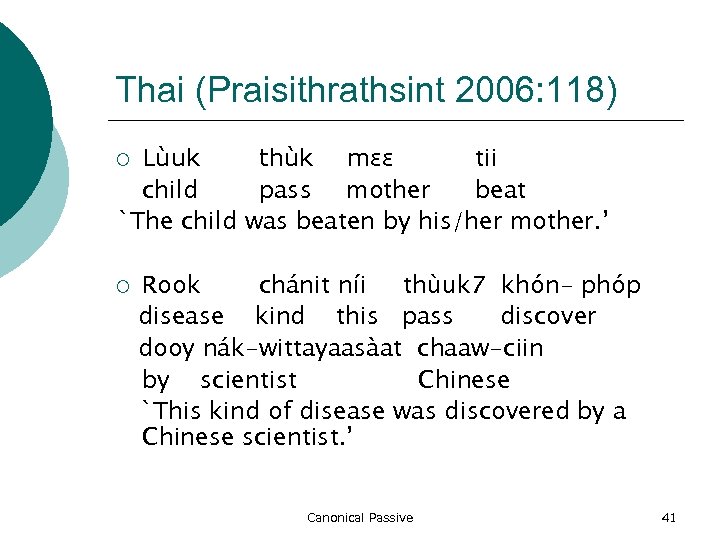 Thai (Praisithrathsint 2006: 118) Lùuk thùk mɛɛ tii child pass mother beat `The child was beaten by his/her mother. ’ ¡ ¡ Rook chánit níi thùuk 7 khón- phóp disease kind this pass discover dooy nák-wittayaasàat chaaw-ciin by scientist Chinese `This kind of disease was discovered by a Chinese scientist. ’ Canonical Passive 41
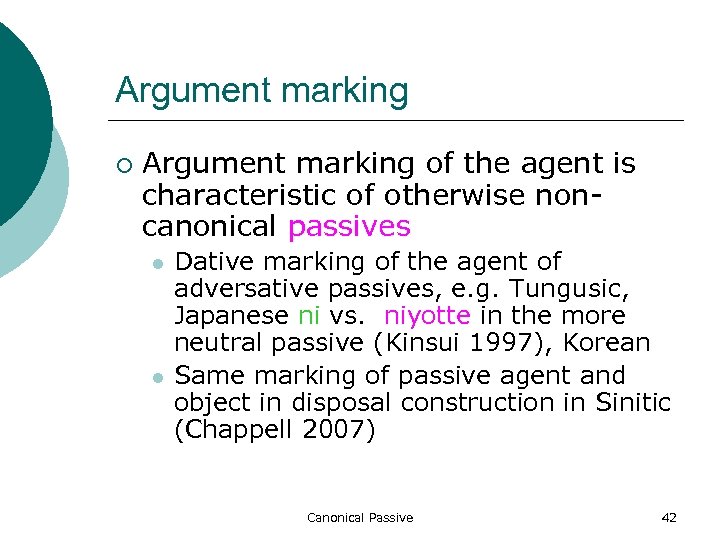 Argument marking ¡ Argument marking of the agent is characteristic of otherwise noncanonical passives l l Dative marking of the agent of adversative passives, e. g. Tungusic, Japanese ni vs. niyotte in the more neutral passive (Kinsui 1997), Korean Same marking of passive agent and object in disposal construction in Sinitic (Chappell 2007) Canonical Passive 42
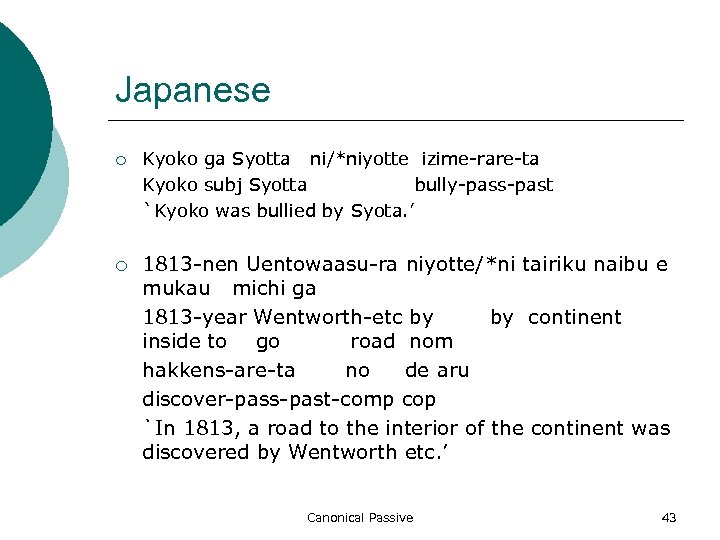 Japanese ¡ ¡ Kyoko ga Syotta ni/*niyotte izime-rare-ta Kyoko subj Syotta bully-pass-past `Kyoko was bullied by Syota. ’ 1813 -nen Uentowaasu-ra niyotte/*ni tairiku naibu e mukau michi ga 1813 -year Wentworth-etc by by continent inside to go road nom hakkens-are-ta no de aru discover-pass-past-comp cop `In 1813, a road to the interior of the continent was discovered by Wentworth etc. ’ Canonical Passive 43
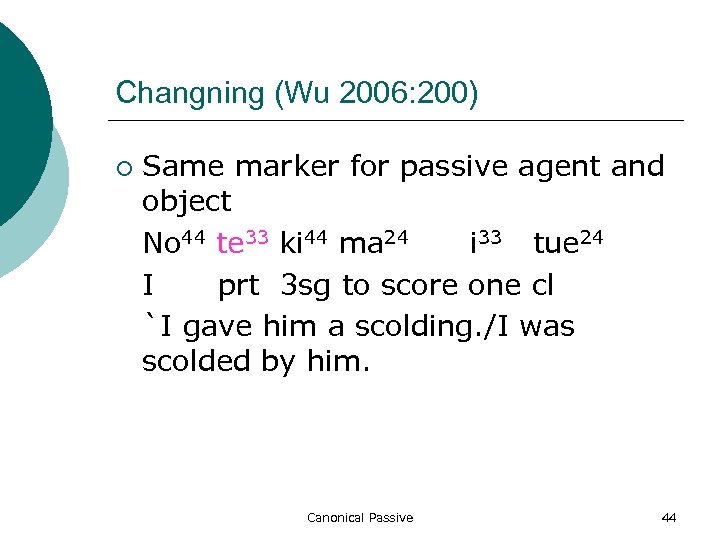 Changning (Wu 2006: 200) ¡ Same marker for passive agent and object No 44 te 33 ki 44 ma 24 i 33 tue 24 I prt 3 sg to score one cl `I gave him a scolding. /I was scolded by him. Canonical Passive 44
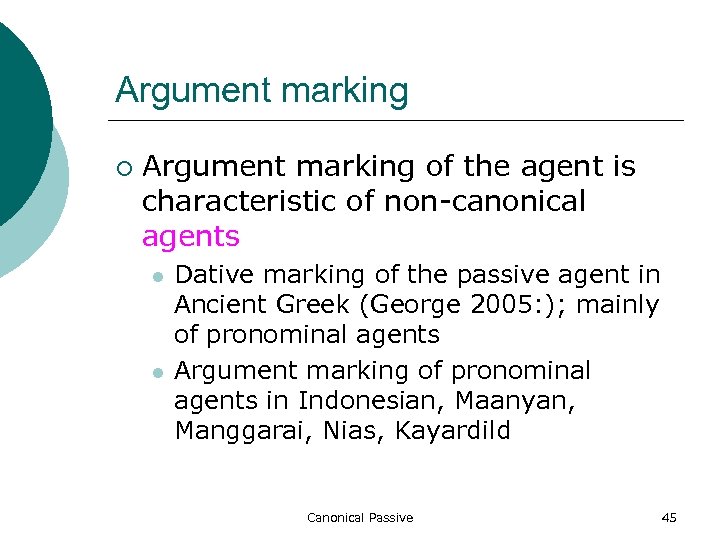 Argument marking ¡ Argument marking of the agent is characteristic of non-canonical agents l l Dative marking of the passive agent in Ancient Greek (George 2005: ); mainly of pronominal agents Argument marking of pronominal agents in Indonesian, Maanyan, Manggarai, Nias, Kayardild Canonical Passive 45
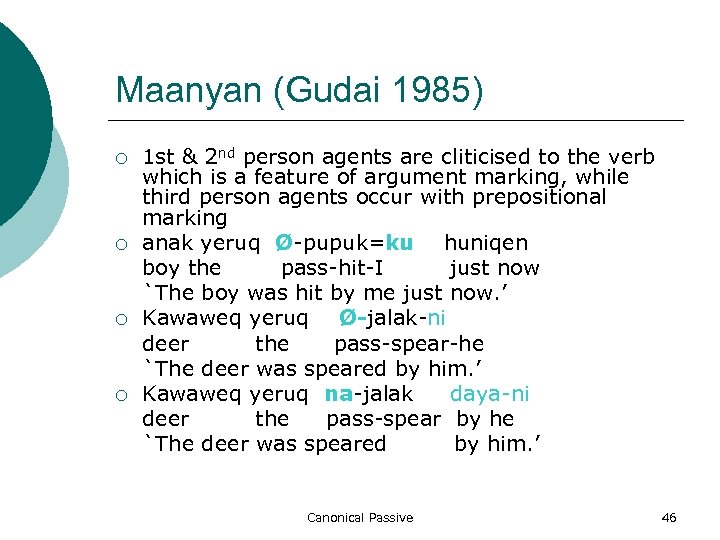 Maanyan (Gudai 1985) ¡ ¡ 1 st & 2 nd person agents are cliticised to the verb which is a feature of argument marking, while third person agents occur with prepositional marking anak yeruq Ø-pupuk=ku huniqen boy the pass-hit-I just now `The boy was hit by me just now. ’ Kawaweq yeruq Ø-jalak-ni deer the pass-spear-he `The deer was speared by him. ’ Kawaweq yeruq na-jalak daya-ni deer the pass-spear by he `The deer was speared by him. ’ Canonical Passive 46
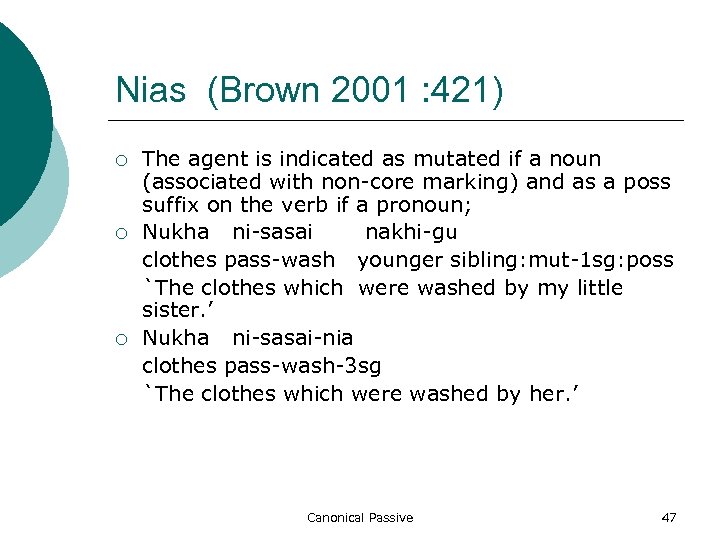 Nias (Brown 2001 : 421) ¡ ¡ ¡ The agent is indicated as mutated if a noun (associated with non-core marking) and as a poss suffix on the verb if a pronoun; Nukha ni-sasai nakhi-gu clothes pass-wash younger sibling: mut-1 sg: poss `The clothes which were washed by my little sister. ’ Nukha ni-sasai-nia clothes pass-wash-3 sg `The clothes which were washed by her. ’ Canonical Passive 47
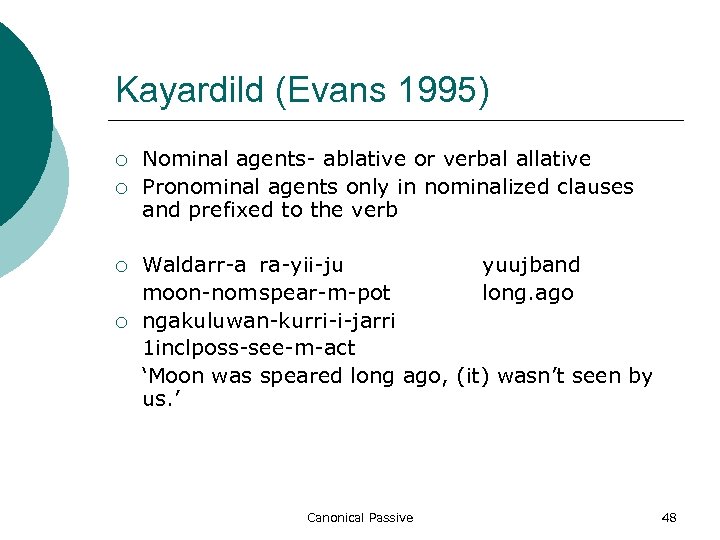 Kayardild (Evans 1995) ¡ ¡ Nominal agents- ablative or verbal allative Pronominal agents only in nominalized clauses and prefixed to the verb Waldarr-a ra-yii-ju yuujband moon-nomspear-m-pot long. ago ngakuluwan-kurri-i-jarri 1 inclposs-see-m-act ‘Moon was speared long ago, (it) wasn’t seen by us. ’ Canonical Passive 48
 Conclusions Canonical Passive
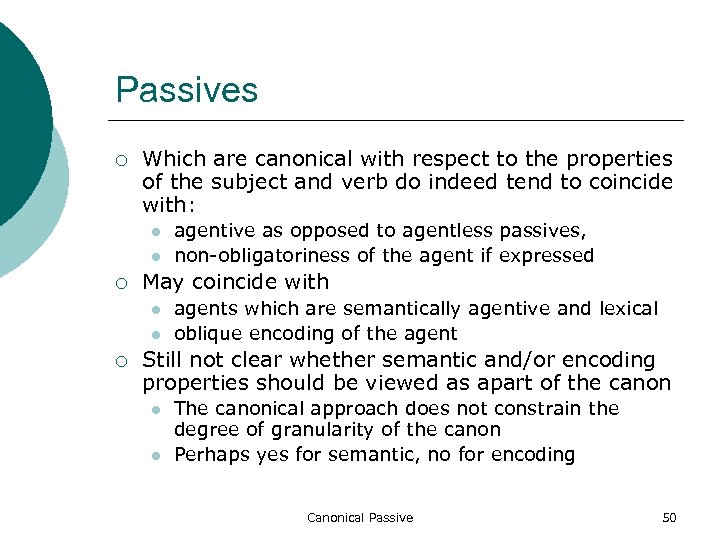 Passives ¡ Which are canonical with respect to the properties of the subject and verb do indeed tend to coincide with: l l ¡ May coincide with l l ¡ agentive as opposed to agentless passives, non-obligatoriness of the agent if expressed agents which are semantically agentive and lexical oblique encoding of the agent Still not clear whether semantic and/or encoding properties should be viewed as apart of the canon l l The canonical approach does not constrain the degree of granularity of the canon Perhaps yes for semantic, no for encoding Canonical Passive 50
 References ¡ ¡ ¡ Arka I Wayan and Jeladu Kosmas. 2002. Passive without passive morphology? Evidence from Manggarai. Paper read at 9 ICAL, Canberra Brown, Lea. 2001. A Grammar of Nias Selatan. Ph. D Dissertation, University of Sydney. Chappell Hilary (2007). Grammaticalization zones for the identical marking of agents and patients in Sinitic languages. Paper presented at the Fifth Conference of the European Association of Chinese Linguistics, 5 -7 September 2007, Leipzig, Germany. Corbett, Greville. 2005. The canonical approach in typology. In: Zygmunt Frajzyngier, Adam Hodges and David S. Rood eds. , Linguistic Diversity and Language Theories. Amsterdam: John Benjamins. 25 -49. Dixon, R. M. W & A. Y. Aikhnevald. 2000. Changing Valency. Cambridge: Cambridge University Press. Evans, Nicholas. 1995. A Grammar of Kayardild. Berlin: Mouton de Gruyter. Canonical Passive 51
 References ¡ ¡ ¡ George, Coulter H. (2005). Expressions of Agency in Ancient Greek. Cambridge: CUP Givon, Talmy. 1979. Understanding Grammar. New York: Academic Press. Granger, Sylviane 1983. The Be + Past Participle Construction in Spoken English. Amsterdam: North Holland Grimes, Charles E. 1991. The Buru Language of Eastern Indonesia. Ph. D. Dissertation, The Australian National University. Gudai, Darmansyah, H. 1985. A Grammar of Maanyan, A Language of Central Kalimantan. Ph. D. Dissertation. Australian National University. Kinsui, Satishi 1997. The influence of translation on the historical development of the Japanese passive construction. Journal of Pragmatics 28: 759 -779. Canonical Passive 52
 References ¡ ¡ ¡ Prasithrathsint, Amara. 2006. Development of the thùuk passive marker in Thai. In. Werner Abraham & Larisa Leisiö eds, Passivization and Typology. Amsterdam: John Benjamins, 115 -131. Shibatani, Masayoshi. 1985. Passives and related constructions: a prototype approach. Language 61, 821– 848. Siewierska, Anna. 1984. The Passive: A Contrastive Linguistic Analysis. London: Croom Helm Siewierska, Anna. 2005. Passive constructions, In M. Haspelmath, M. S. Dryer, D. Gil & B. Comrie eds, World Atlas of Language Structure. Oxford University Press, chapter 107: 434 -437. Słoń, Anna. 2003. Impersonal Constructions in English and Polish. A Cognitive Grammar Approach. Ph. D. Dissertation, Maria Curie-Skłodowska University in Lublin Canonical Passive 53