


 Скачать презентацию Passion fruit work in Uganda M O Ssemakula
1a67d25d229f9027e75b902d7747bc6a.ppt
- Количество слайдов: 26
 Passion fruit work in Uganda M O Ssemakula 1, V Aritua 2, R Edema 1, T Sengooba 3, J J Hakiza 2, J Tumwine 2, S Kyamanywa 1 & E Adipala 4. 1 Department of Crop Science, Makerere University, Uganda. 2 Na. CRRI, National Agricultural Research Organization, Uganda. 3 IFPRI, Kampala, Uganda. 4 RUFORUM, Kampala, Uganda.
 Background § The crop: Passion fruit • Is a major export crop from Uganda to the European market. • Is mainly grown by small-scale farmers in the Eastern and Western highlands of Uganda. • Was cultivated on a large-scale in Central Uganda between 1990 -2000 as part of the export diversification initiative of the Ugandan Government. • Earned Uganda US$ 100, 000 from the export of 50 metric tons at the peak of production in 1998.
 Background § The problem: Reduced productivity • Since 2000, fluctuations in production and export have been realized. • By 2005, only 7 tons of fresh fruit were being exported from Uganda. • Reduction in production has been attributed to biotic and management-related factors first identified in feasibility and market-oriented studies from 1989 -1993.
 Background § Limiting factors to production & export: • Pests and diseases. • Limited commercial germplasm pool: • • • Dominated by a single variety, the Kawanda Hybrid is susceptible to prevalent pests and diseases. Poor agronomic and post harvest practices, thus: • Variability in the quality of produce. • Fruit damage.
 Background § Diseases: • Are the most significant biotic constraint to passion fruit production in Uganda. • Priority diseases include: • Brown spot. • Collar rot. • Viral diseases.
 Background § Management of priority diseases: • Brown spot: • Mainly occurs in warm, humid production areas. • Is currently being managed using the fungicide Ridomil (Dithane M 45), which controls disease incidence and severity (Ssonko et al. 2005).
 Background § Management of priority diseases: • Collar rot: • Introduction of improved germplasm from external sources (Campbell 1992, NARO 1994). • Grafting of Kawanda Hybrid to tolerant local yellow rootstock (Ssekyewa 1993, NARO 1998, ADC/IDEA 1999). • Screening of local yellow and sweet calabash (hard-shelled) passion fruit types for disease tolerance, with some success in screen house trials (NARO, 2006).
 Background § Management of priority diseases: • Viruses: • Retrieval of Kawanda Hybrid clones 5, 6, 7 and 8, previously lost from the Horticultural Program (NARO 1994, ADC/IDEA 1999). • Dissemination of clean planting material to farmers (MAAIF 1990, NARO 2000, ADC/IDEA 2000, 2002). • Identification of the causal agent as a potyvirus similar to passion fruit woodiness virus (PWV) and cowpea aphid-borne mosaic virus (CABMV).
 Background for IPM CRSP Work § Impact of management efforts for viral diseases was not felt because: • Data on disease epidemiology was not adequate enough for appropriate management strategies to be formulated. • Causal agents were not fully identified while widespread variation in disease distribution was suggestive of multiple species or strain occurrence. • No sources of tolerance were identified to counteract the susceptibility of commercial germplasm.
 Background § Viral diseases on passion fruit, therefore escalated since the cultural measures in use were ineffective in disease management. § A research program on passion fruit viruses was then initiated at Makerere University to: • Map viral disease incidence and severity. • Identify and characterize viral pathogens. • Characterize and screen local passion fruit germplasm for sources of host tolerance to viruses.
 Disease mapping § Two disease surveys were conducted in 15 major passion fruit-growing districts of Uganda during November 2003 and May 2005. § Data on disease incidence and severity were collected and mapped using Geographical Information System (GIS) software (Ilwis 3. 1 and Arc. View 3. 2).
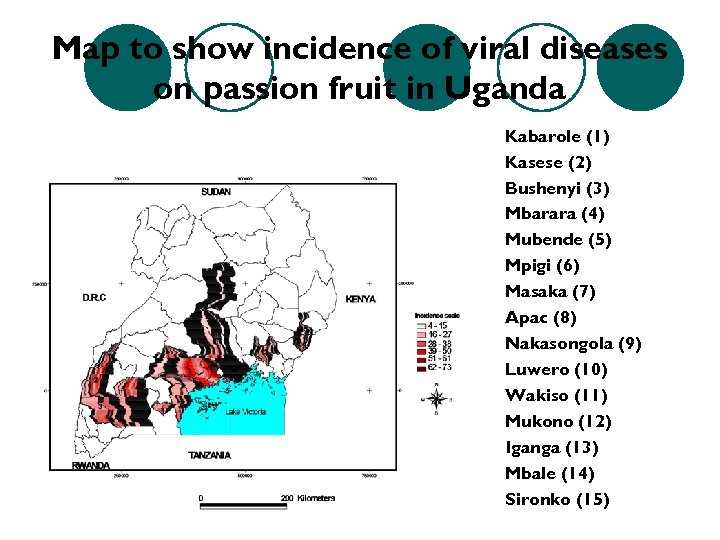 Map to show incidence of viral diseases on passion fruit in Uganda Kabarole (1) Kasese (2) Bushenyi (3) Mbarara (4) Mubende (5) Mpigi (6) Masaka (7) Apac (8) Nakasongola (9) Luwero (10) Wakiso (11) Mukono (12) Iganga (13) Mbale (14) Sironko (15)
 Pathogen identification § The Ugandan Passiflora potyvirus has been identified: • As a novel potyvirus species on passion fruit: • With AA motifs associated with aphid-transmission. • With biological similarity to CABMV, passion fruit ringspot virus and PWV • Distinct from PWV, CABMV and other viruses causing passion fruit woodiness disease worldwide such as Cucumber mosaic virus and East Asian Passiflora virus.
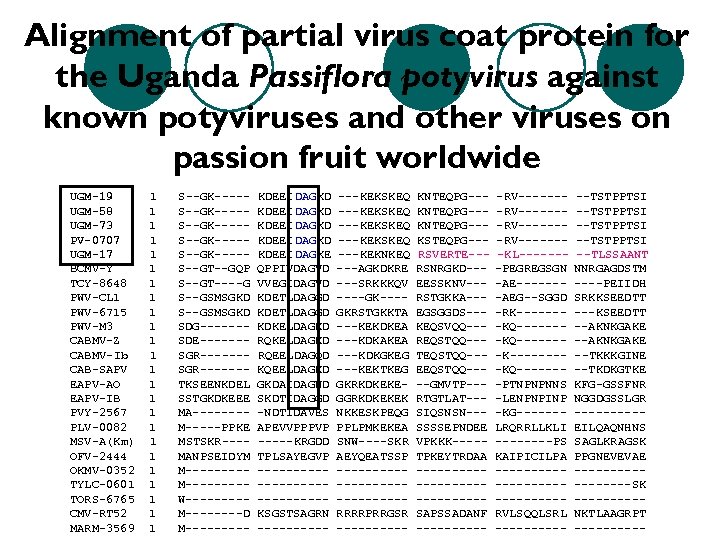 Alignment of partial virus coat protein for the Uganda Passiflora potyvirus against known potyviruses and other viruses on passion fruit worldwide UGM-19 UGM-58 UGM-73 PV-0707 UGM-17 BCMV-Y TCY-8648 PWV-CL 1 PWV-6715 PWV-M 3 CABMV-Z CABMV-Ib CAB-SAPV EAPV-AO EAPV-IB PVY-2567 PLV-0082 MSV-A(Km) OFV-2444 OKMV-0352 TYLC-0601 TORS-6765 CMV-RT 52 MARM-3569 1 1 1 1 1 1 S--GK----S--GK----S--GK----S--GT--GQP S--GT----G S--GSMSGKD SDG------SDE------SGR------TKSEENKDEL SSTGKDKEEE MA-------M-----PPKE MSTSKR---MANPSEIDYM M--------W----M----D M----- KDEEI DAGKD KDEEI DAGKE QPPIVDAGVD VVEGIDAGVD KDETLDAGGD KDKELDAGKD RQEELDAGQD KQEELDAGKD GKDAIDAGND SKDTIDAGGD -NDTIDAVES APEVVPPPVP -----KRGDD TPLSAYEGVP --------------KSGSTSAGRN ----- ---KEKSKEQ ---KEKNKEQ ---AGKDKRE ---SRKKKQV ----GKRSTGKKTA ---KEKDKEA ---KDKAKEA ---KDKGKEG ---KEKTKEG GKRKDKEKEGGRKDKEKEK NKKESKPEQG PPLPMKEKEA SNW----SKR AEYQEATSSP --------------RRRRPRRGSR ----- KNTEQPG--KNTEQPG--KSTEQPG--RSVERTE--RSNRGKD--EESSKNV--RSTGKKA--EGSGGDS--KEQSVQQ--REQSTQQ--TEQSTQQ--EEQSTQQ----GMVTP--RTGTLAT--SIQSNSN--SSSSEPNDEE VPKKK----TPKEYTRDAA --------------SAPSSADANF ----- -RV-------RV-------KL-------PEGREGSGN -AE-------AEG--SGGD -RK-------KQ-------K----KQ-------PTNPNPNNS -LENPNPINP -KG------LRQRRLLKLI ----PS KAIPICILPA --------------RVLSQQLSRL ----- --TSTPPTSI --TLSSAANT NNRGAGDSTM ----PEIIDH SRKKSEEDTT ---KSEEDTT --AKNKGAKE --TKKKGINE --TKDKGTKE KFG-GSSFNR NGGDGSSLGR -----EILQAQNHNS SAGLKRAGSK PPGNEVEVAE ---------SK -----NKTLAAGRPT -----
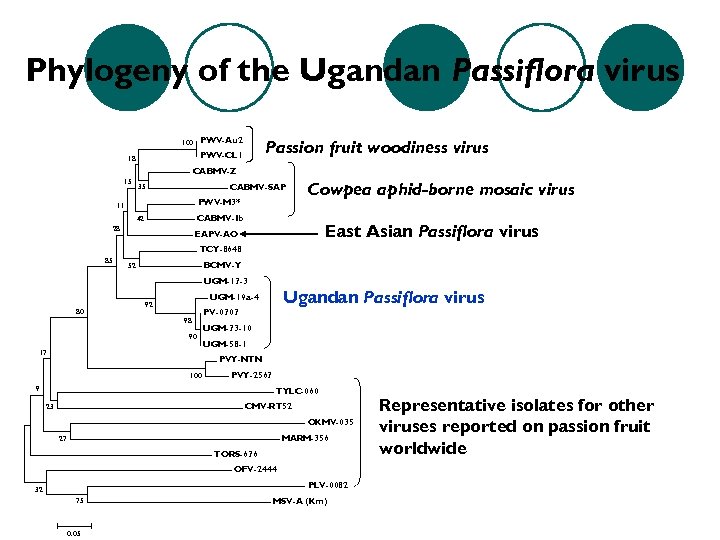 Phylogeny of the Ugandan Passiflora virus PWV-Au 2 100 Passion fruit woodiness virus PWV-CL 1 18 CABMV-Z 15 CABMV-SAP 35 PWV-M 3* 11 Cowpea aphid-borne mosaic virus CABMV-Ib 42 28 East Asian Passiflora virus EAPV-AO TCY-8648 85 BCMV-Y 52 UGM-17 -3 80 Ugandan Passiflora virus UGM-19 a-4 92 98 90 17 PV-0707 UGM-73 -10 UGM-58 -1 PVY-NTN 100 PVY-2567 9 TYLC-060 CMV-RT 52 23 OKMV-035 MARM-356 27 TORS-676 OFV-2444 PLV-0082 32 75 0. 05 MSV-A (Km) Representative isolates for other viruses reported on passion fruit worldwide
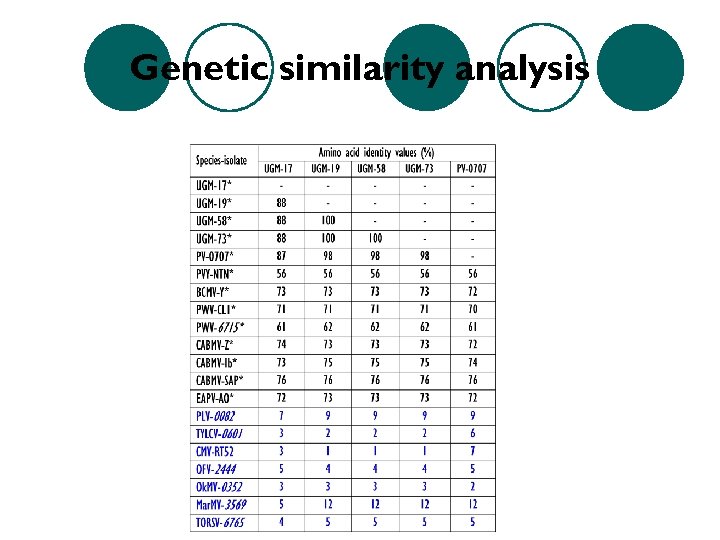 Genetic similarity analysis
 Virus characterization § Host assays using 26 plant species in Nicotiana, Chenopodium, Datura and Passiflora: • Revealed variability across virus isolates: • Host range. • Severity of infection.
 Germplasm Characterization Sixty accessions of 5 passion fruit types were collected from farmers’ fields. § Morphological characterization done in 2005 B and 2006 A: § • • High variability in phenotypic traits for germplasm within and between locations. Plants with beneficial qualitative and quantitative traits were identified.
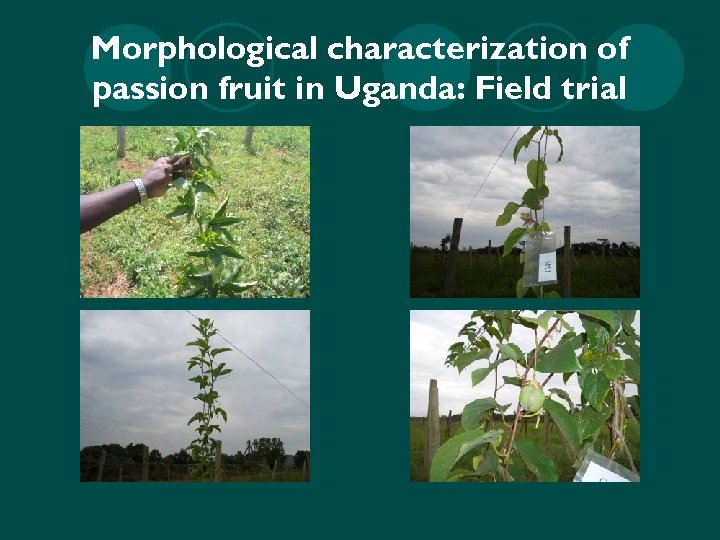 Morphological characterization of passion fruit in Uganda: Field trial
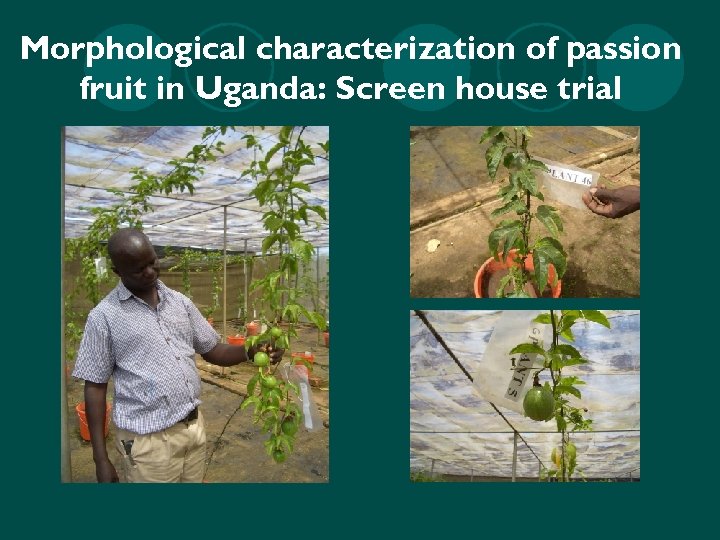 Morphological characterization of passion fruit in Uganda: Screen house trial
 Molecular characterization § Simple sequence repeat (SSR) markers: • § Not polymorphic enough across species. Random amplified polymorphic DNA (RAPD) markers: • Currently under evaluation. • Preliminary results reveal genetic diversity within and across species.
 Germplasm screening for virus tolerance § Experiment: • Completely Randomized Design in a screen house trial. • Double graft technique for plant inoculation. • Six accessions of yellow, hard-shelled and sweet granadilla types were grafted to 4 virus isolates maintained on passion fruit. • Data collected from 30 days after second grafting, for a duration of 5 months. • Data type: Disease severity and virus titre (ELISA).
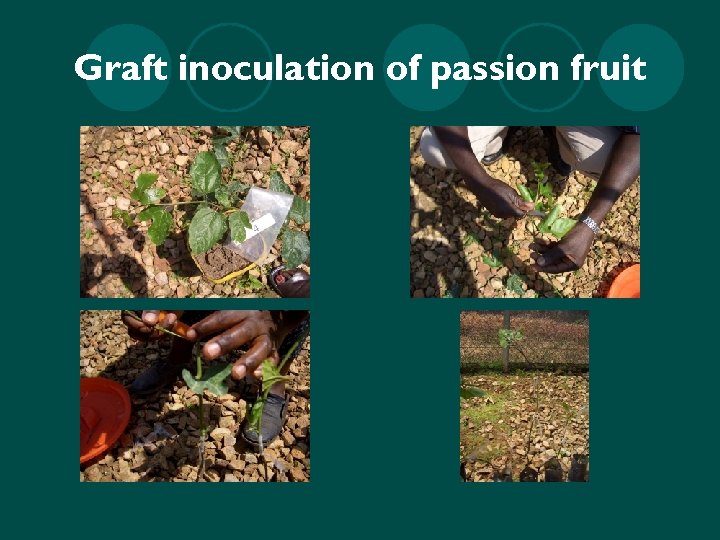 Graft inoculation of passion fruit
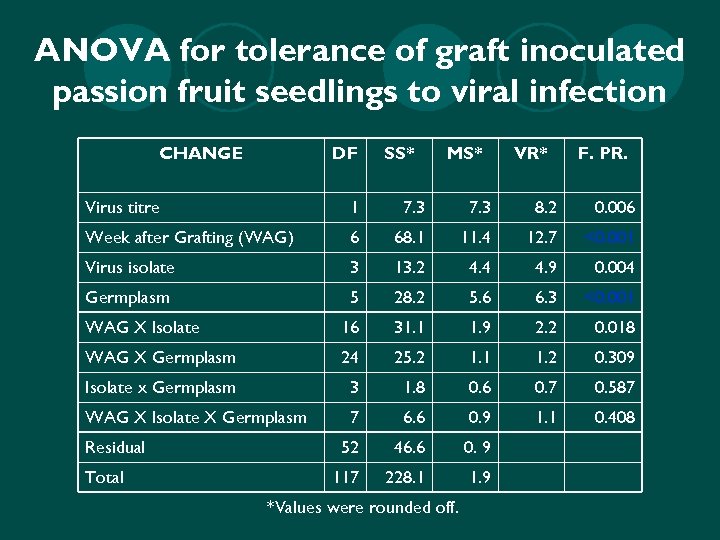 ANOVA for tolerance of graft inoculated passion fruit seedlings to viral infection CHANGE DF SS* MS* VR* F. PR. Virus titre 1 7. 3 8. 2 0. 006 Week after Grafting (WAG) 6 68. 1 11. 4 12. 7 <0. 001 Virus isolate 3 13. 2 4. 4 4. 9 0. 004 Germplasm 5 28. 2 5. 6 6. 3 <0. 001 WAG X Isolate 16 31. 1 1. 9 2. 2 0. 018 WAG X Germplasm 24 25. 2 1. 1 1. 2 0. 309 Isolate x Germplasm 3 1. 8 0. 6 0. 7 0. 587 WAG X Isolate X Germplasm 7 6. 6 0. 9 1. 1 0. 408 52 46. 6 0. 9 117 228. 1 1. 9 Residual Total *Values were rounded off.
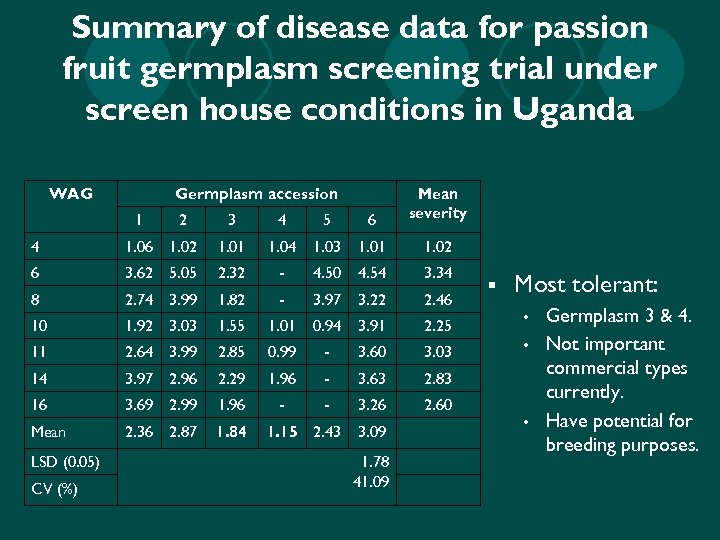 Summary of disease data for passion fruit germplasm screening trial under screen house conditions in Uganda WAG 1 2 3 4 5 6 Mean severity 4 1. 06 1. 02 1. 01 1. 04 1. 03 1. 01 1. 02 6 3. 62 5. 05 2. 32 - 4. 50 4. 54 3. 34 8 2. 74 3. 99 1. 82 - 3. 97 3. 22 2. 46 10 1. 92 3. 03 1. 55 1. 01 0. 94 3. 91 2. 25 11 2. 64 3. 99 2. 85 0. 99 - 3. 60 3. 03 14 3. 97 2. 96 2. 29 1. 96 - 3. 63 2. 83 16 3. 69 2. 99 1. 96 - - 3. 26 2. 60 Mean 2. 36 2. 87 1. 84 LSD (0. 05) CV (%) Germplasm accession 1. 15 2. 43 3. 09 1. 78 41. 09 § Most tolerant: • • • Germplasm 3 & 4. Not important commercial types currently. Have potential for breeding purposes.
 Partners § Funding: • • • § Innovations at Makerere Program (Rockefeller Foundation/ World Bank). International Foundation for Science. Faculty of Agriculture (Sida-SAREC and NORAD grants). Technical support/Collaboration: • • Deutsche Sammlung von Mikroorganismen und Zellkulturen (DSMZ), Germany. National Agricultural Research Organization (NARO): • National Crop Resources Research Institute (Na. CCRI): • Horticultural Research Program (NHRP). • National Agricultural Research Laboratories: • Agricultural Biotechnology Centre (NABC).