


 Скачать презентацию Passage 1 It is predicted that there will
2c2ffc092058447ecea76d4812d8288c.ppt
- Количество слайдов: 14
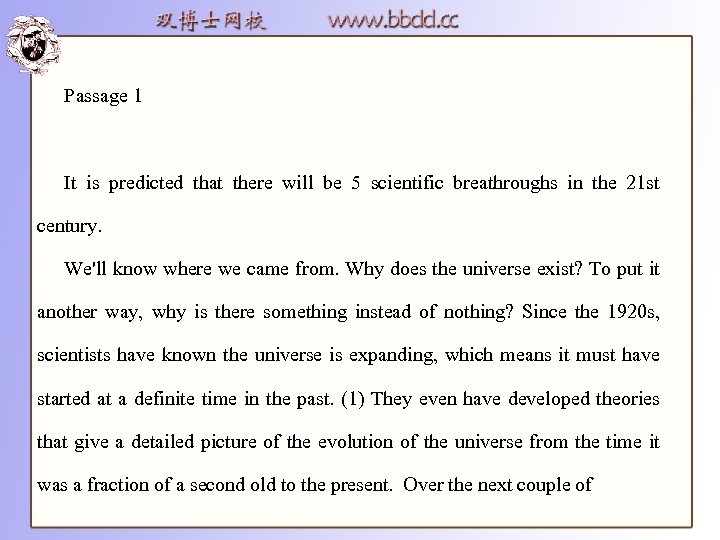 Passage 1 It is predicted that there will be 5 scientific breathroughs in the 21 st century. We'll know where we came from. Why does the universe exist? To put it another way, why is there something instead of nothing? Since the 1920 s, scientists have known the universe is expanding, which means it must have started at a definite time in the past. (1) They even have developed theories that give a detailed picture of the evolution of the universe from the time it was a fraction of a second old to the present. Over the next couple of
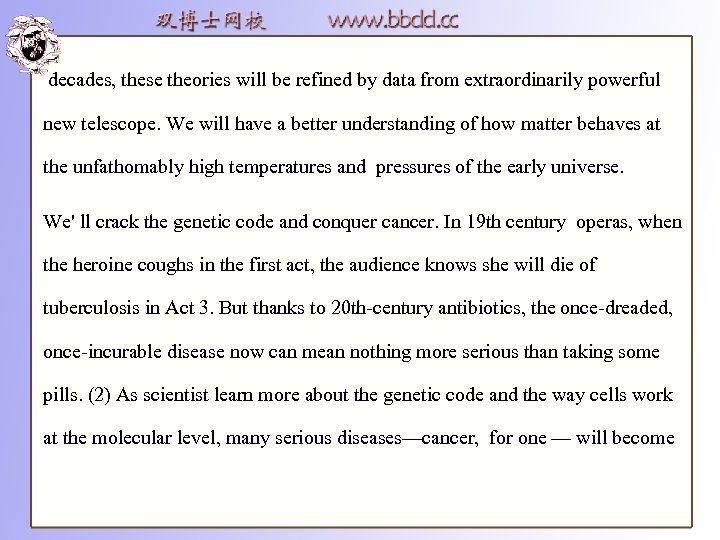 decades, these theories will be refined by data from extraordinarily powerful new telescope. We will have a better understanding of how matter behaves at the unfathomably high temperatures and pressures of the early universe. We' ll crack the genetic code and conquer cancer. In 19 th century operas, when the heroine coughs in the first act, the audience knows she will die of tuberculosis in Act 3. But thanks to 20 th-century antibiotics, the once-dreaded, once-incurable disease now can mean nothing more serious than taking some pills. (2) As scientist learn more about the genetic code and the way cells work at the molecular level, many serious diseases—cancer, for one — will become
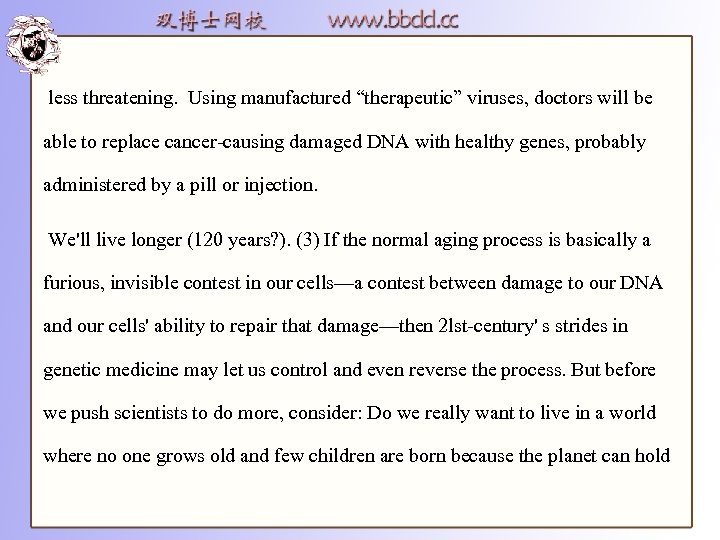 less threatening. Using manufactured “therapeutic” viruses, doctors will be able to replace cancer-causing damaged DNA with healthy genes, probably administered by a pill or injection. We'll live longer (120 years? ). (3) If the normal aging process is basically a furious, invisible contest in our cells—a contest between damage to our DNA and our cells' ability to repair that damage—then 2 lst-century' s strides in genetic medicine may let us control and even reverse the process. But before we push scientists to do more, consider: Do we really want to live in a world where no one grows old and few children are born because the planet can hold
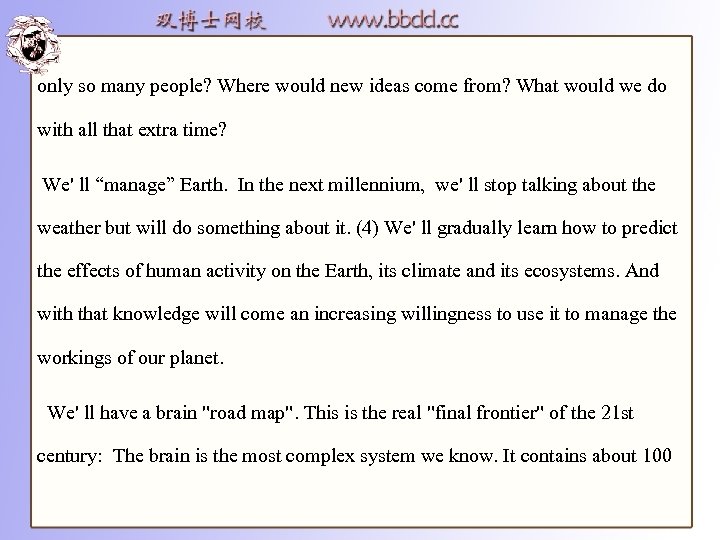 only so many people? Where would new ideas come from? What would we do with all that extra time? We' ll “manage” Earth. In the next millennium, we' ll stop talking about the weather but will do something about it. (4) We' ll gradually learn how to predict the effects of human activity on the Earth, its climate and its ecosystems. And with that knowledge will come an increasing willingness to use it to manage the workings of our planet. We' ll have a brain "road map". This is the real "final frontier" of the 21 st century: The brain is the most complex system we know. It contains about 100
 billion neurons (roughly the number of stars in the Milky Way), each connected to as many as 1, 000 others. Early in the next century, we will use advanced forms of magnetic resonance imaging to produce detailed maps of the neurons in operation. (5) We' ll be able to say with certainty which ones are working when you read a word, when you say a wolf, when you think about a word, and so on.
![[参考译文] 1. 科学家们甚至已经提出种种理论,详尽地描绘宇宙从它形成的最初 一瞬间一直到现在的演变过程。 2. 由于科学家对遗传密码和细胞的分子活动方式更加了解,许多严重 的疾病(比如癌症)对人类的威胁将会变得越来越小。 3. 如果说正常的衰老过程基本上是我们细胞内一场激烈的无形竞赛的 话(一场对我们的脱氧核糖核酸进行破坏和我们体内的细胞修复这种破 坏之间的竞赛),那么21世纪遗传医学的巨大成就,可能使我们控制、 甚至逆转这一过程。](https://present5.com/presentation/2c2ffc092058447ecea76d4812d8288c/image-6.jpg "[参考译文] 1. 科学家们甚至已经提出种种理论,详尽地描绘宇宙从它形成的最初 一瞬间一直到现在的演变过程。 2. 由于科学家对遗传密码和细胞的分子活动方式更加了解,许多严重 的疾病(比如癌症)对人类的威胁将会变得越来越小。 3. 如果说正常的衰老过程基本上是我们细胞内一场激烈的无形竞赛的 话(一场对我们的脱氧核糖核酸进行破坏和我们体内的细胞修复这种破 坏之间的竞赛),那么21世纪遗传医学的巨大成就,可能使我们控制、 甚至逆转这一过程。") [参考译文] 1. 科学家们甚至已经提出种种理论,详尽地描绘宇宙从它形成的最初 一瞬间一直到现在的演变过程。 2. 由于科学家对遗传密码和细胞的分子活动方式更加了解,许多严重 的疾病(比如癌症)对人类的威胁将会变得越来越小。 3. 如果说正常的衰老过程基本上是我们细胞内一场激烈的无形竞赛的 话(一场对我们的脱氧核糖核酸进行破坏和我们体内的细胞修复这种破 坏之间的竞赛),那么21世纪遗传医学的巨大成就,可能使我们控制、 甚至逆转这一过程。
[参考译文] 1. 科学家们甚至已经提出种种理论,详尽地描绘宇宙从它形成的最初 一瞬间一直到现在的演变过程。 2. 由于科学家对遗传密码和细胞的分子活动方式更加了解,许多严重 的疾病(比如癌症)对人类的威胁将会变得越来越小。 3. 如果说正常的衰老过程基本上是我们细胞内一场激烈的无形竞赛的 话(一场对我们的脱氧核糖核酸进行破坏和我们体内的细胞修复这种破 坏之间的竞赛),那么21世纪遗传医学的巨大成就,可能使我们控制、 甚至逆转这一过程。
 4. 我们将逐渐学会预测人类活动给地球、气候以及生态系统带来的影响, 拥有了这些知识,人们将越来越愿意用它来管理我们这个星球的活动。 5. 当你读一个词,说一个词,想一个词以及做其他事情的时候,我们将能 肯定地说出哪些神经元在 作。
 Passage 2 Like most people, you may have heard a lot about online banking but probably haven' t tried it yourself. You still pay your bills by mail and deposit checks at your bank branch, much the way your parents did. Actually, online banking isn' t out to change your money habits. (1) Instead, it uses today' s computer technology to give you the option of by-passing the time-consuming, paper-based aspects of traditional banking in order to manage your finances more quickly and efficiently.
 The advent of the Internet and the popularity of personal computers presented both an opportunity and a challenge for the banking industry. For years, financial institutions have used powerful computer networks to automate millions of daily transactions. (2) Now that their customers are connected to the Internet via personal computers, banks begin to envision similar economic advantages by adapting those same internal electronic processes to home use. Banks view online banking as a powerful "value-added" tool to attract and retain new customer while helping to eliminate costly paper handling and teller interactions in an increasingly competitive banking environment.
 Today, most large national banks, many regional banks and even smaller banks and credit unions offer some form of online banking, variously known as PC banking, home banking, electronic banking or Internet banking. (3) Online banks are sometimes referred to as "brick-to-click" banks, both to distinguish them from "brick-and-mortar" banks that haven't yet offer online banking, as well as from "virtual" banks that have no physical branches or tellers whatsoever.
 The challenge for the banking industry has been to design this new service channel in such a way that its customers will readily learn to use and trust it. Most of the large banks can now offer fully secure, fully functional online banking for free or for a small fee. (4) As more banks succeed online and more customers use their sites, fully functional online banking likely will become as commonplace as automated teller machines. Online banking has a lot of advantages. Unlike your corner bank, online banking sites never close; they' re available 24 hours a day, seven days a week , and they' re only a mouse click away. If you' re out of state or even out of the
 country when a money problem arises, you can log on instantly to your online bank and take care of business. Online bank sites generally execute and confirm transactions at or quicker than ATM processing speeds. (5) Many online banking sites now offer sophisticated tools, including account aggregation, stock quotes, and portfolio managing programs to help you manage all of your assets more effectively.
![[参考译文] 1. 而是利用当今的计算机技术,为你提供一种方式,绕过耗时的、纸 介操作的传统银行服务,从而更快捷有效地管理你的财务。 2. 今天,既然客户可以通过个人电脑连接互联网,各个银行开始设想 将那些相同的内部电子处理过程应用于家庭,以发挥类似的经济优势。 3. 网上银行有时被称作“从砖头到点击”银行,以区别于那些尚未提供 网上银行业务的“砖头与灰浆”银行以及那些连储蓄所或出纳员都没有的“ 虚拟”银行。](https://present5.com/presentation/2c2ffc092058447ecea76d4812d8288c/image-13.jpg "[参考译文] 1. 而是利用当今的计算机技术,为你提供一种方式,绕过耗时的、纸 介操作的传统银行服务,从而更快捷有效地管理你的财务。 2. 今天,既然客户可以通过个人电脑连接互联网,各个银行开始设想 将那些相同的内部电子处理过程应用于家庭,以发挥类似的经济优势。 3. 网上银行有时被称作“从砖头到点击”银行,以区别于那些尚未提供 网上银行业务的“砖头与灰浆”银行以及那些连储蓄所或出纳员都没有的“ 虚拟”银行。") [参考译文] 1. 而是利用当今的计算机技术,为你提供一种方式,绕过耗时的、纸 介操作的传统银行服务,从而更快捷有效地管理你的财务。 2. 今天,既然客户可以通过个人电脑连接互联网,各个银行开始设想 将那些相同的内部电子处理过程应用于家庭,以发挥类似的经济优势。 3. 网上银行有时被称作“从砖头到点击”银行,以区别于那些尚未提供 网上银行业务的“砖头与灰浆”银行以及那些连储蓄所或出纳员都没有的“ 虚拟”银行。
[参考译文] 1. 而是利用当今的计算机技术,为你提供一种方式,绕过耗时的、纸 介操作的传统银行服务,从而更快捷有效地管理你的财务。 2. 今天,既然客户可以通过个人电脑连接互联网,各个银行开始设想 将那些相同的内部电子处理过程应用于家庭,以发挥类似的经济优势。 3. 网上银行有时被称作“从砖头到点击”银行,以区别于那些尚未提供 网上银行业务的“砖头与灰浆”银行以及那些连储蓄所或出纳员都没有的“ 虚拟”银行。
 4. 随着越来越多的银行网上业务的成功,以及越来越多的客户登陆它们 的网站,功能齐全的网上银行业务很可能变得像自动柜员机一样普及。 5. 许多网上银行网站现在还提供先进的 具,包括账目总计、股票报价 以个人证券投资管理项目,以帮助你更有效地理财。