


 Скачать презентацию PASS EMPOWERING STUDENTS WITH THE TOOLS FOR ACADEMIC
f29a019a021141db1aba031fa88d884e.ppt
- Количество слайдов: 57
 PASS EMPOWERING STUDENTS WITH THE TOOLS FOR ACADEMIC SUCCESS VENTURA COLLEGE SCHOOL OF NURSING Claudia Peter RN, Ed. D © 2006
 LEARNING PROBLEMS l WHAT WOULD YOU LIKE YOUR STUDENTS TO DO DIFFERENTLY? ? ?
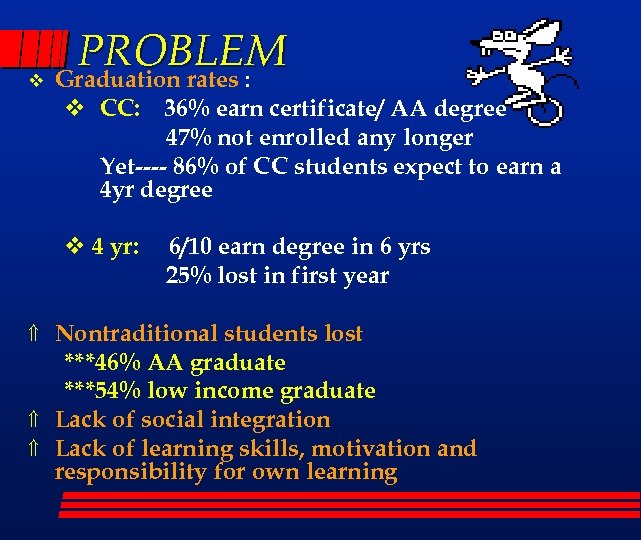 PROBLEM v Graduation rates : v CC: 36% earn certificate/ AA degree 47% not enrolled any longer Yet---- 86% of CC students expect to earn a 4 yr degree v 4 yr: Ý Ý Ý 6/10 earn degree in 6 yrs 25% lost in first year Nontraditional students lost ***46% AA graduate ***54% low income graduate Lack of social integration Lack of learning skills, motivation and responsibility for own learning
 PASS PROGRAM FOR ACADEMIC STUDENT SUCCESS
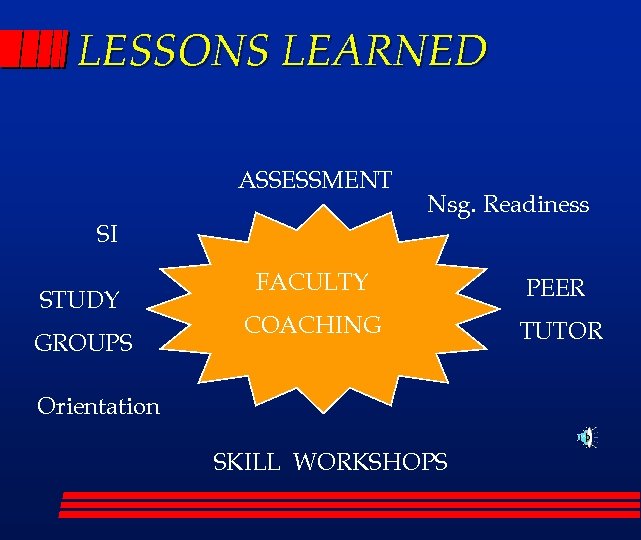 LESSONS LEARNED ASSESSMENT Nsg. Readiness SI STUDY GROUPS FACULTY PEER COACHING TUTOR Orientation SKILL WORKSHOPS
 PASS PROGRAM GOALS ID& recruit at-risk students to PASS Ø Implement student counseling, tutoring and support program Ø Track at risk student success Ø Develop faculty coaches & orient faculty to PASS Ø
 PASS TEAM Faculty coaches l Tutors l – Peer – Lab Manager l Retention and Progression Committee – Nursing Faculty – PASS Coordinator – Counselors – EAC Learning Specialist & Liason
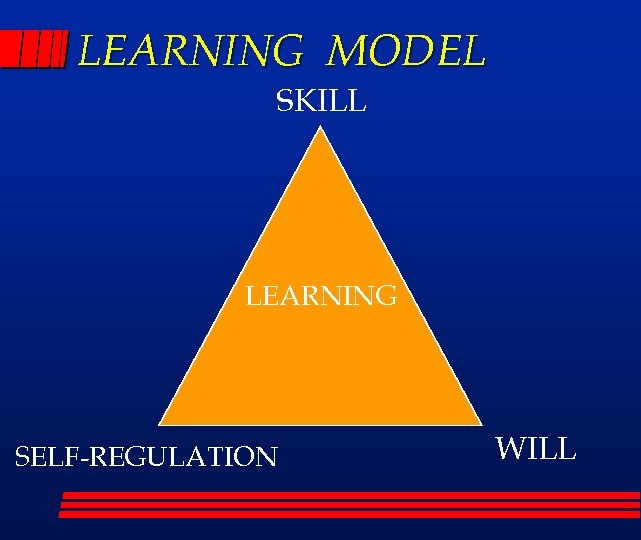 LEARNING MODEL SKILL LEARNING SELF-REGULATION WILL
 Program For Academic Student Success PASS WHAT IS IT?
 AT RISK IDENTIFICATION Nurse Entrance Test Ø LASSI Ø Learning and Study Strategies Inventory FUTURE – GPA / Science GPA – Repetition of Science Prerequisites
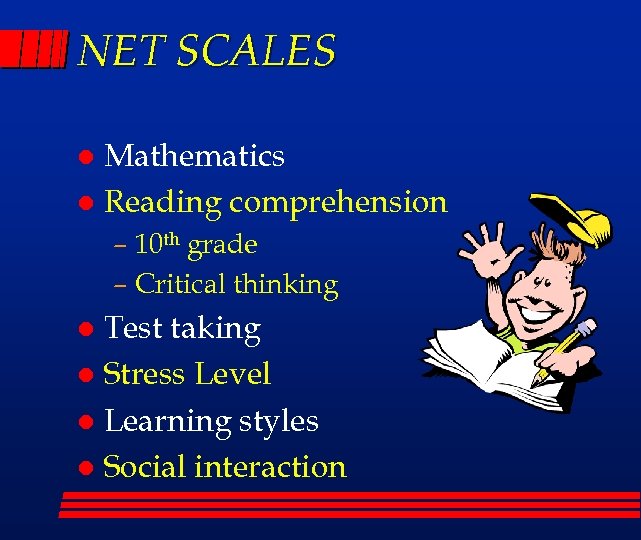 NET SCALES Mathematics l Reading comprehension l – 10 th grade – Critical thinking Test taking l Stress Level l Learning styles l Social interaction l
 NET RESULTS l Review results and recommendations (Math – workshops, PT, Math 30) l At risk identification – FC l Individual review – Learning plans – Referrals
 LASSI SCALES l l l l l Test taking Anxiety Select main idea Information processing Study aids Concentration Attitude Motivation Self testing Time management
 LASSI RESULTS l Group review with recommendations (Self testing – PT, study grp, EAC workshops, Note-making and test taking workshops; review tests) At risk identification l Individual review l – Learning plan – Referrals
 FACULTY COACHING l ID At-risk students l Monthly meetings l Goal-setting worksheet l Referrals
 GOAL SETTING WORKSHEET Concerns l Planning l – My specific learning goals for this month are: – I will know I have accomplished my goals by: – Actions or steps I will take to accomplish these goals
 GOAL SETTING WORKSHEET l Problem-Solving – Possible blocks that may interfere with my goals: – If I need help I can go to: – My confidence in reaching my goal: – 0 – none 13 25 very confident
 GOAL SETTING WORKSHEET l Evaluation – My satisfaction in reaching my goal: – 0 13 25 – unsatisfied very satisfied – _________________ – Reasons for attaining or not attaining my goal:
 Counseling and EAC q. Counseling q. Early at risk ID q. Checklist for pre-nursing referrals q. Educational Assistance q. Learning Disability q. Skill Workshops
 Nursing Readiness q At risk ID q Learning Styles q Skills q. Study strategies q. Note-making q. Test-taking q. Stress Reduction q. Dosage Calculation q. Medical terminology
 Nursing Readiness q Nursing Process q Nursing Culture q Resources – Campus and PASS q Nursing Program q. Conceptual framework q. Structure q. Expectations q. Skill Lab
 Orientation Expectations – old students Ø Resources and referrals Ø Answer Questions Ø Reduce Anxiety Ø Student handbook Ø Study Skills and Time management Workshops Ø Sense of community Ø Library Tour Ø
 SUCCESS WORKSHOPS Study Skills Ø Time Management Ø Test Taking Ø Note-making Ø Reading texts for main ideas Ø Dosage Calculation Ø Concept mapping Ø Stress Reduction Ø
 NOTE-MAKING l l Rephrase l l Active listening l l Learn to be safe and competent Attend class l Read texts Store in LTM Review, review Recite aloud Link new to old and organize
 Note Making l Chronological order l Shorthand l Diagrams and pictures l Tape lectures
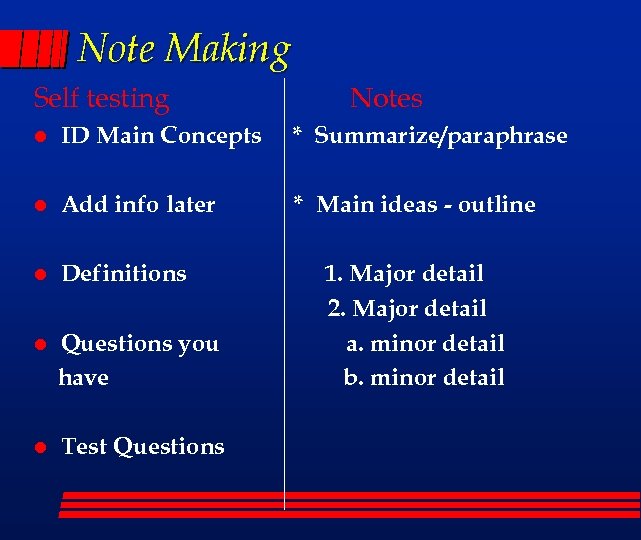 Note Making Self testing Notes l ID Main Concepts * Summarize/paraphrase l Add info later * Main ideas - outline l Definitions l Questions you have l Test Questions 1. Major detail 2. Major detail a. minor detail b. minor detail
 Note – making exercise l Discuss process – ID main ideas from text – Use objectives to select main ideas l Teams take notes on 2 – 3 pages l You show them your notes l Discuss why you selected info
 Note Making Review notes within 6 hours l Compare notes with study buddy l Highlight main ideas l – Select single word for each section – Fill in left hand column Cover and recite (self-testing) l Relate to own life l Review all notes weekly l
 Support from others l Study Group Guidelines l Lab Manager l Communication – E-groups l Peer Tutoring – Selection – Recognition
 Support – Lab manager Teach dosage calculation l Tutor math l Tutor nursing care planning l Remediation of skills in lab l Remediation in clinical l Testing skills in lab l Testing skills in clinical l Referrals l
 E-groups – Yahoogroups. com l l l Communication- professional only Support Files – Care plan forms – assignments l Web links – Hear lung and heart sounds – Compare and contrast medicare/medical l Assignments for the semester
 PEER TUTOR l Volunteer for minimum of 1 hour per week l Meet every week not just before tests l No phone tutoring
 PEER TUTORS - confidential • Answer questions courteously l Explain difficult concepts l Think aloud when you answer questions or explain concepts – models problemsolving l Quiz tutee on important course content. Anticipate student errors and difficult areas.
 PEER TUTOR l Ask tutee to diagram concepts/processes l Review the tutee's answers to objectives. – Ask them to explain their answers. – Provide cue cards to prompt the tutee. – Give the tutee feedback. Tell them how well they are learning.
 Peer tutor l Go from Simple to complex content l Present info in small steps – do not overwhelm l Provide examples of expert work for the tutee to model ( nursing care plans or research papers )
 Peer tutor l Explain part of the concept and let the tutee complete the explanation. – Use flowcharts, pictures, drawings, flashcards, and charts to organize and explain information. – Build on previously learned information. For example, review A& P before of respiratory system before patho for asthma
 STUDY GROUPS - Goals Identify main ideas l Understand difficult concepts l Develop study skills l Improve motivation l Support group l
 Study groups Members participate weekly l 5 members or less l Membership constant l Meet same day / time / place l Leader tracks attendance l 2 hours l
 Study groups - process l 20 min – review main ideas in lecture and assigned readings 40 min – ask questions and clarify l 10 min – break l 30 min – self test with quiz games l 30 min – summarize answers to objectives and/or review NCLEXRN questions l
 Study groups - process Stay on task l Come with questions for clarification l Model learning strategies l – Diagram difficult concepts on board – Make outlines, concept maps, compare and contrast charts Bring 6 quiz questions l Encourage all to participate l
 Supplemental Instruction— Critical thinking q NS 10 High Risk Course q. Test Taking Skills q. Clarify Difficult Concepts q. Study Group q. Support/ games q. How to find info in books q. How to concept map/ NCP q NS 20 High Risk Course q. Case Studies
 Supplemental instruction l Course – Cr/No Cr (2 credits) – Midterm registration 1 credit l Not instructor – Student co leader – » Voice of experience l Meet several days after lecture – Need time to review notes – Read materials
 ACADEMIC SUCCESS q Higher retention rates q Self-reports of changes in learning behaviors and beliefs
 SUCCESS
 Learning Changes l Nursing Readiness – Avg grade in NS 10 = 83% – ***Improved math skills – “Read” – Tips for test taking – Better note taker – Aware of what to expect – Resources
 Learning Changes l Orientation – How to be successful – What is expected – Resources – There is always help available
 Learning Changes Ø Note-Making Skills – Added information to notes from text – Compared notes with peers for main ideas – Use objectives and key concepts
 Learning Changes Note making – Mapped concepts & drew diagrams – Outlined texts & notes – Paraphrased main ideas in own word – Made up own test questions
 Learning Changes Ø Seek Support of Others – Exam Reviews with Faculty – Learned about resources
 PEER TUTORS q Understanding not memorization q Identified and clarified concepts q Generated questions & self-tested q Reviewed notes for main ideas q Came prepared
 STUDY GROUPS Quizzed each other q Reduced stress by sharing work q Felt accountable /came prepared q Felt capable q Answered objectives and study guides q Made diagrams and concept maps q Modeled study skills – note-making q Explained difficult concepts to each other q
 Learning Changes Ø Self - Esteem – Boosted my self-esteem and gave me confidence – Felt good about myself – Found I wasn’t the only one seeking help
 SUPLEMENTAL INSTRUCTION l Helped understand concepts l Became more organized l No procrastination l Read assignments before class l Reviewed my notes every night
 FACULTY COACH Learning Changes – Identified strengths & weaknesses – Developed plans & monitored progress – Identified what “to do differently” --SELF REGULATION--
 FACULTY COACHINGLearning Changes » SELF REGULATION – Recognized I wasn’t working hard – Came to lecture – Made sure I understood criteria & expectations before I started assignments
 FACULTY COACHING Learning Changes Ø Will - Motivation – Encouraged me to work harder – Set and prioritized goals and then said “I did it!”
 FACULTY COACHINGLearning Changes Ø Motivation - Will – Encouragement – Got a lot of support – knew I could do it