


 Скачать презентацию Parts Management Reengineering TLCSM Executive Council Update 05
f15b78e71d5f01700730f32addd1694e.ppt
- Количество слайдов: 21
 Parts Management Reengineering TLCSM Executive Council Update 05 Oct 06 Gregory Saunders, Director Defense Standardization Program Office
 Tasking of the Reengineering Effort ØParts Management Declined After Acquisition Reform (1995 – 2002) ØADUSD (LPP) & Director DSPO Decided Parts Management Should be Reengineered (2003) ØParts Management Reengineering Working Group Chaired by DSPO (PMRWG) Chartered (2003)
 TLCSM EC Briefings Ø October 14, 2004: – Initial brief (preliminary) – Challenges, findings, conclusions ØJanuary 6, 2005: – Status brief – Preliminary Recommendations – Preliminary Approval ØApril 6, 2006: – Final brief – Kickoff implementation phase ØOctober 5, 2006: – Interim brief – Progress update
 What Is Parts Management? Ø Selecting parts during weapon system design Ø Analyzing parts for reliability, availability, and quality – Mitigating DMSMS is critical Ø Screening for common usage Ø Reducing the number of unique parts Ø Qualifying products
 PMRWG Conclusions Ø Parts Management needs to be a requirement Ø Parts Management needs a total system approach Ø Parts Management decision-makers need better tools Ø Parts Management can be fully accomplished within a performance-based environment
 Major PMRWG Recommendations Ø Restore parts management as an engineering discipline Ø Make parts management a contractual requirement Ø Create a Parts Management Knowledge Sharing Portal Ø Improve DOD organization for parts management Ø Build key partnerships and relationships Ø Develop parts management tools and metrics Ø Develop new marketing products Ø Understand parts management’s contribution to logistics footprint
 What We Requested From You Ø Green light to proceed into implementation Ø Support during implementation phase – Systems Engineering – Acquisition policy – Defense Acquisition University – Industry participation/buy-in Ø Advocacy for Do. D Policy Changes
 Implementation Progress Ø DSPO Chartered Parts Management Reengineering Implementation Process Team (PMRIPT) – Kick-off meeting in May 06 – 3 -day meetings held in July and August 06 – Meetings scheduled for Oct 06, Nov 06 and Jan 07 Ø Organized PMRIPT into project teams to guide implementation of the top three recommendations: – Systems Engineering Team – Policy and Contracts Team – Tools Development Team Ø Enlisted Parts Standardization & Management Committee (PSMC) to support reengineering effort
 Implementation Team Participants Ø Military Departments and DLA Ø OSD Systems Engineering Ø DMSMS Working Group Ø GIDEP Ø PSMC Ø Industry Ø Trade Associations (i. e. , AIAA)
 Implementation Approach Ø Systems Engineering Team – Working with Systems Engineering community on how best to restore parts management into current systems engineering policy and processes – Coordinating with DAU on incorporating parts management language into appropriate courses (i. e. , acquisition, logistics, systems engineering, DMSMS) Ø Policy and Contracts Team – Drafting policy documentation (i. e. , Do. D 5000. 2, Defense Acquisition Guidebook), and developing a proposed MIL-STD-XXX, Parts Management – Drafting contract templates and data item descriptions for parts management contractual requirements Ø Tools Development Team – Interviewing key users to determine tools requirements – Coordinating with DMSMS community to maximize and build upon existing DMSMS capabilities to develop a single point of entry to parts management data and information.
 Closing Any Questions?

 What Is Parts Management? Ø A multi-disciplined process designed to improve system supportability : – – – – Reduce Life Cycle Cost Improve reliability Improve readiness (logistics/operational) Improve interoperability Control growth of Logistics Footprint Mitigate DMSMS issues Promote standardization across platforms Ø Collaboration between primes, subs, and the Government
 History of Parts Management 1977: MIL-STD-965, Parts Control Program 1983: SECDEF Weinberger Spare Parts Acq memo 1984: DEPSECDEF Taft Do. D Parts Control memo 1994: SECDEF Perry Acquisition Reform memo 1996: MIL-HDBK-965, Parts Management Program 2000: MIL-HDBK-512, Parts Management 2004: Re-Engineer Processes
 Reengineering Ø All Services, DLA, OSD, Industry, Trade Assoc. Ø Fact Finding Ø Study Industry Best Practices Ø Evaluate – Analyze – Explore Alternatives Ø Examine Parallel Efforts (PBL, SE, CSI) Ø Develop Findings, Conclusions, Recommendations
 Warfighter Support Parts Management: Ø Ensures optimum part is used in a design – quality, reliability, availability, logistical, and cost Ø Provides Warfighter a more reliable, available, and maintainable weapon system Ø Ensures the logistics community has a better understanding of the part and its application Ø Provides metrics that relate parts management decisions to increases in readiness and ROI
 Parts Management is First and Foremost an Engineering Discipline Ø Part selection is an engineering responsibility Ø Selecting the right parts drives downstream outcomes Ø Today, engineering parts management practice is inadequate Ø OEM parts management often unfunded, therefore, not done Ø Our recommendations address these issues
 What We Mean by Making Parts Management A “Requirement” Ø Not a return to past “prescriptive” practices Ø Proposal to add some needed discipline – Action: Parts Management during design phase – Result: A more supportable system during sustainment Ø Require a Parts Management Plan that addresses: – DMSMS – Parts Selection Ø Address Parts Management in program reviews – Key element of a well-executed program Ø Do. D provide mechanism / shared data warehouse
 The Critical Need — Current, Accurate Parts Data Ø Existing parts data is inadequate, inaccurate, incomplete, inconsistent Ø Parts data is spread across hundreds of sources Ø Do. D is now reengineering many of its parts-related information systems Ø Now is the time to act Ø We must integrate parts management requirements with current initiatives Ø The first element is the DMSMS KSP
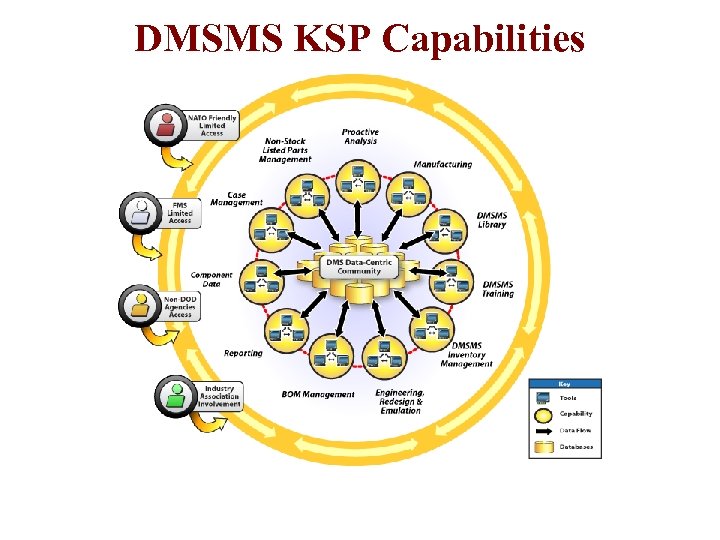 DMSMS KSP Capabilities
 Logistics Footprint The size of the presence of logistics support required to deploy, sustain, and move a weapon system, including: Ø Inventory/equipment/parts Ø Personnel Ø Facilities Ø Transportation Ø Real Estate