 Скачать презентацию Partnerships Collaborations Networks Levering relationships to
54caab27e4c0a565e6a183a719e8a639.ppt
- Количество слайдов: 57



Partnerships, Collaborations & Networks — Levering relationships to improve performance William Eimicke Columbia University 2011
1 Agenda • Why should an organization partner with other organizations? • What leads to successful partnerships? • What are some examples of highly successful partnerships in NYC ? • What other options are available to get work done more efficiently and effectively? William Eimicke Copyright 2011 Columbia University
2 Why should organizations partner with other organizations? • What would you identify as a successful partnership? • Why was it successful? William Eimicke Copyright 2011 Columbia University
3 Why partner with another organization? • • Make more money Solve problems Do more with less Access new skills & new suppliers Globalize quickly Access new customers Provide new services William Eimicke Copyright 2011 Columbia University
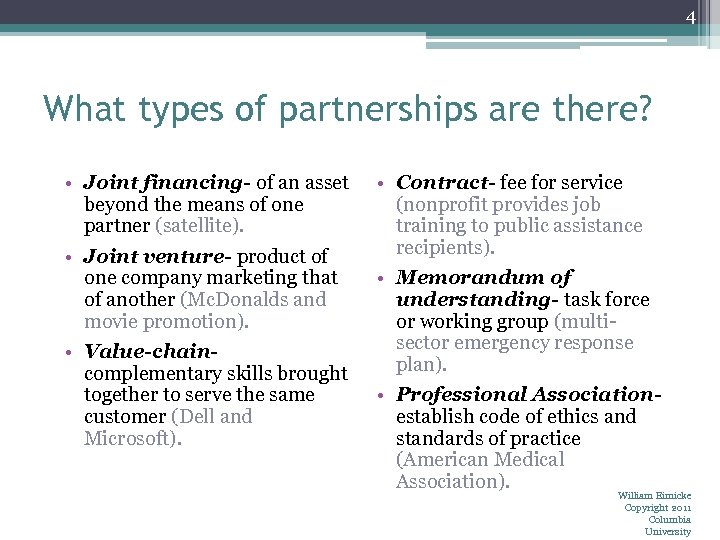
4 What types of partnerships are there? • Joint financing- of an asset beyond the means of one partner (satellite). • Joint venture- product of one company marketing that of another (Mc. Donalds and movie promotion). • Value-chaincomplementary skills brought together to serve the same customer (Dell and Microsoft). • Contract- fee for service (nonprofit provides job training to public assistance recipients). • Memorandum of understanding- task force or working group (multisector emergency response plan). • Professional Associationestablish code of ethics and standards of practice (American Medical Association). William Eimicke Copyright 2011 Columbia University
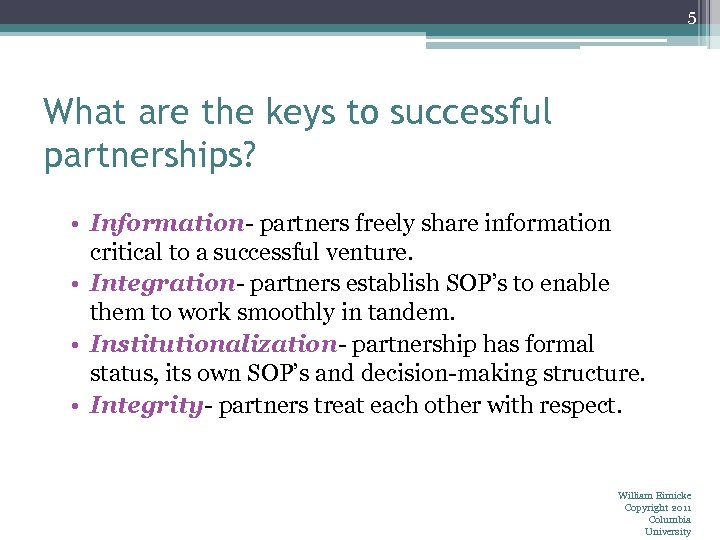
5 What are the keys to successful partnerships? • Information- partners freely share information critical to a successful venture. • Integration- partners establish SOP’s to enable them to work smoothly in tandem. • Institutionalization- partnership has formal status, its own SOP’s and decision-making structure. • Integrity- partners treat each other with respect. William Eimicke Copyright 2011 Columbia University
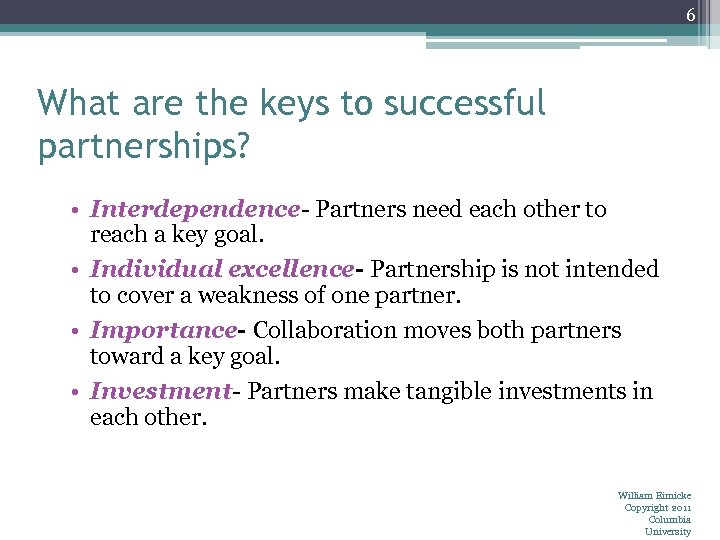
6 What are the keys to successful partnerships? • Interdependence- Partners need each other to reach a key goal. • Individual excellence- Partnership is not intended to cover a weakness of one partner. • Importance- Collaboration moves both partners toward a key goal. • Investment- Partners make tangible investments in each other. William Eimicke Copyright 2011 Columbia University
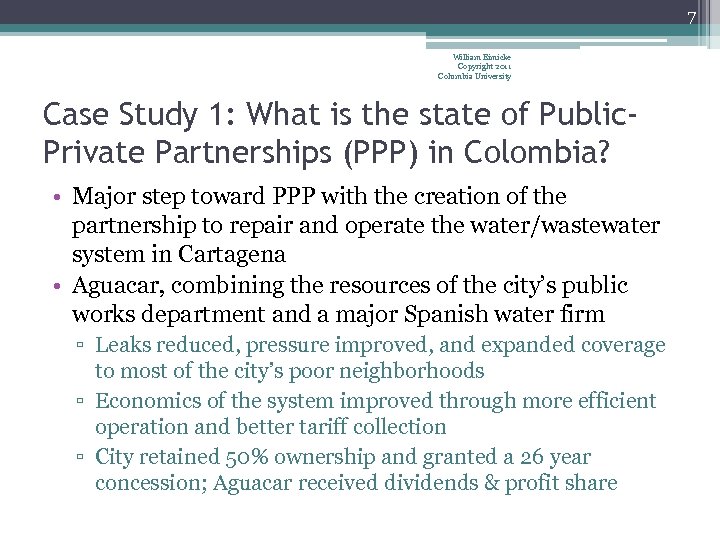
7 William Eimicke Copyright 2011 Columbia University Case Study 1: What is the state of Public. Private Partnerships (PPP) in Colombia? • Major step toward PPP with the creation of the partnership to repair and operate the water/wastewater system in Cartagena • Aguacar, combining the resources of the city’s public works department and a major Spanish water firm ▫ Leaks reduced, pressure improved, and expanded coverage to most of the city’s poor neighborhoods ▫ Economics of the system improved through more efficient operation and better tariff collection ▫ City retained 50% ownership and granted a 26 year concession; Aguacar received dividends & profit share
8 William Eimicke Copyright 2011 Columbia University What is the state of Public-Private Partnerships (PPP) in Colombia? • Between 1996 and 2007 more than 40 water and sewer contracts were initiated across Colombia serving more than 7. 3 • Trans. Milenio opened in 2000 ▫ serves more than 1 million passengers a day through a network of dedicated express bus lines connected to multiple feeder traditional bus services; public company owner, multiple private contractors for service provision • State-owned Ecopetrol develops oil and gas reserves with BP and other private companies
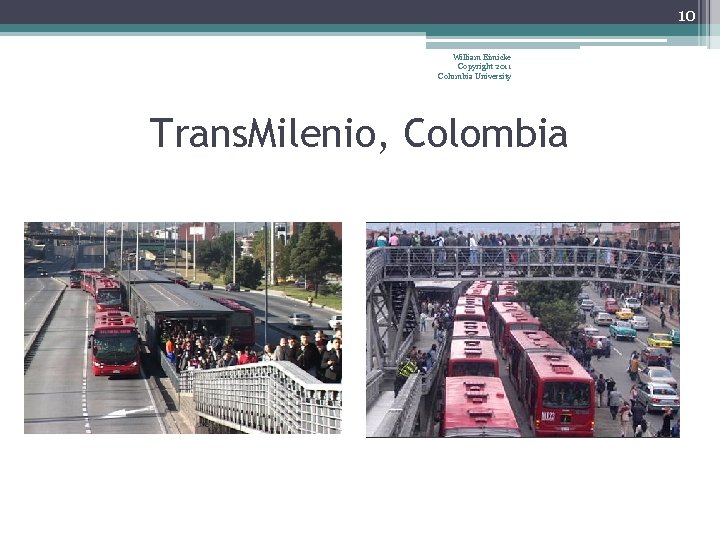
10 William Eimicke Copyright 2011 Columbia University Trans. Milenio, Colombia
9 William Eimicke Copyright 2011 Columbia University What is the state of Public-Private Partnerships (PPP)in Colombia? • PPPs and privatization occurred in power generation and telecom • Solid waste collection has been contracted out for many years • Rural Productive Partnership Project ▫ Sponsored by the World Bank ▫ Has helped small farmers upgrade and meet larger market standards • Major innovations in education delivery through Confama and other private partners
10 William Eimicke Copyright 2011 Columbia University Case Study 2: What is the history of Public. Private Partnerships (PPP) in Brazil? • PPP Law of 2004 has not yet been transformative but… • History of innovation—Bolivia-Brazil Gas Pipeline • Sao Paulo Line 4 of the Subway • MG-050 state highway project improvement • Bahia state sewage pipeline project • Tax incentives and low interest loans for investment in innovation
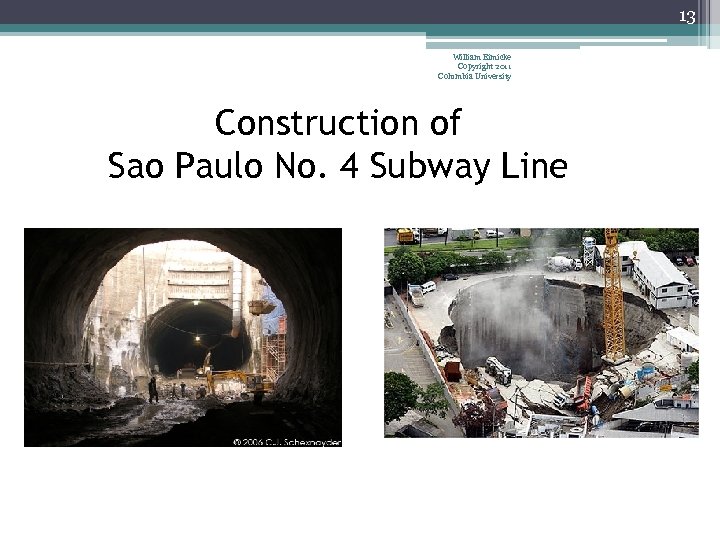
13 William Eimicke Copyright 2011 Columbia University Construction of Sao Paulo No. 4 Subway Line
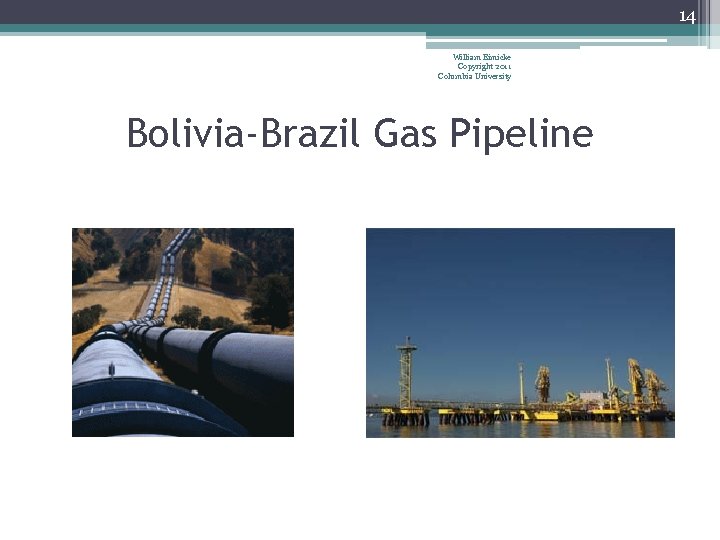
14 William Eimicke Copyright 2011 Columbia University Bolivia-Brazil Gas Pipeline
11 William Eimicke Copyright 2011 Columbia University What is the history of Public-Private Partnerships (PPP) in Brazil? • According to the Economist Infrascope study of 2009, Brazil ranks third to Chile and Peru in readiness and capacity to carry out PPP infrastructure projects. • Also, Brazil ranked ▫ 1 st on institutional framework ▫ 2 nd on investment climate ▫ 2 nd on operational maturity ▫ 3 rd on financial facilities ▫ 5 th on legal and regulatory framework • Rather complex legal and administrative structure
12 William Eimicke Copyright 2011 Columbia University What is the history of Public-Private Partnerships (PPP)in Brazil? • Innovation in deep water oil exploration technology and production and use of renewable fuels • Progress has been slowed by certain weaknesses in state power, and inefficient and complex public bureaucracies • Laws and policies biased against export industries, government dominated labor policies, poor infrastructure, high cost of capital and inadequate education & health care
13 William Eimicke Copyright 2011 Columbia University What is the history of Public-Private Partnerships (PPP)in Brazil? • Innovation in deep water oil exploration technology and production and use of renewable fuels • Progress has been slowed by certain weaknesses in state power, and inefficient and complex public bureaucracies • Laws and policies biased against export industries, government dominated labor policies, poor infrastructure, high cost of capital and inadequate education & health care
14 William Eimicke Copyright 2011 Columbia University What is the history of Public-Private Partnerships (PPP) in Brazil • Innovation policy is fragmented among government levels with extensive decentralization to the states (good & bad) • Drive toward university-business partnerships • More focus needed on innovation as an organizing principle for PPPs • Need for a coherent national innovation policy • Need for monitoring and evaluation of investments in innovation partnerships
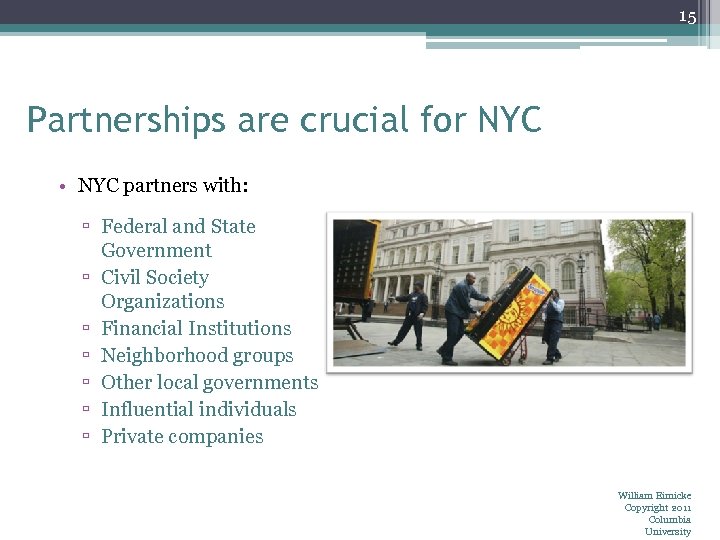
15 Partnerships are crucial for NYC • NYC partners with: ▫ Federal and State ▫ ▫ ▫ Government Civil Society Organizations Financial Institutions Neighborhood groups Other local governments Influential individuals Private companies William Eimicke Copyright 2011 Columbia University
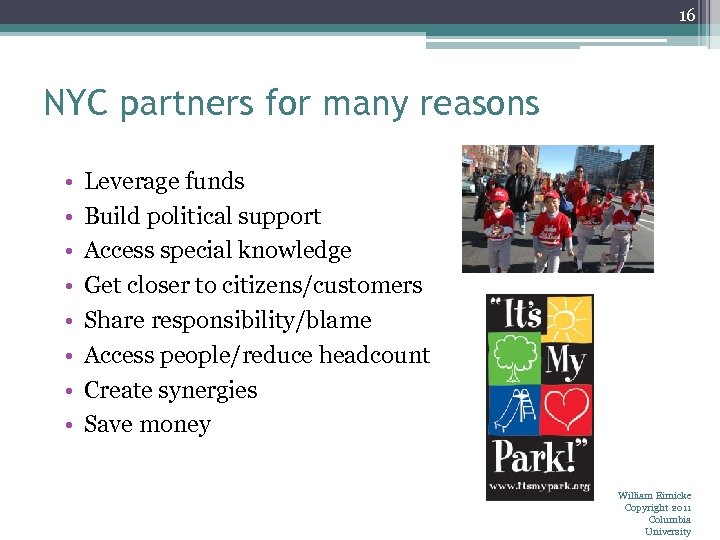
16 NYC partners for many reasons • • Leverage funds Build political support Access special knowledge Get closer to citizens/customers Share responsibility/blame Access people/reduce headcount Create synergies Save money William Eimicke Copyright 2011 Columbia University
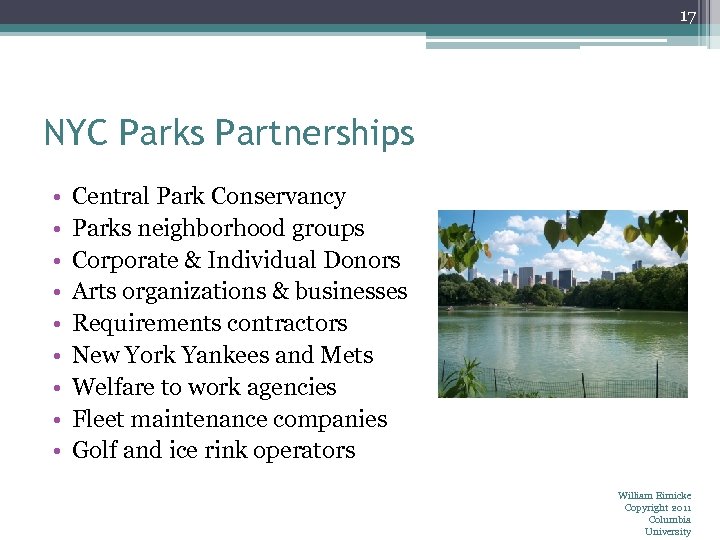
17 NYC Parks Partnerships • • • Central Park Conservancy Parks neighborhood groups Corporate & Individual Donors Arts organizations & businesses Requirements contractors New York Yankees and Mets Welfare to work agencies Fleet maintenance companies Golf and ice rink operators William Eimicke Copyright 2011 Columbia University
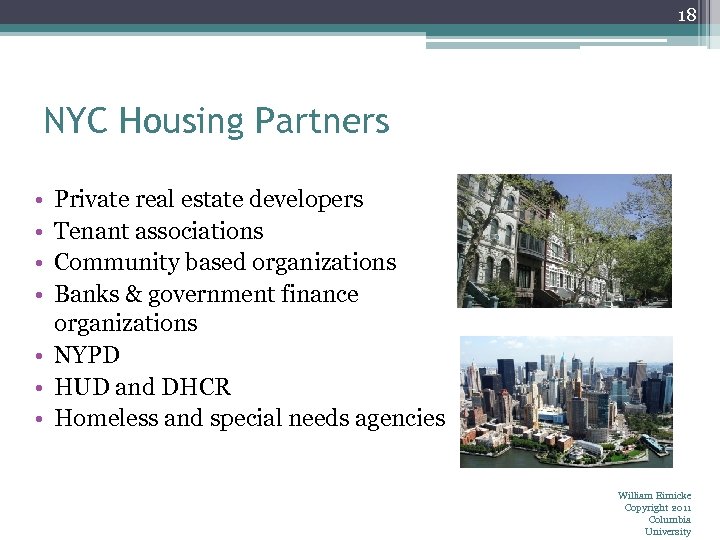
18 NYC Housing Partners • • Private real estate developers Tenant associations Community based organizations Banks & government finance organizations • NYPD • HUD and DHCR • Homeless and special needs agencies William Eimicke Copyright 2011 Columbia University
19 NYC Health Partners • • Doctors Private hospitals Insurance companies Drug companies State and federal government FDNY and private ambulances Vendors and suppliers Advocacy and community organizations William Eimicke Copyright 2011 Columbia University
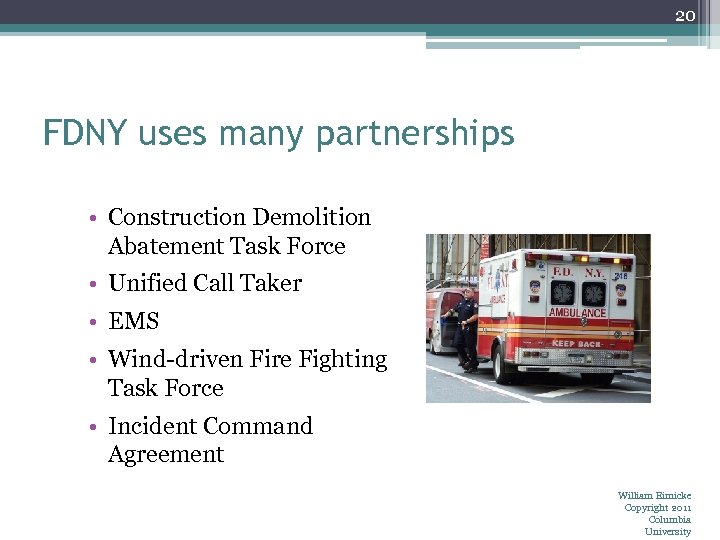
20 FDNY uses many partnerships • Construction Demolition Abatement Task Force • Unified Call Taker • EMS • Wind-driven Fire Fighting Task Force • Incident Command Agreement William Eimicke Copyright 2011 Columbia University
21 SIPA depends on partnerships • We host recruitment fairs in conjunction with partner schools • We work with other Columbia schools to provide a wider choice of faculty and courses • We globalized by partnering with NUS, LSE, Sciences Po, Peking University, Externado, and other schools at various levels, including joint degree programs, executive education, research, student and faculty exchanges • We are partnering with the NYS Attorney General to help NYS local governments with consolidation plans William Eimicke Copyright 2011 Columbia University
22 Partnerships and collaborations may be better than privatization • Economy and efficiency may not be the most important objective for many public services, such as education, justice, safety and health care. • Privatization policy affects the economy— employment, distribution of income, supply of goods and services—macro-economic negatives may outweigh the benefits of the individual transaction. William Eimicke Copyright 2011 Columbia University
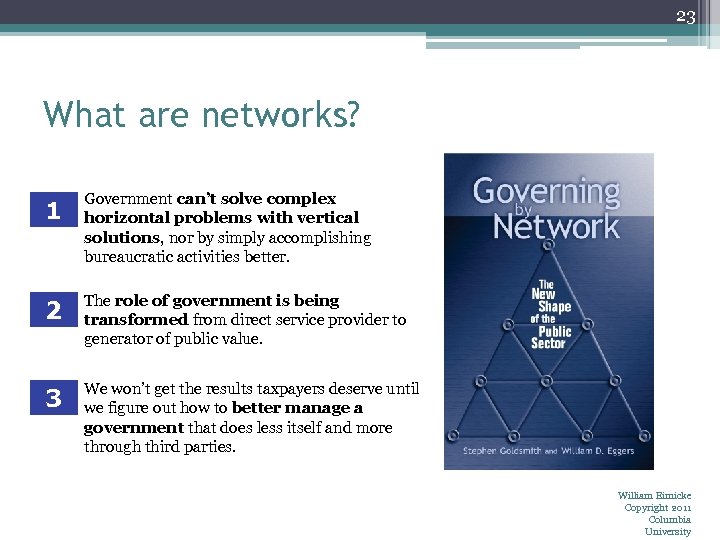
23 What are networks? 1 Government can’t solve complex horizontal problems with vertical solutions, nor by simply accomplishing bureaucratic activities better. 2 The role of government is being transformed from direct service provider to generator of public value. 3 We won’t get the results taxpayers deserve until we figure out how to better manage a government that does less itself and more through third parties. William Eimicke Copyright 2011 Columbia University
24 How are networks different than partnerships? • Network partnerships: ▫ Are more intense, involving complete integration of SOPs, billing, customer relations and communications ▫ May be invisible to the customer (and the best ones often are) ▫ Take a long time to build and as long to disengage • In Network partnerships, work flows must be carefully William Eimicke synchronized Copyright 2011 Columbia University
25 What makes a network successful? • Wal-Mart and Proctor & Gamble built a computer network ▫ Enables P&G to monitor the inventory at Wal-Mart’s distribution centers monitor sales at checkout counters ship the proper amount of product “just in time” ▫ Facilitates automatic invoicing and payment maximization of customer service, efficiency and profit William Eimicke Copyright 2011 Columbia University
26 What makes the P&G and Wal-Mart network so successful? • Measures of success ▫ are common ▫ easy to define and track • Problems are usually obvious and easy to fix • Overall outcomes are shared ▫ only fair share of the costs and benefits require negotiation William Eimicke Copyright 2011 Columbia University
27 Why are public and non-profit networks more difficult? • Services are more difficult to coordinate among multiple suppliers than products • Success is more difficult to measure and outcomes may take decades to emerge • Partners often have different objectives and measures of success—education, job training, welfare, environmental protection or even public safety—making money is not a common metric William Eimicke Copyright 2011 Columbia University
28 Partnerships may be better than networks • Establishing a less integrated relationship is much easier • Accountability is much easier to allocate • A greater number of members is possible • The degree of involvement can be less • Shorter timeframes are possible, making disengagement less disruptive • There are more successful models to copy William Eimicke Copyright 2011 Columbia University
29 What have we learned? • Partnerships can leverage the resources and impact of any organization. • Partnerships are complicated and the work is ongoing. • Many NYC agencies could not function without partnerships. William Eimicke Copyright 2011 Columbia University
30 Readings • D. Osborne and T. Gaebler, Reinventing Government, Reading, Ma: Addison-Wesley, 1991. • S. Goldsmith, The Power of Social Innovation, San Francisco: Jossey-Bass, 2010. • S. Goldsmith and W. Eggers, Governing by Networks, Washington, DC: Brookings Institution, 2004. • S. Cohen and W. Eimicke, Tools for Innovators, San Francisco: Jossey-Bass, 1995. • S. Cohen and W. Eimicke, The Effective Public Manager, SF: Jossey-Bass, 2008. • R. Behn, Democratic Accountability. Washington, DC: Brookings Institution, 2001. • P. Drucker, Management Challenges for the 21 st Century. NY: Harper Business, 1999. • E. S. Savas, Privatization: The Key to Better Government. N. J. : Chatham House, 1987. • Eliot Sclar, You Don’t Always Get What You Pay For. Ithaca, NY: Cornell University Press, 2000. • J. Kamensky and T. Burlin, Collaboration: Using Networks and Partnerships. NY: Rowman and Littlefield, 2004. • M. Christopher, Logistics and Supply Chain Management. NY: FT Prentice-Hall, 2005. • D. Kettl, Sharing Power: Public Governance and Private Markets. Washington, DC: Brookings Institution, 1993. • J. Welch. Winning, NY: Harper Business, 2005. William Eimicke Copyright 2011 Columbia University
Contracting: “The Make or Buy Decision” William Eimicke Columbia University 2011
36 Agenda • What is contracting & contract management? • When should you contract? • How do you find the right contractor? • What are the keys to effective contracting? • Why did contracting work in Indianapolis and not in Atlanta? • How do you contract and stay ethical? William Eimicke Copyright 2011 Columbia University
37 What is contracting? • Agreement between two or more parties, usually written & enforced by law. • Legal instrument defining price, schedule, definition of good/service & amount. • For government, contract is typically with nongovernmental entity and is often ideologically characterized as “outsourcing”, implying cost-cutting, downsizing and non-union. • Long history for weapons, supplies and construction; recent explosion in human services delivery. William Eimicke Copyright 2011 Columbia University
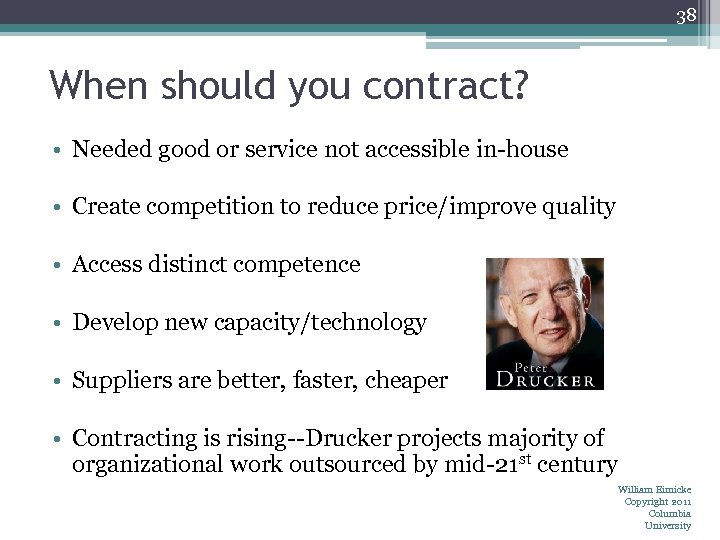
38 When should you contract? • Needed good or service not accessible in-house • Create competition to reduce price/improve quality • Access distinct competence • Develop new capacity/technology • Suppliers are better, faster, cheaper • Contracting is rising--Drucker projects majority of organizational work outsourced by mid-21 st century William Eimicke Copyright 2011 Columbia University
39 What are the politics of contracting? • Anti-government philosophy • Illusion of smaller government with lower public personnel headcount/cost • Weaken unions, cut pension and benefit costs • Avoid civil service and long term commitments • Build bridges to key constituencies • Avoid direct responsibility for difficult services William Eimicke Copyright 2011 Columbia University
40 Why shouldn’t you contract? • The process is long and complicated • You don’t have the right people to manage contracts • It’s difficult to measure and monitor performance • Limited number of potential suppliers • Security concerns are high • Very difficult to reverse the outsource • Limited best practices to model William Eimicke Copyright 2011 Columbia University
41 How do you find the right contractor? • Advertise in print, mail and on the web • Outreach—NYCDSBS POP; US SBA web education • RFI, RFQ • Create lists of potential bidders with email/mail bid notifications • Create selection preferences for small business and minority/women owned businesses William Eimicke Copyright 2011 Columbia University
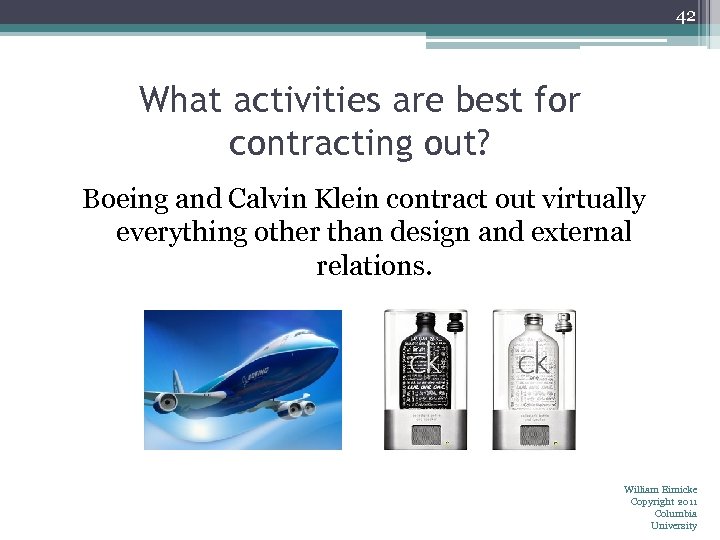
42 What activities are best for contracting out? Boeing and Calvin Klein contract out virtually everything other than design and external relations. William Eimicke Copyright 2011 Columbia University
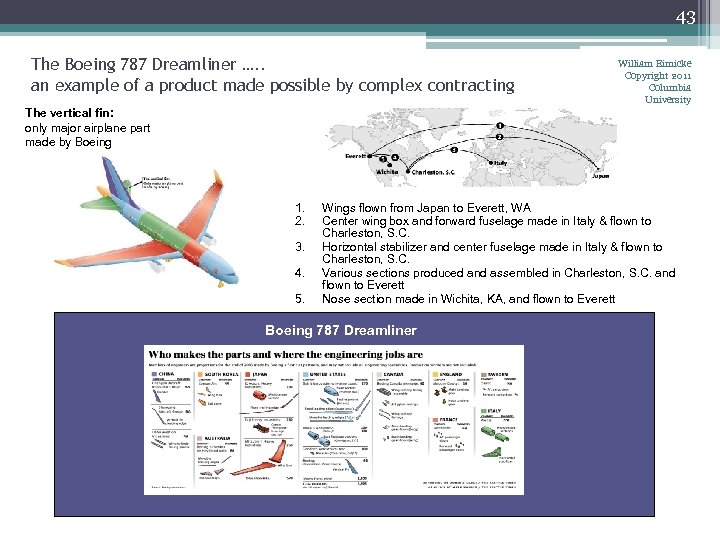
43 The Boeing 787 Dreamliner …. . an example of a product made possible by complex contracting William Eimicke Copyright 2011 Columbia University The vertical fin: only major airplane part made by Boeing 1. 2. 3. 4. 5. Wings flown from Japan to Everett, WA Center wing box and forward fuselage made in Italy & flown to Charleston, S. C. Horizontal stabilizer and center fuselage made in Italy & flown to Charleston, S. C. Various sections produced and assembled in Charleston, S. C. and flown to Everett Nose section made in Wichita, KA, and flown to Everett Boeing 787 Dreamliner
44 What are the best targets for contracting? • Paper and pencils easier than specialized services. • Yellow pages test can help address the competitiveness issue. • Specification must address quality and reliability William Eimicke Copyright 2011 Columbia University
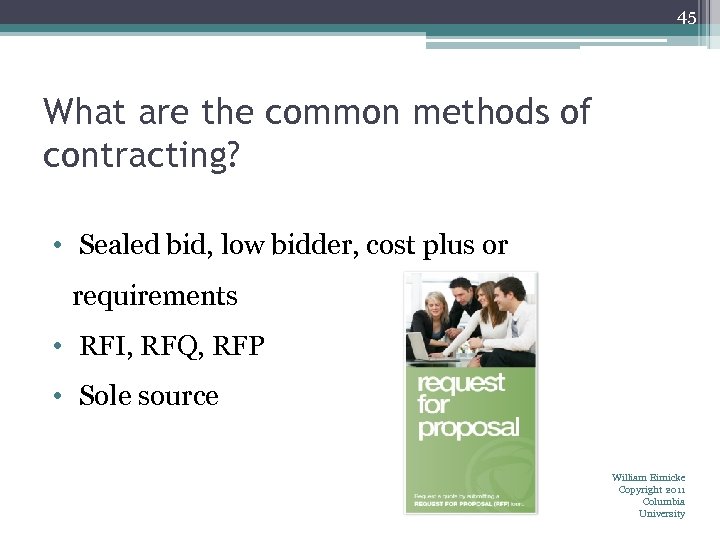
45 What are the common methods of contracting? • Sealed bid, low bidder, cost plus or requirements • RFI, RFQ, RFP • Sole source William Eimicke Copyright 2011 Columbia University
46 What are the keys to effective contracting? • Build capacity-develop staff, process and evaluation mechanisms to manage contracting • Oversight-monitor contractors in the field and in the files including operations and finance • Accountability-through benchmarking, competition and performance management William Eimicke Copyright 2011 Columbia University
47 What are the common challenges in contracting ? • Flawed RFP and/or contract document • Slow, complex, high cost process • Few bidders/collusion among contractors • Poor communication between agency & contractor • Poor agency/contractor staff relations • Poor direction to contractors William Eimicke Copyright 2011 Columbia University
48 What are the common challenges in contracting ? • Contractor gives agency work low priority • Contractor under-staffed or poorly equipped • Under/Over-estimate contract budget • Over/under budget contract profit • Inappropriate performance data/poor communication of performance William Eimicke Copyright 2011 Columbia University
49 What are the common challenges in contracting ? • Conflict of interest/ethical issues • Union issues • Media/political spotlight on contract • Weak decision-making on data • Politics influenced decisions • Poor audit procedures William Eimicke Copyright 2011 Columbia University
50 The contract document is crucial • Costly to develop & administer • Balance flexibility with control • Provide accountability & allow discretion • Specify performance standards with consequences • Mix of incentives and penalties William Eimicke Copyright 2011 Columbia University
51 No contract can cover every issue • No contract can cover all contingencies • Renewal option can be valuable • Transparency is crucial—parties are not equal in ability and access to information William Eimicke Copyright 2011 Columbia University
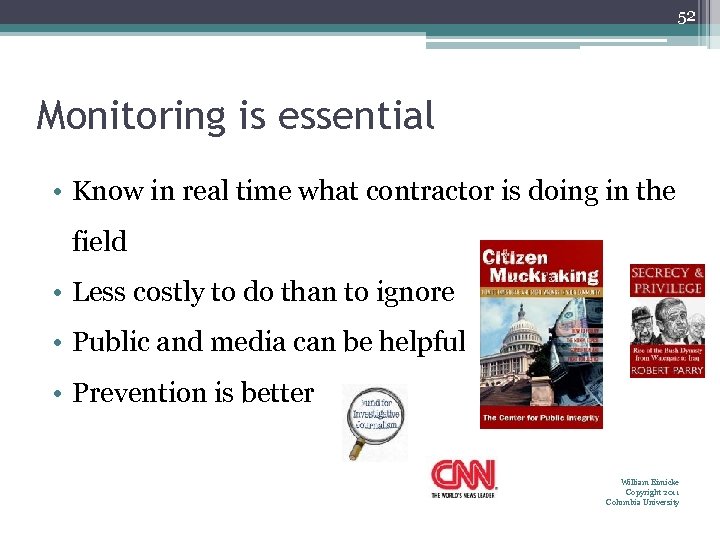
52 Monitoring is essential • Know in real time what contractor is doing in the field • Less costly to do than to ignore • Public and media can be helpful • Prevention is better William Eimicke Copyright 2011 Columbia University
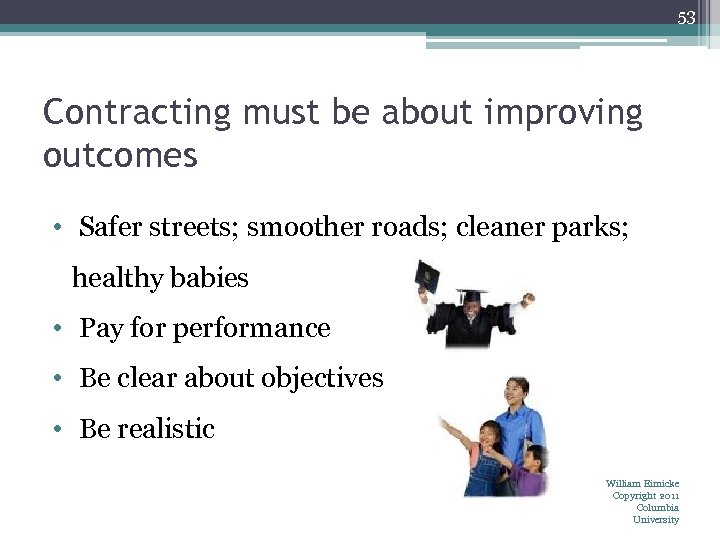
53 Contracting must be about improving outcomes • Safer streets; smoother roads; cleaner parks; healthy babies • Pay for performance • Be clear about objectives • Be realistic William Eimicke Copyright 2011 Columbia University
54 What can we learn from Atlanta and Indianapolis water contracts? • Similar circumstances • The same contractor • Radically different outcomes • One took back the system, the other is still working with the same contractor William Eimicke Copyright 2011 Columbia University
55 What can we learn from Atlanta and Indianapolis? • About capacity? • About staffing? • About tradeoffs? • About stakeholder involvement? • About contract documents? • About risk and uncertainty? • About transparency and ethics? William Eimicke Copyright 2011 Columbia University
56 Conclusion • Cheaper, better, faster? It depends • Becoming a smart buyer is crucial • Corruption is a danger • Competitive market is essential • Measuring performance is important • Management reform is an option William Eimicke Copyright 2011 Columbia University
57 Readings • • • S. Cohen and W. Eimicke, The Responsible Contract Manager, San Francisco: Jossey -Bass, 2008. D. Osborne and T. Gaebler, Reinventing Government, Reading, Ma: Addison. Wesley, 1991. S. Goldsmith and W. Eggers, Governing by Networks, Washington, DC: Brookings Institution, 2004. S. Cohen and W. Eimicke, Tools for Innovators, San Francisco: Jossey-Bass, 1995. R. Behn, Democratic Accountability. Washington, DC: Brookings Institution, 2001. P. Drucker, Management Challenges for the 21 st Century. NY: Harper Business, 1999. E. S. Savas, Privatization: The Key to Better Government. N. J. : Chatham House, 1987. Eliot Sclar, You Don’t Always Get What You Pay For. Ithaca, NY: Cornell University Press, 2000. J. Kamensky and T. Burlin, Collaboration: Using Networks and Partnerships. NY: Rowman and Littlefield, 2004. M. Christopher, Logistics and Supply Chain Management. NY: FT Prentice-Hall, 2005. D. Kettl, Sharing Power: Public Governance and Private Markets. Washington, DC: Brookings Institution, 1993. William Eimicke Copyright 2011 Columbia University
Скачать презентацию Partnerships Collaborations Networks Levering relationships to
54caab27e4c0a565e6a183a719e8a639.ppt