


 Скачать презентацию Particle energies in a laser fusion environment David Neely
1fa7cdd5fee77084e2c797e48007ca26.ppt
- Количество слайдов: 30
 Particle energies in a laser/fusion environment David Neely 1, 2, J Collier 1, M Dunne 1, P Mc. Kenna 2 and J. M Perlado 3 1 Central Laser Facility, STFC, Oxfordshire, UK 2 University 3 Instituto of Strathclyde, Glasgow, Scotland de Fusión Nuclear (DENIM)/ETSII/ Universidad Politécnica Madrid, International Conference on Frontiers in Diagnostic Technologies (CFDT 1) Frascati, Italy 25 -27 th November 2009 Rutherford Appleton Laboratory, Chilton, Didcot, Oxon, OX 11 0 QX, UK. Telephone: (44)1235 446150 Fax: (44)1235 445888 e-mail: david. neely@stfc. ac. uk
 Introduction Fast Ignition and Hi. PER Electron transport Ion Fast Ignition ? Ultra-high Intensity“relativistic”
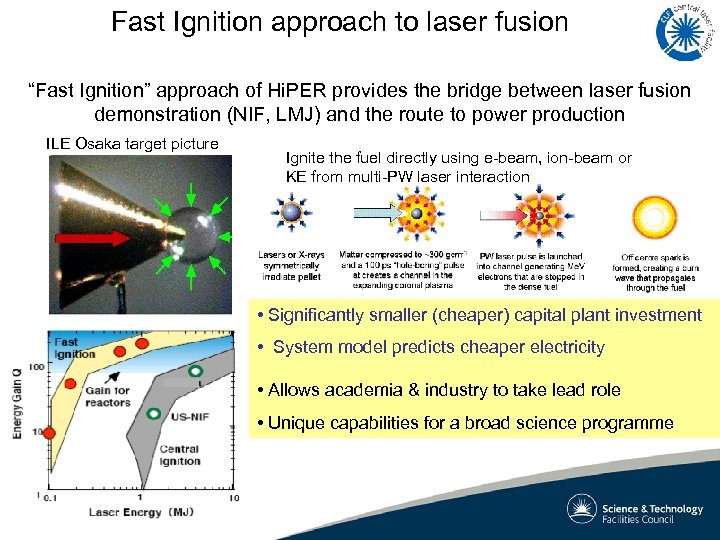 Fast Ignition approach to laser fusion “Fast Ignition” approach of Hi. PER provides the bridge between laser fusion demonstration (NIF, LMJ) and the route to power production ILE Osaka target picture Ignite the fuel directly using e-beam, ion-beam or KE from multi-PW laser interaction • Significantly smaller (cheaper) capital plant investment • System model predicts cheaper electricity • Allows academia & industry to take lead role • Unique capabilities for a broad science programme
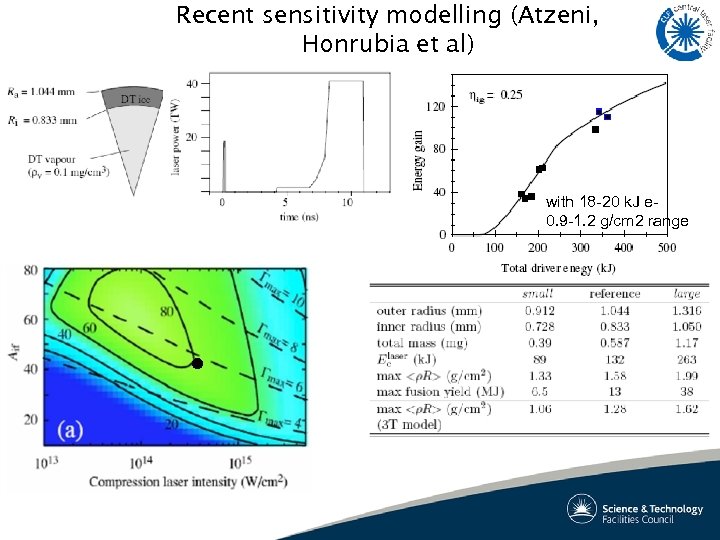 Recent sensitivity modelling (Atzeni, Honrubia et al) with 18 -20 k. J e 0. 9 -1. 2 g/cm 2 range
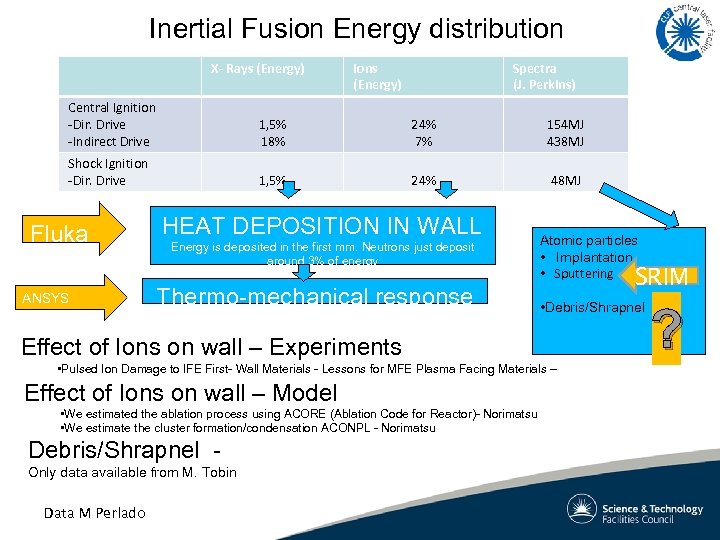 Inertial Fusion Energy distribution X- Rays (Energy) Ions (Energy) Spectra (J. Perkins) Central Ignition -Dir. Drive -Indirect Drive 1, 5% 18% 24% 7% 154 MJ 438 MJ Shock Ignition -Dir. Drive 1, 5% 24% 48 MJ Fluka ANSYS HEAT DEPOSITION IN WALL Energy is deposited in the first mm. Neutrons just deposit around 3% of energy Thermo-mechanical response Atomic particles • Implantation • Sputtering SRIM • Debris/Shrapnel Effect of Ions on wall – Experiments • Pulsed Ion Damage to IFE First- Wall Materials - Lessons for MFE Plasma Facing Materials – Effect of Ions on wall – Model • We estimated the ablation process using ACORE (Ablation Code for Reactor)- Norimatsu • We estimate the cluster formation/condensation ACONPL - Norimatsu Debris/Shrapnel Only data available from M. Tobin Data M Perlado ?
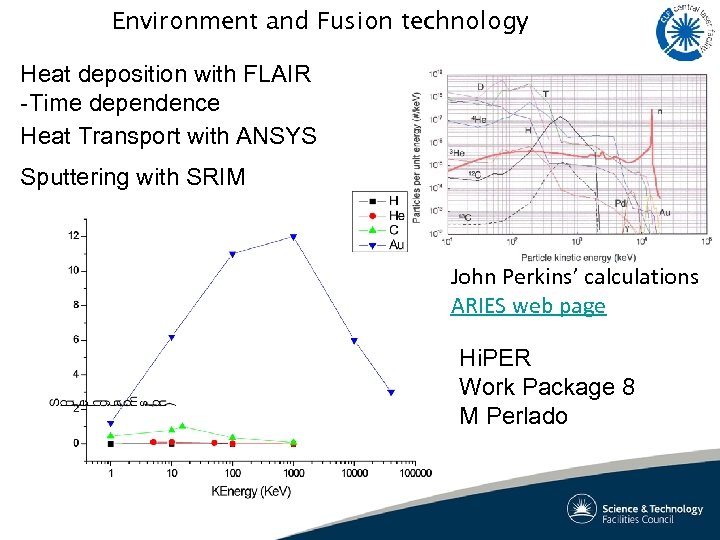 Environment and Fusion technology Heat deposition with FLAIR -Time dependence Heat Transport with ANSYS Sputtering with SRIM John Perkins’ calculations ARIES web page Hi. PER Work Package 8 M Perlado
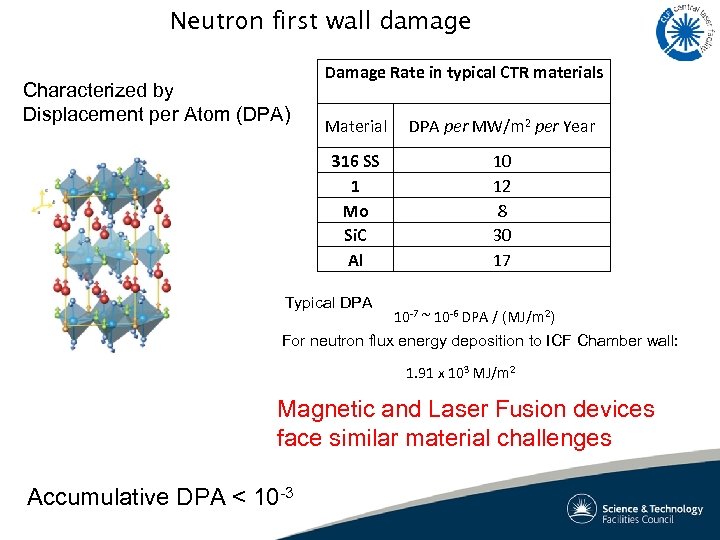 Neutron first wall damage Characterized by Displacement per Atom (DPA) Damage Rate in typical CTR materials Material DPA per MW/m 2 per Year 316 SS 1 Mo Si. C Al 10 12 8 30 17 Typical DPA 10 -7 ~ 10 -6 DPA / (MJ/m 2) For neutron flux energy deposition to ICF Chamber wall: 1. 91 x 103 MJ/m 2 Magnetic and Laser Fusion devices face similar material challenges Accumulative DPA < 10 -3
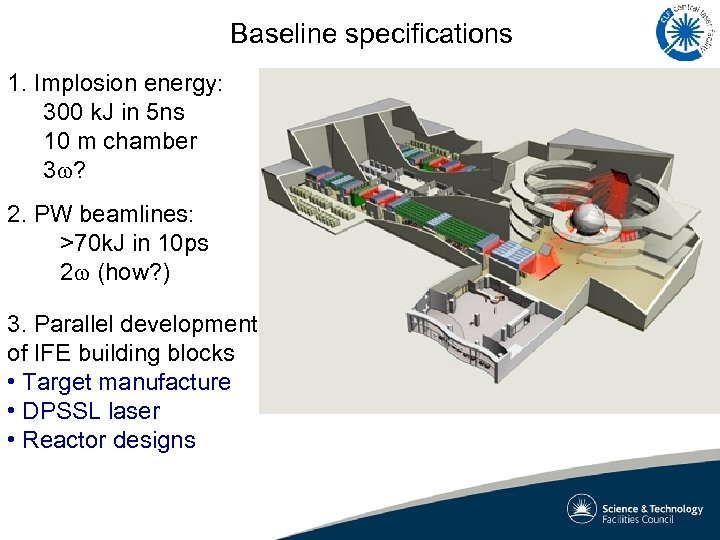 Baseline specifications 1. Implosion energy: 300 k. J in 5 ns 10 m chamber 3 w? 2. PW beamlines: >70 k. J in 10 ps 2 w (how? ) 3. Parallel development of IFE building blocks • Target manufacture • DPSSL laser • Reactor designs
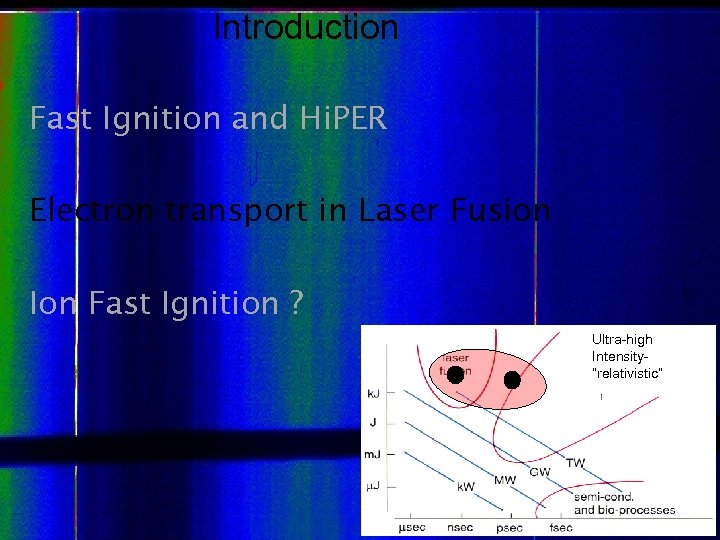 Introduction Fast Ignition and Hi. PER Electron transport in Laser Fusion Ion Fast Ignition ? Ultra-high Intensity“relativistic”
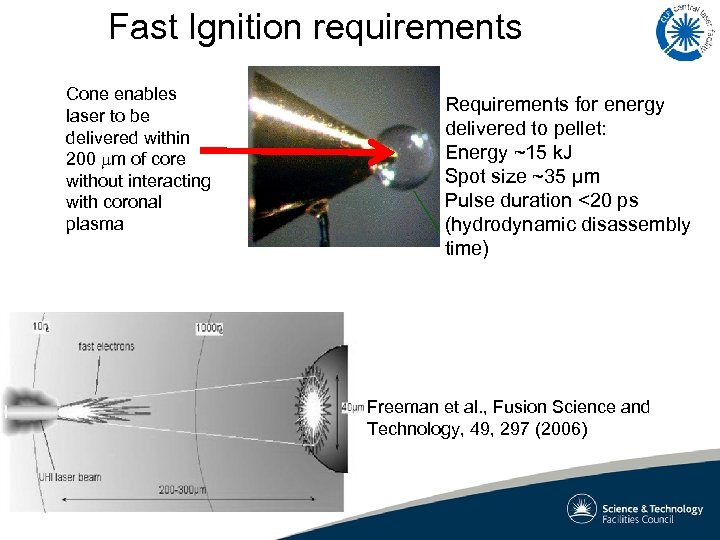 Fast Ignition requirements Cone enables laser to be delivered within 200 mm of core without interacting with coronal plasma Requirements for energy delivered to pellet: Energy ~15 k. J Spot size ~35 μm Pulse duration <20 ps (hydrodynamic disassembly time) Freeman et al. , Fusion Science and Technology, 49, 297 (2006)
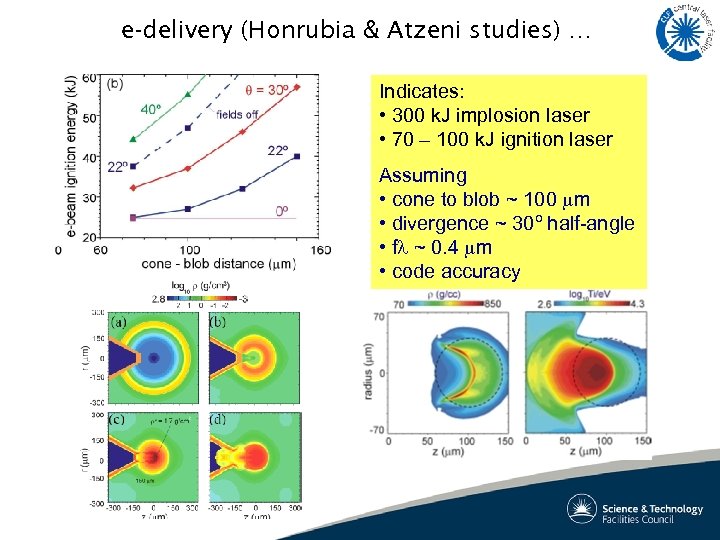 e-delivery (Honrubia & Atzeni studies) … Indicates: • 300 k. J implosion laser • 70 – 100 k. J ignition laser Assuming • cone to blob ~ 100 mm • divergence ~ 30º half-angle • fl ~ 0. 4 mm • code accuracy
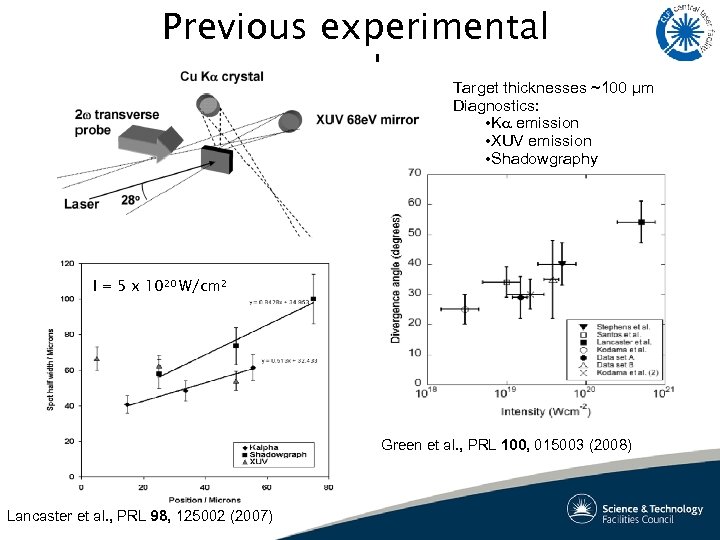 Previous experimental work: Target thicknesses ~100 µm Diagnostics: • K emission • XUV emission • Shadowgraphy I = 5 x 10²⁰ W/cm 2 Green et al. , PRL 100, 015003 (2008) Lancaster et al. , PRL 98, 125002 (2007)
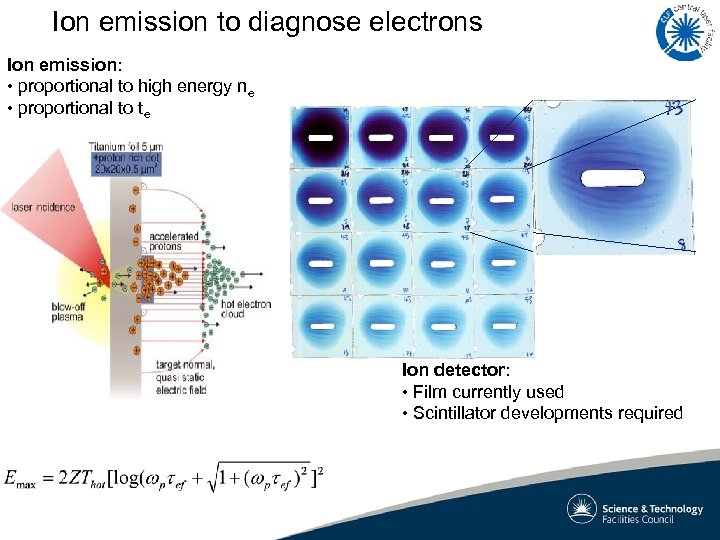 Ion emission to diagnose electrons Ion emission: • proportional to high energy ne • proportional to te Ion detector: • Film currently used • Scintillator developments required
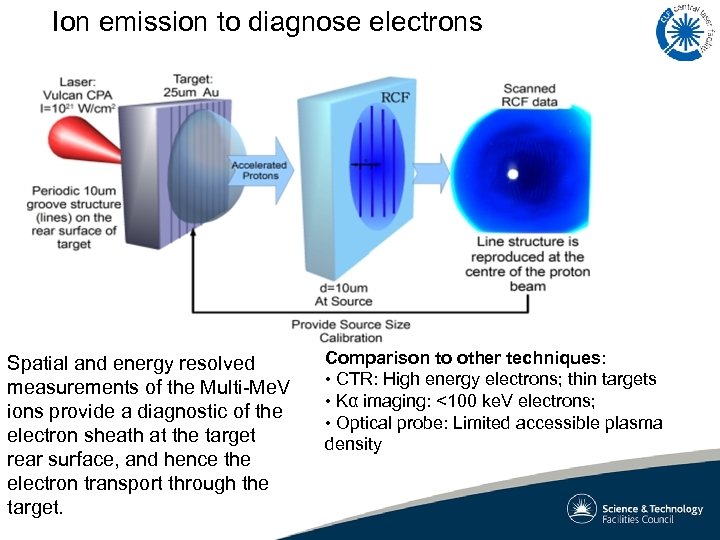 Ion emission to diagnose electrons Spatial and energy resolved measurements of the Multi-Me. V ions provide a diagnostic of the electron sheath at the target rear surface, and hence the electron transport through the target. Comparison to other techniques: • CTR: High energy electrons; thin targets • Kα imaging: <100 ke. V electrons; • Optical probe: Limited accessible plasma density
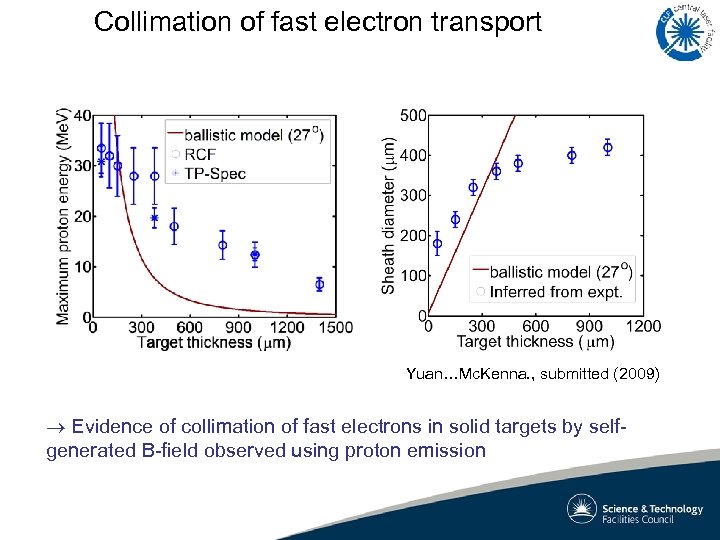 Collimation of fast electron transport Yuan…Mc. Kenna. , submitted (2009) Evidence of collimation of fast electrons in solid targets by selfgenerated B-field observed using proton emission
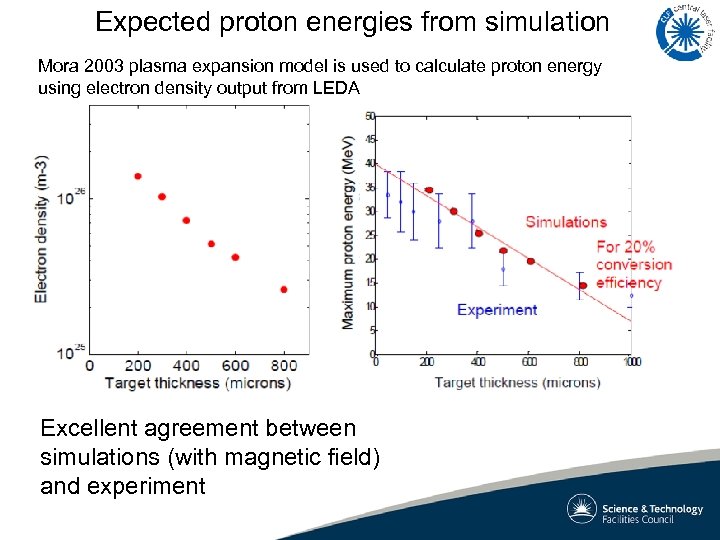 Expected proton energies from simulation Mora 2003 plasma expansion model is used to calculate proton energy using electron density output from LEDA Excellent agreement between simulations (with magnetic field) and experiment
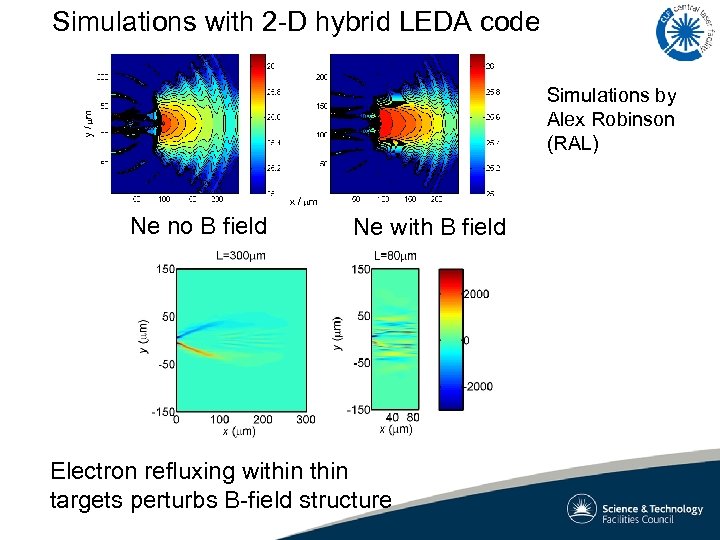 Simulations with 2 -D hybrid LEDA code Simulations by Alex Robinson (RAL) Ne no B field Ne with B field Electron refluxing within targets perturbs B-field structure
 Introduction Fast Ignition and Hi. PER Electron transport Ion Fast Ignition ? Ultra-high Intensity“relativistic”
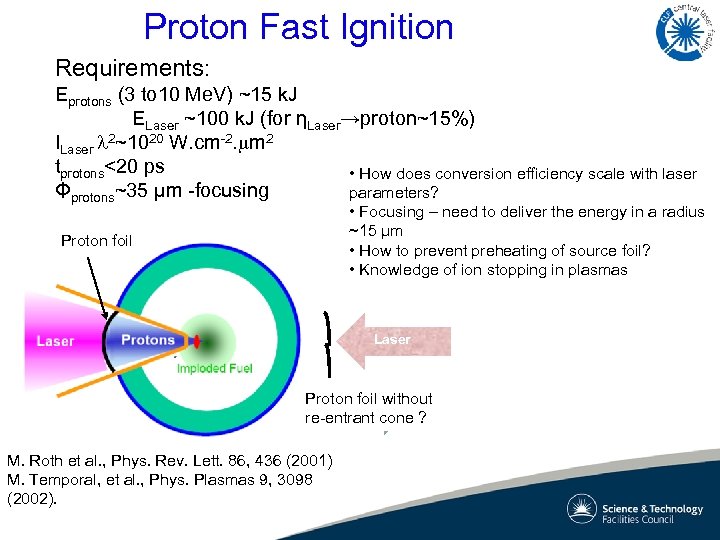 Proton Fast Ignition Requirements: Eprotons (3 to 10 Me. V) ~15 k. J ELaser ~100 k. J (for ηLaser→proton~15%) ILaser l 2~1020 W. cm-2. mm 2 tprotons<20 ps • How does conversion efficiency scale with laser Φprotons~35 μm -focusing parameters? • Focusing – need to deliver the energy in a radius ~15 μm • How to prevent preheating of source foil? • Knowledge of ion stopping in plasmas Proton foil Laser Proton foil without re-entrant cone ? M. Roth et al. , Phys. Rev. Lett. 86, 436 (2001) M. Temporal, et al. , Phys. Plasmas 9, 3098 (2002).
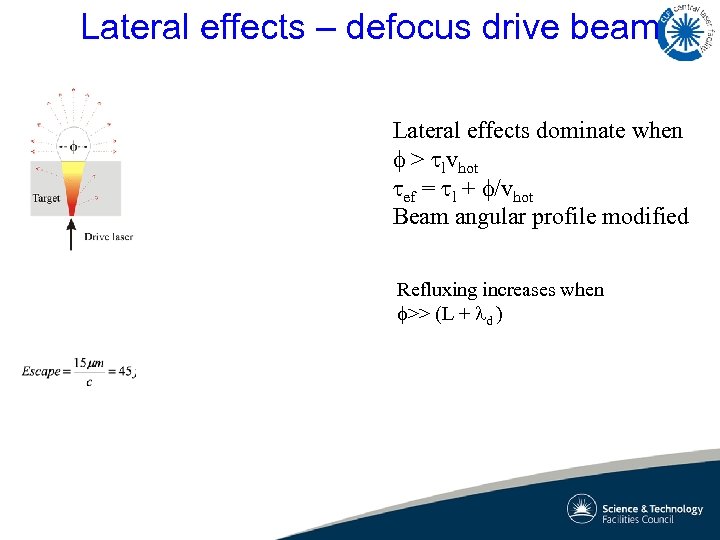 Lateral effects – defocus drive beam Lateral effects dominate when f > tlvhot tef = tl + f/vhot Beam angular profile modified Refluxing increases when f>> (L + ld )
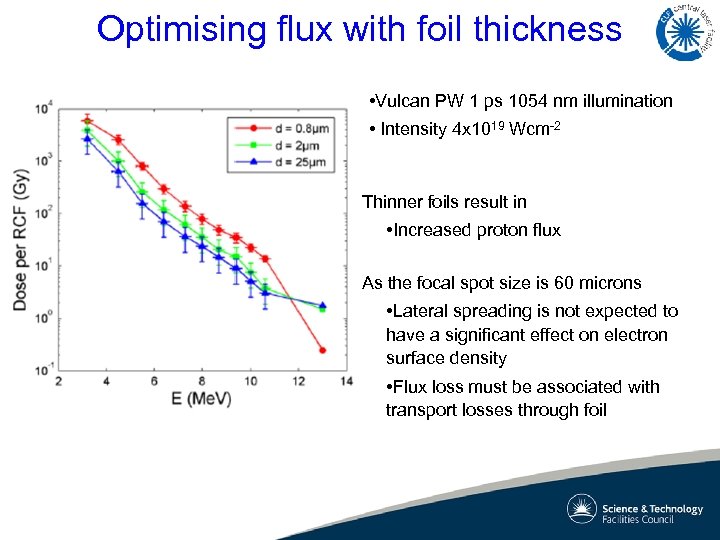 Optimising flux with foil thickness • Vulcan PW 1 ps 1054 nm illumination • Intensity 4 x 10¹⁹ Wcm-2 • Thinner foils result in • Increased proton flux • As the focal spot size is 60 microns • Lateral spreading is not expected to have a significant effect on electron surface density • Flux loss must be associated with transport losses through foil
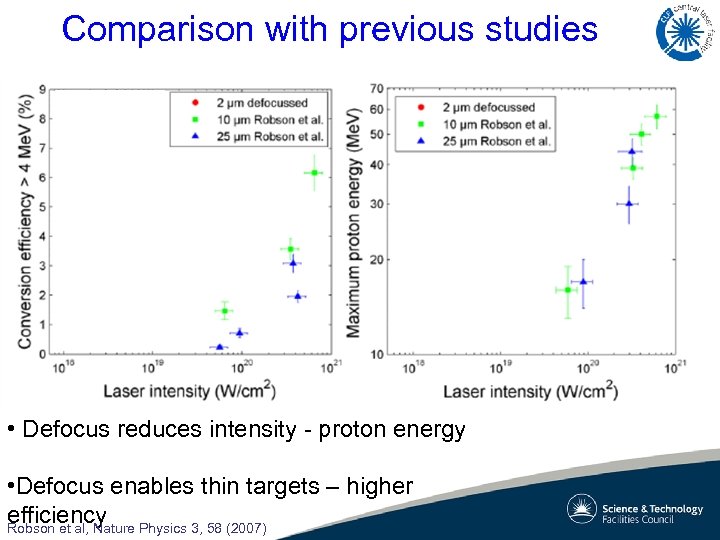 Comparison with previous studies • Defocus reduces intensity - proton energy • Defocus enables thin targets – higher efficiency Robson et al, Nature Physics 3, 58 (2007)
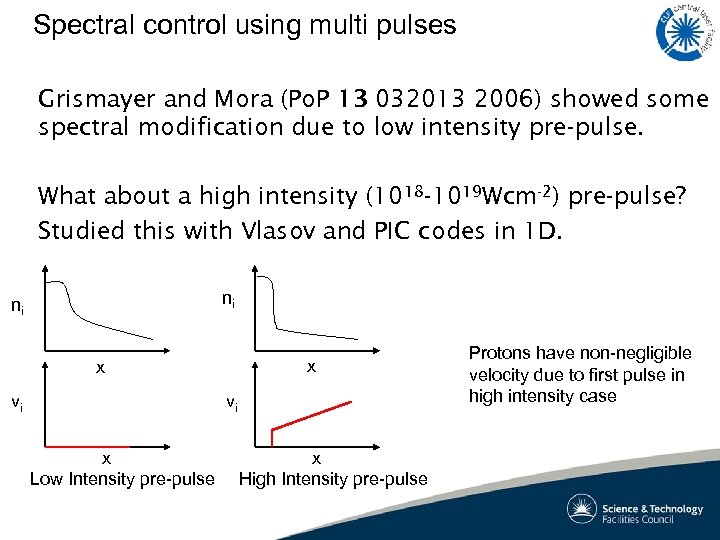 Spectral control using multi pulses Grismayer and Mora (Po. P 13 032013 2006) showed some spectral modification due to low intensity pre-pulse. What about a high intensity (1018 -1019 Wcm-2) pre-pulse? Studied this with Vlasov and PIC codes in 1 D. ni ni x x vi vi x Low Intensity pre-pulse x High Intensity pre-pulse Protons have non-negligible velocity due to first pulse in high intensity case
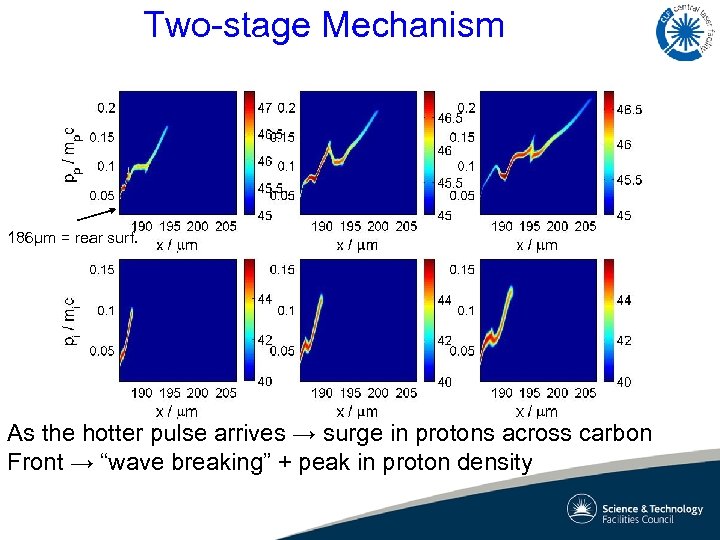 Two-stage Mechanism 186μm = rear surf. As the hotter pulse arrives → surge in protons across carbon Front → “wave breaking” + peak in proton density
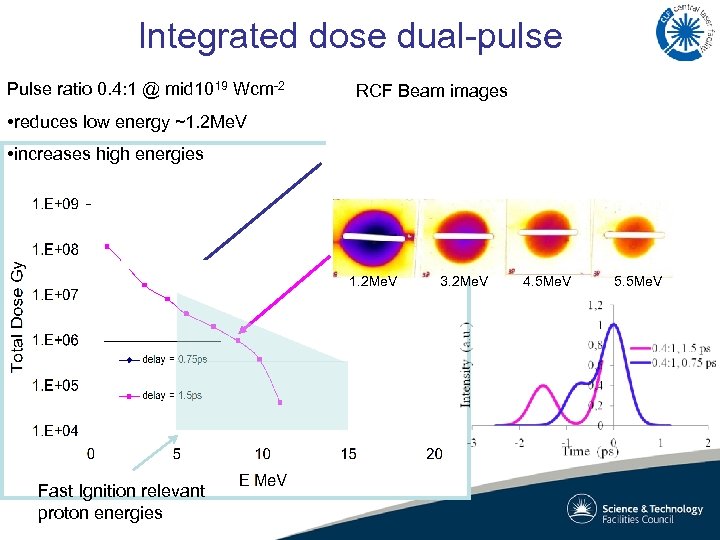 Integrated dose dual-pulse Pulse ratio 0. 4: 1 @ mid 1019 Wcm-2 RCF Beam images • reduces low energy ~1. 2 Me. V • increases high energies 1. 2 Me. V Fast Ignition relevant proton energies 3. 2 Me. V 4. 5 Me. V 5. 5 Me. V
 Co-workers J Collier, P Foster, R Evans, S Hawkes, A Robinson, M Streeter, C Spindloe, M Tolley Central Laser Facility, STFC P Mc. Kenna, D C Carroll University of Strathclyde F. Nurnberg, M. Roth, M Guentner, K Harres GSI, University of Darmstadt M Zepf, B Dromey, K Markey, S Karr, Queens University of Belfast C-G Wahlström Lund Laser Centre, Sweden Y T Li, M H Xu Beijing National Laboratory Rutherford Appleton Laboratory, Chilton, Didcot, Oxon, OX 11 0 QX, UK. Telephone: (44)1235 446150 Fax: (44)1235 445888 e-mail: david. neely@stfc. ac. uk
 Conclusion • Ion emission as an electron transport diagnostic • Provides spatial information on hot electron transport • Refluxing effects on many present experiments a limitation • Ion spectral control - dual-pulse and planar • Simple optical control mechanisms- high efficiency • First results indicate mechanism effective • Ion source for probing • Detector developments • Fast Scintillators and transducers required • High resolution neutron and g-ray imaging required • EMP, neutron, g-ray and radiation hardened developments needed
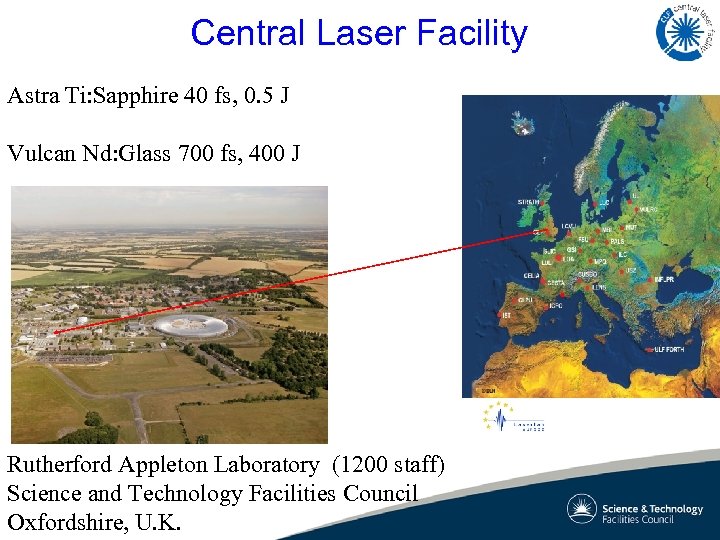 Central Laser Facility Astra Ti: Sapphire 40 fs, 0. 5 J Vulcan Nd: Glass 700 fs, 400 J Rutherford Appleton Laboratory (1200 staff) Science and Technology Facilities Council Oxfordshire, U. K.
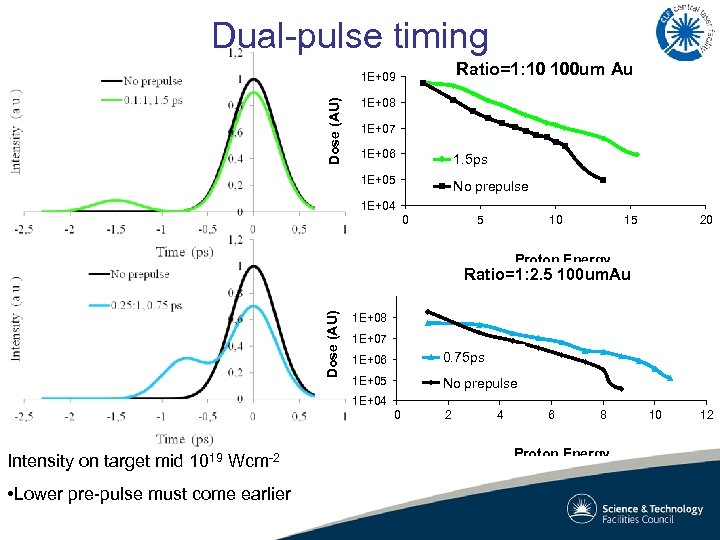 Dual-pulse timing Ratio=1: 10 100 um Au Dose (AU) 1 E+09 1 E+08 1 E+07 1 E+06 1. 5 ps 1 E+05 No prepulse 1 E+04 0 5 10 15 20 Proton Energy Dose (AU) Ratio=1: 2. 5 100 um. Au 1 E+08 1 E+07 1 E+06 0. 75 ps 1 E+05 No prepulse 1 E+04 0 Intensity on target mid 1019 Wcm-2 • Lower pre-pulse must come earlier 2 4 6 8 Proton Energy 10 12
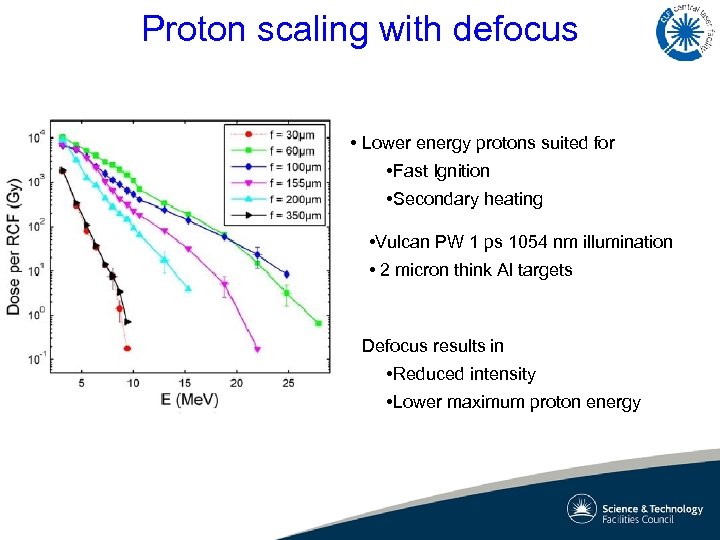 Proton scaling with defocus • Lower energy protons suited for • Fast Ignition • Secondary heating • Vulcan PW 1 ps 1054 nm illumination • 2 micron think Al targets • Defocus results in • Reduced intensity • Lower maximum proton energy