 Скачать презентацию Participatory urban governance innovations from Latin America Innovations
862c446da1289813fe77569d544bc50e.ppt
- Количество слайдов: 31



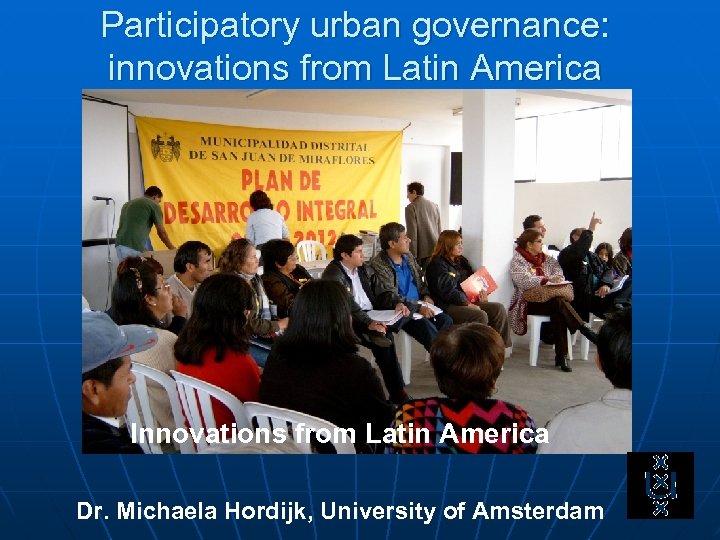
Participatory urban governance: innovations from Latin America Innovations from Latin America Dr. Michaela Hordijk, University of Amsterdam
Structure of the Lecture n n Introducing Participatory Budgeting (PB) Watching PB (Video Beyond Elections) Revisiting Urban Governance – wrap up last week Governance and citizenship: contrasting NPM and Radical democracy n n The Brazilian example Discussing PB
Participatory Budgetring: The story n n PT wins elections in Porto Alegre Some data about Porto Alegre • Capital of richest state of Brazil • High HDI-indicators • But also poverty n n Strong civil society Special PT-cadre • PT-CSO ideals
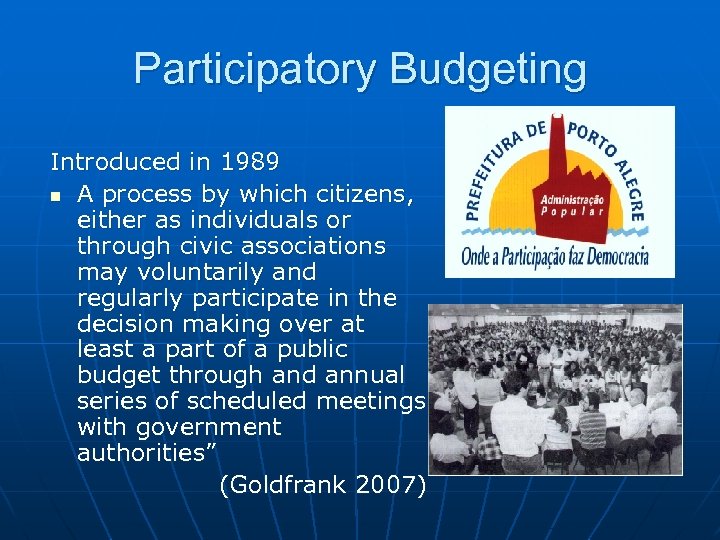
Participatory Budgeting Introduced in 1989 n A process by which citizens, either as individuals or through civic associations may voluntarily and regularly participate in the decision making over at least a part of a public budget through and annual series of scheduled meetings with government authorities” (Goldfrank 2007)
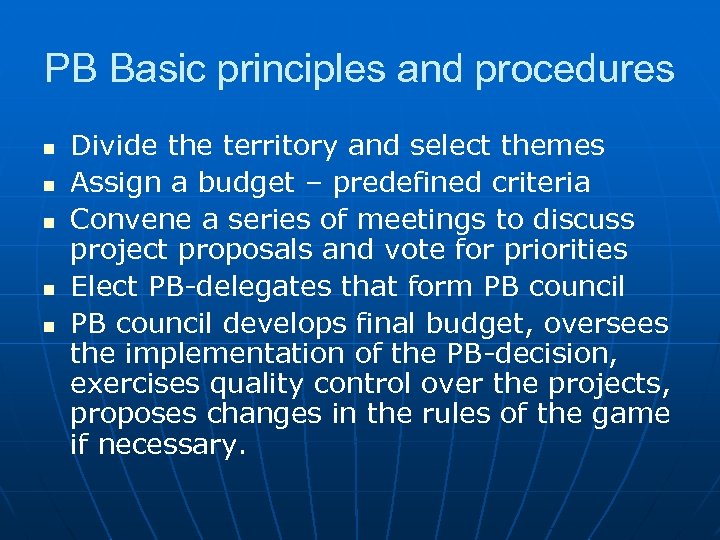
PB Basic principles and procedures n n n Divide the territory and select themes Assign a budget – predefined criteria Convene a series of meetings to discuss project proposals and vote for priorities Elect PB-delegates that form PB council develops final budget, oversees the implementation of the PB-decision, exercises quality control over the projects, proposes changes in the rules of the game if necessary.
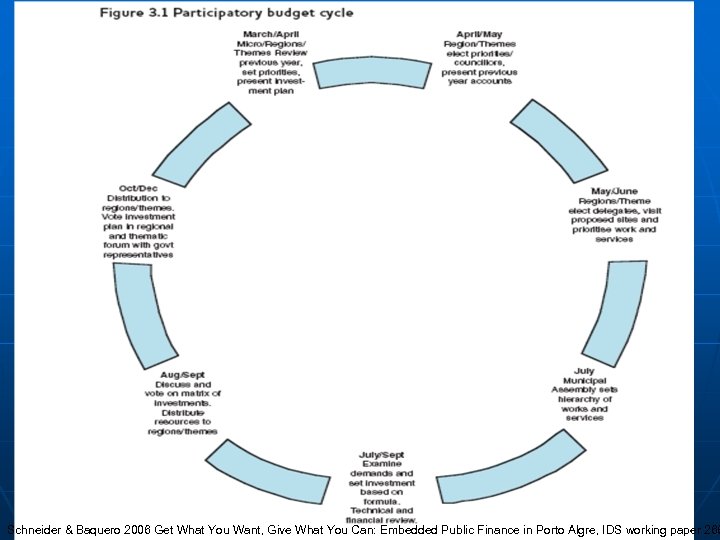
Schneider & Baquero 2006 Get What You Want, Give What You Can: Embedded Public Finance in Porto Algre, IDS working paper 266
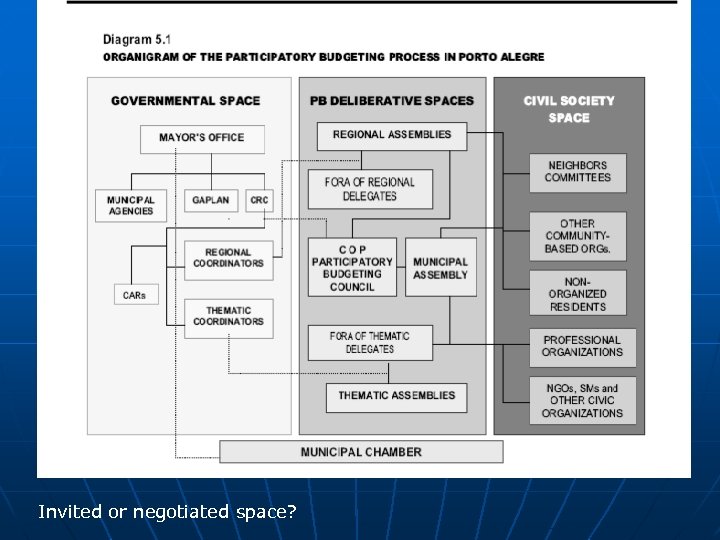
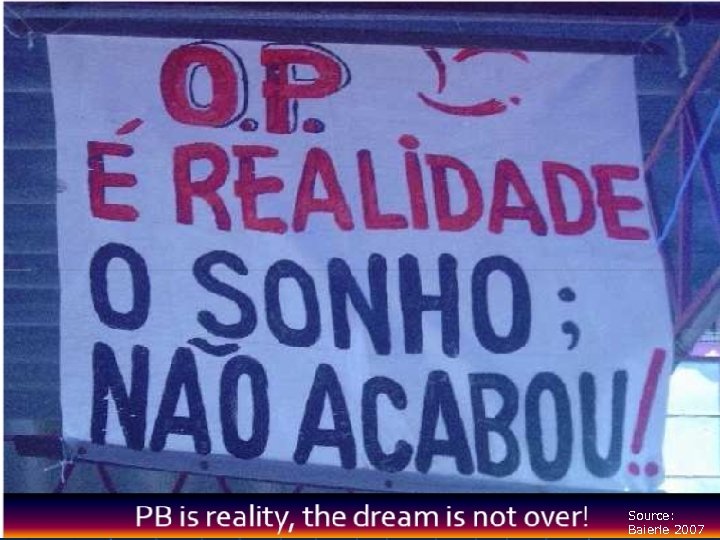
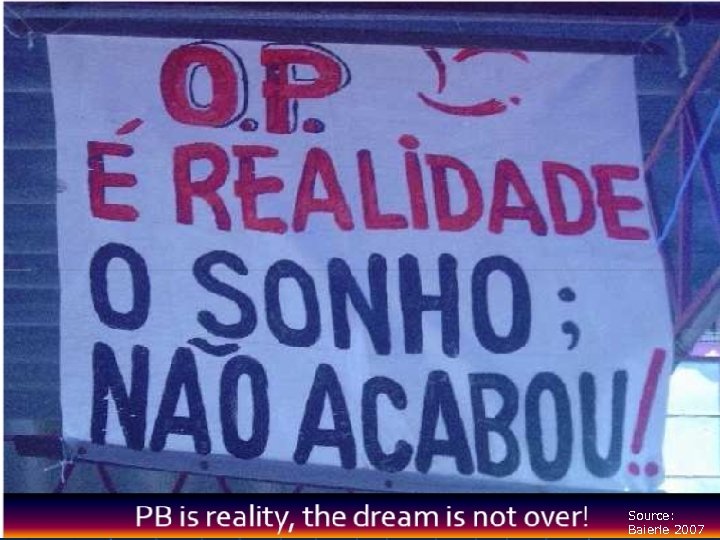
Invited or negotiated space?
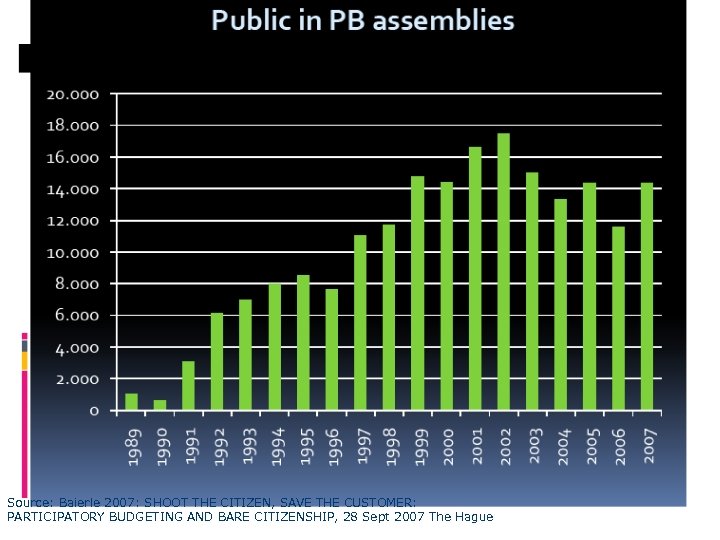
Source: Baierle 2007: SHOOT THE CITIZEN, SAVE THE CUSTOMER: PARTICIPATORY BUDGETING AND BARE CITIZENSHIP, 28 Sept 2007 The Hague
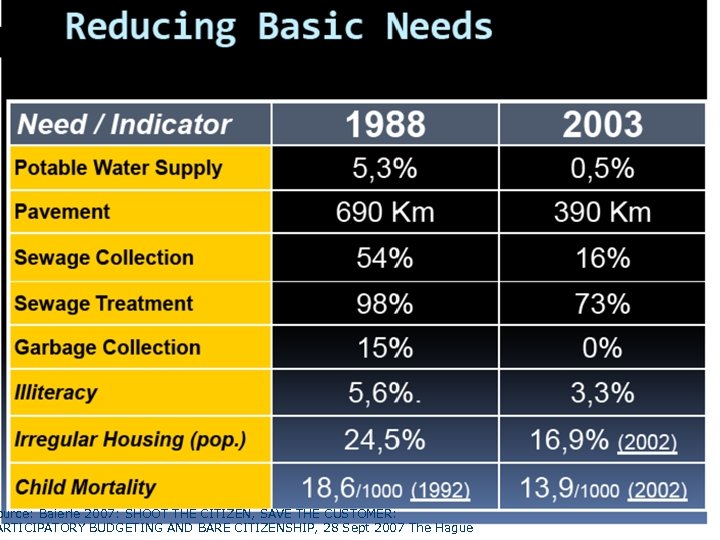
ource: Baierle 2007: SHOOT THE CITIZEN, SAVE THE CUSTOMER: ARTICIPATORY BUDGETING AND BARE CITIZENSHIP, 28 Sept 2007 The Hague
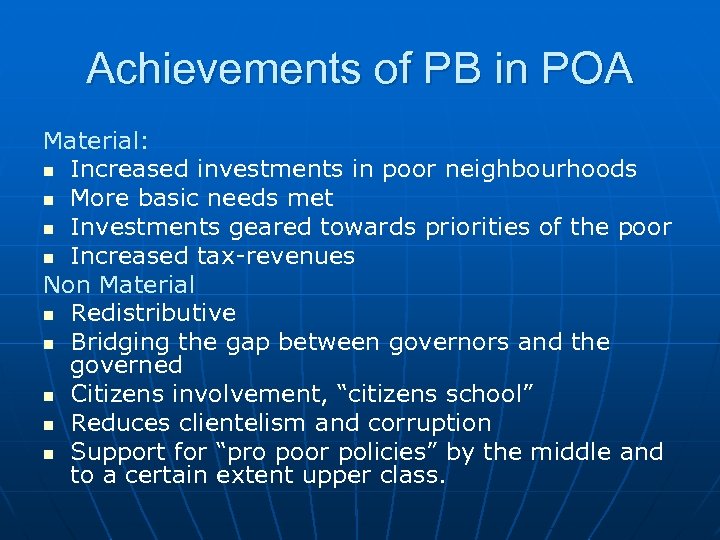
Achievements of PB in POA Material: n Increased investments in poor neighbourhoods n More basic needs met n Investments geared towards priorities of the poor n Increased tax-revenues Non Material n Redistributive n Bridging the gap between governors and the governed n Citizens involvement, “citizens school” n Reduces clientelism and corruption n Support for “pro poor policies” by the middle and to a certain extent upper class.
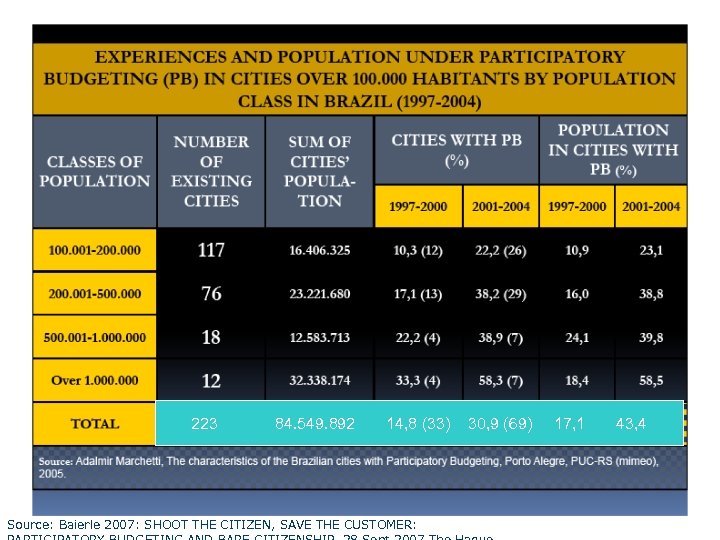
223 84. 549. 892 14, 8 (33) Source: Baierle 2007: SHOOT THE CITIZEN, SAVE THE CUSTOMER: 30, 9 (69) 17, 1 43, 4

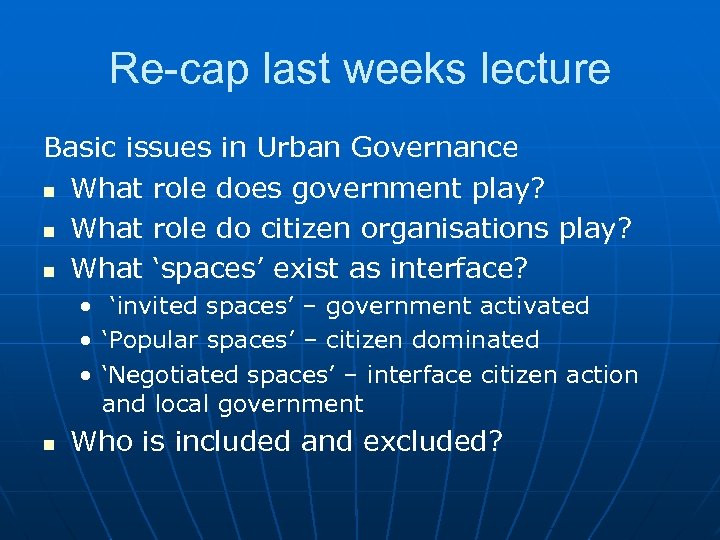
Re-cap last weeks lecture Basic issues in Urban Governance n What role does government play? n What role do citizen organisations play? n What ‘spaces’ exist as interface? • ‘invited spaces’ – government activated • ‘Popular spaces’ – citizen dominated • ‘Negotiated spaces’ – interface citizen action and local government n Who is included and excluded?
Recap Urban Governance - Baud n n From government to governance From provider to enabler • Relations with non-state actors – private sector/ civil society • Participatory decision-making • State is enabler; non-state agencies providers
Revisiting Lecture Sayed Governance = n Distinct from government, government is agent, n In origin governance means to steer – steering policies and mechanisms n Governance is a more encompassing terms which subsume government and refer to Institutions, rules and norms for developing policies, implementing them and for accountability n ‘Rules of the game’
Revisit Sayed Governance: whose agenda • Usually associated with work of WB and development agencies • Rooted in a concern with making aid effective • Attempt to redress systemic institutional failures and problems to make service delivery effective n Taken up in more recent times by other IO and regional organisations
Sayed Revisited n n n Devolution to lower /local levels Decentralization to local levels Increase choice and competition -> Privatisation and marketisation
Urban Governance Defined n n “The relationship between ‘government’ and “citizen”. “The interactive relationship between and within government and nongovernmental forces” (Stoker 1998) • Sound administration and management on behalf of citizens (NPM) – • Citizens involvement in decision making and governments accountability (EPG- Fung and Wright) radical (Heller) or deliberative democracy (Baiocchi)
From lecture Pfeffer and Martinez Remember: n Better governance implies that policy makers and the public sector are aware of the needs and differences within the civil society, being equity one of governance elements. • But: what is BETTER governance? n NPM or Radical democracy?
Urban Governance -2 n “The institutions and processes, both formal and informal, which provide for the interaction of the state with a range of other agents or stakeholders affected by the activities of government” (Gaventa 2001) • Please remember that the state is NOT an homogeneous entity -> there are many conflicting interests WITHIN the state.
NPM or Participatory – Baud n n Sound administration on behalf of the citizens or radical democracy New public management issues: • Decentralisation; greater role for city government • Privatisation of basic services • More effective public administration, tax collection n All meant to increase (cost) efficiency and effectiveness • But what about “the citizen”
Citizenship – Baud revisited n n n Citizens defined as people with particular rights Political rights, socio-economic rights Democratic processes: • Representation through political parties, voting – representative democracy • Direct participation through civil society org. OR by individuals DIRECT DEMOCRACY • Advocacy through interest groups
Citizenship - Baud n Hollow citizenship – unequal rights and entitlements n Lack of vertical accountability – governments n Weak horizontal accountability – bureaucrats n Shrinking International accountability – global companies, global markets, international organisations
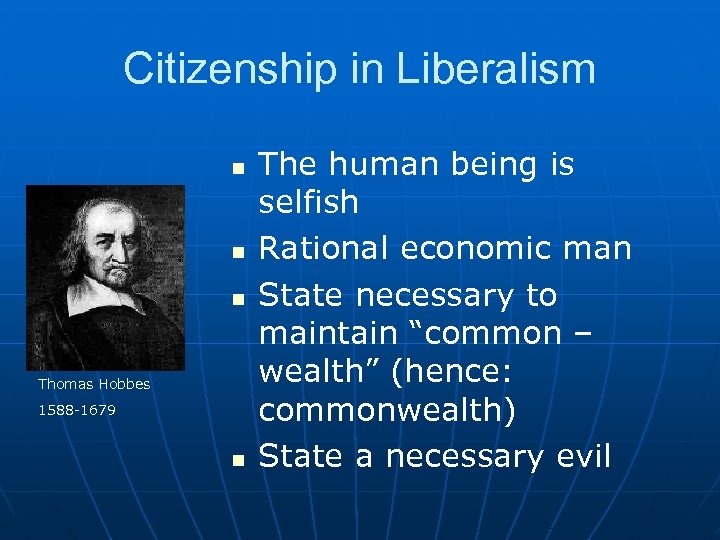
Citizenship in Liberalism n n n Thomas Hobbes 1588 -1679 n The human being is selfish Rational economic man State necessary to maintain “common – wealth” (hence: commonwealth) State a necessary evil
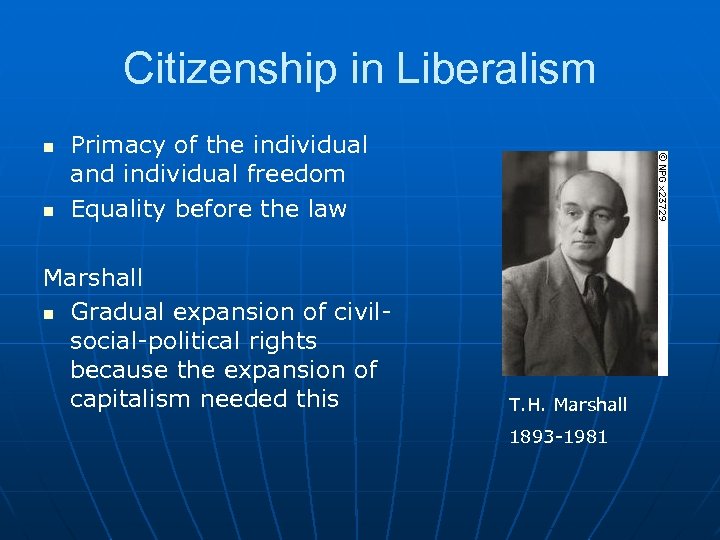
Citizenship in Liberalism n n Primacy of the individual and individual freedom Equality before the law Marshall n Gradual expansion of civilsocial-political rights because the expansion of capitalism needed this T. H. Marshall 1893 -1981
Citizenship in Neoliberalism n n “Citizenship is about individual integration into the market” “Citizenship” = a passive notion Citizens express their preferences through market choices and voting Citizen = consumer/client
Citizenship in Latin America Oxhorn: - Vast expansion of political rights due to (re) democratization/3 rd wave of democratization - Specifically free and fair elections - - Precarious civil rights Erosion of social rights as a consequence of neo-liberalism “Daily experience of non-citizenship”
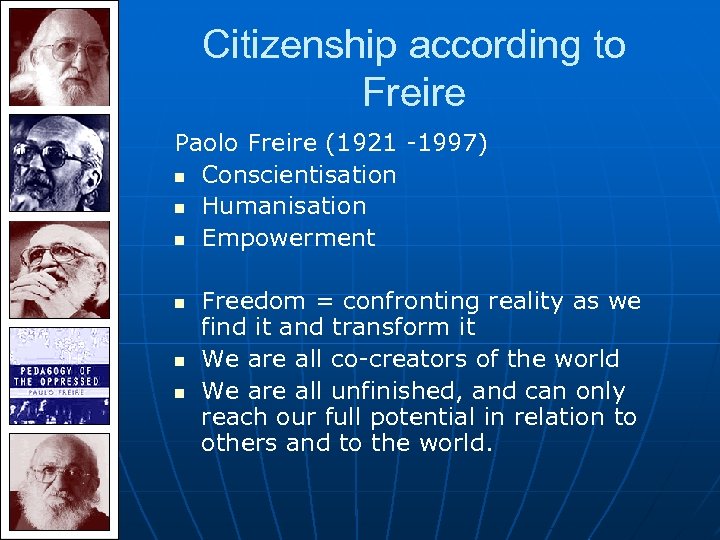
Citizenship according to Freire Paolo Freire (1921 -1997) n Conscientisation n Humanisation n Empowerment n n n Freedom = confronting reality as we find it and transform it We are all co-creators of the world We are all unfinished, and can only reach our full potential in relation to others and to the world.
Conclusions n PB embodies many elements of the traditional (neo-liberal) good governance agenda • Accountability, transparency, reduction of corruption. • Citizens participation n PB is built on an image of human nature fundamentally different from the liberal/neoliberal paradigm. • Radical democratisation of SOCIETY - > participatory decision making in ALL institutions. • Empowerment and self-realisation of the human being n PB on its own is not capable of countering effects of (neo-liberal) globalisation at the local level, but can create critical mass.
Source: Baierle 2007
Source: Baierle 2007
Скачать презентацию Participatory urban governance innovations from Latin America Innovations
862c446da1289813fe77569d544bc50e.ppt