


 Скачать презентацию PARTICIPATORY ACTION RESEARCH ON AVIAN INFLUENZA COMMUNICATION IN
a12520e24ad151745af4663b7d6e6cf1.ppt
- Количество слайдов: 58
 PARTICIPATORY ACTION RESEARCH ON AVIAN INFLUENZA COMMUNICATION IN WEST AFRICA
 BACKGROUND AND OBJECTIVES
 AVIAN INFLUENZA IN WESTERN AND CENTRAL AFRICA Between February 2006 and February 2007, outbreaks in birds were reported in: Burkina Faso Cameroon Cote d’Ivoire Nigeria In January 2007 –confirmed human death in Nigeria UNICEF/AED PAR ON AI IN WEST AFRICA 3
 OVERALL OBJECTIVE Developing communication/community mobilization interventions to reduce the negative impact of AI in three circumstances: Continuing AI outbreaks Widespread AI Pandemic human influenza. For effective communication and mobilization interventions need to know The problem in context How communities identify problems and determine appropriate courses of actions UNICEF/AED PAR ON AI IN WEST AFRICA 4
 SPECIFIC OBJECTIVES TO UNDERSTAND: Perception of community members about AI Its potential impact on different aspects of their life Relationships between the spread of AI in the community and social, cultural and economic factors Communication resources that could be mobilized and feasible interventions that could be implemented using local resources UNICEF/AED PAR ON AI IN WEST AFRICA 5
 APPROACH UNICEF partnered with AED to carry out communitybased participatory action research (PAR). To capture diversity, three locations: Burkina Faso Lagos State, Nigeria Kano State, Nigeria In each location, one urban/peri-urban and one more rural site UNICEF/AED PAR ON AI IN WEST AFRICA 6
 WHAT IS PAR?
 PAR METHOD - PRINCIPLES Inclusion Participation Self determination UNICEF/AED PAR ON AI IN WEST AFRICA 8
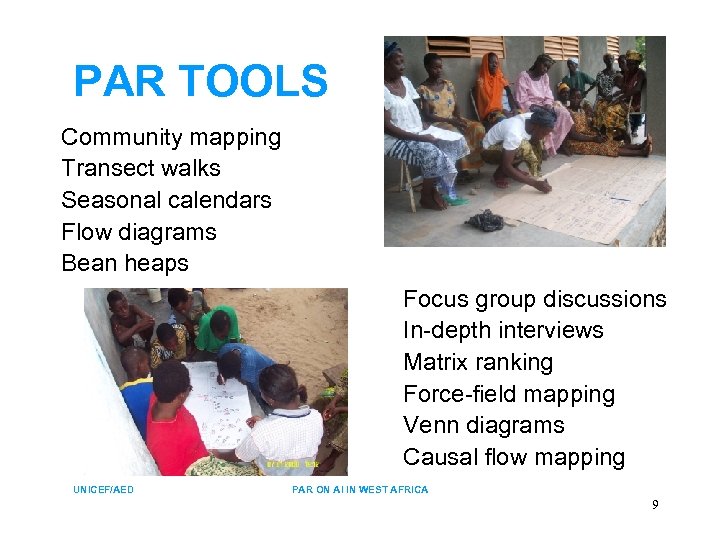 PAR TOOLS Community mapping Transect walks Seasonal calendars Flow diagrams Bean heaps Focus group discussions In-depth interviews Matrix ranking Force-field mapping Venn diagrams Causal flow mapping UNICEF/AED PAR ON AI IN WEST AFRICA 9
 KEY ASPECTS OF PAR PROCESS Multiple tools Different aspects Different groups Men, Women, Youth Replicates Ordered implementation Daily review and planning Refine research Q’s Progress from general to specific Triangulation UNICEF/AED PAR ON AI IN WEST AFRICA 10
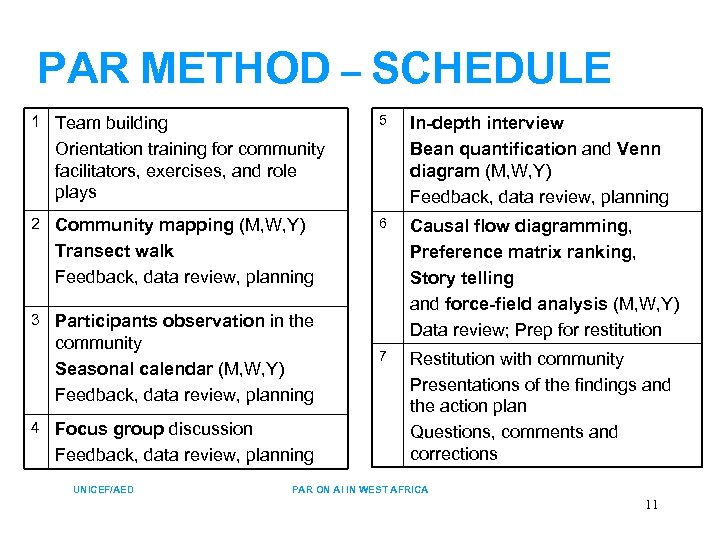 PAR METHOD – SCHEDULE 5 1 Team building In-depth interview Bean quantification and Venn diagram (M, W, Y) Feedback, data review, planning 6 Causal flow diagramming, Preference matrix ranking, Story telling and force-field analysis (M, W, Y) Data review; Prep for restitution 7 Restitution with community Presentations of the findings and the action plan Questions, comments and corrections Orientation training for community facilitators, exercises, and role plays 2 Community mapping (M, W, Y) Transect walk Feedback, data review, planning 3 Participants observation in the community Seasonal calendar (M, W, Y) Feedback, data review, planning 4 Focus group discussion Feedback, data review, planning UNICEF/AED PAR ON AI IN WEST AFRICA 11
 BURKINA FASO FINDINGS
 BURKINA FASO PAR TEAM Dr Daniel Thieba, Team leader Dr Christophe Coulibaly, Field Coordinator M. Pierre Aimé Ouédraogo, Facilitator M. Luc Lankoande, Facilitator Mme Fatoumata Koné, Facilitator M. YANOGO Enoch; Community facilitator, Gampela M. TONDE Abel, Community facilitator, Gampela M. BAKI Benoit Community facilitator, Ténado M. BAMOUNI Philippe Community facilitator, Ténado UNICEF/AED PAR ON AI IN WEST AFRICA 13
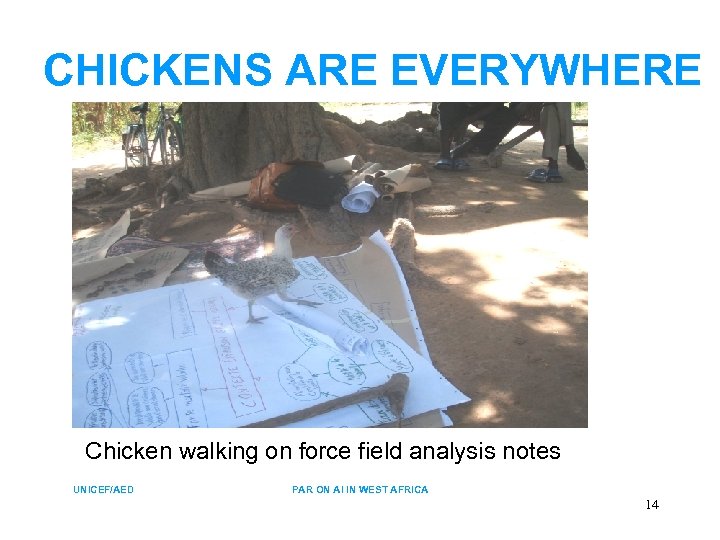 CHICKENS ARE EVERYWHERE Chicken walking on force field analysis notes UNICEF/AED PAR ON AI IN WEST AFRICA 14
 KNOWLEDGE ABOUT AI People know about AI People differentiate AI from other diseases such as Newcastle Specific local name for each site: “Noukoumtoaga” = “large number of chicken deaths” “Kitjumanbeyolo” =“ the bad chicken disease” UNICEF/AED PAR ON AI IN WEST AFRICA 15
 ORIGIN AND CAUSES OF AI IN BIRDS Wind and dust Migrating and wild birds Introduction of foreign birds by traders and travelers Drinking contaminated water Backyard garbage disposal Eating dead birds UNICEF/AED PAR ON AI IN WEST AFRICA 16
 MAIN USES OF BIRDS Commerce (monetary and barter) Religious and socio-cultural ceremonies Gifts Consumption UNICEF/AED PAR ON AI IN WEST AFRICA 17
 POTENTIAL IMPACT 1 On livelihood Lower family income for traders Lower access to health care and schooling On religious aspects of life Difficult/impossible to carry out Traditional ceremonies (Annual celebration of village founding father, prayers for rains, thanking ancestors) Rituals to mark all life milestones (engagement, marriage, death) Sacrifices for building a new house etc. UNICEF/AED PAR ON AI IN WEST AFRICA 18
 POTENTIAL IMPACT 2 On food security and nutrition Reduced consumption of chicken Reduced access to food Because of loss of income About 20% of income from poultry used to buy food On health Reduced access to health care because of loss of income Potential risk of human infection UNICEF/AED PAR ON AI IN WEST AFRICA 19
 SOCIAL & CULTURAL FACTORS AND THE SPREAD OF AI Poultry movement Seasonal sales/barter of poultry Introduction of foreign poultry Poultry scavenging Contacts with wild birds Sick birds and reporting Small producers and sellers : Less use of veterinarian specialists No reporting of sick birds Hygiene Body and hand washing after cleaning of chicken houses but not with soap (main motivation is odor) No special care after handling chicken droppings UNICEF/AED PAR ON AI IN WEST AFRICA 20
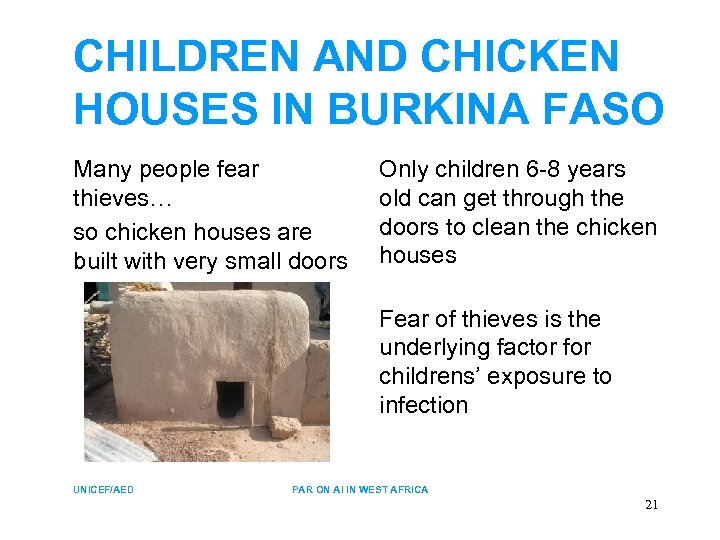 CHILDREN AND CHICKEN HOUSES IN BURKINA FASO Many people fear thieves… so chicken houses are built with very small doors Only children 6 -8 years old can get through the doors to clean the chicken houses Fear of thieves is the underlying factor for childrens’ exposure to infection UNICEF/AED PAR ON AI IN WEST AFRICA 21
 FLEXIBILITY FOR CHANGE Possible alternatives to mitigate AI consequences: Raising other animals as sources of income and food Gardening, vocational training for young people No alternative for religious, socio-cultural and traditional medicine Barriers and facilitating elements for AI mitigation: Resources - All communities mentioned needing government/donor help UNICEF/AED PAR ON AI IN WEST AFRICA 22
 EXISTING COMMUNICATION RESOURCES RELIABLE, TRUSTED AND EFFECTIVE SOURCES OF INFORMATION IN THE COMMUNITY: Channel 1 : Traditional network: Village chief, neighborhood chief, village administrative delegate, traditional healers Channel 2 : Poultry network : Administrative chief, veterinarian, vaccinators, women’s groups The two channels should work in close collaboration UNICEF/AED PAR ON AI IN WEST AFRICA 23
 WIDESPREAD AI- RESPONSES Culling is an accepted measure Community surveillance: Organize a local committee, provide adequate IEC, and ensure participation of administrative and technical authorities and community leaders Training of community volunteers for monitoring and reporting Bio-security measures suggested: Bird separation (but not realistic) Movement control UNICEF/AED PAR ON AI IN WEST AFRICA 24
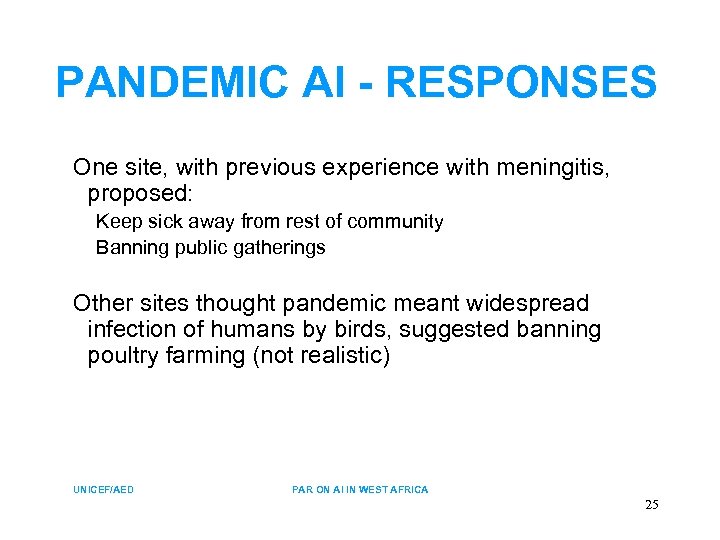 PANDEMIC AI - RESPONSES One site, with previous experience with meningitis, proposed: Keep sick away from rest of community Banning public gatherings Other sites thought pandemic meant widespread infection of humans by birds, suggested banning poultry farming (not realistic) UNICEF/AED PAR ON AI IN WEST AFRICA 25
 NIGERIA FINDINGS
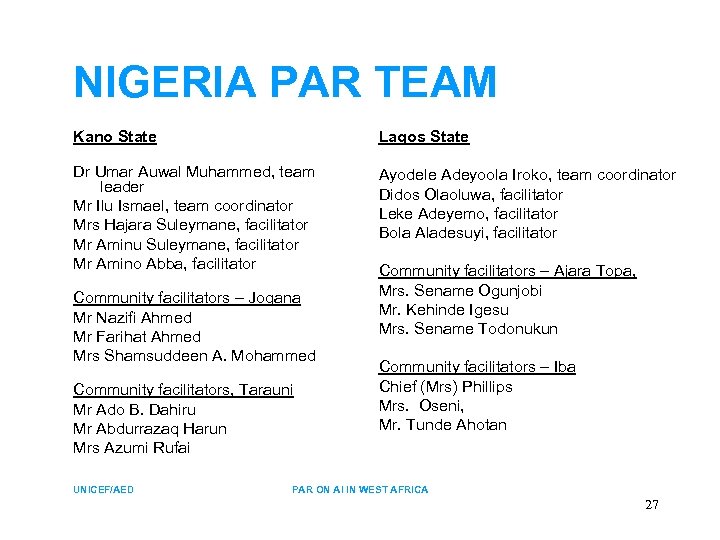 NIGERIA PAR TEAM Kano State Lagos State Dr Umar Auwal Muhammed, team leader Mr Ilu Ismael, team coordinator Mrs Hajara Suleymane, facilitator Mr Aminu Suleymane, facilitator Mr Amino Abba, facilitator Ayodele Adeyoola Iroko, team coordinator Didos Olaoluwa, facilitator Leke Adeyemo, facilitator Bola Aladesuyi, facilitator Community facilitators – Jogana Mr Nazifi Ahmed Mr Farihat Ahmed Mrs Shamsuddeen A. Mohammed Community facilitators, Tarauni Mr Ado B. Dahiru Mr Abdurrazaq Harun Mrs Azumi Rufai UNICEF/AED Community facilitators – Ajara Topa, Mrs. Sename Ogunjobi Mr. Kehinde Igesu Mrs. Sename Todonukun Community facilitators – Iba Chief (Mrs) Phillips Mrs. Oseni, Mr. Tunde Ahotan PAR ON AI IN WEST AFRICA 27
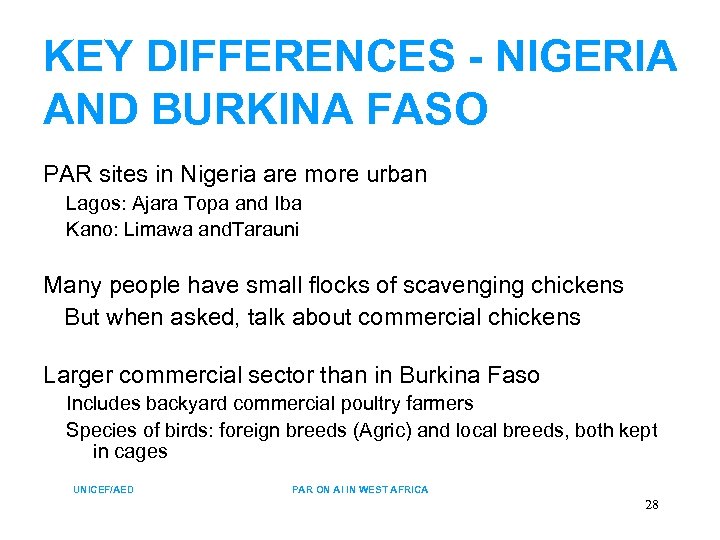 KEY DIFFERENCES - NIGERIA AND BURKINA FASO PAR sites in Nigeria are more urban Lagos: Ajara Topa and Iba Kano: Limawa and. Tarauni Many people have small flocks of scavenging chickens But when asked, talk about commercial chickens Larger commercial sector than in Burkina Faso Includes backyard commercial poultry farmers Species of birds: foreign breeds (Agric) and local breeds, both kept in cages UNICEF/AED PAR ON AI IN WEST AFRICA 28
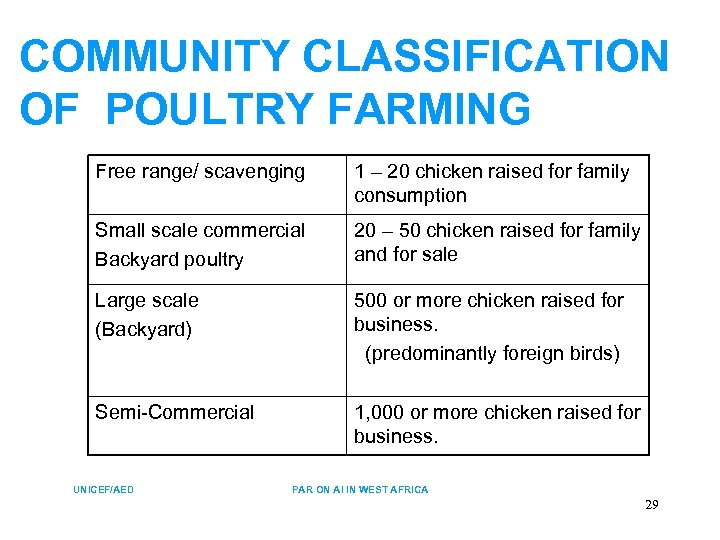 COMMUNITY CLASSIFICATION OF POULTRY FARMING Free range/ scavenging 1 – 20 chicken raised for family consumption Small scale commercial Backyard poultry 20 – 50 chicken raised for family and for sale Large scale (Backyard) 500 or more chicken raised for business. (predominantly foreign birds) Semi-Commercial 1, 000 or more chicken raised for business. UNICEF/AED PAR ON AI IN WEST AFRICA 29
 PERCEPTION OF CAUSES AND ORIGINS RECURRING THEME: EXTERNAL SOURCE Birds migrating from Asia and South Africa Deliberately introduced by western countries Rumors about the rich wanting to take the poultry business away from the middle and low income earners Rumors about the government encouraging the minority (rich people) to take over poultry business UNICEF/AED PAR ON AI IN WEST AFRICA 30
 RELEVANT SOCIAL AND CULTURAL FACTORS Ownership No restriction on ownership or rearing of chicken Husbands’ endorsements are needed when chickens are to be given out or consumed in a household Cultural rites Chickens are perceived as protective wall for household members against evil spirit manipulation e. g. sickness, death and other evil occurrences Not clear how widespread this belief is UNICEF/AED PAR ON AI IN WEST AFRICA 31
 PERCEPTION OF THE IMPACT OF AI Direct impact of AI on livelihood Massive death of birds & falling poultry price Loss of money by poultry farmers Loss of jobs by poultry workers Direct impact of AI on religious/social rites If all chickens die, there may be no substitute for rites; belief that the gods accept only chicken blood Belief that family protection is threatened Indirect impact on food security Fear of human infection and death prompted educated and rich people to shift to beef and fish which increased in price UNICEF/AED PAR ON AI IN WEST AFRICA 32
 ACTIONS TAKEN TO PREVENT SPREAD AND REDUCE IMPACT OF AI Avoiding infection Most individuals stopped eating poultry and eggs Buried dead and affected birds Protecting livelihood Traditional remedies at the onset of the epidemic as well as offering prayers Awareness campaign to encourage people to eat chicken implemented by POFAN (Nigerian Farmer’s Poultry Association) UNICEF/AED PAR ON AI IN WEST AFRICA 33
 BARRIERS TO CHANGING PRACTICES Custom of letting chickens roam free Consumption of chickens that die or slaughter and consumption of infected chickens is an accepted practice in some communities For some, monetary incentive to buy cheaply (near outbreaks), sell elsewhere Lack of infrastructure (dumpsite, water) UNICEF/AED PAR ON AI IN WEST AFRICA 34
 MOTIVATORS FOR CHANGING PRACTICES Protecting livelihoods/sources of income Ritual/ceremonial uses of chickens Health UNICEF/AED PAR ON AI IN WEST AFRICA 35
 VIEWS ON COMPENSATION Views of authorities and communities differ: Authorities: compensation was a “token” for chickens that were culled Communities: compensation should be 1) equivalent to the pre-outbreak price 2) paid both for culled chickens and those that died during the outbreak UNICEF/AED PAR ON AI IN WEST AFRICA 36
 WIDESPREAD AI Communities expressed fear and concern about Loss of investment Loss of jobs Proposed solutions: Sensitization and education of community Community surveillance and reporting Culling with support from local government authorities (full compensation) UNICEF/AED PAR ON AI IN WEST AFRICA 37
 WIDESPREAD AI Almost impossible to imagine “gods will not allow this” Actions communities could take: Take family members for vaccinations Reduce movement of people to the barest minimum Educate children and adults on the dangers of the infection Quarantine Pray UNICEF/AED PAR ON AI IN WEST AFRICA 38
 EXISTING COMMUNICATION RESOURCES Source of information Radio, TV, word of mouth, public gatherings, posters and booklets Reliable and trusted sources Radio, traditional and religious leaders Veterinarians and health workers UNICEF/AED PAR ON AI IN WEST AFRICA 39
 IMPLICATIONS FOR THE CONTENT OF COMMUNICATIONS INTERVENTIONS
 KEY BEHAVIORAL INTERVENTIONS Key behavioral interventions for AI risk reduction recommended by WHO/FAO/UNICEF in March 2006: Report Separate Wash Cook PAR showed that not all are feasible for communities because key enabling factors are absent UNICEF/AED PAR ON AI IN WEST AFRICA 41
 “REPORT” BARRIERS AND RECOMMENDATIONS Lack of recognition of AI (Nigeria) No longer a problem Lack of a surveillance system and confused/delayed response to reports or positive samples Advocacy for better response Mistrust of authorities Advocacy for improved/continuing transparency Problems with compensation Advocacy for a well-thought-out, fair and timely policy As part of the process, dialogue with farmers to establish a policy UNICEF/AED PAR ON AI IN WEST AFRICA 42
 “SEPARATE” BARRIERS AND RECOMMENDATIONS Most difficult set of behaviors to change because of the custom of letting birds roam free Contributing factors: Cost of caging materials Cost of feeding caged birds (biggest impediment) Belief that commercial birds can be source of infection Possible undesirable consequence – greater exposure of children to feces (cleaning cages) Not much scope for communication intervention; need to address underlying factors UNICEF/AED PAR ON AI IN WEST AFRICA 43
 “SEPARATE” BARRIERS THAT CAN BE ADDRESSED Temporary quarantine Most feasible to initiate (because temporary): quarantine of new stock for 2 weeks before introducing to flock Communication should focus on Information about transmission of infection Modeling how to do it UNICEF/AED PAR ON AI IN WEST AFRICA 44
 “SEPARATE” BARRIERS THAT CAN BE ADDRESSED Disposing of dead birds Food insecurity is the key factor underlying consumption of dead birds Long-term response: Advocacy In the short term, address the problem of slaughtering and eating potentially infected birds Focus on safe practices for slaughter and food preparation UNICEF/AED PAR ON AI IN WEST AFRICA 45
 “WASH” BARRIERS AND RECOMMENDATIONS Not using soap Possibly related to price, but also just habit Motivation for washing (with water) Smell Bad feel of hands Build on this in communication Emphasize how hands smell better after washing with soap and encourge people to “wash often” Not thinking handling birds is contaminating Information problem (communication solution) UNICEF/AED PAR ON AI IN WEST AFRICA 46
 “COOK” BARRIERS AND RECOMMENDATIONS Main situations when undercooked meat is consumed: Children cooking As part of rituals In both cases, problem seems to be simply impatience Focus communication efforts on children and traditional practitioners UNICEF/AED PAR ON AI IN WEST AFRICA 47
 AUDIENCES Complex ownership/management issues Related to decision making Also implications for who gets compensation Issue of equity for women Ritual importance of chickens Need to involve traditional healers Differing organization of poultry production in Burkina Faso and Nigeria Much large commercial sector in Nigeria Commercial farmers may need different messages UNICEF/AED PAR ON AI IN WEST AFRICA 48
 MOTIVATION Variety of motivating factors identified: Health/mortality risks, especially for children Livelihood and specific uses for chicken income (school fees, health costs, buy other food) Lack of substitutes for ritual/social uses of chicken Existing fear of thieves affects children’s exposure to risk (through design of coops) Belief in chickens as protective barrier may affect willingness to cull UNICEF/AED PAR ON AI IN WEST AFRICA 49
 MESSAGE CONTENT Existing information, including both “true” and “false” Not a blank slate Many rumors Different views about source of AI Biomedical AND supernatural explanations Conspiracy explanations Gap between communicated and perceived risk Most people who eat dead birds have no bad consequences Seasonality of poultry movement & of risk UNICEF/AED PAR ON AI IN WEST AFRICA 50
 IMPLICATIONS FOR COMMUNICATIONS CHANNELS AND CHANNEL MIX
 MIX OF CHANNELS Mass media was used to convey information to public Needed to be supplemented with interpersonal channels for communities to act: Nigeria – Professional Poultry Farmers Association roving theater Burkina Faso – Traditional village leaders and traditional healers Recommendation: best to use mix of channels UNICEF/AED PAR ON AI IN WEST AFRICA 52
 OPTIMAL INTERPERSONAL CHANNELS Local leaders and traditional healers for backyard poultry farmers and the general public Veterinarians and experienced farmers for semicommercial and commercial farmers Religious leaders of all types and local authorities to discuss and prepare for widespread AI and human pandemic UNICEF/AED PAR ON AI IN WEST AFRICA 53
 THE FUTURE OF PAR
 ADDED VALUE OF PAR Richer, wider understanding of issue than obtained using conventional formative research approaches because the results are contextualized/grounded Stimulates communities to assess what they might do themselves Involving professionals as local facilitators improves community – professional dialogue Some results meaningful across many topics (e. g. , key motivators, trusted sources, existing networks) UNICEF/AED PAR ON AI IN WEST AFRICA 55
 RECOMMENDATIONS Implement at scale to capture national diversity Apply to other health topics Investigate possibility of training community agents to use an abbreviated PAR process to initiate dialogue with communities UNICEF/AED PAR ON AI IN WEST AFRICA 56
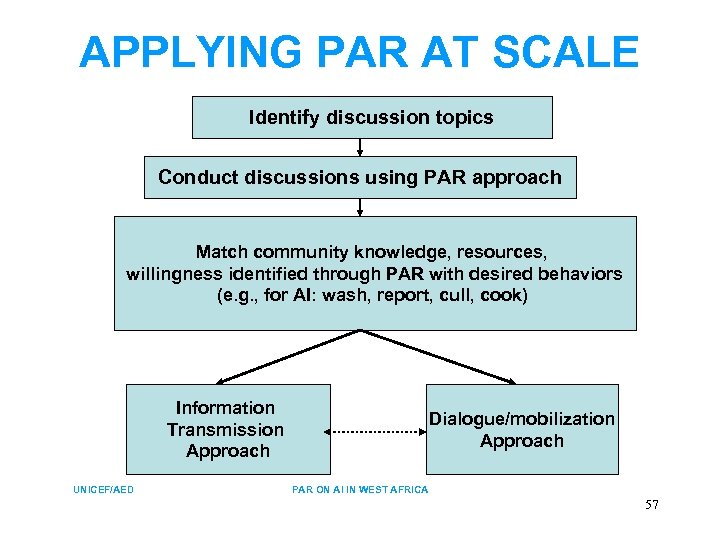 APPLYING PAR AT SCALE Identify discussion topics Conduct discussions using PAR approach Match community knowledge, resources, willingness identified through PAR with desired behaviors (e. g. , for AI: wash, report, cull, cook) Information Transmission Approach UNICEF/AED Dialogue/mobilization Approach PAR ON AI IN WEST AFRICA 57
 POSSIBLE BOTTLENECKS Cost (time/money) Build on existing PAR network(s) Managed through a core local institution/group Able to rapidly mobilize local teams Mainstream across health/development interventions Advocate for PAR among key stakeholders Technical expertise Build on existing PAR network(s) Toolkit Coaching/mentoring by core local institution/group UNICEF/AED PAR ON AI IN WEST AFRICA 58