


 Скачать презентацию PARTICIPATION RULES AND ROLE OF NCPs Dr Gerda
e3d8b01bb9fd809462f3b2f177321997.ppt
- Количество слайдов: 29
 PARTICIPATION RULES AND ROLE OF NCPs Dr. Gerda Geyer Central Infoday Brussels, 6 February, 2013
 BASIC INFORMATION I • • Date of publication: 31 January 2013 Closure date: 30 April 2013, 17 h 00 Central European Time (CET) Indicative total funding: 41. 762 M€ This amount includes a contribution of up to 19. 462 M€ by the European Communities. • Consortia submit one common project proposal with one partner acting as coordinator. • Project proposals will be evaluated centrally by independent European experts. 2
 BASIS INFORMATION II • Selection of proposals will be based on the evaluation and other criteria specified in chapter 7 of the Guide for Applicants. • Approval of the list of selected proposal by the AAL General Assembly is expected for September 2013. • Funding of individual project partners will follow the respective national rules; reference to the national rules can be found at http: //www. aal-europe. eu/calls/call-6 -2013 • Funding decisions by national funding institutions is expected for December 2013. 3
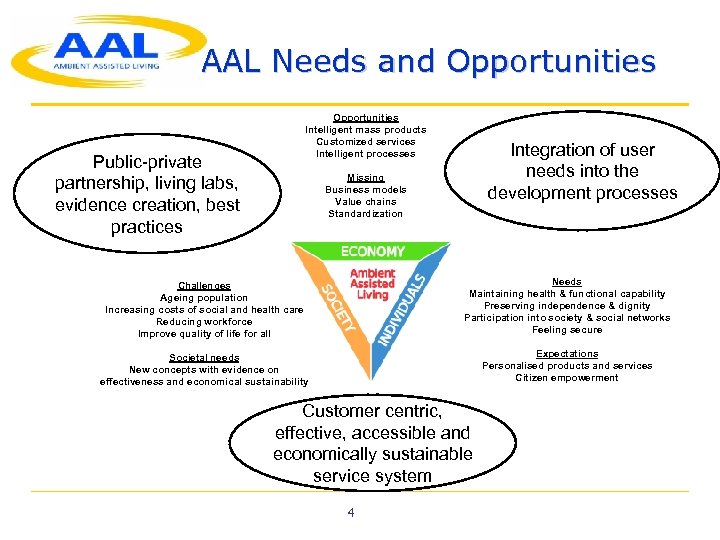 AAL Needs and Opportunities Intelligent mass products Customized services Intelligent processes Public-private partnership, living labs, evidence creation, best practices Integration of user needs into the development processes Missing Business models Value chains Standardization Challenges Ageing population Increasing costs of social and health care Reducing workforce Improve quality of life for all Needs Maintaining health & functional capability Preserving independence & dignity Participation into society & social networks Feeling secure Societal needs New concepts with evidence on effectiveness and economical sustainability Expectations Personalised products and services Citizen empowerment Customer centric, effective, accessible and economically sustainable service system 4
 CHARACTERISTICS OF AAL JP PROJECTS • Aim at ICT-based solutions to identified user needs • Demonstrate realistic business case with time-to-market perspective of maximum 2 to 3 years after end of the project • Project total budget: 1 - 7 M€ • Maximum funding from the AAL Joint Programme: 3 M€ • Significant involvement of industry and other business partners, particularly SMEs are encouraged. The efforts by industry and other business partners is expected in total to be 50% or more (in person months). • Proactive end-user involvement throughout the life of the project 5
 ELIGIBILITY CRITERIA Under the AAL JP, both, central and national eligibility criteria are applied: • The central eligibility criteria have been agreed upon by all participating AAL member states. • National eligibility criteria are defined by the AAL member States (see Annex of this document). National eligibility criteria stem from the national funding programme(s) that provide the national funding for national project partners under the AAL JP. 6
 CONSORTIUM LEVEL ELIGIBILITY CRITERIA I • Submission of a complete proposal through the AAL electronic submission system before the deadline, as specified in the Call for Proposals • English as the language of the proposal • Size of the consortium: 3 – 10 partners • Duration of the project: 12 – 36 months • Adherence to the specifications for structure and technical details (e. g. page count) of the proposal submission. 7
 CONSORTIUM LEVEL ELIGIBILITY CRITERIA II • Consortium composition of at least 3 independent eligible organizations (legal entities), from at least 3 different AAL Partner States participating in the Call for Proposals • Consortium must include at least one eligible for profit business partner • Consortium must include at least one eligible for profit SME partner which can be the business partner • Consortium must include at least one eligible end-user organization 8
 NATIONAL FUNDING: HOW DOES IT WORK? v Project partner within a funded project applies at his/her National Funding Agency (NFA) for funding v Project Funding at national level v National funding rules are applies v Payment according to national procedures and rules, EU contribution transferred to the project partner through the NFA 9
 NATIONAL FUNDING: ADVANTAGES FOR ROPOSERS Collaboration of Nationale Programmes offers a relatively low barrier approach: • proposers are often already familiar with the national funding schemes, • communication with NCPs facilitates the participation. - focus on SME - focus on end-users involvement - regional differences often of importance 10
 NATIONAL ELIGIBILITY CRITERIA I The national funding rules define the concrete participation conditions for project partners under the AAL JP: • eligibility or ineligibility of types of organisations (e. g. in some AAL partner States, universities or user organisations are excluded from funding) • national funding quota (the quota may vary for the same type of organisation between AAL partner States) • eligible costs • other national rules (e. g. funding of large enterprises and compulsory participation of certain entities) • description of national eligibility criteria: Annex to the Guide for Applicants (www. aal-europe. eu/calls) or from the sites of the NFAs 11
 NATIONAL ELIGIBILITY CRITERIA II • Eligible for funding are only organisations that are explicitly included in the national eligibility criteria published as part of the Guide for Applicants. • It is highly recommended to contact the AAL National Contact Persons (NCP) prior to submission of a proposal (list of NCPs and contact data can be found on the AAL JP website www. aaleurope. eu). • In some countries, establishing contact with the NCP prior to the submission of the proposal is a requirement for being eligible for funding. 12
 NATIONAL CONTACT PERSON: NCP vrepresent the national funding agencies vcontact person for national partners vproject coordinator and associated NCP (the “lead” NCP) will handle all project related matters (defining common project start and duration, collection of consortium agreement, . . . ) vlist of NCPs: web-site www. aal-europe. eu. 13
 ROLE OF YOUR NCP? • National communication about the call (websites/newsletters/info days etc. ) • Info & advise for national (potential) proposers • Pre-check proposals / eligibility national partners • Available for all your questions! CONTACT YOUR NCP!!! 14
 NON FUNDED PARTNERS • In addition, the project may eventually include organizations not requesting funding or organizations that are not eligible for funding according to national eligibility rules or organizations not residing in any AAL Partner State. Such organizations may be associated to the project without funding from the AAL Joint Programme, but they cannot be crucial for the project’s implementation. They will not be taken into consideration when assessing the project proposal against the eligibility criteria and project characteristics stated above. The participation of organisations residing outside an AAL Partner State is restricted to organisations residing in a Member State of the European Union that currently does not participate in the AAL Joint Programme, i. e. Bulgaria, Czech Republic, Estonia, Greece, Latvia, Lithuania, Malta and Slovak Republic. 15
 EVALUATION CRITERIA (1) Scoring 1 -5 / treshold 3 for each criterion 1. Relevance & scope To assess whether the proposed project is in line with the objectives of the call and addresses a relevant challenge 2. Quality of the proposed solution and the Workplan To assess the excellence and overall quality of the proposed AAL solution, the extent to which the project’s objectives will be able to contribute to innovation in the field and deliver its planned final deliverables 16
 EVALUATION CRITERIA (2) 3. Quality of the consortium & project management To assess the extent to which the consortium composition includes the critical mass and diversity of competencies and infrastructure required for the successful completion of the defined tasks. 4. Potential impact of the proposed solution on Quality of life To assess the extent to which the proposed solution may provide a direct benefit to the specific groups of end-users. 5. Potential impact of the proposed solution on Market Development To assess the extent to which the proposed solution is able to bring the solution onto the market. 17
 WEIGHT & SCORING 1. Relevance and scope: threshold = 3, weight = 1 2. Quality of proposed solution and workplan: threshold = 3, weight = 2 3. Quality of the consortium and project management: threshold = 3, weight = 1 4. Potential impact – quality of life: threshold = 3, weight = 1 5. Potential impact – market development: threshold = 3, weight = 1 18
 END-USE INVOLVEMENT End-use involvement is a mandatory and essential part of all collaborative projects funded under the AAL Joint Programme. When developing new solutions for older adults as the primary end-users, specific questions and challenges related to user involvement need to be addressed: 19
 RELEVANT QUESTIONS • Relevant end-users • Stakeholders and their roles (pay, decide or regulate, purchase and use it? • Purpose of end-use involvement • Methodology (intermediary organisation? ) • Time and work plan • Privacy concerns, dignity and other relevant ethical issues • If primary end-users include persons with reduced cognitive capabilities - who will represent them and protect their • How will the innovation potential of the end-users be explored and mobilized (creating an innovation culture where the design of new solutions is done with and for older adults). 20
 END-USER IN CALL 6 • enterprises can have the role of secondary endusers Definition of end-users in this call of the AAL Joint Programme: Primary end-users are older adults who are using AAL solutions. Secondary end-users are persons (families, friends, neighbours…), companies or organisations that are accessing or using AAL solutions for the benefit of primary end-users. Tertiary end-users are institutions and private or public organisations that are not directly in contact with AAL solution, but who play a role in providing, financing or enabling them. This group includes the public sector service organizers, social security systems, insurance companies. 21
 Ethics in the context of AAL/benefit projects • Crucial question: What can and shall a project do for the benefit of those defined as the end-users of that particular project? Also important: Ethical issues may also be raised with regard to the relationships and social networks of the involved (or future) endusers. New AAL solutions might bring about new allocation of resources and responsibilities and thus have an impact that goes beyond the quality of life of primary end-users. 22
 Ethical Issues in AAL Projects In AAL projects, ethical considerations apply 1) to the process of implementing the project, and 2) to the solutions targeted as results of the project. Both dimensions must be handled in ways that are ethically valid and acceptable to the end-users and to society in general. 23
 Ethical Issues in AAL Projects Ethical issues arise • in the concept phase • in test installations • in user involvement during the project and • when the solution is tested and eventually launched in the market. 24
 In short … … the involvement of end-users in projects requires ethical awareness and respect for their dignity and right to self-determination all through the project. 25
 The conduct of an AAL/benefit project • • correct recruitment correct involvement of end-users informed consent transparency All end-users who participate in an AAL project through • interviews, • observations • and/or testing of prototypes, should know what they are signing up for and how they can withdraw from the project at any time. 26
 Informed Consent should contain … • a description of the project and its aims (accessible with respect to language and content), • a specification of the role(s) of different end-users in the project, • self-determination of the end-users (must be able to turn off systems or services at their own discretion), • compensations provided to the primary end-users (expenses or fees paid, etc. ), • contact person in the project (for ethical issues and related questions), • exit rights for individual end-users (procedure for withdrawal from the project at any time, without giving a reason and without incurring costs or penalties) 27
 The macro level of ethical issues … … concern distributive ethics: • issues of justice, • equality of access, • choice etc. Proposals must demonstrate the ethical quality of the proposed solution as an element in the life of older people in a socially sustainable society. 28
 Thank you! Contact details: Dr Gerda Geyer gerda. geyer@ffg. at Tel: 057755 -4205 http: //www. ffg. at/aal, http: //www. aal-europe. eu http: //www. ffg. at/benefit 29