


 Скачать презентацию Participation in The Airways Program TAP and associated
fada6f1ce6119cc527c994772925f77a.ppt
- Количество слайдов: 1
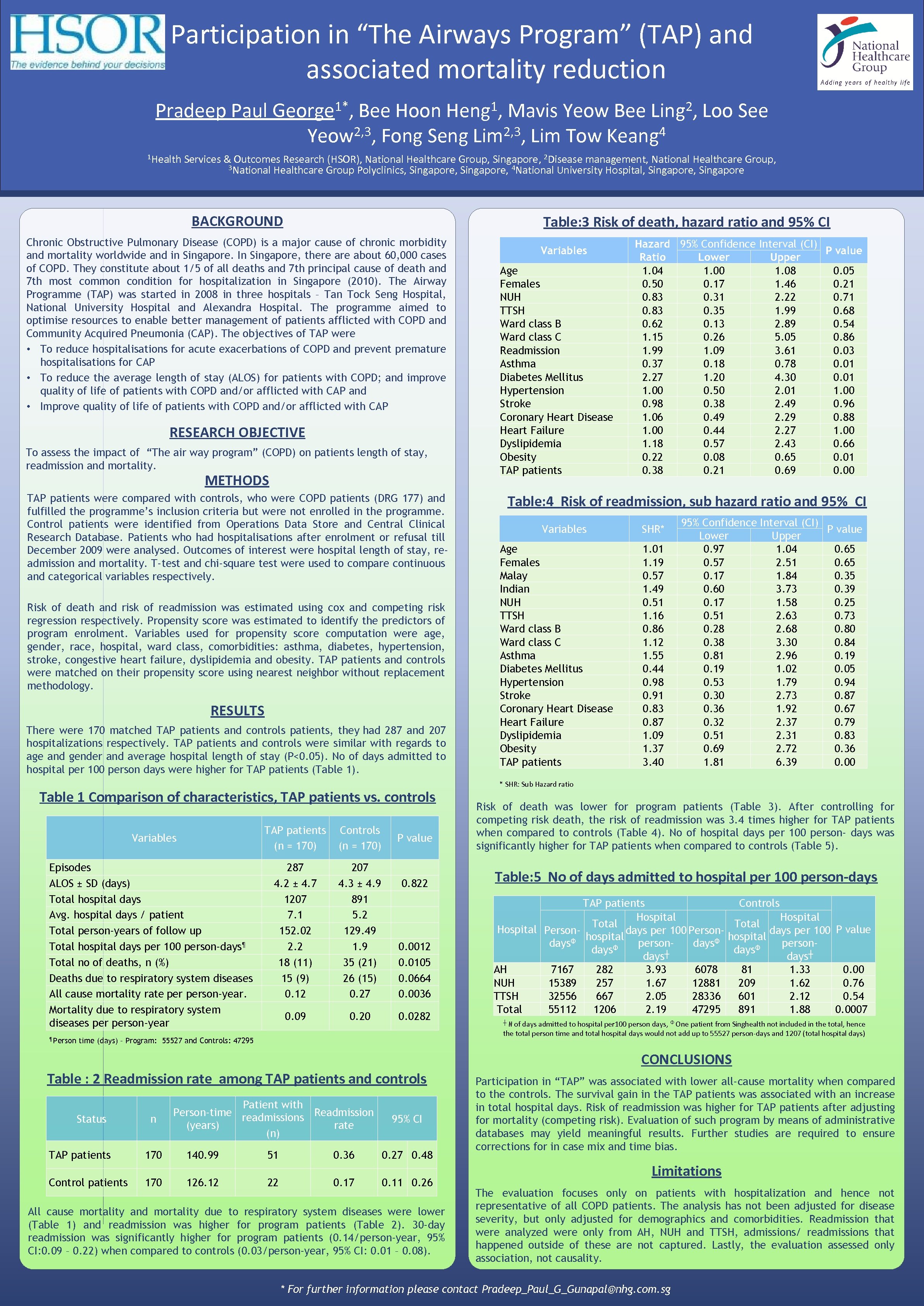 Participation in “The Airways Program” (TAP) and associated mortality reduction Pradeep Paul 1 Health 1*, George 1, Heng 2, Ling Bee Hoon Mavis Yeow Bee 2, 3, Fong Seng Lim 2, 3, Lim Tow Keang 4 Yeow Services & Outcomes Research (HSOR), National Healthcare Group, Singapore, 2 Disease management, National Healthcare Group, 3 National Healthcare Group Polyclinics, Singapore, 4 National University Hospital, Singapore BACKGROUND Table: 3 Risk of death, hazard ratio and 95% CI Chronic Obstructive Pulmonary Disease (COPD) is a major cause of chronic morbidity and mortality worldwide and in Singapore. In Singapore, there about 60, 000 cases of COPD. They constitute about 1/5 of all deaths and 7 th principal cause of death and 7 th most common condition for hospitalization in Singapore (2010). The Airway Programme (TAP) was started in 2008 in three hospitals – Tan Tock Seng Hospital, National University Hospital and Alexandra Hospital. The programme aimed to optimise resources to enable better management of patients afflicted with COPD and Community Acquired Pneumonia (CAP). The objectives of TAP were • To reduce hospitalisations for acute exacerbations of COPD and prevent premature hospitalisations for CAP • To reduce the average length of stay (ALOS) for patients with COPD; and improve quality of life of patients with COPD and/or afflicted with CAP and • Improve quality of life of patients with COPD and/or afflicted with CAP RESEARCH OBJECTIVE To assess the impact of “The air way program” (COPD) on patients length of stay, readmission and mortality. METHODS TAP patients were compared with controls, who were COPD patients (DRG 177) and fulfilled the programme’s inclusion criteria but were not enrolled in the programme. Control patients were identified from Operations Data Store and Central Clinical Research Database. Patients who had hospitalisations after enrolment or refusal till December 2009 were analysed. Outcomes of interest were hospital length of stay, readmission and mortality. T-test and chi-square test were used to compare continuous and categorical variables respectively. Risk of death and risk of readmission was estimated using cox and competing risk regression respectively. Propensity score was estimated to identify the predictors of program enrolment. Variables used for propensity score computation were age, gender, race, hospital, ward class, comorbidities: asthma, diabetes, hypertension, stroke, congestive heart failure, dyslipidemia and obesity. TAP patients and controls were matched on their propensity score using nearest neighbor without replacement methodology. RESULTS There were 170 matched TAP patients and controls patients, they had 287 and 207 hospitalizations respectively. TAP patients and controls were similar with regards to age and gender and average hospital length of stay (P<0. 05). No of days admitted to hospital per 100 person days were higher for TAP patients (Table 1). Table 1 Comparison of characteristics, TAP patients vs. controls TAP patients (n = 170) Variables Episodes ALOS ± SD (days) Total hospital days Avg. hospital days / patient Total person-years of follow up Total hospital days per 100 person-days¶ Total no of deaths, n (%) Deaths due to respiratory system diseases All cause mortality rate person-year. Mortality due to respiratory system diseases person-year ¶ Person Loo See Controls (n = 170) 287 4. 2 ± 4. 7 1207 7. 1 152. 02 2. 2 18 (11) 15 (9) 0. 12 207 4. 3 ± 4. 9 891 5. 2 129. 49 1. 9 35 (21) 26 (15) 0. 27 0. 0012 0. 0105 0. 0664 0. 0036 0. 09 0. 20 0. 0282 P value 0. 822 time (days) – Program: 55527 and Controls: 47295 Variables Age Females NUH TTSH Ward class B Ward class C Readmission Asthma Diabetes Mellitus Hypertension Stroke Coronary Heart Disease Heart Failure Dyslipidemia Obesity TAP patients Hazard 95% Confidence Interval (CI) P value Ratio Lower Upper 1. 04 1. 00 1. 08 0. 05 0. 50 0. 17 1. 46 0. 21 0. 83 0. 31 2. 22 0. 71 0. 83 0. 35 1. 99 0. 68 0. 62 0. 13 2. 89 0. 54 1. 15 0. 26 5. 05 0. 86 1. 99 1. 09 3. 61 0. 03 0. 37 0. 18 0. 78 0. 01 2. 27 1. 20 4. 30 0. 01 1. 00 0. 50 2. 01 1. 00 0. 98 0. 38 2. 49 0. 96 1. 06 0. 49 2. 29 0. 88 1. 00 0. 44 2. 27 1. 00 1. 18 0. 57 2. 43 0. 66 0. 22 0. 08 0. 65 0. 01 0. 38 0. 21 0. 69 0. 00 Table: 4 Risk of readmission, sub hazard ratio and 95% CI Variables Age Females Malay Indian NUH TTSH Ward class B Ward class C Asthma Diabetes Mellitus Hypertension Stroke Coronary Heart Disease Heart Failure Dyslipidemia Obesity TAP patients SHR* 1. 01 1. 19 0. 57 1. 49 0. 51 1. 16 0. 86 1. 12 1. 55 0. 44 0. 98 0. 91 0. 83 0. 87 1. 09 1. 37 3. 40 95% Confidence Interval (CI) P value Lower Upper 0. 97 1. 04 0. 65 0. 57 2. 51 0. 65 0. 17 1. 84 0. 35 0. 60 3. 73 0. 39 0. 17 1. 58 0. 25 0. 51 2. 63 0. 73 0. 28 2. 68 0. 80 0. 38 3. 30 0. 84 0. 81 2. 96 0. 19 1. 02 0. 05 0. 53 1. 79 0. 94 0. 30 2. 73 0. 87 0. 36 1. 92 0. 67 0. 32 2. 37 0. 79 0. 51 2. 31 0. 83 0. 69 2. 72 0. 36 1. 81 6. 39 0. 00 * SHR: Sub Hazard ratio Risk of death was lower for program patients (Table 3). After controlling for competing risk death, the risk of readmission was 3. 4 times higher for TAP patients when compared to controls (Table 4). No of hospital days per 100 person- days was significantly higher for TAP patients when compared to controls (Table 5). Table: 5 No of days admitted to hospital per 100 person-days TAP patients Controls Hospital Total Hospital Persondays per 100 P value Φ hospital days personΦ Φ days ┼ days┼ AH 7167 282 3. 93 6078 81 1. 33 0. 00 NUH 15389 257 1. 67 12881 209 1. 62 0. 76 TTSH 32556 667 2. 05 28336 601 2. 12 0. 54 Total 55112 1206 2. 19 47295 891 1. 88 0. 0007 # of days admitted to hospital per 100 person days, Φ One patient from Singhealth not included in the total, hence the total person time and total hospital days would not add up to 55527 person-days and 1207 (total hospital days) ┼ CONCLUSIONS Table : 2 Readmission rate among TAP patients and controls Status TAP patients Control patients n 170 Patient with Person-time readmissions Readmission (years) rate (n) 140. 99 126. 12 51 22 0. 36 0. 17 95% CI 0. 27 0. 48 0. 11 0. 26 All cause mortality and mortality due to respiratory system diseases were lower (Table 1) and readmission was higher for program patients (Table 2). 30 -day readmission was significantly higher for program patients (0. 14/person-year, 95% CI: 0. 09 – 0. 22) when compared to controls (0. 03/person-year, 95% CI: 0. 01 – 0. 08). Participation in “TAP” was associated with lower all-cause mortality when compared to the controls. The survival gain in the TAP patients was associated with an increase in total hospital days. Risk of readmission was higher for TAP patients after adjusting for mortality (competing risk). Evaluation of such program by means of administrative databases may yield meaningful results. Further studies are required to ensure corrections for in case mix and time bias. Limitations The evaluation focuses only on patients with hospitalization and hence not representative of all COPD patients. The analysis has not been adjusted for disease severity, but only adjusted for demographics and comorbidities. Readmission that were analyzed were only from AH, NUH and TTSH, admissions/ readmissions that happened outside of these are not captured. Lastly, the evaluation assessed only association, not causality. * For further information please contact Pradeep_Paul_G_Gunapal@nhg. com. sg