 Скачать презентацию PARTICIPATION BANKING IN TURKEY Turkish Participation Banking Strategy
2a0ad1a8c8eb0eb20f6f2a7be2aac2bc.ppt
- Количество слайдов: 22



PARTICIPATION BANKING IN TURKEY: Turkish Participation Banking Strategy Document 2015 -2025 Aydın YABANLI Deputy Manager Corporate Communications and R&D Department (PMO-Project Management Office) OIC-COMCEC Workshop; Ankara, March 17, 2016
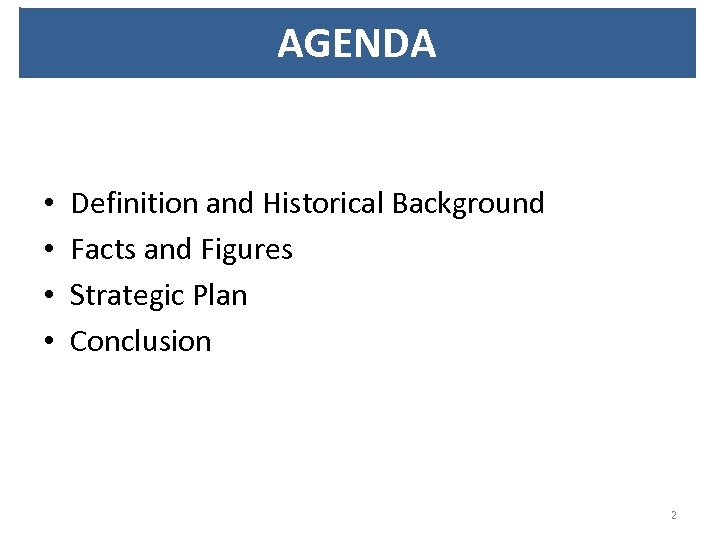
AGENDA • • Definition and Historical Background Facts and Figures Strategic Plan Conclusion 2
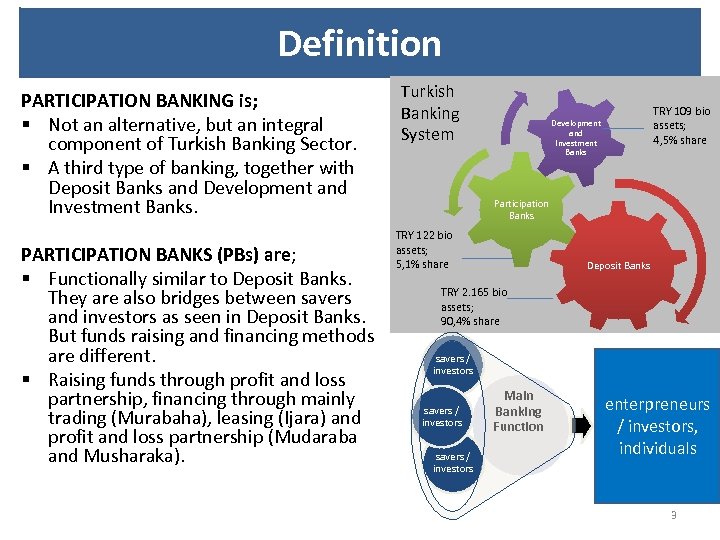
Definition PARTICIPATION BANKING is; § Not an alternative, but an integral component of Turkish Banking Sector. § A third type of banking, together with Deposit Banks and Development and Investment Banks. PARTICIPATION BANKS (PBs) are; § Functionally similar to Deposit Banks. They are also bridges between savers and investors as seen in Deposit Banks. But funds raising and financing methods are different. § Raising funds through profit and loss partnership, financing through mainly trading (Murabaha), leasing (Ijara) and profit and loss partnership (Mudaraba and Musharaka). Turkish Banking System TRY 109 bio assets; 4, 5% share Development and Investment Banks Participation Banks TRY 122 bio assets; 5, 1% share Deposit Banks TRY 2. 165 bio assets; 90, 4% share savers / investors Main Banking Function enterpreneurs / investors, individuals 3
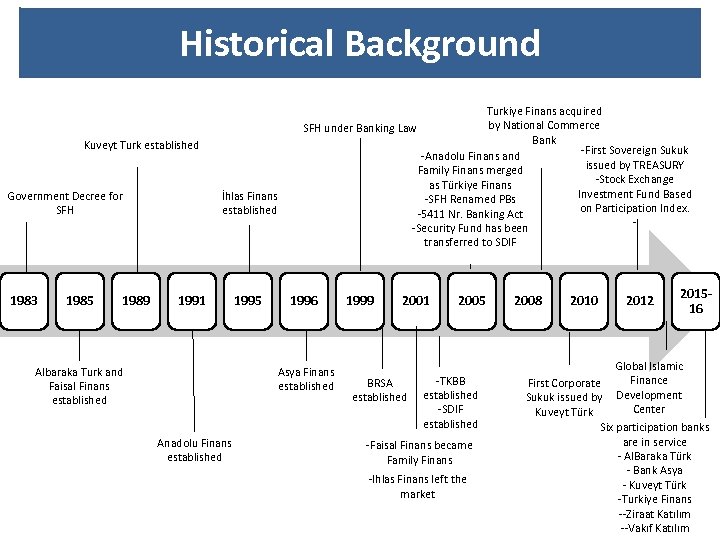
Historical Background Kuveyt Turk established Government Decree for SFH 1983 1985 1989 İhlas Finans established 1991 Albaraka Turk and Faisal Finans established 1995 Turkiye Finans acquired by National Commerce SFH under Banking Law Bank -First Sovereign Sukuk -Anadolu Finans and issued by TREASURY Family Finans merged -Stock Exchange as Türkiye Finans Investment Fund Based -SFH Renamed PBs on Participation Index. -5411 Nr. Banking Act -Security Fund has been transferred to SDIF 1996 Asya Finans established Anadolu Finans established 1999 2001 BRSA established 2005 -TKBB established -SDIF established -Faisal Finans became Family Finans -Ihlas Finans left the market 2008 2010 2012 201516 Global Islamic Finance Development Center First Corporate Sukuk issued by Kuveyt Türk Six participation banks are in service - Al. Baraka Türk - Bank Asya - Kuveyt Türk -Turkiye Finans --Ziraat Katılım --Vakıf Katılım
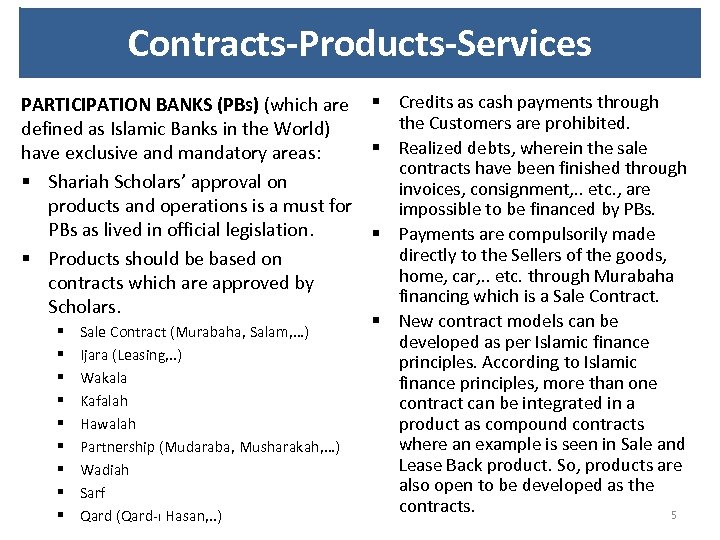
Contracts-Products-Services PARTICIPATION BANKS (PBs) (which are § Credits as cash payments through the Customers are prohibited. defined as Islamic Banks in the World) § Realized debts, wherein the sale have exclusive and mandatory areas: contracts have been finished through § Shariah Scholars’ approval on invoices, consignment, . . etc. , are products and operations is a must for impossible to be financed by PBs as lived in official legislation. § Payments are compulsorily made directly to the Sellers of the goods, § Products should be based on home, car, . . etc. through Murabaha contracts which are approved by financing which is a Sale Contract. Scholars. § New contract models can be § Sale Contract (Murabaha, Salam, …) § § § § Ijara (Leasing, . . ) Wakala Kafalah Hawalah Partnership (Mudaraba, Musharakah, …) Wadiah Sarf Qard (Qard-ı Hasan, . . ) developed as per Islamic finance principles. According to Islamic finance principles, more than one contract can be integrated in a product as compound contracts where an example is seen in Sale and Lease Back product. So, products are also open to be developed as the contracts. 5
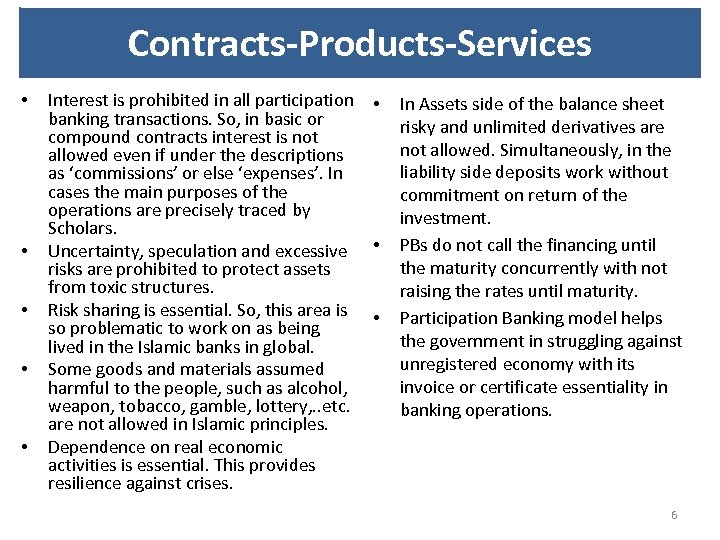
Contracts-Products-Services • • • Interest is prohibited in all participation banking transactions. So, in basic or compound contracts interest is not allowed even if under the descriptions as ‘commissions’ or else ‘expenses’. In cases the main purposes of the operations are precisely traced by Scholars. Uncertainty, speculation and excessive risks are prohibited to protect assets from toxic structures. Risk sharing is essential. So, this area is so problematic to work on as being lived in the Islamic banks in global. Some goods and materials assumed harmful to the people, such as alcohol, weapon, tobacco, gamble, lottery, . . etc. are not allowed in Islamic principles. Dependence on real economic activities is essential. This provides resilience against crises. • • • In Assets side of the balance sheet risky and unlimited derivatives are not allowed. Simultaneously, in the liability side deposits work without commitment on return of the investment. PBs do not call the financing until the maturity concurrently with not raising the rates until maturity. Participation Banking model helps the government in struggling against unregistered economy with its invoice or certificate essentiality in banking operations. 6
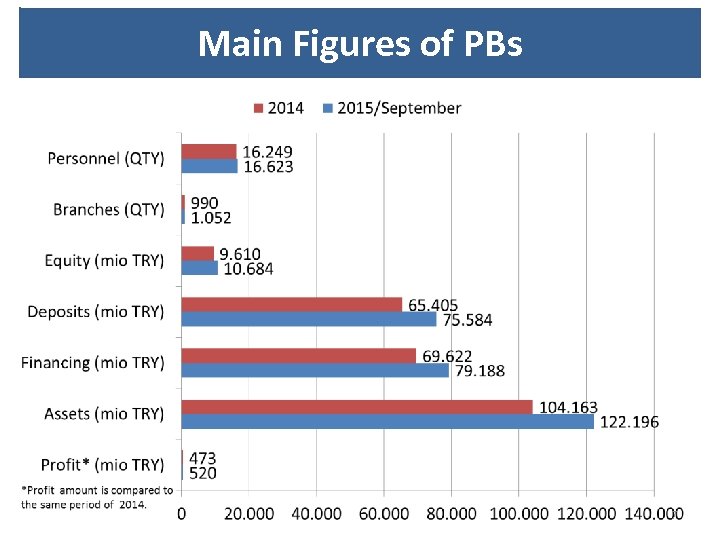
Main Figures of PBs 7
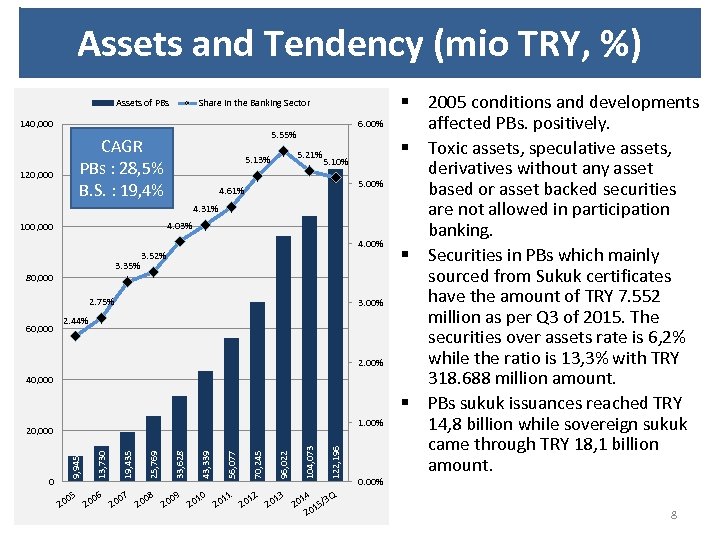
Assets and Tendency (mio TRY, %) Assets of PBs Share in the Banking Sector 140, 000 CAGR PBs : 28, 5% B. S. : 19, 4% 120, 000 6. 00% 5. 55% 5. 21% 5. 13% 5. 10% 5. 00% 4. 61% 4. 31% 4. 03% 100, 000 4. 00% 3. 35% 80, 000 3. 52% 2. 75% 60, 000 3. 00% 2. 44% 2. 00% 40, 000 1. 00% 25, 769 33, 628 43, 339 56, 077 70, 245 07 08 09 10 11 12 20 20 122, 196 19, 435 06 104, 073 13, 730 05 0 96, 022 9, 945 20, 000 13 014 /3 Q 20 2 15 20 0. 00% § 2005 conditions and developments affected PBs. positively. § Toxic assets, speculative assets, derivatives without any asset based or asset backed securities are not allowed in participation banking. § Securities in PBs which mainly sourced from Sukuk certificates have the amount of TRY 7. 552 million as per Q 3 of 2015. The securities over assets rate is 6, 2% while the ratio is 13, 3% with TRY 318. 688 million amount. § PBs sukuk issuances reached TRY 14, 8 billion while sovereign sukuk came through TRY 18, 1 billion amount. 8
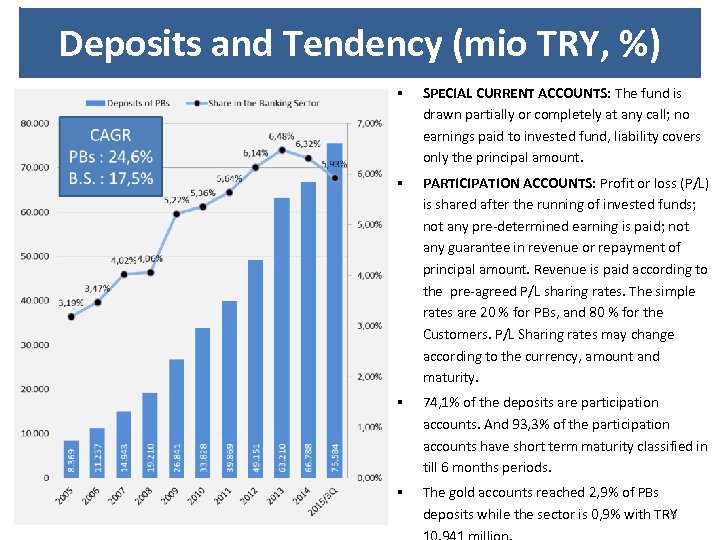
Deposits and Tendency (mio TRY, %) § SPECIAL CURRENT ACCOUNTS: The fund is drawn partially or completely at any call; no earnings paid to invested fund, liability covers only the principal amount. § PARTICIPATION ACCOUNTS: Profit or loss (P/L) is shared after the running of invested funds; not any pre-determined earning is paid; not any guarantee in revenue or repayment of principal amount. Revenue is paid according to the pre-agreed P/L sharing rates. The simple rates are 20 % for PBs, and 80 % for the Customers. P/L Sharing rates may change according to the currency, amount and maturity. § 74, 1% of the deposits are participation accounts. And 93, 3% of the participation accounts have short term maturity classified in till 6 months periods. § The gold accounts reached 2, 9% of PBs deposits while the sector is 0, 9% with TRY 9
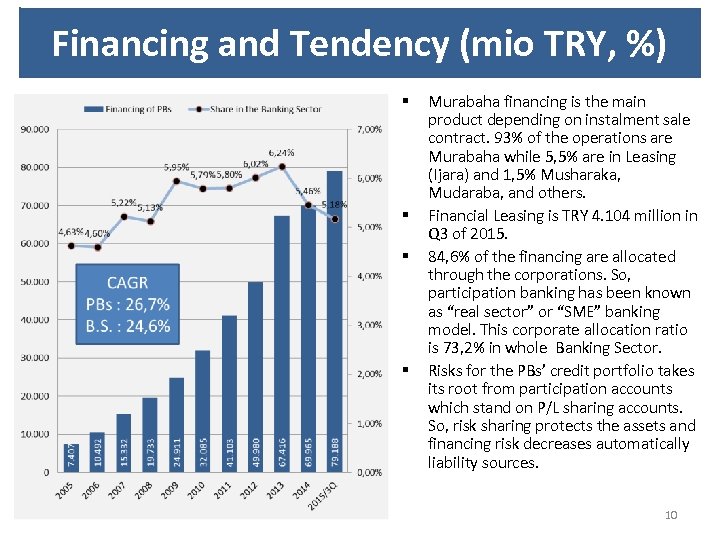
Financing and Tendency (mio TRY, %) § § Murabaha financing is the main product depending on instalment sale contract. 93% of the operations are Murabaha while 5, 5% are in Leasing (Ijara) and 1, 5% Musharaka, Mudaraba, and others. Financial Leasing is TRY 4. 104 million in Q 3 of 2015. 84, 6% of the financing are allocated through the corporations. So, participation banking has been known as “real sector” or “SME” banking model. This corporate allocation ratio is 73, 2% in whole Banking Sector. Risks for the PBs’ credit portfolio takes its root from participation accounts which stand on P/L sharing accounts. So, risk sharing protects the assets and financing risk decreases automatically liability sources. 10
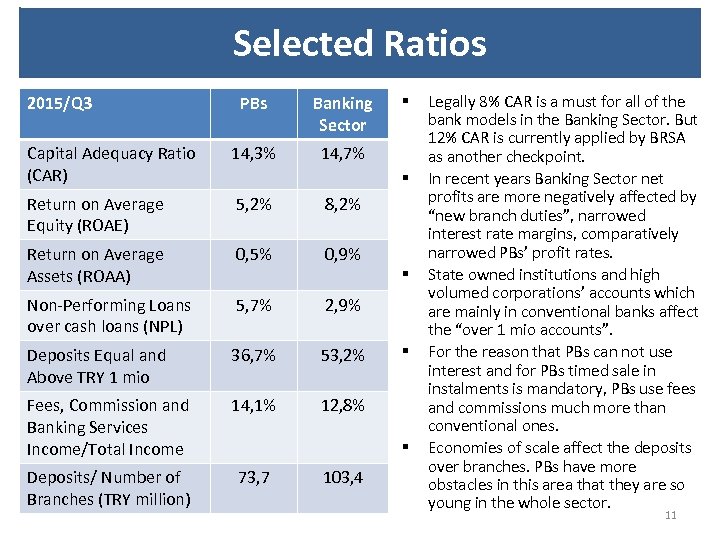
Selected Ratios 2015/Q 3 PBs Banking Sector Capital Adequacy Ratio (CAR) 14, 3% 14, 7% Return on Average Equity (ROAE) 5, 2% 8, 2% Return on Average Assets (ROAA) 0, 5% 0, 9% Non-Performing Loans over cash loans (NPL) 5, 7% 2, 9% Deposits Equal and Above TRY 1 mio 36, 7% 53, 2% Fees, Commission and Banking Services Income/Total Income 14, 1% 12, 8% Deposits/ Number of Branches (TRY million) 73, 7 § § § 103, 4 Legally 8% CAR is a must for all of the bank models in the Banking Sector. But 12% CAR is currently applied by BRSA as another checkpoint. In recent years Banking Sector net profits are more negatively affected by “new branch duties”, narrowed interest rate margins, comparatively narrowed PBs’ profit rates. State owned institutions and high volumed corporations’ accounts which are mainly in conventional banks affect the “over 1 mio accounts”. For the reason that PBs can not use interest and for PBs timed sale in instalments is mandatory, PBs use fees and commissions much more than conventional ones. Economies of scale affect the deposits over branches. PBs have more obstacles in this area that they are so young in the whole sector. 11
IFC-Strategy Document IFC-Prior Action Plan Potential of Istanbul Finance Center Report TBB, Deloitte 2007 2009 2013 2014 IFC Strategy and Action Development Plan – High Planning Ministry-10 th Supreme Planning Development Council Decision. Plan 2014 -2018 29/09/2009 GNAT Decision 02/07/2013 Islamic finance and PB. ing Development Component added into IFC Plan 16/02/2015 TKBB – Turkish Participation Banking Strategiy Document 2015 -2025 TKBB/BDDK – Workshop Report on Islamic finance and PBing IFC Actions last finalizing dates 2016 IFC Act is expected to be published Interest Free Coordination Council established 2018 Vision of Government 2021/6 Strategy Document Actions Last Finalizing Dates 2023 2025 Vision of Strategy Document
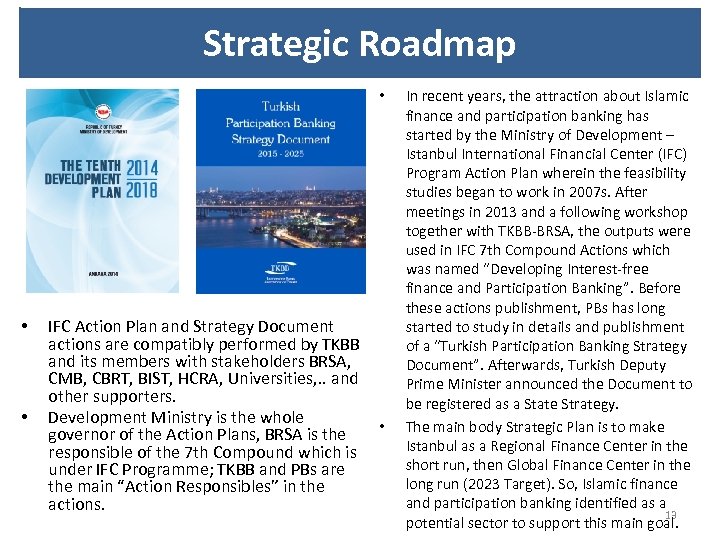
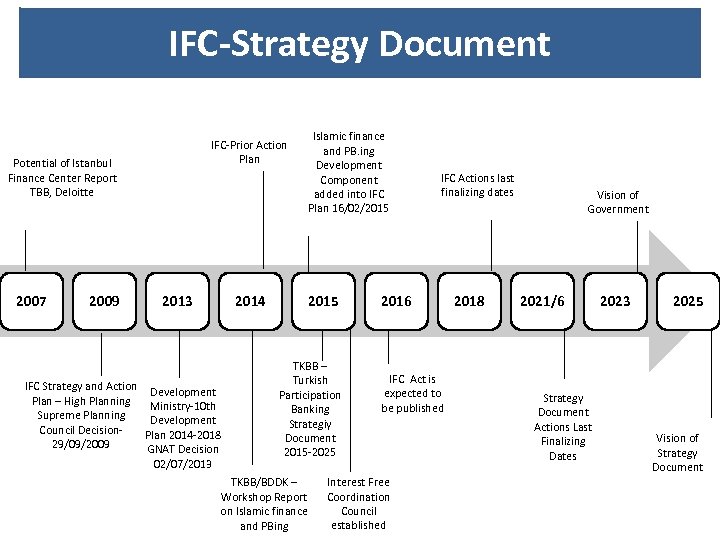
Strategic Roadmap • • • IFC Action Plan and Strategy Document actions are compatibly performed by TKBB and its members with stakeholders BRSA, CMB, CBRT, BIST, HCRA, Universities, . . and other supporters. Development Ministry is the whole governor of the Action Plans, BRSA is the responsible of the 7 th Compound which is under IFC Programme; TKBB and PBs are the main “Action Responsibles” in the actions. • In recent years, the attraction about Islamic finance and participation banking has started by the Ministry of Development – Istanbul International Financial Center (IFC) Program Action Plan wherein the feasibility studies began to work in 2007 s. After meetings in 2013 and a following workshop together with TKBB-BRSA, the outputs were used in IFC 7 th Compound Actions which was named “Developing Interest-free finance and Participation Banking”. Before these actions publishment, PBs has long started to study in details and publishment of a “Turkish Participation Banking Strategy Document”. Afterwards, Turkish Deputy Prime Minister announced the Document to be registered as a State Strategy. The main body Strategic Plan is to make Istanbul as a Regional Finance Center in the short run, then Global Finance Center in the long run (2023 Target). So, Islamic finance and participation banking identified as a 13 potential sector to support this main goal.
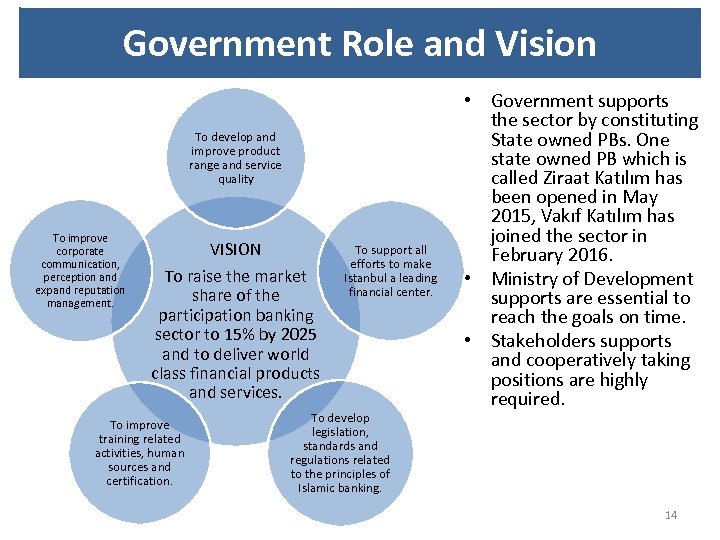
Government Role and Vision To develop and improve product range and service quality To improve corporate communication, perception and expand reputation management. VISION To raise the market share of the participation banking sector to 15% by 2025 and to deliver world class financial products and services. To improve training related activities, human sources and certification. To support all efforts to make Istanbul a leading financial center. To develop legislation, standards and regulations related to the principles of Islamic banking. • Government supports the sector by constituting State owned PBs. One state owned PB which is called Ziraat Katılım has been opened in May 2015, Vakıf Katılım has joined the sector in February 2016. • Ministry of Development supports are essential to reach the goals on time. • Stakeholders supports and cooperatively taking positions are highly required. 14
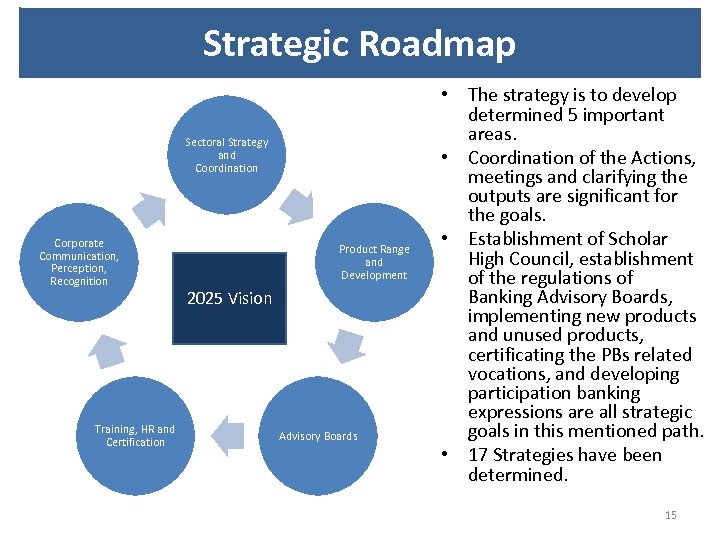
Strategic Roadmap Sectoral Strategy and Coordination Corporate Communication, Perception, Recognition Training, HR and Certification Product Range and Development 2025 Vision Advisory Boards • The strategy is to develop determined 5 important areas. • Coordination of the Actions, meetings and clarifying the outputs are significant for the goals. • Establishment of Scholar High Council, establishment of the regulations of Banking Advisory Boards, implementing new products and unused products, certificating the PBs related vocations, and developing participation banking expressions are all strategic goals in this mentioned path. • 17 Strategies have been determined. 15
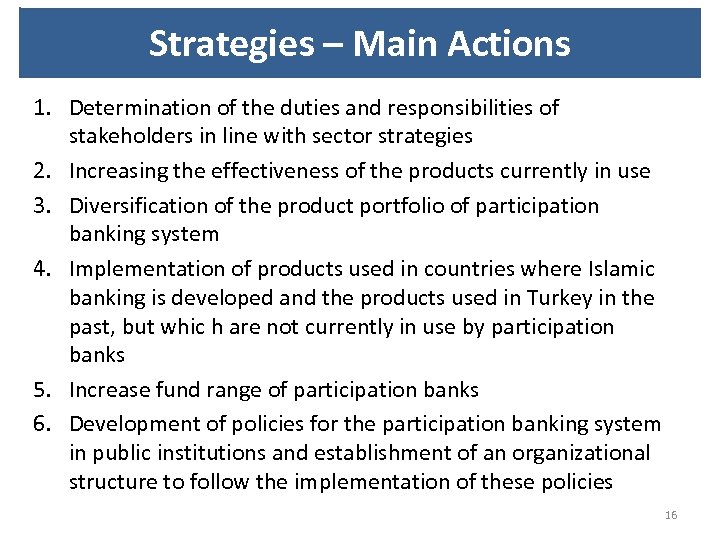
Strategies – Main Actions 1. Determination of the duties and responsibilities of stakeholders in line with sector strategies 2. Increasing the effectiveness of the products currently in use 3. Diversification of the product portfolio of participation banking system 4. Implementation of products used in countries where Islamic banking is developed and the products used in Turkey in the past, but whic h are not currently in use by participation banks 5. Increase fund range of participation banks 6. Development of policies for the participation banking system in public institutions and establishment of an organizational structure to follow the implementation of these policies 16
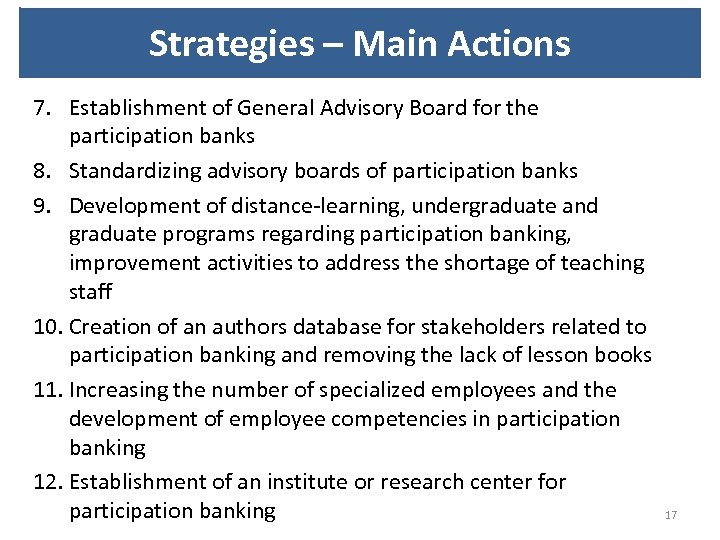
Strategies – Main Actions 7. Establishment of General Advisory Board for the participation banks 8. Standardizing advisory boards of participation banks 9. Development of distance-learning, undergraduate and graduate programs regarding participation banking, improvement activities to address the shortage of teaching staff 10. Creation of an authors database for stakeholders related to participation banking and removing the lack of lesson books 11. Increasing the number of specialized employees and the development of employee competencies in participation banking 12. Establishment of an institute or research center for participation banking 17
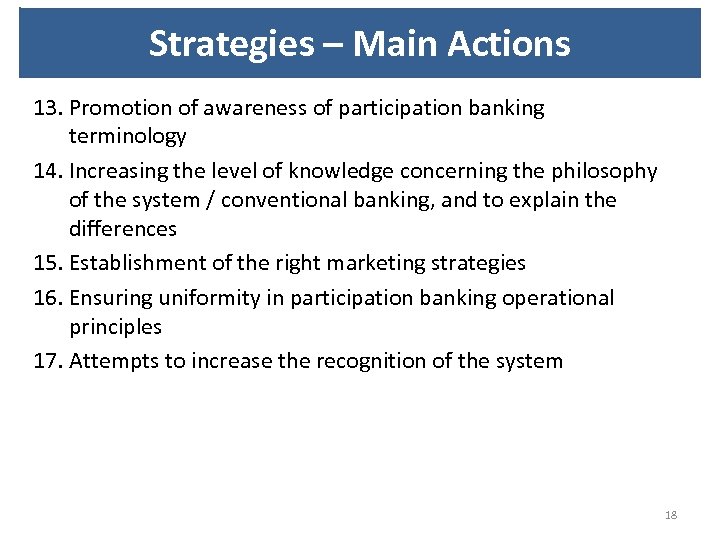
Strategies – Main Actions 13. Promotion of awareness of participation banking terminology 14. Increasing the level of knowledge concerning the philosophy of the system / conventional banking, and to explain the differences 15. Establishment of the right marketing strategies 16. Ensuring uniformity in participation banking operational principles 17. Attempts to increase the recognition of the system 18
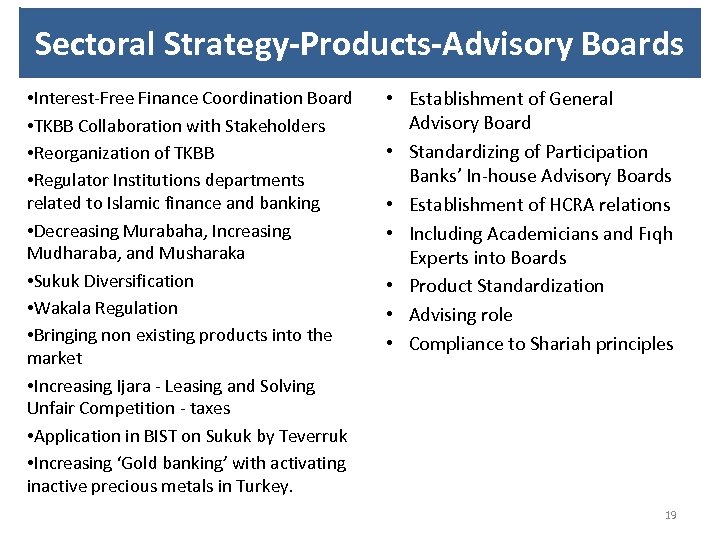
Sectoral Strategy-Products-Advisory Boards • Interest-Free Finance Coordination Board • TKBB Collaboration with Stakeholders • Reorganization of TKBB • Regulator Institutions departments related to Islamic finance and banking • Decreasing Murabaha, Increasing Mudharaba, and Musharaka • Sukuk Diversification • Wakala Regulation • Bringing non existing products into the market • Increasing Ijara - Leasing and Solving Unfair Competition - taxes • Application in BIST on Sukuk by Teverruk • Increasing ‘Gold banking’ with activating inactive precious metals in Turkey. • Establishment of General Advisory Board • Standardizing of Participation Banks’ In-house Advisory Boards • Establishment of HCRA relations • Including Academicians and Fıqh Experts into Boards • Product Standardization • Advising role • Compliance to Shariah principles 19
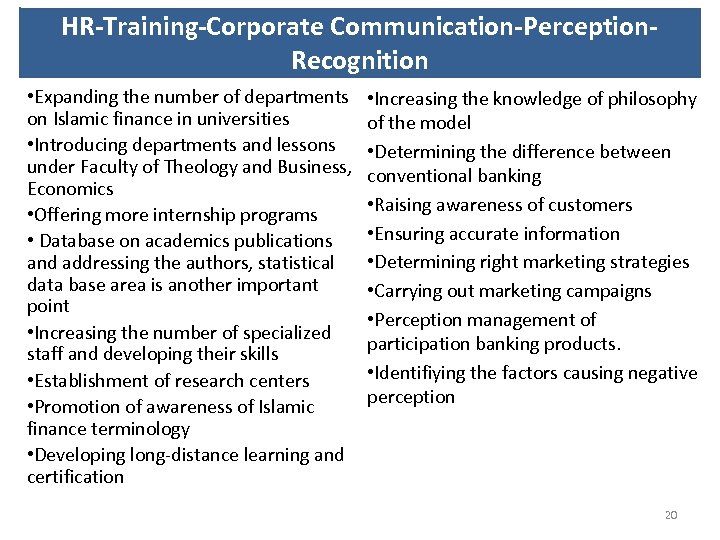
HR-Training-Corporate Communication-Perception. Recognition • Expanding the number of departments on Islamic finance in universities • Introducing departments and lessons under Faculty of Theology and Business, Economics • Offering more internship programs • Database on academics publications and addressing the authors, statistical data base area is another important point • Increasing the number of specialized staff and developing their skills • Establishment of research centers • Promotion of awareness of Islamic finance terminology • Developing long-distance learning and certification • Increasing the knowledge of philosophy of the model • Determining the difference between conventional banking • Raising awareness of customers • Ensuring accurate information • Determining right marketing strategies • Carrying out marketing campaigns • Perception management of participation banking products. • Identifiying the factors causing negative perception 20
Conclusion • Turkey is a leading Country in its region with great potentials and eager in Islamic finance and banking with its stakeholders, as corporate and state partners. • “Sharing” is the base of this model for it is highly needed for a stable prosperity development. • If the cake expands, we will face much more prosperity to share. • Islamic Banking model, which relies on risk sharing, is helping not only to these goals but to the labour and capital relations peace also. • These banking model is “Shariah compliant banking model” and the difference is the point that all the stakeholders must supervise and protect. 21
Thank You Aydın YABANLI Deputy Manager Corporate Communications and R&D Department (PMO-Project Management Office) Office: : +90216 651 94 35 Mobile: +90505 723 23 89 E-mail: aydinyabanli@tkbb. org. tr
Скачать презентацию PARTICIPATION BANKING IN TURKEY Turkish Participation Banking Strategy
2a0ad1a8c8eb0eb20f6f2a7be2aac2bc.ppt