


 Скачать презентацию Participation and Empowerment of Migrants in Austria EU-Grundtvig
f386fd611150fa588e6d156a694ab40b.ppt
- Количество слайдов: 21
 Participation and Empowerment of Migrants in Austria EU-Grundtvig Project 22 – 25 March 2011 Caritas Linz – Migrant. Innenhilfe Mag. Evelina Glöckner
 Overview l Facts & Figures l National Level - Legal Framework - Impact on Politics - Impact on Economy (also Employment, Education und Qualification) - Impact on Culture l Regional Level - Integration Concept of Upper Austria - Integration Concept Vienna l Organisational Level - Empowerment Concept „Help the people to help themselves“ - Objectives - Obstacles to Empowerment (Society and individual obstacles; organisational Bottlenecks)
 Facts & Figures At the beginning of 2010: l Foreign residents: 895, 000 (10. 7%) l Residents with a migrant background: 1, 468 million (17. 8%) l First generation : 1, 082 million l Second generation: 385, 500
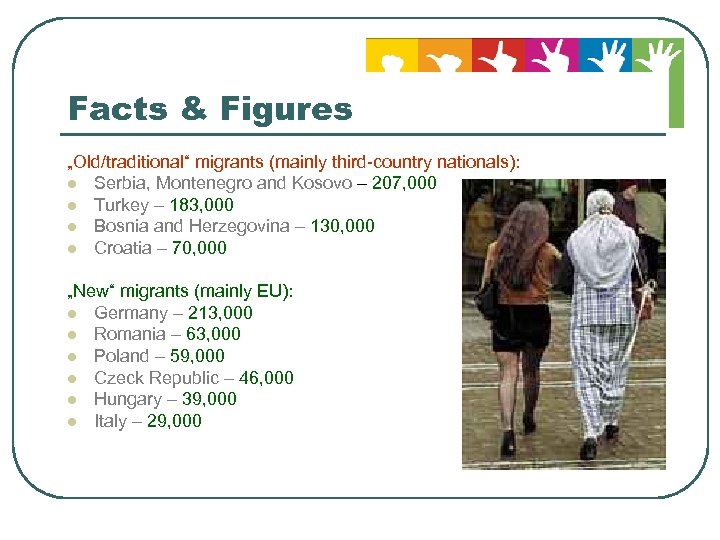 Facts & Figures „Old/traditional“ migrants (mainly third-country nationals): l Serbia, Montenegro and Kosovo – 207, 000 l Turkey – 183, 000 l Bosnia and Herzegovina – 130, 000 l Croatia – 70, 000 „New“ migrants (mainly EU): l Germany – 213, 000 l Romania – 63, 000 l Poland – 59, 000 l Czeck Republic – 46, 000 l Hungary – 39, 000 l Italy – 29, 000
 National Level Legal Framework l Austria has no comprehensive integration strategy – a fact that was l In 2010, the government committed to a National Action Plan for Integration, after years of NGO consultations, an integration plattform, expert noted with concern by the European Commission against Racism and Intolerance (ECRI) in its fourth report on Austria published in March 2010 reports and panels, statistics and new indicators. This process of policy change has produced much paper and discussion, but few improvements so far l Most initiatives to promote integration are still local and regional projects, limited in time and reach. These ‘best practices’ cannot overcome all the obstacles to integration in the national legal framework l Austrian Integration Fund
 National Level Impact on Politics l Third country nationals have no right to vote und to stand for elections (minicipal councils, provincial parliaments, national parliament) l Political participation in trade unions and representations of interests ist possible but restricted (Workers´ Councils, Student representation) l Participation through „Foreigners` Councils“ (Ausländerbeiräte) l Traditional route of political participation ist naturalisation (obtaining Austrian citizenship)
 National Level Impact on Politics l Political parties began to discover the potential of immigrant votes in elections in recent years and started placing naturalised immigrants to their lists l Self-organisation of immigrants/ migrant organisations l Austria’s foreign residents have been encouraged to participate politically through ad hoc funding and consultations (e. g. in Graz, Vienna, Styria). That these projects have been overlooked for national policy is a major weakness in Austria’s National Action Plan for Integration
 National Level Impact on Economy l Migrants have a lower annual income than natives, due to various factors: lower skills and concentration on low wage industries, high proportion of seasonal work and limited opportunities to join core work force of enterprises l Migrants tend to have higher unemployment rates than natives l Migrants are increasingly turning to self-employment by setting up business in services und retail trade (cleaning, restaurants, food, transportation, etc. ) l Austria has not been able yet to attract highly skilled migrant workers in large numbers either because of limited demand for these skills or because of perceived or real bureaucratic hurdles and red tape
 National Level Impact on Economy Employment l Migrants have been included in the country’s labour market objectives. Combined language and vocational training ist being offered l Migrant youth may get better jobs through career coaching and mentoring, while migrant women may benefit from special programmes on language, health, sports and domestic violence l In the future, government wants more migrants in the public sector, including the police, schools, justice, health l Ending EU citizens’ transitional measures in May 2011 (2013 for BG and RO)
 National Level Impact on Economy Obstacles to employment l Recognition of foreign qualifications l Low educational level (third country residents) l Insufficient language proficiency l No free access to the labour market for non-EU temporary residents l Discrimination
 National Level Impact on Economy Education and Qualification l The number of immigrants in the highest and lowest education levels is above average ( lowest – third country nationals, highest mainly EU immigrants) l Compulsory Kindergarten year for preschool aged children l Immigrant pupils rarely attend schools where they can earn a high school diploma. They attend more offen secondary, polytechnic, and vocational schools l In special needs schools the proportion of foreign children was almost twice as high, at about 19%, mostly citizens of former Yugoslavia and Turkey
 National Level Impact on Economy Education and Qualification l The educational level of the second generation has already considerably adapted to that of the Austrian population (an above average percentage of the Austrian population has completed mid-level education in trade and vocational training programs) l There is an urgent need for action with young people who have only completed compulsory school or have no leaving certificate l Around 15% of the non-German speaking schoolchildren who have completed the eighth school year at a secondary school do not continue their education
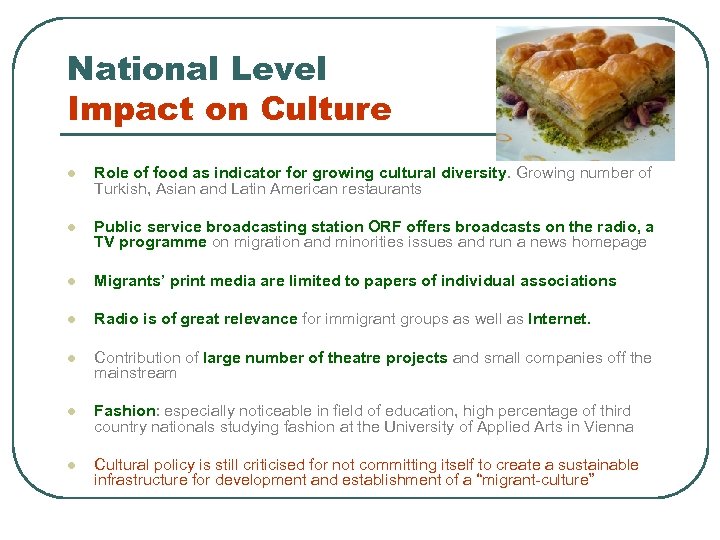 National Level Impact on Culture l Role of food as indicator for growing cultural diversity. Growing number of Turkish, Asian and Latin American restaurants l Public service broadcasting station ORF offers broadcasts on the radio, a TV programme on migration and minorities issues and run a news homepage l Migrants’ print media are limited to papers of individual associations l Radio is of great relevance for immigrant groups as well as Internet. l Contribution of large number of theatre projects and small companies off the mainstream l Fashion: especially noticeable in field of education, high percentage of third country nationals studying fashion at the University of Applied Arts in Vienna l Cultural policy is still criticised for not committing itself to create a sustainable infrastructure for development and establishment of a “migrant-culture”
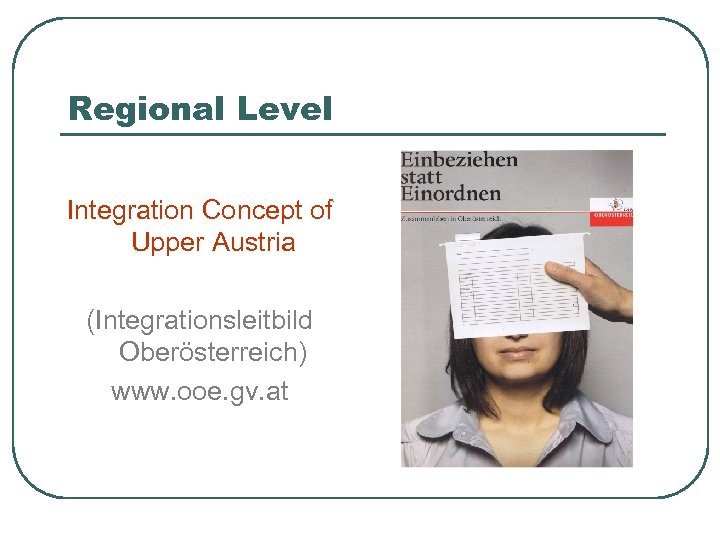 Regional Level Integration Concept of Upper Austria (Integrationsleitbild Oberösterreich) www. ooe. gv. at
 Regional Level
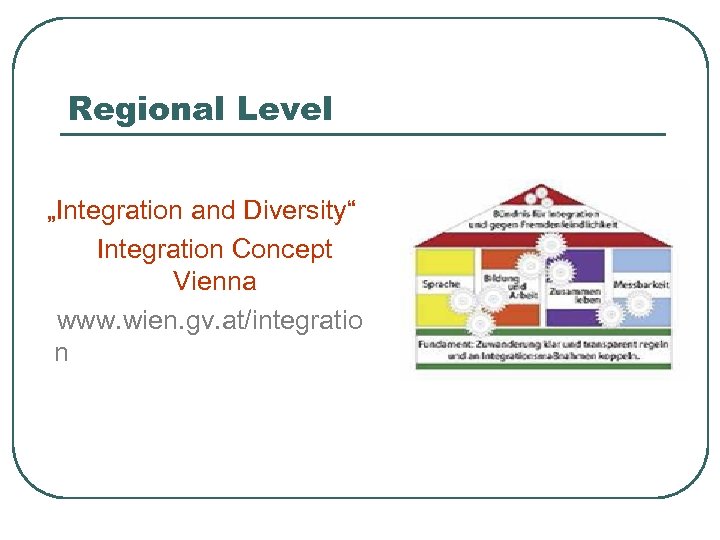 Regional Level „Integration and Diversity“ Integration Concept Vienna www. wien. gv. at/integratio n
 Organisational Level Empowerment Concept „Help the people to help themselves“ • Legal counseling • Financial und material help • Support in case of problems with authorities • Integration events • German language courses • Pool of interpreteurs • Interreligious dialogue • Women`s empowerment projects • Seminars and Workshops
 Organisational Level Objectives Ø Reduce information deficits in migrant communities on austrian health, welfare and education system Ø Improve German skills Ø Increase health awareness among migrant communities Ø Increase the take-up rate of education and health facilities Ø Foster participation and autonomy of migrants Ø Reduce deprivation Ø Increase take-up rate of public transfers and cost-free services Ø Foster intercultural dialogue Ø Fight racism and xenophobia
 Organisational Level Obstacles to Empowerment (Society) l l l Legal und sozial disadvantage Political inequality Stigmatisation Discrimination Disqualification Xenophobia Mobbing Judgement by appearance Automatic exclusion Unequal chances Verbal aggressions/insults Emotional violence
 Organisational Level Obstacles to Empowerment (individual) l l l l Culture shock Life-changing crisis Psychlogical disorders Deprivation Disorganisation Devaluation Regression Helplessness Anger Blackout Thought of suicide Depression Low self-esteem l l l Lack of perspectives Lack of knowledge Identity problems Sorrow Depts
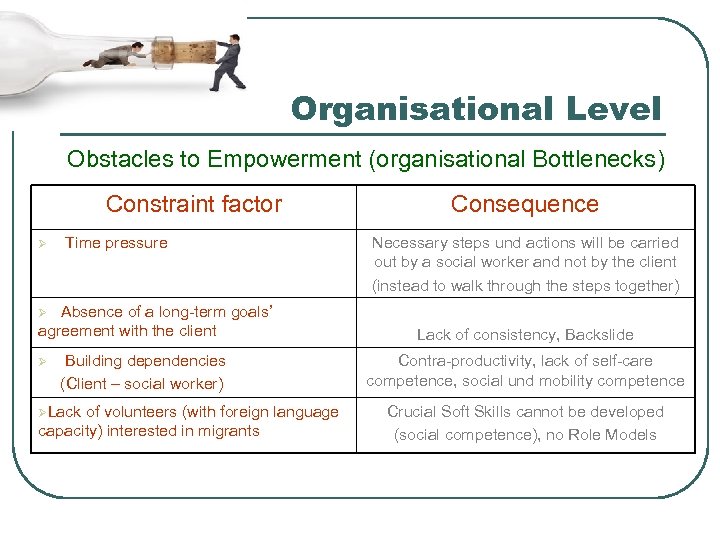 Organisational Level Obstacles to Empowerment (organisational Bottlenecks) Constraint factor Ø Time pressure Absence of a long-term goals’ agreement with the client Consequence Necessary steps und actions will be carried out by a social worker and not by the client (instead to walk through the steps together) Ø Ø Building dependencies (Client – social worker) ØLack of volunteers (with foreign language capacity) interested in migrants Lack of consistency, Backslide Contra-productivity, lack of self-care competence, social und mobility competence Crucial Soft Skills cannot be developed (social competence), no Role Models