


 Скачать презентацию Part V Centimeter-Level Instantaneous Long-Range RTK Methodology Algorithms
13057390dd776d20289b00d306f0bd9b.ppt
- Количество слайдов: 41
 Part V Centimeter-Level Instantaneous Long-Range RTK: Methodology, Algorithms and Application GS 894 G
 Presentation Outline Ø Network RTK – Concept and Benefits Ø Research Objectives Ø The MPGPS™ Software Ø Methodology and Algorithms Ø Experiments and Test Results Ø Summary and Conclusions Ø Current and Future Developments
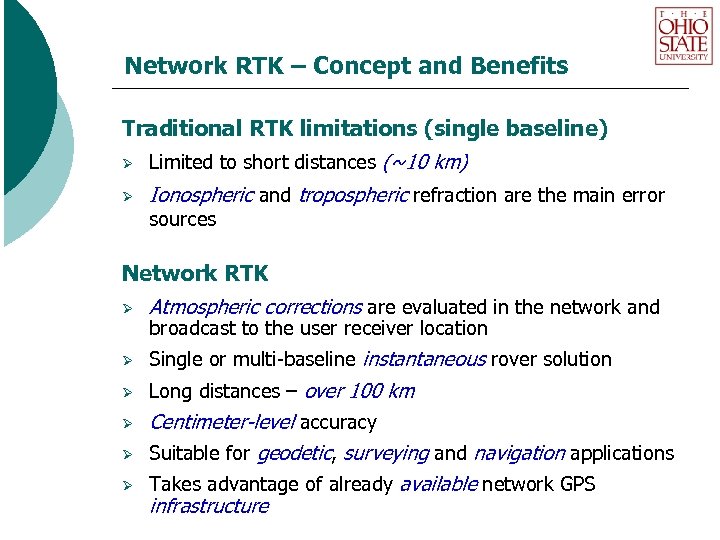 Network RTK – Concept and Benefits Traditional RTK limitations (single baseline) Ø Limited to short distances (~10 km) Ø Ionospheric and tropospheric refraction are the main error sources Network RTK Ø Atmospheric corrections are evaluated in the network and broadcast to the user receiver location Ø Single or multi-baseline instantaneous rover solution Ø Long distances – over 100 km Ø Ø Ø Centimeter-level accuracy Suitable for geodetic, surveying and navigation applications Takes advantage of already available network GPS infrastructure
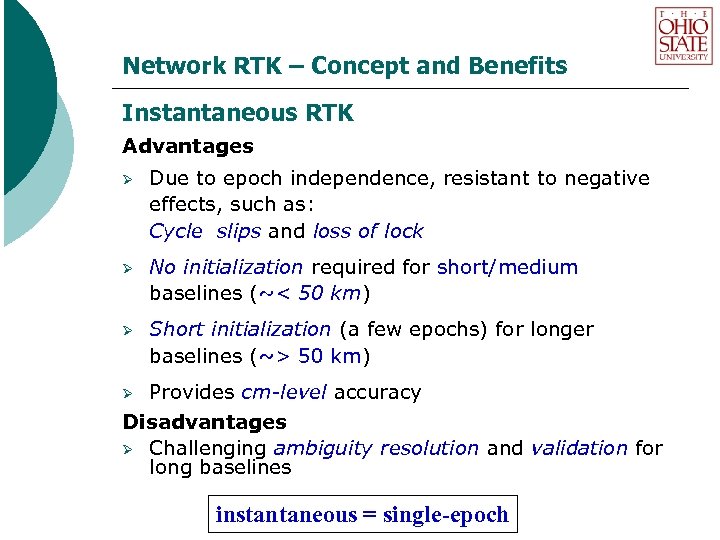 Network RTK – Concept and Benefits Instantaneous RTK Advantages Ø Due to epoch independence, resistant to negative effects, such as: Cycle slips and loss of lock Ø No initialization required for short/medium baselines (~< 50 km) Ø Short initialization (a few epochs) for longer baselines (~> 50 km) Ø Provides cm-level accuracy Disadvantages Ø Challenging ambiguity resolution and validation for long baselines instantaneous = single-epoch
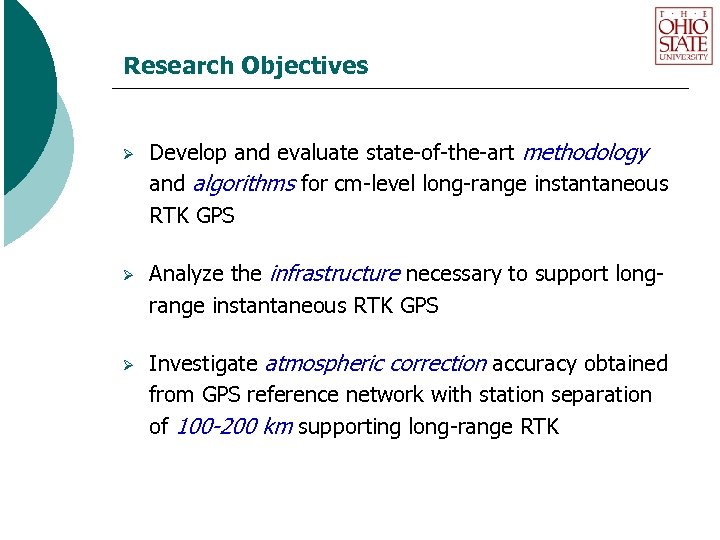 Research Objectives Ø Ø Ø Develop and evaluate state-of-the-art methodology and algorithms for cm-level long-range instantaneous RTK GPS Analyze the infrastructure necessary to support longrange instantaneous RTK GPS Investigate atmospheric correction accuracy obtained from GPS reference network with station separation of 100 -200 km supporting long-range RTK
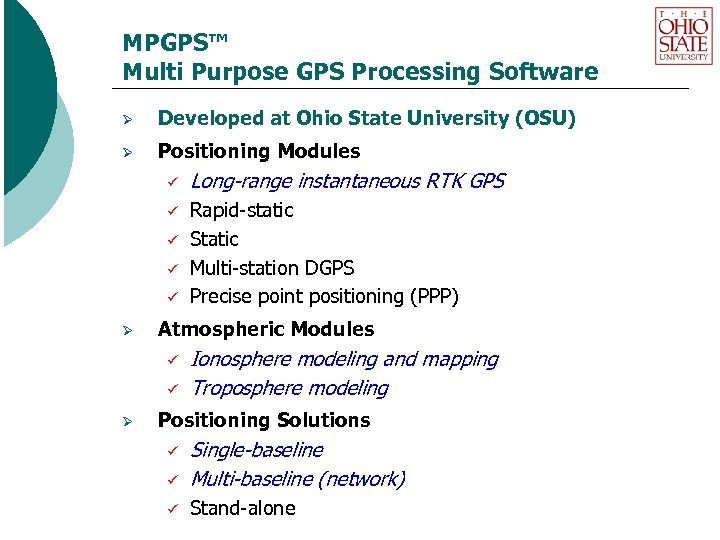 MPGPS™ Multi Purpose GPS Processing Software Ø Developed at Ohio State University (OSU) Ø Positioning Modules ü ü ü Ø Rapid-static Static Multi-station DGPS Precise point positioning (PPP) Atmospheric Modules ü ü Ø Long-range instantaneous RTK GPS Ionosphere modeling and mapping Troposphere modeling Positioning Solutions ü Single-baseline Multi-baseline (network) ü Stand-alone ü
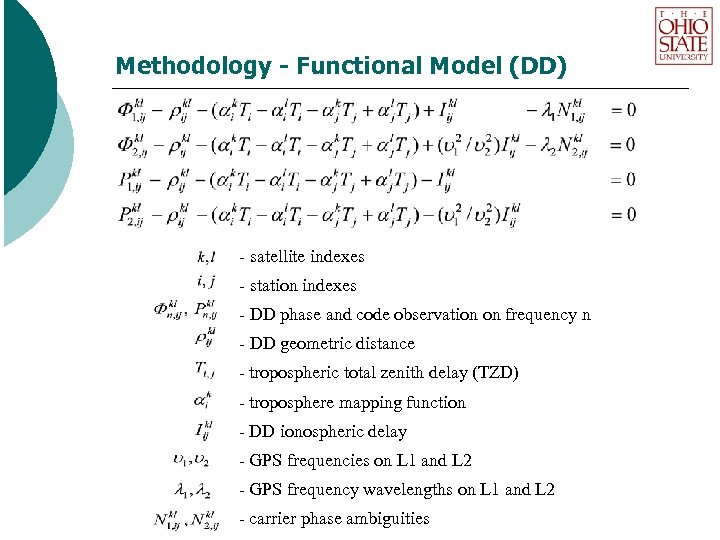 Methodology - Functional Model (DD) - satellite indexes - station indexes - DD phase and code observation on frequency n - DD geometric distance - tropospheric total zenith delay (TZD) - troposphere mapping function - DD ionospheric delay - GPS frequencies on L 1 and L 2 - GPS frequency wavelengths on L 1 and L 2 - carrier phase ambiguities
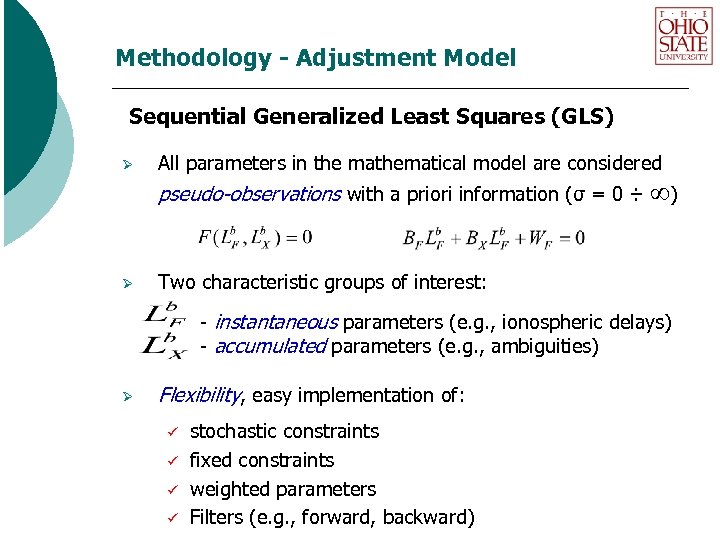 Methodology - Adjustment Model Sequential Generalized Least Squares (GLS) Ø All parameters in the mathematical model are considered pseudo-observations with a priori information (σ = 0 ÷ ) Ø Two characteristic groups of interest: - instantaneous parameters (e. g. , ionospheric delays) - accumulated parameters (e. g. , ambiguities) Ø Flexibility, easy implementation of: ü ü stochastic constraints fixed constraints weighted parameters Filters (e. g. , forward, backward)
 Methodology - Network Solution Network correction generation Ø Precisely known reference station coordinates Ø Double-difference (DD) ionospheric delay estimation and decomposition to zero-difference (ZD) Ø Single layer model (SLM) ionosphere approximation Ø Tropospheric total zenith delay (TZD) estimation Ambiguity resolution (AR) Ø Least square AMBiguity Decorrelation Algorithm (LAMBDA) Validation Ø W-ratio and success-rate Unknowns Ø DD Ionospheric delays, Tropospheric TZD per station, DD ambiguities The network corrections are broadcast to the rover in a form of a grid
 Methodology - Network Solution Ionospheric delay decomposition Ø n-2 linearly independent DD observation equations for an individual baseline and n ZDs, thus rigorous decomposition is not possible Solutions Ø Ø Introduce additional independent constraints on at least two ZD delay parameters Introduce loose constraints to the diagonal of the normal matrix Both methods are numerically identical However, the first method results in an “unbiased” estimate while the second one provides a “biased” estimate in the least squares sense
 Methodology - Network Solution Single layer model (SLM) ionosphere approximation ü Slant ionospheric delays estimation from dual-frequency GPS data at the permanent stations ü Slant ionospheric delays conversion to vertical total electron content (VTEC) at ionosphere pierce points (IPPs) ü Kriging interpolation to produce LIM in a form of a grid using the calculated vertical TEC values at IPPs
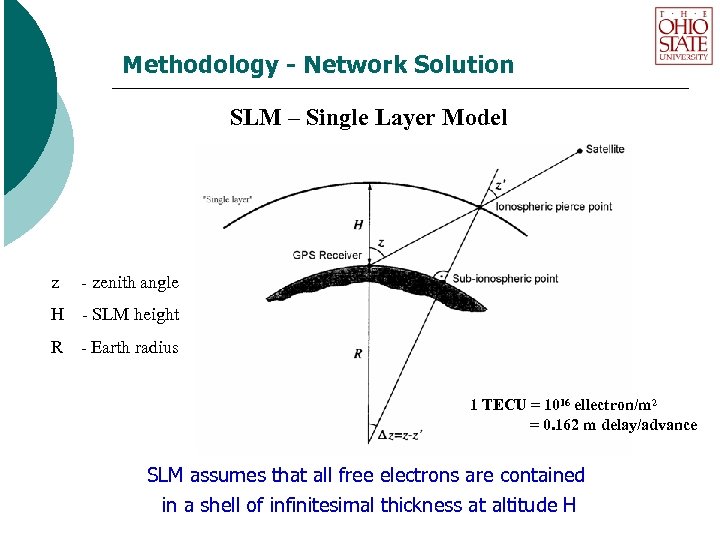 Methodology - Network Solution SLM – Single Layer Model z - zenith angle H - SLM height R - Earth radius 1 TECU = 1016 ellectron/m 2 = 0. 162 m delay/advance SLM assumes that all free electrons are contained in a shell of infinitesimal thickness at altitude H
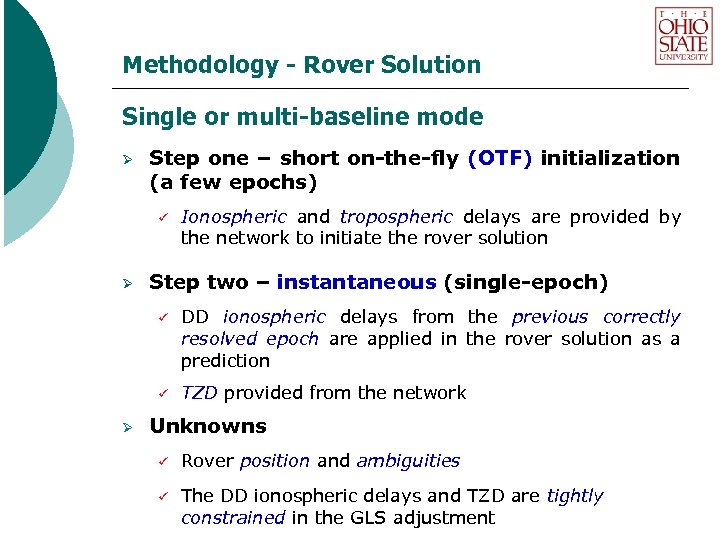 Methodology - Rover Solution Single or multi-baseline mode Ø Step one – short on-the-fly (OTF) initialization (a few epochs) ü Ø Ionospheric and tropospheric delays are provided by the network to initiate the rover solution Step two – instantaneous (single-epoch) ü ü Ø DD ionospheric delays from the previous correctly resolved epoch are applied in the rover solution as a prediction TZD provided from the network Unknowns ü Rover position and ambiguities ü The DD ionospheric delays and TZD are tightly constrained in the GLS adjustment
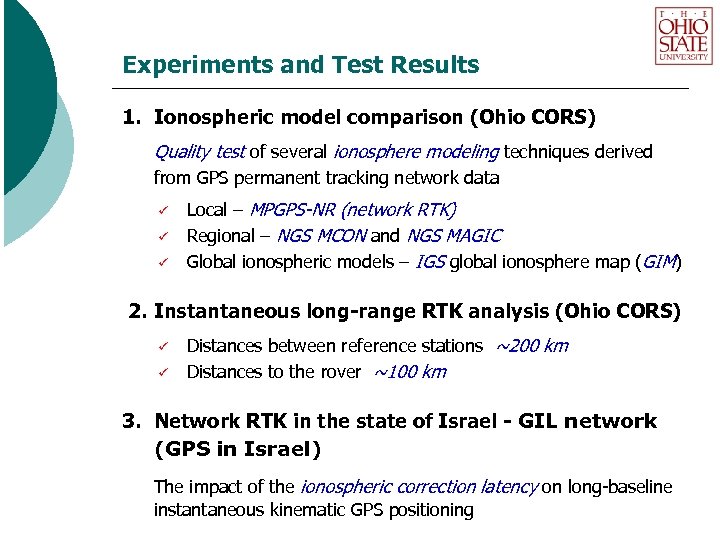 Experiments and Test Results 1. Ionospheric model comparison (Ohio CORS) Quality test of several ionosphere modeling techniques derived from GPS permanent tracking network data ü ü ü Local – MPGPS-NR (network RTK) Regional – NGS MCON and NGS MAGIC Global ionospheric models – IGS global ionosphere map (GIM) 2. Instantaneous long-range RTK analysis (Ohio CORS) ü ü Distances between reference stations ~200 km Distances to the rover ~100 km 3. Network RTK in the state of Israel - GIL network (GPS in Israel) The impact of the ionospheric correction latency on long-baseline instantaneous kinematic GPS positioning
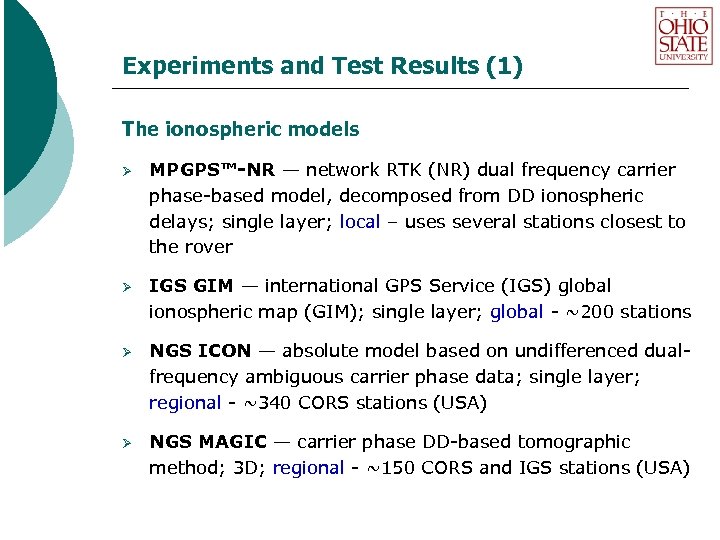 Experiments and Test Results (1) The ionospheric models Ø MPGPS™-NR — network RTK (NR) dual frequency carrier phase-based model, decomposed from DD ionospheric delays; single layer; local – uses several stations closest to the rover Ø IGS GIM — international GPS Service (IGS) global ionospheric map (GIM); single layer; global - ~200 stations Ø NGS ICON — absolute model based on undifferenced dualfrequency ambiguous carrier phase data; single layer; regional - ~340 CORS stations (USA) Ø NGS MAGIC — carrier phase DD-based tomographic method; 3 D; regional - ~150 CORS and IGS stations (USA)
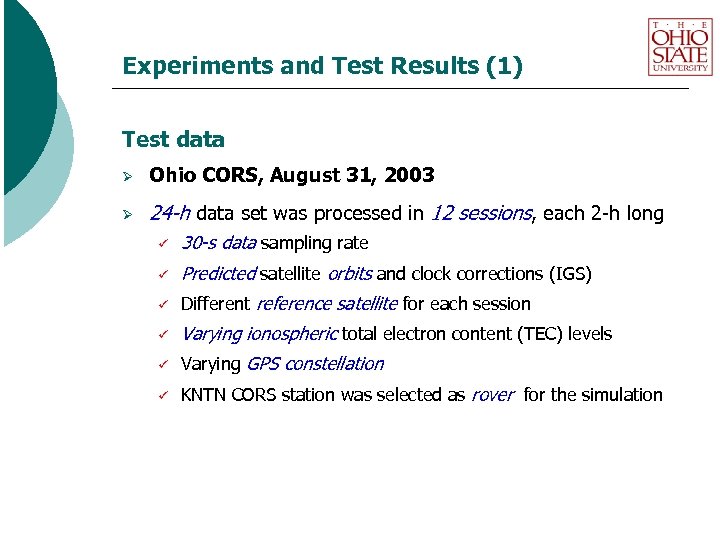 Experiments and Test Results (1) Test data Ø Ohio CORS, August 31, 2003 Ø 24 -h data set was processed in 12 sessions, each 2 -h long ü 30 -s data sampling rate ü Predicted satellite orbits and clock corrections (IGS) ü Different reference satellite for each session ü Varying ionospheric total electron content (TEC) levels ü Varying GPS constellation ü KNTN CORS station was selected as rover for the simulation
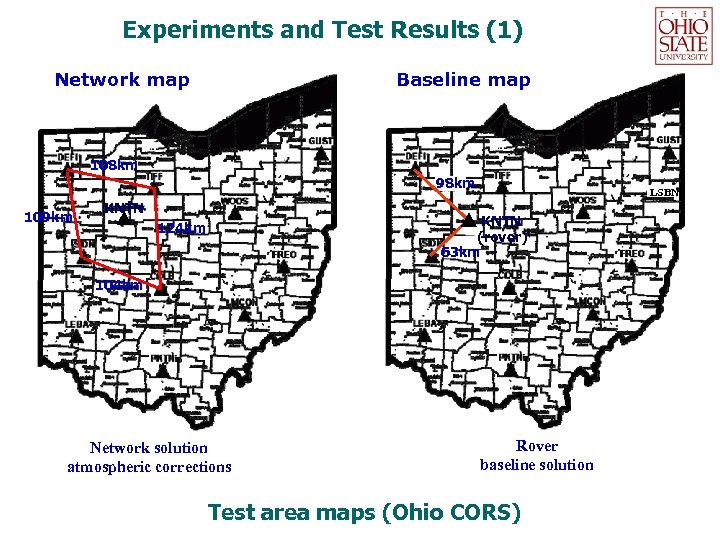 Experiments and Test Results (1) Network map Baseline map 108 km 98 km 109 km KNTN LSBN KNTN (rover) 63 km 124 km 104 km Network solution atmospheric corrections Rover baseline solution Test area maps (Ohio CORS)
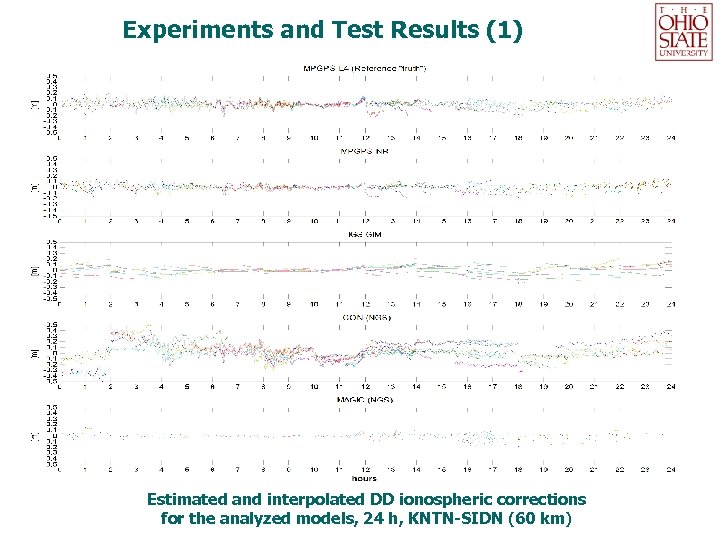 Experiments and Test Results (1) Estimated and interpolated DD ionospheric corrections for the analyzed models, 24 h, KNTN-SIDN (60 km)
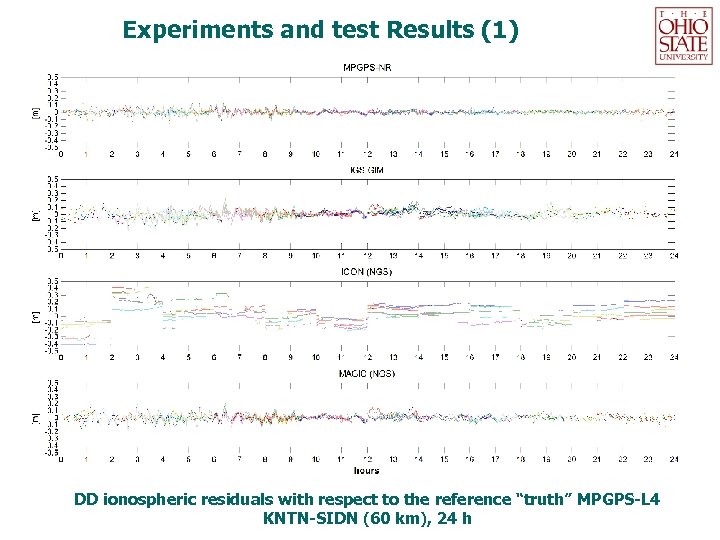 Experiments and test Results (1) DD ionospheric residuals with respect to the reference “truth” MPGPS-L 4 KNTN-SIDN (60 km), 24 h
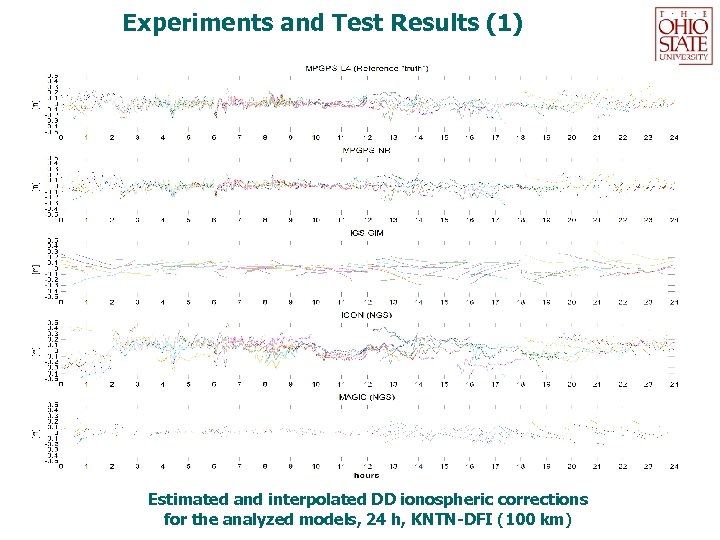 Experiments and Test Results (1) Estimated and interpolated DD ionospheric corrections for the analyzed models, 24 h, KNTN-DFI (100 km)
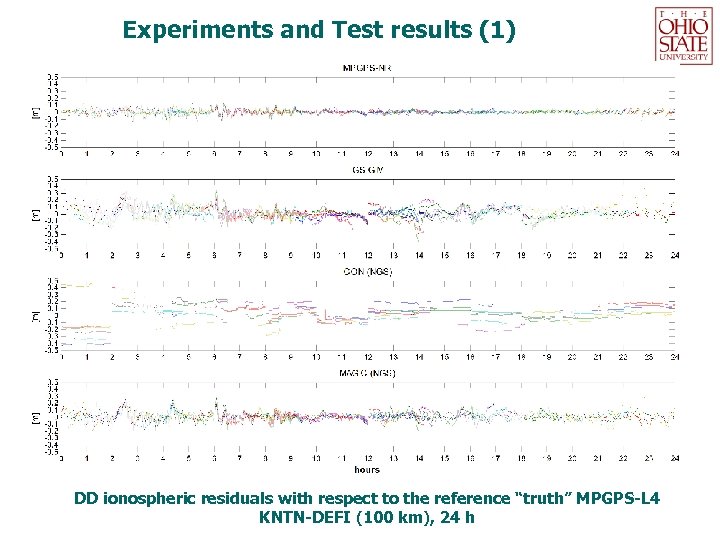 Experiments and Test results (1) DD ionospheric residuals with respect to the reference “truth” MPGPS-L 4 KNTN-DEFI (100 km), 24 h
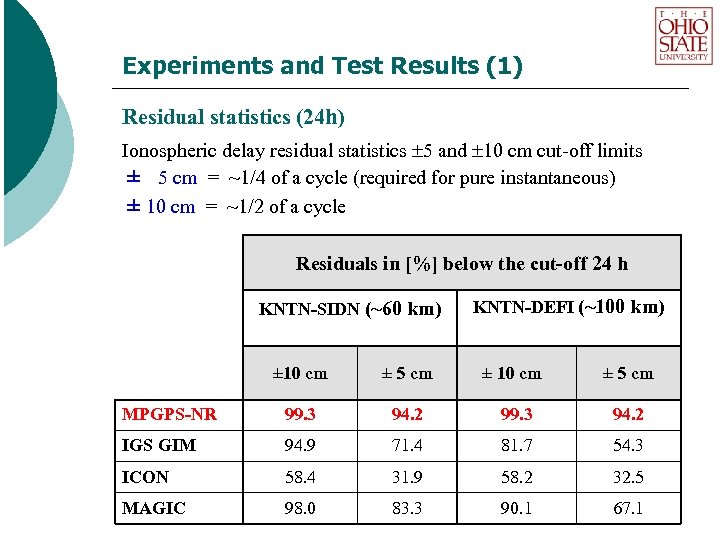 Experiments and Test Results (1) Residual statistics (24 h) Ionospheric delay residual statistics 5 and 10 cm cut-off limits ± 5 cm = ~1/4 of a cycle (required for pure instantaneous) ± 10 cm = ~1/2 of a cycle Residuals in [%] below the cut-off 24 h KNTN-SIDN (~60 km) KNTN-DEFI (~100 km) ± 10 cm ± 5 cm MPGPS-NR 99. 3 94. 2 IGS GIM 94. 9 71. 4 81. 7 54. 3 ICON 58. 4 31. 9 58. 2 32. 5 MAGIC 98. 0 83. 3 90. 1 67. 1
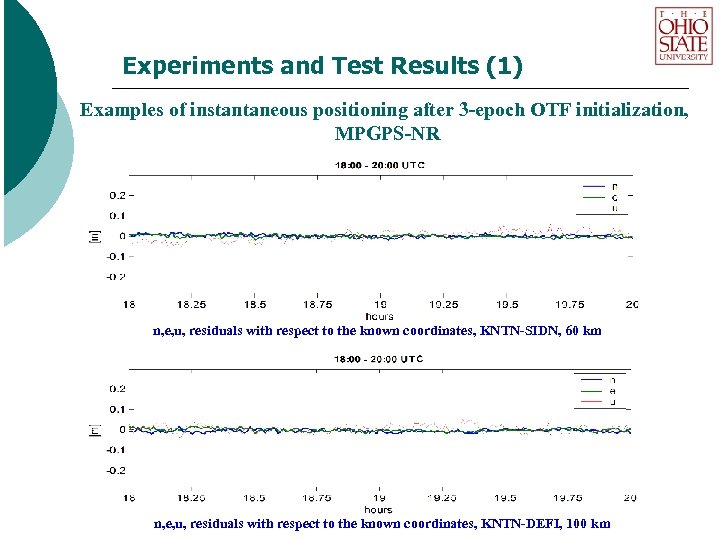 Experiments and Test Results (1) Examples of instantaneous positioning after 3 -epoch OTF initialization, MPGPS-NR n, e, u, residuals with respect to the known coordinates, KNTN-SIDN, 60 km n, e, u, residuals with respect to the known coordinates, KNTN-DEFI, 100 km
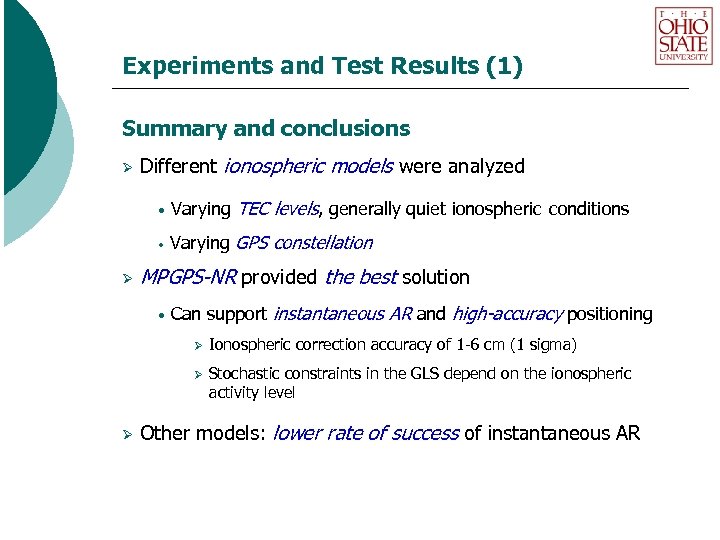 Experiments and Test Results (1) Summary and conclusions Ø Different ionospheric models were analyzed • • Ø Varying TEC levels, generally quiet ionospheric conditions Varying GPS constellation MPGPS-NR provided the best solution • Can support instantaneous AR and high-accuracy positioning Ø Ø Ø Ionospheric correction accuracy of 1 -6 cm (1 sigma) Stochastic constraints in the GLS depend on the ionospheric activity level Other models: lower rate of success of instantaneous AR
 Experiments and Test Results (2) Test data Ø Ohio CORS, August 31, 2003 Ø Four two-hour sessions (daytime): ü 14 - 16 UT (10 pm - 12 pm LT) ü 16 - 18 UT (12 pm - 14 pm LT) ü 18 - 20 UT (14 pm - 16 pm LT) ü 20 - 22 UT (16 am - 18 pm LT) Ø 30 -second sampling rate (i. e. , 120 epochs per session) Ø Predicted satellite orbits and clock corrections (IGS) Ø Distances between reference stations ~200 km Ø Distances to the rover >100 km Ø COLB CORS station was selected as rover for the simulation
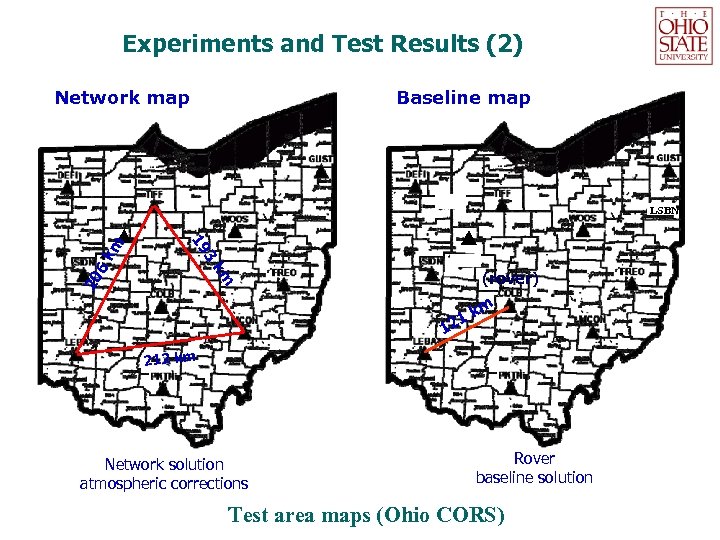 Experiments and Test Results (2) Network map Baseline map 3 19 20 km 6 k m LSBN (rover) m k 21 1 212 km Network solution atmospheric corrections Rover baseline solution Test area maps (Ohio CORS)
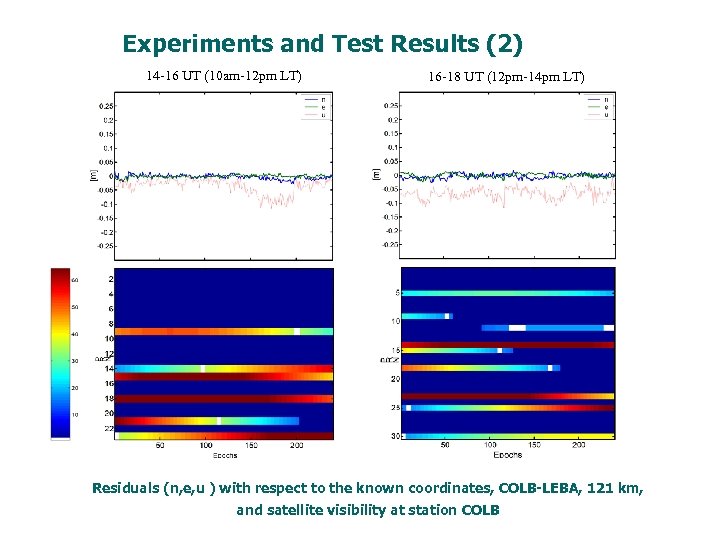 Experiments and Test Results (2) 14 -16 UT (10 am-12 pm LT) 16 -18 UT (12 pm-14 pm LT) Residuals (n, e, u ) with respect to the known coordinates, COLB-LEBA, 121 km, and satellite visibility at station COLB
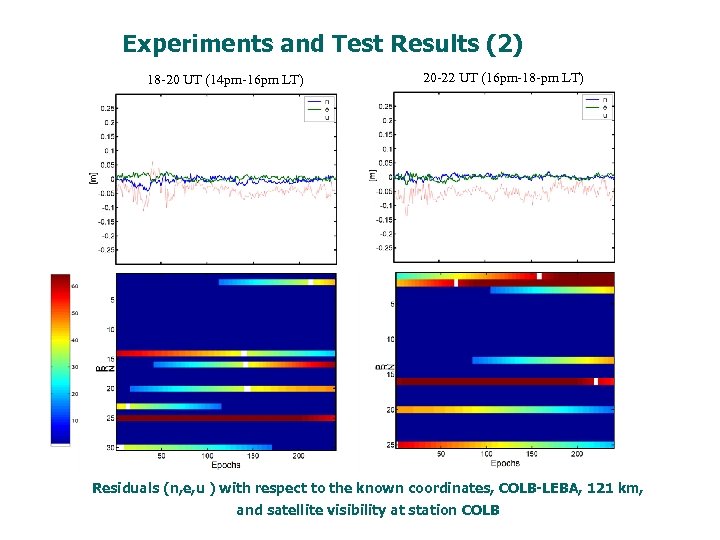 Experiments and Test Results (2) 18 -20 UT (14 pm-16 pm LT) 20 -22 UT (16 pm-18 -pm LT) Residuals (n, e, u ) with respect to the known coordinates, COLB-LEBA, 121 km, and satellite visibility at station COLB
 Experiments and Test Results (2) Summary and conclusions Ø Ø Ø A sub-network characterized by inter-station separation of ~200 km was chosen to generate the atmospheric corrections The rover-reference stations distances are larger than 100 km Although these large distances, centimeter-level instantaneous rover positioning was demonstrated in this simulation. The vertical component is weaker than the horizontal ones, as expected It may be concluded that 200 km separation between the GPS reference stations is a sufficient infrastructure for centimeterlevel long range instantaneous RTK
 Experiments and Test Results (3) Test data Ø GIL (GPS in Israel) permanent network, June 21, 2004 Ø Four one-hour sessions: ü 01 - 02 UT ( 4 am - 5 am LT) - sunrise ü 09 - 10 UT (12 am - 13 pm LT) - noon ü 13 - 14 UT (16 am - 17 pm LT) - afternoon ü 17 - 19 UT (20 am - 21 pm LT) - sunset Ø 10 -second sampling rate (i. e. , 360 epochs per session) Ø Predicted satellite orbits and clock corrections (IGS) Ø Distances between reference stations ~100 -200 km Ø Distances to the rover ~50 -100 km Ø GILB station was selected as rover for the simulation
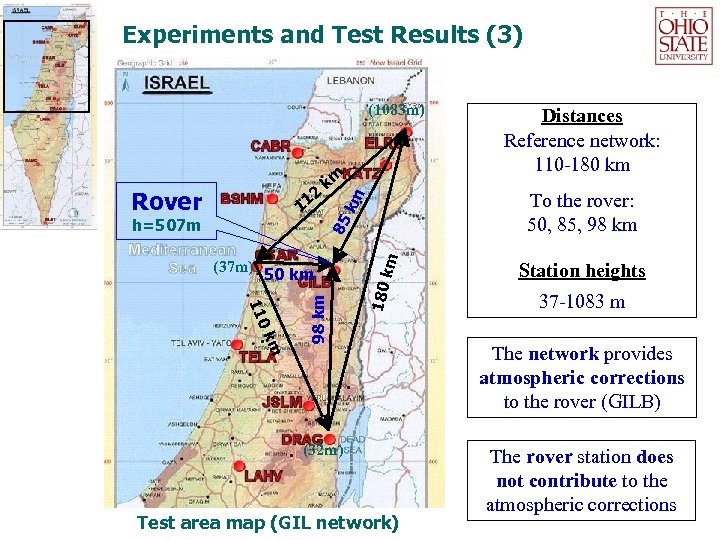 Experiments and Test Results (3) (1083 m) 110 180 50 km km 98 km (37 m) km 85 h=507 m To the rover: 50, 85, 98 km km 12 1 Rover km Distances Reference network: 110 -180 km (32 m) Test area map (GIL network) Station heights 37 -1083 m The network provides atmospheric corrections to the rover (GILB) The rover station does not contribute to the atmospheric corrections
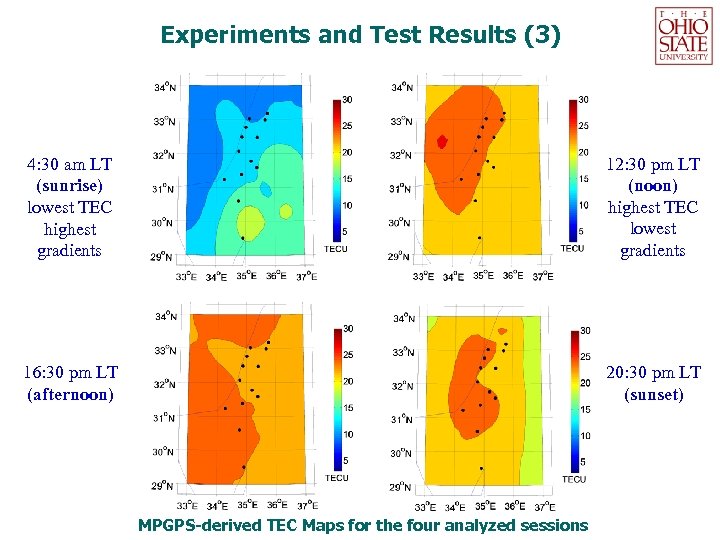 Experiments and Test Results (3) 4: 30 am LT (sunrise) lowest TEC highest gradients 12: 30 pm LT (noon) highest TEC lowest gradients 16: 30 pm LT (afternoon) 20: 30 pm LT (sunset) MPGPS-derived TEC Maps for the four analyzed sessions
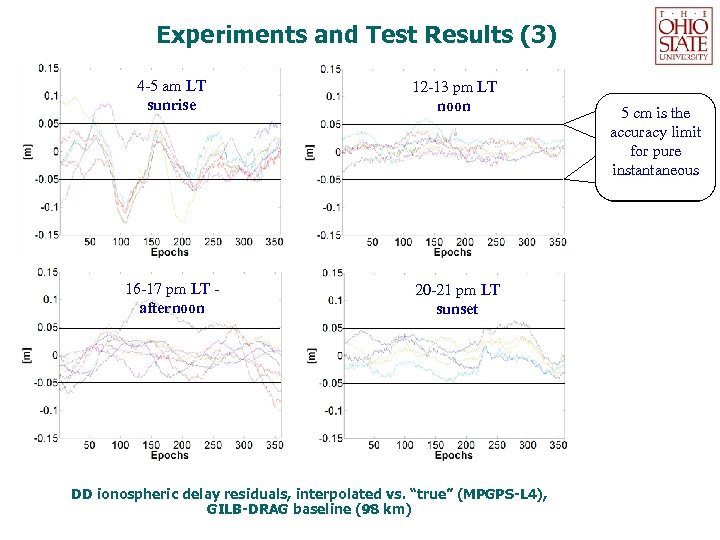 Experiments and Test Results (3) 4 -5 am LT sunrise 12 -13 pm LT noon 16 -17 pm LT afternoon 20 -21 pm LT sunset DD ionospheric delay residuals, interpolated vs. “true” (MPGPS-L 4), GILB-DRAG baseline (98 km) 5 cm is the accuracy limit for pure instantaneous
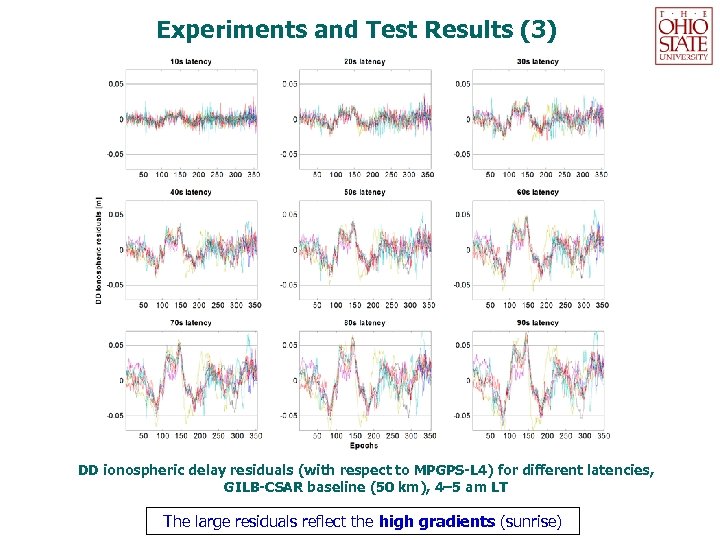 Experiments and Test Results (3) DD ionospheric delay residuals (with respect to MPGPS-L 4) for different latencies, GILB-CSAR baseline (50 km), 4– 5 am LT The large residuals reflect the high gradients (sunrise)
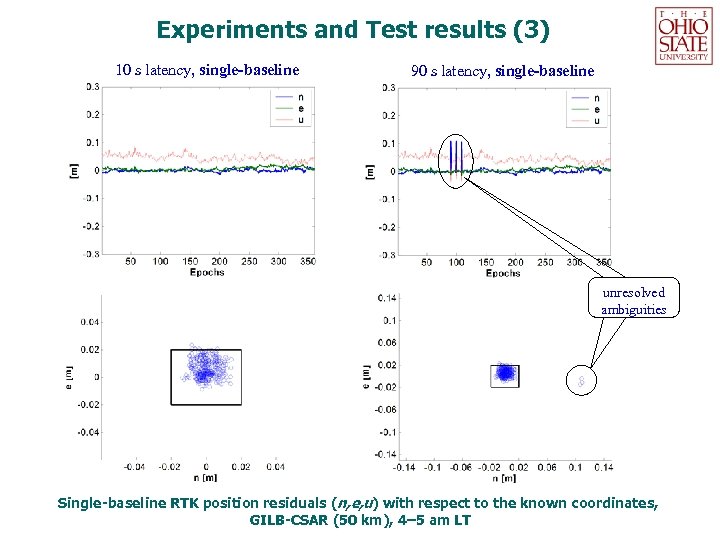 Experiments and Test results (3) 10 s latency, single-baseline 90 s latency, single-baseline unresolved ambiguities Single-baseline RTK position residuals (n, e, u) with respect to the known coordinates, GILB-CSAR (50 km), 4– 5 am LT
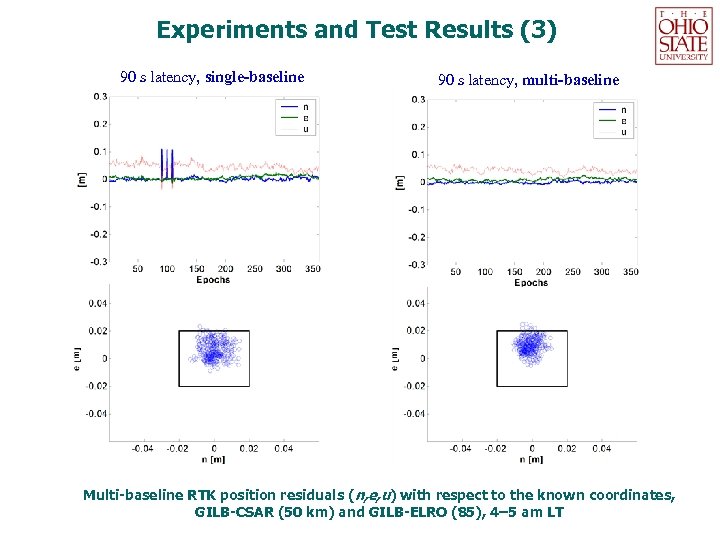 Experiments and Test Results (3) 90 s latency, single-baseline 90 s latency, multi-baseline Multi-baseline RTK position residuals (n, e, u) with respect to the known coordinates, GILB-CSAR (50 km) and GILB-ELRO (85), 4– 5 am LT
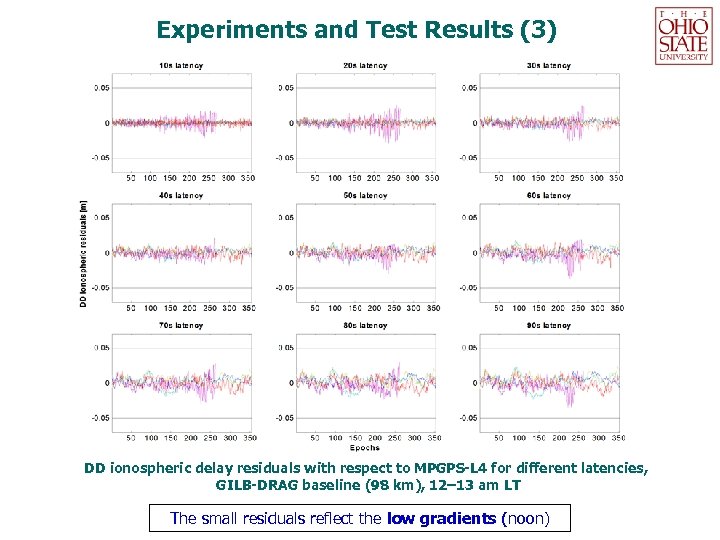 Experiments and Test Results (3) DD ionospheric delay residuals with respect to MPGPS-L 4 for different latencies, GILB-DRAG baseline (98 km), 12– 13 am LT The small residuals reflect the low gradients (noon)
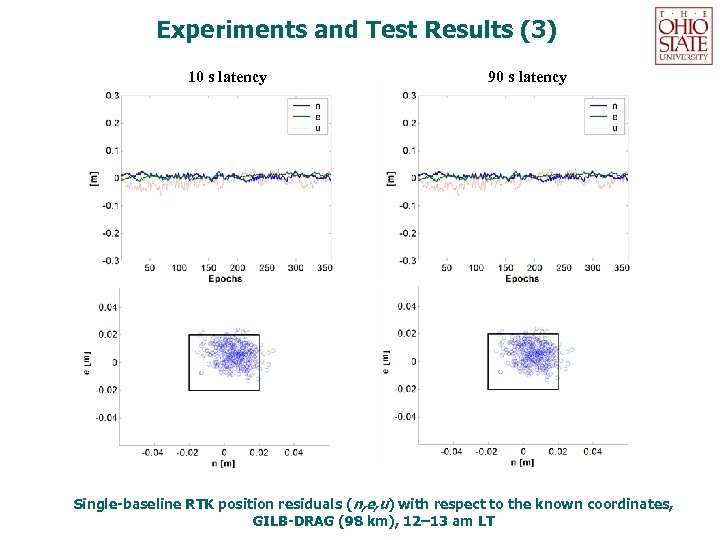 Experiments and Test Results (3) 10 s latency 90 s latency Single-baseline RTK position residuals (n, e, u) with respect to the known coordinates, GILB-DRAG (98 km), 12– 13 am LT
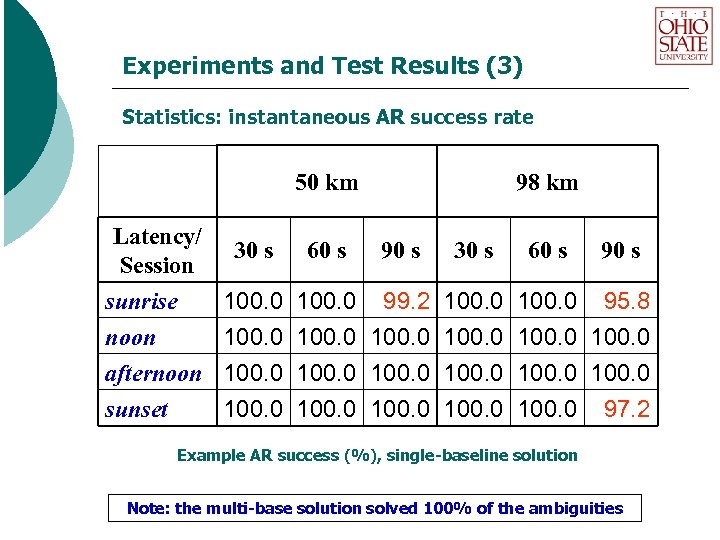 Experiments and Test Results (3) Statistics: instantaneous AR success rate 50 km Latency/ Session 30 s sunrise noon afternoon sunset 100. 0 60 s 98 km 90 s 30 s 60 s 90 s 100. 0 99. 2 100. 0 95. 8 100. 0 100. 0 97. 2 Example AR success (%), single-baseline solution Note: the multi-base solution solved 100% of the ambiguities
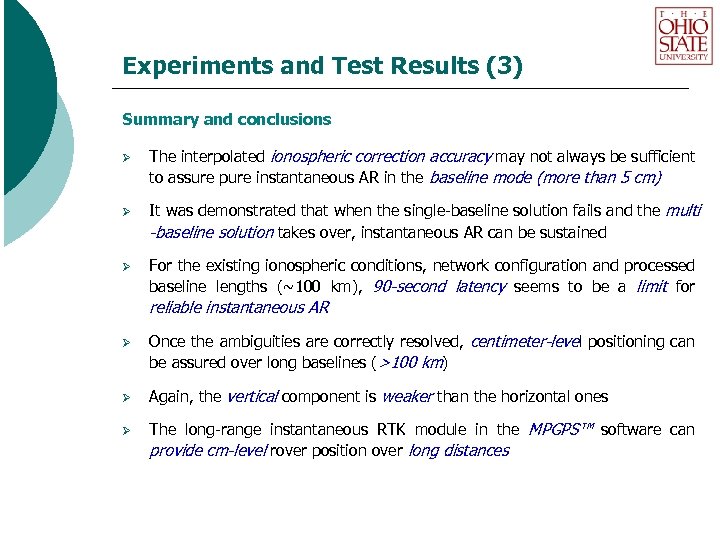 Experiments and Test Results (3) Summary and conclusions Ø Ø Ø The interpolated ionospheric correction accuracy may not always be sufficient to assure pure instantaneous AR in the baseline mode (more than 5 cm) It was demonstrated that when the single-baseline solution fails and the multi -baseline solution takes over, instantaneous AR can be sustained For the existing ionospheric conditions, network configuration and processed baseline lengths (~100 km), 90 -second latency seems to be a limit for reliable instantaneous AR Ø Ø Ø Once the ambiguities are correctly resolved, centimeter-level positioning can be assured over long baselines (>100 km) Again, the vertical component is weaker than the horizontal ones The long-range instantaneous RTK module in the MPGPS™ software can provide cm-level rover position over long distances
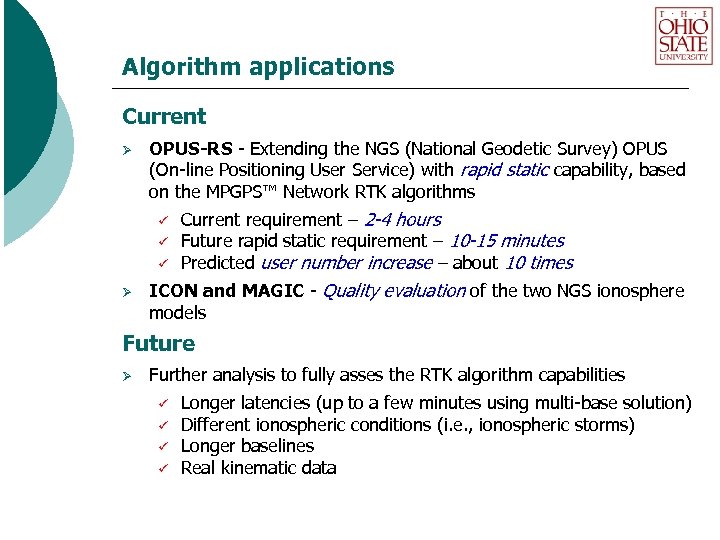 Algorithm applications Current Ø OPUS-RS - Extending the NGS (National Geodetic Survey) OPUS (On-line Positioning User Service) with rapid static capability, based on the MPGPS™ Network RTK algorithms ü ü ü Ø Current requirement – 2 -4 hours Future rapid static requirement – 10 -15 minutes Predicted user number increase – about 10 times ICON and MAGIC - Quality evaluation of the two NGS ionosphere models Future Ø Further analysis to fully asses the RTK algorithm capabilities ü ü Longer latencies (up to a few minutes using multi-base solution) Different ionospheric conditions (i. e. , ionospheric storms) Longer baselines Real kinematic data