 Скачать презентацию Part Three Thermodynamics Steam turbine converts the energy
4829f135e94495274d8131a80b89e493.ppt
- Количество слайдов: 38




Part Three: Thermodynamics Steam turbine converts the energy of high-pressure steam to mechanical energy and then electricity.
World energy consumption (2008): ~ 15 1012 (15 trillion / tera) watts. , mostly from fossil fuels Applications of the laws of thermodynamics: • Combustion engines. • Sun Heat flows on Earth Climate. • Global warming. • Big bang: Heat flow in the universe.

List of countries by electricity consumption Rank Country Electricity consumption Year of Data Source (MW·h/yr) — 16, 830, 000 1 World United States 3, 816, 000 Population As of Average power per capita (watts person) 2005 CIA Est. [3] 6, 464, 750, 000 2005 297 2005 CIA[1] 298, 213, 000 1, 460 1, 315, 844, 000 2009 277 2005 2 China 3, 640, 000 2009 [4] — European Union[5] 2, 820, 000 2004 CIA Est. 459, 387, 000 2005 700 3 Russia 985, 200, 000 2007 CIA Est. 143, 202, 000 2005 785 4 Japan 974, 200, 000 2005 CIA 128, 085, 000 2005 868 5 Germany 593, 400, 000 2007 CIA Est. 82, 329, 758 2009 (CIA Est. ) 822. 22 6 Canada 540, 200, 000 2005 CIA 32, 268, 000 2005 7 India 488, 500, 000 2005 CIA 1, 103, 371, 000 2005 50. 5 8 France 451, 500, 000 2005 CIA 60, 496, 000 2005 851 9 South Korea 368, 600, 000 2007 CIA 47, 817, 000 2005 879 10 Brazil 368, 500, 000 2005 CIA 186, 405, 000 2005 226 11 United Kingdom 348, 700, 000 2005 CIA 59, 668, 000 2005 667 12 Italy 307, 100, 000 2005 CIA 58, 093, 000 2005 603 13 Spain 243, 000 2005 CIA 43, 064, 000 2005 644 14 South Africa 241, 400, 000 2007 CIA 47, 432, 000 2005 581 15 Taiwan (Republic of China) 221, 000 2006 CIA 22, 894, 384 2005 1, 101 16 Australia 219, 800, 000 2005 CIA 20, 155, 000 2005 1, 244 17 Mexico 183, 300, 000 2005 CIA 107, 029, 000 2005 195 1, 910
Part Three: Thermodynamics 16. Temperature and Heat 17. Thermal Behavior of Matter 18. Heat, Work, and the First Law of Thermodynamics 19. The Second Law of Thermodynamics
16. Temperature & Heat 1. 2. 3. 4. Heat , Temperature & Thermodynamic Equilibrium Heat Capacity & Specific Heat Transfer Thermal Energy Balance
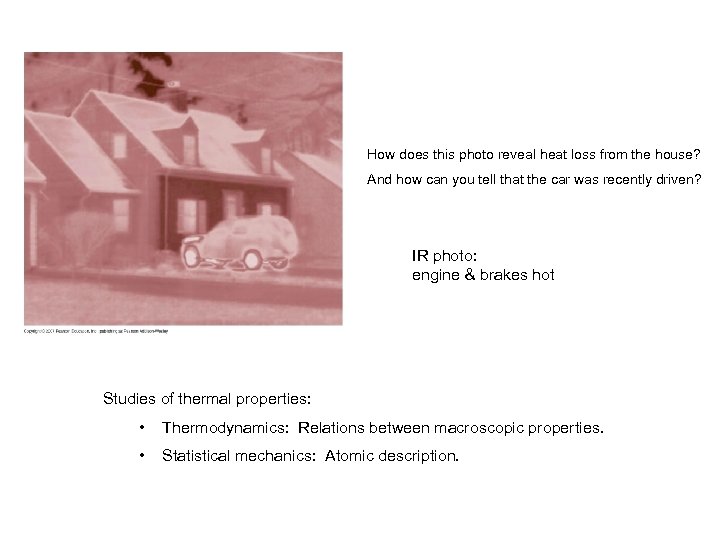
How does this photo reveal heat loss from the house? And how can you tell that the car was recently driven? IR photo: engine & brakes hot Studies of thermal properties: • Thermodynamics: Relations between macroscopic properties. • Statistical mechanics: Atomic description.
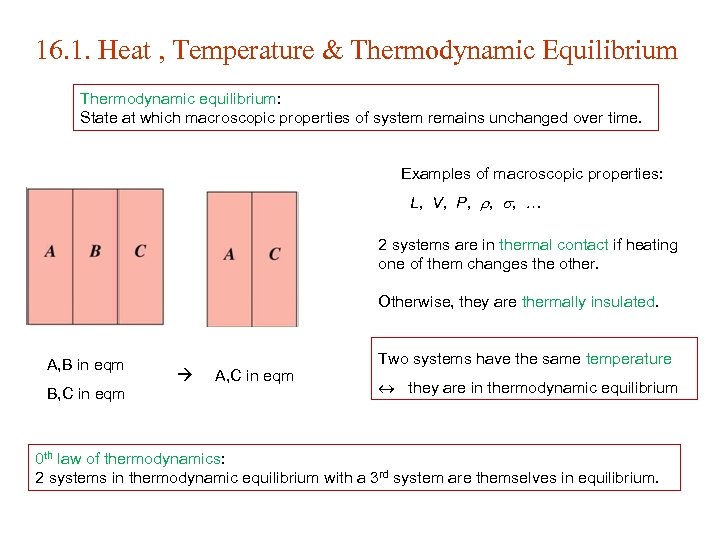
16. 1. Heat , Temperature & Thermodynamic Equilibrium Thermodynamic equilibrium: State at which macroscopic properties of system remains unchanged over time. Examples of macroscopic properties: L, V, P, , , … 2 systems are in thermal contact if heating one of them changes the other. Otherwise, they are thermally insulated. A, B in eqm B, C in eqm A, C in eqm Two systems have the same temperature they are in thermodynamic equilibrium 0 th law of thermodynamics: 2 systems in thermodynamic equilibrium with a 3 rd system are themselves in equilibrium.
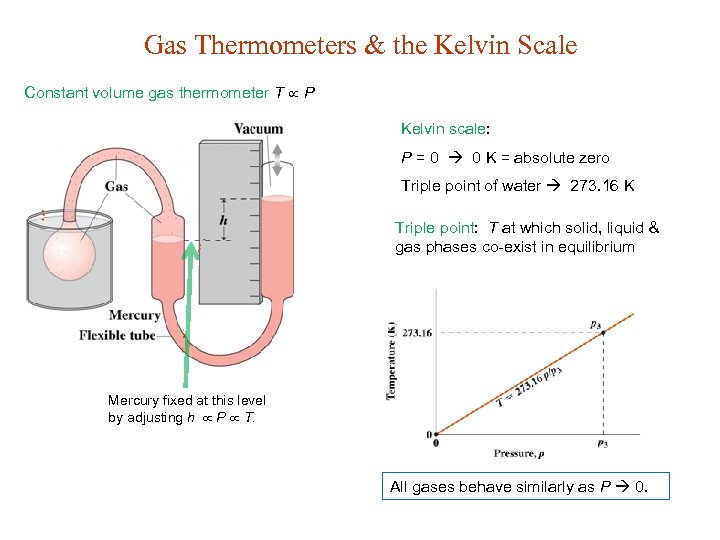
Gas Thermometers & the Kelvin Scale Constant volume gas thermometer T P Kelvin scale: P = 0 0 K = absolute zero Triple point of water 273. 16 K Triple point: T at which solid, liquid & gas phases co-exist in equilibrium Mercury fixed at this level by adjusting h P T. All gases behave similarly as P 0.
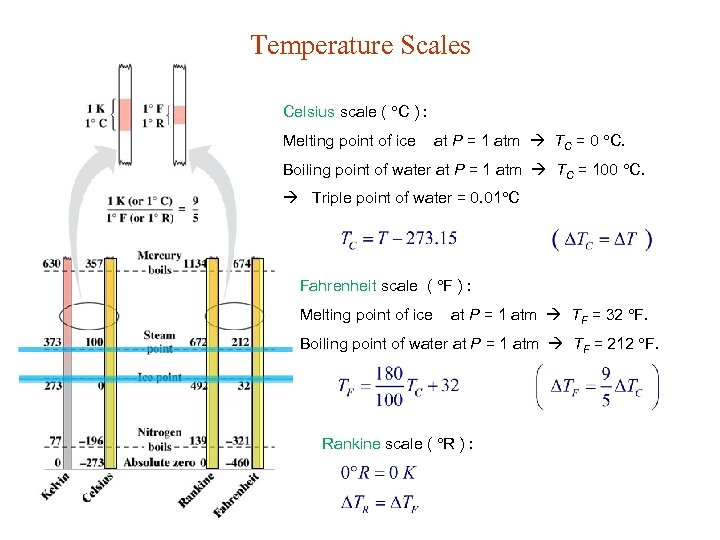
Temperature Scales Celsius scale ( C ) : Melting point of ice at P = 1 atm TC = 0 C. Boiling point of water at P = 1 atm TC = 100 C. Triple point of water = 0. 01 C Fahrenheit scale ( F ) : Melting point of ice at P = 1 atm TF = 32 F. Boiling point of water at P = 1 atm TF = 212 F. Rankine scale ( R ) :
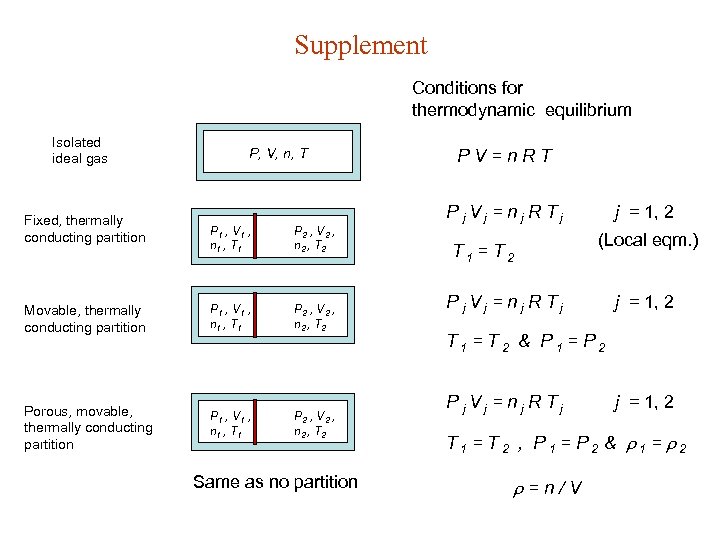
Supplement Conditions for thermodynamic equilibrium Isolated ideal gas Fixed, thermally conducting partition P, V, n, T P 1 , V 1 , n 1 , T 1 P 2 , V 2 , n 2 , T 2 Movable, thermally conducting partition P 1 , V 1 , n 1 , T 1 P 2 , V 2 , n 2 , T 2 Porous, movable, thermally conducting partition P 1 , V 1 , n 1 , T 1 P 2 , V 2 , n 2 , T 2 Same as no partition PV=n. RT P j. Vj = nj R Tj T 1 = T 2 j = 1, 2 (Local eqm. ) P j. Vj = nj R Tj j = 1, 2 T 1 = T 2 & P 1 = P 2 P j. Vj = nj R Tj j = 1, 2 T 1 = T 2 , P 1 = P 2 & 1 = 2 =n/V
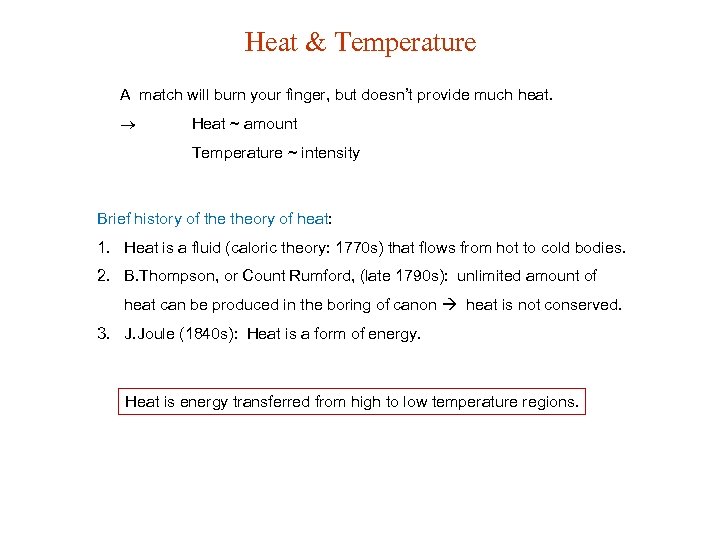
Heat & Temperature A match will burn your finger, but doesn’t provide much heat. Heat ~ amount Temperature ~ intensity Brief history of theory of heat: 1. Heat is a fluid (caloric theory: 1770 s) that flows from hot to cold bodies. 2. B. Thompson, or Count Rumford, (late 1790 s): unlimited amount of heat can be produced in the boring of canon heat is not conserved. 3. J. Joule (1840 s): Heat is a form of energy. Heat is energy transferred from high to low temperature regions.
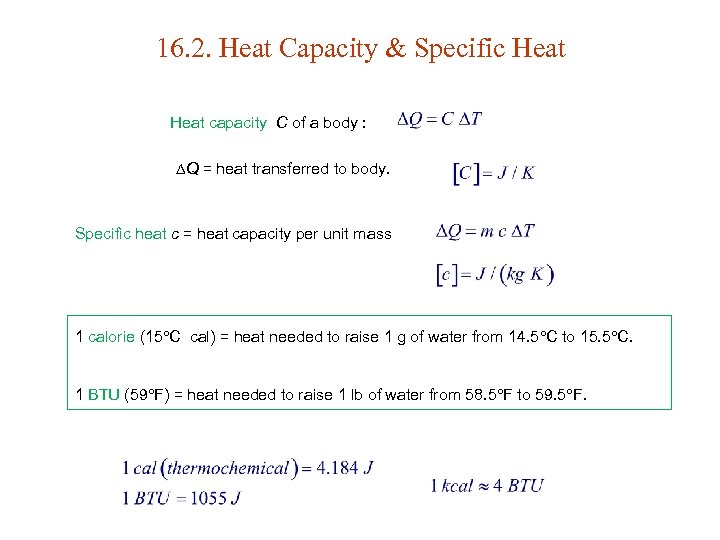
16. 2. Heat Capacity & Specific Heat capacity C of a body : Q = heat transferred to body. Specific heat c = heat capacity per unit mass 1 calorie (15 C cal) = heat needed to raise 1 g of water from 14. 5 C to 15. 5 C. 1 BTU (59 F) = heat needed to raise 1 lb of water from 58. 5 F to 59. 5 F.
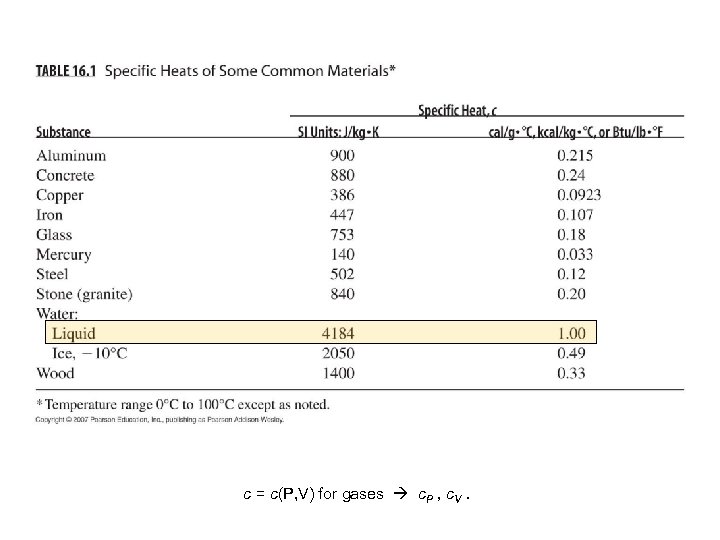
c = c(P, V) for gases c. P , c. V.
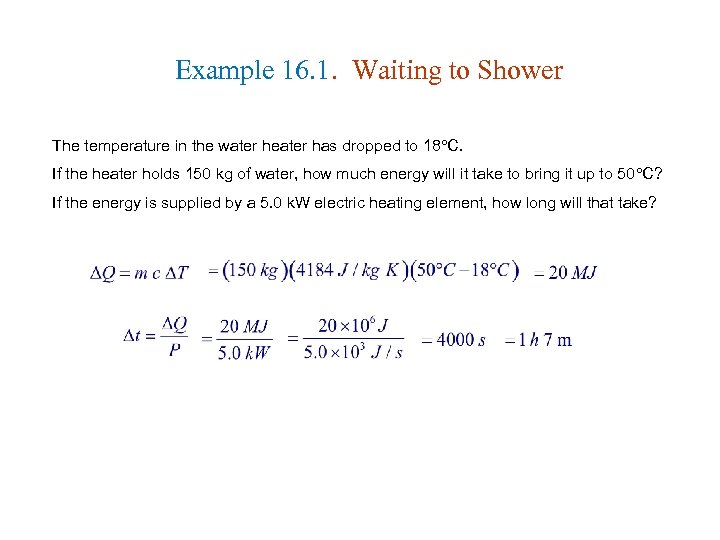
Example 16. 1. Waiting to Shower The temperature in the water heater has dropped to 18 C. If the heater holds 150 kg of water, how much energy will it take to bring it up to 50 C? If the energy is supplied by a 5. 0 k. W electric heating element, how long will that take?
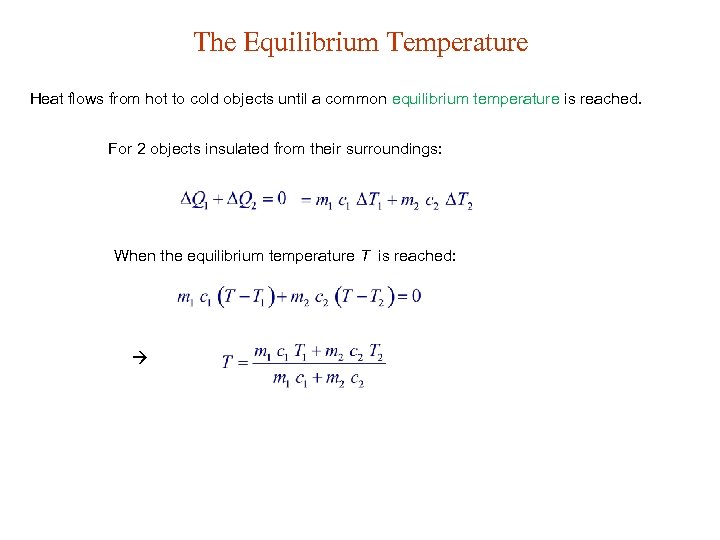
The Equilibrium Temperature Heat flows from hot to cold objects until a common equilibrium temperature is reached. For 2 objects insulated from their surroundings: When the equilibrium temperature T is reached:
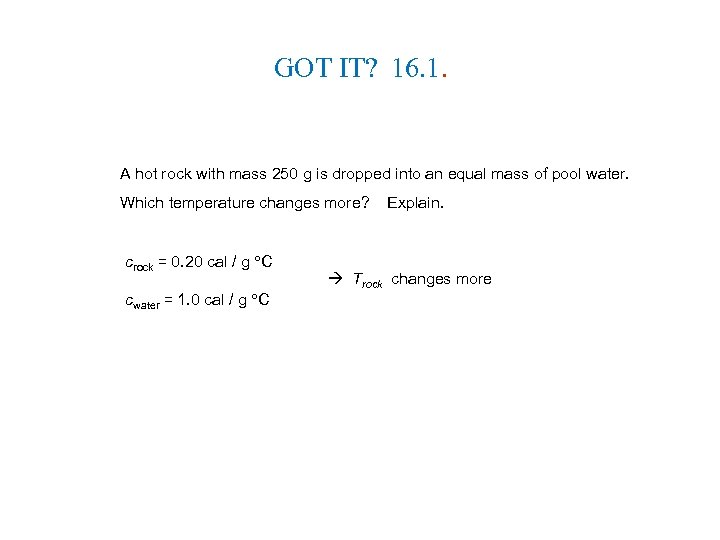
GOT IT? 16. 1. A hot rock with mass 250 g is dropped into an equal mass of pool water. Which temperature changes more? crock = 0. 20 cal / g C cwater = 1. 0 cal / g C Explain. Trock changes more
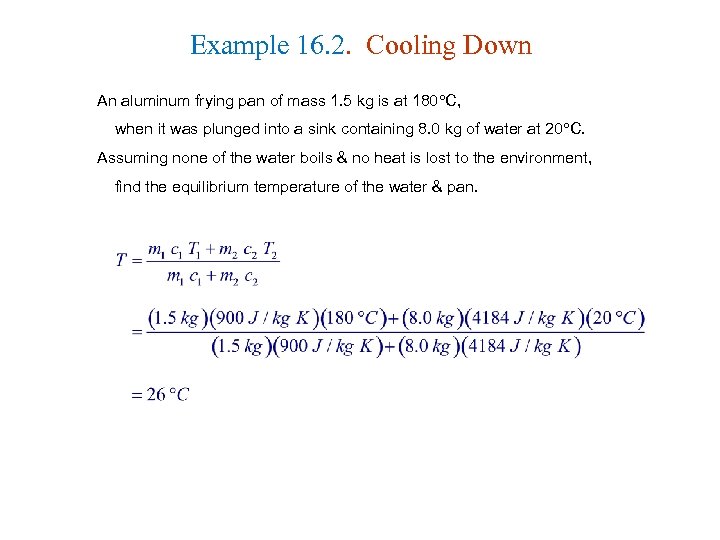
Example 16. 2. Cooling Down An aluminum frying pan of mass 1. 5 kg is at 180 C, when it was plunged into a sink containing 8. 0 kg of water at 20 C. Assuming none of the water boils & no heat is lost to the environment, find the equilibrium temperature of the water & pan.
16. 3. Heat Transfer Common heat-transfer mechanisms: • Conduction • Convection • Radiation
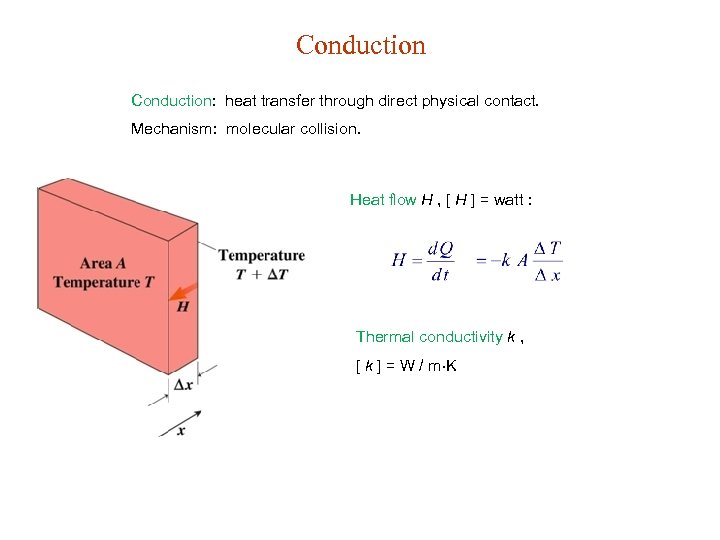
Conduction: heat transfer through direct physical contact. Mechanism: molecular collision. Heat flow H , [ H ] = watt : Thermal conductivity k , [ k ] = W / m K
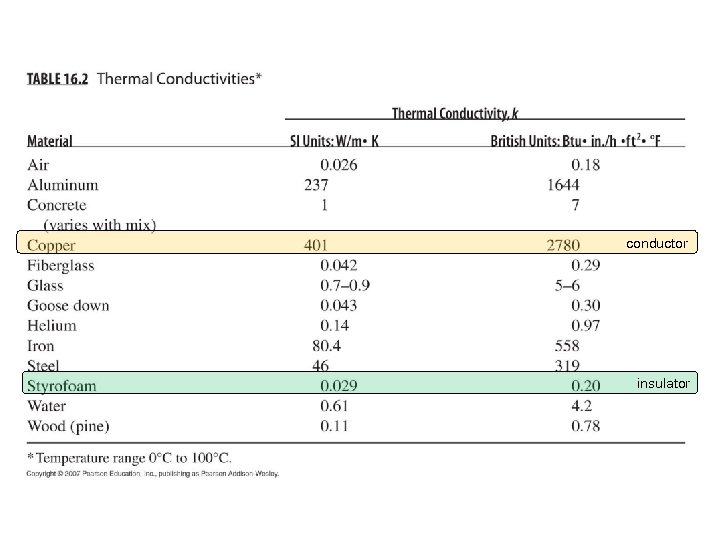
conductor insulator
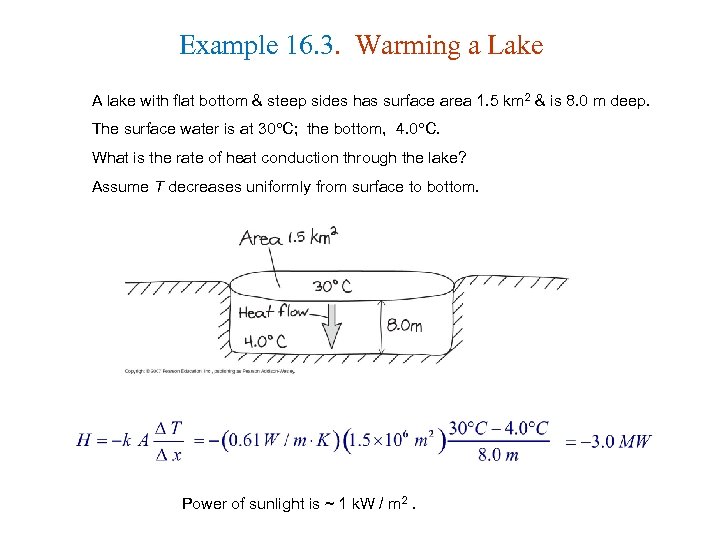
Example 16. 3. Warming a Lake A lake with flat bottom & steep sides has surface area 1. 5 km 2 & is 8. 0 m deep. The surface water is at 30 C; the bottom, 4. 0 C. What is the rate of heat conduction through the lake? Assume T decreases uniformly from surface to bottom. Power of sunlight is ~ 1 k. W / m 2.
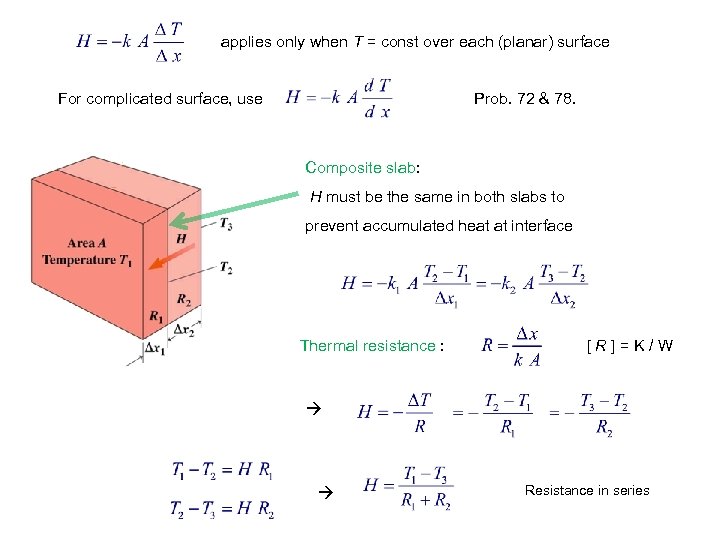
applies only when T = const over each (planar) surface For complicated surface, use Prob. 72 & 78. Composite slab: H must be the same in both slabs to prevent accumulated heat at interface Thermal resistance : [R]=K/W Resistance in series
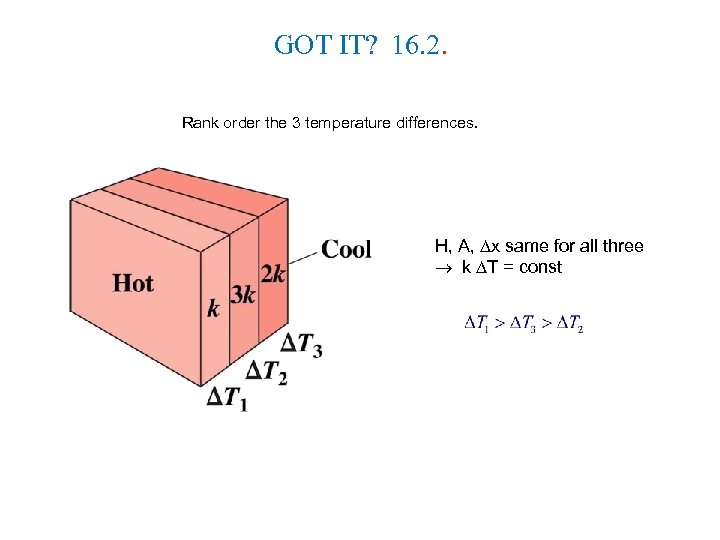
GOT IT? 16. 2. Rank order the 3 temperature differences. H, A, x same for all three k T = const
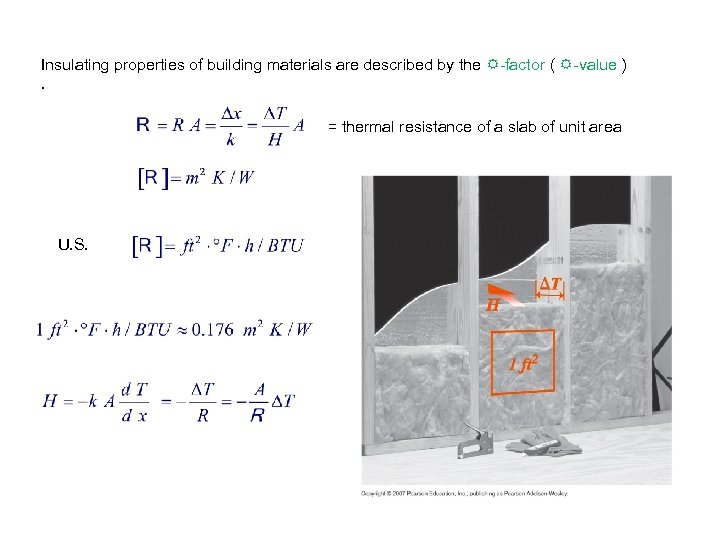
Insulating properties of building materials are described by the R-factor ( R-value ). = thermal resistance of a slab of unit area U. S.
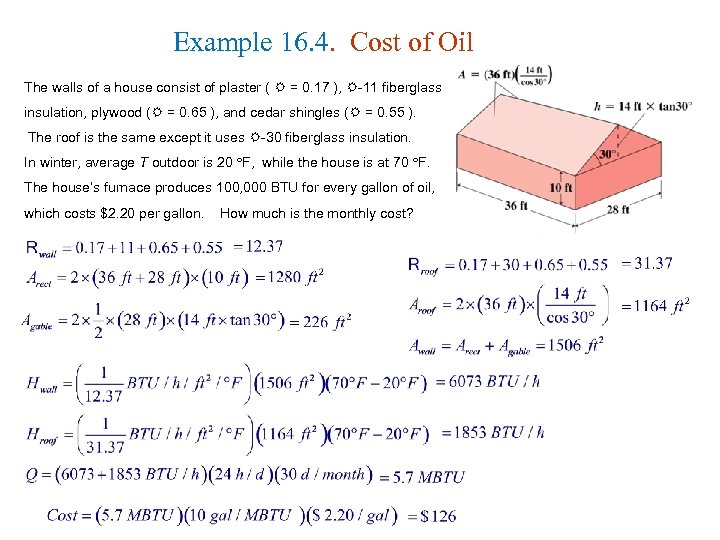
Example 16. 4. Cost of Oil The walls of a house consist of plaster ( R = 0. 17 ), R-11 fiberglass insulation, plywood (R = 0. 65 ), and cedar shingles (R = 0. 55 ). The roof is the same except it uses R-30 fiberglass insulation. In winter, average T outdoor is 20 F, while the house is at 70 F. The house’s furnace produces 100, 000 BTU for every gallon of oil, which costs $2. 20 per gallon. How much is the monthly cost?
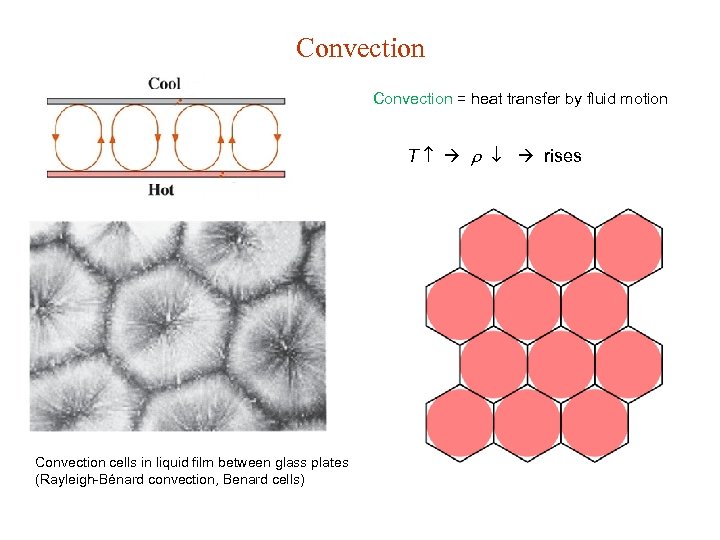
Convection = heat transfer by fluid motion T rises Convection cells in liquid film between glass plates (Rayleigh-Bénard convection, Benard cells)
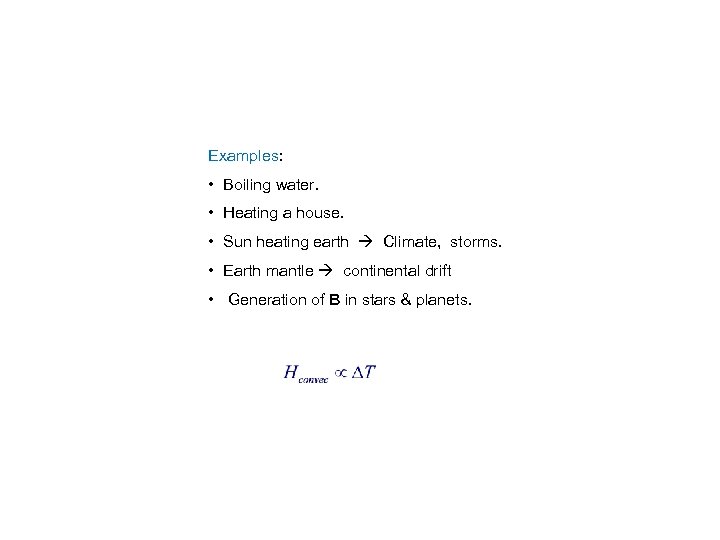
Examples: • Boiling water. • Heating a house. • Sun heating earth Climate, storms. • Earth mantle continental drift • Generation of B in stars & planets.
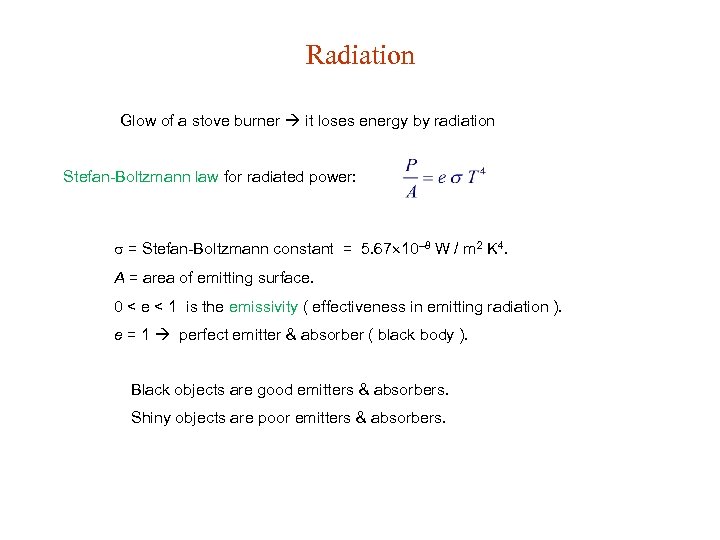
Radiation Glow of a stove burner it loses energy by radiation Stefan-Boltzmann law for radiated power: = Stefan-Boltzmann constant = 5. 67 10 8 W / m 2 K 4. A = area of emitting surface. 0 < e < 1 is the emissivity ( effectiveness in emitting radiation ). e = 1 perfect emitter & absorber ( black body ). Black objects are good emitters & absorbers. Shiny objects are poor emitters & absorbers.
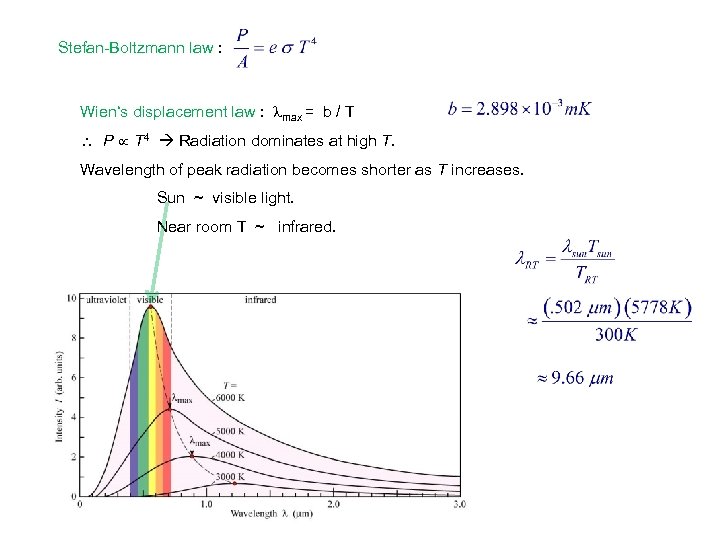
Stefan-Boltzmann law : Wien‘s displacement law : max = b / T P T 4 Radiation dominates at high T. Wavelength of peak radiation becomes shorter as T increases. Sun ~ visible light. Near room T ~ infrared.
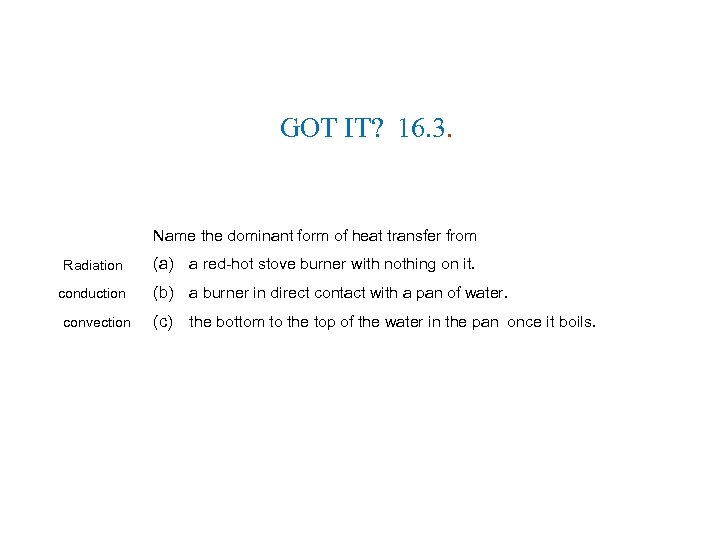
GOT IT? 16. 3. Name the dominant form of heat transfer from Radiation conduction convection (a) a red-hot stove burner with nothing on it. (b) a burner in direct contact with a pan of water. (c) the bottom to the top of the water in the pan once it boils.
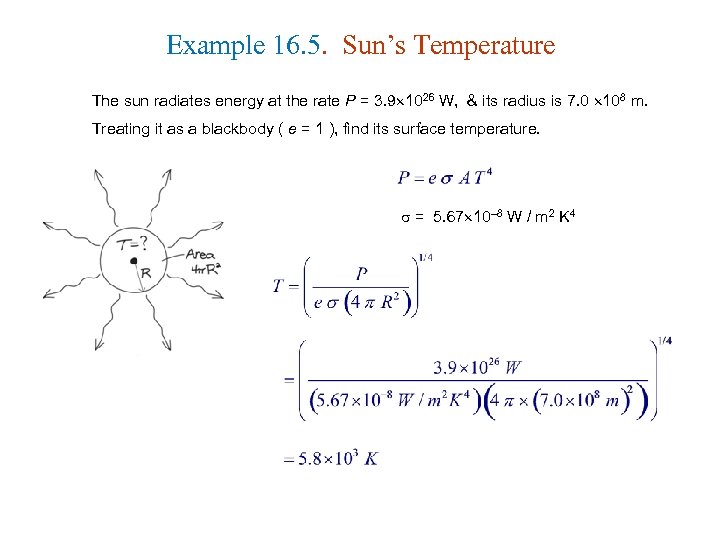
Example 16. 5. Sun’s Temperature The sun radiates energy at the rate P = 3. 9 1026 W, & its radius is 7. 0 108 m. Treating it as a blackbody ( e = 1 ), find its surface temperature. = 5. 67 10 8 W / m 2 K 4
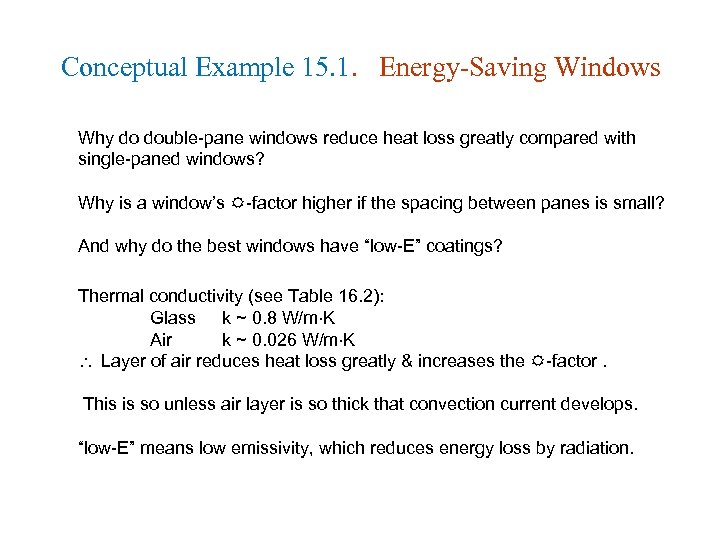
Conceptual Example 15. 1. Energy-Saving Windows Why do double-pane windows reduce heat loss greatly compared with single-paned windows? Why is a window’s R-factor higher if the spacing between panes is small? And why do the best windows have “low-E” coatings? Thermal conductivity (see Table 16. 2): Glass k ~ 0. 8 W/m K Air k ~ 0. 026 W/m K Layer of air reduces heat loss greatly & increases the R-factor. This is so unless air layer is so thick that convection current develops. “low-E” means low emissivity, which reduces energy loss by radiation.
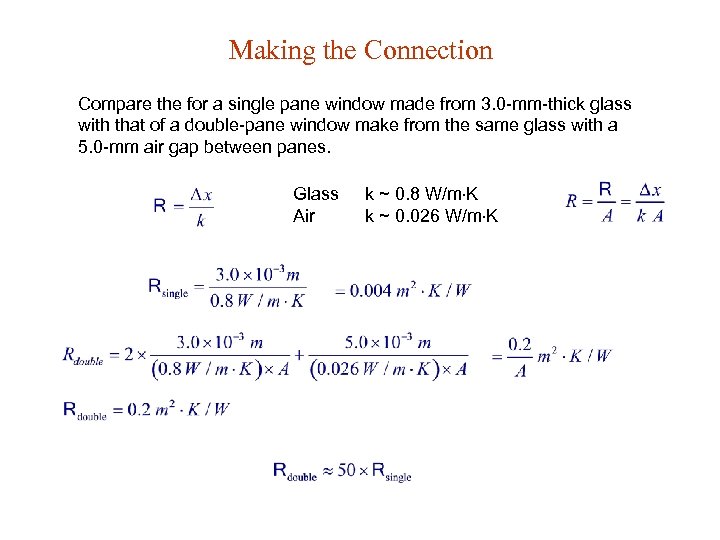
Making the Connection Compare the for a single pane window made from 3. 0 -mm-thick glass with that of a double-pane window make from the same glass with a 5. 0 -mm air gap between panes. Glass Air k ~ 0. 8 W/m K k ~ 0. 026 W/m K
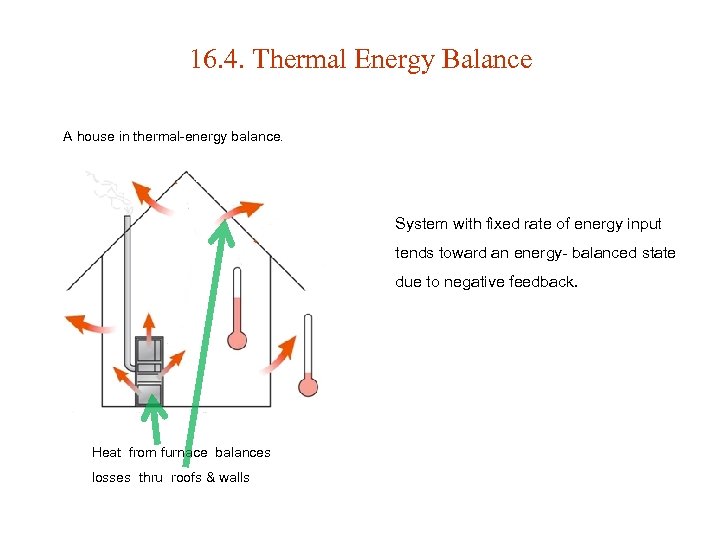
16. 4. Thermal Energy Balance A house in thermal-energy balance. System with fixed rate of energy input tends toward an energy- balanced state due to negative feedback. Heat from furnace balances losses thru roofs & walls
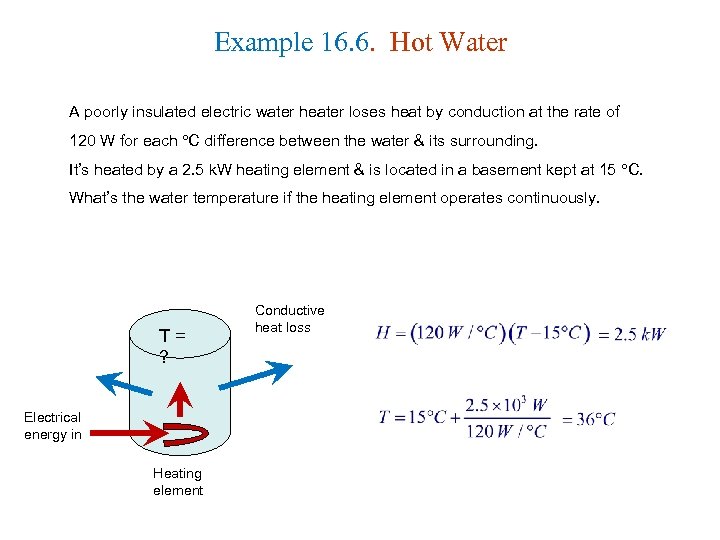
Example 16. 6. Hot Water A poorly insulated electric water heater loses heat by conduction at the rate of 120 W for each C difference between the water & its surrounding. It’s heated by a 2. 5 k. W heating element & is located in a basement kept at 15 C. What’s the water temperature if the heating element operates continuously. T= ? Electrical energy in Heating element Conductive heat loss
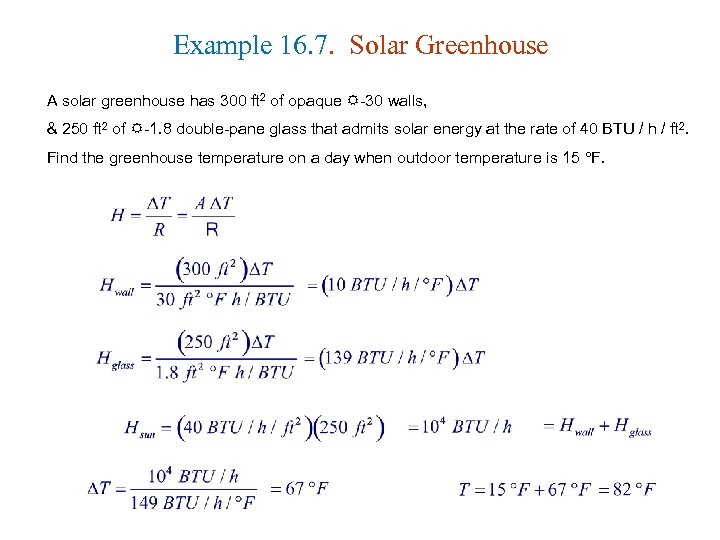
Example 16. 7. Solar Greenhouse A solar greenhouse has 300 ft 2 of opaque R-30 walls, & 250 ft 2 of R-1. 8 double-pane glass that admits solar energy at the rate of 40 BTU / h / ft 2. Find the greenhouse temperature on a day when outdoor temperature is 15 F.
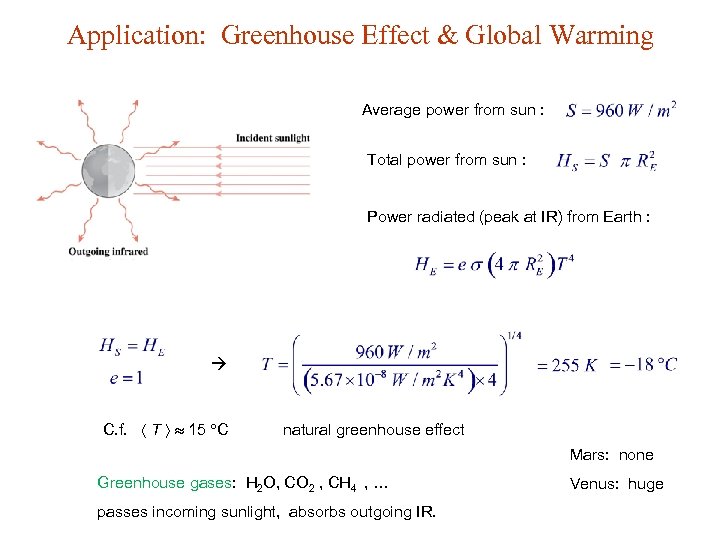
Application: Greenhouse Effect & Global Warming Average power from sun : Total power from sun : Power radiated (peak at IR) from Earth : C. f. T 15 C natural greenhouse effect Mars: none Greenhouse gases: H 2 O, CO 2 , CH 4 , … passes incoming sunlight, absorbs outgoing IR. Venus: huge
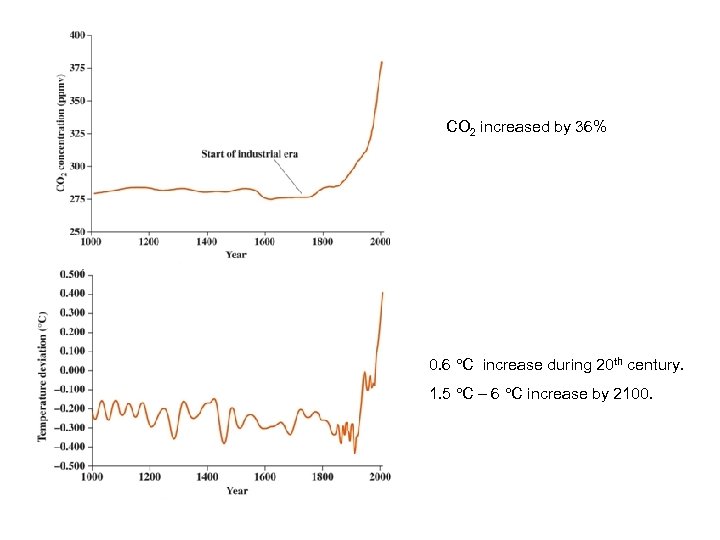
CO 2 increased by 36% 0. 6 C increase during 20 th century. 1. 5 C – 6 C increase by 2100.
Скачать презентацию Part Three Thermodynamics Steam turbine converts the energy
4829f135e94495274d8131a80b89e493.ppt